One question still dogs Administration: Why not try harder to solve the coronavirus crisis?

https://www.washingtonpost.com/politics/trump-not-solve-coronavirus-crisis/2020/07/26/7fca9a92-cdb0-11ea-91f1-28aca4d833a0_story.html?utm_source=ActiveCampaign&utm_medium=email&utm_content=Republicans+Roll+Out+%241+Trillion+Coronavirus+Relief+Plan&utm_campaign=TFT+Newsletter+07272020

Questions to ask students in class to help them deal with the ...

Both President Trump’s advisers and operatives laboring to defeat him increasingly agree on one thing: The best way for him to regain his political footing is to wrest control of the novel coronavirus.

In the six months since the deadly contagion was first reported in the United States, Trump has demanded the economy reopen and children return to school, all while scrambling to salvage his reelection campaign.

But allies and opponents agree he has failed at the one task that could help him achieve all his goals — confronting the pandemic with a clear strategy and consistent leadership.

Trump’s shortcomings have perplexed even some of his most loyal allies, who increasingly have wondered why the president has not at least pantomimed a sense of command over the crisis or conveyed compassion for the millions of Americans hurt by it.

People close to Trump, many speaking on the condition of anonymity to share candid discussions and impressions, say the president’s inability to wholly address the crisis is due to his almost pathological unwillingness to admit error; a positive feedback loop of overly rosy assessments and data from advisers and Fox News; and a penchant for magical thinking that prevented him from fully engaging with the pandemic.

In recent weeks, with more than 145,000 Americans now dead from the virus, the White House has attempted to overhaul — or at least rejigger — its approach. The administration has revived news briefings led by Trump and presented the president with projections showing how the virus is now decimating Republican states full of his voters. Officials have also set up a separate, smaller coronavirus working group led by Deborah Birx, the White House coronavirus response coordinator, along with Trump son-in-law and senior adviser Jared Kushner.

For many, however, the question is why Trump did not adjust sooner, realizing that the path to nearly all his goals — from an economic recovery to an electoral victory in November — runs directly through a healthy nation in control of the virus.

“The irony is that if he’d just performed with minimal competence and just mouthed words about national unity, he actually could be in a pretty strong position right now, where the economy is reopening, where jobs are coming back,” said Ben Rhodes, a deputy national security adviser to former president Barack Obama. “And he just could not do it.”

Many public health experts agree.

“The best thing that we can do to set our economy up for success and rebounding from the last few months is making sure our outbreak is in a good place,” said Caitlin Rivers, an epidemiologist at the Johns Hopkins Center for Health Security. “People are not going to feel comfortable returning to activities in the community — even if it’s allowed from a policy perspective — if they don’t feel the outbreak is under control.”

Some aides and outside advisers have tried to stress to Trump and others in his orbit that before he could move on to reopening the economy and getting the country back to work — and life — he needed to grapple with the reality of the virus.

But until recently, the president was largely unreceptive to that message, they said, not fully grasping the magnitude of the pandemic — and overly preoccupied with his own sense of grievance, beginning many conversations casting himself as the blameless victim of the crisis.

In the past couple of weeks, senior advisers began presenting Trump with maps and data showing spikes in coronavirus cases among “our people” in Republican states, a senior administration official said. They also shared projections predicting that virus surges could soon hit politically important states in the Midwest — including Michigan, Minnesota and Wisconsin, the official said.

This new approach seemed to resonate, as he hewed closely to pre-scripted remarks in a trio of coronavirus briefings last week.

“This could have been stopped. It could have been stopped quickly and easily. But for some reason, it wasn’t, and we’ll figure out what that reason was,” Trump said Thursday, seeming to simultaneously acknowledge his predicament while trying to assign blame elsewhere.

In addition to Birx and Kushner, the new coronavirus group guiding Trump includes Kushner advisers Adam Boehler and Brad Smith, according to two administration officials. Marc Short, chief of staff to Vice President Pence, also attends, along with Alyssa Farah, the White House director of strategic communications, and Stephen Miller, Trump’s senior policy adviser.

The working group’s goal is to meet every day, for no more than 30 minutes. It views its mission as half focused on the government’s response to the pandemic and half focused on the White House’s public message, the officials said.

White House spokeswoman Sarah Matthews defended the president’s handling of the crisis, saying he acted “early and decisively.”

“The president has also led an historic, whole-of-America coronavirus response — resulting in 100,000 ventilators procured, sourcing critical PPE for our front-line heroes, and a robust testing regime resulting in more than double the number of tests than any other country in the world,” Matthews said in an email statement. “His message has been consistent and his strong leadership will continue as we safely reopen the economy, expedite vaccine and therapeutics developments, and continue to see an encouraging decline in the U.S. mortality rate.”

For some, however, the additional effort is too little and far too late.

“This is a situation where if Trump did his job and put in the work to combat the health crisis, it would solve the economic crisis, and it’s an instance where the correct governing move is also the correct political move, and Trump is doing the opposite,” said Josh Schwerin, a senior strategist for Priorities USA, a super PAC supporting former vice president Joe Biden, the presumptive Democratic nominee.

Other anti-Trump operatives agree, saying he could make up lost ground and make his race with Biden far more competitive with a simple course correction.

“He’s staring in the mirror at night: That’s who can fix his political problem,” said John Weaver, one of the Republican strategists leading the Lincoln Project, a group known for its anti-Trump ads.

One of Trump’s biggest obstacles is his refusal to take responsibility and admit error.

In mid-March, as many of the nation’s businesses were shuttering early in the pandemic, Trump proclaimed in the Rose Garden, “I don’t take responsibility at all.” Those six words have neatly summed up Trump’s approach not only to the pandemic, but also to many of the other crises he has faced during his presidency.

“His operating style is to double- and triple-down on positions and to never, ever admit he’s wrong about anything,” said Anthony Scaramucci, a longtime Trump associate who briefly served as White House communications director and is now a critic of the president. “His 50-year track record is to bulldog through whatever he’s doing, whether it’s Atlantic City, which was a failure, or the Plaza Hotel, which was a failure, or Eastern Airlines, which was a failure. He can never just say, ‘I got it wrong and let’s try over again.’ ”

Another self-imposed hurdle for Trump has been his reliance on a positive feedback loop. Rather than sit for briefings by infectious-disease director Anthony S. Fauci and other medical experts, the president consumes much of his information about the virus from Fox News and other conservative media sources, where his on-air boosters put a positive spin on developments.

Consider one example from last week. About 6:15 a.m. that Tuesday on “Fox & Friends,” co-host Steve Doocy told viewers, “There is a lot of good news out there regarding the development of vaccines and therapeutics.” The president appears to have been watching because, 16 minutes later, he tweeted from his iPhone, “Tremendous progress being made on Vaccines and Therapeutics!!!”

It is not just pro-Trump media figures feeding Trump positive information. White House staffers have long made upbeat assessments and projections in an effort to satisfy the president. This, in turn, makes Trump further distrustful of the presentations of scientists and reports in the mainstream news media, according to his advisers and other people familiar with the president’s approach.

This dynamic was on display during an in-depth interview with “Fox News Sunday” anchor Chris Wallace that aired July 19. After the president claimed the United States had one of the lowest coronavirus mortality rates in the world, Wallace interjected to fact-check him: “It’s not true, sir.”

Agitated by Wallace’s persistence, Trump turned off-camera to call for White House press secretary Kayleigh McEnany. “Can you please get me the mortality rates?” he asked. Turning to Wallace, he said, “Kayleigh’s right here. I heard we have one of the lowest, maybe the lowest mortality rate anywhere in the world.”

Trump, relying on cherry-picked White House data, insisted that the United States was “number one low mortality fatality rates.”

Fox then interrupted the taped interview to air a voice-over from Wallace explaining that the White House chart showed Italy and Spain doing worse than the United States but countries like Brazil and South Korea doing better — and other countries that are doing better, including Russia, were not included on the White House chart. By contrast, worldwide data compiled by Johns Hopkins University shows the U.S. mortality rate is far from the lowest.

Trump is also predisposed to magical thinking — an unerring belief, at an almost elemental level, that he can will his goals into existence, through sheer force of personality, according to outside advisers and former White House officials.

The trait is one he shares with his late father and family patriarch, Fred Trump. In her best-selling memoir, “Too Much and Never Enough,” the president’s niece, Mary L. Trump, writes that Fred Trump was instantly taken by the “shallow message of self-sufficiency” he encountered in Norman Vincent Peale’s 1952 bestseller, “The Power of Positive Thinking.”

Some close to the president say that when Trump claims, as he did twice last week, that the virus will simply “disappear,” there is a part of him that actually believes the assessment, making him more reluctant to take the practical steps required to combat the pandemic.

Until recently, Trump also refused to fully engage with the magnitude of the crisis. After appointing Pence head of the coronavirus task force, the president gradually stopped attending task force briefings and was lulled into a false sense of assurance that the group had the virus under control, according to one person familiar with the dynamic.

Trump also maintained such a sense of grievance — about how the virus was personally hurting him, his presidency and his reelection prospects — that aides recount spending valuable time listening to his gripes, rather than focusing on crafting a national strategy to fight the pandemic.

Nonetheless, some White House aides insist the president has always been focused on aggressively responding to the virus. And some advisers are still optimistic that if Trump — who trails Biden in national polls — can sustain at least a modicum of self-discipline and demonstrate real focus on the pandemic, he can still prevail on Election Day.

Others are less certain, including critics who say Trump squandered an obvious solution — good governance and leadership — as the simplest means of achieving his other goals.

“There is quite a high likelihood where people look back and think between February and April was when Trump burned down his own presidency, and he can’t recover from it,” Rhodes said. “The decisions he made then ensured he’d be in his endless cycle of covid spikes and economic disruption because he couldn’t exhibit any medium- or long-term thinking.”


Fauci’s warning about reopening may have more influence over Americans than governors

https://www.washingtonpost.com/politics/2020/05/12/faucis-warning-about-reopening-may-have-more-influence-over-americans-than-governors/?fbclid=IwAR0eDoGHpOUI1Ty2RdCoKcxSzwne2NscJfoVGQXnEH8ud2s5MEKIunzXuRA

White House coronavirus expert Dr Anthony Fauci says world may ...

It’s one of those moments that, even as it occurs, seems definitive. The country’s leading infectious-disease expert, Anthony S. Fauci, offering testimony before a Senate committee about a virus that’s infected more than a million Americans — but doing so remotely, because of his own contact with an infected individual. Speaking from quarantine, Fauci will offer a grim warning: Attempting to return economic activity to normal levels too quickly will “result in needless suffering and death” and itself result in negative effects for the economy.

Fauci’s warning stands in obvious contrast to the assertions of his boss, President Trump. As he has so often over the course of the pandemic, Trump waves away questions about whether states are ready to resume normal economic activity, insisting that many places are ready to gear back up. His White House released a set of recommendations for doing so, recommendations to which Fauci will refer. But even as those recommendations were introduced, Trump undercut them. He quickly embraced anti-social-distancing protests in states with blue governors — states where things were not yet ready to return to normal.

The recommendations espoused by Fauci (and, ostensibly, Trump) set an initial baseline of data that states should meet before taking even introductory steps toward reopening their economies. They’re centered on three categories benchmarks: coronavirus symptoms, actual cases and hospital capacity. The initial presentation from the White House explained how those benchmarks could be met:

For the first two, we have publicly available data that allows us to evaluate how states are doing. In the case of demonstrated symptoms, the data are somewhat old, with the most recent metrics reflecting the week of May 2. What’s more, data on the number of people showing up to emergency rooms with symptoms reflecting possible covid-19 cases (the disease caused by the coronavirus) are compiled only by region. Nonetheless, we can get a sense for how many people in each place are showing symptoms as well as up-to-date information on the number of cases and positive tests in each state.

By now, many states appear to meet the benchmarks on these two conditions. (Again, given the limits on the symptomatic data, it’s tricky to say how each fares in the moment.) A number of states that have already begun to reopen, though, don’t. In Texas, for example, the number of new cases is up and the percent of positive tests is flat. In Georgia, the number of new cases is flat and the rate of positive tests has been variable. Both states are nonetheless reopening.

Georgia’s been in the process of reopening for about three weeks, despite missing the basic benchmarks even when that process began. Gov. Brian Kemp (R) made a blanket determination that things could get back to normal, ignoring the sort of regionalized shifts that Trump himself has advocated.

New York, the state hit hardest by the virus, has implemented a deliberate, region-by-region plan for reopening. Gov. Andrew M. Cuomo (D) has outlined seven different criteria in each region of the state before it can resume some normal economic activity (though not all). (Among those? A program sufficient to trace the contacts of individuals with newly confirmed infections.) As of Monday, only three regions met the seven conditions. New York City hit four of the seven.

This is presumably how states are encouraged to reopen to avoid Fauci’s most dire predictions. It’s no guarantee that outbreaks won’t emerge, but New York’s plan is predicated on safety over normalcy while Georgia’s appears to be the opposite.

That’s the important context for Fauci’s testimony. His warnings about moving slowly are not new — though, in the past, they’ve mostly been tempered by the looming physical presence of a president who’s not very interested in diluting his optimistic economic assumptions. Fauci’s language about the ramifications is strong, but the message is consistent.

It also comes a bit too late for states such as Georgia — at least at the official level. One effect of the effort to get the state back to normal is that many Georgians aren’t ready to do so. Economic data shows that, despite businesses being open, they’re often not seeing many customers. The state’s residents are skeptical about getting back to normal. A new Post-Ipsos poll suggests that they are also skeptical of their governor.

Those participating in protests against social distancing are a small minority. Most Americans understand the thrust of Fauci’s concerns and are willing to support continued social distancing measures. While governors are occasionally skipping over the guidelines offered by Fauci and his team, the consumers who can return the economy to normal are still wary — and may be the best audience for Fauci’s warnings.
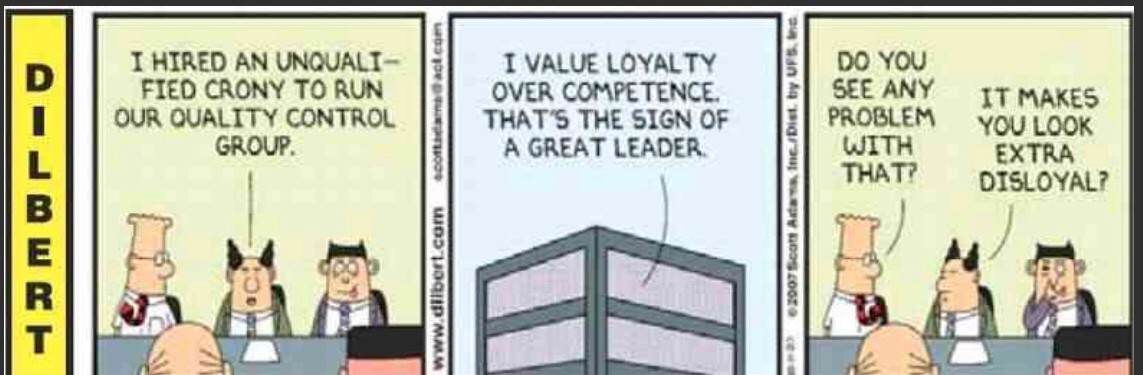


Cartoon – Modern Governance

How to Manage Incompetence at Work - Paul Zhao - Medium

The Most Important Leadership Competencies, According to Leaders Around the World

https://hbr.org/2016/03/the-most-important-leadership-competencies-according-to-leaders-around-the-world?utm_source=facebook&utm_medium=social&utm_campaign=hbr&fbclid=IwAR3P_HH0Xd1-7iiT-xo0OydmS9uu6OOONRkj0ox_CH2phzt1wwr9p3suryE

Image result for The Most Important Leadership Competencies, According to Leaders Around the World

What makes an effective leader? This question is a focus of my research as an organizational scientist, executive coach, and leadership development consultant. Looking for answers, I recently completed the first round of a study of 195 leaders in 15 countries over 30 global organizations. Participants were asked to choose the 15 most important leadership competencies from a list of 74. I’ve grouped the top ones into five major themes that suggest a set of priorities for leaders and leadership development programs. While some may not surprise you, they’re all difficult to master, in part because improving them requires acting against our nature.

Demonstrates strong ethics and provides a sense of safety.

This theme combines two of the three most highly rated attributes: “high ethical and moral standards” (67% selected it as one of the most important) and “communicating clear expectations” (56%).

Taken together, these attributes are all about creating a safe and trusting environment. A leader with high ethical standards conveys a commitment to fairness, instilling confidence that both they and their employees will honor the rules of the game. Similarly, when leaders clearly communicate their expectations, they avoid blindsiding people and ensure that everyone is on the same page. In a safe environment employees can relax, invoking the brain’s higher capacity for social engagement, innovation, creativity, and ambition.

Neuroscience corroborates this point. When the amygdala registers a threat to our safety, arteries harden and thicken to handle an increased blood flow to our limbs in preparation for a fight-or-flight response. In this state, we lose access to the social engagement system of the limbic brain and the executive function of the prefrontal cortex, inhibiting creativity and the drive for excellence. From a neuroscience perspective, making sure that people feel safe on a deep level should be job #1 for leaders.

But how? This competency is all about behaving in a way that is consistent with your values. If you find yourself making decisions that feel at odds with your principles or justifying actions in spite of a nagging sense of discomfort, you probably need to reconnect with your core values. I facilitate a simple exercise with my clients called “Deep Fast Forwarding” to help with this. Envision your funeral and what people say about you in a eulogy. Is it what you want to hear? This exercise will give you a clearer sense of what’s important to you, which will then help guide daily decision making.

To increase feelings of safety, work on communicating with the specific intent of making people feel safe. One way to accomplish this is to acknowledge and neutralize feared results or consequences from the outset. I call this “clearing the air.” For example, you might approach a conversation about a project gone wrong by saying, “I’m not trying to blame you. I just want to understand what happened.”

Empowers others to self-organize.

Providing clear direction while allowing employees to organize their own time and work was identified as the next most important leadership competency.

No leader can do everything themselves. Therefore, it’s critical to distribute power throughout the organization and to rely on decision making from those who are closest to the action.

Research has repeatedly shown that empowered teams are more productive and proactive, provide better customer service, and show higher levels of job satisfaction and commitment to their team and organization. And yet many leaders struggle to let people self-organize. They resist because they believe that power is a zero-sum game, they are reluctant to allow others to make mistakes, and they fear facing negative consequences from subordinates’ decisions.

To overcome the fear of relinquishing power, start by increasing awareness of physical tension that arises when you feel your position is being challenged. As discussed above, perceived threats activate a fight, flight, or freeze response in the amygdala. The good news is that we can train our bodies to experience relaxation instead of defensiveness when stress runs high. Try to separate the current situation from the past, share the outcome you fear most with others instead of trying to hold on to control, and remember that giving power up is a great way to increase influence — which builds power over time.

Fosters a sense of connection and belonging.

Leaders who “communicate often and openly” (competency #6) and “create a feeling of succeeding and failing together as a pack” (#8) build a strong foundation for connection.

We are a social species — we want to connect and feel a sense of belonging. From an evolutionary perspective, attachment is important because it improves our chances of survival in a world full of predators. Research suggests that a sense of connection could also impact productivity and emotional well-being. For example, scientists have found that emotions are contagious in the workplace: Employees feel emotionally depleted just by watching unpleasant interactions between coworkers.

From a neuroscience perspective, creating connection is a leader’s second most important job. Once we feel safe (a sensation that is registered in the reptilian brain), we also have to feel cared for (which activates the limbic brain) in order to unleash the full potential of our higher functioning prefrontal cortex.

There are some simple ways to promote belonging among employees: Smile at people, call them by name, and remember their interests and family members’ names. Pay focused attention when speaking to them, and clearly set the tone of the members of your team having each other’s backs. Using a song, motto, symbol, chant, or ritual that uniquely identifies your team can also strengthen this sense of connection.

Shows openness to new ideas and fosters organizational learning.

What do “flexibility to change opinions” (competency #4), “being open to new ideas and approaches” (#7), and “provides safety for trial and error” (#10) have in common? If a leader has these strengths, they encourage learning; if they don’t, they risk stifling it.

Admitting we’re wrong isn’t easy. Once again, the negative effects of stress on brain function are partly to blame — in this case they impede learning. Researchers have found that reduced blood flow to our brains under threat reduces peripheral vision, ostensibly so we can deal with the immediate danger. For instance, they have observed a significant reduction in athletes’ peripheral vision before competition. While tunnel vision helps athletes focus, it closes the rest of us off to new ideas and approaches. Our opinions are more inflexible even when we’re presented with contradicting evidence, which makes learning almost impossible.

To encourage learning among employees, leaders must first ensure that they are open to learning (and changing course) themselves. Try to approach problem-solving discussions without a specific agenda or outcome. Withhold judgment until everyone has spoken, and let people know that all ideas will be considered. A greater diversity of ideas will emerge.

Failure is required for learning, but our relentless pursuit of results can also discourage employees from taking chances. To resolve this conflict, leaders must create a culture that supports risk-taking. One way of doing this is to use controlled experiments — think A/B testing — that allow for small failures and require rapid feedback and correction. This provides a platform for building collective intelligence so that employees learn from each other’s mistakes, too.

Nurtures growth.

“Being committed to my ongoing training” (competency #5) and “helping me grow into a next-generation leader” (#9) make up the final category.

All living organisms have an innate need to leave copies of their genes. They maximize their offspring’s chances of success by nurturing and teaching them. In turn, those on the receiving end feel a sense of gratitude and loyalty. Think of the people to whom you’re most grateful — parents, teachers, friends, mentors. Chances are, they’ve cared for you or taught you something important.

When leaders show a commitment to our growth, the same primal emotions are tapped. Employees are motivated to reciprocate, expressing their gratitude or loyalty by going the extra mile. While managing through fear generates stress, which impairs higher brain function, the quality of work is vastly different when we are compelled by appreciation. If you want to inspire the best from your team, advocate for them, support their training and promotion, and go to bat to sponsor their important projects.

These five areas present significant challenges to leaders due to the natural responses that are hardwired into us. But with deep self-reflection and a shift in perspective (perhaps aided by a coach), there are also enormous opportunities for improving everyone’s performance by focusing on our own.