U.S. Healthcare in 2025 and Beyond: Three Major Predictions

With days before voters decide the composition of the 119th U.S. Congress and the next White House occupant, the immediate future for U.S. healthcare is both predictable and problematic:

It’s predictable that…

1-States will be the epicenter for healthcare legislation and regulation; federal initiatives will be substantially fewer.

At a federal level, new initiatives will be limited: continued attention to hospital and insurer consolidation, drug prices and the role of PBMs, Medicare Advantage business practices and a short-term fix to physician payments are likely but little more. The Affordable Care Act will be modified slightly to address marketplace coverage and subsidies and CMSs Center for Medicare and Medicaid Innovation (CMMI) will test new alternative payment models even as doubt about their value mounts. But “BIG FEDERAL LAWS” impacting the U.S. health system are unlikely.

But in states, activity will explode:  for example…

  • In this cycle, 10 states will decide their abortion policies joining 17 others that have already enacted new policies.
  • 3 will vote on marijuana legalization joining 24 states that have passed laws.
  • 24 states have already passed Prescription Drug Pricing legislation and 4 are considering commissions to set limits.
  • 40 have expanded their Medicaid programs
  • 35 states and Washington, D.C., operate CON programs; in 12 states, CONs have been repealed.
  • 14 have legislation governing mental health access.
  • 5 have passed or are developing commissions to control health costs.
  • And so on.

Given partisan dysfunction in Congress and the surprising lack of attention to healthcare in Campaign 2024 (other than abortion coverage), the center of attention in 2025-2026 will be states. In addition to the list above, attention in states will address protections for artificial intelligence utilization, access to and pricing for weight loss medications, tax exemptions for not-for-profit health systems, telehealth access, conditions for private equity ownership in health services, constraints on contract pharmacies, implementation of site neutral payments, new 340B accountability requirements and much more. In many of these efforts, state legislatures and/or Governors will go beyond federal guidance setting the stage for court challenges, and the flavor of these efforts will align with a state’s partisan majorities: as of September 30th, 2024, Republicans controlled 54.85% of all state legislative seats nationally, while Democrats held 44.19%. Republicans held a majority in 56 chambers, and Democrats held the majority in 41 chambers. In 2024, 27 states are led by GOP governors and 23 by Dems and 11 face voters November 5.  And going into the election, 22 states are considered red, 21 are considered blue and 7 are tagged as purple.

The U.S. Constitution affirms Federalism as the structure for U.S. governance: it pledges the pursuit of “life, liberty and the pursuit of happiness” as its purpose but leaves the lion’s share of responsibilities to states to figure out how. Healthcare may be federalism’s greatest test.

2-Large employers will take direct action to control their health costs.

Per the Kaiser Family Foundation’s most recent employer survey, employer health costs are expected to increase 7% this year for the second year in a row. Willis Towers Watson, predicts a 6.4% increase this year on the heels of a 6% bump last year. The Business Group on Health, which represents large self-insured employers, forecasts an 8% increase in 2025 following a 7% increase last year. All well-above inflation, ages and consumer prices this year.

Employers know they pay 254% of Medicare rates (RAND) and they’re frustrated. They believe their concerns about costs, affordability and spending are not taken seriously by hospitals, physicians, insurers and drug companies. They see lackluster results from federal price transparency mandates and believe the CMS’ value agenda anchored by accountable care organizations are not achieving needed results. Small-and-midsize employers are dropping benefits altogether if they think they can. For large employers, it’s a different story. Keeping health benefits is necessary to attract and keep talent, but costs are increasingly prohibitive against macro-pressures of workforce availability, cybersecurity threats, heightened supply-chain and logistics regulatory scrutiny and shareholder activism.

Maintaining employee health benefits while absorbing hyper-inflationary drug prices, insurance premiums and hospital services is their challenge. The old playbook—cost sharing with employees, narrow networks of providers, onsite/near site primary care clinics et al—is not working to keep up with the industry’s propensity to drive higher prices through consolidation.

In 2025, they will carefully test a new playbook while mindful of inherent risks. They will use reference pricing, narrow specialty specific networks, technology-enabled self-care and employee gainsharing to address health costs head on while adjusting employee wages. Federal and state advocacy about Medicare and Medicaid funding, insurer and hospital consolidation and drug pricing will intensify. And some big names in corporate America will step into a national debate about healthcare affordability and accountability.

Employers are fed up with the status quo. They don’t buy the blame game between hospitals, insurers and drug companies. And they don’t think their voice has been heard.

3-Private equity and strategic investors will capitalize on healthcare market conditions. 

The plans set forth by the two major party candidates feature populist themes including protections for women’s health and abortion services, maintenance/expansion of the Affordable Care Act and prescription drug price controls. But the substance of their plans focus on consumer prices and inflation: each promises new spending likely to add to the national deficit:

  • Per the Non-Partisan Committee for a Responsible Federal Budget, over the next 10 years, the Trump plan would add $7.5 trillion to the deficit; the Harris plan would add $3.5 trillion.
  • Per the Wharton School at the University of Pennsylvania, Harris’ proposals would add $1.2 trillion to the national deficits over 10 years and Trump’s proposals would add $5.8 trillion over the same period

Per the Congressional Budget Office, federal budget deficit for FY2024 which ended September 30 will be $1.8 trillion– $139 billion more than FT 2023. Revenues increased by an estimated $479 billion (or 11 percent). Revenues in all major categories, but notably individual income taxes, were greater than they were in fiscal year 2023. Outlays rose by an estimated $617 billion (or 10 percent). The largest increase in outlays was for education ($308 billion). Net outlays for interest on the public debt rose by $240 billion to total $950 billion.

The federal government spent $6.75 trillion in 2024, a 10% increase from the prior year. Spending on Social Security (22% of total spending) and healthcare programs (28.5% of total spending) also increased substantially. The U.S. debt as of Friday was $37.77 trillion, or $106 thousand per citizen.

The non-partisan Congressional Budget Office (CBO) reports that federal debt held by the public averaged 48.3 % of GDP for the half century ending in 2023– far above its historic average. It projects next year’s national debt will hit 100% for the first time since the US military build-up in the second world war. And it forecast the debt reaching 122.4% in 2034 potentially pushing interest payments from 13% of total spending this year to 20% or more.

Adding debt is increasingly cumbersome for national lawmakers despite campaign promises, and healthcare is rivaled by education, climate and national defense in seeking funding through taxes and appropriations. Thus, opportunities for private investors in healthcare will increase dramatically in 2025 and 2026. After all, it’s a growth industry ripe for fresh solutions that improve affordability and cost reduction at scale.

Combined, these three predictions foretell a U.S. healthcare system that faces a significant pressure to demonstrate value.

They require every healthcare organization to assess long-term strategies in the likely context of reduced funding, increased regulation and heightened attention to prices and affordability. This is problematic for insiders accustomed to incrementalism that’s protected them from unwelcome changes for 3 decades.  

Announcements last week by Walgreens and CVS about changes to their strategies going forward reflect the industry’s new normal: change is constant, success is not. In 2025, regardless of the election outcome, healthcare will be a major focus for lawmakers, regulators, employers and consumers.  

Pandemic rent inflation is still working its way through the economy

Everybody is waiting for rent relief to help bring overall inflation down. It might take longer than conventional wisdom suggests.

Why it matters: 

A surge in market rents in 2021 and 2022 still has a ways to go in fully working its way through the economy, despite moderation in market rents since then, a new paper from a Boston Fed economist finds.

  • As a result, rents are on track to exert upward pressure on overall inflation for quite a while to come, the paper argues, a headwind to bringing inflation down to the Fed’s 2% target.

The big picture: 

Rents soared during and immediately after the pandemic as Americans sought bigger homes and were flush with higher paychecks and pent-up savings. But private-sector indicators of market rents rose much faster than the rent numbers calculated for the Consumer Price Index and other inflation indicators at that time.

  • That’s because market rent data only encompasses people signing new leases. Many existing tenants saw no immediate change — perhaps because they had long-term leases in place, or landlords were reluctant to raise rent on existing tenants, or local laws constrained rent hikes.
  • But over time, those leases turn over, with more renters paying the higher market prices. That process is still underway, even though market rents have risen less in 2023 and 2024, according to the analysis from the Boston Fed’s Christopher D. Cotton.

By the numbers: 

Compared to 2019 levels, there is a 6 percentage point gap between rents on new leases and the shelter inflation shown in the CPI.

  • The process of higher market rents filtering through the inflation data is on track to add 0.7 percentage point to the core Consumer Price Index over the next year and 0.3 percentage points to core inflation using the Fed’s preferred gauge, Cotton finds.
  • “The fact that market rents remain 6% higher than CPI-shelter relative to pre-pandemic implies that CPI-shelter will grow more quickly than market rents for the foreseeable future,” Cotton tells Axios.

Of note: 

Fed vice chair Philip Jefferson noted last month that “market rents adjust more quickly to economic conditions than what landlords charge their existing tenants.”

  • “This lag suggests that the large increase in market rents during the pandemic is still being passed through to existing rents and may keep housing services inflation elevated for a while longer,” Jefferson said.

The intrigue: 

One risk to watch is that even once the pandemic-era rent inflation has worked its way through the data, there could be a new surge in market rents due to under-supply.

  • Construction of new multifamily housing has plunged below pre-pandemic levels in recent months as builders grapple with high interest rates.

The Healthcare Economy: Three Key Takeaways that Frame Public and Private Sector Response

Last week, 2 important economic reports were released that provide a retrospective and prospective assessment of the U.S. health economy:

The CBO National Health Expenditure Forecast to 2032: 

“Health care spending growth is expected to outpace that of the gross domestic product (GDP) during the coming decade, resulting in a health share of GDP that reaches 19.7% by 2032 (up from 17.3% in 2022). National health expenditures are projected to have grown 7.5% in 2023, when the COVID-19 public health emergency ended. This reflects broad increases in the use of health care, which is associated with an estimated 93.1% of the population being insured that year… During 2027–32, personal health care price inflation and growth in the use of health care services and goods contribute to projected health spending that grows at a faster rate than the rest of the economy.”

The Congressional Budget Office forecast that from 2024 to 2032:

  • National Health Expenditures will increase 52.6%: $5.048 trillion (17.6% of GDP) to $7,705 trillion (19.7% of GDP) based on average annual growth of: +5.2% in 2024 increasing to +5.6% in 2032
  • NHE/Capita will increase 45.6%: from $15,054 in 2024 to $21,927 in 2032
  • Physician services spending will increase 51.2%: from $1006.5 trillion (19.9% of NHE) to $1522.1 trillion (19.7% of total NHE)
  • Hospital spending will increase 51.6%: from $1559.6 trillion (30.9% of total NHE) in 2024 to $2366.3 trillion (30.7% of total NHE) in 2032.
  • Prescription drug spending will increase 57.1%: from 463.6 billion (9.2% of total NHE) to 728.5 billion (9.4% of total NHE)
  • The net cost of insurance will increase 62.9%: from 328.2 billion (6.5% of total NHE) to 534.7 billion (6.9% of total NHE).
  • The U.S. Population will increase 4.9%: from 334.9 million in 2024 to 351.4 million in 2032.

The Bureau of Labor Statistics CPI Report for May 2024 and Last 12 Months (May 2023-May2024): 

“The Consumer Price Index for All Urban Consumers (CPI-U) was unchanged in May on a seasonally adjusted basis, after rising 0.3% in April… Over the last 12 months, the all-items index increased 3.3% before seasonal adjustment. More than offsetting a decline in gasoline, the index for shelter rose in May, up 0.4% for the fourth consecutive month. The index for food increased 0.1% in May. … The index for all items less food and energy rose 0.2% in May, after rising 0.3 % the preceding month… The all-items index rose 3.3% for the 12 months ending May, a smaller increase than the 3.4% increase for the 12 months ending April. The all items less food and energy index rose 3.4 % over the last 12 months. The energy index increased 3.7%for the 12 months ending May. The food index increased 2.1%over the last year.

Medical care services, which represents 6.5% of the overall CPI, increased 3.1%–lower than the overall CPI. Key elements included in this category reflect wide variance: hospital and OTC prices exceeded the overall CPI while insurance, prescription drugs and physician services were lower.

  • Physicians’ services CPI (1.8% of total impact): LTM: +1.4%
  • Hospital services CPI (1.0% of total impact): LTM: +7.3%
  • Prescription drugs (.9% of total impact) LTM +2.4%
  • Over the Counter Products (.4% of total impact) LTM 5.9%
  • Health insurance (.6% of total) LTM -7.7%

Other categories of greater impact on the overall CPI than medical services are Shelter (36.1%), Commodities (18.6%), Food (13.4%), Energy (7.0%) and Transportation (6.5%).

Three key takeaways from these reports:

  • The health economy is big and getting bigger. But it’s less obvious to consumers in the prices they experience than to employers, state and federal government who fund the majority of its spending. Notably, OTC products are an exception: they’re a direct OOP expense for most consumers. To consumers, especially renters and young adults hoping to purchase homes, the escalating costs of housing have considerably more impact than health prices today but directly impact on their ability to afford coverage and services. Per Redfin, mortgage rates will hover at 6-7% through next year and rents will increase 10% or more.
  • Proportionate to National Health Expenditure growth, spending for hospitals and physician services will remain at current levels while spending for prescription drugs and health insurance will increase. That’s certain to increase attention to price controls and heighten tension between insurers and providers.
  • There’s scant evidence the value agenda aka value-based purchases, alternative payment models et al has lowered spending nor considered significant in forecasts.

The health economy is expanding above the overall rates of population growth, overall inflation and the U.S. economy. GDP.  Its long-term sustainability is in question unless monetary policies enable other industries to grow proportionately and/or taxpayers agree to pay more for its services. These data confirm its unit costs and prices are problematic.

As Campaign 2024 heats up with the economy as its key issue, promises to contain health spending, impose price controls, limit consolidation and increase competition will be prominent.

Public sector actions

will likely feature state initiatives to lower cost and spend taxpayer money more effectively.

Private sector actions

will center on employer and insurer initiatives to increase out of pocket payments for enrollees and reduce their choices of providers.

Thus, these reports paint a cautionary picture for the health economy going forward. Each sector will feel cost-containment pressure and each will claim it is responding appropriately. Some actually will.

PS: The issue of tax exemptions for not-for-profit hospitals reared itself again last week.

The Committee for a Responsible Federal Budget—a conservative leaning think tank—issued a report arguing the exemption needs to be ended or cut.  In response,

the American Hospital Association issued a testy reply claiming the report’s math misleading and motivation ill-conceived.

This issue is not going away: it requires objective analysis, fresh thinking and new voices.  For a recap, see the Hospital Section below.

Medicare Physician Payment Not Keeping Up

https://www.kaufmanhall.com/insights/infographic/medicare-physician-payment-not-keeping

Following the US Senate Finance Committee’s recent white paper on Medicare physician payment reform, the graphic above shows how Medicare payments to physicians have not kept pace with inflation. 

The Medicare physician fee schedule conversion factor, which is used to assign dollar amounts to relative value units, decreased by eight percent between 2000 and 2024. 

Over the same period, the Medicare Economic Index (MEI), which measures practice cost inflation, and Consumer Price Index rose 57 percent and 83 percent, respectively. Reductions to the conversion factor contributed to a 20 percent decline in Medicare physician pay relative to practice cost inflation from 2000 to 2021. 

Physician practice margins in general have also worsened since COVID, not just due to Medicare payments. 

Although net revenue per physician at system-affiliated clinics increased about 10 percent from 2020 to 2023,total expenses per physician rose about 27 percent, driven by a per physician clinical staffing expense increase of nearly the same amount. 

Both the Senate Finance Committee’s white paper and a recently introduced House bill suggest tying the Medicare physician fee schedule conversion factor updates to the MEI, either partially or fully, but immediate legislative action in an election year appears unlikely. 

In the meantime, physician practices continue to face a difficult operating environment with costs rising faster than revenues.

Inflation cools, reassuring Fed after unexpectedly hot gains in Q1

The yield on the benchmark 10-year Treasury note fell on investor speculation that slower inflation will prompt the Fed to sooner cut borrowing costs.

Dive Brief:

  • The consumer price index excluding volatile food and energy prices rose last month at the slowest pace this year, giving Federal Reserve policymakers some relief from a barrage of first-quarter data that shook confidence inflation will steadily slow to their 2% goal.
  • So-called core CPI gained 0.3% in April compared with 0.4% during the prior month, and eased to 3.6% on an annual basis from 3.8% in March, the Bureau of Labor Statistics said Wednesday. Shelter costs rose 0.4% last month, pushing up core CPI more than any other category. Prices for transportation, apparel and medical care also increased.
  • “Inflation should show some signs of more material disinflation over the coming months as upside surprises in Q1 reverse and shelter inflation continues to soften, particularly” during the second half of this year, David Page, head of macroeconomic research at AXA IM, said in a report.

Dive Insight:

Fed Chair Jerome Powell has repeatedly said this month that unexpectedly high first-quarter inflation eroded his confidence that price pressures are falling steadily enough to warrant a reduction in the highest federal funds rate in 23 years.

“I would say my confidence in that is not as high as it was, having seen these readings in the first three months of the year,” Powell said Tuesday.

Investor speculation that cooling inflation will prompt the Fed to sooner trim borrowing costs pushed down the yield on the benchmark Treasury note on Wednesday by about 0.1 percentage point to 3.86%. Equity prices rose.

“Today’s data may be a relief relative to past months, and that should reduce any fears that the Fed might have to raise rates,” Eric Winograd, developed market research director at AllianceBernstein, said in an email.

Still, “today’s data are not good enough to move the policy needle,” Winograd said, forecasting that the central bank will not cut the main interest rate until the fourth quarter.

“Unless the labor market weakens appreciably, it will take several months of inflation steadily decelerating before the Fed will be comfortable cutting rates,” he said.

Traders in interest rate futures put 69% odds that the Fed will trim the main interest rate by at least 0.5 percentage point by the end of this year, compared with 57% odds on Tuesday, according to the CME FedWatch Tool.

“The Fed is making progress, but taming inflation is taking time,” Scott Helfstein, head of investment strategy at Global X, said in an email response to questions.

“The Fed will probably be patient,” Helfstein said, forecasting either no change to the federal funds rate this year or at most a quarter-point cut in December. “A stable rate and inflation environment, most importantly, is good for companies.”

Powell predicted that inflation will eventually slow to a more moderate pace. “I expect that inflation will move back down on a monthly level, on a monthly basis, to levels that were more like the lower readings we were having last year,” Powell said Tuesday.

A separate report Wednesday showed consumers may be pocketing their wallets in response to higher borrowing costs and the waning of savings built during the pandemic.

Retail sales in April were unchanged from March, the Census Bureau said, releasing data that was lower than expected by economists. Growth in retail sales in March was marked down to 0.6% from 0.7%.

Still, “the consumer is okay,” Helfstein said, predicting that “economic growth will likely be driven by corporate investment through the back part of the year.”

Key Inflation Measure Falls To Lowest Rate Since Early 2021

TOPLINE

Inflation moderated as economists forecasted last month, according to the Federal Reserve’s favored inflation metric, bringing welcome news for investors, home buyers and consumers alike looking for interest rate cuts.

KEY FACTS

Americans spent 2.4% more in January than they did in January 2023, according to the personal consumption expenditures (PCE) price index released Thursday morning by the Bureau of Economic Analysis.

That meets consensus economist estimates of 2.4% annual PCE inflation and comes in lower than last month’s 2.6%.

It’s the lowest PCE reading since March 2021.

Core PCE inflation, which tracks expenditures for goods and services other than the less sticky food and services inputs, was 2.8% in January, in line with forecasts of 2.8%.

It’s similarly the lowest core PCE reading since March 2021 and checks in significantly lower than January 2023’s 4.7% inflation.

KEY BACKGROUND

Core PCE inflation, which is Fed Chairman Jerome Powell’s inflation measure of choice, is still well above the Fed’s long-term 2% target.

Earlier this month, PCE’s sister consumer price index (CPI) revealed far worse CPI inflation than economists projected, sending the S&P 500 stock index to its biggest loss in almost 12 months as sticky inflation would likely cause the Fed to delay the much-anticipated rate cuts until more tangible progress toward 2% inflation is apparent. CPI measures the average prices nationwide of a predetermined basket of goods and services, while PCE measures how much Americans actually spend monthly, earning the latter policymakers’ affection as it arguably paints a better picture of the health of Americans’ wallets.

The series of hotter than anticipated inflation data has dramatically pushed back expectations of when and by how much the Fed will slash rates in 2024. Higher inflation typically keeps rates higher for longer, making loans such as mortgages more expensive, exemplified by mortgage rates more than doubling over the last two years to their highest levels since the turn of the century.

The futures market currently prices in June as the most likely date of the first cut and 75 basis points of cuts as the most likely outcomeaccording to the CME Group’s FedWatch Tool, much softer than a month ago’s implied forecasts of the first reduction coming in May and 125 basis points of cuts.

Health Sector Economic Indicators Briefs

https://mailchi.mp/altarum/health-sector-economic-indicators-briefs-august-2023?e=b4c24e7e20

The latest Altarum Health Sector Economic Indicators show that health spending as a percent of GDP has stabilized near 17.5%, health care price growth and economywide inflation recently converged, and the health sector added over 60,000 jobs in July. See the highlights below.

Health spending as a percent of GDP has stabilized at 17.5%

  • In June 2023, national health spending grew by 5.0%, year over year, and now represents 17.5% of GDP, equal to the average percent of GDP for the previous 12 months.
  • Nominal GDP in June 2023 was 5.8% higher than in June 2022, and grew 0.8 percentage points faster than health spending.
  • Neglecting government subsidies, spending on personal health care in June increased by 8.1%, year over year, and by 7.3% when subsidies are included, exceeding the GDP growth rate for the fifth consecutive month.
  • Neglecting government subsidies, year-over-year spending on home health care (12.2%) and nursing home care (12.0%) grew fastest in June, while physician and clinical services spending increased the least (6.9%) among major categories.
  • Personal health care growth (neglecting government subsidies), which continues to be dominated by growth in utilization rather than price increases, has slowed somewhat in the past 4 months.

Health care price growth and economywide inflation finally converge

  • The overall Health Care Price Index (HCPI) increased by 2.7% year over year in July, slowing 0.1 percentage points from the slightly revised rate in June (2.8%).
  • For the first time in over two years, health care price growth exceeded overall inflation as economywide price growth (measured by the GDP Deflator) fell to 2.6% in June, its lowest growth rate since March 2021.
  • In new data for July, overall year-over-year CPI growth actually increased slightly to 3.2%, the first increase in its growth rate since June 2022, driven primarily by changes in commodities price growth.
  • Among the major health care categories, prices for nursing home care (5.5%) and dental care (5.1%) grew fastest, while physician and clinical services (0.7%) price growth was the slowest in July.
  • Year-over-year growth in hospital prices paid by private payers fell nearly 2.5 percentage points over the past two months (from 6.1% in May to 3.7% in July), beginning to converge with public payer price growth. In July, growth in Medicare and Medicaid hospital prices reached 2.6% and 2.3% growth respectively.
  • Our implicit measure of health care utilization growth declined in June, up 4.5% year over year, and down somewhat from slightly revised data (4.9% growth) a month prior.

Health care adds 63,000 jobs in July, the largest increase since July 2022

  • Health care added 63,000 jobs in July 2023, exceeding the average of 43,700 jobs added per month for the first 6 months of the year and the largest monthly increase in the past year.
  • July’s health sector job growth was led by growth in ambulatory care settings, which added 35,400 jobs, followed by hospitals, which added 16,100 jobs.
  • Nursing and residential care facilities added 11,500 jobs in July, with growth occurring in both nursing homes (6,300 jobs) and other nursing and residential care settings (5,200 jobs).
  • The economy added 187,000 jobs in July, somewhat below the 12-month average of 280,200 jobs. The unemployment rate, at 3.5%, changed little in July.
  • Health care wage growth in June 2023 was 3.7% year over year, somewhat below the total private sector wage growth of 4.4%.
  • Wage growth in health care settings is now highest in nursing and residential care, at 4.8% year over year in June 2023. Wage growth in hospitals was 4.3%, while wage growth in ambulatory care settings was 3.0% in June.

National Hospital Flash Report: May 2023

Hospital finances showed signs of stabilizing in May amid slightly improving operating margins, declining expenses and notable increases in outpatient visits.

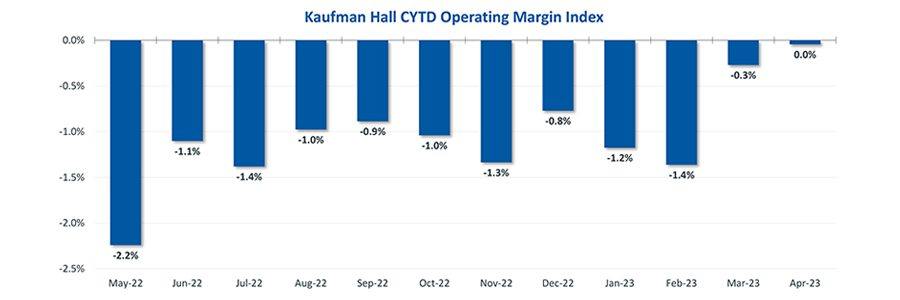
The median Kaufman Hall Year-To-Date Operating Margin Index reflecting actual margins was 0.3% in May.

The June issue of the National Hospital Flash Report covers these and other key performance metrics.

About the Data


The National Hospital Flash Report uses both actual and budget
data over the last three years, sampled from more than 900 hospitals
on a recurring monthly basis from Syntellis Performance Solutions.


The sample of hospitals for this report is representative of all hospitals in
the United States both geographically and by bed size. Additionally,
hospitals of all types are represented, from large academic to small
critical access. Advanced statistical techniques are used to standardize
data, identify and handle outliers, and ensure statistical soundness prior
to inclusion in the report.


While this report presents data in the aggregate, Syntellis Performance
Solutions also has real-time data down to individual department,
jobcode, paytype, and account levels, which can be customized into peer
groups for unparalleled comparisons to drive operational decisions and
performance improvement initiatives.

Key Takeaways

  1. Hospitals broke even in April.
    The median operating margin for hospitals was 0% in April, leaving most hospitals with little to no
    financial wiggle room.
  2. Volumes dropped while lengths of stay increased.
    Hospital volumes dropped across the board—including inpatient and outpatient. Emergency department
    volumes were the least affected.
  3. Effects of Medicaid disenrollment could be materializing.
    Hospitals experienced increases in bad debt and charity care in April. Combined with anemic patient
    volumes, experts note this data could illustrate the effects of the start of widespread disenrollment from
    Medicaid following the end of the COVID-19 public health emergency.
  4. Inflation continued to throttle hospital finances.
    Labor costs jumped in April and the costs of goods and services continued to be well above pre-pandemic
    levels. Though expenses generally fell in April, revenues declined at a faster rate.

National Non-Operating Results

Key Observations

At their May meeting, the Federal Open Market Committee (FOMC) raised the
benchmark borrowing rate another 25 basis points, setting the range to 5.00-5.25%
and marking the 10th consecutive hike in the cycle as well as a 16-year high

  • Fed officials acknowledged discussion of a potential pause in tightening while
    leaving wiggle room, saying “rates are going to come down” over a long period of
    time while also warning inflation “continues to run high”
    and the Fed will be taking
    a “data-dependent approach”
  • The consumer price index (CPI) rose 0.4% in April, a 4.9% increase year-over-year,
    an annual pace of inflation below 5% for the first time in two years
  • The labor market continued to show resilience in April as U.S. nonfarm payrolls
    grew by 253,000 and unemployment fell back to a 53-year low of 3.4%
  • Strong inflation, a robust labor market, continued banking sector woes, and a debt
    ceiling standoff further complicates credit conditions and may challenge
    the Fed to stabilize financial markets
  • Equities in April, as measured by the S&P 500, were up 1.5% in April and
    8.6% YTD despite downbeat economic data, reoccurring banking sector fears,
    and mixed earnings

America’s inflation turnaround

It may be time to update your inflation narrative.

The ultra-hot readings that defined the first half of 2022 appear to be firmly in the rearview mirror, improving the odds that price pressures can dissipate further without excessive economic pain.

  • That’s the key takeaway from the December Consumer Price Index released this morning, which confirmed notably cooler inflation as the year came to a close.

Why it matters: 

The nation’s inflation problem isn’t over, but so far inflation is slowing while the job market is still healthy, an enviable combination.

  • As Princeton economist Alan Blinder put it in an op-ed last week, inflation was “vastly lower” in the second half of 2022 than the first; yet, “hardly anyone seems to have noticed.”

By the numbers: 

In the final three months of 2022, core inflation (which excludes food and fuel costs) came in at an annualized 3.1% — higher than the Fed aims for, but hardly crisis levels. In the second quarter of the year, that number was 7.9%.

  • It’s a stunning decline, occurring alongside a labor market that by nearly all measures is still flourishing. Just this morning, the Labor Department announced that jobless claims fell to an ultra-low 205,000 last week.

State of play: 

Grocery prices rose 1.1% in the final three months of the year, an uncomfortably high rate, but not as extreme as the rates seen earlier in 2022.

  • Gasoline prices, pushed up by Russia’s invasion of Ukraine, were once the crucial reason why inflation was rising. In recent months, the opposite has been true: December pump prices slid 9.4%, helping drag the overall index into negative territory.
  • Disinflation was at work for many other goods, including used cars (-2.5%) and new vehicles (-0.1%) where prices have reversed, helped by easing supply chain bottlenecks.
  • Shelter costs pushed inflation upward, surging 0.8% in December. But private-sector data points to rents on new leases falling in recent months, which would only filter into the CPI data over time. That makes for a more benign inflation outlook in 2023.

What to watch: 

That’s not to say there aren’t risks ahead. The war in Ukraine is ongoing, and another energy price shock could occur.

  • The Fed has also focused in on the services sector, where price increases have slowed from last summer but remain frothy. The risk is that business costs associated with the still-tight labor market (like higher wages) will pass through to prices for consumers.

The bottom line: 

Inflation will still be a worry in 2023, but much less so than it seemed a few months ago.

Consumer prices fell in December as inflation continues to cool

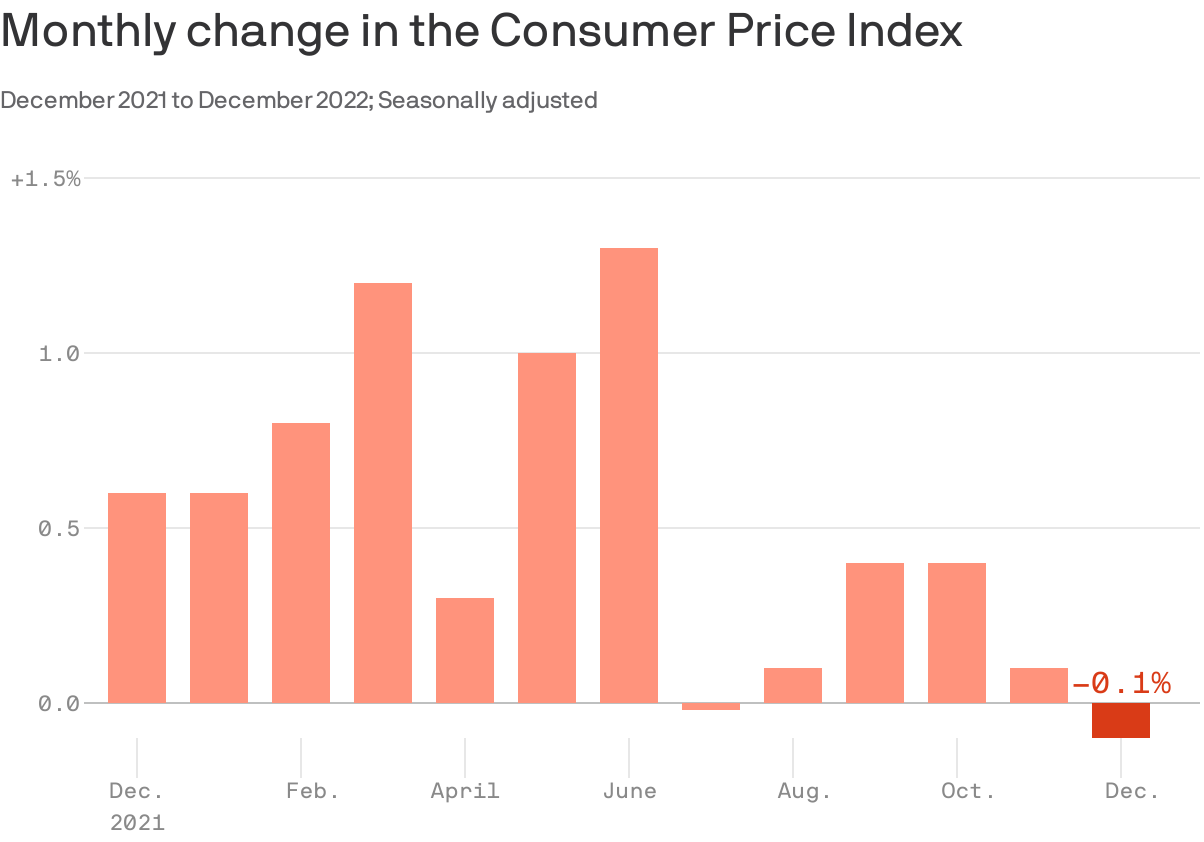
U.S. consumers got a reprieve from soaring costs in December: the Consumer Price Index declined on a monthly basis, the first drop since last summer as falling prices for items including gasoline and used cars dragged the overall index down.

By the numbers:

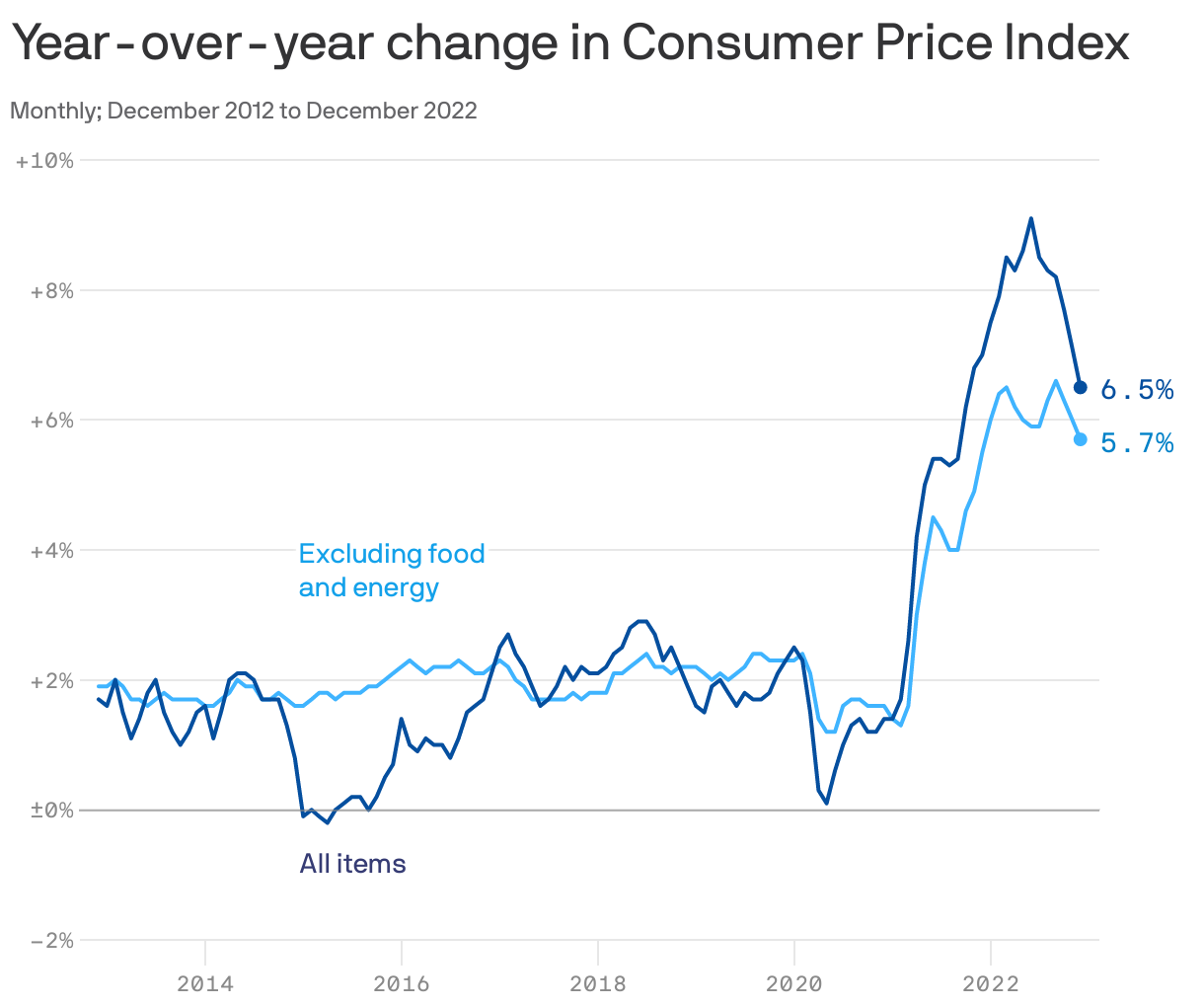
The index, which captures price changes across a basket of consumer goods and services, fell 0.1%, following an increase by the same amount in November. Over the past 12 months ending in December, the index is up 6.5%, falling from 7.1% through November.

  • Core CPI, which excludes food and fuel costs, rose by 0.3% last month. Over the last 12 months through December, the index rose 5.7%. In November, those figures were 0.2% and 6%, respectively.

Why it matters:

The hot inflation that persisted through much of last year continues to show signs of receding — offering at least some relief for shoppers, the White House and the Federal Reserve, though some underlying inflation pressure remains.

Where it stands:

The data caps a year in which consumer prices rose rapidly, though the pace of cost increases began to slow in the final months of the year.

  • As consumers shifted spending and supply chains began to heal, price increases for a range of goods have cooled or, in some cases, costs have fallen outright.

Between the lines:

The Federal Reserve, which has been raising interest rates aggressively to tame inflation, is watching the services sector closely, where inflation can be more challenging to stamp out.

  • A sub-index measuring price moves within the services category (excluding housing) accelerated by 0.4%, after two straight months of cooler readings
  • Still, in the 12 months through December, this sub-index is up 7.4% (compared to 7.3% in November).