Melinda Gates: US coronavirus response ‘lacking leadership at the federal level’

https://finance.yahoo.com/news/us-coronavirus-response-lacks-leadership-at-the-federal-level-melinda-gates-151610533.html

Melinda Gates: US coronavirus response “lacks leadership at the ...

Philanthropist Melinda Gates on Thursday sharply criticized the U.S. response to the coronavirus outbreak, telling Yahoo Finance that the country is “lacking leadership at the federal level” and as a result has endured unnecessary deaths and economic pain.

“It’s highly distressing and disappointing,” says Gates, co-chair of the Bill and Melinda Gates Foundation, which she said has donated $300 million to organizations involved in the coronavirus response.

“To have 50 state-grown solutions is inefficient, it makes no sense, and it’s costing people their lives,” she adds.

President Donald Trump said on Tuesday “there’ll be more death” as states lift stay-at-home measures but has urged a path toward reopening the economy in order to blunt job loss and other damaging effects caused by the mandates.

The Trump administration has drawn criticism for what some consider a failure to adequately address the coronavirus outbreak in its early stages. Trump has repeatedly said “nobody” could have foreseen the pandemic though he reportedly received dire warnings as early as February.

“The lack of action is really causing harm and hurt unnecessarily in this country,” Gates says. “I’m incredibly disappointed to see that.”

The White House recently declined to take up guidelines written by the Centers for Disease Control and Prevention for how schools, restaurants, and other institutions can safely reopen, the Associated Press reported on Thursday.

The Trump administration did release a set of conditions for coronavirus containment that it recommends states meet before they reopen, including a 14-day downward trajectory in new cases or positive test rates. However, many states that remain short of that benchmark have started to reopen or will do it soon, among them Kentucky, Ohio, and Utah, the AP reported on Thursday.

On Friday, the monthly jobs report showed the U.S. economy cut 20.5 million payrolls in April, and the unemployment rate jumped to 14.7%.

The severity of economic pain is a direct result of inaction from the federal government, Gates said.

“It is impacting families now, because if we had a good testing and tracing system like Germany has, we would have started to reopen slowly more places in the economy, people wouldn’t be struggling so much to put a meal on their table,” says Gates, who released a book last year entitled “The Moment of Lift: How Empowering Women Changes the World.”

‘Difficult tension’ faced by parents at home

She said the U.S. must bolster its benefits for paid sick, medical, and family leave in order to mitigate some of the economic pain and reopen the economy, since some workers will return to their jobs while others will need to remain home to care for sick family members or children educated remotely.

Speaking with Yahoo Finance, she called on Congress to improve the paid sick and family leave expansion passed in March, which excluded many companies from the benefits requirements.

“Congress made a first step that is in one of the stimulus packages, they really did put in sick days and paid leave,” she says. “The problem is, it doesn’t go far enough.”

Moreover, she advocated for a nationwide paid medical and family leave plan — a proposal backed in part by both parties, though they differ sharply on the details.

The Republican-controlled Senate and Democrat-controlled House remain divided over an additional stimulus measure, while President Donald Trump has sought likely-polarizing tax cuts to be included in the bill, the New York Times reported on Wednesday.

Nevertheless, Gates said she is optimistic that Congress will enact paid medical and family leave.

“Congress is hearing about this difficult tension moms and dads — but particularly moms — are facing at home,” she says.


Administration’s Handling of Coronavirus Threatens a Long Unemployment Crisis

https://www.americanprogress.org/issues/economy/news/2020/05/07/484795/trump-administrations-handling-coronavirus-threatens-long-unemployment-crisis/
The Trump Administration's Handling of Coronavirus Threatens a ...

On Friday, the Bureau of Labor Statistics will release employment numbers for April that are expected to show a tragic and historic increase in unemployment. Consensus estimates anticipate more than 20 million jobs lost and an unemployment rate of 16 percent—a figure that may well be an underestimate given that millions of people may not be looking for jobs, effectively exiting the labor force and reducing the labor force participation rate. Moreover, state-level unemployment claims data show that this economic pain is being felt across the country, with sharp rises in joblessness in every state. And Thursday’s jobless claims release suggests that job losses have continued at high levels since the April unemployment survey was taken.

While the immediate cause of this spike in joblessness is, of course, the necessary stay-at-home orders and social distancing measures taken to respond to the crisis, the rise in unemployment—and how long it lasts—cannot be separated from choices made by the Trump administration. In understanding the state of the economy, as well as what comes next, the following three elements of this crisis must be understood:

  1. The economic crisis we are facing—and the economic pain we expect in the months ahead—is the result of a failed public health response. The Trump administration ignored early warnings, misled the public, and made the coronavirus crisis worse. The fact that the administration bungled the testing regime early on in the crisis meant that the United States could never contain the virus, as other countries such as South Korea, New Zealand, and Taiwan have done. As a consequence of that failure, the United States has had to engage in social distancing that has meant economic shock in order to avoid significantly greater levels of infections and deaths. The depth and scope of the economic pain being felt is a consequence of the administration’s delayed response and complete failure take leadership during this crisis.
  2. The administration’s inability to put in place appropriate public health measures going forward—combined with its insistence that efforts to contain the virus should be lifted in the absence of those measures—is likely to not only prolong the public health crisis but also extend the economic pain. Rather than provide workers, businesses, and families the confidence that they can return to activity safely, the administration is taking steps that try to ignore the risk of infection, such as absolving employers of responsibility for worker safety through a liability shield or forcing workers to return to work even when they have concerns about their health. In this environment, we are likely to see decreased demand for some time to come because people will have little confidence in individual state reopening strategies disconnected from science—as we are already seeing across the country.
  3. By rejecting efforts that would support families, workers, and communities during this crisis, the administration and its allies in Congress are putting us on a path for continued double-digit unemployment even after the pandemic finally ends. Indeed, the Congressional Budget Office (CBO) projects that the unemployment rate—absent additional action—will be near 10 percent at the end of 2021, several months after they project social distancing as a result of the health crisis abates. By opposing efforts to provide sufficient aid to states and localities; relief to families and unemployed workers; and assistance to those struggling the most, President Donald Trump, Majority Leader Mitch McConnell (R-KY), and their allies are insisting on making this extended period of double-digit unemployment a reality.

There is an alternative path, however: Taking the necessary steps to address the public health crisis and ensure that people can go back to work safely and doing what is needed to address the immediate economic pain and avoid prolonged unemployment. As Congress and the administration consider an additional stimulus package, they should put in place necessary public health protections while providing robust aid to families, workers, and communities for as long as the crisis lasts. This will allow us to avoid double-digit unemployment from being a devastating reality for American families for the next year and a half or more.

Public health failures has driven unemployment up

The rise in unemployment over the past two months is a direct consequence of the public health crisis—one that could have taken a far less severe toll under an administration that had been better prepared for it and that had approached it more wisely. The Trump administration has failed to develop an evidence-based plan to end the coronavirus crisis. Instead, its mismanagement has resulted in widespread fear and uncertainty as to when it might be appropriate to reopen parts of the economy. President Trump did not take the pandemic seriously when cases first emerged in the United States; his administration failed to use the month of April—when the nation was largely shut down—to ramp up the testing, contact tracing, and other pieces necessary for the public health response. And now, Trump is pushing states to reopen too soon. Before people feel comfortable enough to once again venture out of their homes and reengage in work and other economic activities, we need to ensure the country has developed the necessary health infrastructure to allow us to gradually reopen our economy without sparking a second wave of infections.

The economic crisis cannot end until public health crisis is solved

The Trump administration and its allies are arguing that the way to solve the economic crisis is to open up the country, ending stay-at-home orders and engaging in aggressive efforts to force business to return to normal. But in the absence of public health measures that actually allow activity to return safely, the administration’s strategy appears to be one of “ignore and press on,” with potentially devastating results for workers and communities. This strategy includes:

  • Pushing communities to lift stay-at-home orders and other public health measures before sufficient testing, tracing, isolation and ongoing surveillance is in place
  • Forcing workers back on the job, even without sufficient personal protective equipment or workplace safety protections—whether by removing unemployment insurance for those who are recalled to unsafe situations or through executive actions such as those taken for the meatpacking industry
  • Proposing to absolve employers of the responsibility to keep workers and communities safe through blanket immunity from liability—a measure that would do nothing to keep workers safe or build confidence in economic reopening

These steps reflect an acceptance of elevated risks of transmission, and ultimately, death. And despite the president’s rhetoric, it will make it less likely that the economy can return faster.

First, it is clear that the public isn’t going to feel safe to return to normal economic activity absent additional public health measures. A recent Washington Post-University of Maryland poll found that “67 percent say they would be uncomfortable shopping at a retail clothing store, and 78 percent would be uncomfortable eating at a sit-down restaurant.” These results were similar both in states that had loosened restrictions and those that had not and is consistent with other data. As long as people are anxious that returning to normal activities could put them at risk of contracting the virus, the economy will be unable to recover.

Second, a strategy that fails to put in place the necessary protections against spreading the virus will increase transmission among the public, and especially workers, in ways that may force additional shutdowns and prolong the period of public health crisis. In sum, prolonged public health crisis equals a prolonged state of economic distress—extending the number of months with a job market like April’s. The best approach—an approach adopted by other countries who are faring better both with their health outcomes and their economic impacts—is a national plan to fight the virus that is based on testing, tracing, and isolation.

After the pandemic ends, double-digit unemployment will persist under the current course

The CARES act provided large, necessary relief to most Americans, including assistance for workers, families, and small businesses. But this assistance will run out before the economic emergency is behind us, forcing the economy into unnecessarily prolonged hardship.

Indeed, the measures in the CARES Act both leave important gaps and will expire long before the economy is expected to return to normal. States and localities are facing extreme budget shortfalls. If action is not taken before state budget deadlines on July 1, states are likely to begin implementing layoffs of teachers and first responders and service cuts in the coming months that will cause additional job loss. Expanded unemployment insurance benefits expire at the end of July, removing an important lifeline for those out of work. While the direct payments in the CARES Act provided important assistance to families, the $1,200 per person payment will not be enough to sustain households through a prolonged crisis. The initial Paycheck Protection Program (PPP) support for small businesses has run out, and a second round of funding may soon run out too. And in important areas such as housingfood assistancechild care, and health coverage, among others, the CARES Act failed to do enough to address the hardship being felt today, let alone over a prolonged crisis—even as it provided generous aid to corporations.

As a result, under baseline projections—those that assume no further action on the part of the government—double-digit unemployment is expected to be a feature of the economy for at least the next year and a half. As noted above, the CBO estimates that the unemployment rate will remain near 10 percent at the end of 2021—many months after they predict that social distancing due to the pandemic itself ends.

Yet the Trump administration and congressional Republicans have indicated that they are prepared to accept this reality, or at best, offer solutions that do nothing to shift it. White House economic adviser Kevin Hassett said that another round of coronavirus relief legislation might not be necessary, and chief economic adviser Larry Kudlow said on Sunday that nothing has been decided yet and that “there’s kind of a pause period right now” and that “we will wait and see.” Senator McConnell has dismissed state and local aid as a “blue state bailout,” despite pain being felt in all states.

To the extent the administration or its allies have signaled a desire to act, they have focused on measures that would be woefully insufficient to address the economic challenges we face. Aside from the liability shield, Trump has signaled a push for poorly targeted corporate tax cuts or a payroll tax cut that would fail to benefit those who are out of work. An illustrative example of Trump’s approach is his call for removing limits on corporate deductions for meals and entertainment—effectively allowing companies to deduct expenses for sports tickets, golf trips, or visits to casinos—which would provide a benefit to corporations and their wealthiest executives but do little to help put money in the hands of those who need it.

A better path: a response that meets the public health and economic challenge

As it considers another package to address this crisis, Congress has the opportunity to take a path that rejects double-digit unemployment as a lasting feature of this crisis. The approach Congress should take would allow economic activity to restart safely and ensure that, as the economy restarts, we are actually getting people back to work rather than accepting a recession that keeps millions unemployed.

First, that requires a sufficient public health response. The purpose of stay-at-home orders in the first place was to suppress transmission to low levels and buy time to put in place extensive testing and contact tracing programs, but we have yet to meet those goals. Nationally, we still need to increase our testing capacity and reach at least 500,000 tests a day; scale up contact tracing—both manually and by apps that meet privacy standards—in order to isolate people who test positive as well as their contacts; and have in place a far more robust disease surveillance system.

And second, it requires an economic response that offers relief that both addresses immediate pain that families, small businesses, and communities are facing and is sufficient to build back to a stronger economy.

In particular, the package must be:

  1. At a scale necessary to address the crisis. We need to pursue a fiscal response that is proportional to both the public health and economic threat posed by COVID-19. The economic consequences of this crisis are staggering. Children are going hungry; households are piling massive debts; millions of homeowners are delaying their mortgage payments; small businesses in hard hit states received fewer loans than others; minority small business owners are struggling to stay open; and state and local governments are preparing for significant layoffs of teachers and first responders in the absence of federal aid. Action needs to be sufficiently large to both address the immediate hardship that families are facing and get the economy back to work. This big push for aid has to be coordinated at the national, state, and local levels. An important lesson form the Great Recession was that austerity at the level of states and localities was a key factor in delaying economic recovery for years, since states were in austerity mode from 2008 until 2012, contributing to lower GDP growth. And, in contrast to concerns raised by some congressional Republicans—concerns that were absent during the passage of nearly $2 trillion in tax cuts in 2017—we have the fiscal capacity to respond robustly, especially with interest rates near zero. Indeed, evidence suggests that increased fiscal stimulus may increase fiscal sustainability.
  2. Sustained for the duration of the crisis. Relief must be sustained, automatic, and available with certainty for as long as it is needed. We should learn from the Great Recession, when stimulus was insufficient and removed too soon. During that crisis, unemployment insurance expired for many workers long before the crisis had passed; fiscal aid ended long before state and fiscal budget cuts ceased being a drag on the recovery. Key measures to support the economy, such as unemployment insurance, state and local aid, and direct relief to families, should automatically extend for the duration of the economic crisis—ensuring that we are providing sufficient relief and necessary stimulus as long as is needed to support a robust recovery.
  3. Targeted to all the areas where Americans are feeling economic hardship. There is no silver bullet that will bring the economy back. We need a multilayered attack that addresses the root cause of the problem—the spread of the virus—and ameliorates its symptoms in the form of hardship for families, workers, small businesses, and communities. Building off the CARES Act, additional aid needs to make sure it is reaching those who have been excluded. That requires ensuring that aid is more completely available—for example, ensuring that immigrant families can access needed relief or closing loopholes that prevent workers from having access to paid leave. It also means providing much needed assistance in areas such as food assistance, child care, housing, and for people with disabilities—areas that would both address concentrated harm and support the economy going forward. Finally, the package should be designed so that—rather than exacerbating structural problems in our economy that benefited corporations over workers—it puts us on a path for a stronger economy once the crisis ends.

The administration and its allies appear content to accept a prolonged period of public health and economic harm that is a result of the mismanagement of the COVID-19 crisis to date—essentially condemning the nation to a greater toll from the virus itself and a much longer period of economic distress. It must be clear that the harsh reality of the April jobs report—and the much broader pain that has been felt over recent weeks—was the result of both failed policy decisions and mismanagement. By the same token, we have the choice going forward as to whether we accept further pain or take steps that would both keep people healthy and get Americans back to work.


Coronavirus’ double whammy on vulnerable populations

https://www.axios.com/newsletters/axios-vitals-e6483366-26b3-4f34-99c1-f2b356e47b4a.html?utm_source=newsletter&utm_medium=email&utm_campaign=newsletter_axiosvitals&stream=top

The coronavirus' double whammy on minorities and low-income ...

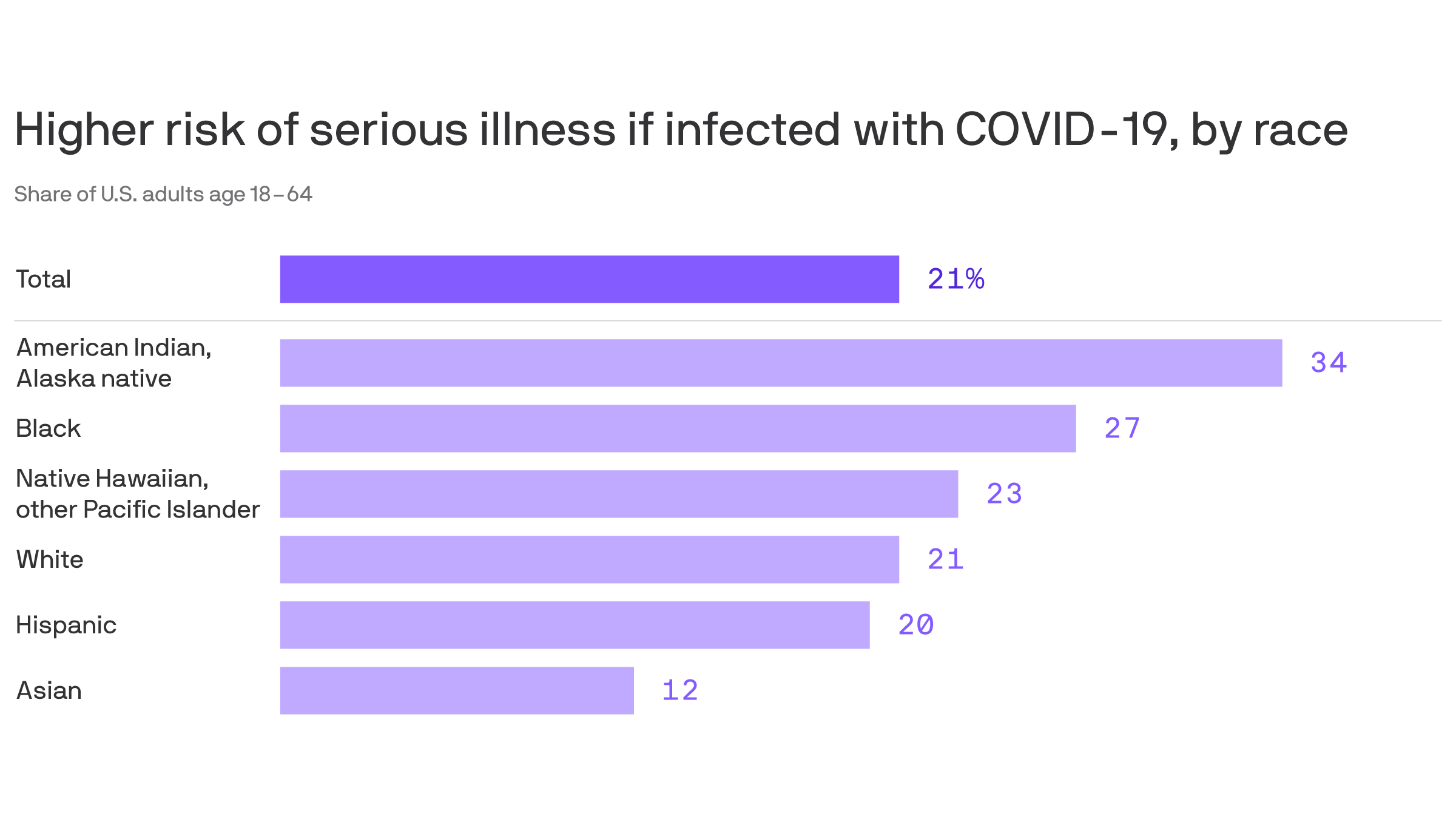
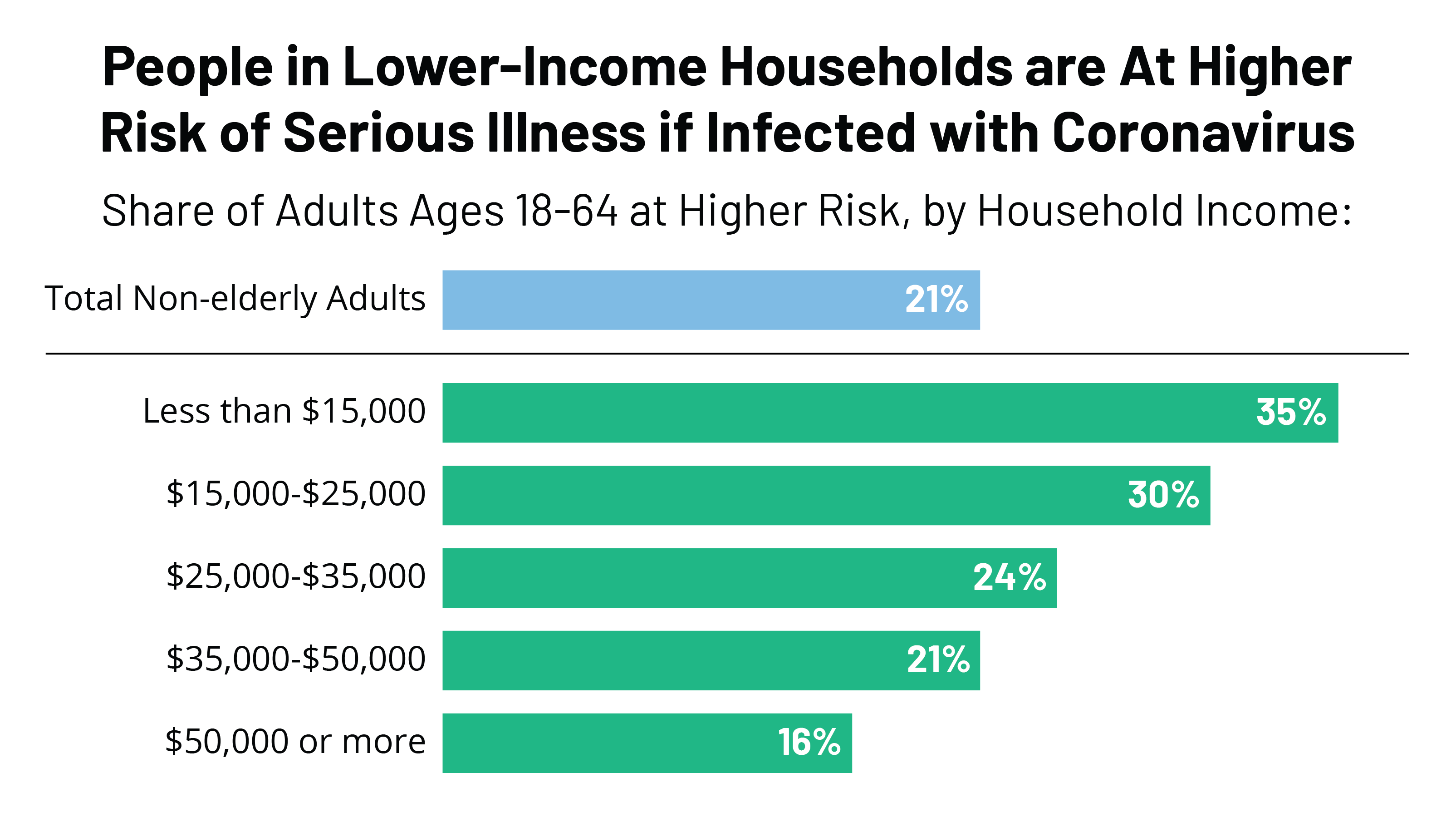
Minorities and low-income people are more likely to become seriously ill if infected with the coronavirus, according to a new Kaiser Family Foundation analysis.

Why it matters: These populations are also less likely to be able to social distance, or have been hit hardest economically by doing so. The coronavirus may be a national problem, but its impact is most devastating to the people who were already worse off.

Kaiser Family Foundation - Health Policy Research, Analysis ...


The big picture: Even before the virus hit, minorities suffered from worse health outcomes, in part because they’re more likely to be low-income — which is also correlated with higher rates of chronic conditions.

  • People with underlying health conditions — like heart disease, chronic obstructive pulmonary disease (COPD), uncontrolled asthma, diabetes or obesity — are more vulnerable to severe illness from the novel coronavirus.
  • Health care and socioeconomic disparities also exacerbate Native Americans’ and black Americans’ risk.
  • And “even though the shares of Hispanic and Native Hawaiian or Pacific Islander nonelderly adults at higher risk for serious illness if infected are similar to that of White adults, these groups face disparities in other health, social, and economic factors that may contribute to barriers to health care associated with coronavirus,” KFF adds.

Between the lines: People with low-income jobs deemed essential — like grocery store workers, home health aides or delivery drivers — are also at higher risk of contracting the virus.

  • Those in other low-income jobs, like in retail or restaurants, are more likely to be out of work right now or working fewer hours.
  • As the fight between businesses and workers heats up in states reopening sooner than public health experts advise, low-income workers have less of an option to quit if they feel unsafe.


The New Culture War

American Identity Is The New Culture War - Auburn Seminary

You’re either a liberal snowflake controlled by big government or a greedy conservative willing to sacrifice Grandma for the economy. It took less than two months for Americans to get here.

Wear a mask? You’re a liberal snowflake controlled by big government. Want to reopen restaurants? You’re a greedy conservative willing to sacrifice Grandma for the economy.

It took less than two months for the coronavirus pandemic to become just the latest battle in the culture wars.

With the country still in the firm grip of the coronavirus pandemic, conservatives are on social media and Fox News stoking protests that argue masks, stay-at-home orders and social distancing violate constitutional rights and are causing unacceptable harm to the economy.

Liberals, at the same time, say personal liberties must be sacrificed for public health, even as millions file for unemployment and more than a quarter of the work force is jobless in some states.

Take a look at what two governors — one from a reliably Republican state and another from a reliably Democratic state — said this week.

“We have a public health crisis in this country, there’s no doubt about it,” Gov. Tate Reeves of Mississippi said in an appearance on “Fox News Sunday.” “But we also have an economic crisis.”

“We have turned the corner and we are on the decline,” Gov. Andrew M. Cuomo said, citing an article showing that the death rate has fallen by half in New York City, in his daily briefing on Wednesday. “To me, that vindicates what we are doing here in New York, which says: Follow the science, follow the data, put the politics aside and the emotion aside. What we’re doing here shows results.”

The problem with all these politics? Epidemiology.

So far, the virus has hit Democratic states the hardest, with the most cases per capita in five deeply Democratic states — New York, New Jersey, Massachusetts, California and Illinois. Cities have borne the brunt of the caseload. And African-Americans and Latinos — a key part of the Democratic coalition — are getting sick and dying of the virus at higher rates.

But anyone who believes this virus is fading away — or somehow contained to urban areas — is engaging in some serious magical thinking.

At least 25,000 new coronavirus cases are identified almost daily, meaning that the total in the United States — which has the highest number of known cases in the world — is expanding daily by 2 to 4 percent.

New York Times analysis found that 18 of the states that are reopening had an increase of daily average cases over the last two weeks. Fifteen of those states are led by Republican governors.

Three of the top five states where the virus is spreading the fastest — Texas, Georgia and Ohio — have Republican governors and Republican-controlled legislatures. All three have moved toward reopening.

In the Midwest and South, smaller towns and more rural areas have suddenly been hit hard as the virus tears through nursing homes, meatpacking plants and prisons.

The nation’s highest per capita infection rate can be found in Trousdale County, Tenn., a rural county where a prison has become a hot spot. Businesses in the county are reopening this week.

In the Trump era, rural counties like Trousdale have represented the backbone of the Republican base. In Trousdale, nearly 67 percent of the county supported President Trump in 2016. Over all, the average margin of victory in rural counties won by Republicans was nearly 47 percent in 2016.

Rural areas tend to be older and have a larger share of the population with pre-existing medical conditions, making them far more vulnerable to the worst health effects of the virus.

Republican governors and conservative activists may think the coronavirus is an urban problem. Or a density problem. Or, quite frankly, a Democratic problem.

They may soon find out that it’s not.


Reopening the U.S. Economy

https://www.goldmansachs.com/insights/pages/reopening-the-us-economy.html

Click to access report.pdf

Allison Nathan, senior strategist for Goldman Sachs Research, discusses her latest Top of Mind report where she speaks with leading experts across health and policy to understand how well-positioned the U.S. is to achieve a safe reopening of the economy and how quickly it would translate into economic recovery. 

With COVID-19 mitigation measures leading to an apparent leveling off of case
growth globally at the same time that the economic costs of such measures continue
to mount, several countries around the world have begun to plan for—or have
already started to implement—economic reopening. But absent herd immunity or
a vaccine for the virus, such reopenings increase the risk of disease resurgence.
With this in mind, what a safe reopening might look like, how well-positioned the
US is to achieve one and how quickly reopening would really translate into economic
recovery is Top of Mind. We consult three experts on these questions: University of
Pennsylvania’s Dr. Zeke Emanuel, Duke University’s Dr. Mark McClellan and Harvard
University’s Dr. Barry Bloom. And we share our own take on a potential US recovery path, informed by lessons from
China’s reopening experience so far. Finally, with more complete economic normalization only likely with an effective
testing regime, treatments, or a widely available vaccine for COVID-19-we discuss where we are on all of the above.


COVID-19 and the End of Individualism

https://www.project-syndicate.org/commentary/covid19-economic-interdependence-waning-individualism-by-diane-coyle-2020-05?utm_source=Project+Syndicate+Newsletter&utm_campaign=1cfd702284-covid_newsletter_07_05_2020&utm_medium=email&utm_term=0_73bad5b7d8-1cfd702284-105592221&mc_cid=1cfd702284&mc_eid=5f214075f8

Daniel Innerarity - Project Syndicate

The pandemic has shown that it is not existential dangers, but rather everyday economic activities, that reveal the collective, connected character of modern life. Just as a spider’s web crumples when a few strands are broken, so the coronavirus has highlighted the risks arising from our economic interdependence.

CAMBRIDGE – Aristotle was right. Humans have never been atomized individuals, but rather social beings whose every decision affects other people. And now the COVID-19 pandemic is driving home this fundamental point: each of us is morally responsible for the infection risks we pose to others through our own behavior.

In fact, this pandemic is just one of many collective-action problems facing humankind, including climate change, catastrophic biodiversity loss, antimicrobial resistance, nuclear tensions fueled by escalating geopolitical uncertainty, and even potential threats such as a collision with an asteroid.

As the pandemic has demonstrated, however, it is not these existential dangers, but rather everyday economic activities, that reveal the collective, connected character of modern life beneath the individualist façade of rights and contracts.

Those of us in white-collar jobs who are able to work from home and swap sourdough tips are more dependent than we perhaps realized on previously invisible essential workers, such as hospital cleaners and medics, supermarket staff, parcel couriers, and telecoms technicians who maintain our connectivity.

Similarly, manufacturers of new essentials such as face masks and chemical reagents depend on imports from the other side of the world. And many people who are ill, self-isolating, or suddenly unemployed depend on the kindness of neighbors, friends, and strangers to get by.

The sudden stop to economic activity underscores a truth about the modern, interconnected economy: what affects some parts substantially affects the whole. This web of linkages is therefore a vulnerability when disrupted. But it is also a strength, because it shows once again how the division of labor makes everyone better off, exactly as Adam Smith pointed out over two centuries ago.

Today’s transformative digital technologies are dramatically increasing such social spillovers, and not only because they underpin sophisticated logistics networks and just-in-time supply chains. The very nature of the digital economy means that each of our individual choices will affect many other people.

Consider the question of data, which has become even more salient today because of the policy debate about whether digital contact-tracing apps can help the economy to emerge from lockdown faster.

This approach will be effective only if a high enough proportion of the population uses the same app and shares the data it gathers. And, as the Ada Lovelace Institute points out in a thoughtful report, that will depend on whether people regard the app as trustworthy and are sure that using it will help them. No app will be effective if people are unwilling to provide “their” data to governments rolling out the system. If I decide to withhold information about my movements and contacts, this would adversely affect everyone.

Yet, while much information certainly should remain private, data about individuals is only rarely “personal,” in the sense that it is only about them. Indeed, very little data with useful information content concerns a single individual; it is the context – whether population data, location, or the activities of others – that gives it value.

Most commentators recognize that privacy and trust must be balanced with the need to fill the huge gaps in our knowledge about COVID-19. But the balance is tipping toward the latter. In the current circumstances, the collective goal outweighs individual preferences.

But the current emergency is only an acute symptom of increasing interdependence. Underlying it is the steady shift from an economy in which the classical assumptions of diminishing or constant returns to scale hold true to one in which there are increasing returns to scale almost everywhere.

In the conventional framework, adding a unit of input (capital and labor) produces a smaller or (at best) the same increment to output. For an economy based on agriculture and manufacturing, this was a reasonable assumption.

But much of today’s economy is characterized by increasing returns, with bigger firms doing ever better. The network effects that drive the growth of digital platforms are one example of this. And because most sectors of the economy have high upfront costs, bigger producers face lower unit costs.

One important source of increasing returns is the extensive experience-based know-how needed in high-value activities such as software design, architecture, and advanced manufacturing. Such returns not only favor incumbents, but also mean that choices by individual producers and consumers have spillover effects on others.

The pervasiveness of increasing returns to scale, and spillovers more generally, has been surprisingly slow to influence policy choices, even though economists have been focusing on the phenomenon for many years now. The COVID-19 pandemic may make it harder to ignore.

Just as a spider’s web crumples when a few strands are broken, so the pandemic has highlighted the risks arising from our economic interdependence. And now California and Georgia, Germany and Italy, and China and the United States need each other to recover and rebuild. No one should waste time yearning for an unsustainable fantasy.


The U.S. coronavirus recovery is way behind Europe

https://www.axios.com/newsletters/axios-vitals-a8ccd48c-549e-4b89-957d-eee60dc3490c.html?utm_source=newsletter&utm_medium=email&utm_campaign=newsletter_axiosvitals&stream=top

Nathan Newman 🧭 (@nathansnewman) | Twitter

Other countries — even some hit hard by the coronavirus — are beating back their outbreaks more successfully than the U.S., Axios’ Dave Lawler and I report.

Why it matters: The number of new cases every day is holding steady in the U.S., but it’s not going down — a key benchmark many other countries achieved before loosening their lockdowns and social distancing measures.

In some of Europe’s hardest-hit countries, case counts seemed to skyrocket uncontrollably even amid some of the world’s strictest lockdowns.

  • Italy and Spain followed a similar pattern. New cases climbed over about a month from under 100 per day to terrifying peaks of roughly 8,000 per day in Spain and 6,000 per day in Italy.
  • The fall was nearly as sharp. Within two weeks of the peak, the rates of daily recorded cases had been halved. They’ve continued to fall since.

America’s daily rate climbed faster and higher (due in part to its larger population), but appears to have peaked at around 30,000 new cases per day in the first week of April.

  • But rather than falling, the rate stagnated. Outside of New York (which has bent its curve) the rate is actually continuing to climb.

Between the lines: The U.S. didn’t lock down as tightly as some of those countries, and made a host of mistakes early in the response.

  • Italy and Spain issued strict nationwide lockdowns that forced most people to remain inside except to shop for necessities. Spain didn’t allow children outside at all.
  • “Our economic shutdown … wasn’t as broad as some of the other countries’, so there was more opportunity for the virus to spread,” said Amesh Adalja, a senior scholar at the John Hopkins Center for Health Security.

The big picture: “It seems that this is a controllable pandemic without it having to run its natural course,” says Columbia University economist Jeffrey Sachs.


Cartoon – Poor Safety and False Hopes

The False Hope Comics And Cartoons | The Cartoonist Group

New Studies Add to Evidence that Children May Transmit the Coronavirus

New Studies Add to Evidence that Children May Transmit the ...

Experts said the new data suggest that cases could soar in many U.S. communities if schools reopen soon.

Among the most important unanswered questions about Covid-19 is this: What role do children play in keeping the pandemic going?

Fewer children seem to get infected by the coronavirus than adults, and most of those who do have mild symptoms, if any. But do they pass the virus on to adults and continue the chain of transmission?

The answer is key to deciding whether and when to reopen schools, a step that President Trump urged states to consider before the summer.

Two new studies offer compelling evidence that children can transmit the virus. Neither proved it, but the evidence was strong enough to suggest that schools should be kept closed for now, many epidemiologists who were not involved in the research said.

Many other countries, including Israel, Finland, France, Germany, the Netherlands and the United Kingdom have all either reopened schools or are considering doing so in the next few weeks.

In some of those countries, the rate of community transmission is low enough to take the risk. But in others, including the United States, reopening schools may nudge the epidemic’s reproduction number — the number of new infections estimated to stem from a single case, commonly referred to as R0 — to dangerous levels, epidemiologists warned after reviewing the results from the new studies.

In one study, published last week in the journal Science, a team analyzed data from two cities in China — Wuhan, where the virus first emerged, and Shanghai — and found that children were about a third as susceptible to coronavirus infection as adults were. But when schools were open, they found, children had about three times as many contacts as adults, and three times as many opportunities to become infected, essentially evening out their risk.

Based on their data, the researchers estimated that closing schools is not enough on its own to stop an outbreak, but it can reduce the surge by about 40 to 60 percent and slow the epidemic’s course.

“My simulation shows that yes, if you reopen the schools, you’ll see a big increase in the reproduction number, which is exactly what you don’t want,” said Marco Ajelli, a mathematical epidemiologist who did the work while at the Bruno Kessler Foundation in Trento, Italy.

The second study, by a group of German researchers, was more straightforward. The team tested children and adults and found that children who test positive harbor just as much virus as adults do — sometimes more — and so, presumably, are just as infectious.

“Are any of these studies definitive? The answer is ‘No, of course not,’” said Jeffrey Shaman, an epidemiologist at Columbia University who was not involved in either study. But, he said, “to open schools because of some uninvestigated notion that children aren’t really involved in this, that would be a very foolish thing.”

The German study was led by Christian Drosten, a virologist who has ascended to something like celebrity status in recent months for his candid and clear commentary on the pandemic. Dr. Drosten leads a large virology lab in Berlin that has tested about 60,000 people for the coronavirus. Consistent with other studies, he and his colleagues found many more infected adults than children.

The team also analyzed a group of 47 infected children between ages 1 and 11. Fifteen of them had an underlying condition or were hospitalized, but the remaining were mostly free of symptoms. The children who were asymptomatic had viral loads that were just as high or higher than the symptomatic children or adults.

“In this cloud of children, there are these few children that have a virus concentration that is sky-high,” Dr. Drosten said.

He noted that there is a significant body of work suggesting that a person’s viral load tracks closely with their infectiousness. “So I’m a bit reluctant to happily recommend to politicians that we can now reopen day cares and schools.”

Dr. Drosten said he posted his study on his lab’s website ahead of its peer review because of the ongoing discussion about schools in Germany.

Many statisticians contacted him via Twitter suggesting one or another more sophisticated analysis. His team applied the suggestions, Dr. Drosten said, and even invited one of the statisticians to collaborate.

“But the message of the paper is really unchanged by any type of more sophisticated statistical analysis,” he said. For the United States to even consider reopening schools, he said, “I think it’s way too early.”

In the China study, the researchers created a contact matrix of 636 people in Wuhan and 557 people in Shanghai. They called each of these people and asked them to recall everyone they’d had contact with the day before the call.

They defined a contact as either an in-person conversation involving three or more words or physical touch such as a handshake, and asked for the age of each contact as well as the relationship to the survey participant.

Comparing the lockdown with a baseline survey from Shanghai in 2018, they found that the number of contacts during the lockdown decreased by about a factor of seven in Wuhan and eight in Shanghai.

“There was a huge decrease in the number of contacts,” Dr. Ajelli said. “In both of those places, that explains why the epidemic came under control.”

The researchers also had access to a rich data set from Hunan province’s Center for Disease Control and Prevention. Officials in the province traced 7,000 contacts of 137 confirmed cases, observed them over 14 days and tested them for coronavirus infection. They had information not just for people who became ill, but for those who became infected and remained asymptomatic, and for anyone who remained virus-free.

Data from hospitals or from households tend to focus only on people who are symptomatic or severely ill, Dr. Ajelli noted. “This kind of data is better.”

The researchers stratified the data from these contacts by age and found that children between the ages of 0 and 14 years are about a third less susceptible to coronavirus infection than those ages 15 to 64, and adults 65 or older are more susceptible by about 50 percent.

They also estimated that closing schools can lower the reproduction number — again, the estimate of the number of infections tied to a single case — by about 0.3; an epidemic starts to grow exponentially once this metric tops 1.

In many parts of the United States, the number is already hovering around 0.8, Dr. Ajelli said. “If you’re so close to the threshold, an addition of 0.3 can be devastating.”

However, some other experts noted that keeping schools closed indefinitely is not just impractical, but may do lasting harm to children.

Jennifer Nuzzo, an epidemiologist at Johns Hopkins University’s Bloomberg School of Public Health, said the decision to reopen schools cannot be made based solely on trying to prevent transmission.

“I think we have to take a holistic view of the impact of school closures on kids and our families,” Dr. Nuzzo said. “I do worry at some point, the accumulated harms from the measures may exceed the harm to the kids from the virus.”

E-learning approaches may temporarily provide children with a routine, “but any parent will tell you it’s not really learning,” she said. Children are known to backslide during the summer months, and adding several more months to that might permanently hurt them, and particularly those who are already struggling.

Children also need the social aspects of school, and for some children, home may not even be a safe place, she said.

“I’m not saying we need to absolutely rip off the Band-aid and reopen schools tomorrow,” she said, “but we have to consider these other endpoints.”

Dr. Nuzzo also pointed to a study in the Netherlands, conducted by the Dutch government, which concluded that “patients under 20 years play a much smaller role in the spread than adults and the elderly.”

But other experts said that study was not well designed because it looked at household transmission. Unless the scientists deliberately tested everyone, they would have noticed and tested only more severe infections — which tend to be among adults, said Bill Hanage, an epidemiologist at the Harvard T.H. Chan School of Public Health.

“Assumptions that children are not involved in the epidemiology, because they do not have severe illness, are exactly the kind of assumption that you really, really need to question in the face of a pandemic,” Dr. Hanage said. “Because if it’s wrong, it has really pretty disastrous consequences.”

A new study by the National Institutes of Health may help provide more information to guide decisions in the United States. The project, called Heros, will follow 6,000 people from 2,000 families and collect information on which children get infected with the virus and whether they pass it on to other family members.

The experts all agreed on one thing: that governments should hold active discussions on what reopening schools looks like. Students could be scheduled to come to school on different days to reduce the number of people in the building at one time, for example; desks could be placed six feet apart; and schools could avoid having students gather in large groups.

Teachers with underlying health conditions or of advanced age should be allowed to opt out and given alternative jobs outside the classroom, if possible, Dr. Nuzzo said, and children with underlying conditions should continue to learn from home.

The leaders of the two new studies, Dr. Drosten and Dr. Ajelli, were both more circumspect, saying their role is merely to provide the data that governments can use to make policies.

“I’m somehow the bringer of the bad news but I can’t change the news,” Dr. Drosten said. “It’s in the data.”


Where the virus is spreading

https://www.axios.com/newsletters/axios-vitals-7038a5b1-74fa-44e3-ba7e-43c87052e1c5.html?utm_source=newsletter&utm_medium=email&utm_campaign=newsletter_axiosvitals&stream=top

Axios

The Trump administration’s reopening guidelines detail that in order to start lifting restrictions and reopening the economy, a state needs to report 14-day trends of fewer cases or fewer positive tests (though local officials do get some leeway in adjusting the metrics).

  • Not a lot of states meet that criteria, Axios editor-in-chief Nick Johnston writes.

Our chart compares each state’s seven-day average of new cases from Monday and the seven-day average from a week prior, April 27.

  • By this metric, Minnesota, Nebraska and Puerto Rico have the most worrisome trends, while Arkansas and Wyoming have the most positive trends. Twelve states are moving in the right direction.
  • But more than a third of the nation still has growing numbers of cases. And that includes states such as Texas and Virginia, where Republican and Democratic governors are beginning to unveil re-opening plans.

Yes, but: These trends only tell us so much.

  • Some states may see their case counts rise not necessarily because their outbreaks are getting dramatically worse, but because their testing is getting better, so they’re catching more cases.
  • That’s why health officials are also pulling in other metrics — including the number of deaths, the number of hospitalizations and the percentage of tested patients who test positive. A higher percentage means you’re probably missing people.
  • Still, public-health guidance calls for a steady decrease in cases before opening up, and few states have achieved that.

The bottom line: The virus isn’t just some other states’ problem. It’s everyone’s problem.