Ruth Bader Ginsburg on a Meaningful Life

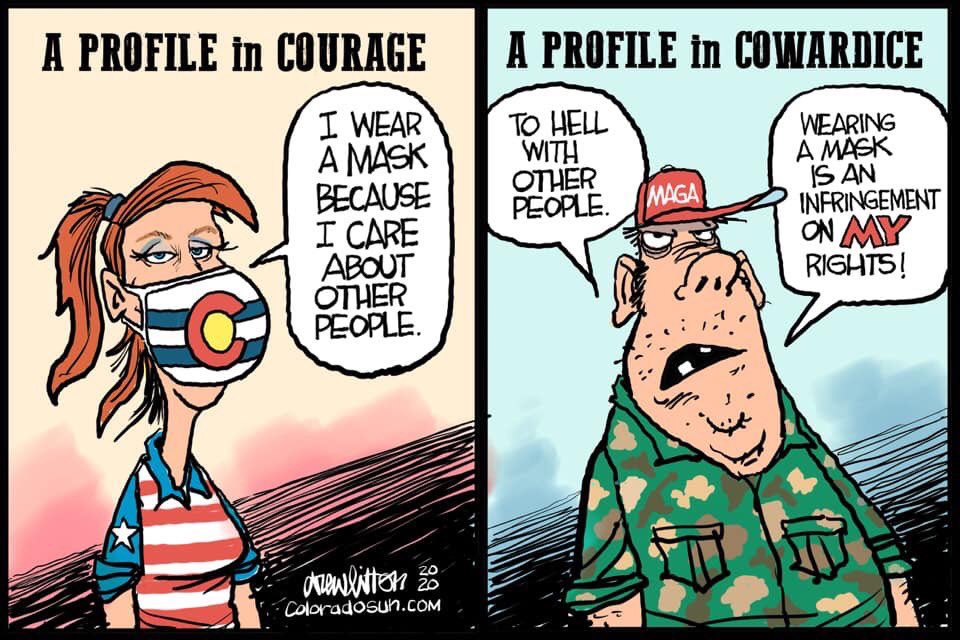
Cartoon – Profile in Courage vs. Cowardice

COVID-19 News - Updated Daily

Fauci says family has faced threats, harassment amid pandemic

Fauci says family has faced threats, harassment amid pandemic

Fauci says family has faced threats, harassment amid pandemic ...

Dr. Anthony Fauci, the nation’s top infectious disease expert, said he and his family are getting death threats because people don’t like what he says about COVID-19.

“Getting death threats for me, and my family, and harassing my daughters, to the point where I have to get security is just — I mean, it’s amazing,” Fauci said during an interview with CNN’s Sanjay Gupta on Wednesday.

“I wouldn’t have imagined in my wildest dreams that people who object to things that are pure public health principles, are so set against it and don’t like what you and I say, namely in the world of science, that they actually threaten you.”

He noted that crises like COVID-19 has brought out the best of people but also the worst of people.

Fauci’s notoriety has been elevated by COVID-19, as he is often on TV offering a blunt portrayal of the state of the pandemic in the U.S.

Fauci, 79, is one of the world’s most respected infectious disease experts, having advised six presidents on HIV/AIDS, Ebola, Zika and other health crises. He has earned a reputation for being blunt and willing to correct the president.

Fauci has had a security detail since at least April.

Fauci also reflected on what he says is a degree of “anti-science” sentiment in the U.S. that is making it difficult to get people to do things to slow the spread of COVID-19 like wearing masks.

“There is a degree of anti-science feeling in this country, and I think it is not just related to science. It’s almost related to authority and a mistrust in authority that spills over,” he told Gupta.

“Because in some respects, scientists, because they’re trying to present data, may be looked upon as being an authoritative figure, and the pushing back on authority, the pushing back on government is the same as pushing back on science.”

He said the scientific community should be more transparent and reach out to people to underscore the importance of science and evidence-based policy.

“I know when I say that if we follow these five or six principles, we can open up we don’t have to stay shut…There are some people that just don’t believe me or don’t pay attention to that. And that’s unfortunate because that is the way out of this,” he said.

President Trump has repeatedly undermined Fauci, questioning the White House coronavirus task force member on Twitter and in interviews with the media.

Over the weekend, Trump tweeted out a video of a portion of Fauci’s testimony explaining why the U.S. has recorded more cases than European cases and called it “wrong.” Trump has falsely claimed several times that the U.S. has more cases because it is doing more testing.

Trump has also retweeted multiple messages that question Fauci’s expertise, including one last week that said he had “misled the American public.”


Coronavirus threat rises across U.S.: ‘We just have to assume the monster is everywhere’

https://www.washingtonpost.com/health/coronavirus-threat-rises-across-us-we-just-have-to-assume-the-monster-is-everywhere/2020/08/01/cdb505e0-d1d8-11ea-8c55-61e7fa5e82ab_story.html?utm_campaign=wp_post_most&utm_medium=email&utm_source=newsletter&wpisrc=nl_most

The coronavirus is spreading at dangerous levels across much of the United States, and public health experts are demanding a dramatic reset in the national response, one that recognizes that the crisis is intensifying and that current piecemeal strategies aren’t working.

This is a new phase of the pandemic, one no longer built around local or regional clusters and hot spots. It comes at an unnerving moment in which the economy suffered its worst collapse since the Great Depression, schools are rapidly canceling plans for in-person instruction and Congress has failed to pass a new emergency relief package. President Trump continues to promote fringe science, the daily death toll keeps climbing and the human cost of the virus in America has just passed 150,000 lives.

“Unlike many countries in the world, the United States is not currently on course to get control of this epidemic. It’s time to reset,” declared a report released this week by Johns Hopkins University.

Another report from the Association of American Medical Colleges offered a similarly blunt message: “If the nation does not change its course — and soon — deaths in the United States could be well into the multiple hundreds of thousands.”

The country is exhausted, but the virus is not. It has shown a consistent pattern: It spreads opportunistically wherever people let down their guard and return to more familiar patterns of mobility and socializing. When communities tighten up, by closing bars or requiring masks in public, transmission drops.

That has happened in some Sun Belt states, including Arizona, Florida and Texas, which are still dealing with a surge of hospitalizations and deaths but are finally turning around the rate of new infections.

There are signs, however, that the virus is spreading freely in much of the country. Experts are focused on upticks in the percentage of positive coronavirus tests in the upper South and Midwest. It is a sign that the virus could soon surge anew in the heartland. Infectious-disease experts also see warning signs in East Coast cities hammered in the spring.

“There are fewer and fewer places where anybody can assume the virus is not there,” Gov. Mike DeWine (R) of Ohio said Wednesday. “It’s in our most rural counties. It’s in our smallest communities. And we just have to assume the monster is everywhere. It’s everywhere.”

Dire data

An internal Trump administration briefing document prepared by the Federal Emergency Management Agency and obtained Friday by The Washington Post counted 453,659 new infections in the past week.

Alaska is in trouble. And Hawaii, Missouri, Montana and Oklahoma. Those are the five states, as of Friday, with the highest percentage increase in the seven-day average of new cases, according to a Post analysis of nationwide health data.

“The dominoes are falling now,” said David Rubin, director of the PolicyLab at Children’s Hospital of Philadelphia, which has produced a model showing where the virus is likely to spread over the next four weeks.

His team sees ominous trends in big cities, including Baltimore, Chicago, Detroit, Indianapolis, Kansas City, Louisville, Philadelphia, St. Louis and Washington, with Boston and New York not far behind. And Rubin warns that the expected influx of students into college towns at the end of this month will be another epidemiological shock.

“I suspect we’re going to see big outbreaks in college towns,” he said.

Young people are less likely to have a severe outcome from the coronavirus, but they are adept at propelling the virus through the broader population, including among people at elevated risk. Numbers of coronavirus-related hospitalizations in the United States went from 36,158 on July 1 to 52,767 on July 31, according to The Post’s data. FEMA reports a sharp increase in the number of patients on ventilators.

The crisis has highlighted the deep disparities in health outcomes among racial and ethnic groups, and data from the Centers for Disease Control and Prevention this week showed that hospitalization rates due to the coronavirus are roughly five times higher among Black, Hispanic and Native Americans than Whites.

Thirty-seven states and Puerto Rico will probably see rising daily death tolls during the next two weeks compared with the previous two weeks, according to the latest ensemble forecast from the University of Massachusetts at Amherst that combines more than 30 coronavirus models.

There are glimmers of progress. The FEMA report showed 237 U.S. counties with at least two weeks of steady declines in numbers of new coronavirus cases.

But there are more than 3,100 counties in America.

“This is not a natural disaster that happens to one or two or three communities and then you rebuild,” said Beth Cameron, vice president for global biological policy and programs at the Nuclear Threat Initiative and a former White House National Security Council staffer focused on pandemics. “This is a spreading disaster that moves from one place to another, and until it’s suppressed and until we ultimately have a safe and effective and distributed vaccine, every community is at risk.”

A national strategy, whether advanced by the federal government or by the states working in tandem, will more effectively control viral spread than the current patchwork of state and local policies, according to a study from researchers at the Massachusetts Institute of Technology published Thursday in the Proceedings of the National Academy of Sciences.

The coordination is necessary because one state’s policies affect other states. Sometimes, that influence is at a distance, because states that are geographically far apart can have cultural and social ties, as is the case with the “peer states” of New York and Florida, the report found.

“The cost of our uncoordinated national response to covid-19, it’s dramatic,” said MIT economist Sinan Aral, senior author of the paper.

Some experts argue for a full six-to-eight-week national shutdown, something even more sweeping than what was instituted in the spring. There appears to be no political support for such a move.

Neil Bradley, executive vice president of the U.S. Chamber of Commerce, said fresh federal intervention is necessary in this second wave of closures. Enhanced federal unemployment benefits expired at the end of July, with no agreement on a new stimulus package in sight.

“Congress, on a bipartisan basis, was trying to create a bridge to help individuals and businesses navigate the period of a shutdown,” Bradley said. “Absent an extension of that bridge, in light of a second shutdown, that bridge becomes a pier. And then that’s a real problem.”

With the economy in shambles, hospitals filling up and the public frustrated, anxious and angry, the challenge for national leadership is finding a plausible sea-to-sea strategy that can win widespread support and simultaneously limit sickness and death from the virus.

Many Americans may simply feel discouraged and overtaxed, unable to maintain precautions such as social distancing and mask-wearing. Others remain resistant, for cultural or ideological reasons, to public health guidance and buy into conspiracy theories and pseudoscience.

DeWine is struggling to get Ohio citizens to take seriously the need to wear masks. A sheriff in rural western Ohio told the governor Wednesday that people didn’t think the virus was a big problem. DeWine informed the sheriff that the numbers in his county were higher per capita than in Toledo.

“The way I’ve explained to people, if we want to have Friday night football in the fall, if we want our kids back in school, what we do in the next two weeks will determine if that happens,” DeWine said.

The crucial metric

The coronavirus has always been several steps ahead of the U.S. government, the scientific community, the news media and the general public. By the time a community notices a surge in patients to hospital emergency rooms, the virus has seeded itself widely.

The virus officially known as SARS-CoV-2 can be transmitted by people who are infectious but not symptomatic. The incubation period is typically about six days, according to the CDC. When symptoms flare, they can be ambiguous. A person may not seek a test right away. Then, the test results may not come back for days, a week, even longer.

That delay makes contact tracing nearly futile. It also means government data on virus transmission is invariably out of date to some degree — it’s a snapshot of what was happening a week or two weeks before. And different jurisdictions use different metrics to track the virus, further fogging the picture.

The top doctors on the White House coronavirus task force, Deborah Birx and Anthony S. Fauci, are newly focused on the early warning signs of a virus outbreak. This week, they warned that the kind of runaway outbreaks seen in the Sun Belt could potentially happen elsewhere. Among the states of greatest concern: Indiana, Kentucky, Ohio and Tennessee.

Fauci and Birx have pointed to a critical metric: the percentage of positive test results. When that figure starts to tick upward, it is a sign of increasing community spread of the virus.

“That is kind of the predictor that if you don’t do something — namely, do something different — if you’re opening up at a certain pace, slow down, maybe even backtrack a little,” Fauci said in an interview Wednesday.

Without a vaccine, the primary tools for combating the spread of the virus remain the common-sense “non-pharmaceutical interventions,” including mask-wearing, hand-washing, staying out of bars and other confined spaces, maintaining social distancing of at least six feet and avoiding crowds, Fauci said.

“Seemingly simple maneuvers have been very effective in preventing or even turning around the kind of surges we’ve seen,” he said.

Thirty-three U.S. states have positivity rates above 5 percent. The World Health Organization has cited that percentage as a crucial benchmark for governments deciding whether to reopen their economy. Above 5 percent, stay closed. Below, open with caution.

Of states with positivity rates below 5 percent, nine have seen those rates rise during the last two weeks.

“You may not fully realize that when you think things are okay, you actually are seeing a subtle, insidious increase that is usually reflected in the percent of your tests that are positive,” Fauci said.

The shutdown blues

Some governors immediately took the White House warnings to heart. On Monday, Kentucky Gov. Andy Beshear (D) said at a news conference that he had met with Birx the previous day and was told he was getting the same warning Texas and Florida received “weeks before the worst of the worst happened.”

To prevent that outcome in his state, Beshear said, he was closing bars for two weeks and cutting seating in restaurants.

But as Beshear pleaded that “we all need to be singing from the same sheet of music,” discord and confusion prevailed.

Iowa Gov. Kim Reynolds (R) said Thursday she wasn’t convinced a mask mandate is effective: “No one knows particularly the best strategy.”

Earlier in the week, Tennessee Gov. Bill Lee (R) demurred on masks and bar closures even as he stood next to Birx and spoke to reporters.

“That’s not a plan for us now,” he said. He added emphatically, “We are not going to close the economy back down.”

The virus is spreading throughout his state, and not just in the big cities. Vacationers took the virus home from the honky-tonks of Nashville and blues clubs of Memphis to where they live in more rural areas, said John Graves, a professor at Vanderbilt University studying the pandemic.

“The geographical footprint of the virus has reached all corners of the state at this point,” Graves said.

In Missouri, Gov. Michael L. Parson (R) was dismissive of New York’s imposition of a quarantine on residents from his state as a sign of a worsening pandemic. “I’m not going to put much stock in what New York says — they’re a disaster,” he said at a news conference Monday.

Missouri has no mask mandate, leaving it to local officials to act — often in the face of hostility and threats. In the town of Branson, angry opponents testified Tuesday that there was no reason for a mask order when deaths in the county have been few and far between.

“It hasn’t hit us here yet, that’s what I’m scared of,” Branson Alderman Bill Skains said before voting with a majority in favor of the mandate. “It is coming, and it’s coming like a freight train.”

Democratic mayors in Missouri’s two biggest cities, Kansas City and St. Louis, said that with so many people needing jobs, they are reluctant to follow Birx’s recommendation to close bars.

“The whole-blanket approach to shut everybody down feels a little harsh for the people who are doing it right,” said Jacob Long, spokesman for St. Louis Mayor Lyda Krewson. “We’re trying to take care of some bad actors first.”

Minneapolis Mayor Jacob Frey also got a warning from Birx. On Wednesday, he said all bar drinking must move outside.

“We don’t want to be heading in the direction of everybody else,” said Kristen Ehresmann, director of the infectious-disease epidemiology division at the Minnesota Department of Health. She acknowledged that some options “are really pretty draconian.”

The problem is that less-painful measures have proven insufficient.

“The disease transmission we’re seeing is more than what would have been expected if people were following the guidance as it is laid out. It’s a reflection of the fact that they’re not,” she said.

‘A tremendous disappointment’

Wisconsin Gov. Tony Evers (D) tried to implement broad statewide measures early in the pandemic, only to have his “Safer at Home” order struck down by the state’s Supreme Court.

With cases in his state rising anew, he tried again Thursday, declaring a public health emergency and issuing a statewide mask mandate.

“While our local health departments have been doing a heck of a job responding to this pandemic in our communities, the fact of the matter is, this virus doesn’t care about any town, city or county boundary, and we need a statewide approach to get Wisconsin back on track,” Evers said.

Ryan Westergaard, Wisconsin’s chief medical officer, said he is dismayed by the failures of the national pandemic response.

“I really thought we had a chance to keep this suppressed,” Westergaard said. “The model is a good one: testing, tracing, isolation, supportive quarantine. Those things work. We saw this coming. We knew we had to build robust, flexible systems to do this in all of our communities. It feels like a tremendous disappointment that we weren’t able to build a system in time that could handle this.”

There is one benefit to the way the virus has spread so broadly, he noted: “We no longer have to keep track of people traveling to a hot spot if hot spots are everywhere.”


Fauci has been an example of conscience and courage.

https://www.washingtonpost.com/opinions/fauci-has-been-an-example-of-conscience-and-courage-trump-has-been-nothing-but-weak/2020/07/13/7c9a7578-c52b-11ea-8ffe-372be8d82298_story.html?fbclid=IwAR0n0o67FMhhUjxqU11cfrd4daMkW0ZWZtIg–I1P3ioLPA7ka7Ew0XT_EA&utm_campaign=wp_main&utm_medium=social&utm_source=facebook

Opinion | Fauci has been an example of conscience and courage ...

When historians try to identify the most shameful documents from the Trump administration, a few are likely to stand out. For unconstitutional bigotry, it is hard to beat the initial executive order banning travel to the United States from Muslim countries. For cruelty and smallness, there is the “zero tolerance” directive to federal prosecutors that led to family separations at the border. For naked corruption, there is the transcript of the quid-pro-quo conversation between President Trump and the president of Ukraine.

But for rash, foolish irresponsibility, I’d nominate the opposition research paper recently circulated by the White House in an attempt to discredit the National Institute of Allergy and Infectious Diseases’ Anthony S. Fauci. As reported by The Post, the document recounted a number of instances — on community transmission, asymptomatic transmission and mask wearing in particular — where Fauci’s views have shifted over time. As far as I know, this official record is unique: A White House attack on the government’s leading infectious-disease specialist during a raging pandemic. It indicates an administration so far gone in rage, bitterness and paranoia that it can no longer be trusted to preserve American lives.

From a purely political standpoint, it is understandable that the administration would want to divert attention from its covid-19 record. Trump’s policy of reopening at any cost is exacting a mounting cost. Five months into the greatest health crisis of modern U.S. history, there are still serious problems with supply chains for protective equipment. There are still long wait times for testing results in many places. The contact tracing process in many communities remains (as one health expert described it to me) “a joke.” More than 132,000 Americans have died.

Rather than addressing these failures, Trump has chosen to sabotage a public official who admits their existence. Rather than confronting these problems, Trump wants to ensure his whole administration lies about them in unison. The president has surveyed America’s massive spike in new infections and thinks the most urgent matter is . . . message discipline.

It is true that a number of Fauci’s views on the novel coronavirus have evolved (though some of the administration’s charges against him are distorted). But attacking a scientist for making such shifts is to willfully misunderstand the role of science in the fight against disease. We do not trust public health officials during an emerging pandemic because they have fully formed scientific views from the beginning. We trust them because 1) they are making judgments based on the best available information and 2) they have no other motive than the health of the public. If, say, health officials were initially mistaken about the possibility of asymptomatic transmission, it is not failure when they change their views according to better data. It is the nature of the scientific method and the definition of their duty.

In the inch-deep world of politics, amending your view based on new information is a flip-flop. In epidemiology, it is known as, well, epidemiology.

Meanwhile, the president is failing according to both requirements of public trust. Trump is not making judgments based on the best available information. And he clearly has political goals that compete with (and often override) his commitment to public health. The president is hoping against hope that the public will forget about the virus until November, or at least about the federal role in fighting it. To apply a veneer of normalcy, he is holding public events that endanger his staff and his audience and is planning a Republican convention that will double as a petri dish.

It now seems likely that the most decisive moment of the American pandemic took place in mid-April when new cases began to stabilize around 25,000 a day. Even four or six more weeks of firm presidential leadership — urging the tough, sacrificial application of stay-at-home orders — might have reduced the burden of disease to more sustainable levels, as happened in Western Europe. And this would have relieved stress on systems of testing, tracing and treatment.

But Trump’s nerve failed him. Instead of holding firm, he began siding with populist demands for immediate opening, pressuring governors to take precipitous steps and encouraging skepticism about basic public health information and measures. This may well have been the defining moment of the Trump presidency. And he was weak, weak, weak.

It is typical for Trump to shift blame. But in this case, the president has selected his fall guy poorly. Fauci has been an example of conscience and courage in an administration that values neither. When Trump encourages a contrast to his own selfishness and cravenness, he only damages himself.


Anthony Fauci’s security is stepped up as doctor and face of U.S. coronavirus response receives threats

https://www.washingtonpost.com/politics/anthony-faucis-security-is-stepped-up-as-doctor-and-face-of-us-coronavirus-response-receives-threats/2020/04/01/ff861a16-744d-11ea-85cb-8670579b863d_story.html?utm_campaign=wp_news_alert_revere&utm_medium=email&utm_source=alert&wpisrc=al_news__alert-hse–alert-national&wpmk=1

Nation's top coronavirus expert Dr. Anthony Fauci forced to beef ...

Anthony S. Fauci, the nation’s top infectious-diseases expert and the face of the U.S. response to the novel coronavirus pandemic, is facing growing threats to his personal safety, prompting the government to step up his security, according to people familiar with the matter.

The concerns include threats as well as unwelcome communications from fervent admirers, according to people with knowledge of deliberations inside the Department of Health and Human Services and the Department of Justice.

Fauci, 79, is the most outspoken member of the administration in favor of sweeping public health guidelines and is among the few officials willing to correct President Trump’s misstatements. Along with Deborah Birx, the coordinator for the White House’s task force, Fauci has encouraged the president to extend the timeline for social-distancing guidelines, presenting him with grim models about the possible toll of the pandemic.

“Now is the time, whenever you’re having an effect, not to take your foot off the accelerator and on the brake, but to just press it down on the accelerator,” he said Tuesday as the White House’s task force made some of those models public, warning of 100,000 to 240,000 deaths in the United States.

The exact nature of the threats against him was not clear. Greater exposure has led to more praise for the doctor but also more criticism.

Fauci has become a public target for some right-wing commentators and bloggers, who exercise influence over parts of the president’s base. As they press for the president to ease restrictions to reinvigorate economic activity, some of these figures have assailed Fauci and questioned his expertise.

Last month, an article depicting him as an agent of the “deep state” gained nearly 25,000 interactions on Facebook — meaning likes, comments and shares — as it was posted to large pro-Trump groups with titles such as “Trump Strong” and “Tampa Bay Trump Club.”

Alex Azar, the HHS secretary, recently grew concerned about Fauci’s safety as his profile rose and he endured more vitriolic criticism online, according to people familiar with the situation. In recent weeks, admirers have also approached Fauci, asking to him sign baseballs, along with other acts of adulation. It was determined that Fauci should have a security detail. Azar also has a security detail because he is in the presidential line of succession.

Asked Wednesday whether he was receiving security protection, Fauci told reporters, “I would have to refer you to HHS [inspector general] on that. I wouldn’t comment.”

The president interjected, saying, “He doesn’t need security. Everybody loves him.”

HHS asked the U.S. Marshals Service to deputize a group of agents in the office of the HHS inspector general to provide protective services for the doctor, according to an official with knowledge of the request.

The U.S. Marshals Service conveyed the request to the deputy attorney general, who has authority over deputations for the purpose of providing protective services, with the recommendation that it be approved, according to the official, who spoke on the condition of anonymity to reveal sensitive plans that the person was not authorized to discuss.

A Justice Department official signed paperwork Tuesday authorizing HHS to provide its own security detail to Fauci, according to an administration official.

An HHS spokesperson declined to discuss details of the doctor’s security but said: “Dr. Fauci is an integral part of the U.S. Government’s response against covid-19. Among other efforts, he is leading the development of a covid-19 vaccine and he regularly appears at White House press briefings and media interviews.”

At the briefings, Fauci, who has advised presidents of both parties as director of the National Institute of Allergy and Infectious Diseases, has spoken authoritatively about the spread of the coronavirus and the sacrifices involved in mitigating its effects.

He has at times corrected the president, in particular when prompted by reporters. After Trump said a covid-19 vaccine would be available in a couple of months, Fauci said it would in fact be available in about a year to a year and a half, at best.

His role has turned him into a hero for some. When he was absent from a briefing last month, followers who had grown accustomed to his frank assessments of the outbreak were alarmed that he might have been sidelined for his forthrightness. Many took to Twitter to ask, “Where is Dr. Fauci?” causing the question to trend on the platform.

He gained viral attention two days later when he placed his hand in front of his face in a gesture of apparent disbelief as Trump referred to the State Department as the “deep state department” from the White House briefing room.

Fauci has also given several interviews in which he has tempered praise for the president with doubts about his pronouncements, including about the viability of anti-malarial drugs as a treatment for the novel coronavirus. Most notably, he told the journal Science that he attempts to guide Trump’s statements but “can’t jump in front of the microphone and push him down.”

These moves have inspired fandom. But they have also drawn scorn from some of the president’s most vocal supporters, even as both men have sought to tamp down the appearance of tension.

“The president was right, and frankly Fauci was wrong,” Lou Dobbs said last week on his show on the Fox Business Network, referring to the use of experimental medicine.

Right-wing news and opinion sites have gone further, launching baseless smears against the doctor that have gained significant traction within pro-Trump communities online.

Outlets such as the Gateway Pundit and American Thinker seized on a 2013 email — released by WikiLeaks as part of a cache of communications hacked by Russian operatives — in which Fauci praised Hillary Clinton’s “stamina and capability” during her testimony as secretary of state before the congressional committee investigating the attacks in Benghazi, Libya.

The headline in the American Thinker referred to Fauci as a “Deep-State ­Hillary Clinton-loving stooge.” The author, Peter Barry Chowka, didn’t respond to requests for comment. When asked about the relevance of Fauci’s emails to his role in advising the White House’s coronavirus response, Jim Hoft, the editor of the Gateway Pundit, said, “I don’t have a problem with more information being shared about the doctor.”

The outlet has continued to criticize Fauci in recent days, saying that by offering new predictions about the possible death toll, Fauci and others were “going to destroy the U.S. economy based on total guesses and hysterical predictions.”

Several senior administration officials said that Trump respects Fauci and that the two generally have a good working relationship. Trump heeded the guidance of Fauci and Birx this week when he announced his administration would extend social-distancing guidelines for another 30 days. Last week, many health officials and experts grew worried when Trump said he hoped to reopen the country by Easter, even as coronavirus cases in the United States continue to rapidly climb.

The immunologist, who graduated first in his class from Cornell’s medical school, has been the director of the National Institute of Allergy and Infectious Diseases since 1984. Between 1983 and 2002, he was the 13th-most-cited scientist among the 2.5 million to 3 million authors worldwide and across all disciplines publishing in scientific journals, according to the Institute for Scientific Information.


Great Leaders Are Thoughtful and Deliberate, Not Impulsive and Reactive

https://hbr.org/2019/04/great-leaders-are-thoughtful-and-deliberate-not-impulsive-and-reactive?utm_source=facebook&utm_medium=social&utm_campaign=hbr&fbclid=IwAR15xBzRuRJsKxkITe-z0wa1AwDMc_gwJmhM5r6ONnL7bw3s9zP8qRxYiEE

You set aside the first hour of your day to work on a strategy document that you’ve been putting off for a week. You haven’t been disciplined about getting to it, but you’ve had one crisis after another to deal with in the past week. Now, finally, you’ve carved out 90 early morning minutes to work on it.

First, however, you take a quick peek at the email that has piled up in your inbox overnight. Before you know it, you’ve used up the whole 90 minutes responding to emails, even though none of them were truly urgent.

By the time you walk into your next meeting, you’re feeling frustrated that you failed to stick by your plan. This meeting is a discussion with a direct report about the approach he’ll be taking in a negotiation with an important client. You have strong views about how best to deal with the situation, but you’ve promised yourself that you will be open and curious rather than directive and judgmental. You’re committed, after all, to becoming a more empowering manager.

Instead, you find yourself growing even more irritable as he describes an approach that doesn’t feel right to you. Impulsively, you jump in with a sharp comment. He reacts defensively. You worry for a moment — and rightly so — that you cut him off too quickly, but you tell yourself that you’ve worked with this client for years, the outcome is critical, and you don’t have time to hear your direct report’s whole explanation. He leaves your office looking hurt and defeated.

Welcome to the invisible drama that operates inside us all day long at work, mostly outside our consciousness. Most of us believe we have one self. In reality, we have two different selves, run by two separate operating systems, in different parts of our brain.

The self that we’re most aware of — the one that planned to work diligently on the strategy document and listen patiently to your direct report — is run by our pre-frontal cortex and mediated through our parasympathetic nervous system. This is the self we prefer to present to the world. It’s calm, measured, rational, and capable of making deliberate choices.

The second self is run by our amygdala, a small almond-shaped cluster of nuclei in our mid-brain and it is mediated by our sympathetic nervous system. Our second self seizes control any time we begin to perceive threat or danger. It’s reactive, impulsive, and operates largely outside our conscious control.

This second self serves us well if a lion is coming at us, but the threats we experience today are mostly to our sense of worth and value. They can feel nearly as terrifying as those to our survival, but the danger we experience isn’t truly life-threatening. Responding to them as if they are only make things worse.

It’s in these moments that we often use our highest cognitive capacities to justify our worst behaviors. When we feel we’ve fallen short, we instinctively summon up our “inner lawyer” — a term coined by author Jonathan Haidt — to defend us.

Our inner lawyer is expert at rationalizing, avoiding, deflecting, dissembling, denying, disparaging, attacking, and blaming others for our missteps and shortcomings. The inner lawyer works overtime to silence our own inner critic, and to counter criticism from others. All this inner turmoil narrows and consumes our attention and drains our energy.

The problem is that most organizations spend far more time focused on generating external value than they do attending to people’s internal sense of value. Doing so requires navigational skills that most leaders have never been taught, much less mastered. The irony is that ignoring people’s internal experience leads them to spend more energy defending their value, leaving them less energy to create value.

In our work with leaders, we’ve discovered that the antidote to reacting from the second self is to develop the capacity to observe our two selves in real time. You can’t change what you don’t notice, but noticing can be a powerful tool for shifting from defending our value to creating value.

A well-cultivated self-observer allows us to watch our dueling selves without reacting impulsively. It also makes it possible to ask our inner lawyer to stand down whenever it rises up to argue our case to our inner and outer critics. Finally, the self-observer can acknowledge, without judgment, that we are both our best and our worst selves, and then make deliberate rather than reactive choices about how to respond in challenging situations.

To improve your capacity to self-observe, begin with negative emotions such as impatience, frustration, and anger. When you feel them arising, it’s a strong signal that you’re sliding into the second self. Simply naming these emotions as they arise is a way to gain some distance from them.

Also, watch out for times when you feel you’re digging in your heels. The absolute conviction that you’re right and the compulsion to take action are both strong indicators that you‘re feeling a sense of threat and danger.

In our work, we provide leaders with small daily doses of support — reminders to pay attention to what they’re feeling and thinking.  We’ve also found it helpful to build small groups that meet at regular intervals so leaders can share their experiences. A blend of support, community, connection and accountability helps offset our shared impulse to stop noticing, push away discomfort, and revert to survival behaviors in the face of perceived threats to our value. A good starting place is to find a colleague you trust to be your accountability partner, and to seek regular feedback from one another.

Finally, it’s important to ask yourself two key questions in challenging moments: “What else could be true here?” and “What is my responsibility in this?” By regularly questioning your conclusions, you’re offsetting your confirmation bias — the instinct to look for evidence that supports what you already believe. By always looking for your own responsibility, you’re resisting the instinct to blame others and play victim and focusing instead on what you have the greatest ability to influence — your own behavior.

A deceptively simple premise lies at the heart of this deliberate set of practices: see more to be more. Rather than simply getting better at what they already do, transformational leaders balance courage and humility in order to grow and develop every day.


The Three Types of Workplace Courage

http://www.leadershipdigital.com/edition/weekly-innovation-management-2019-05-11?open-article-id=10478094&article-title=the-three-types-of-workplace-courage&blog-domain=leadershipnow.com&blog-title=leading-blog

Three Types of Workplace Courage

COURAGE IS THE FIRST VIRTUE of organizational performance. Consider, for example, all the other concepts that courage connects to in workplace settings. Leadership takes courage because it requires making bold decisions that some people won’t agree with or support. Innovation takes courage because it requires creating ideas that are ground-breaking and tradition-defying; great ideas always start out as blasphemy! And sales always take courage because it requires knocking on the doors of prospects over and over in the face of rejection. These aspects of work simply can’t exist in the absence of courage.

That’s why it’s crucial to instill courage in those you lead, both in their development and training programs, but also by leading by example. There’s a lot you can do as a leader toward this end: rewarding jumping first, creating safety nets to make trying and failing a palatable option, teaching to harness fear, and modulating comfort levels are all management tools for setting a foundation that supports and encourages courageous behavior. But while courage in the abstract is an easy thing to get behind, in practice it’s more useful to break it down into different types of courage. Having a way of categorizing courageous behavior allows you to pinpoint the exact type of courage that each individual worker may be most in need of building.

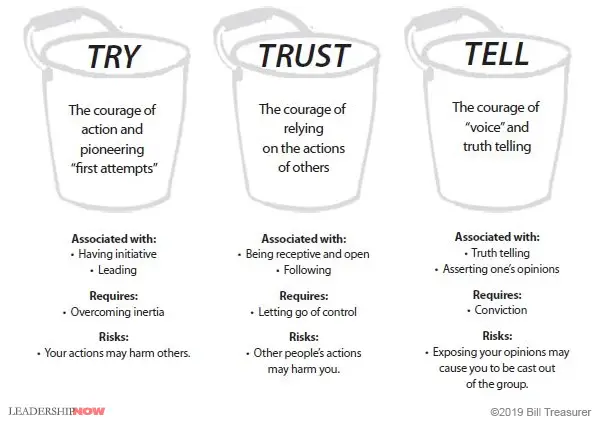
I think of courage as falling into three distinct buckets: TRY, TRUST, and TELL Courage. Let’s talk about each.

TRY Courage

The first bucket of courage is TRY Courage. TRY Courage is the courage of action. It is the courage of initiative. TRY Courage requires you to exert energy in order to overcome inertia. Certainly, it is easier not to do something than to do it, which is one reason why many people prefer to stay in their “comfort zones.” It takes courage to TRY something, particularly when you’ve not done it before. This is the kind of courage that’s demonstrated when someone “steps up to the plate,” for example, taking on a project on which others have failed. You experience your TRY Courage whenever you must attempt something for the very first time, as when you cross over a threshold that other people may have already crossed over.

The courage of try is associated with:

  • “Stepping up to the plate,” such as volunteering for a leadership role.
  • First attempts; for example, the first time you lead an important strategic initiative for the company.
  • Pioneering efforts, such as leading an initiative that your organization has never done before.
  • Taking action.

All courage buckets come with a risk, and the risk is what causes people to avoid behaving with courage. The risk associated with TRY Courage is that your courageous actions may harm you, and, perhaps more importantly, other people. If you act on the risk and wipe out, not only are you likely to be hurt, but you could also potentially harm those around you. It is the risk of harming yourself or others that most commonly causes people to avoid exercising their TRY Courage.

TRUST Courage

TRUST Courage involves resisting the temptation to control other people. Unlike TRY Courage, TRUST Courage is not about action. Instead it often involves inaction, or “letting go” of the need to control. With TRUST Courage, you step back and follow the lead of others. A common example of TRUST Courage is delegation. TRUST Courage is very hard for people who tend to be controlling and those who have been burned by trusting people in the past. TRUST Courage, though, is a crucial element in building strong bonds between people.

The courage of trust is associated with:

  • Releasing control, such as delegating a task without hovering over the person to whom you’ve delegated.
  • Following the lead of others, such as letting a direct report facilitate your meeting.
  • Presuming positive intentions and giving team members the benefit of the doubt.

TRUST Courage, of course, comes with a risk. The risk associated with TRUST Courage isn’t that you will harm other people, but that by trusting them, they might harm you. By trusting others, you open yourself up to the possibility of your trust being misused. Thus, many people, especially those who have been betrayed in the past, find offering people trust very difficult. For them, entrusting others is an act of courage.

TELL Courage

The third bucket of courage is TELL Courage, which is the courage of voice. TELL Courage is what is needed to tell the truth, regardless of how difficult that truth may be for others to hear. It is the courage to not bite your tongue when you feel strongly about something. Brown-nosing and people pleasing are symptoms of low TELL Courage. TELL Courage requires independence of thought. We also use our TELL Courage when we take responsibility for a mistake or offer an apology. Whenever we speak up and say what’s hard to say, whether it be speaking truth to power, admitting a mistake, or saying “I’m sorry,” we are using TELL Courage.

The courage of TELL is associated with:

  • Speaking up and asserting yourself when you feel strongly about an issue.
  • Telling the truth, regardless of where the person to whom you are telling the truth resides in the organizational hierarchy, such as presenting an idea to your boss’s boss.
  • Using constructive confrontation, such as providing difficult feedback to a peer, direct report, or boss.
  • Admitting mistakes and saying, “I am sorry.”

TELL Courage can be scary and comes with risks too. We avoid using TELL Courage because we don’t want to offend others and fear being cast out of the group. The need for affiliation with those we work with is very strong, and the risk of TELL Courage is that, by speaking up and asserting ourselves, we will be cast out of the group and won’t “belong” anymore.

Courage is Contagious

Understanding (and influencing) courageous behavior requires that you be well versed in the different ways that people behave when their courage is activated. By acting in a way that demonstrates these different types of courage, and by fostering an environment that encourages them, you can make your company culture a courageous one where employees innovate and grow both personally and professionally. Here’s a handy diagram to remind you of these types of courage and what they require:

Courage is Contagious