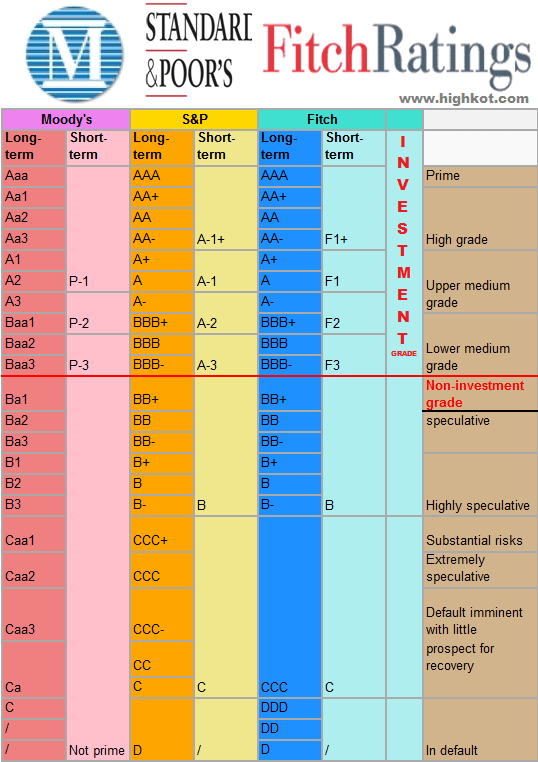
16 latest hospital credit rating downgrades

https://www.beckershospitalreview.com/finance/16-latest-hospital-credit-rating-downgrades-051120.html?utm_medium=email

20 recent hospital, health system outlook and credit rating ...

The following 16 hospital and health system credit rating downgrades occurred since March 1. They are listed below in alphabetical order.

1. Boulder (Colo.) Community Health — from “A2” to “A3” (Moody’s Investors Service)

2. Butler (Pa.) Health System — from “Baa1” to “Baa2” (Moody’s Investors Service)

3. Catholic Health System (Buffalo, N.Y.) — from “Baa1” to “Baa2” (Moody’s Investors Service)

4. Catholic Medical Center (Manchester, N.H.) — from “Baa1” to “Baa2” (Moody’s Investors Service)

5. Hutchinson (Kan.) Regional Medical Center — from “Baa3” to “Ba1” (Moody’s Investors Service)

6. Magnolia Regional Health Center (Corinth, Miss.) — from “Ba3” to “B1” (Moody’s Investors Service)

7. Marshall Medical Center (Placerville, Calif.) — from “BBB-” to “BB+” (Fitch Ratings)

8. Prisma Health (Greenville, S.C.) — from “A2” to “A3” (Moody’s Investors Service)

9. Quorum Health (Brentood, Tenn.) — from “Caa2” to “Ca” (Moody’s Investors Service)

10. SoutheastHealth (Cape Girardeau, Mo.) — from “Baa3” to “Ba1” (Moody’s Investors Service)

11. Sutter Health (Sacramento, Calif.) — from “Aa3” to “A1” (Moody’s Investors Service); from “AA-” to “A+” (S&P Global Ratings)

12. University of Vermont Health Network (Burlington) — from “A2” to “A3” (Moody’s Investors Service)

13. UPMC (Pittsburgh) — from “A+” to “A” (Fitch Ratings); from “A1” to “A2” (Moody’s Investors Service)

14. Virginia Mason Medical Center (Seattle) — from “Baa2” to “Baa3” (Moody’s Investors Service)

15. Washington County (Calif.) Health Care District — from “Baa1” to “Baa2”  (Moody’s Investors Service)

16. Wood County Hospital (Bowling Green, Ky.) — from “Ba2” to “Ba3” (Moody’s Investors Service)


9 health systems with strong finances

https://www.beckershospitalreview.com/finance/9-health-systems-with-strong-finances-050620.html?utm_medium=email

Here are nine health systems with strong operational metrics and solid financial positions, according to reports from Fitch Ratings, Moody’s Investors Service and S&P Global Ratings.

1. Advocate Aurora Health, which has dual headquarters in Milwaukee and Downers Grove, Ill., has an “Aa3” rating and positive outlook with Moody’s and an “AA” rating and stable outlook with S&P. Moody’s said it expects Advocate Aurora to maintain low leverage, a favorable liquidity position and healthy long-term margins, despite the near-term impact from COVID-19.

2. Phoenix-based Banner Health has an “AA-” rating and stable outlook with Fitch and an “AA-” rating and stable outlook with S&P. The health system has a strong financial profile and growing financial stability in its insurance division, Fitch said. Notwithstanding the impact from the COVID-19 pandemic, Fitch expects Banner’s improvement to operating margins will resume and continue to support spending levels and liquidity growth.

3. Clearwater, Fla.-based BayCare Health System has an “Aa2” rating and stable outlook with Moody’s. The health system has strong operating performance and favorable balance sheet metrics, Moody’s said. The credit rating agency expects the health system to maintain strong liquidity and to move quickly with capital expansion.

4. Cincinnati-based Bon Secours Mercy Health has an “AA-” rating and stable outlook with Fitch. The health system has a broad geographic footprint, a good payer mix and a strong financial profile, Fitch said. The credit rating agency anticipates that Bon Secours Mercy Health will increase capital spending over the next three years due to strategic investments in its expanded markets.

5. Omaha, Neb.-based Children’s Hospital and Medical Center has an “AA-” rating and stable outlook with Fitch. The hospital has a dominant market position as the only comprehensive pediatric provider in Nebraska, and its operating cash flow levels are robust enough to absorb any short-term pressure related to the COVID-19 pandemic, Fitch said.

6. Naples, Fla.-based NCH Healthcare System has an “AA-” rating and stable outlook with Fitch. The health system has a strong financial profile, robust operating performance and a leading market position in a favorable service area, Fitch said.

7. Stanford (Calif.) Health Care has an “Aa3” rating and stable outlook with Moody’s. The health system has unique clinical offerings and a strong reputation for patient care and research, Moody’s said. The credit rating agency expects Stanford Health Care to maintain strong patient demand and grow absolute cash flow over the next several years.

8. West Des Moines, Iowa-based UnityPoint Health has an “AA-” rating and stable outlook with Fitch. The health system has strong leverage metrics and regional diversification, Fitch said. The credit rating agency expects the system’s cash flow margins to return to levels of at least 7 percent beyond early 2021 after declining in 2020 due to the COVID-19 pandemic.

9. Arlington-based Virginia Hospital Center has an “AA-” rating and stable outlook with Fitch. The credit rating agency expects Virginia Hospital Center’s strong operating performance to continue after the market recovers from the COVID-19 pandemic.


Envision Healthcare considering bankruptcy filing

https://mailchi.mp/0d4b1a52108c/the-weekly-gist-april-24-2020?e=d1e747d2d8

KKR-backed Envision Healthcare hires restructuring advisers ...


National physician staffing firm Envision Healthcare is considering filing for bankruptcy, according a report from Bloomberg. Sources say the company, backed by private equity (PE) firm KKR, which acquired Envision for $9.9B in June 2018, has hired restructuring advisors and is working with an investment bank. The abrupt halt to elective surgeries and reduction in emergency room volumes due to COVID-19 has caused Envision’s business to shrink by 65 to 75 percent in just two weeks at its 168 open ambulatory surgery centers (ASCs), compared to the same time period last year.

The Nashville-based company, which employs over 25,000 physicians and advanced practitioners, has already been reducing pay for providers and executives, in addition to implementing temporary furloughs. Envision is also struggling with a debt load of more than $7B, resulting from its 2018 leveraged buyout, and has been unable to convince its bondholders to approve a debt swap.

It remains to be seen whether Envision will be a bellwether for how other PE-backed physician groups will weather the ongoing COVID crisis. While Envision’s composition of mainly hospital- and ASC-based providers, coupled with its huge debt load, leave it on especially shaky financial footing, many PE-backed physician groups will struggle this year to achieve anything close to the 20 percent annual rate of return often promised to investors.

If high-profile PE-backed groups like Envision end up declaring bankruptcy, it will likely impact the calculus of the many independent practices which may have previously looked to PE firms for acquisitionand temper the enthusiasm of investors, who might see physician staffing and practice roll-ups as less attractive as volumes continue to fluctuate.


39 hospitals get negative rating outlook from S&P amid pandemic

https://www.beckershospitalreview.com/finance/39-hospitals-get-negative-rating-outlook-from-s-p-amid-pandemic.html?utm_medium=email

Standard & Poor's lowers credit rating outlook to negative

S&P Global Ratings has revised the rating outlook for 39 hospitals to negative from stable due to the financial hit caused by the COVID-19 pandemic.

The affected hospitals have speculative-grade ratings or have about 100 days’ cash on hand or less, S&P said.

A negative outlook reflects S&P’s view that there is a 33 percent chance that operating and economic conditions will worsen to a degree that will cause a rating downgrade.

Below are the 39 hospitals or obligated groups, and their current rating:

1. Atrius Health (Auburndale, Mass.) — “BBB”
2. Bibb County Healthcare Authority (Centreville, Ala.) — “BB”
3. Dawson County Hospital District (Lamessa, Texas) — “CCC”
4. Delta (Colorado) County Memorial Hospital District — “BB”
5. Ector County Hospital District (Odessa, Texas) — “BBB”
6. Genesis HealthCare System (Zanesville, Ohio) — “BB+”
7. Grand River Hospital District (Rifle, Colo.) — “BB+”
8. Griffin Health Services (Derby, Conn.) — “BB+”
9. Guadalupe Regional Medical Center (Seguin, Texas) — “BB”
10. Hardin Memorial Hospital (Elizabethtown, Ky.) — “A-”
11. Holy Name Medical Center (Teaneck, N.J.) — “BBB”
12. Jackson Hospital and Clinic (Montgomery, Ala.) — “BBB-”
13. Jefferson County Public Hospital District No. 2 (Port Townsend, Wash.) — “BB+”
14. Jennie Stuart Medical Center (Hopkinsville, Ky.) — “BB+”
15. Lifespan (Providence, R.I.) — “BBB+”
16. Loma Linda (Calif.) University Medical Center — “BB-”
17. Madison Memorial Hospital (Rexburg, Idaho) — “BB+”
18. Milford (Mass.) Regional Medical Center — “BB+”
19. Mohawk Valley Health System (Utica, N.Y.) — “BB+”
20. National Jewish Health (Denver) — “BB+”
21. Nicholas H. Noyes Memorial Hospital (Dansville, N.Y.) — “BB”
22. North Oaks Health System (Hammond, La.) — “BB+”
23. Oak Valley Hospital District (Oakdale, Calif.) — “BB”
24. Opelousas (La.) General Hospital Authority — “BB+”
25. Oroville (Calif.) Hospital — “BB+”
26. OU Medicine (Oklahoma City) — “BB+”
27. Palomar Health (Poway, Calif.) — “BBB”
28. Pomona (Calif.) Valley Hospital Medical Center — “BBB”
29. Pullman (Wash.) Regional Hospital — “BBB-”
30. Rochester (N.Y.) General Hospital — “A-”
31. Ryder Memorial Hospital (Humacao, Puerto Rico) — “CCC”
32. Samaritan Medical Center (Watertown, N.Y.) — “BBB-”
33. Southeastern Regional Medical Center (Lumberton, N.C.) — “BBB+”
34. SoutheastHealth (Cape Girardeau, Mo.) — “BBB-”
35. Southwest Louisiana Hospital Association (Lake Charles) — “BB+”
36. Temple University Health System (Philadelphia) — “BBB-”
37. Westchester County Health Care Corporation (Valhalla, N.Y.) — “BBB-”
38. White River Health System (Batesville, Ark.) — “BBB-”
39. Winkler County Hospital District (Kermit, Texas) — “BB+”


$100B federal hospital aid won’t fully compensate lost revenue, Moody’s says

https://www.beckershospitalreview.com/finance/100b-federal-hospital-aid-won-t-fully-compensate-lost-revenue-moody-s-says.html?utm_medium=email

Moodys | HENRY KOTULA

The $2 trillion federal coronavirus aid package signed into law that includes $100 billion for nonprofit hospitals won’t completely cover the revenue hospitals will lose as a result of the pandemic, Moody’s Investors Service wrote in an April 3 note.

While the aid package includes several provisions like compensation for lost revenue, increased Medicare reimbursement and advances on future Medicare reimbursement, cash flow at nonprofit hospitals will still likely be materially lower for the next several months. Postponed services alone are likely to reduce hospital revenue by 25 percent to 40 percent a month on average, Moody’s said, a reduction that is affecting even hospitals that aren’t treating large COVID-19 case loads.

“The $100 billion aid package provides some relief to hospitals by supporting their operations and providing access to critical supplies,” Dan Steingart, vice president at Moody’s, said. “However, it is unlikely to fully compensate the sector for the two main financial challenges facing providers as a result of the coronavirus outbreak. The first is a material decline in revenue and cash flow as profitable elective surgeries, procedures and other services are postponed to preserve resources and avoid spreading the virus. The second is difficulty curbing expenses as surge preparation costs offset any expense reductions from postponed or canceled services.”

Moody’s maintained its negative outlook on nonprofit hospitals. 


Nonprofit hospitals vulnerable to coronavirus-related market fallout, Fitch says

https://www.beckershospitalreview.com/finance/nonprofit-hospitals-vulnerable-to-coronavirus-related-market-fallout-fitch-says.html

I Like Boats Dump- Especially Boats Crashing Into Waves - Album on ...

Continued market losses prompted by the COVID-19 pandemic will likely weaken key liquidity metrics and pressure the ratings of some nonprofit hospitals, according to a new Fitch Ratings report. 

About half of Fitch’s rated nonprofit hospitals have 10 percent to 40 percent of their portfolios invested in equities, but other nonprofit hospitals exceed this range by a wide margin, Fitch noted.

Throughout the last month, the stock market suffered historic losses, which caused hospitals with more aggressive asset allocation to underperform their more conservative counterparts by 10 percent to 25 percent, Fitch said. 

Fitch said that hospitals in the last few weeks have seen a median loss of about 30 days of cash on hand. It noted this metric is not “an immediate concern yet, given the ample liquidity these hospitals have.”

But Fitch said most hospitals have cash on hand to fund about 200 days of operations.

The ratings agency said the market likely will remain volatile, and “time will tell if and how the stock market declines eat into a hospital’s reserves.”


The Memo: Scale of economic crisis sends shudders through nation

The Memo: Scale of economic crisis sends shudders through nation

Pandemic derails resilient US economy | TheHill

New data released Thursday revealed the scale of the economic devastation wrought by the coronavirus crisis — and experts say there is no end in sight.

More than 6.6 million new unemployment claims were filed during the week ending March 28, according to the Department of Labor. The figure was double that of the previous week, which had itself been by far the highest since records began.

The stark reality is that roughly 10 million people have been dumped from their jobs in two weeks. A previously robust economy has been scythed down by the virus. A nation that had been enjoying its lowest unemployment rate for decades is now virtually certain to see jobless totals surpass those of the Great Recession a decade ago.

“The present economic situation is awful,” said Jason Furman, a Harvard University professor who served as chairman of President Obama’s Council of Economic Advisers. “The data is just telling us what we can see with our own eyes — there is very little business happening.”

Economists who had already been deeply worried about the immediate outlook are now wondering if their earlier projections were in fact too rosy.

“In our earlier scenario, we had expected 6.5 million job losses by May,” said Beth Ann Bovino, the chief U.S. economist at Standard & Poor’s. That figure will be exceeded, she now believes, given that there were “more lockdowns, more business closures and more businesses just trying to keep themselves alive” by laying off workers.

Heidi Shierholz, senior economist and director of policy at the Economic Policy Institute, said that even the 10 million figure for new unemployment claims was “likely a massive undercount” of actual losses because, during that period, self-employed people and workers in the so-called “gig economy” were generally not eligible to apply. This is changing as a consequence of the package recently passed by Congress that extends eligibility for unemployment benefits, as well as providing other aid for businesses and individuals.

“Our estimate is that by the end of June, 20 million people will have lost their jobs — and I am wondering if even that is optimistic,” Shierholz said.

The political ramifications of such a huge economic shock are unknowable.

President Trump had been looking forward to using the economy as his strongest card as he seeks a second term in November. That card has been shredded.

Trump has promised repeatedly during his White House briefings on the crisis that the nation can bounce back very fast once the public health dangers have receded.

Trump’s approval ratings have also ticked up modestly since the crisis began in many polls. He may be benefitting from the traditional “rallying around the flag” effect that has occurred in previous moments of crisis.

President George W. Bush, for example, hit 90 percent approval in a Gallup poll — the highest result for any president in the polling organization’s history — right after the terrorist attacks of Sept. 11, 2001.

In a statement on Thursday, probable Democratic nominee Joe Biden hit Trump for “failing to prepare our nation” for the ramifications of the coronavirus crisis. Biden called on Trump to allow open enrollment in the Affordable Care Act and also jabbed at Treasury Secretary Steven Mnuchin for having referred to previous unemployment figures as “not relevant.”

In response, Trump campaign communications director Tim Murtaugh blasted back at Biden for “ineffectively sniping from the sidelines, stumbling through television interviews, and hoping for relevance and political gain.”

Economic experts caution that Trump’s promises of a v-shaped recovery, in which the nation jolts itself back into strong economic shape quickly, are almost certainly unrealistic. It will not be a matter of the nation simply rolling the shutters back up and returning to business as usual.

“The economy is not symmetrical,” said Furman. “It is easier to separate someone from a job than to connect someone to a job. In recessions, the unemployment rate can go up very quickly and it comes down very slowly. The worry is that this will be like that.”

Several economic experts who spoke with The Hill made similar points, unprompted, as to the ways the federal government could ease the crisis.

One refrain was that huge assistance needs to be made available to states. States are generally required to balance their budgets. In a situation like the current one, where their tax revenue is cratering, this means they are obligated to severely cut spending — something that most economists believe would deepen and prolong the recession.

Another theme was the need to tie together financial assistance for businesses and the retention of employees.

The recently passed stimulus package makes some effort to do that, particularly in the case of small businesses. The Paycheck Protection Program extends loans to small businesses based upon eight weeks of payroll costs plus an additional 25 percent of the total.

The payroll portion of the loans would be forgiven — rendering them in effect a grant, not a loan — so long as the workforce was maintained at existing levels.

Economic experts praise the principle but worry that the total amount of money in the pot for these loans — $349 billion — may not be enough. 

“The small business subsidies will be critical,” said Steven Hamilton, an assistant professor of economics at The George Washington University. “The government needs to get the word out on those, and Congress will likely need to pass an expansion both to adequately fund the existing scheme and to make the scheme more generous to businesses to keep them from laying off workers.”

The public seems to share the view that the aid package, which also includes checks of up to $1,200 for individuals, is a move in the right direction — but unlikely to suffice.

A CBS News poll released late Thursday afternoon indicated 81 percent of Americans support the recent legislation but 57 percent also say it likely won’t be enough.

The same trepidation is shared by the experts, given the unprecedented nature of the coronavirus and the economic crisis it has created.

“It’s like nothing we have ever seen before,” said Shierholz.


Hospital leaders plead for financial help, warn of closures, missing payroll

https://www.healthcaredive.com/news/hospital-leaders-plead-for-financial-help-warn-of-closures-missing-payrol/574625/

Hospital executives from across the country sounded the alarm Saturday about the dire need for federal financial aid as their cash on hand continues to erode amid the coronavirus pandemic.

“We’ll exhaust all avenues to make payroll in the next few weeks,” Scott Graham, CEO of Three Rivers and North Valley Hospitals in rural Washington said of Three Rivers during a call with reporters Saturday morning.

The American Hospital Association is urging lawmakers on Capitol Hill to consider deploying at least $100 billion to aid hospitals fight against the outbreak of the novel coronavirus. The relief package would fund medical personnel, supplies and infrastructure, and expenses related to COVID-19, Rick Pollack, CEO of AHA, told reporters.

Without a relief package, Pollack warned it “could mean that many hospitals won’t survive.” The pleas came as Congress debates a stimulus package this weekend.

American life has ground to halt as experts urge the public to distance themselves from others in an attempt to slow the spread of the virus. Many states closed bars and restaurants with virtually all group events canceled. Likewise, hospitals have been asked — or required in some locales — to halt all elective procedures to free up resources for an expected surge of patients.

But hospitals rely on those typically lucrative procedures to drive revenue. Some hospitals are starting to wonder how they’ll keep the lights on after facing the reality of canceled procedures and the need to increase staff and supplies to combat the pathogen.

On top of that, hospitals are unable to get much needed supplies as some vendors are requiring payment on delivery, funds they do not have.

There is no time to waste, hospital leaders warned, citing less than two weeks cash on hand.

“We need to get this done now,” Pollack said of an emergency funding package from the federal government.

Despite the dire financial strain, hospitals are still preparing to increase capacity to meet a surge in demand. It’s unclear whether they will be reimbursed for all expenses related to increasing the amount of beds, capacity and supplies.

Some areas were already facing a shortage of nurses and physicians before the outbreak and anticipate that to become worse.

“In spite of our existing financial challenges, we are planning to increase capacity because that is what we must do,” LaRay Brown, CEO of One Brooklyn Health System in New York, said Saturday. One Brooklyn​ operates three hospitals, nursing homes and community health centers in New York, serving about 2 million.

Brown said all hospitals in New York were asked Friday by state health officials to submit plans for the upping of capacity by 50% of existing bed count.

Brown anticipates receiving some support from the state of New York but seemed wary of the state’s future financial footing as it battles the pathogen as well, and with a weakened tax base as businesses have shuttered.

“This is why I’m on this call,” Brown said. “We need immediate cash relief from the federal government.”


Financial updates from Scripps, Providence, 5 more health systems

https://www.beckershospitalreview.com/finance/financial-updates-from-scripps-providence-5-more-health-systems.html?utm_medium=email

The following seven health systems recently released financial updates:

1. Phoenix-based Banner Health saw its revenue climb 10.6 percent year over year to $9.4 million in 2019. The revenue growth was attributed to a 7 percent growth in care delivery revenue and a 29 percent increase in revenue from its insurance division. Overall, Banner saw its net income climb from $44 million in 2018 to $726.8 million in 2019 due to strong investment gains.

2. Henry Ford Health System, based in Detroit, recorded a net income of $354.5 million in 2019, more than four times the $86.8 million reported in 2018. In 2019, the health system generated $6.3 billion in revenue, up from $5.9 billion the same period one year prior. Part of the revenue increase was attributed to a rise in net patient revenue from outpatient visits and expanded specialty pharmacy activity.

3. Portland-based MaineHealth reported an operating gain of $82.8 million in the year ended Sept. 30, 2019, a 21.9 percent increase from an operating gain of $67.9 billion reported in the same period in 2018. MaineHealth’s revenue increased to $2.7 billion, compared to $2.5 billion reported in the same period one year prior. Overall, the system recorded a net income of $119.1 million, up slightly from the $118.2 million reported in fiscal 2018.

4. New York-based Montefiore Health System posted an operating revenue of $6.24 billion in 2019, which compares to an operating revenue of $5.91 billion in 2018. After factoring expenses, nonoperating gains and the revenue it generated from a vital access provider program, the health system ended the year with a net income of $8.67 million, down from the $53.48 million reported in 2018. Montefiore attributed the financial setback in net income to participation in some value-based contracts and underpayments from government-run insurance programs.

5. Renton, Wash.-based Providence posted a net income of $1.36 billion in 2019, compared to a deficit of $445 million in 2018. The health system reported revenue of $25.03 billion in 2019, up 2 percent from the $24.43 billion reported in 2018. The revenue increase was largely attributed to patient volume increases. The system’s operating expenses rose to $24.65 billion in 2019. This compares to $24.26 billion in 2018.

6. Trinity Health, based in Livonia, Mich, recorded an operating income of $102.6 million in the first half of fiscal year 2020, which ended Dec. 31. That’s compared to the same period of fiscal 2019, when the health system recorded operating income of $113.4 million. After factoring in nonoperating gains, Trinity reported a net income of $805.7 million in the first half of fiscal 2020, compared to an operating loss of $301.5 million in the same period one year prior.

7. San Diego-based Scripps Health reported revenue of $780.2 million in the first quarter of fiscal year 2020, which ended Dec. 31. This compares to the same period in fiscal 2019, in which Scripps recorded revenue of $747.2 million. The health system’s expenses also increased 4.3 percent year over year in the first quarter of fiscal 2020. In the first quarter of fiscal 2020, Scripps posted an operating income of $1.9 million, more than triple the $607,000 in operating income posted in the same quarter in fiscal 2019. Scripps ended the first quarter of fiscal 2020 with a net income of $141.5 million, compared to a net loss of $171 million in the same period a year earlier.


Nonprofit hospital outlook negative as COVID-19 restricts cash flow, Moody’s says

https://www.beckershospitalreview.com/finance/nonprofit-hospital-outlook-negative-as-covid-19-restricts-cash-flow-moody-s-says.html?utm_medium=email

Image result for Nonprofit hospital outlook negative as COVID-19 restricts cash flow, Moody's says

Moody’s Investor Services changed its outlook for nonprofit hospitals from stable to negative because of how the coronavirus outbreak is expected to affect cash flow.

Four things to know:

1. While Moody’s previously expected 2-3 percent growth in cash flow for 2020, this is no longer the case. Moody’s said the coronavirus situation is changing too quickly to estimate a specific range for this year, but nonprofit hospitals will likely see lower cash flow compared to 2019.

2. Moody’s said nonprofit hospitals will take a revenue hit as they cancel lucrative elective surgeries and procedures to prepare for a surge in COVID-19 patients. 

3. Revenue declines will be paired with higher expenses as the need for equipment and supplies increases.

4. Moody’s predicts the containment of the outbreak will come in 2020, and the economy will start to gradually recover. Still, analysts note there is a high degree of uncertainty and a risk that the outbreak could last longer than predicted.