Lawsuit Challenges GA’s 1332 Waiver, ACA in the Biden Pandemic Plan

Lawsuit Challenges GA's 1332 Waiver, ACA in the Biden Pandemic Plan |  Health Affairs

On January 14, 2021, Planned Parenthood Southeast and the Feminist Women’s Health Center filed a lawsuit challenging the Trump administration’s approval of Georgia’s waiver under Section 1332 of the Affordable Care Act (ACA). The lawsuit was filed in federal district court in DC. This post summarizes that legal challenge as well as parts of President Biden’s recent proposed pandemic relief package that relate to the ACA and coverage. The $1.9 trillion American Rescue Plan includes several coverage-related proposals and would follow the pandemic relief passed by Congress in December 2020.

Advocates Challenge The Approval of Georgia’s 1332 Waiver

Regular readers know that the Trump administration—through the Centers for Medicare and Medicaid Services (CMS) and the Treasury Department—approved a broad waiver request from Georgia under Section 1332 of the ACA. The approved waiver authorizes the state to establish a reinsurance program for plan year 2022 and eliminate the use of HealthCare.gov beginning with plan year 2023. CMS and Treasury approved the waiver application on November 1, 2020. The history of Georgia’s waiver application and approval is summarized in prior posts as well as in the complaint filed in the lawsuit.

The reinsurance portion of the waiver is straightforward; of the 16 states with an approved Section 1332 waiver, all but one state has established a state-based reinsurance program. But the second part of the waiver application, known as the Georgia Access Model, is far more controversial. This is the broadest waiver yet to be approved under Section 1332 and relies on interpretations of Section 1332 made in much-criticized Trump-era guidance from 2018.

Critics have long argued that Georgia’s proposal fails to satisfy Section 1332’s procedural and substantive guardrails, meaning it could not be lawfully approved by the Trump administration. Given this controversy, legal challenges to the waiver approval were expected.

The Lawsuit

Planned Parenthood Southeast and the Feminist Women’s Health Center—represented by Democracy Forward—filed a lawsuit in federal district court in DC on January 14, 2021. The lawsuit alleges that the Trump administration’s 2018 guidance and approval of Georgia’s waiver are unlawful because these actions violate Section 1332 of the ACA and the Administrative Procedure Act (APA). The lawsuit also cites many of the Trump administration’s ongoing efforts to undermine the ACA as evidence that the 2018 guidance and waiver approval are part of a pattern of ACA sabotage.

In particular, the plaintiffs argue that the 2018 guidance and waiver approval are contrary to Section 1332, exceed the scope of the agencies’ authority (by allowing states to waive non-waivable provisions of the ACA), and are arbitrary and capricious. They also argue that the waiver approval failed to satisfy procedural requirements under the ACA and APA because Georgia and the Trump administration rushed through the process without adequate time for public comment and without adequate clarification of how the state intends to approach key issues.” Here, the lawsuit points to the fact that Georgia went through four iterations of its waiver application, that its application was incomplete, and that only eight comments (less than one half of one percent) of the 1,826 total comments submitted during the most recent federal public comment period were in support of the Georgia Access Model.

As such, the plaintiffs ask the court to vacate both the approved waiver and the 2018 guidance and declare that they are unlawful. They also ask that the federal government be enjoined from taking further action on Georgia’s waiver or considering other waivers under the 2018 guidance. The plaintiffs acknowledge that the reinsurance portion of the waiver is uncontroversial and that the focus of the lawsuit is on the Georgia Access Model; however, the plaintiffs challenge approval of the waiver as a whole and ask the court to set aside the waiver in whole or in part. The plaintiffs have not sued Georgia, although it is possible that Georgia may ask to intervene in the litigation to defend its interests.

Much of the lawsuit turns on how the Trump administration interpreted the statutory guardrails under Section 1332 and long-standing concerns about direct enrollment and enhanced direct enrollment. Federal officials can grant a Section 1332 waiver only if a state demonstrates that their proposal meets certain statutory “guardrails.” These guardrails ensure that a waiver proposal will 1) provide coverage that is at least as comprehensive as ACA coverage ( “comprehensiveness” guardrail); 2) provide coverage and cost-sharing protections that are at least as affordable as ACA requirements (“affordability” guardrail); 3) provide coverage to at least a comparable number of residents as under the ACA ( “coverage” guardrail); and 4) not increase the federal deficit. The Obama administration issued guidance in 2015 on its interpretation of these guardrails.

In 2018, the Trump administration replaced that guidance and adopted its own interpretation, which many argued was inconsistent with Section 1332. The 2018 guidance tried to pave the way for the Trump administration to approve waivers where only some coverage under the waiver (instead of all coverage) satisfied the comprehensiveness and affordability guardrails. Under this view, waivers could be approved even if only some coverage under the waiver was as comprehensive, as affordable, and as available as coverage provided under the ACA. The 2018 guidance would also allow waivers to expand access to plans that do not have to meet the ACA’s requirements. (Separately, the Trump administration issued a final rule to codify the 2018 guidance’s interpretations into regulations.)

The lawsuit argues that the Georgia Access Model violates all four statutory guardrails because it will “drastically underperform the ACA.” The waiver proposal could lead to net enrollment losses in Georgia, which violates the coverage guardrail. The waiver could lead some consumers to enroll in non-ACA plans (such as short-term plans) with benefit gaps, which violates the comprehensiveness guardrail. And consumers will have to pay higher premiums and out-of-pocket costs through higher broker commissions, reduced competition, and adverse selection against the ACA markets, which violates the affordability guardrail and potentially the deficit neutrality guardrail (since higher ACA premiums mean higher federal outlays in the form of premium tax credits).

As health care providers in Georgia, Planned Parenthood Southeast and the Feminist Women’s Health Center allege they will be harmed for several reasons. They argue that the Georgia Access Model will make it more difficult and expensive for their patients to obtain health insurance. Fewer patients with health insurance will result in higher levels of uncompensated care. More uncompensated care will strain the plaintiffs’ resources and limit other services, such as community outreach. The loss of coverage resulting from the waiver will leave their patients in worse health and develop more complex treatment needs, making it more expensive for plaintiffs to treat those patients as a result. And approval of the waiver will make it more complicated for the plaintiffs to assist their patients with enrollment.

What Happens Next

The lawsuit was assigned to Judge James E. Boasberg of the federal district court for DC. Health policy watchers know Judge Boasberg as the judge who repeatedly invalidated the Trump administration’s approval of state Section 1115 waivers with work and community engagement requirements. He is thus no stranger to assessing the legality of waiver approvals under the APA and other federal statutes.

The lawsuit will proceed, and the Biden administration will be responsible for filing a response in court. One potential option could be for the Biden administration to ask the court for a stay while it revisits the approved waiver and perhaps holds another round of public comment on the most recent version of the waiver (which, as the lawsuit points out, was never submitted for public comment). The Biden administration could consider any new comments in reevaluating approval of the Georgia Access Model.

If the federal government newly concludes that the proposal fails to satisfy the substantive guardrails, it could have grounds to amend, suspend, or terminate Georgia’s waiver, so long as certain procedures are followed. This is because the terms and conditions of the waiver agreement between the federal government and Georgia (as well as implementing regulations) always give the federal government “the right to suspend or terminate a waiver, in whole or in part, any time before the date of expiration, if the Secretaries determine that the state materially failed to comply with the terms” of the waiver.

Georgia’s waiver agreement includes some unique terms and conditions relative to waivers in other states. Those terms seem designed to limit the federal government’s ability to suspend or terminate Georgia’s waiver. But the federal government can do so as long as it complies with relevant procedures. This includes notifying Georgia of its determination, providing an effective date, and citing reasons for the amendment or termination (i.e., why the Georgia Access Model fails to satisfy Section 1332’s substantive guardrails). Georgia would have 90 days to respond, with the possibility of providing a corrective action plan to come into compliance with the waiver conditions. Georgia must also be given an opportunity to be heard and challenge the suspension or termination.

Alternatively, the Biden administration could regularly assess and monitor the state’s compliance with the terms and conditions and its progress, or lack thereof, in implementing the Georgia Access Model. Federal officials do this with all waivers. Under the waiver approval, Georgia must, for instance, satisfy requirements related to funding, reporting and evaluation, development of an outreach and communications plan, and operational standards for eligibility determinations. If Georgia fails to comply with these terms and conditions, that too would be grounds to initiate the process to amend or terminate parts or all of Georgia’s waiver.

Coverage Provisions In Biden’s American Rescue Plan

On January 14, a few days before taking office, President Biden issued a 19-page fact sheet outlining his proposed American Rescue Plan to contain the COVID-19 virus and stabilize the economy. The announcement praised the bipartisan package adopted in December 2020 as “a step in the right direction” but notes that Congress did not go far enough to fully address the pandemic and economic fallout. Following Inauguration Day, Biden is expected to lay out an additional economic recovery plan. 

Among many other initiatives, the comprehensive $1.9 trillion plan would provide funding for a national vaccination program, create a new public health jobs program, provide funding for schools to reopen safely, extend and expand emergency paid leave, extend and expand unemployment benefits, raise the minimum wage, and deliver $1,400 in support for people across the country. The Biden plan also calls for preserving and expanding health insurance, noting that 30 million people were uninsured even before the pandemic and that millions may have lost job-based coverage in 2020.

First, the American Rescue Plan calls for Congress to provide COBRA subsidies through the end of September. Presumably, these subsidies would be available from the beginning of 2021, rather than subsidizing premiums from 2020. COBRA subsidies during an economic emergency are not new. Congress subsidized COBRA premiums during the 2008 recession, with mixed results. Full COBRA subsidies were included in the original Heroes Act passed by the U.S. House of Representatives in May 2020, although not in the revised Heroes Act that was passed by the House in October 2020. But neither bill was ever taken up by the U.S. Senate. It is not clear from the fact sheet whether the Biden administration is aiming for full COBRA subsidies where the government would pay 100 percent of the premiums for COBRA coverage for laid-off workers and furloughed employees—or some other amount (e.g., 80 percent of premiums).

Second, the American Rescue Plan would accomplish one of candidate Biden’s key campaign promises by expanding and increasing the value of premium tax credits under the ACA. Democrats in Congress have repeatedly passed legislation that would accomplish what the American Rescue Plan fact sheet seems to call for. For instance, the Patient Protection and Affordable Care Enhancement Act—passed by the House in July 2020—would have expanded the availability of premium tax credits to those whose income is above 400 percent of the federal poverty level and made those credits more generous by reducing the level of income that an individual must contribute towards their health insurance premiums to 8.5 percent for those with the highest incomes. This subsidy expansion and enhancement would improve the affordability of coverage for millions of Americans who purchase coverage in the individual market.

Beyond COBRA and ACA subsidies, the American Rescue Plan calls for additional funding for veterans’ health care needs and for the Substance Abuse and Mental Health Services Administration and the Health Resources and Services Administration to expand access to behavioral health services. The proposal would also increase the federal Medicaid assistance percentage (FMAP) to 100 percent for the administration of COVID-19 vaccines to help ensure that all Medicaid enrollees will be vaccinated. The proposal does not appear to otherwise mention Medicaid, which is serving as a key safety net as incomes have dropped for millions of Americans, despite bipartisan support for an enhanced FMAP during the pandemic.

Whatever Affects One Directly, Affects All Indirectly

Apple once more dedicates homepage to celebrating Martin Luther King Jr Day  - 9to5Mac

New unemployment claims jump to nearly 1 million, the highest level since August

Unemployment rate remains at 6.7%, employers cut 140,000 jobs last month -  ABC News

The number of new unemployment claims filed last week jumped by 181,000 the week before to 965,000, the largest increase since the beginning of the pandemic.

It was the largest number of new unemployment claims since August.

An additional 284,000 claims were filed for the Pandemic Unemployment Assistance, the insurance for gig and self-employed workers.

The weekly report is President Trump’s last before President-elect Joe Biden is sworn in on Jan. 20. Biden will inherit a labor market badly weakened by the coronavirus pandemic and an economic recovery that appears to have stalled: 140,000 people lost their jobs in December, the first decline in months, with the U.S. still down millions of jobs since February.

The dire numbers will serve as a backdrop for Biden as he formally unveils an ambitious stimulus package proposal on Thursday, which could top $1 trillion, and is expected include an expansion of the child tax credit, a $2,000 stimulus payment, and other assistance for the economy.

Democrats were already using the weak labor to argue about the necessity of more aid.

Economists say that the economy’s struggles could be explained, in part, by the delay Congress allowed between the summer, when many fiscal aid programs expired and December, when lawmakers finally agreed on a new package after months of stalemate.

The number of new jobless claims has come down since the earliest days of the pandemic, but remains at a extremely high level week in and week out.

The total number of continuing people in any of the unemployment programs at the end of the year was 18.4 million, although officials have cautioned that the number is inflated by accounting issues and duplicate claims.

The increase in claims is not entirely unexpected. As the aid package passed by Congress in December kicks in, including a $300 a week unemployment supplement, some economists expected that to result in more workers filing claims.

3 health care policy predictions now that Democrats have won control of the Senate

https://www.vox.com/policy-and-politics/22216716/georgia-senate-election-results-obamacare-vote

Health Care Reform - American Academy of Nursing Main Site

How Democratic wins in Georgia affect the odds on 3 health care policy proposals.

Democrats have won control of the Senate, and suddenly the possibilities for health care policy look a little wider than they did before the Georgia runoff elections.

Their Senate majority will be slim as can be, and their margin for error in the House is also quite small. So it’s not going to be easy to get anything done. But it seems likely that the Biden White House and a Democratic Congress will try to pass legislation to expand health coverage.

Regarding what Democrats’ health care agenda would look like if the party enjoyed full control of Congress and the White House, a senior party official told reporters this fall: “If we don’t take full advantage of this moment, we’ll be making a huge mistake.”

The question is how big they will go. A lengthy health care section will likely be part of any new Covid-19 relief and recovery bill. But will that be the end of it, or do Democrats want to try to pass another health care plan through budget reconciliation? Given Senate rules, that process is probably their best chance of passing a major bill.

Taking a cue from my Future Perfect colleagues and their 21 predictions for 2021, I thought I would lay out some of my expectations for the coming two years of health policy. These projections are based on my own reporting, but they are not meant to be definitive — and nothing is 100 percent guaranteed. It’s more like a list of issues I’ll be watching.

Democrats will expand eligibility for Obamacare subsidies: 85 percent chance

Democrats could attempt to take two bites at the health care apple: first as part of a Covid-19 relief bill, and second in a budget reconciliation package that can pass with a bare majority. I think there is a very strong chance both attempts would end up with provisions expanding eligibility for insurance tax subsidies.

The $2.4 trillion HEROES Act passed by the House, a likely starting point for Covid-19 negotiations between the House and the Senate, would have made anybody currently on unemployment insurance eligible for premium tax credits. That would help people who have lost their employer-sponsored coverage afford a new health care plan. A provision like that is likely to become part of whatever Covid-19 bill Congress comes up with.

A reconciliation bill could make that change permanent and universal. Back in spring 2020, Senate Democrats released a list of their health care priorities in response in response to Covid-19. At the top was a plan to raise the current cutoff for Obamacare subsidies, which stands at 400 percent of the federal poverty level.

Under current law, anybody with an annual income above that threshold, which is about $51,000 for an individual or $87,000 for a family of three, is ineligible for any assistance. Democrats have introduced plans to expand eligibility, either by doubling the income cap to 800 percent of the federal poverty level (like in this bill from Sen. Jeanne Shaheen) or by eliminating it entirely so that nobody pays more than a fixed percentage of their income on health insurance (as President-elect Joe Biden proposed). Democrats could also try to make low-income people in states that have not expanded Medicaid eligible for tax credits to buy private coverage.

The people squeezed under Obamacare have been the ones ineligible for the law’s financial aid. Expanding eligibility could insure up to 4 million people, and it seems like the bare minimum Democrats would want to do on health care with their new power.

The public option won’t be part of a Democratic health care bill: 75 percent chance

Much like the 2009 debate over Obamacare, a new government insurance plan would probably be the most hotly debated proposal if Democrats try to approve a major health care bill. Biden embraced the public option in his campaign, but passing it won’t be easy — in fact, I think it’s more likely than not that it doesn’t happen.

One problem for a public option is budget reconciliation. Unless Democrats are willing to eliminate the 60-vote legislative filibuster, they’ll have to use this special procedural tool in order to pass a bill with just 51 votes.

But budget reconciliation comes with limits on what provisions can be included, narrowly targeted to federal spending, and creating this new program may not qualify. Capital Alpha, a health care policy analysis group, thinks there is “virtually zero chance” a public option like that proposed by Biden during his campaign would be enacted because it likely doesn’t satisfy the reconciliation rules.

Progressives will push Democratic leadership to be as aggressive in pursuing a public option as possible, including in how they handle those procedural limits. But the moderate Senate Democrats who will ultimately dictate what the final package will look like have sounded ambivalent about the public option, and Democrats are wary of the party getting dragged into a messy health care fight.

Support for a public option would be substantial — about 70 percent of Americans say they’re for it, polls show — but so would the opposition. The health care industry will surely mobilize against the plan if Democrats look serious about pursuing it.

I suspect that, either because the moderates rule it out from the start or Democratic leaders balk at a drawn-out health care debate, politics will take the policy off the table.

Democrats will approve Medicare negotiations for prescription drugs: 55 percent chance

Democrats have campaigned for several election cycles now on a promise to give Medicare more power to negotiate drug prices with pharma companies. This promise was a part of the drug pricing bill that House Democrats passed in the last Congress, a plan that was estimated to cut federal spending by $456 billion over 10 years.

Savings are the reason the policy could be handy for Democrats in crafting a budget reconciliation plan. Democrats will need to include provisions that save the government money to help pay for the new provisions that cost money, like expanding eligibility for tax subsidies.

“We have long believed that pharma faces the greatest risk of drug pricing reforms in conjunction with Democrats’ efforts to expand coverage,” Capital Alpha wrote in a recent analysis.

Those twin incentives — delivering on a campaign promise and finding offsets — could help overcome what would surely be fierce industry opposition.

But the politics of drug pricing have shifted during the Covid-19 pandemic, which is why I think there’s only a slightly better than even chance that Congress will approve Medicare negotiations. Pharma has delivered the Covid-19 vaccines in record time, improving the industry’s relationship with the public in the process. This, in turn, has lowered expectations among the experts for how aggressive Democrats will be on drug prices.

“I think now you don’t have all those stories about insulin and EpiPen, plus you have positive stories about vaccines and other drugs,” Walid Gellad, director of the Center for Pharmaceutical Policy and Prescribing at the University of Pittsburgh, told me in December. “You don’t have as fertile an environment for more extreme drug measures.”

Thus, my feeling that the odds for Medicare negotiations are closer to 50/50.

Twenty states raise minimum wage at start of new year

https://thehill.com/policy/finance/532279-twenty-states-raise-minimum-wage-at-start-of-new-year?rnd=1609675645

These 20 states will raise their minimum wage by January 1 - WRCBtv.com |  Chattanooga News, Weather & Sports

Twenty states and dozens of localities increased their minimum wage on Friday, giving a financial boost to many frontline workers during the pandemic.

New Mexico will see the largest jump, adding $1.50 to its hourly minimum and bringing it up to $10.50. Arkansas, California, Illinois and New Jersey will each increase their minimum wages by $1.

Alaska, Maine and South Dakota will increase wages by just 15 cents an hour, while the rate in Minnesota will rise by half that, at 8 cents, to $10.08 an hour.

Additional increases are scheduled for elsewhere this year, with most changes taking effect on July 1.

Low-income earners, like much of the country’s workforce, have seen their wages remain relatively stagnant for decades when inflation is taken into account. Proponents say the new raises will help reduce poverty and offer much-needed pay hikes to some of the most vulnerable workers.

“Minimum wage increases income levels, reduces poverty, so I think it’s pretty clear that it improves conditions in the lower end of the wage distribution,” said Daniel Kuehn a research associate at The Urban Institute.

Localities are also boosting their minimum pay. Flagstaff, Ariz., will see wages rise from $13 an hour to $15, as will Burlingame, Calif

In some municipalities, the increases are dependent on business size. Hayward, Calif., for example, will follow the same wage hike as Burlingame, but employers who 25 or fewer workers will need to raise wages from $12 an hour to $14.

Varying minimum wages across localities, Kuehn said, lets governments take into account different cost-of-living conditions.

“I think the ideal policy would include a lot of local variation, but that doesn’t mean a federal floor isn’t helpful,” he said.

The federal minimum wage has been stuck at $7.25 since 2009. In recent years, the goal of a $15 minimum wage has become a standard progressive policy.

House Democrats in July 2019 passed a bill that would gradually increase the federal minimum wage to $15 gradually through 2025, but the measure died in the GOP-controlled Senate.

“While families work hard to make ends meet, their cost of living has surged to unsustainable highs, inflation has eaten nearly 20 percent of their wages and the GOP’s special interested agenda has left them behind,” Speaker Nancy Pelosi (D-Calif.) said at the time.

“No one can live with dignity on a $7.25 an hour wage,” she added.

The issue is back in the political spotlight again with Tuesday’s runoff elections in Georgia that will determine which party controls the Senate for the next two years.

The Democratic challengers are arguing that the federal minimum wage will only increase if they win both races.

“If the federal minimum wage kept up with the cost of living, it would be even higher than $15,” Democratic candidate Jon Ossoff said last week. “The basic premise is that anybody in this country working a single full-time job should be bringing home enough money to sustain themselves and then some.”

But critics argue that minimum wage increases could slow job growth by raising labor costs for employers, an issue of particular concern during the fragile recovery from the coronavirus recession.

“A dramatic increase in the minimum wage even in good economic times has been shown to be harmful,” said Michael Saltsman, the managing director for the Employment Policy Institute, a think tank tied to the restaurant and hospitality industry.

“In the current climate, for many employers it could be the final nail in the coffin,” he added.

Saltsman argued that increasing anti-poverty programs such as the Earned Income Tax Credit are better policies than wage increases. The tax credit essentially operates as a government subsidy for low-wage work, shifting the onus of paying the extra wages from businesses to taxpayers.

Kuehn said there is little evidence to suggest that small and gradual increases of the minimum wage have significant effects on employment.

“The minimum wage increase levels we see get passed are not large enough to have significant employment effects,” he said.

But he concedes that it’s harder to predict the effects of a quick nationwide boost toward $15.

“I think it’s important to note that since we’ve never had a federal increase of that magnitude, there’s a lot we don’t know,” he said. “With something of that size, you would worry about low-wage places like Mississippi or Alabama.”

A report from the nonpartisan Congressional Budget Office in 2019 projected that a gradual increase to $15 through 2025 would mean “1.3 million workers who would otherwise be employed would be jobless in an average week in 2025.”

But it also specified a range of possible outcomes, including no job losses on the low end and as many as 3.7 million jobs lost on the high end.

The report found that 27 million people would see higher income, and that the poorest families would have wages rise as much as 5.2 percent.

Researchers such as Kuehn are adamant that businesses can handle increasing wages at moderate levels, even in the midst of a global health crisis.

“It certainly doesn’t make businesses’ lives easier, but businesses aren’t struggling right now because of wage costs,” he said.

“They’re hurting because of the pandemic.”

Millions of Americans Are Calling In Sick, Stunting the Recovery

https://www.bloomberg.com/news/articles/2020-12-31/covid-keeps-millions-from-work-just-as-u-s-economy-loses-steam

Covid Keeps Millions From Work Just as U.S. Economy Loses Steam

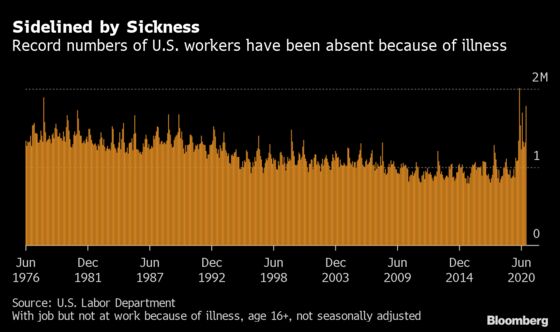
Amid the surge in the ranks of the unemployed during the pandemic, another crucial problem in the labor market has gone mostly overlooked: Workers are calling out sick in record numbers this year.

Whether it’s because they have Covid-19 themselves, are worried about getting it or are taking care of someone who already has it, the number of workers who’ve missed days on the job has doubled in the pandemic.

What’s more, unlike the jobless rate, which has steadily declined from its April peak, the rate of abseenteism — as it is called by economists — has remained stubbornly high. Almost 1.8 million workers were absent in November because of illness, nearly matching the record 2 million set back in April, according to Labor Department data.

These lost days of work are sapping an economic recovery that’s been progressing in fits and starts for much of the past several months. While some indicators have improved markedly, others such as retail sales and consumer spending and incomes have weakened as the pandemic rages on and local governments impose fresh restrictions on businesses and travel.

Michael Gapen, chief U.S. economist at Barclays Plc, said that the vaccine could start driving down absenteeism by the second quarter. Until then, he said, the missed work is leading to supply chain disruptions.

Absenteeism “could lead to shortages, it could lead to higher prices and more restrained output,” Gapen said.

With about 1.5 million new cases per week and deaths at a record pace, employee absenteeism may remain elevated for some time, especially in early 2021 before vaccines are widely distributed and with the rollout in the U.S. moving slower than government officials expected.

Factory Workers

While the Labor Department data tracks people currently in the labor force who are out sick, a separate survey by the Census Bureau captures an even wider view of the challenge. Its latest Household Pulse Survey — based on responses in late November and early December — estimates that more than 11 million people weren’t working because of the virus. The figures also include those who refrained from working because they were worried about getting or spreading the virus, and those caring for someone with symptoms.

The effects of missing workers are especially concentrated in manufacturing. Absenteeism, combined with short-term shutdowns to sanitize facilities and difficulties in returning and hiring workers, limit the sector’s growth potential, according to Timothy Fiore, chair of the Institute for Supply Management’s Manufacturing Business Survey Committee.

The group’s gauge of factory activity grew at a slower pace in November, with the employment component falling back to a level that indicates contraction.

“It’s not a lack of work,” Fiore said on a recent call with reporters, noting absenteeism especially for low- to medium-skill roles. “It’s a lack of people.”

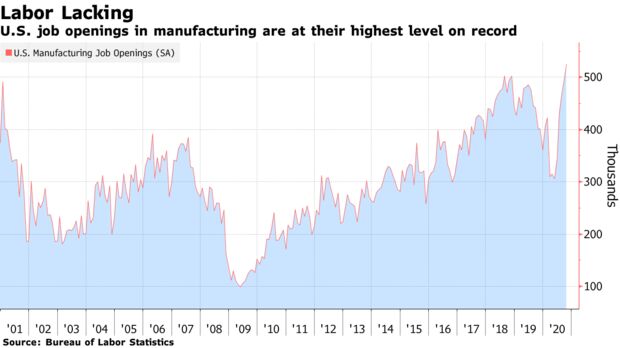
In addition to temporarily absent workers, the manufacturing sector has 525,000 job openings, the most in Labor records back to 2000.

U.S. job openings in manufacturing are at their highest level on record

Auto plants are feeling the effects. General Motors Co. put white-collar employees on the production floor in August to cope with high absenteeism amid strong demand. Volkswagen AG Chief Financial Officer Frank Witter has said high levels of missing staff left the automaker “at times struggling to get all the cars built for customer orders.”

U.S. businesses have reported that surging cases precipitated plant closings and infection fears, adding to labor challenges including absenteeism and attrition, according to the Federal Reserve’s latest Beige Book summary of economic conditions. Manufacturers in the Chicago region have used overtime to make up for staff shortages, the Dec. 2 report said.

Sick Leave

For office workers, 90% of professionals said before the pandemic they’d sometimes go to work sick, according to a 2019 study by staffing firm Accountemps. Covid changed the conversation, and more employees are staying home to protect themselves and others.

The Families First Coronavirus Response Act earlier this year made the decision to stay home easier for some Americans by allowing two weeks of paid sick leave for certain employees. The law also allows leave for those unable to work because they must care for a child.

The latest stimulus bill, signed by President Donald Trump on Dec. 27, includes an extension of the act through March 31, but makes paid leave voluntary for employers rather than mandatory as it was in the first iteration. That may continue the trend of workers staying home depending on how many employers choose to grant the leave.

The act, however, excludes essential workers, which means those employed at facilities such as meatpacking plants can’t take advantage of the policy. That in turn can lead to workplace outbreaks and further disrupt production.

With fewer employees at work, slaughter rates at U.S. meat plants fell in the third quarter. Tyson Foods Inc. Chief Executive Officer Dean Banks said on a recent earnings call that absenteeism has “increased the cost and complexity of our operations” and that the company expects that to continue in 2021.

Employment in Economic Downturns

First case of highly infectious coronavirus variant detected in Colorado

Colorado officials on Tuesday reported the first known case in the United States of a person infected with the coronavirus variant that has been circulating rapidly across much of the United Kingdom and has led to a lockdown of much of southern England.

Scientists have said the variant is more transmissible but does not make people sicker.

The Colorado case involves a man in his 20s, who is in isolation in Elbert County, about 50 miles southeast of Denver, and has no travel history, according to a tweet from the office of Gov. Jared Polis (D).

“The individual has no close contacts identified so far but public health officials are working to identify other potential cases and contacts through thorough contact tracing interviews,” the statement said.

A federal scientist familiar with the investigation said the man’s lack of known travel — in contrast with most confirmed cases outside the United Kingdom — indicates this is probably not an isolated case. “We can expect that it will be detected elsewhere,” said the official, who spoke on the condition of anonymity to discuss the broader context of the announcement.

The Centers for Disease Control and Prevention confirmed as much in a statement Tuesday afternoon, saying additional cases with the new variant will be detected in the United States in coming days. The variant’s apparent increase in contagiousness “could lead to more cases and place greater demand on already strained health care resources,” the agency said in a statement.

Researchers have detected the more transmissible variant in at least 17 countries outside the United Kingdom, including as far away as Australia and South Korea, as of Tuesday afternoon. Officials in Canada had previously said they had identified two cases.

Although the U.K. variant appears more contagious, it is not leading to higher rates of hospitalizations or deaths, according to a report from Public Health England, a government agency. Nor is there any sign that people who were infected months ago with the coronavirus are more likely to be reinfected if exposed to the variant, according to the report. All available evidence indicates that vaccines, and immunity built up in the population, should be protective against this variant.

The Colorado case occurred in a county of about 27,000, which is currently classified, along with much of the state, in the “red” level for the virus, denoting serious but not extreme risk.

Two weeks ago, several hundred people gathered at a community church in the county seat of Kiowa to consider whether to pursue legal actions against Polis and other state officials for imposing coronavirus-related restrictions, according to the Elbert County News. County commissioners and the county sheriff have declined to enforce restrictions emanating from Denver.

“I was expecting to see it in ski country first because those areas are where people from across Colorado, the U.S. and internationally, gather,” said Elizabeth Carlton, an assistant professor of environmental and occupational health at the Colorado School of Public Health. The absence of any apparent travel history associated with the infected person, she said, suggests he “can’t be the only case in Colorado.”

Polis, in his statement, called on Coloradans to do everything they could to prevent transmission by wearing masks, standing six feet apart when gathering with others, and interacting only with members of their immediate households.

The arrival of the new variant “doesn’t fundamentally change the nature of the threat,” said Justin Lessler, an epidemiologist at Johns Hopkins Bloomberg School of Public Health. “It’s no more deadly than the virus was before, and it doesn’t look like it infects people who are immune.”

Lessler echoed others, saying he would be “astounded” if this was the only chain of transmission of the new variant in the United States. “We know that the virus spreads easily and quickly between countries,” he said, and the fact that the infected person had no travel history indicates “this strain has gotten here sometime in the past, and there are chains of transmission ongoing.”

The variant has a higher attack rate, according to the U.K. report, which bolsters the hypothesis that the variant has out-competed other versions of the coronavirus and is now the dominant variant across much of the United Kingdom. Among people known to have been exposed to someone already infected with the variant, 15.1 percent became infected. People exposed to someone infected with the non-variant version had a 9.8 percent infection rate.

That difference suggests the variant is more transmissible, though Public Health England said more investigation is needed to bolster the hypothesis.

The working theory among many scientists is that the increased transmissibility of the variant, known as B.1.1.7, is driven by mutations that have altered the spike protein on the surface of the virus. The variant has 17 mutations — eight of which alter the spike protein.

Precisely how those changes are leading to more infections is unknown. The virus may be binding more easily to receptor cells in the human body, or replicating more easily and driving higher viral loads, enhancing viral shedding by someone who is infected. Another possibility is that people are shedding the virus for a longer period, increasing the chances of passing it along.

“Preliminary evidence suggests that the new variant does not cause more severe disease or increased mortality,” Susan Hopkins, a senior medical adviser to Public Health England, said in a statement released Tuesday.

The newly published data echo the findings in a separate study published last week, based on modeling and hospitalization data — and not yet peer-reviewed — that estimated that the variant is 56 percent more transmissible but does not appear to alter the lethality of the virus.

“The good news is that B.1.1.7 does not seem to cause much more severe disease, and there’s no evidence that it is managing to evade the immune system, which means vaccines are expected to protect against it,” William Hanage, an epidemiologists at the Harvard T.H. Chan School of Public Health, said Tuesday after reviewing the new report. “The bad news is that B.1.1.7 does appear to be much more transmissible.”

Officials in the United States have been signaling since last week that the new variant was probably already present in this country.

“I’m not surprised,” Anthony S. Fauci, director of the National Institute of Allergy and Infectious Diseases, said Tuesday. “I think we have to keep an eye on it, and we have to take it seriously. We obviously take any kind of mutation that might have a functional significance seriously. But I don’t think we know enough about it to make any definitive statements, except to follow it carefully and study it carefully.”

Research findings on coronavirus variants have been ambiguous at times, and scientists say they are still trying to extract reliable signals from noisy data. There have been several false alarms sounded about virus mutations in the past. A major challenge is discerning whether a virus variant is spreading rapidly because it has a competitive advantage based on genetic and structural differences, or because it is simply lucky, having arrived early to a location or leveraged a few superspreader events to gain dominance.

But with the United Kingdom seeing a severe winter surge of infections, public officials are taking no chances and have effectively locked down southern England, including London. Other countries have banned travelers from the United Kingdom.

The United States, despite having the world’s highest number of documented infections, has a weak track record in publishing genomic sequences, the process that enables researchers to track changes in the virus. Most sequences have been published by academic or private research institutions. By comparison, the United Kingdom has a national health system with a robust surveillance system.

“The U.K. made the decision in the spring to do this. The U.S. has sequencing equipment and infrastructure. As with many things in this pandemic, it was not executed the way it should have been,” said Neville Sanjana, a geneticist at New York University.

All viruses mutate randomly, and over time some of those mutations appear to confer some kind of advantage to the virus as it adapts to the human species. The novel coronavirus, SARS-CoV-2, mutates at a slow rate, and scientists do not think the genetic changes seen in the variant so far are sufficient to allow it to elude the vaccines now being administered to millions of people in many countries. But the coronavirus is a moving target and these mutations require surveillance.

Many scientists call the arrival of more transmissible mutations a wake-up call. “The lack of virus sequencing and case tracking in the USA is a scandal,” said Jeremy Luban, a virologist at the University of Massachusetts Medical School.

Francois Balloux, who directs the Genetics Institute at University College London, on Twitter predicted that within two weeks, enough data will accumulate to determine whether this new variant is indeed more transmissible. Previously, Balloux and his colleagues combed through genome sequences, looking for evidence that common variants had increased transmissibility.

“We don’t see much,” he said, referring to a report published in the journal Nature in November that found no signs of mutations that helped the virus to spread more easily. However, he said he “wouldn’t underestimate the evolutionary potential of SARS-CoV-2.”

The deadliest year in U.S. history didn’t have to be so deadly

If you decided to read the names of every American who is known to have died of covid-19, the disease caused by the novel coronavirus, at a rate of one per second starting at 5 p.m. Tuesday, you would not finish until a bit after 10 a.m. Saturday. Except, of course, that’s only including the deaths known as of writing; by then, we can expect 8,000 more deaths, pushing the recitation past noon.

Preliminary federal figures indicate that more than 3.2 million Americans will die over the course of 2020, the highest figure on record. It’s just a bit shy of 1 percent of the total population as of July 1, and about 1 in 10 of those deaths will be a result of covid-19.

That’s the primary context in which any discussion about how the pandemic has affected the United States should occur. Secondarily, we should consider how the number of new coronavirus infections correlates to that figure. At the moment, nearly two people are dying of covid-19 each minute, a function of a massive surge in the number of new infections that began in mid-September.

The surge and the deaths are inextricable. For months, the number of new deaths on any given day has been about 1.8 percent of new cases several weeks prior. Allowing the virus to spread wildly means allowing more Americans to die.

In an opinion piece for the Wall Street Journal, one of the architects of the decision to let the virus spread, former White House adviser Scott Atlas, blames the scale of the pandemic on the media. It’s the “politicization” of the virus, he argues, that has led to the dire outcomes we see, and that’s largely due to “media distortion.”

It’s hard to overstate both how dishonest Atlas’s argument is and how ironic it is that he should point the blame elsewhere. He makes false assertions about where states have been successful and suggests that mitigation efforts that weren’t 100 percent effective shouldn’t be used. He boasts that the effort to combat the spread of the virus was left to states — which is precisely the criticism aimed at President Trump’s administration. When Trump (and Atlas) undercut efforts to slow the spread of the virus, Trump supporters — including state leaders — picked up on that approach, contributing to the current spread.

Trump and Atlas shared the view that allowing the virus to spread was beneficial, as doing so increased population immunity. That another result would be surging deaths was met with a shrug or silence.

At the end of March, Trump offered one of his only forceful endorsements of slowing the spread of the virus. Having been presented with research indicating that as many as 2.2 million Americans would die of the virus if no effort was taken to limit its spread, he endorsed stay-at-home measures aimed at preventing new infections. His team suggested that implementing such mitigation efforts would keep the death toll under 240,000, with the added benefit of preventing hospitals from being overwhelmed.

This was one of Atlas’s arguments, too: Let the virus spread but backstop hospitals to prevent them from being flooded. The government accomplished the first goal, at least.

So we’ve raced past the 240,000-death mark, passing 300,000 deaths this month.

It’s important to remember, too, how often Trump himself promised this wasn’t going to be the country’s future. As the virus was spreading without detection — in part thanks to the Centers for Disease Control and Prevention’s failure to develop a working test — Trump repeatedly downplayed how bad things would get. There were thousands of deaths around the world, he noted in early March, but less than a dozen in the United States. He compared the coronavirus to the seasonal flu and to the H1N1 pandemic in 2009, an event that had the politically useful characteristic of having occurred while Trump’s eventual opponent in the presidential election was vice president.

Over and over, Trump predicted a high-water mark for coronavirus deaths. Over and over, the country surged past his predictions. As the election approached, he began simply comparing the death toll to that 2.2-million-death figure he’d first introduced in March.

The United States will not reach 2.2 million coronavirus deaths over the course of the pandemic. We probably won’t reach 500,000, assuming that the national vaccination effort — the far-safer way to spread immunity — progresses without significant problems.

Right now, though, thousands of people are dying every day and tens of thousands more are on an inevitable path to the same result. More robust efforts to prevent new infections could have reduced these numbers, as robust efforts did elsewhere (contrary to Atlas’s theories). A consistent, forceful message from a president whose base is devoutly supportive of him would unquestionably have reshaped the virus’s spread. Had Trump embraced the expertise of government virologists, instead of a radiologist he saw on Fox News, it would have perhaps pushed the curve depicting the number of deaths each day back down instead of driving it higher.

This was the deadliest year in American history. Perhaps it would inevitably have been, given the size of the population (particularly the elderly population) and the emergence of covid-19. But it unquestionably didn’t have to be as deadly as it was.