The Memo: Scale of economic crisis sends shudders through nation

The Memo: Scale of economic crisis sends shudders through nation

Pandemic derails resilient US economy | TheHill

New data released Thursday revealed the scale of the economic devastation wrought by the coronavirus crisis — and experts say there is no end in sight.

More than 6.6 million new unemployment claims were filed during the week ending March 28, according to the Department of Labor. The figure was double that of the previous week, which had itself been by far the highest since records began.

The stark reality is that roughly 10 million people have been dumped from their jobs in two weeks. A previously robust economy has been scythed down by the virus. A nation that had been enjoying its lowest unemployment rate for decades is now virtually certain to see jobless totals surpass those of the Great Recession a decade ago.

“The present economic situation is awful,” said Jason Furman, a Harvard University professor who served as chairman of President Obama’s Council of Economic Advisers. “The data is just telling us what we can see with our own eyes — there is very little business happening.”

Economists who had already been deeply worried about the immediate outlook are now wondering if their earlier projections were in fact too rosy.

“In our earlier scenario, we had expected 6.5 million job losses by May,” said Beth Ann Bovino, the chief U.S. economist at Standard & Poor’s. That figure will be exceeded, she now believes, given that there were “more lockdowns, more business closures and more businesses just trying to keep themselves alive” by laying off workers.

Heidi Shierholz, senior economist and director of policy at the Economic Policy Institute, said that even the 10 million figure for new unemployment claims was “likely a massive undercount” of actual losses because, during that period, self-employed people and workers in the so-called “gig economy” were generally not eligible to apply. This is changing as a consequence of the package recently passed by Congress that extends eligibility for unemployment benefits, as well as providing other aid for businesses and individuals.

“Our estimate is that by the end of June, 20 million people will have lost their jobs — and I am wondering if even that is optimistic,” Shierholz said.

The political ramifications of such a huge economic shock are unknowable.

President Trump had been looking forward to using the economy as his strongest card as he seeks a second term in November. That card has been shredded.

Trump has promised repeatedly during his White House briefings on the crisis that the nation can bounce back very fast once the public health dangers have receded.

Trump’s approval ratings have also ticked up modestly since the crisis began in many polls. He may be benefitting from the traditional “rallying around the flag” effect that has occurred in previous moments of crisis.

President George W. Bush, for example, hit 90 percent approval in a Gallup poll — the highest result for any president in the polling organization’s history — right after the terrorist attacks of Sept. 11, 2001.

In a statement on Thursday, probable Democratic nominee Joe Biden hit Trump for “failing to prepare our nation” for the ramifications of the coronavirus crisis. Biden called on Trump to allow open enrollment in the Affordable Care Act and also jabbed at Treasury Secretary Steven Mnuchin for having referred to previous unemployment figures as “not relevant.”

In response, Trump campaign communications director Tim Murtaugh blasted back at Biden for “ineffectively sniping from the sidelines, stumbling through television interviews, and hoping for relevance and political gain.”

Economic experts caution that Trump’s promises of a v-shaped recovery, in which the nation jolts itself back into strong economic shape quickly, are almost certainly unrealistic. It will not be a matter of the nation simply rolling the shutters back up and returning to business as usual.

“The economy is not symmetrical,” said Furman. “It is easier to separate someone from a job than to connect someone to a job. In recessions, the unemployment rate can go up very quickly and it comes down very slowly. The worry is that this will be like that.”

Several economic experts who spoke with The Hill made similar points, unprompted, as to the ways the federal government could ease the crisis.

One refrain was that huge assistance needs to be made available to states. States are generally required to balance their budgets. In a situation like the current one, where their tax revenue is cratering, this means they are obligated to severely cut spending — something that most economists believe would deepen and prolong the recession.

Another theme was the need to tie together financial assistance for businesses and the retention of employees.

The recently passed stimulus package makes some effort to do that, particularly in the case of small businesses. The Paycheck Protection Program extends loans to small businesses based upon eight weeks of payroll costs plus an additional 25 percent of the total.

The payroll portion of the loans would be forgiven — rendering them in effect a grant, not a loan — so long as the workforce was maintained at existing levels.

Economic experts praise the principle but worry that the total amount of money in the pot for these loans — $349 billion — may not be enough. 

“The small business subsidies will be critical,” said Steven Hamilton, an assistant professor of economics at The George Washington University. “The government needs to get the word out on those, and Congress will likely need to pass an expansion both to adequately fund the existing scheme and to make the scheme more generous to businesses to keep them from laying off workers.”

The public seems to share the view that the aid package, which also includes checks of up to $1,200 for individuals, is a move in the right direction — but unlikely to suffice.

A CBS News poll released late Thursday afternoon indicated 81 percent of Americans support the recent legislation but 57 percent also say it likely won’t be enough.

The same trepidation is shared by the experts, given the unprecedented nature of the coronavirus and the economic crisis it has created.

“It’s like nothing we have ever seen before,” said Shierholz.


Hertz thanks our healthcare workers

https://pub.emails.hertz.com/HealthcareHonor?utm_medium=email&utm_campaign=H_US_GPR_AD_HLTH_PNT_20200326&utm_source=hertz_master_list&utm_content=health_cta&sfmc_j=156129&sfmc_s=37058107&sfmc_l=146&sfmc_jb=5023&sfmc_mid=7269153&sfmc_u=6209368&utm_krxconf=s6iu815js

Image result for Hertz thanks our healthcare workers.

We see you go the extra mile every day – and you inspire us. Thank you.


Bill Gates says we can’t restart the economy soon and simply “ignore that pile of bodies over in the corner”

https://www.vox.com/recode/2020/3/24/21192638/coronavirus-bill-gates-trump-reopen-business?fbclid=IwAR3j7XzP_Mf3i9VhZwzYk2jTesqLjr9SAtmb4B-xLy0KXaeyZ2zK4lUWjdU

Image result for Bill Gates says we can’t restart the economy soon and simply “ignore that pile of bodies over in the corner”

Bill Gates rebuked proposals, floated over the last two days by leaders like Donald Trump, to reopen the global economy despite the Covid-19 coronavirus outbreak, saying that this approach would be “very irresponsible.”

Gates did not mention Trump by name, but the American president has said that he may decide to relax some of the country’s “social distancing” in order to jumpstart the country’s shut-down economy. Gates, the country’s leading philanthropist, has been among the most active tech leaders in using his resources to try and contain the virus.

“There really is no middle ground, and it’s very tough to say to people, ‘Hey, keep going to restaurants, go buy new houses, ignore that pile of bodies over in the corner. We want you to keep spending because there’s maybe a politician who thinks GDP growth is all that counts,’” Gates said in an interview with TED Tuesday. “It’s very irresponsible for somebody to suggest that we can have the best of both worlds.”

Trump has suggested that this middle ground would indeed be possible — by letting some healthy people return to work, for instance, while keeping more vulnerable workers in their homes. Experts have said that drastic and widespread social distancing is required to keep the pandemic from spreading further. Trump has said he would make a decision at the end of the month but has said that he believes the “cure” could be worse than the “problem itself.”

Asked what he would do if he were president, Gates returned to his concerns about reopening the economy.

“The economic effect of this is really dramatic. Nothing like this has ever happened to the economy in our lifetimes,” Gates said. “But bringing the economy back … that’s more of a reversible thing than bringing people back to life. So we’re going to take the pain in the economic dimension — huge pain — in order to minimize the pain in the diseases-and-death dimension.”

The Bill and Melinda Gates Foundation has put up $100 million for programs to fund testing and science around the pandemic, and he has begun using his public profile, too, to shape the coronavirus conversation. This month, Gates himself resigned from the board of Microsoft, which he founded, and is now effectively a full-time philanthropist — and the country’s most famous one.

And Gates has tried to cast himself as an optimist. He has said that the social distancing measures might need to last as little as six weeks, but said that “we have no choice,” despite the economic impacts.

“It’s disastrous for the economy,” Gates said. But “the sooner you do it in a tough way, the sooner you can undo it and go back to normal.”


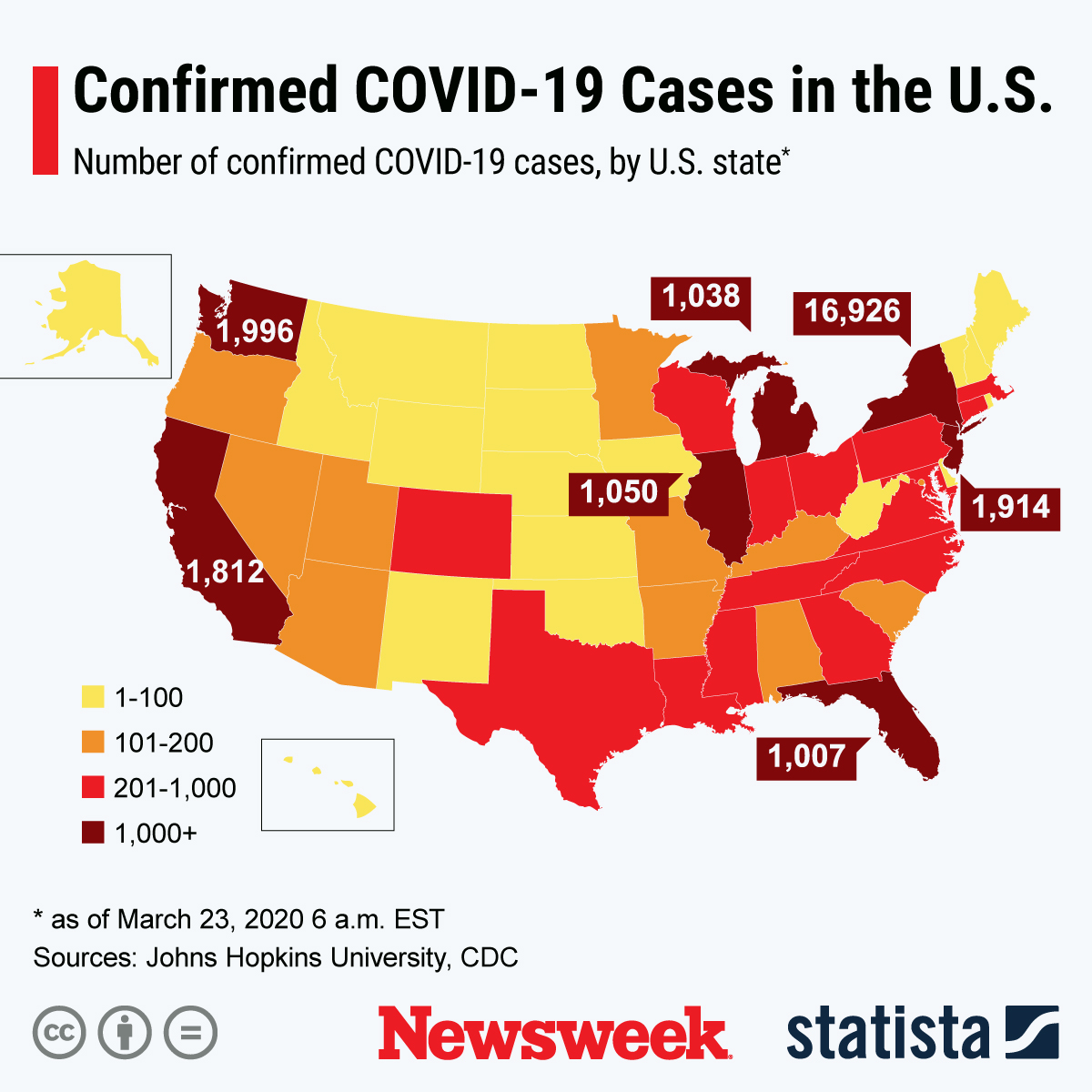
The Latest in the U.S. on the Coronavirus

https://www.axios.com/newsletters/axios-vitals-10e7b50f-26eb-4233-854a-36a6b5405524.html?utm_source=newsletter&utm_medium=email&utm_campaign=newsletter_axiosvitals&stream=top

Image result for axios confirmed u.s. cases of covid-19

President Trump said at a Fox News town hall Tuesday that he would “love” to have the country “opened up, and just raring to go” by Easter, or April 12, despite warnings from public health officials that easing social distancing restrictions too soon could cause the number of coronavirus cases to skyrocket.

  • Dr. Anthony Fauci, director of the National Institute of Allergy and Infectious Diseases, then said at a coronavirus briefing Tuesday evening that President Trump’s target date of Easter to ease social distancing is “really very flexible.”
  • 2020 Democratic front-runner Joe Biden harshly criticized the idea of lifting restrictions by Easter, saying on CNN that the president should “stop talking and start listening to the medical experts.”

New York City Mayor Bill de Blasio told a news conference Tuesday he plans to release from Rikers Island some 300 nonviolent inmates who are over 70 years old as a measure against the novel coronavirus pandemic.

The USS Theodore Roosevelt reported three cases of sailors contracting COVID-19 Tuesday, Navy officials said at a briefing — marking the first U.S. sailors to test positive aboard a Navy ship while at sea.

A minor died from the novel coronavirus in Los Angeles County, California, the county’s health department said Tuesday, although it later said that “there may be an alternate explanation” for the death of a California teenager whose “early tests indicated a positive result for COVID-19.”

The trade groups representing hospitals, doctors and nurses called on the public today to stay at home to slow the spread of the new coronavirus.

Up to 5,000 students will be allowed to return to Liberty University’s campus this week, as the Lynchburg, Virginia, college bucks the national trend of school closures.


America’s incomplete coronavirus shutdown

https://www.axios.com/newsletters/axios-vitals-10e7b50f-26eb-4233-854a-36a6b5405524.html?utm_source=newsletter&utm_medium=email&utm_campaign=newsletter_axiosvitals&stream=top

Image result for axios America's incomplete coronavirus shutdown

If President Trump follows through on his statements that he wants to “open” the U.S. up again, an already patchwork shield of state “stay at home” orders could look like even more of a patchwork, Axios’ David Nather reports.

The big picture: Just 17 states have ordered people to stay at home, and most of those are states with Democratic governors. Only Ohio, Indiana, Massachusetts and West Virginia have Republican governors.

  • If Trump declares it’s time to start getting back to normal, those GOP governors could face pressure to start easing their own social restrictions, too.
  • That doesn’t mean they’ll do it, but the political pressure will intensify every time Trump talks about the importance of restarting the economy. And it could become even less likely that other Republican governors will impose stay-at-home orders of their own.

Between the lines: Some Republican governors, like Greg Abbott of Texas, have resisted calls to issue statewide stay-at-home orders, leaving it to cities and counties to issue their own restrictions.

  • Not all Democratic governors have ordered statewide restrictions, either. Pennsylvania Gov. Tom Wolf, for example, issued a stay-at-home order for people in the hardest-hit areas, but not for the whole state.
  • There are 26 Republican governors and 24 Democratic governors — and seven Republicans are up for re-election, compared to four Democrats.

The bottom line: The “mitigation strategy” of social distancing urged by health experts has been uneven throughout the U.S. — and it’s likely to get more uneven.


We keep underestimating the coronavirus

https://www.axios.com/newsletters/axios-vitals-10e7b50f-26eb-4233-854a-36a6b5405524.html?utm_source=newsletter&utm_medium=email&utm_campaign=newsletter_axiosvitals&stream=top

Image result for axios We keep underestimating the coronavirus

The U.S. keeps reacting too late to the novel coronavirus, prolonging its economic pain and multiplying its toll on Americans’ health.

Why it matters: The spread and impact of the coronavirus may be unfathomable, but it’s not unpredictable. And yet the U.S. has failed to respond accordingly over and over again.

First, it happened with testing — a delay that allowed the virus to spread undetected.

  • Then we were caught flat-footed by the surge in demand for medical supplies in emerging hotspots.
  • And the Trump administration declined to issue a national shelter-in-place order. The resulting patchwork across the country left enough economic hubs closed to crash the economy, but enough places up and running to allow the virus to continue to spread rampantly.

Between the lines: Proactive containment and mitigation steps would have required extraordinary political and economic capital, especially if they had come early in the process, when many Americans didn’t grasp the full weight of this challenge.

  • But making decisions based on today’s information — without an understanding of how much worse tomorrow will be — is also politically and economically risky, and carries the extra cost of more deaths.

Now, even as testing and hospital capacity remain limited, President Trump is eager for an economic recovery — even though, by all estimates, the outbreak is only going to get worse.

The bottom line: When I asked one senior Health and Human Services official how all of this keeps happening, the official said it’s at least partially due to disconnects — between Trump and his administration; between the government and the private sector, and between the U.S. and the rest of the world.

  • “At the end of the day, the virus has slipped through all those cracks that exist between all of these entities,” the official said.


Administration Considers Reopening Economy, Over Health Experts’ Objections

Image result for Trump Considers Reopening Economy, Over Health Experts’ Objections

The president is questioning whether stay-at-home orders have gone too far. But relaxing them could significantly increase the death toll from the coronavirus, health officials warn.

As the United States entered Week 2 of trying to contain the spread of the coronavirus by shuttering large swaths of the economy, President Trump, Wall Street executives and many conservative economists began questioning whether the government had gone too far and should instead lift restrictions that are already inflicting deep pain on workers and businesses.

Consensus continues to grow among government leaders and health officials that the best way to defeat the virus is to order nonessential businesses to close and residents to confine themselves at home. Britain, after initially resisting such measures, essentially locked down its economy on Monday, as did the governors of Virginia, Michigan and Oregon. More than 100 million Americans will soon be subject to stay-at-home orders.

Relaxing those restrictions could significantly increase the death toll from the virus, public health officials warn. Many economists say there is no positive trade-off — resuming normal activity prematurely would only strain hospitals and result in even more deaths, while exacerbating a recession that has most likely already arrived.

The economic shutdown is causing damage that is only beginning to appear in official data. Morgan Stanley researchers said on Monday that they now expected the economy to shrink by an annualized rate of 30 percent in the second quarter of this year, and the unemployment rate to jump to nearly 13 percent. Both would be records, in modern economic statistics.

Officials have said the federal government’s initial 15-day period for social distancing is vital to slowing the spread of the virus, which has already infected more than 40,000 people in the United States. But Mr. Trump and a chorus of conservative voices have begun to suggest that the shock to the economy could hurt the country more than deaths from the virus.

On Monday, Mr. Trump said his administration would reassess whether to keep the economy shuttered after the initial 15-day period ends next Monday, saying it could extend another week and that certain parts of the country could reopen sooner than others, depending on the extent of infections.

“Our country wasn’t built to be shut down,” Mr. Trump said during a briefing at the White House. “America will, again, and soon, be open for business. Very soon. A lot sooner than three or four months that somebody was suggesting. Lot sooner. We cannot let the cure be worse than the problem itself.”

Similar views are emanating from parts of corporate America, where companies are struggling with a shutdown that has emptied hotels, airplanes, malls and restaurants and sent the stock market tumbling so fast that automatic circuit breakers to halt trading have been tripped repeatedly. Stocks have collapsed about 34 percent since the coronavirus spread globally — the steepest plunge in decades — erasing three years of gains under Mr. Trump.

Lloyd Blankfein, the former chief executive of Goldman Sachs, wrote on Twitter that “crushing the economy” had downsides and suggested that “within a very few weeks let those with a lower risk to the disease return to work.”

Even Gov. Andrew M. Cuomo of New York, whose state has emerged as the epicenter of the outbreak in the United States, has begun publicly floating the notion that, at some point, states will need to restart economic activity and debating how that should unfold.

“You can’t stop the economy forever,” Mr. Cuomo said in a news conference on Monday. “So we have to start to think about does everyone stay out of work? Should young people go back to work sooner? Can we test for those who had the virus, resolved, and are now immune and can they start to go back to work?”

Any push to loosen the new limits on commerce and movement would contradict the consensus advice of public health officials, risking a surge in infections and deaths from the virus. Many economists warn that abruptly reopening the economy could backfire, overwhelming an already stressed health care system, sowing uncertainty among consumers, and ultimately dealing deeper, longer-lasting damage to growth.

The recent rise of cases in Hong Kong, after there had been an easing of the spread of the virus, is something of an object lesson about how ending strict measures too soon can have dangerous consequences. Yet places like China, which took the idea of lockdown to the extreme, have managed to flatten the curve.

“You can’t call off the best weapon we have, which is social isolation, even out of economic desperation, unless you’re willing to be responsible for a mountain of deaths,” said Arthur Caplan, a professor of bioethics at NYU Langone Medical Center. “Thirty days makes more sense than 15 days. Can’t we try to put people’s lives first for at least a month?”

For the last four days, some White House officials, including those working for Vice President Mike Pence, who leads the coronavirus task force, have been raising questions about when the government should start easing restrictions.

Among the options being discussed are narrowing restrictions on economic activity to target specific age groups or locations, as well as increasing the numbers of people who can be together in groups, said one official, who cautioned that the discussions were preliminary.

Health officials inside the administration have mostly opposed that idea, including Dr. Anthony S. Fauci, an infectious diseases expert and a member of the White House coronavirus task force, who has said in interviews that he believes it will be “at least” several more weeks until people can start going about their lives in a more normal fashion.

Dr. Deborah L. Birx, the White House coronavirus response coordinator, said the United States had learned from other countries like China and South Korea, which were able to control the spread of the virus through strict measures and widespread testing.

“Those were eight- to 10-week curves,” she said on Monday, adding that “each state and each hot spot in the United States is going to be its own curve because the seeds came in at different times.”

Dr. Birx added that the response “has to be very tailored geographically and it may have to be tailored by age group, really understanding who’s at the greatest risk and understanding how to protect them.”

Other advisers, including members of Mr. Trump’s economic team, have said repeatedly in recent months that the virus does not itself pose an extraordinary threat to Americans’ lives or the economy, likening it to a common flu season. Some advisers believe the White House overreacted to criticism of Mr. Trump’s muted actions to deal with the emerging pandemic and gave health experts too large a sway in policymaking.

On Monday, Mr. Trump echoed those concerns, saying that things like the flu or car accidents posed as much of a threat to Americans as the coronavirus and that the response to those was far less draconian.

“We have a very active flu season, more active than most. It’s looking like it’s heading to 50,000 or more deaths,” he said, adding: “That’s a lot. And you look at automobile accidents, which are far greater than any numbers we’re talking about. That doesn’t mean we’re going to tell everybody no more driving of cars. So we have to do things to get our country open.”

Mr. Trump has watched as a record economic expansion and booming stock market that served as the basis of his re-election campaign evaporated in a matter of weeks. The president became engaged with the discussion on Sunday evening, after watching television reports and hearing from various business officials and outside advisers who were agitating for an end to the shutdown.

Casey Mulligan, a University of Chicago professor who served as chief economist for Mr. Trump’s Council of Economic Advisers, said on Monday that efforts to shut down economic activity to slow the virus would be more damaging than doing nothing at all. He suggested a middle ground, one that weighs the costs and benefits of saving additional lives.

“It’s a little bit like, when you discover sex can be dangerous, you don’t come out and say, there should be no more sex,” Mr. Mulligan said. “You should give people guidance on how to have sex less dangerously.”

Many other economists say the restrictions in activity now are helping the economy in the long run, by beginning to suppress the infection rate.

“The idea that there’s a trade-off between health and economics right now is likely badly mistaken,” said Jason Furman of Harvard University, a former chairman of the Council of Economic Advisers under President Barack Obama. “The thing damaging our economy is a virus. Everyone who is trying to stop that virus is working to limit the damage it does to our economy and help our eventual rebound. The choice may well be taking pretty extreme steps now or taking very extreme steps later.”

Mr. Furman and other economists have pushed Mr. Trump and Congress to ease the economic pain by offering trillions of dollars in government assistance to affected workers and businesses. As lawmakers tried to negotiate an agreement on such a bill Monday, an influential business lobbying group, the U.S. Chamber of Commerce, said it supported restrictions on the economy to slow the virus.

“Our view is, when it comes to how you contain the virus, you do everything the public health professionals say to contain the virus,” said Neil Bradley, the chamber’s executive vice president and chief policy officer.

The president’s suggestion that the response may be an overreaction plays into doubts already held by some Americans suffering the economic consequences. Among the self-quarantined, some have questioned the purpose of isolating themselves if the virus is already circulating widely. Students sent home from college have wondered whether they are more likely to infect higher-risk older adults at home.

Dan Patrick, Texas’ lieutenant governor, said Monday on Fox News that he was in the “high-risk pool” but would be willing to risk his life to preserve the country for his children and grandchildren.

“We are going to be in a total collapse, recession, depression, collapse in our society,” said Mr. Patrick, who turns 70 next week. “If this goes on another several months, there won’t be any jobs to come back to for many people.”

But public health officials stress that there would be consequences to ending the measures too quickly. In a tweet on Monday morning, Thomas P. Bossert, the former homeland security adviser who for weeks has been vocal about the need for the U.S. government to take stricter measures, said: “Sadly, the numbers now suggest the U.S. is poised to take the lead in #coronavirus cases. It’s reasonable to plan for the US to top the list of countries with the most cases in approximately 1 week. This does NOT make social intervention futile. It makes it imperative!”

Mr. Trump’s interest in potentially easing some of the restrictions met with pushback from one of his close allies, Senator Lindsey Graham, Republican of South Carolina, who himself self-quarantined after a potential exposure. “President Trump’s best decision was stopping travel from China early on,” Mr. Graham tweeted on Monday. “I hope we will not undercut that decision by suggesting we back off aggressive containment policies within the United States.”

Health officials remain largely united in defense of sustaining the restrictions.

“There is a way to think through how and when to start reopening our economy and society, and it’s important to get this right,” said Dr. Thomas R. Frieden, a former director of the Centers for Disease Control and Prevention.

Dr. Tom Inglesby, the director of the Center for Health Security at the Johns Hopkins Bloomberg School of Public Health, pointed to the experience of countries like Italy, which did not institute aggressive measures to stop the spread of the virus and saw infection rates and deaths soar as a result.

The United States will need “a couple weeks” to see positive effects from its measures, Dr. Inglesby said, and abandoning them would mean “patients will get sick in extraordinary numbers all over the country, far beyond what the U.S. health care system will bear.”


Everybody wants a piece of the stimulus

https://www.axios.com/newsletters/axios-vitals-a411a6cb-fd41-45d9-9dcb-da9136c68ea6.html?utm_source=newsletter&utm_medium=email&utm_campaign=newsletter_axiosvitals&stream=top

Image result for axios vitals Everybody wants a piece of the stimulus

Lobbyists are racing to grab a piece of the stimulus package lawmakers are still trying to hammer out on Capitol Hill, Bob writes.

Driving the news: Hospitals and physicians want at least $100 billion and significant Medicare payment hikes, partially because they’ve had to cancel lucrative elective procedures.

  • Hotels, airlines, restaurants, casinos, manufacturers and other service industries that have been battered by the coronavirus spread are angling to get hundreds of billions in loans and other funding.
  • A coalition of major employers is lobbying Congress for payroll tax credits and coverage subsidies for people who lose their jobs.

The intrigue: The chance for federal bailouts has motivated small players to make bigger investments, and some nontraditional parties are spending their first lobbying dollars.


The recession risk

https://www.axios.com/newsletters/axios-future-trends-0eb404e7-34a3-40ac-af56-8fefba59535c.html?utm_source=newsletter&utm_medium=email&utm_campaign=newsletter_axiosfuturetrends&stream=top

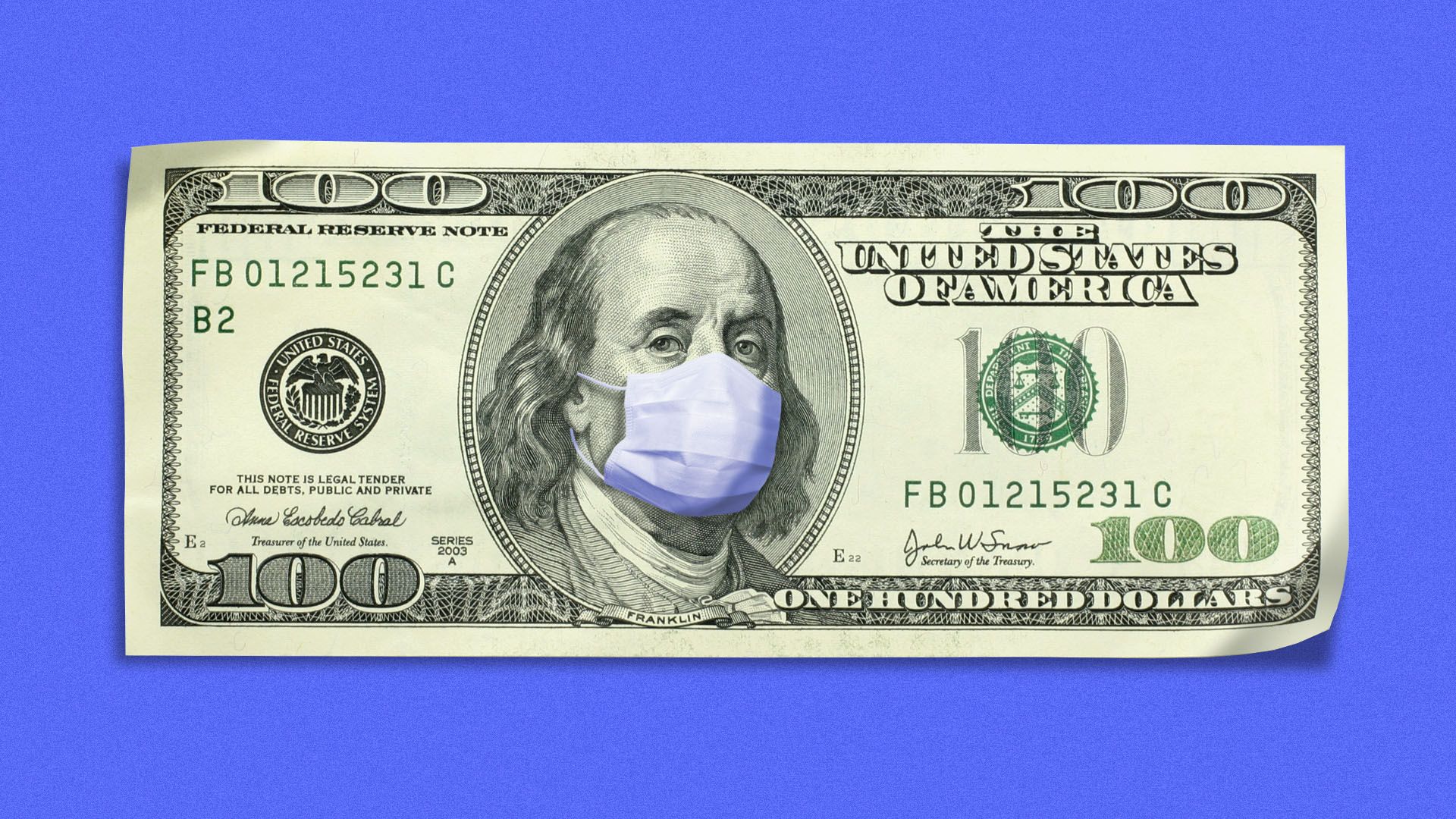
Illustration of Benjamin Franklin on a 100 dollar bill wearing a medical mask

Economists are growing more certain both the U.S. and the world are going to have a recession in 2020, Axios markets editor Dion Rabouin reports.

The big question: How bad will it be?

  • The answer depends on how quickly the outbreak can be contained and how fast people regain confidence to participate in activities they once enjoyed.

What’s happening: Economists and investment banks continue to write down their expectations for growth this year, as more economic activity is halted “until further notice.”

  • The shutdown of the NCAA’s annual March Madness basketball tournament and Austin’s South by Southwest festival are just two examples of mass gatherings that were expected to generate billions of dollars.
  • And that’s to say nothing of the millions of dollars that Chinese and European tourists would have spent, but who are temporarily banned or reluctant to come to the United States.

The bottom line: Businesses had pulled back on spending even before the year began, as a result of the U.S.-China trade war. That left consumer spending as the only thing holding up the economy, and the COVID-19 outbreak will kick that leg out from under us for an unknown period of time.

Go deeper: Listen to Dion discuss the risk of a recession with Dan Primack on the Pro Rata podcast.