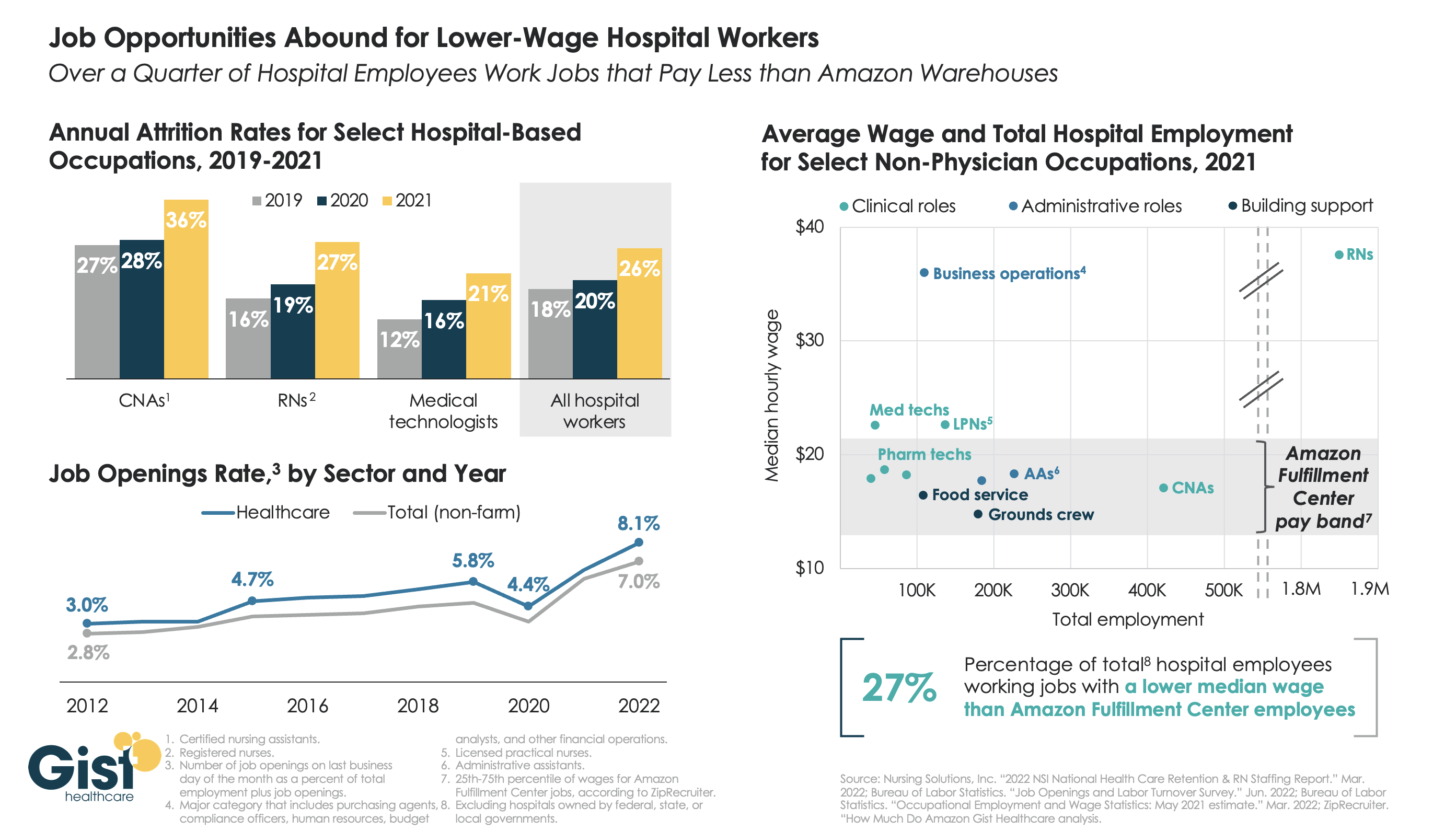
Although the nursing shortage has attracted much attention in recent months, the healthcare workforce crisis is hitting at all levels of the labor force. As the graphic above shows, the attrition rate for all hospital workers in 2021 was eight percentage points higher than in 2019.
Among clinicians and allied health professionals, certified nursing assistants (CNAs) have the highest turnover levels. Given the demands of the job and relatively low pay, CNA openings have been consistently difficult to fill. But it’s become even harder to hire for the role in today’s labor market as job openings near an all-time high.
Although labor force participation rates have rebounded to 2019 levels, pandemic-induced economic shifts have led to a boom in lower-wage jobs. In 2021 alone, Amazon opened over 250 new fulfillment centers and other delivery-related work sites. The company is competing directly with hospitals and nursing facilities for the same pool of workers at many of these new sites.
In fact, our analysis shows that more than a quarter of hospital employees currently work in jobs with a lower median wage than Amazon warehouses. Health systems have historically relied on rich benefits packages and strong career ladder opportunities to attract lower-wage employees, but that’s no longer enough—Amazon and other companies have ramped up their benefits, such that they now meet, or even surpass, what many hospitals are providing.
The time has come for health systems to reevaluate their position in local labor markets, and better define and promote their employee value proposition.
Health care workers nationwide are organizing and pushing for workplace changes like better pay or more favorable staffing ratios after waves of pandemic-fueled burnout and frustration.
Why it matters: COVID-19 and its aftereffects triggered an exodus of health care workers. Those who stayed are demanding more from health systems that claim to be reaching their own breaking points.
“The pandemic exacerbated a crisis that was already there,” Michelle Boyle, a Pittsburgh nurse told Axios. “It went from being a crisis to being a catastrophic freefall in staffing.”
Driving the news: About 1,400 resident physicians in public Los Angeles County hospitals have authorized a strike if their demands for pay parity with other local facilities aren’t met in contract negotiations this week.
Nurses demonstrated across Pennsylvania in early May, protesting one state lawmaker’s inaction on legislation that would have set nurse-to-patient ratios.
A fight is brewing in Minnesota as contracts covering 15,000 nurses in several hospital systems are expiring.
Some 2,000 resident physicians and interns at Stanford University and the University of Vermont Medical Center joined an affiliate of the SEIU for medical workers that claims more than 20,000 members nationwide.
In North Carolina, where union membership is low, staff at Mission Health in Asheville voted to unionize largely over staffing concerns.
Less than half of the of nearly 12,000 nurses polled by the American Nurses Association last year believe their employer cares about their concerns, and 52% of those surveyed said they intend to leave their jobs or are considering doing so.
The other side: Hospital operators generally oppose unionization efforts, as well as mandated staffing ratios.
“The last thing we need is requirements set by somebody in Washington as to exactly how many nurses ought to be providing service at any given time,” said Chip Kahn, CEO of the Federation of American Hospitals. “That ought to be a local decision based on the need in the hospital at the time.”
The American Organization for Nursing Leadership, an affiliate of the American Hospital Association, also opposes staffing ratios.
The industry says decisions on staffing and workplace rules are best left to local executives who need to be flexible to meet shifting demand for care.
“You’re basically taking away the flexibility of those on the scene to determine what it takes to provide the needed patient care,” Kahn said.
Go deeper: The pandemic drove up labor costs significantly for hospitals that were forced to pay travel nurses to fill workforce gaps during COVID surges.
April marked the fourth month in a row this year that major hospitals and health care systems reported negative margins, a Kaufman Hall report found. And executives say things could worsen amid inflation and stubborn supply chain woes.
And yet, some big hospital chains like Tenet reported strong earnings in the first quarter.
Between the lines: California is the only state to have set staffing ratios for nurses, but hospital unions in other states have fought for similar requirements in their contracts.
In California, every nurse on a general hospital floor has no more than five patients to care for at a time; nurses in ICUs should care for no more than two patients.
Nurses want look-alike standards in states like Pennsylvania, where only some hospitals have staffing ratios, saying short-staffing threatens patients’ well-being.
What we’re watching: While many legislative proposals failed this year, unions representing health care workers say their message is getting across.
Unions in Illinois, Pennsylvania and Washington state are redoubling efforts for staffing ratio legislation modeled on California’s.
In New York, nurses passed a law that took effect in January mandating staffing committees at hospitals.
The bottom line: The labor tension is a sobering coda to a health crisis that’s stretched health systems and workers alike in unprecedented ways.
“What you’re seeing is nurses finally saying enough is enough and this system is broken and we need it to be fixed,” said Denelle Korin, a nurse alliance coordinator with Nurses of Pennsylvania.
Organizations should prepare themselves for a continuation of quits as a new culture of quitting becomes the norm as the annual quit rate stands to jump up nearly 20 percent from annual pre pandemic levels, according to Gartner.
The pre pandemic average for quits stood at 31.9 million, but that figure could rise to 37.4 million this year, said executive consultancy Gartner in an April 28 news release.
“An individual organization with a turnover rate of 20 percent before the pandemic could face a turnover rate as high as 24 percent in 2022 and the years to come,” Piers Hudson, senior director in the Gartner HR practice said in the news release. “For example, a workforce of 25,000 employees would need to prepare for an additional 1,000 voluntary departures.”
The reason for the likely increase in quits is new flexibility in work arrangements and employees’ higher expectations, according to Gartner. A misalignment between leaders and workers is also contributing to the attrition.
“Organizations must look forward, not backward, and design a post-pandemic employee experience that meets employees’ changing expectations and leverages the advantages of hybrid work,” said Mr. Hudson.
Beaufort (S.C.) Memorial Hospital has created a homebuyer assistance program to help staff purchase a home or refinance mortgages, with up to $10,000 in assistance.
To be eligible for the program, employees must be full time, have worked at the hospital for at least six months, attend a homebuyer education workshop and meet household income requirements, among other criteria, according to a Jan. 10 news release from the hospital.
Additionally, properties must be within a 15-mile radius of a designated Beaufort Memorial campus, be the buyer’s primary residence and have monthly mortgage payments of no more than 33 percent of monthly income.
Recipients can use the funds for down payments and closing costs, the release said.
The hospital is partnering with development financial institution CommunityWorks for the program.
“We know that homeownership provides stability, security and a means to building financial health and wealth for future generations,” Beaufort Memorial President and CEO Russell Baxley said. “We also recognize that a major obstacle can be coming up with the money needed for a down payment or closing costs. This assistance program will help our employees bridge that financial gap.”
Companies that fail to adjust to labor shortages and satisfy the growing demands of workers will likely falter as they lose the battle for talent, BlackRock CEO Larry Fink said in a letter to CEOs.
“No relationship has been changed more by the pandemic than the one between employers and employees,” Fink said, noting that “employees across the globe are looking for more from their employer — including more flexibility and more meaningful work.” Fink, while leading the world’s largest asset manager, has sought for a decade to influence corporate behavior through an annual CEO letter.
“As companies rebuild themselves coming out of the pandemic, CEOs face a profoundly different paradigm than we used to,” Fink said. Companies can no longer overlook employee mental health, insist that staff work in the office five days per week and provide modest wage increases for low- and middle-income workers.
Dive Insight:
CFOs considering an increase in prices and employee wages need to balance the imperative to sustain profits with pressures from the worst inflation and labor shortages in decades.
The persistence of COVID-19 has slowed the labor market’s post-lockdown recovery and churned up company payrolls. Fink noted that in November the quits rate, or the number of workers who left their jobs as a percent of total employment, rose to 3%, a record high first breached in September.
CFOs aiming to attract and retain employees with wage increases must take into account a 7% jump in the consumer price index (CPI) during the 12 months through December — the biggest surge since 1982.
“Workers demanding more from their employers is an essential feature of effective capitalism,” Fink said. Describing “a new world of work,” he said, “companies not adjusting to this new reality and responding to workers do so at their own peril.
“Turnover drives up expenses, drives down productivity and erodes culture and corporate memory,” Fink said. BlackRock manages more than $10 trillion in assets for institutional and retail investors.
In order to satisfy workers, CEOs must look beyond pay and workplace flexibility, Fink said. The coronavirus “shone a light on issues like racial equality, childcare and mental health — and revealed the gap between generational expectations at work.”
Fink also reiterated his support for “stakeholder capitalism,” saying that “a company must create value for and be valued by its full range of stakeholders in order to deliver long-term value for its shareholders.”
“Stakeholder capitalism is not about politics. It is not a social or ideological agenda. It is not ‘woke,’” he said. “It is capitalism driven by mutually beneficial relationships between you and the employees, customers, suppliers and communities your company relies on to prosper.”
Most stakeholders expect companies to help “decarbonize” the global economy, Fink said, predicting that so-called sustainable investment will surge well beyond the $4 trillion total.
BlackRock has asked companies to set short-, medium- and long-term targets for greenhouse gas reductions which “are critical to the long-term economic interests of your shareholders,” he said.
At the same time, “divesting from entire sectors — or simply passing carbon-intensive assets from public markets to private markets — will not get the world to net zero,” Fink said, adding that “BlackRock does not pursue divestment from oil and gas companies as a policy.”
Fink’s annual letter drew fire from environmentalists.
The letter “is just another rehashing of the same vague rhetoric, without any meaningful new commitment to actually help lead the necessary transition to a climate-safe future,” Ben Cushing, the Sierra Club’s fossil-free finance campaign manager, said in a statement.
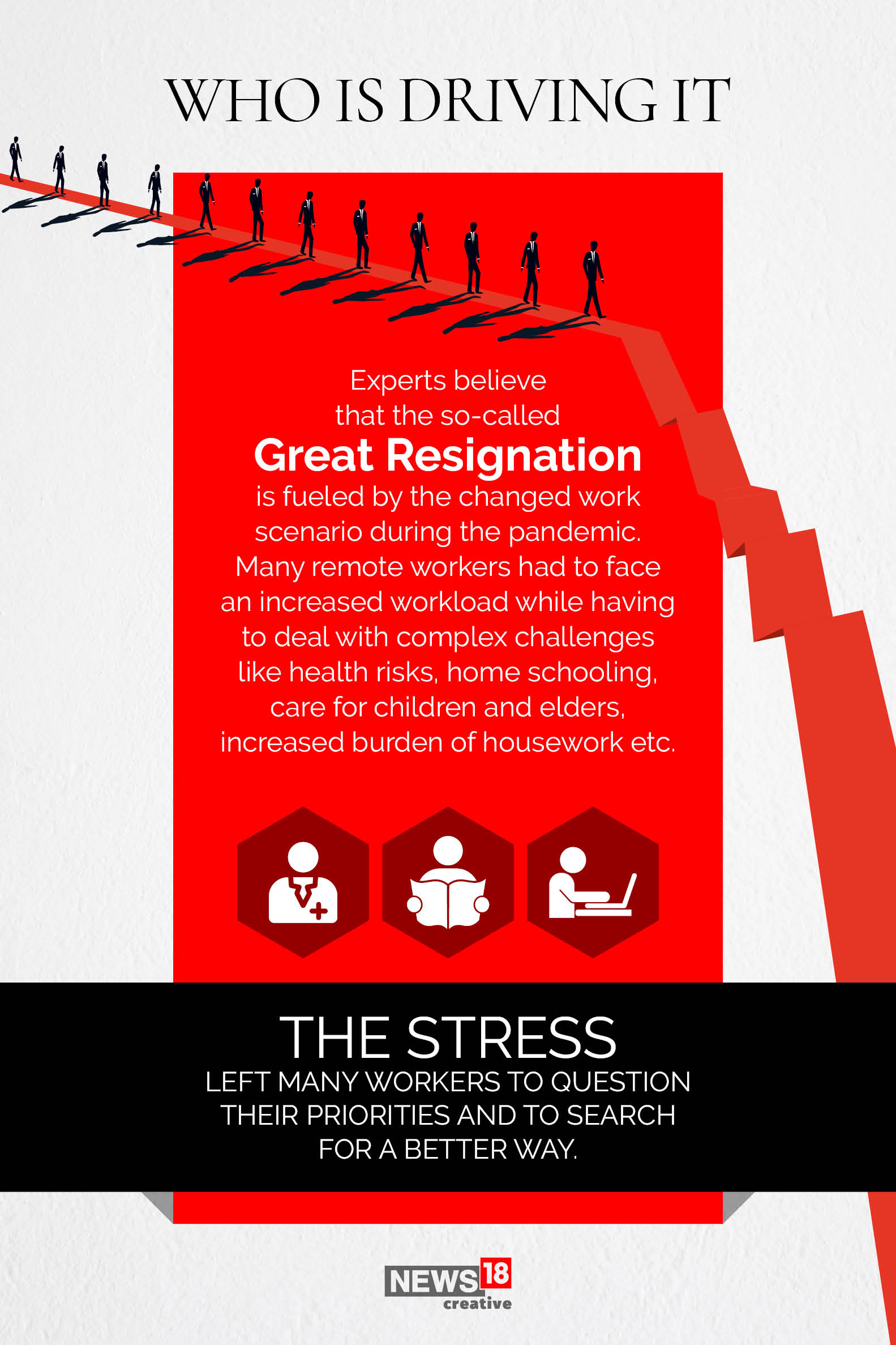
The workers who have stayed on at their jobs amid the Great Resignation are struggling to fill the gaps left by former colleagues, CNBC reported Nov. 2.
The effects of the Great Resignation continue to be felt by companies after a record high of 4.3 million workers quit their jobs in August alone. The workers who remained in their roles, though, are struggling with their new increased workload.
A report by the Society for Human Resource Management that surveyed 1,150 employed Americans in July as well as 220 executives illuminated some of the challenges of the workers who stayed.
It found that 52 percent of workers who stayed with their companies have taken on more responsibilities, with 30 percent of remaining employees stating they struggle to complete necessary tasks. A majority of workers are questioning whether their pay is high enough, and 27 percent feel less loyalty to their company.
This worker dissatisfaction opens up a vicious cycle, Johnny Taylor Jr., president and CEO of the Society for Human Resource Management, told CNBC.
“The employees who remain now say, ‘I’m working too hard, I don’t have balance in my life, etc.’ And so then they want to leave and thus a vicious cycle continues” Mr. Taylor told CNBC.
Thus, it’s more important now than ever for employers to exercise empathy and listen to what their employees are experiencing in the wake of workplace shifts.
“Invest in them today,” Alex Durand, a career transition and leadership coach, told CNBC. “Show them you care before they tell you they are leaving.”
Clinical labor costs are up by an average of 8% per patient day, translating to $17 million in additional annual labor expenses.
As the delta variant pushes COVID-19 caseloads to all-time highs, hospitals and health systems across the country are paying $24 billion more per year for qualified clinical labor than they did pre-pandemic, according to a new PINC AI analysis from Premier.
Clinical labor costs are up by an average of 8% per patient day when compared to a pre-pandemic baseline period in 2019. For the average 500-bed facility, this translates to $17 million in additional annual labor expenses since the beginning of the public health emergency.
The data also shows that overtime hours are up 52% as of September. At the same time, the use of agency and temporary labor is up 132% for full-time and 131% for part-time workers. The use of contingency labor – positions created to complete a temporary project or work function – is up nearly 126%.
Overtime and the use of agency staff are the most expensive labor choices for hospitals – usually adding 50% or more to a typical employee’s hourly rate, Premier found.
And hospital workers aren’t just putting in more hours – they’re also working harder. The analysis shows that productivity, measured in worked hours per unit of departmental volume, increased by an average of 7% to 14% year-over-year across the intensive care, nursing and emergency department units, highlighting the significance of the increases in cost-per-hour.
Another complicating factor is that hospital employees are more exposed to COVID-19 than many other workers, with quarantines and recoveries requiring the use of sick time. The data shows that use of sick time, particularly among full-time employees (FTEs) in the intensive care unit, is up 50% for full-time clinical staff and more than 60% for part-time employees when compared with the pre-pandemic baseline.
WHAT’S THE IMPACT
The combined stressors of working more hours while under the constant threat of coronavirus exposure are pushing many hospital workers to the breaking point. In fact, the data shows clinical staff turnover is reaching record highs in key departments like emergency, ICU and nursing.
Since the start of the pandemic, the annual rate of turnover across these departments has increased from 18% to 30%. This means nearly one-third of all employees in these departments are now turning over each year, which is almost double the rate from two years ago.
This is a number that could increase as new vaccination mandates take effect. Already, one Midwestern system reported a loss of 125 employees who chose not to be vaccinated, while a New York facility reported another 90 resignations. Overall, staffing agencies are predicting up to a 5% resignation rate once vaccine mandates kick in.
While a minority of the overall workforce, losses of even a few employees during times of extreme stress can have a ripple effect on hospital operations and costs.
THE LARGER TREND
According to the American Hospital Association, hospitals nationwide will lose an estimated $54 billion in net income over the course of the year, even taking into account the $176 billion in federal CARES Act funding from last year. Added staffing costs were not addressed as part of CARES and are further eating into hospital finances.
As a result, some are now predicting that more than half of all hospitals will have negative margins by the end of 2021 – a trend that could be dire for some community hospitals.
Prior to the pandemic, about one quarter of hospitals had negative margins, the Kaufman Hall data showed. At the beginning of 2021, after almost a year of COVID-19, half of hospitals had negative margins.
Meanwhile, the most potentially disruptive forces facing hospitals and health systems in the next three years are provider burnout, disengagement and the resulting shortages among healthcare professionals, according to a March survey of 551 healthcare executives.
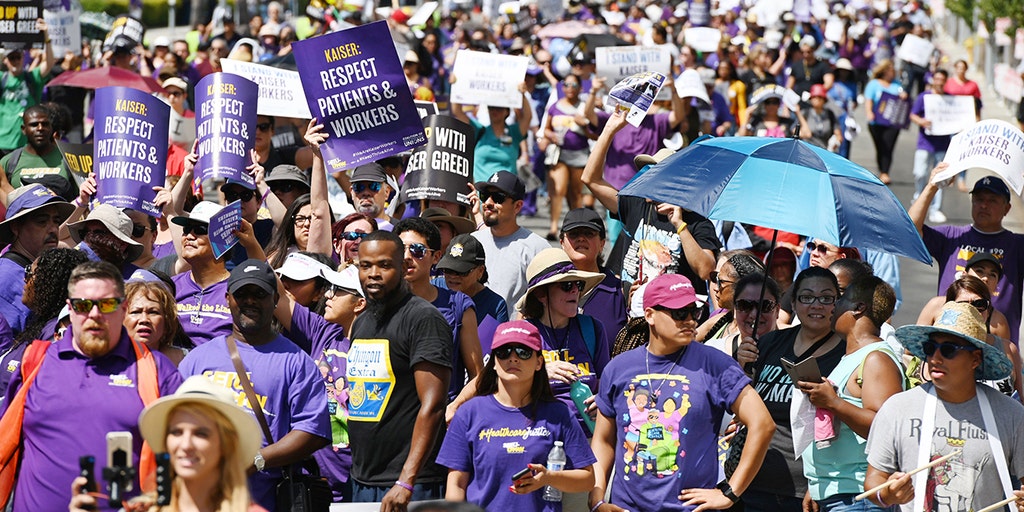
Nurses and other healthcare workers have voted to authorize a strike at Kaiser Permanente in Southern California, according to a union news release.
The vote covers 21,000 registered nurses, pharmacists, midwives, physical therapists and other healthcare professionals represented by the United Nurses Associations of California/Union of Health Care Professionals, as well as 7,000 members of United Steelworkers. It does not mean a strike is scheduled. However, it gives bargaining teams the option of calling a strike. Unions representing the workers would have to provide a 10-day notice before striking.
The vote comes as Oakland, Calif.-based Kaiser is negotiating for a national contract with UNAC/UHCP, along with about 20 other unions in the Alliance of Health Care Unions. The alliance, which has been in negotiations with Kaiser since April, covers more than 50,000 Kaiser workers nationwide.
UNAC/UHCP said union members are facing “protracted understaffing” amid record levels of burnout during the COVID-19 pandemic.
“While healthcare workers are facing record levels of burnout after 18 months of the COVID pandemic, they continue to deal with protracted understaffing. Talks at the table center on how to recruit to fill open positions that impact patient care and service,” the union said in a news release. “Kaiser Permanente … wants to slash wages for new nurses and healthcare workers and depress wages for current workers trying to keep up with rising costs for food, housing and other essentials.”
Kaiser has defended its pay amid a challenging pandemic, saying its proposal includes wage increases for current employees “on top of the already market-leading pay and benefits,” as well as a market-based compensation structure for those hired in 2023 and beyond.
In a statement shared with Becker’s Oct. 11, the system also emphasized its continued focus on high-quality, safe care.
“In the event of any kind of work stoppage, our facilities will be staffed by our physicians along with trained and experienced managers and contingency staff,” the system said.
This strike would affect Kaiser hospitals and medical centers in Anaheim, Bakersfield, Baldwin Park, Downey, Fontana, Irvine, Los Angeles, Ontario Vineyard, Panorama City, Riverside, San Diego, West Los Angeles and Woodland Hills, as well as various clinics and medical office buildings in Southern California.
The US now has more job openings than any time in history—and the mismatch in workforce supply and demand in the broader economy is even more acute in the healthcare sector. While the industry saw significant job losses in April 2020, employment in many healthcare subsectors quickly rebounded to slightly below pre-pandemic levels, according to data from the Bureau of Labor Statistics.
While ambulatory and hospital employment has mostly recovered, employment in nursing and residential care facilities has continued to decline.
Healthcare’s sluggish return to pre-pandemic employment levels is not for lack of demand. The number of job listings has grown nearly 30 percent since the second quarter of 2020, to nearly 4.5M openings, while new hires have flatlined, resulting in over half of healthcare job listings remaining unfilled as of Q2 2021.
In a recent McKinsey & Company survey of over 100 large US hospitals, health system executives ranked workforce shortages among nurses and clinical staff as their greatest barrier to increasing capacity.
Amid the current COVID surge, many systems are offering sizeable bonuses to attract new employees. These strategies will be critical across the next year, as systems look to reduce spending on costly travel nurses, manage COVID surges while continuing to offer elective care, and forestall further burnout.
But longer term, rethinking job functions, integrating new technology and finding ways to educate and upskill critical clinical talent will be key to winning the war for talent.
With vaccine mandates on the rise among healthcare organizations, including many of the health systems we work with, we’ve begun to hear a new argument in favor of getting staff vaccinated—one that weighs against the worry that mandates will drive scarce clinical workers away.
With staffing already stretched, some systems have been concerned that implementing mandates could worsen shortages and force an increase in the use of costly agency labor. But, some executives are now telling us, so could not vaccinating staff. As the highly contagious Delta variant continues to sweep through unvaccinated populations, clinical workers who haven’t gotten their shots are especially susceptible to contracting the virus.
That’s driven a sharp increase in unvaccinated nurses and other workers calling out sick with COVID symptoms, which has made a difficult staffing situation even worse.
Some of the high-profile reports of hospitals running out of beds in the face of the Delta variant are actually driven by running out of staff to keep those beds in use—making it even more critical to ensure that frontline workers are protected against the virus.
As a growing number of hospitals and other care facilities mandate that their workers get vaccinated, we’d hope this unwelcome pressure on an already stretched workforce begins to wane.








 HENRY KOTULA