Massive Growth in Expenses and Rising Inflation Fuel Continued Financial Challenges for America’s Hospitals and Health Systems

https://www.aha.org/costsofcaring

Hospitals are experiencing significant increases in expenses for workforce, drugs and medical supplies

Introduction

For over two years since the outset of the COVID-19 pandemic, America’s hospitals and health systems have been on the front lines caring for patients, comforting families and protecting communities.

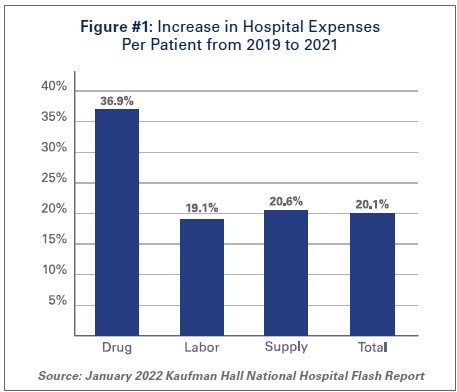
With over 80 million cases1, nearly 1 million deaths2, and over 4.6 million hospitalizations3, the pandemic has taken a significant toll on hospitals and health systems and placed enormous strain on the nation’s health care workforce. During this unprecedented public health crisis, hospitals and health systems have confronted many challenges, including historic volume and revenue losses, as well as skyrocketing expenses (See Figure #1).
Hospitals and health systems have been nimble in responding to surges in COVID-19 cases throughout the pandemic by expanding treatment capacity, hiring staff to meet demand, acquiring and maintaining adequate supplies and personal protective equipment (PPE) to protect patients and staff and ensuring that critical services and programs remain available to the patients and communities they serve. However, these and other factors have led to billions of dollars in losses over the last two years for hospitals, and over 33% of hospitals are operating on negative margins.

The most recent surges triggered by the delta and omicron variants have added even more pressure to hospitals. During these surges, hospitals saw the number of COVID-19 infected patients rise while other patient volumes fell, and patient acuity increased. This drove up expenses and added significant financial pressure for hospitals. Moreover, hospitals did not receive any government assistance through the COVID-19 Provider Relief Fund (PRF) to help mitigate rising expenses and lost revenues during the delta and omicron surges. This is despite the fact that more than half of COVID-19 hospitalizations have occurred since July 1, 2021, during these two most recent COVID-19 surges.

At the same time, patient acuity has increased, as measured by how long patients need to stay in the hospital. The increase in acuity is a result of the complexity of COVID-19 care, as well as treatment for patients who may have put off care during the pandemic. The average length of a patient stay increased 9.9% by the end of 2021 compared to pre-pandemic levels in 2019.4

As hospitals treat sicker patients requiring more intensive treatment, they also must ensure that sufficient staffing levels are available to care for these patients, and must acquire the necessary expensive drugs and medical supplies to provide high-quality care. As a result, overall hospital expenses have experienced considerable growth.

Data from Kaufman Hall, a consulting firm that tracks hospital financial metrics, shows that by the end of 2021, total hospital expenses were up 11% compared to pre-pandemic levels in 2019. Even after accounting for changes in volume that occurred during the pandemic, hospital expenses per patient increased significantly from pre-pandemic levels across every category. (See Figure #1)

The pandemic has strained hospitals’ and health systems’ finances. Many hospitals operate on razorthin margins, so even slight increases in expenses can have dramatic negative effects on operating margins, which can jeopardize their ability to care for patients. These expense increases have been more challenging to withstand in light of rising inflation and growth in input prices. In fact, despite modest growth in revenues compared to pre-pandemic levels, median hospital operating margins were down 3.8% by the end of 2021 compared to pre-pandemic levels, according to Kaufman Hall. Further exacerbating the problem for hospitals are Medicare sequestration cuts and payment increases that are well below increases in costs. For example, an analysis by PINC found that for fiscal year 2022, hospitals received a 2.4% increase in their Medicare inpatient payment rate, while hospital labor rates increased 6.5%.5

These levels of increased expenses and declines in operating margins are not sustainable. This report highlights key pressures currently facing hospitals and health systems, including:

  1. Workforce and contract labor expenses
  2. Drug expenses
  3. Medical supply and PPE expenses
  4. Rising economy-wide inflation

Each of these issues separately presents significant challenges to the hospital field. Taken together, they represent conditions that would be potentially catastrophic for most organizations, institutions and industries. However, the fact that the nation’s hospitals and health systems continue to serve on the front lines of the ongoing pandemic is a testament to their resiliency and steadfast commitment to their mission to serve patients and communities around the country.

Hospitals and health systems are the cornerstones of their communities. Their patients depend on them for access to care 24 hours a day, seven days a week. Hospitals are often the largest employers in their community, and large purchasers of local services and goods. Additional support is needed to help ensure hospitals have the adequate resources to care for their communities.

I. Workforce and Contract Labor Expenses

The hospital workforce is central to the care process and often the largest expense for hospitals. It is no surprise then that even before the pandemic, labor costs — which include costs associated with recruiting and retaining employed staff, benefits and incentives — accounted for more than 50% of hospitals’ total expenses. Therefore, even a slight increase in these costs can have significant impacts on a hospital’s total expenses and operating margins.

As the pandemic has persisted for over two years, the toll on the health care workforce has been immense. A recent survey of health care workers found that approximately half of respondents felt “burned out” and nearly a quarter of respondents said they anticipated leaving the health care field.6

This has been mirrored by a significant and sustained decline in hospital employment, down approximately 100,000 employees from pre-pandemic levels.7 At the height of the omicron surge, approximately 1,400 hospitals or 30% of all U.S. hospitals reporting data to the government, indicated that they anticipated a critical staffing shortage within the week.8 This high percentage of hospitals reporting a critical staffing shortage stayed relatively consistent throughout the delta and omicron surges.
The combination of employee burnout, fewer available staff, increased patient acuity and higher demand for care especially during the delta and omicron surges, has forced hospitals to turn to contract staffing firms to help address staffing shortages.

Though hospitals have long worked with contract staffing firms to bridge temporary gaps in staffing, the pandemic-driven-staffing-shortage has created an expanded reliance on contract staff, especially contract or travel registered nurses. Travel nurses are in particularly high demand because they serve a critical role in delivering care for both COVID-19 and non-COVID-19 patients and allow the hospital to meet the demand for care, especially during pandemic surges.

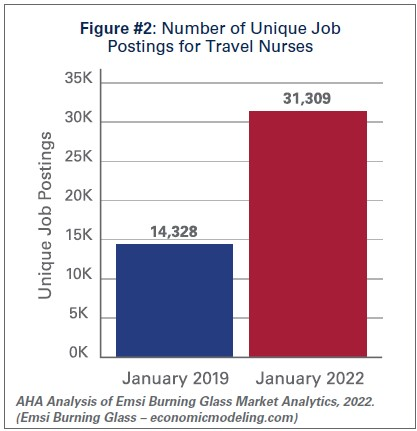
According to a survey by AMN Healthcare, one of the nation’s largest health care staffing agencies, 95% of health care facilities reported hiring nurse staff from contract labor firms during the pandemic.9 Staffing firms have increased their recruitment of contract or travel nurses, illustrating the significant growth in their demand. According to data from EMSI/Burning Glass, there has been a nearly 120% increase in job postings for contract or travel nurses from pre-pandemic levels in January 2019 to January 2022. (See Figure #2)

Similarly, the hours worked by contract or travel nurses as a percentage of total hours worked by nurses in hospitals has grown from 3.9% in January 2019 to 23.4% in January 2022, according to data from Syntellis Performance Solutions. (See Figure #3) In fact, a quarter of hospitals have experienced nearly a third of their total nurse hours accounted for by contract or travel nurses.
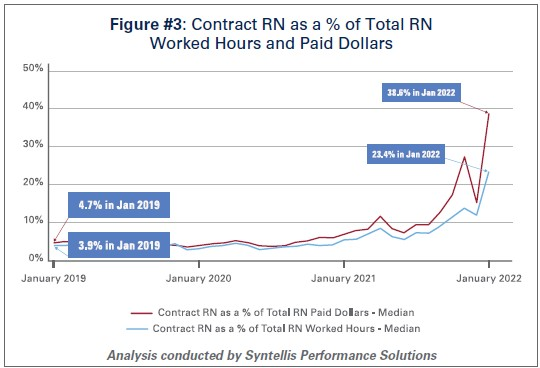
As the share of contract travel nurse hours has grown significantly compared to before the pandemic, so too have the costs of employing travel nurses compared to pre-pandemic levels. In 2019, hospitals spent a median of 4.7% of their total nurse labor expenses for contract travel nurses, which skyrocketed to a median of 38.6% in January 2022. (See Figure #3) A quarter of hospitals — those who have had to rely disproportionately on contract travel nurses — saw their costs for contract travel nurses account for over 50% of their total nurse labor expenses. In fact, while contract travel nurses accounted for 23.4% of total nurse hours in January 2022, they accounted for nearly 40% of the labor expenses for nurses. (See Figure #3) This difference has grown considerably compared to pre-pandemic levels in 2019, suggesting that the exorbitant prices charged by staffing companies are a primary driver of higher labor expenses for hospitals.

Data from Syntellis Performance Solutions show a 213% increase in hourly rates charged to hospitals by staffing companies for travel nurses in January 2022 compared to pre-pandemic levels in January 2019. This is because staffing agencies have exploited the situation by increasing the hourly rates billed to hospitals for contract travel nurses more than the hourly rates they pay to travel nurses. This is effectively the “margin” retained by the staffing agencies. During pre-pandemic levels in 2019, the average “margin” retained by staffing agencies for travel nurses was about 15%. As of January 2022, the average “margin” has grown to an astounding 62%. (See Figure #4)

These high “margins” have fueled massive growth in the revenues and profits of health care staffing companies. Several staffing firms have reported significant growth in their revenues to as high as $1.1 billion in just the fourth quarter of 202110, tripling their revenues and net income compared to 2020 levels.11

The data indicate that the growth in labor expenses for hospitals and health systems was in large part due to the exorbitant rates charged by contract staffing firms. By the end of 2021, hospital labor expenses per patient were 36.9% higher than pre-pandemic levels, and increased to 57% at the height of the omicron surge in January 2022.12 A study looking at hospitals in New Jersey found that the increased labor expenses for contract staff amounted to $670 million in 2021 alone, which was more than triple what their hospitals spent in 2020.13 High reliance on contract or travel staff prevents hospitals and health systems from investing those costs into their existing employees, leading to low morale and high turnover, which further exacerbates the challenges hospitals and health systems have been facing.

II. Drug Expenses

Prescription drug spending in the U.S. has grown significantly since the pandemic. In 2021, drug spending (including spending in both retail and non-retail settings) increased 7.7%14, which was on top of an increase of 4.9%15 in 2020. While some of this growth can be attributed to increased utilization as patient acuity increased during the pandemic, a significant driver has been the continued increase in prices of existing drugs as well as the introduction of new products at very high prices. A study by GoodRx found that in January 2022 alone, drug companies increased the price of about 810 brand and generic drugs that they reviewed by an average of 5.1%.16 These price increases followed massive price hikes for certain drugs often used in the hospital such as Hydromorphone (107%), Mitomycin (99%), and Vasopressin (97%).17 For another example, the drug manufacturer of Humira, one of the most popular brand drugs used to treat rheumatoid arthritis, increased the price of the drug by 21% between 2019 and 2021.18 A study by the Kaiser Family Foundation found that in Medicare Part B and D markets, half of all drugs in each market experienced price increases above the rate of inflation between 2019 and 2020 – in fact, a third of these drugs experienced price increases of greater than 7.5%.19 At the same time, according to a report by the Institute for Clinical and Economic Review (ICER), eight drugs with unsupported U.S. drug price increases between 2019 and 2020 alone accounted for an additional $1.67 billion in drug spending, further illustrating that drug companies’ decisions to raise the prices of their drugs are simply an unsustainable practice.20
As hospitals have worked to treat sicker patients during the pandemic, they have been forced to contend with sky-high prices for drugs, many of which are critical and lifesaving for their patients. For example, in 2020, 16 of the top 25 drugs by spending in Medicare Part B (hospital outpatient settings) had price increases greater than inflation — two of the top three drugs, Keytruda and Prolia — experienced price increases of 3.3% and 4.1%, respectively.21

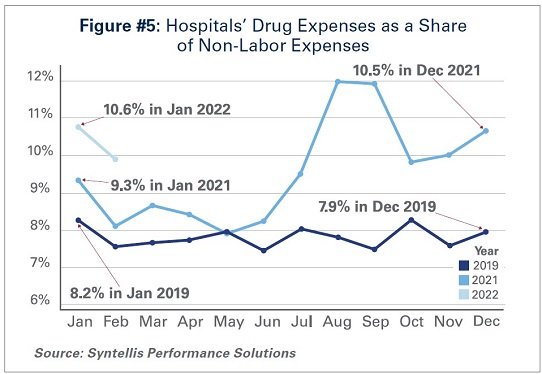
As a result of these price increases, hospital drug expenses have skyrocketed. By the end of 2021, total drug expenses were 28.2% higher than pre-pandemic levels.22 When taken as a share of all non-labor expenses, drug expenses have grown from approximately 8.2% in January 2019, to 9.3% in January 2021, and to 10.6% in January 2022. (See Figure #5) Even when considering changes in volume during the pandemic, drug expenses per patient compared to pre-pandemic levels in 2019 saw significant increases, with a 36.9% increase through 2021.

While continued drug price increases by drug companies have been a major driver of the growth in overall hospital drug expenses, there also are other important driving factors to consider:

  • Drug Treatments for COVID-19 Patients: Remdesivir, one of the primary drugs used to treat COVID-19 patients in the hospital, has become the top spend drug for most hospitals since the pandemic. This drug alone accounted for over $1 billion in sales in the fourth quarter of 2021.23 Priced at an average of $3,12024Remdesivir’s cost was initially covered by the federal government. However, hospitals must now purchase the drug directly.
  • Limitation of 340B Contract Pharmacies: The 340B program allows eligible providers, including hospitals that treat many low-income patients or treat certain patient populations like children and cancer patients, to buy certain outpatient drugs at discounted prices and use those savings to provide more comprehensive services to the patients and communities they serve. Since July 2020, several of the largest drug manufacturers have denied 340B pricing to eligible hospitals through pharmacies with whom they contract, despite calls from the Department of Health and Human Services that such actions are illegal. Because of these actions, many 340B hospitals, especially rural hospitals who disproportionately rely on contract pharmacies to ensure access to drugs for their patients, have lost millions in 340B drug savings.25 In addition, these manufacturers have required claim-level data submissions as a condition of receiving 340B discounts, which has increased costs to deliver the data as well as staff time and expense to manage that process. The loss of 340B savings coupled with increased burden of providing detailed data to drug companies have contributed to increasing drug expenses.
  • Health Plans’/Pharmacy Benefit Managers’ (PBMs’) “White Bagging” Policies: Health plans and PBMs have engaged in a tactic that steers hospital patients to third-party specialty pharmacies to acquire medication necessary for clinician-administered treatments, known as “white-bagging.” This practice disallows the hospital from procuring and managing the handling of a drug — typically drugs that are infused or injected requiring a clinician to administer in a hospital or clinic setting — used in patient care. These policies not only create serious patient safety concerns, but create delays and risks in patient care; add to administration, storage and handling costs; and create important liability issues for hospitals.

Taken together, these factors increase both drug expenses and overall hospital expenses.

III. Medical Supply and PPE Expenses

The U.S., like most countries in the world, relies on global supply chains for goods and services. This is especially true for medical supplies used at hospitals and other health care settings. Everything from the masks and gloves worn by staff to medical devices used in patient care come from a large network of global suppliers. Prior to the global pandemic, hospitals had established relationships with distributors and other vendors in the global health care supply chain to deliver goods as necessitated by demand. After the pandemic hit, many factories, distributors and other vendors shut down their operations, leaving hospitals, which were on the front lines facing surging demand, to fend for themselves. In fact, supply chain disruptions across industries, including health care, increased by 67% in 2020 alone.26

As a result, hospitals turned to local suppliers and non-traditional suppliers, often paying significantly higher rates than they did prior to the pandemic. Between fall 2020 and early 2022 costs for energy, resins, cotton and most metals surged in excess of 30%; these all are critical elements in the manufacturing of medical supplies and devices used every day in hospitals.27 As COVID-19 cases surged, demand for hospital PPE, such as N95 masks, gloves, eye protection and surgical gowns, increased dramatically causing hospitals to invest in acquiring and maintaining reserves of these supplies. Further, downstream effects from other global events such as the war in Ukraine and the energy crisis in China, as well as domestic issues, such as labor shortages and rising fuel and transportation costs, have all contributed to drive up even higher overall medical supply expenses for hospitals in the U.S.28 For instance, according to the Health Industry Distributors Association, transportation times for medical supplies are 440% longer than pre-pandemic times resulting in massive delays.29

Compared to 2019 levels, supply expenses for hospitals were up 15.9%30 through the end of 2021. When focusing on hospital departments involved most directly in care for COVID-19 patients − primarily hospital intensive care units (ICUs) and respiratory care departments − the increase in expenses is significantly higher. Medical supply expenses in ICUs and respiratory care departments increased 31.5% and 22.3%, respectively. Further, accounting for changes in volume during surge and non-surge periods of the pandemic, medical supply expenses per patient in ICUs and respiratory care departments were 31.8% and 25.9% higher, respectively. (See Figure #6) These numbers help illustrate the magnitude of the impact that increases in supply costs have had on hospital finances during the pandemic.

IV. Impact of Rising Inflation

Higher economy-wide costs have serious implications for hospitals and health systems, increasing the pressures of higher labor, supply, and acquisition costs; and potentially lower consumer demand. Inflation is defined as the general increase in prices and the decrease in purchasing power. It is measured by the Consumer Price Index (CPI-U). In April 2021, the Bureau of Labor Statistics (BLS) reported that the CPI-U had the largest 12-month increase since September 2008. The CPI-U hit 40-year highs in February 2022.31 Overall, consumer prices rose by a historic 8.5% on an annualized basis in March 2022 alone.32

As inflation measured by consumer prices is at record highs, below are key considerations on the potential impact of higher general inflation on hospital prices:

  • Labor Costs and Retention: Labor costs represent a significant portion of hospital costs (typically more than 50% of hospital expenses are related to labor costs). As the cost-of-living increases, employees generally demand higher wages/total compensation packages to offset those costs. This is especially true in the health care sector, where labor demands are already high, and labor supply is low.
  • Supply Chain Costs: Medical supplies account for approximately 20% of hospital expenses, on average. As input/raw good costs increase due to general inflation, hospital supplies and medical device costs increase as well. Furthermore, shortages of raw materials, including those used to manufacture drugs, could stress supply chains (i.e., medical supply shortages), which may result in changes in care patterns and add further burden on staff to implement work arounds.
  • Capital Investment Costs: Capital investments also may be strained, especially as hospitals have already invested heavily in expanding capacity to treat patients during the pandemic (e.g., constructing spaces for testing and isolation of COVID-19 patients). One of the areas that has seen the largest increase in prices/shortages is building materials (e.g., lumber). Additionally, a historically large increase in inflation has resulted in increases in interest rates, which may hamper borrowing options and add to overall costs.
  • Consumer Demand: Higher inflation also may result in decreases in demand for health care services, specifically if inflation exceeds wage growth. Specifically, higher costs for necessities (food, transportation, etc.) could push down demand for health care services and, in turn, dampen hospital volumes and revenues in the long run.
Health care and hospital prices are not driving recent overall inflation increases. The BLS has cited increases in the indices for gasoline, shelter and food as the largest contributors to the seasonally adjusted all items increase. The CPI-U increased 0.8% in February on a seasonally adjusted basis, whereas the medical care index rose 0.2% in February. The index for prescription drugs rose 0.3%, but the hospital index for hospital services declined 0.1%.33

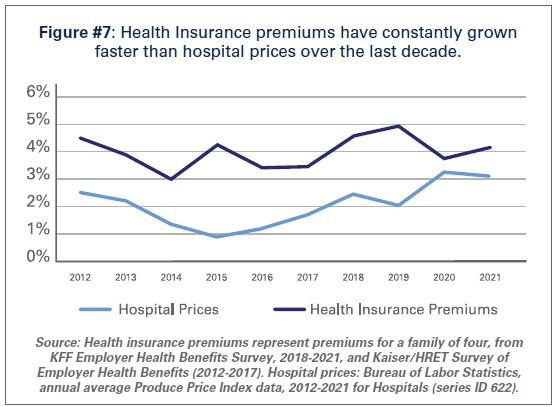
This is consistent with pre-pandemic trends. Despite persistent cost pressures, hospital prices have seen consistently modest growth in recent years. According to BLS data, hospital prices have grown an average 2.1% per year over the last decade, about half the average annual increase in health insurance premiums. (See Figure #7) More recently, hospital prices have grown much more slowly than the overall rate of inflation. In the 12 months ending in February 2022, hospital prices increased 2.1%. In fact, even when excluding the artificially low rates paid to hospitals by Medicare and Medicaid, average annual price growth has still been below 3% in recent years.34

Conclusion

While we hope that our nation is rounding the corner in the battle against COVID-19, it is clear that the pandemic is not over. During the week of April 11, there have been an average of over 33,000 cases per day35 and reports suggest that a new subvariant of the virus (Omicron BA.2) is now the dominant strain in the U.S.36 As a result, the challenges hospitals and health systems are currently facing are bound to last much longer.

As COVID-19 infections and hospitalizations are decreasing in some parts of the U.S. and increasing in others, hospitals and health systems continue to care for COVID-19 and non-COVID-19 patients. With additional surges potentially on the horizon, the massive growth in expenses is unsustainable. Most of the nation’s hospitals were operating on razor thin margins prior to the pandemic; and now, many of these hospitals are in an even more precarious financial situation. Regardless of potential new surges of COVID-19, hospitals and health systems continue to face workforce retention and recruitment challenges, supply chain disruptions and exorbitant expenses as outlined in this report.

Hospitals appreciate the support and resources that Congress has provided throughout the pandemic; however, additional support is needed now to keep hospitals strong so they can continue to provide care to patients and communities.


One-third of hospitals operating with negative margins & 6 other things to know

Hospitals and health systems have lost billions over the last two years, leaving more than 33 percent of them with negative margins, according to an April 25 report by the American Hospital Association.

Six findings:

1. Employment is down by 100,000 jobs compared to pre-pandemic levels, the U.S. Bureau of Labor Statistics found. But at a time when hospitals are desperately trying to fill positions, labor expenses per patient were 19.1 percent higher in 2021 than in 2019. Labor expenses are more than 50 percent of hospitals’ total expenses, meaning a small increase in labor costs can have a major effect on hospital’s total expenses and operating margins. 

2. The report attributed the increase in labor expenses to hospitals’ dependence on contract staff, specifically nurses. In 2019, travel nurses accounted for a median of 4.7 percent of hospitals’ total nurse labor expenses, compared to a median of 38.6 percent in January.

3. Hourly billing rates for contract employees rose 213 percent compared to pre-pandemic levels. This created a 62 percent profit margin for staff agencies.

4. Drug expenses soared by 36.9 percent per patient compared to pre-pandemic levels. 

5. Medical supply expenses also rose through 2021, by 20.6 percent, compared to pre-pandemic levels. For intensive care units and respiratory care departments — which were most involved in COVID-19 care — medical supply expenses grew 31.5 percent and 22.3 percent, respectively.

6. Economywide, the consumer price index saw major increases, the Bureau of Labor Statistics found. Meanwhile, hospital prices rose modestly, by an average of 2.1 percent per year in the last decade, about half the average annual increase in health insurance premiums. 

Retail wages are rising. Can hospital pay keep up?

While healthcare workers battle burnout, hospitals have been ramping up wages and other benefits to recruit and retain workers. It has created a culture of competition among health systems as well as travel agencies that offer considerably higher pay.

But other healthcare organizations are not hospitals’ only competitors. Some hospitals, particularly those in rural areas, are struggling to match rising employee pay among nonindustry employers such as Target and Walmart.

“We monitor and we’ve been looking and we ask around in the community and we can ask who’s paying what,” Troy Bruntz, CEO of Community Hospital in McCook, Neb., told Becker’s. “So we know where Walmart is on different things, and we’re OK. But if Walmart tried to match what Target’s doing, that would not be good.”

At Target, the hourly starting wage now ranges from $15-$24. The organization is making a $300 million investment total to boost wages and benefits, including health plans. Starting pay is dependent on the job, the market and local wage data, according to NPR.

Walmart raised the hourly wages for 565,000 workers in 2021 by at least $1 an hour, The New York Times reported. The company’s average hourly wage is $16.40, with the lowest being $12 and the highest being $17.

Meanwhile, Costco raised its minimum wage to $17 an hour, according to NPR. The federal minimum wage is $7.25.

Estimated employment for healthcare practitioners and technical occupations is 8.8 million, according to the latest data released March 31 by the U.S. Bureau of Labor Statistics. This includes nurse practitioners, physicians, registered nurses, physician assistants and respiratory therapists, among others. 

In sales and related occupations, estimated employment is 13.3 million, according to the bureau. This includes retail salespersons, cashiers and first-line supervisors of retail salespersons, among others.  

While retail companies up their wages, at least one hospital CEO is monitoring the issue.

Healthcare leaders weigh their options

Mr. Bruntz said rising wages among retailers is an issue his organization monitors. Although Target does not have a store in McCook, there is a Walmart, where pay is increasing.

“I was quoted a few months ago saying Walmart was approaching $15 an hour, and we can handle that,” Mr. Bruntz said. “But when it gets to $20 or $25, it’s going to be an issue.”

He also said he cannot solely increase the wages of the people making less than $15 or less than $25 because he has to be fair in terms of wages for different types of roles.

Specifically, he said he is concerned about what matching rising wages at retailers would mean for labor expenses, which make up about half of the hospital’s cost structure.

“I double that half, that’s 25 percent more expenses instantly,” Mr. Bruntz said. “And how is that going to ratchet to a bottom line anything less than a massive negative number? So it’s a huge problem.”

Clinical positions are not the only ones hospitals and health systems are struggling to fill; they are encountering similar difficulties with technicians and food service workers. Regarding these roles, competition from industries outside healthcare is particularly challenging.

This is an issue Patrice Weiss, MD, executive vice president and chief medical officer of Roanoke, Va.-based Carilion Clinic, addressed during a Becker’s panel discussion April 4. The organization saw workforce issues not just in its clinical staff, but among environmental services staff.

“When you look at what … even fast food restaurants were offering to pay per hour, well gosh, those hours are a whole lot better,” she said during the panel discussion. “There’s no exposure. You’re not walking into a building where there’s an infectious disease or patients with pandemics are being admitted.” 

Amid workforce challenges, Community Hospital is elevating its recruitment and retention efforts.

Mr. Bruntz touted the hospital as a hard place to leave because of the culture while acknowledging the monetary efforts his organization is making to keep staff.

He said the hospital has a retention program where full-time employees get a bonus amount if they are at the employer on Dec. 31 and have been there at least since April 15. Part-time workers are also eligible for a bonus, though a lesser amount.

“It also encourages staff [who work on an as-needed basis] to go part-time or full-time, and [those who are] part-time to go full-time,” Mr. Bruntz said. “That’s another thing we’re doing is higher amounts for higher status to encourage that trend.” 

Additionally, Community Hospital, which has 330 employees, offers a referral bonus to staff to encourage people they know to come work with them. 

“We want staff to bring people they like. [We are] encouraging staff to be their own ambassadors for filling positions,” Mr. Bruntz said.  

He said the hospital also will offer employees a sizable market wage adjustment not because of competition from Walmart but because of inflation.

Graham County Hospital in Hill City, Kan., is also affected by the tight labor market, although it has not experienced much competition with retail companies, CEO Melissa Atkins told Becker’s. However, the hospital is struggling with competition from other healthcare organizations, particularly when it comes to patient care departments and nursing. While many hospitals have struggled to retain employees from travel agencies, Graham County Hospital has mostly been able to avoid it.

“As the demand increases, so does the wage,” Ms. Atkins said. “In addition to other hospitals offering sign-on bonuses and increased wages, nurse agency companies are offering higher wages for traveling nurse aides and nurses. We are extremely fortunate in that we have not had to use agency nurses. Our current staff has stepped up and filled in the shortages [with additional incentive pay].”

To combat this trend, the hospital has increased hourly wages and shift differentials, as many healthcare organizations have done. It has also provided bonuses using COVID-19 relief funds.

Overall, Mr. Bruntz said he prefers “not to get into an arms race with wages” among nonindustry competitors. 

“It’s not going to end well for anybody. We prefer not to use that,” he said. “At the same time, we’re trying to do as much as possible without being in a full arms race. But if Walmart started paying $25 for a door greeter and cashier, we would have to reassess.”

U.S. added 467,000 jobs in January despite omicron variant surge

The U.S. economy added 467,000 jobs in January as the omicron variant spiked to record heights, with the labor market performing better than many expected two years after the pandemic began.

The unemployment rate ticked up slightly to 4 percent, from 3.9 percent the month before.

The monthly report, released by the Department of Labor, stems from a survey taken in mid-January, around the time the omicron variant was beginning to peak, with close to 1 million new confirmed cases each day. The rapid spread during that period upended many parts of the economy, closing schools, day cares, and a number of businesses, forcing parents to scramble.

But the labor market, according to the new data, performed very well during that stretch.

In addition to the robust January, the Department of Labor also revised upward the figure for December’s jobs report, to 510,000 from 199,000, and November, to 647,000 from 249,000. That means that there were some 700,000 more jobs added at the end of last year than previously estimated — showing a labor market with momentum heading into the new year.

The data sets show a labor market that continues to recover at a strong pace from the pandemic’s worst disruption in March and April of 2020.

New outbreaks and variants have sent shockwaves through the economy since then, but the labor market has continued to return, with companies working to add jobs and wages steadily rising.

The industries experiencing growth in January were lead by the leisure and hospitality sector, which added 151,000 jobs on the month, mostly in restaurants and bars. Professional and business services added 86,000 jobs. Retailers added 61,000 jobs in January, which is typically an off month. Transportation and warehousing added 54,000 jobs.

The labor market’s participation rate, a critical measurement that has never fully recovered from losses during the pandemic’s earliest days, also went up significantly, to 62.2 percent from 61.9 percent. That shows more people are reentering the labor force, looking for work.

Average hourly earnings increased by 23 cents on the month to $31.63, up 5.7 percent over the last year. However, those gains for many people have largely been wiped out by rising prices from inflation.

The data was collected during a tumultuous period. Nearly nine million workers were out sick around the time the survey was taken, and some of them could have been counted as unemployed based on the way the survey is conducted.

January is traditionally a weak month for employment when retail and other industries shed jobs after the holiday season. Economists say that seasonal adjustments made to the survey’s data to account for this have the potential to distort the survey in the other direction, given that the holiday shopping boom appeared to take place earlier this year than typical.

As such, predictions for job growth for the month had been all over the map. Analysts surveyed by Dow Jones predicted an average of about 150,000 jobs added for the month, in what would be the lowest amount added in a year. Some economists predicted job losses, of up to 400,000.

Last year was a strong year for growth in the labor market, with the country adding an average of more than 550,000 jobs a month — regaining some 6.5 million jobs lost in the pandemic’s earlier days, after the Department revised its numbers. The country has about 2.9 million fewer jobs than it had before the pandemic, according to the figures released Friday.

Omicron is going to make it look like things dropped off a cliff in January, but overall they did not,” said Drew Matus, chief market strategist for MetLife Investment Management.

Some economists like Matus say that the prospects for such rapid regrowth are more complicated this year, with the fiscal measures that boosted the economy during the pandemic’s first two years, like generous government aid, and record low interest rates from federal bankers, having largely expired, and the country’s confidence in a virus-free future dented after the winter wave.

Since the rollout of vaccines last year, there have been hopes that a return to a more typical rhythm of life could encourage some of the roughly two million people who have left the labor force during the pandemic to seek work anew, but thus far, continued threats from variants — and uncertainty after more closures of schools, daycares, and office — have prevented this from materializing in a substantial way.

There are signs that the omicron exacted a toll on the economy during its peak.

Weekly unemployment claims swelled mid-month to its highest level since October, though the numbers have come down in the two weeks since. Other statistical markers like passenger traffic at airports, hotel revenues, and dining reservations also took a hit during the month.

Recent months continue to be marked by incredible churn in the labor market, as record numbers of workers are switching jobs. In December, some 4.3 million people quit or changed jobs — a number which was down from an all-time high in November but still at elevated. Employers continue to report near record numbers of job openings: the Bureau of Labor Statistics said they reported some 10.9 million openings last month.

Companies ignoring employee demands will falter

Dive Brief:

  • Companies that fail to adjust to labor shortages and satisfy the growing demands of workers will likely falter as they lose the battle for talent, BlackRock CEO Larry Fink said in a letter to CEOs.
  • “No relationship has been changed more by the pandemic than the one between employers and employees,” Fink said, noting that “employees across the globe are looking for more from their employer — including more flexibility and more meaningful work.” Fink, while leading the world’s largest asset manager, has sought for a decade to influence corporate behavior through an annual CEO letter.
  • “As companies rebuild themselves coming out of the pandemic, CEOs face a profoundly different paradigm than we used to,” Fink said. Companies can no longer overlook employee mental health, insist that staff work in the office five days per week and provide modest wage increases for low- and middle-income workers.

Dive Insight:

CFOs considering an increase in prices and employee wages need to balance the imperative to sustain profits with pressures from the worst inflation and labor shortages in decades.

The persistence of COVID-19 has slowed the labor market’s post-lockdown recovery and churned up company payrolls. Fink noted that in November the quits rate, or the number of workers who left their jobs as a percent of total employment, rose to 3%, a record high first breached in September.

CFOs aiming to attract and retain employees with wage increases must take into account a 7% jump in the consumer price index (CPI) during the 12 months through December — the biggest surge since 1982.

“Workers demanding more from their employers is an essential feature of effective capitalism,” Fink said. Describing “a new world of work,” he said, “companies not adjusting to this new reality and responding to workers do so at their own peril.

“Turnover drives up expenses, drives down productivity and erodes culture and corporate memory,” Fink said. BlackRock manages more than $10 trillion in assets for institutional and retail investors.

In order to satisfy workers, CEOs must look beyond pay and workplace flexibility, Fink said. The coronavirus “shone a light on issues like racial equality, childcare and mental health — and revealed the gap between generational expectations at work.”

Fink also reiterated his support for “stakeholder capitalism,” saying that “a company must create value for and be valued by its full range of stakeholders in order to deliver long-term value for its shareholders.”

“Stakeholder capitalism is not about politics. It is not a social or ideological agenda. It is not ‘woke,’” he said. “It is capitalism driven by mutually beneficial relationships between you and the employees, customers, suppliers and communities your company relies on to prosper.”

Most stakeholders expect companies to help “decarbonize” the global economy, Fink said, predicting that so-called sustainable investment will surge well beyond the $4 trillion total.

BlackRock has asked companies to set short-, medium- and long-term targets for greenhouse gas reductions which “are critical to the long-term economic interests of your shareholders,” he said.

At the same time, “divesting from entire sectors — or simply passing carbon-intensive assets from public markets to private markets — will not get the world to net zero,” Fink said, adding that “BlackRock does not pursue divestment from oil and gas companies as a policy.”

Fink’s annual letter drew fire from environmentalists.

The letter “is just another rehashing of the same vague rhetoric, without any meaningful new commitment to actually help lead the necessary transition to a climate-safe future,” Ben Cushing, the Sierra Club’s fossil-free finance campaign manager, said in a statement.

Looking ahead to a year of belt-tightening

Looking ahead to a year of belt-tightening

https://mailchi.mp/92a96980a92f/the-weekly-gist-january-14-2022?e=d1e747d2d8

We’ve been having “year ahead” discussions with our health system members over the past few weeks, although it’s been difficult for some to carve out time for planning in the midst of the Omicron surge.

One common theme is that, from a financial perspective, 2022 is expected to be a more difficult year. For many systems, despite the trying COVID situation, the past two years have been financial record-setters. In 2020, systems benefited from a massive infusion of COVID relief funding from the government, and in 2021, they continued to enjoy enhanced reimbursement due to COVID, plus had a resurgence of volume as patients sought care that was previously postponed.

2022 looks to be a more “normal” year—meaning a return to the financial pressures of pre-pandemic times. Those include mounting price compression from payers, an accelerating shift of care from inpatient to outpatient settings, and increasing competition for patients from disruptors and others. At the same time, patient acuity will continue to rise, with patients presenting sicker and with more comorbidities. The cost of caring for those patients will escalate, as the workforce shortage drives labor costs higher and supply chain woes persist.

We’d anticipate a year or more of belt-tightening among many health systems, as they adjust to the post-pandemic environment.

Healthcare workers are hospitals’ greatest concern

https://mailchi.mp/92a96980a92f/the-weekly-gist-january-14-2022?e=d1e747d2d8

As COVID hospitalizations surge to new highs, healthcare workers have become the rate-limiting factor for most hospitals’ ability to deliver care. Using self-reported data collected by the Department of Health and Human Services, the graphic above shows that hospital staffing concerns reached an all-time high this month, with nearly one in three hospitals reporting a critical shortage. (Anecdotal evidence from our conversations with hospital leaders suggests that the actual number in crisis may be even higher, with every system we’ve spoken to in the past month reporting severe staffing challenges.)

During previous surges, COVID hospitalizations and reported staffing shortages have ebbed and flowed together. However, staffing challenges and case numbers became decoupled during the Delta surge, as the percentage of hospitals reporting staffing shortages did not go down as the Delta wave subsided.
 
With a growing number of nurses and other staff choosing early retirement or looking for jobs in other sectors, health systems are navigating the Omicron spike with a smaller pool of workers. And now the high transmissibility of the Omicron variant is forcing healthcare workers to quarantine in droves.

As shown on the map, this is playing out both in highly vaccinated states like Vermont and California, and less-vaccinated places like West Virginia and Wyoming. That’s leading some state health officials and health systems to allow COVID-positive staff who are asymptomatic or experiencing mild symptoms to continue working—a policy which is being sharply criticized by nurses

While the end of the Omicron surge should bring some relief, longer-term staffing challenges will surely remain for most health systems.

Patients “with COVID” who are admitted for other reasons still strain hospitals

https://mailchi.mp/92a96980a92f/the-weekly-gist-january-14-2022?e=d1e747d2d8

As new COVID strain rages, a look inside a packed Louisiana hospital: 'We  haven't had many wins' | Coronavirus | theadvocate.com

Some pundits claim that current reporting on COVID hospital admissions is overly pessimistic, failing to account for a distinction between patients admitted explicitly “for COVID”, and those admitted for other reasons who also, incidentally, have COVID. The latter now comprise up to half of some health systems’ COVID patients.

In an article in The Atlantic this week, reporter Ed Yong rejects this dichotomy, on the grounds that it ignores both the significant number of people for whom COVID exacerbates underlying chronic conditions, as well as the challenges any patient with COVID poses to hospitals. As he points out, those patients still require isolation and special safety measures, further worsening the burden on an already-strained staff.

The Gist: For hospitals, dealing with endemic COVID will mean establishing strategies to manage COVID-positive patients without postponing much needed non-emergency care, and without overly taxing a stretched workforce. Downplaying the burden of “incidental COVID” is not helpful, but sustaining operations while on perpetual crisis footing will prove untenable.

Omicron exacerbates existing staffing shortages

https://mailchi.mp/0b6c9295412a/the-weekly-gist-january-7-2022?e=d1e747d2d8

  1. The incredibly contagious new coronavirus variant is sidelining healthcare workers with breakthrough infections and quarantines, as patients flood into hospitals across the country. While hospitals are reporting that most infected patients are less sick, the sheer number of patients is pushing an already stressed system into crisis. 

The Gist: Given mounting evidence that Omicron is both causing less severe disease and evading vaccines, health systems will need to balance employee COVID testing and quarantine protocols against the constraints caused by mounting numbers of otherwise asymptomatic care workers out sick. As COVID becomes endemic, health systems must find a way to normalize operations even as they manage employee infections. It won’t be sustainable to continually revert to canceling non-emergent procedures (many of which carry clinical consequences to patients if they are delayed) and shifting to crisis standards of care. 

Consumer confidence unshaken by Omicron—at least so far

https://mailchi.mp/0b6c9295412a/the-weekly-gist-january-7-2022?e=d1e747d2d8

While Omicron’s rapid spread is causing COVID hospitalizations to surge once again, the impact on consumer confidence may be different this time around. Drawing on the most recent data from analytics firm Strata Decision Technology, the graphic above shows how hospital volumes have fluctuated throughout the pandemic. Hospital volumes mostly returned to pre-COVID levels early last summer, until the Delta surge caused patients to begin avoiding care across all settings once again. 

It remains to be seen if the forty percent of consumers who said they were less likely to seek non-emergency care during the Delta surge feel similarly about the Omicron spike. So far, consumer sentiment seems to be holding steady at last summer’s levels, though we’re still a few weeks away from Omicron’s expected peak. 

As the pandemic enters its third year, it’s also likely that consumers who have been delaying care will simply be unwilling or unable to hold off any longer. But even if Omicron doesn’t dissuade consumers from seeking non-COVID care, health systems will be hard pressed to accommodate both COVID and non-COVID care amid worrisome staffing shortages.