What role should the federal government play in addressing major healthcare issues? And does the way you vote affect your prospects for a long and healthy life? We talked about it on today’s episode of the 4sight Friday Roundup podcast.
David Johnson is CEO of 4sight Health.
Julie Vaughan Murchinson is Partner of Transformation Capital and former CEO of Health Evolution.
David Burda is News Editor and Columnist of 4sight Health.
At its annual meeting this week, the AMA’s policymaking arm voted to adopt resolutions opposing state efforts that criminalize abortion or limit access to reproductive healthcare. This comes ahead of the much-anticipated Supreme Court decision, which is expected to overturn the 1973 Roe v. Wade decision. The nation’s largest physician organization joined the American College of Obstetricians and Gynecologists in calling on the Food and Drug Administration to make birth control pills available over-the-counter and without age restrictions. The AMA also declared climate change a public health crisis, as physicians are already seeing negative health effects from heat-related injuries.
The Gist: As a new generation of physicians has entered the workforce, the policy priorities of physician lobbying organizations have evolved. We are seeing a growing interest in addressing hot-button social issues head-on. The AMA has declared both gun violence and racism to be public health issues, and supports health insurance coverage expansion, positions that would have been unimaginable a few decades ago.
Though progressive on social issues, however, the AMA is still advocating against state efforts to expand mid-level providers’ scope of practice—maintaining its traditional role as a protector of the physician guild.
The Biden administration recently signaled that it will extend the federal COVID-19 public health emergency (PHE), which has been in place for nearly two-and-a-half years, beyond its current July 15 expiration date. As shown in the graphic above, a number of key pandemic-era policies would end if the PHE were discontinued. Hospitals, already experiencing financial challenges, would face an immediate 20 percent reduction in Medicare reimbursement for each hospitalized COVID patient.
Combined with the end of funding for treating uninsured COVID patients, and with millions of Americans expected to lose Medicaid coverage when eligibility checks restart, the cost of treating COVID patients will fall more heavily on providers. More treatment costs will also be passed on to patients, as most private insurers no longer waive cost-sharing for COVID care.
On the telemedicine front, Congress has temporarily extended some Medicare telehealth flexibilities (including current payment codes and coverage for non-rural beneficiaries) for five months after the PHE ends, while CMS studies permanent coverage options. But further Congressional action will be required to keep current Medicare telehealth coverage in place, and these decisions will surely influence private insurers’ telehealth reimbursement policies.
Although the Biden administration promises that it will provide sixty days’ notice before terminating the PHE or letting it expire, providers must prepare for the inevitable financial hit when the PHE ends.
In an effort to rein in healthcare costs for its employees, Walmart sends them directly to health systems that demonstrate high-quality care outcomes, otherwise known as Centers of Excellence.
Through the COE program, Walmart will cover the travel and treatment costs for employees seeking a range of services, but only with providers the company is contracted with. Walmart then reimburses with bundled payments negotiated with the providers.
To determine which providers get access to its 1.6 million employees, Walmart starts by examining health systems. Lisa Woods, vice president of physical and emotional well-being at Walmart, and her team analyze public data, distribute requests for information and conduct detailed on-site visits.
Below are the 18 health systems or campuses to which Walmart will refer patients for defined episodes of care in 2022. (See how COE participants have evolved since 2019 or 2021.)
A certain segment of the health policy world spends a lot of time trying to get more states to expand Medicaid and reduce underinsurance.
But are we doing enough to make sure care is accessible once people enroll? One issue is access to physicians, who are less likely to treat patients on Medicaid than Medicare or private insurance because Medicaid payment rates are lower.
A new paper in Health Affairs by Avital Ludomirsky and colleagues looked at how well the networks of physicians supposedly participating in Medicaid reflect access to care. The researchers used claims data and provider directories from Medicaid managed care plans (the private insurers that most states contract with to run their Medicaid programs) in Kansas, Louisiana, Michigan and Tennessee from 2015 and 2017 to assess how the delivery of care to Medicaid patients was distributed among participating doctors. Their results were striking:
One-quarter of primary care physicians provided 86% of the care; one-quarter of specialists provided 75%.
One-third of both types of physicians saw fewer than 10 Medicaid patients per year, hardly contributing any “access” at all.
There was only one psychiatrist for every 8,834 Medicaid enrollees after excluding those seeing fewer than 10 Medicaid patients per year. This is especially concerning given that the COVID-19 pandemic has worsened mental health in the U.S., particularly among children.
The authors note that their study only covers primary care and mental health providers in four states, so it is not necessarily generalizable to other states or specialties. But these results are still concerning.
States have so-called network adequacy standards for their Medicaid managed care plans that are supposed to make sure there are enough providers. These standards typically rely on either a radius (a certain number of providers for a geographic area) or ratio (number of providers per enrollee), but the authors’ findings show these methods fall short if they are based on directories alone.
The authors specifically recommend states use claims-based assessments like the ones in the study and “secret shopper” programs — like this recently published one from Maryland by Abigail Burman and Simon Haeder — to better evaluate whether plans are offering adequate access to physicians. We absolutely need people to have coverage, but it needs to be more than just a card in their wallet.
Corporate America is facing a flurry of questions about how it provides health benefits in the wake of a leaked U.S. Supreme Court draft that indicates the federal right to abortion could be overturned.
Why it matters: Businesses hoping to use reproductive health benefits as part of efforts to recruit and retain employees would have to be careful not to run afoul of laws should states be allowed to ban abortions.
The balancing act over the next several months could get messy, experts warn.
What they’re saying: “It’s a serious issue for employers,” said Candice Sherman, the CEO of the Northeast Business Group on Health. The group represents roughly 80 large companies such as American Express, Colgate, Moderna and Pfizer.
Limits on abortion coverage have the potential to impact the physical and mental health of the workforce and could come as many employers are addressing equity and inclusion for women, people of color and LGBTQ employees, Sherman said.
That is often communicated by companies through benefit design.
State of play: Some large companies like Amazon, Apple and Lyft have already announced plans to provide workarounds in those states with abortion restrictions.
But many others are still on the sidelines as they tease out employees’ priorities on abortion-related benefits, as well as the potential costs and legal risks.
Eleven states restrict insurance coverage of abortion in all private insurance plans written in the state, including those offered through Affordable Care Act markets, according to the Guttmacher Institute. Six other states require abortion coverage in private health insurance plans.
Zoom in: One of the most immediate questions is what kind of employer-sponsored abortion coverage — as well as enhanced benefits like travel stipends — might create legal liabilities for companies in states that ban abortion.
“There’s a question as to whether providing transportation benefits could be construed, or at least alleged by the states in enforcement, as aiding and abetting,” said Garrett Hohimer, director of policy and advocacy for the Business Group on Health. That group counts corporations like The Walt Disney Co., Walmart and General Motors among its members.
Yes, but: In the case of a challenge, companies would have a strong argument that federal protections for providing abortion care benefits preempt state laws, Emily Dickens, the head of government affairs for the Society for Human Resource Management, told Axios.
Dickens pointed specifically to the Pregnancy Discrimination Act which specifically says an employer is permitted to provide health insurance coverage for abortion, as well as protections under ERISA law.
But, but, but: It’s not a sure thing. For instance:“ERISA is not a get out of jail free card,” Hohimer warned, saying there is some question about how the law would be interpreted.
While experts largely believe the Affordable Care Act would provide protections for birth control coverage, it’s unclear how fertility benefits such as egg freezing, surrogacy or in vitro fertilization might be affected, Sherman said.
What to watch: Many large companies already offer health benefits allowing workers to travel to Centers of Excellence for procedures like joint replacements or cancer care.
Those kinds of benefits will likely gain more attention because of the attention surrounding reproductive health, Hohimer said.
Sherman said this may also raise questions about whether there’s flexibility in the tax code to expand the scope of Flexible Spending Accounts or Health Savings Accounts to cover travel for any health care issues.
The bottom line: “Assuming this discussion comes down the way we think it may, organizations are going to have to work very hard,” Sherman said.
Changes are coming to Washington’s state charity care law July 1.
Four things to know:
1. The new law establishes mandatory discount standards for patients from 101 percent to 200 percent of the federal poverty level, according to the Washington State Hospital Association.
2. It establishes two tiers of hospitals and establishes mandated free and discounted care for each based on a patient’s family size and income relative to the federal poverty level, according to the association. Tier 1 includes hospitals that are part of larger systems. Tier 2 includes smaller, independent, and rural hospitals.
3. Hospitals must adopt procedures to identify patients eligible for retroactive Medicaid eligibility and assist them in applying for coverage, according to the association. Hospitals are not required to provide charity care to patients who do not make reasonable efforts to comply with the application process.
4. The law establishes a definition of “indigent persons” who may qualify for charity care, according to the Washington State Hospital Association. It specifies that indigent persons are those who meet the federal poverty level thresholds and have exhausted any third-party coverage.
The formal end of the pandemic could swell the ranks of uninsured children by 6 million or more as temporary reforms to Medicaid are lifted.
Why it matters: Gaps in coverage could limit access to needed care and widen health disparities, by hitting lower-income families and children of color the hardest, experts say.
The big picture: A requirement that states keep Medicaid beneficiaries enrolled during the public health emergency in order to get more federal funding is credited with preventing a spike in uninsured adults and kids during the crisis.
Children are the biggest eligibility group in Medicaid, especially in the 12 states that haven’t expanded their Medicaid programs under the Affordable Care Act.
The lifting of the public health emergency, which was just extended to July 15, will lead states to determine whether their Medicaid enrollees are still eligible for coverage — a complicated process that could result in millions of Americans being removed from the program.
That would more than double the number of uninsured kids, which stood at 4.4 million in 2019.
“It is a stark, though we believe conservative, estimate,” said Joan Alker, the center’s executive director. “There are a lot of children on Medicaid.”
Between the lines: Not all of the Medicaid enrollees who are removed from the program would become uninsured. But parents and their children could be headed down different paths if their household income has risen even slightly.
Adults who’ve returned to work may be able to get insurance through their employer. Others could get coverage through the ACA marketplace, though it’s unclear whether that would come the COVID-inspired extra financial assistance that’s now being offered.
Most kids would be headed for the Children’s Health Insurance Program, Alker said — a prospect that can entail added red tape and the payment of premiums or an annual enrollment fee, depending on the state.
What we’re watching: Changes in children’s coverage could be most pronounced in Texas, Florida and Georgia — the biggest non-Medicaid expansion states, which have higher rates of uninsured children than the national average.
Congress could still require continuous Medicaid coverage, the way the House did when it passed the sweeping social policy package that stalled in the Senate over cost concerns.
CMS’ Office of the Actuary projects a smaller decline in Medicaid enrollment than some health policy experts are predicting — and the Biden administration continues to move people deemed ineligible for Medicaid onto ACA plans, Raymond James analyst Chris Meekins noted in a recent report on the unwinding of the public health emergency.
President Joe Biden proposed a change in federal regulations April 5 to expand health coverage to millions of people through the Affordable Care Act.
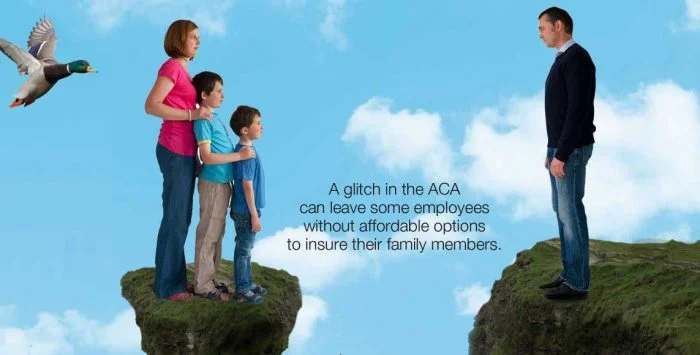
The proposal aims to close what is known as the “family glitch,” according to a press release.
People who do not have access to affordable health coverage through their employers can qualify for subsidies to purchase coverage through the ACA marketplace. The federal definition of affordable employer-provided coverage is only for single individuals and not for family members, meaning about 5 million people are ineligible for the marketplace subsidy.
To fix the glitch, the proposal directs the Treasury Department and Internal Revenue Service to allow family members of employees who are offered affordable self-only coverage but unaffordable family coverage to qualify for the subsidies to purchase family health coverage through the ACA marketplace. If the rule is approved, an estimated 200,000 uninsured people would gain coverage, and nearly 1 million would see their coverage become more affordable.
President Biden will also sign an executive order Tuesday directing agencies to find ways to make coverage more affordable for more people.









 HENRY KOTULA