Humana, the nation’s second-largest Medicare Advantage (MA) insurer, is pushing further into home-based care, partnering with Denver-based startup DispatchHealthto offer its members—especially those with conditions like heart failure, chronic obstructive pulmonary disease, and chronic cellulitis—access tohospital-level care at home.
The service will initially be available in the Denver and Tacoma, WA markets, with plans to expand to Arizona, Nevada, and Texas across 2021. Humana members who meet hospital admission criteria will receive daily home visits from an on-call, dedicated DispatchHealth medical team, as well as 24/7 physician coverage enabled by remote monitoring and an emergency call button.
DispatchHealth will also coordinate other patient care and wraparound services in the home as needed, including pharmacy, imaging, physical therapy, durable medical equipment, and meal delivery. Dispatch’s earlier offerings centered around home-based, on-demand urgent and emergency care services, now available in at least 29 cities nationwide.
Humana’s partnership with DispatchHealth could deliver a full care continuum of home-based services to its Medicare Advantage enrollees and has the potential to displace hospitals from at least a portion of acute care services.
Post-COVID, it’s becoming increasingly clear that the nexus of care delivery has shifted even more rapidly to consumers’ homes—and traditional providers will need to rethink service strategies accordingly.
As the oft-cited 10,000 Baby Boomers continue to age into Medicare each day, Medicare Advantage (MA) enrollment keeps accelerating. The graphic above highlights growth in the MA ranks across the last decade, showing that enrollment has more than doubled since 2010. By the end of this year, an estimated 42 percent of Medicare beneficiaries will get their benefits through a private health insurer.
While seniors like MA plans for the growing number of supplemental benefits they can offer—which now include adult day care services, home-based palliative care, and in-home support services—health insurers are gravitating to these plans due to their attractive economics.
Health insurers’ average gross margin per member, per month (PMPM) for MA plans is significantly higher than in individual or group market plans, a spread that increased in 2020 due to reduced utilization. PMPM margins for MA plans were up an average of 35 percent through September 2020 compared to 2019.
Payers have been blanketing the market with plan options in recent years;the number of MA plans offered has increased 49 percent since 2017, although the MA market is increasingly concentrated. In spite of numerous headlines about venture-backed startups like Oscar, Bright Health Plan, and Devoted Health posting double- or triple-digit growth numbers, the MA market is still dominated by UnitedHealthcare and Humana, which together account for 44 percent of all MA enrollees nationwide.
Health insurers are no longer immune from federal antitrust scrutiny for conduct considered the business of insurance.
The Competitive Health insurance Reform Act of 2020 became law on January 13, a move praised by the Department of Justice but opposed by health insurers.
Health insurers are no longer immune from federal antitrust scrutiny for conduct considered the business of insurance and regulated by state law.
With enactment of the Competitive Health Insurance Reform Act, the DOJ and Federal Trade Commission have expanded authority to prosecute alleged anticompetitive behavior, including data sharing between insurers.
The McCarran-Ferguson Act previously afforded immunity by exempting from federal antitrust laws certain conduct considered the “business of insurance.” This exemption has sometimes been interpreted by courts to allow a range of what the Justice Department considered “harmful” anticompetitive conduct in health insurance markets.
The new law aims to promote more competition in health insurance markets by limiting the scope of conduct that’s exempt from antitrust laws. This move was praised by the Trump Justice Department shortly before the former president left office.
WHAT’S THE IMPACT?
The antitrust scrutiny is coming at a time when insurers are under a deadline to meet interoperability standards to share information with patients that meet Fast Healthcare Interoperability Resources, or FHIR, standards.
Eliminating the exemption undermines the goal of affordable coverage by adding administrative red tape and reducing market competition, according to Matt Eyles, president and CEO of America’s Health Insurance Plans.
“The McCarran-Ferguson Act recognized that all healthcare is local, and that states should be able to govern their own health insurance markets,” Eyles said in December. “Removal of this exemption adds tremendous administrative costs while delivering absolutely no value for patients and consumers. It will unnecessarily add layers of bureaucracy, destabilize markets, create conflicting federal and state oversight requirements, and lead to costly litigation.”
The National Association of Insurance Commissioners sent a letter to Senate leaders on December 2 voicing its concern for the bill’s passage.
“The premise of the Competitive Health Insurance Reform Act is that collusion among health insurance companies is permitted under state law and that the McCarran-Ferguson Act somehow currently protects these practices. This is not true. The McCarran-Ferguson antitrust exemption for health insurance does not allow or encourage conspiratorial behavior but simply leaves oversight of insurance, including health insurance, to the states – and state laws do not allow collusion,” commissioners said.
“The potential for bid rigging, price-fixing and market allocation is of great concern to state insurance regulators and we share your view that such practices would be harmful to consumers and should not be tolerated. However, we want to assure you that these activities are not permitted under state law,” commissioners wrote.
While insurers have not been thrilled with the move, Consumer Reports said the legislation is good for providers who have felt pressured into contract terms that benefit insurers.
THE LARGER TREND
The Justice Department has a track record of successfully enforcing the antitrust laws against health insurers. Over the past five years, the department has enforced the antitrust laws against health insurers involved in transactions valued at over $160 billion.
The Act will help the department build on those successes by requiring health insurers to play by the same rules as competitors in other industries. It will clarify when health insurers qualify for the McCarran-Ferguson exemption, and it will enable the Antitrust Division to spend resources more efficiently to achieve desired results, the Justice Department said.
On January 13, Trump signed into law the Competitive Health Insurance Reform Act of 2020, which limits the antitrust exemption available to health insurance companies under the McCarran-Ferguson Act. The act, sponsored by Rep. Peter DeFazio (D-Ore), passed the House of Representatives on Sept. 21, 2020 and passed the Senate on Dec. 22.
When COVID-19 first swarmed the United States, one health insurer called some customers with a question: Do you have enough to eat?
Oscar Health wanted to know if people had adequate food for the next couple weeks and how they planned to stay stocked up while hunkering down at home.
“We’ve seen time and again, the lack of good and nutritional food causes members to get readmitted” to hospitals, Oscar executive Ananth Lalithakumar said.
Food has become a bigger focus for health insurers as they look to expand their coverage beyond just the care that happens in a doctor’s office. More plans are paying for temporary meal deliveries and some are teaching people how to cook and eat healthier foods.
Benefits experts say insurers and policymakers are growing used to treating food as a form of medicine that can help patients reduce blood sugar or blood pressure levels and stay out of expensive hospitals.
“People are finally getting comfortable with the idea that everybody saves money when you prevent certain things from happening or somebody’s condition from worsening,” said Andrew Shea, a senior vice president with the online insurance broker eHealth.
This push is still relatively small and happening mostly with government-funded programs like Medicaid or Medicare Advantage, the privately run versions of the government’s health program for people who are 65 or older or have disabilities. But some employers that offer coverage to their workers also are growing interested.
Medicaid programs in several states are testing or developing food coverage. Next year, Medicare will start testing meal program vouchers for patients with malnutrition as part of a broader look at improving care and reducing costs.
Nearly 7 million people were enrolled last year in a Medicare Advantage plan that offered some sort of meal benefit, according to research from the consulting firm Avalere Health. That’s more than double the total from 2018.
Insurers commonly cover temporary meal deliveries so patients have something to eat when they return from the hospital. And for several years now, many also have paid for meals tailored to patients with conditions such as diabetes.
But now insurers and other bill payers are taking a more nuanced approach. This comes as the coronavirus pandemic sends millions of Americans to seek help from food banks or neighborhood food pantries.
Oscar Health, for instance, found that nearly 3 out of 10 of its Medicare Advantage customers had food supply problems at the start of the pandemic, so it arranged temporary grocery deliveries from a local store at no cost to the recipient.
The Medicare Advantage specialist Humana started giving some customers with low incomes debit cards with either a $25 or $50 on them to help buy healthy food. The insurer also is testing meal deliveries in the second half of the month.
That’s when money from government food programs can run low. Research shows that diabetes patients wind up making more emergency room visits then, said Humana executive Dr. Andrew Renda.
“It may be because they’re still taking their medications but they don’t have enough food. And so their blood sugar goes crazy and then they end up in the hospital,” he said.
The Blue Cross-Blue Shield insurer Anthem connected Medicare Advantage customer Kim Bischoff with a nutritionist after she asked for help losing weight.
The 43-year-old Napoleon, Ohio, resident had lost more than 100 pounds about 11 years ago, but she was gaining weight again and growing frustrated.
The nutritionist helped wean Bischoff from a so-called keto diet largely centered on meats and cheeses. The insurer also arranged for temporary food deliveries from a nearby Kroger so she could try healthy foods like rice noodles, almonds and dried fruits.
Bischoff said she only lost a few pounds. But she was able to stop taking blood pressure and thyroid medications because her health improved after she balanced her diet.
“I learned that a little bit of weight gain isn’t a huge deal, but the quality of my health is,” she said.
David Berwick of Somerville, Massachusetts, credits a meal delivery program with improving his blood sugar, and he wishes he could stay on it. The 64-year-old has diabetes and started the program last year at the suggestion of his doctor. The Medicaid program MassHealth covered it.
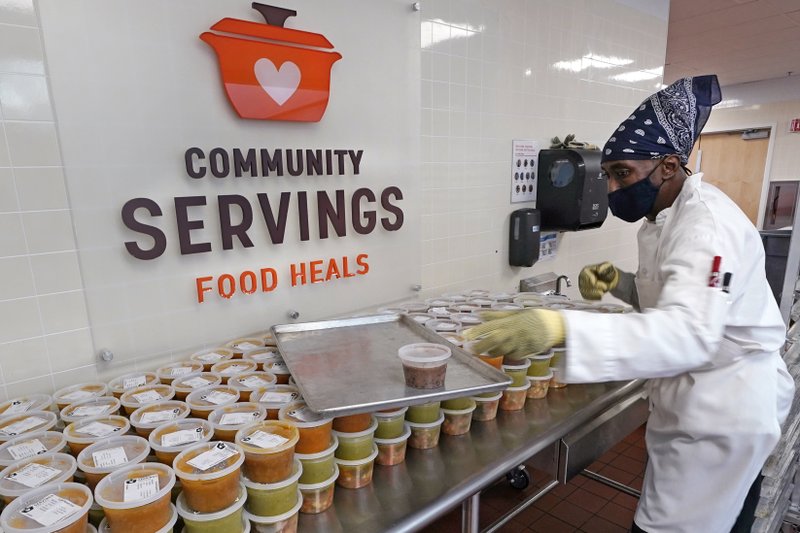
Berwick said the nonprofit Community Servings gave him weekly deliveries of dry cereal and premade meals for him to reheat. Those included soups and turkey meatloaf Berwick described as “absolutely delicious.”
“They’re not things I would make on my own for sure,” he said. “It was a gift, it was a real privilege.”
These programs typically last a few weeks or months and often focus on customers with a medical condition or low incomes who have a hard time getting nutritious food. But they aren’t limited to those groups.
Indianapolis-based Preventia Group is starting food deliveries for some employers that want to improve the eating habits of people covered under their health plans. People who sign up start working with a health coach to learn about nutrition.
Then they can either begin short-term deliveries of meals or bulk boxes of food and recipes to try. The employer picks up the cost.
It’s not just about hunger or a lack of good food, said Chief Operating Officer Susan Rider. They’re also educating people about what healthy, nutritious food is and how to prepare it.
Researchers expect coverage of food as a form of medicine to grow as insurers and employers learn more about which programs work best. Patients with low incomes may need help first with getting access to nutritional food. People with employer-sponsored coverage might need to focus more on how to use their diet to manage diabetes or improve their overall health.
A 2019 study of Massachusetts residents with similar medical conditions found that those who received meals tailored to their condition had fewer hospital admissions and generated less health care spending than those who did not.
Study author Dr. Seth Berkowitz of the University of North Carolina noted that those meals are only one method for addressing food or nutrition problems. He said a lot more can be learned “about what interventions work, in what situations and for whom.”
A lack of healthy food “is very clearly associated with poor health, so we know we need to do something about it,” Berkowitz said.
UnitedHealth Group, both the nation’s largest health insurer and largest employer of physicians, just announced plans to continue to rapidly grow the number of physicians in its Optum division.
This week CEO Dave Wichmann told investors in the company’s fourth quarter earnings call that Optum entered 2021 with over 50,000 employed or affiliated physicians, and expects to add at least 10,000 more across the year.(For context,HCA Healthcare, the largest for-profit US health system, employs or affiliates with roughly 46,000 physicians, and Kaiser Permanente employs about 23,300.) Optum is already making progress toward its ambitious goal with the announcement last week that the company is in talks to acquire Atrius Health, a 715-physician practice in the Boston area.
As was the case with other health plans, United’s health insurance business took an expected hit last quarter due to increased costs from COVID testing and treatment, combined with rebounding healthcare utilization. Optum, however, saw revenue up over 20 percent, which drove much of the company’s overall fourth quarter growth.
Expect United, and other large insurers, flush with record profits from last year, to continue to expand their portfolio of care, digital and analytics assets(see also Optum’s recently announced plan to acquire Change Healthcare for $13B) as they looks to grow integrated insurance and care delivery offerings.
It’s part of what we expect to be a 2021 “land grab” for strategic advantage in healthcare, as providers, health plans, and disruptors look to create comprehensive platforms to secure long-term consumer loyalty.
Neighborhoods in cities like Chicago are rapidly becoming places where people can’t fill medical prescriptions locally because their drugstores have shuttered or don’t accept Medicaid.
Why it matters:The pandemic has accelerated the growth of “pharmacy deserts” as unprofitable and less-profitable stores have closed. It’s a worrisome trend for the urban poor, who are less likely to try online pharmacies and more likely to let their drug regimens lapse when they can’t get medication locally.
Driving the news: Effective Dec. 1, Medicaid patients in Illinois — of which there are 400,000, per the Chicago Tribune — could no longer get their prescriptions filled at Walgreens, a prevalent chain headquartered in a Chicago suburb.
The change came because Aetna, which provides contracts with the state of Illinois to serve Medicaid recipients, dropped Walgreens as a provider. CVS — a top Walgreens rival — owns Aetna as well as the pharmacy benefits manager CVS Caremark.
CVS “has no pharmacies in five key West Side neighborhoods,” per the Tribune.
Illinois state Rep. La Shawn Ford called Aetna’s decision “pathetic” and told the Tribune, “It’s an attack not just on Black people, but on those that are struggling during the pandemic.”
The backstory:Researcher Dima Qato coined the term “pharmacy desert” in a 2014 article that found there were far fewer pharmacies in Chicago’s Black neighborhoods than in white and mixed neighborhoods.
Medicaid policies like the one in Illinois “are all over the country, where Medicaid dictates where and where you can go fill your medication,” Qato tells Axios. “And that leads to certain pharmacies having less patients in them, which leads to less profits, which leads to closures.”
Qato — who recently took a post as a professor at the University of Southern California, and is in the process of moving from Chicago — said that the new Medicaid policy in Illinois is generating “a lot of outrage in the community right now.”
Per Qato’s definition, people live in a “pharmacy desert” if they can’t fill a prescription within a half-a-mile of their homes (for low-income people without cars), and a mile for others.
“We’ve estimated it for Chicago at a third of the city’s population, with substantial difference by racial composition,” Qato says.
Between the lines:Because pharmacies get the lowest reimbursements for filling Medicaid prescriptions, they’re more likely to close stores in low-income neighborhoods and open them in wealthy ones, notes Antonio Ciaccia, chief strategy officer of 3 Axis Advisors, a consultancy focused on the drug supply chain.
“We’re seeing a general retreat from impoverished areas,” said Ciaccia, who serves as an adviser to the American Pharmacy Association.
Of note:Studies draw a direct line between pharmacy closures and people stopping their vital medications — with terrible health outcomes.
Adults over 50 were more likely to drop their cardiovascular pills after their local drug store closed, according to a study published in the Journal of the American Medical Association in 2019 (of which Qato is the lead author).
Benjy Renton, the Middlebury College senior who has been closely tracking the COVID-19 outbreak, noted on Twitter that pharmacy deserts could hold back the administration of vaccines.
What’s next:While “food deserts,” where inner-city residents lack access to fresh and healthy groceries, are a bigger problem in places like New York City, pharmacy access is a growing concern. The number of drugstores has declined 20% in NYC since 2016, according to Jonathan Bowles, executive director of the Center for an Urban Future.
“I for one will miss the 70 Duane Reades that closed this year,” was the headline of an an article that New York Magazine’s “Curbed” ran on Dec. 30. (Duane Reade is owned by Walgreens.)
The Federal Trade Commission sent orders to six health insurance companies to obtain patient-level claims data for inpatient, outpatient, and physician services from 2015 to 2020, the agency said Thursday.
The FTC wants to figure out how hospitals’ acquisitions of physician practices has affected competition.
The agency sent orders to some of the nation’s largest insurance companies, including UnitedHealthcare, Anthem, Aetna, Cigna, Florida Blue and Health Care Service Corporation.
Dive Insight:
This action is part of a larger effort underway at the agency to consider new questions and areas of study to help it understand the ultimate impact of mergers. The hope is that those studies will yield evidence to better equip the agency to legally challenge mergers in the future.
Health economists cheered the news online following the FTC’s Thursday’s announcement about studying physician practice buy-ups.
Martin Gaynor, former director of FTC’s Bureau of Economics, tweeted: “This is a big deal – a huge # of physician practices are now owned by hospitals.” Gaynor is a health economist at Carnegie Mellon.
In the orders, the FTC asks the insurers for data such as the total billed charges of all health providers, total deductibles, copays and coinsurance paid by the patient. It also asks for data tied to each inpatient admission and outpatient and physician episodes during the time period in question, which will likely result in a barrage of data for the agency to review.
“The study results should aid the FTC’s enforcement mission by providing much more detailed information than is currently available about how physician practice mergers and healthcare facility mergers affect competition,” the agency said in a statement.
This area of study expands the agency’s current work. One area already of interest within this broader retrospective merger review program is the scrutiny of labor markets.
One area of concern for the FTC is states’ willingness to greenlight COPAs, or certificates of public advantage (COPAs), which essentially shield mergers from federal antitrust regulators in exchange for prolonged state oversight.
Nearly a year after the first confirmed case of COVID-19 in the U.S., some of the nation’s largest health systems made a case for the need to accelerate toward value-based arrangements and potentially acquiring or partnering with health plans to become an integrated system.
Amid new records for deaths and cases from the novel coronavirus, executives gathered virtually for J.P. Morgan’s 39th annual healthcare conference, which typically draws prominent healthcare leaders to San Francisco at the start of each year.
The pandemic has been a heavily discussed topic during the digital gathering. One theme has been health systems either acknowledging they are on the hunt for health insurer acquisitions and partnerships or advocating for such arrangements as result of the challenges.
Anu Singh, managing director and the leader of the mergers, acquisitions and partnerships practice at consultancy Kaufman Hall, said it’s a natural migration for health systems, though it does come with some risk.
“If you want to move into the realm of being a population health manager, and take greater responsibility for your patient bases, you’re going to have to be thinking about maintaining their health,” Singh said. “And that’s typically something that, at least traditionally and historically, has been driven a little bit more by the health plan.”
For Utah’s Intermountain Healthcare, the lessons of the pandemic are clear: The industry needs to move away from a system that rewards volume. Intermountain is a fully integrated system that manages both providers and an insurance unit.
“It is becoming increasingly apparent that systems that are well integrated, especially systems that understand how to take risks, have prospered in the face of the terrible burden, caring for people in the midst of the first pandemic in 100 years,” Intermountain CEO Marc Harrison said Monday.
From his vantage point, Harrison said it has been interesting to watch the consternation around telehealth visits.
“Lots of folks who are really still caught in the volume-based system are actively switching patients back from tele- or distance to in-person visits so they can maximize revenue,” he said. “I understand that. But that’s a really great example of poorly aligned incentives.”
Intermountain has managed to stay in the black as many other systems have struggled financially as a result of the pandemic driving down patient volumes. It reported net income of $167 million through the first nine months of 2020, compared with $919 million the year prior.
Another integrated system, Baylor Scott and White Health, the largest nonprofit system in Texas, said such diversification has helped buoy its finances as hospital and clinic operations bottomed out in the spring due to the virus.
Baylor Scott and White illustrated this point by showing how operating income for its clinical segment took a nosedive in the spring while operating income for its health plan remained relatively steady.
The theme of integrated health systems also seemed to be on the minds of investors. CommonSpirit Health executives were asked during their presentation if buying or creating a health plan was on their radar as the system has a sizable footprint of 140 hospitals across the country.
“I think this is a interesting question, one that of course we’ve discussed many times strategically,” CFO Daniel Morissette said, noting the system does have a number of regional plans. “At this time, we have no plan of having a national CommonSpirit branded plan.” However, Morissette said the system would consider a partnership opportunity.
On the other hand, Midwest-based Advocate Aurora Health said it is actively on the hunt for a potential insurer deal as part of its long-term strategy.
“We do believe that having health plan capability, not necessarily having our own, but partnering for health plan capability, is going to be critical to our success, and we are taking steps to do that,” CEO Jim Skogsbergh said during the virtual conference.
Kaufman Hall said in its latest report that it expects more payer-provider partnerships as a result of the pandemic. “Limitations on fee-for-service payment structures exposed by the pandemic may increase the number of payer-provider partnerships around new payment and care delivery models,” according to the report.
Singh of Kaufman Hall said it’s not surprising that some may lean more toward a partnership due to the risks of starting a new venture, especially an insurance unit that can have “catastrophic loss”. Systems with less experience of moving toward implementing value-based initiatives may be more vulnerable to such risk.
It’s why he thinks partnerships may be a good fit, at least at first. Payers and providers can work together to improve the health of certain populations and then share in the cost savings.
Congress passed a bill that would end an antitrust exemption for health insurers, and the legislation is expected to be signed by President Donald Trump, according to The National Law Review.
On Sept. 21, 2020, the U.S. House of Representatives passed the Competitive Health Insurance Reform Act of 2020, with the Senate passing the Act on Dec. 22, 2020.
The bill would repeal parts of the McCarran-Ferguson Act that exempt insurance businesses from most federal regulation, including antitrust regulation. When the bill passed the House, Rep. Peter DeFazio, D-Ore., who introduced the bill, said, “As long as this exemption is still on the books, health insurance companies legally can, and do, collude to drive up prices, limit competition, conspire to underpay doctors and hospitals, and overcharge consumers.”
Proponents of the McCarran-Ferguson Act have said it sets up important state authorities. The National Association of Insurance Commissioners has said, “The McCarran-Ferguson Act is as relevant today as it was when it was adopted. It contains the basic delegation of authority from Congress to the states with respect to the regulation and taxation of the business of insurance. It has been affirmed as the law of the land in the Gramm-Leach-Bliley Act and in the Dodd-Frank Act.”
The Competitive Health Insurance Reform Act of 2020 was presented to President Trump for his signature on Jan. 1. He was expected to sign the legislation before pro-Trump rioters stormed the Capitol Jan. 6.







 HENRY KOTULA