Christmas comes early for healthcare industry groups

https://mailchi.mp/f3434dd2ba5d/the-weekly-gist-december-20-2019?e=d1e747d2d8

Image result for Christmas comes early for healthcare industry groups

Today, President Trump is set to sign into law a $1.4T spending agreement that keeps the Federal government open and avoids a year-end budget showdown with Congress. The agreement is comprised of two separate spending packages, with a total of 12 budget bills, and includes good news for almost every segment of the healthcare industry.

It repeals the long-debated “Cadillac Tax” on high-cost health plans, which was a key funding mechanism for the ACA and was intended to force employers to encourage their employees to use healthcare services more frugally.

It also repeals the “device tax” on medical device manufacturers, and the separate fee on health insurers, both also part of the ACA.

In sum, those three repeals will reduce tax revenue by about $375B over the next decade and will remove a substantial portion of funding originally earmarked to sustain the 2010 health law.

Meanwhile, notably absent from the budget deal are measures to address surprise billing, which have proven difficult to finalize despite broad bipartisan support, and steps to reduce the cost of prescription drugs, a key legislative priority on both sides of the aisle.

Thanks to intense lobbying by various industry interest groups, and the toxic political environment in Washington, the year is drawing to an end with virtually no progress to show on either front.

As a result, despite a year’s worth of heated rhetoric about the high cost of care, the burden of health spending on individuals, and the need to rein in runaway health spending, 2019 is ending with almost every industry interest—pharmaceutical companies, device manufacturers, insurers, physician groups, and hospitals—largely avoiding accountability in the form of federal legislation. As we head into an election year, we’ll likely have to wait until after next November to see real progress on any of these issues. Merry Christmas.


Obamacare Ruling May Spare Republicans Some Political Pain

Image result for Obamacare Ruling May Spare Republicans Some Political Pain

The practical effect of the decision is likely to be months of delays, pushing the final outcome of the case beyond the 2020 election.

A federal appeals court in New Orleans handed Republicans a Christmas present.

The court had been considering a case with the potential to dismantle the entire Affordable Care Act, an outcome that could have set off waves of chaos and disruption leading up to the November election, and for which there was very little contingency planning.


The court had two main options. It could have agreed with the Trump administration, along with a set of Republican state officials and a district court in Texas, and overturned all of the law. Or it could have upheld Obamacare, undermining the arguments of the White House and its allies.

The court found a third way. In a decision at the close of business Wednesday, two of the three judges signaled their support for a key part of the Republicans’ legal argument. The two agreed with a lower court that Obamacare’s individual mandate had been made unconstitutional by a 2017 law that eliminated the financial penalty for remaining uninsured. But the judges punted on the case’s key question of what that meant for the rest of the health law, asking a lower court to reconsider it. The effect is likely to be months of delays, pushing the final outcome of the case beyond the 2020 election.


Starting in 2017, the Republicans’ failed effort to repeal and replace large portions of the health law was deeply unpopular and became a central campaign theme of the 2018 election, in which Democrats won a House majority. Democrats cast themselves as the protectors of Obamacare’s most popular provisions, especially its protections for Americans with pre-existing health conditions.

While most Democrats would have favored a court ruling that upheld Obamacare, a reprise of those politics could have given them a lift in an election year. Voters tend to trust Democrats more than Republicans on health care, but much of the debate during the primary season has focused on ambitious new expansions of government coverage. Those proposals do not enjoy the widespread support attached to the preservation of Obamacare’s core consumer protections.

Those dynamics have allowed Republicans to focus on arguments that they will protect private insurance and oppose socialism, without forcing them to articulate their own detailed health plans. President Trump has periodically hinted at an imminent Obamacare replacement plan, but he has yet to produce one. Mitch McConnell, the Senate majority leader, has declined to produce or advance a major health care bill in the Senate.


But if a court had ruled that all of Obamacare had to be wiped off the books, it would have been far harder for Republicans to avoid articulating their vision for health care. The public did not like their previous attempts in 2017, and there has been little progress, even behind the scenes, to produce an alternative plan more palatable to the public. Two concepts have emerged since then, one from a group of conservative think tanks, and one from the House Republican Study Committee. Neither has received much public attention by party leaders, and both share the basic structure of an earlier legislative plan that divided Republican legislators so much that it never made it to a vote.

Meanwhile, Democrats could have retreated to safer ground, by promising to reinstate popular Obamacare provisions.


If the court had overturned all of Obamacare, it could have meant major disruptions to the health system. Such a ruling, if upheld by the Supreme Court, would have eliminated consumer protections for people with pre-existing health conditions, and wiped away financial assistance that have helped millions of middle-class Americans buy their own coverage.

It would have erased the Medicaid expansion, which provides health insurance to millions of low-income Americans in three dozen states. It would have reversed Medicare policies that make prescription drugs more affordable for seniors, and Food and Drug Administration rules that have allowed cheaper copies of expensive biologic drugs to enter the market.

It would have undone major experiments in the delivery of care, meant to improve health care quality. It would have rolled back enhanced punishments for Medicare fraud. It would have reduced requirements that workplaces provide space for lactating mothers to pump breast milk, and requirements that chain restaurants post calorie counts for their food.

Around 20 million more Americans would have become uninsured, according to an estimate from the Urban Institute. Experts on Medicare policy said they were not even sure how some of the changes could have been carried out now that they have been enshrined in complex regulations and built on in subsequent laws.


None of those effects would have happened immediately, even if the Fifth Circuit had agreed in full with the lower court; the Supreme Court would have probably weighed in. But the prospect of such huge changes had the potential to reset the political conversation about health care in both parties. By avoiding a decision on the case’s consequences, the Fifth Circuit has effectively postponed that shift.

In a statement Wednesday night, President Trump applauded the court’s ruling that the individual mandate was unconstitutional. But he emphasized that the decision would not result in any meaningful changes to voters’ health care.

“The radical health care changes being proposed by the far left would strip Americans of their current coverage,” he said. “I will not let this happen. Providing affordable, high-quality health care will always be my priority. They are trying to take away your health care, and I am trying to give the American people the best health care in the world.”


Such a statement would have been harder to issue if the court panel had agreed with the arguments made by Mr. Trump’s lawyers and called for the reversal of Obamacare’s coverage expansions.

Democrats’ frustration with the court’s indecision was palpable. Chuck Schumer, the Senate minority leader, described the judges’ move as “cowardly.” The decision is “obviously an attempt to shield Republicans from the massive blowback they would receive from the public if the highest court in the land were to strike down the A.C.A. before the upcoming election,” he said in a statement.

It’s possible, of course, that the case will reach a final disposition sooner anyway. California’s attorney general, Xavier Becerra, announced that he and other Democratic state officials involved in the case would be appealing the decision to the Supreme Court. Even though the appellate court sent the case back to Texas, the country’s highest court could still choose to take it, should four justices wish to. But the most likely path involves months or years of additional litigation, with lingering uncertainty over the fate of Obamacare.


PENNSYLVANIA HOSPITALS MADE $136.1B IMPACT IN FY 2018

https://www.healthleadersmedia.com/finance/pennsylvania-hospitals-made-1361b-impact-fy-2018?spMailingID=16742301&spUserID=MTg2ODM1MDE3NTU1S0&spJobID=1781321594&spReportId=MTc4MTMyMTU5NAS2

Image result for PENNSYLVANIA HOSPITALS MADE $136.1B IMPACT IN FY 2018

The Hospital and Healthsystem Association of Pennsylvania report found that hospitals also supported more than one in every 10 jobs.

Hospitals in Pennsylvania made a total economic impact of $136.1 billion in Fiscal Year (FY) 2018, according to a Hospital and Healthsystem Association of Pennsylvania (HAP) report released Tuesday.

Of the total economic impact, $60.5 billion were the result of “direct impact,” such as employee salaries, benefits, as well as goods and services for hospital operations. Another $75.6 billion were the result of “ripple impact,” such as additional economic effects of a hospital in a community.

HHAP also found that hospitals supported more than 650,000 jobs, accounting for more than one in every 10 jobs in the state and providing $32.3 billion in total wages. Nearly 300,000 jobs were directly associated with hospitals while 363,000 jobs were associated with “ripple effects” of health systems.

The study’s findings point to the significant economic impact provider organizations have in the Keystone State and the need to promote policies that foster continued growth, according to Sari Siegel, PhD, vice president of healthcare research at HAP.

“While overall growth projections are strong, some hospitals remain financially stressed. Our work illustrates that hospitals often are the backbones of their communities and closure could cause devastating economic ripples throughout a region,” Siegel said in a statement. “The findings of this report underscore the need for policies that bolster hospitals’ long-term sustainability.”

Pennsylvania hospitals have contributed significantly to the state’s economy in recent years and have also made headlines throughout 2019.

Hahnemann University Hospital, a Pennsylvania-based hospital, filed for bankruptcy and closed over the summer. A group of six Philadelphia-based health systems won the hospital at auction for $55 million in early August. 

The report was also released days after two Pennsylvania-based health systems, Tower Health and Drexel University, finalized a $50 million acquisition of St. Christopher’s Hospital for Children, a 188-bed pediatric medical center in Philadelphia.

There are 253 hospitals in Pennsylvania, according to HAP, with more than 37,600 staffed beds. The report also found that hospitals are among the 10 largest employers in 85% of counties across the state.

The total economic impact of Pennsylvania hospitals in FY 2018 grew by nearly $50 billion over the past decade, according to a HAP analysis of data collected from the Department of Health and Human Services (HHS).

Additionally, Pennsylvania hospitals received nearly $2 billion in research allocations from HHS and Patient-Centered Outcomes Research Institute in FY 2018.


Fifth Circuit Appeals Court Strikes Down the Affordable Care Act’s Individual Mandate

https://www.commonwealthfund.org/blog/2019/fifth-circuit-appeals-court-strikes-down-affordable-care-acts-individual-mandate

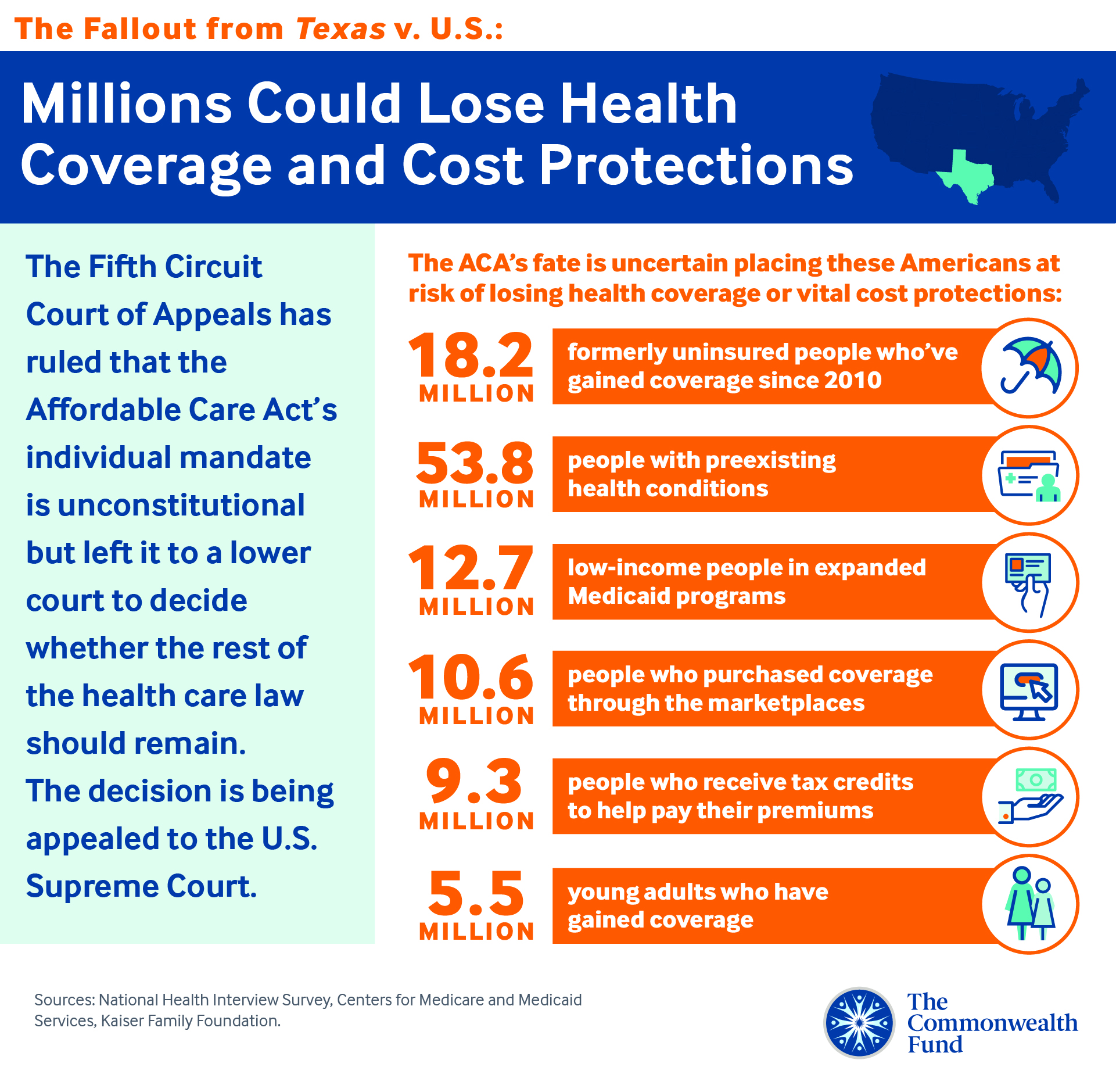
The Fallout from Texas v. U.S.:

Yesterday, a three-judge panel from the Fifth Circuit Court of Appeals struck down the Affordable Care Act (ACA)’s individual mandate. The judges agreed with a lower court decision issued in the case, Texas v. U.S., in December 2018 that the individual mandate is unconstitutional but, unlike the lower court, did not decide that the rest of the ACA is also unconstitutional. Instead, the judges remanded, or sent back, the decision to the same lower court judge to consider. California Attorney General Xavier Becerra, who is leading the 21 Democratic state attorneys general defending the law, along with the U.S. House of Representatives, immediately announced he would appeal the decision to the Supreme Court.

Whether the Supreme Court will decide to take the case now or wait for the decision of Judge O’Connor’s, of the lower court, is uncertain. If the Court decides to take the case now, they could expedite the briefing process and issue a decision in 2020. If it does not take the case now, a ruling will be delayed until after the 2020 presidential election.

No one knows how the Supreme Court will ultimately rule. But we do know that if the Court decides to strike down the ACA, the human toll will be immense and tragic. The law has granted unprecedented health security to millions:

  • 18.2 million formerly uninsured people have gained coverage since 2010
  • 53.8 million Americans with preexisting health conditions are now protected
  • 12.7 million low-income people are insured through expanded Medicaid
  • 10.6 million people have coverage through the ACA marketplaces, 9.3 million of whom receive tax credits to help them pay their premiums
  • 5.5 million young adults have gained coverage, many by staying on their parents’ plans
  • 45 million Medicare beneficiaries have much better drug coverage.

Such a decision will also trigger massive disruption throughout the U.S. health system. The health care industry represents nearly 20 percent of the nation’s economy; the ACA has touched every corner of it. The law restructured the individual and small-group health insurance markets, expanded and streamlined the Medicaid program, improved Medicare benefits, and reformed the way Medicare pays doctors, hospitals, and other providers. It was a catalyst for the movement toward value-based care and established a regulatory pathway for biosimilars — less expensive versions of biologic drugs. States have rewritten laws to incorporate the ACA’s provisions. Insurers, hospitals, physicians, and state and local governments have invested billions of dollars in adjusting to these changes.

The law’s popular preexisting health condition protections have made it possible for people with minor-to-serious health problems to apply for coverage in the same way healthier people have always done. These protections have given the estimated 53.8 million Americans with preexisting health conditions the peace of mind that they will never be denied health insurance because of their health.

More than 150 million people who get coverage through their employers now are eligible for free preventive care, and their children can stay on their policies to age 26.

The wide racial and income inequities in health insurance coverage that have been partly remedied by the ACA would return. Hospitals and providers, especially safety-net institutions, would struggle with mounting uncompensated care burdens and sicker and more costly patients who are not receiving the preventive care they need.

The ACA tore down financial barriers to health care for millions, many of whom were uninsured for most of their lives. It has demonstrably helped people get the health care they need in states across the country. Research indicates that Medicaid expansion has led to improved health status and lower mortality risk.

To date, neither the Trump administration, which has sided with the plaintiffs in the case, nor its Republican colleagues in Congress have offered a replacement plan in the event the law is struck down. The historic progress made by Americans, particularly those with middle and lower incomes and people of color, could unravel. Voters are already telling policymakers they are worried about their ability to afford health care. Yesterday’s decision and the uncertain path forward to the Supreme Court is certain to escalate those worries. With the nation entering the 2020 presidential election year, the Supreme Court may decide to take up the case this term.


Britain’s Bold Move Toward Healthcare

https://www.kornferry.com/institute/britain-election-healthcare-leadership?utm_campaign=12-19-19-twil&utm_source=marketo&utm_medium=email&mkt_tok=eyJpIjoiTnpBek5UVmpOR0UyTkRVeSIsInQiOiJVV2tpTzNyRjlpXC9xS2gweDJSckUxRThIK0F6b2VxeDBNNzRDcDFhTVVEVUpqY2hXdG1ucGc0ZHVFYmFkY1V0WlwvbDhuWFdsNFpqZWVnXC9rdE93SldkY3lqTERSdzZGMW41ZWNOTHJJc0VIQUNycStRa0pkM2ZvaUhJd08wUU5sbyJ9

Just days after a landslide election victory for the Conservative Party, Britain’s Prime Minister Boris Johnson just made a massive and bold announcement: He’ll get laws passed to guarantee plenty of cash for the state-run healthcare system.

The official announcement will likely come Thursday when the Queen, who is the official head of state, will reopen Parliament and outline the coming legislative agenda. Tucked within her speech will be a call for £34 billion ($45 billion) in annual taxpayer money for the National Health Service (NHS).

While other countries embrace their private health systems, the British love their publicly funded NHS, an employer of 1.5 million people, which services the population of 66 million. In general, the people are concerned about the quality of care provided by the NHS and look to the government for solutions, says Mary Macleod, a senior client partner for Korn Ferry’s Board and CEO Services practice and a former Conservative Party MP. “The NHS does become a bit of a political football,” she says. “And to a large extent, everyone in the UK feels that they are stakeholders in it.”

The pledge to secure NHS money will likely bolster Johnson’s political leadership versus the opposition Labour Party. And the move also neutralizes critics that have barraged the Conservative Party with allegations that it would sell parts of the NHS to foreign investors. In other words, pushing a new funding law through Parliament could partially neutralize political opponents.

But the politics of the matter is only part of the announcement’s strength, Macleod says. Promising the NHS years of generous financing will allow the organization to develop a strategy for how it will care for the country’s population for years into the future. In short, Macleod says, it sends a message to the NHS leadership: You can get busy now. “If you now know you are getting the funding, you can plan ahead,” she says.

Johnson’s lack of specifics about how the NHS should spend the money could be a strength. In a sense, he has empowered the organization’s leadership to make the decisions that they deem suitable. “What the prime minister is not doing is defining the solutions,” Macleod says. But she also notes that he will want results in the form of improved service from the organization. “He will hold them accountable,” she says.

While there are benefits when leaders take bold steps, there are also risks, says Christina Harrington, Korn Ferry’s head of advisory services in Stockholm, Sweden. She says it is good for leaders to act quickly and with conviction, as the public expects that of its leaders. But that alone isn’t enough. She says the problem comes when there’s too much ego involved. “You need an egoless conviction to drive a decision making the greater good,” she says.

Ideally, the driver of proposed changes needs to have a long-term vision of something better than the current situation. If that vision is lacking, then the leader may lack the required stamina to get the job done. Indeed, if headline-grabbing is all that the boss wants, then he or she might wind up doing a U-turn. “If there isn’t a long-term vision, then another fast decision may come in the other direction,” Harrington says. “And that’s what we see a lot of.”


Number of Americans with a primary care provider declined 2% over a decade, new study shows

https://www.fiercehealthcare.com/practices/moving-wrong-direction-fewer-americans-have-a-primary-care-provider-new-study-shows?mkt_tok=eyJpIjoiTTJOalpXTXdOV0ZoWkdGbCIsInQiOiJZMlwvUGpSNHhPVGp6ZkdVdkhmSXdza2hJcElGRTJiTDNjWGR0ZnFsOFc4K0Q1eExXR3ZBNWpsTVZ3cmVhRGlMZ1VaOTVyTUlWd2NWQmVPYlBMUkFkTzV0WGNjRWxuNHhuZUFUTVY0dDdsUlwvczdmd0VHVHBBb013b25LMEx5YzhXIn0%3D&mrkid=959610

social determinants

Despite the health benefits, fewer Americans have a primary care provider, according to a new study.

The number of patients in the U.S. who have a primary care provider declined by 2% in a little over a decade, according to the study published in JAMA Internal Medicine.

While that may not sound like much, that decline translates to millions of Americans who do not have primary care, the researchers said.

In the study, researchers from Harvard Medical School looked at primary care use from 2002 to 2015, which raises concerns given that primary care is associated with better health among patients.

“Primary care is the thread that runs through the fabric of all healthcare, and this study demonstrates we are potentially slowly unweaving that fabric,” said the lead author David M. Levine, M.D., a Harvard Medical School instructor in medicine at Brigham and Women’s Hospital in Boston, where he practices internal medicine and primary care, in an announcement about the study.

“America is already behind the curve when it comes to primary care; this shows we are moving in the wrong direction,” Levine said.

The study found that in 2002, 77% of adult Americans had an identified primary care physician, a level that dropped to 75% in 2015. In addition, the study found a particularly marked decline in primary care among younger Americans and those without complex medical issues.

Having a primary care provider decreased across the board for Americans in their 30s, 40s, and 50s. Among 30-year-olds, the number dropped from 71% to 64% from 2002 to 2015.

Among those with no complex conditions, having primary care declined in every decade of age through their 60s. The exception to the decline were less healthy patients. People with three or more chronic health conditions having a primary care physician remained relatively stable, the study found.

Patients who are male, Latino, black or Asian without insurance and lived in the South were much less likely to have a primary care doctor, the study found.

The researchers suggested several steps to stop the decline and increase the rates of Americans with primary care providers, including changes in the primary care payment system, a move toward value-based care and investments in new technology. They also called for creating incentives to encourage more physicians to choose primary care, particularly in rural areas, and increasing the number of Americans with health insurance.

“To improve Americans’ health, we should prioritize investments to reinvigorate the American primary care system,” said senior author Bruce E. Landon, M.D., professor of healthcare policy in the Blavatnik Institute at Harvard Medical School and professor of medicine at Beth Israel Deaconess Medical Center, where he practices internal medicine.

A study released earlier this year from the Patient-Centered Primary Care Collaborative found states that spend more on primary care have better patient outcomes, including fewer hospitalizations and emergency department visits. A separate study found a direct link between the number of primary care doctors and an increase in life expectancy.


Study: Costs from out-of-network billing at in-network hospitals top $40B

https://www.fiercehealthcare.com/hospitals-health-systems/study-finds-billions-costs-from-out-network-billing-for-care-delivered-at?mkt_tok=eyJpIjoiT0RRM1ltSTFaVGd5WmpSaiIsInQiOiJ1K01YRU9EcDFWZWNYYW5ES0JkMDZ3RisxZWdBTlRtSzJTTVwvdVVOMFgrNE1SXC90SjdLQk8rRW1kOXFralJ4SE4rbVwvVThIeFNTYUpqWmxCYTAwOWZyR1FcL0RcL0xVN21Rbkh5aVZlXC83allyU08yeWNZbXB1dHl6SjZia1BmTzNRVCJ9&mrkid=959610

surprise bill

The problem of large and unexpected surprise healthcare bills dominated health headlines in 2019.

Now, a new study to be published in the January print issue of Health Affairs put a figure on how much it’s costing when patients are unwittingly treated by out-of-network providers in in-network hospitals: $40 billion annually.

Led by Zack Cooper, a researcher in the Yale School of Public Health and the department of economics, the study found at in-network hospitals, nearly 12% of anesthesiology care, more than 12% of care involving a pathologist, 5.6% of claims for radiologists and 11.3% of cases involving an assistant surgeon were billed out of network.

“When physicians whom patients do not choose and cannot avoid can bill out of network for care delivered within in-network hospitals, it exposes patients to financial risk and undercuts the functioning of health care markets,” the authors wrote in the study. “The ability to bill out of network allows these specialists to negotiate artificially high in-network rates.

The researchers’ estimates show that if these specialists were not able to bill out of network, it would lower physician payments for privately insured patients by 13.4% and reduce total healthcare spending for people with employer-sponsored insurance by 3.4%. That works out to about $40 billion a year, they said.

The authors used 2015 data from a large commercial insurer for their analysis. The study was funded by the Laura and John Arnold Foundation and the Tobin Center for Economic Policy at Yale University.

Out-of-network billing is more prevalent at hospitals in concentrated hospital and insurance markets and at for-profit hospitals, the authors said.  

“Any policy addressing out-of-network billing must achieve two aims: protect patients from financial harm and introduce a competitively set price for physician services or identify the amount insurers must pay providers if a policyholder is treated by an out-of-network physician,” the authors said in a statement. “Our proposed policy solution—requiring hospitals to sell a package of facility and physician services—would protect patients, restore a competitively determined price for physician services, and lower commercial health spending.” 


Trust issues plague the relationship between Ascension St. Joe’s and the community it serves

https://www.jsonline.com/story/news/health/2019/12/16/st-joes-accountability-coalition-seek-commitment-ascension-hospital/3831008002/?utm_source=Sailthru&utm_medium=email&utm_campaign=Issue:%202019-12-17%20Healthcare%20Dive%20%5Bissue:24684%5D&utm_term=Healthcare%20Dive

Image result for ascension st joseph hospital milwaukee

Three empty chairs at a community meeting epitomized the mistrust between the leaders of Ascension Wisconsin and the St. Joe’s Accountability Coalition.

The coalition, composed primarily of community leaders from Milwaukee’s north side, invited Ascension Wisconsin to that Oct. 1 meeting to press the health system to sign a legal contract binding it to a list of commitments. The commitments included keeping Ascension St. Joseph hospital open and providing an urgent care clinic, affordable housing assistance, local hiring, more employee training and living wages for all employees.

Ascension didn’t show.

For one, Ascension Wisconsin officials said they were told they would not be allowed to speak at the event. For another, they said signing a contract was unnecessary because they have promised to keep the hospital open, already hire locally and provide employee training.

The hospital, which employs about 800 people, is one of the neighborhood’s largest employers.

The coalition wants the hospital to sign a community benefits agreement, known as a CBA, which is a contract between community groups and real estate developers or government entities.

Reggie Newson, Ascension Wisconsin’s vice president of government and community services, said the health system is proving its commitment to the community by expanding and adding services to St. Joseph.

For example, two certified nurse-midwives were just hired for the hospital’s new midwifery clinic and a third is being recruited. The hospital is also planning to hire a cardiac nurse practitioner and cardiologist.

But members of the coalition aren’t convinced, because they say there is no legal penalty if Ascension fails to follow through on its promises.

Nate Gilliam, an organizer with the Wisconsin Federation of Nurses & Health Professionals, advisory board member of the University of Wisconsin Population Health Institute and coalition spokesman, said the coalition just wants accountability.

“It’s good that they’re saying all these great things on paper and to the media,” he said. “But if they are going to do that, they shouldn’t have a problem with signing a CBA.”

Future bright despite history of mistrust, Ascension says

The lack of trust between the coalition and Ascension Wisconsin started 18 months ago, when hospital administrators — citing losses of roughly $30 million a year — proposed cutting some of Ascension St. Joseph’s surgical and medical units and other services, such as cardiology support.

The hospital, at 5000 W. Chambers St., serves a majority African American population on the city’s north side, an area facing steep socioeconomic disadvantages. Decades of limited access to health care have contributed to higher rates of chronic disease. Higher rates of poverty means many residents rely on Medicaid for health insurance.

Residents interpreted Ascension’s proposal as a precursor to closing the hospital and — in an area where transportation is scarce — feared they would have to go farther for health care.

The proposal was criticized by Mayor Tom Barrett, several aldermen and community leaders, including George Hinton, CEO of the Social Development Commission and former president of Aurora Sinai Medical Center, who wrote an op-ed in opposition.

Ascension dropped the proposal.

But that was 18 months ago.

Since then, Newson said the hospital surveyed more than 1,000 people by telephone and held five community listening sessions. The information was used to develop priorities for the hospital and corresponding programs, such as the midwifery program and heart and vascular community care center.

Similarly, members of the coalition conducted their own survey, knocking on hundreds of doors and collecting 584 detailed responses.

When surveyed on non-clinical services, over 40% of residents said housing assistance, local hiring and living wages were their top priorities. From the coalition’s survey on clinical services, 61.6% said access to urgent care was most important to them.

Kevin Kluesner, Ascension St. Joseph’s chief administrative officer, said he and others are well aware of the health disparities and disadvantages within the community they serve.

He said Ascension Wisconsin’s push to expand services is proof the hospital isn’t going anywhere.

That commitment is despite the hospital’s having lost roughly $150 million since the 2012 fiscal year. In the 2018 fiscal year, the most recent for which information is available, Ascension St. Joseph lost $31.6 million.

By comparison, Froedtert Hospital reported $134 million in profits for the 2018 fiscal year, according to information filed with the Wisconsin Hospital Association. Aurora St. Luke’s Medical Center reported $166 million in profits in 2018.

Gilliam said that since the hospital is a non-profit venture, lost profits shouldn’t matter. He also said that Ascension Wisconsin has more profitable locations across the state, that can offset the losses at St. Joseph.

Coalition wants accountability

The results from the coalition’s survey mirrored what residents at the Oct. 1 community meeting described.

Charles Hawkins said he likes his primary care physicians, but said they keep leaving.

Another resident who lives blocks away from the hospital, Arkesia Jackson, said when her brother-in-law experienced a flare-up of his COPD, or chronic obstructive pulmonary disease, she was thankful a community hospital was nearby.

“He ran inside the emergency and collapsed, car running,” she said. “He is a patient at St. Joe’s. They had all his records, they knew who he was, they knew what he was suffering from.”

Newson said the goal is to provide consistent, quality care for all patients.

Gilliam acknowledged that details of what the coalition is asking for, such as racially equitable health care and helping with housing assistance, are somewhat vague. However, that’s because its members said they want to sit down with Ascension and hammer out an agreement — as long as Ascension commits to signing one.

Coalition members argue that other hospitals have worked with community groups on similar initiatives.

Robert Silverman, a professor in the Department of Urban and Regional Planning at the University of Buffalo, said there are some rare examples of CBAs being used in the health care field.

For example, Yale University signed a CBA with the Community Organized for Responsible Development group in 2006 regarding the construction of a new cancer center.

It still remains unlikely that Ascension, a national organization, would willingly set such a precedent for its hospitals.

Gilliam said he thinks it’s important for hospitals to be accountable to the community.

“I don’t see why they see a community benefits agreement as adversarial off the top,” Gilliam said. “Whenever they’re ready to come to the table in earnest, we’ll be there. That’s it.”

But with the addition and expansion of several new programs, Kluesner said he’s not sure what else hospital officials can do to prove they are serious about being a reliable anchor institution on the city’s north side.

“We’ve signed 11 new providers. That’s the best proof we could give of our commitment to growing services here at St. Joseph. If people are wondering what are we doing at Ascension St. Joseph, I think that actions speak louder than words,” he said.


Hospitals lose challenge to 2020 site-neutral pay cuts

https://www.beckershospitalreview.com/finance/hospitals-lose-challenge-to-2020-site-neutral-pay-cuts.html?origin=CFOE&utm_source=CFOE&utm_medium=email

Image result for site-neutral pay cuts

A Washington, D.C., federal judge ruled Dec. 16 that the court cannot stop CMS from enacting site-neutral payments for off-campus providers in 2020.

In its final Outpatient Prospective Payment System rule for 2019, CMS made payments for clinic visits site-neutral by reducing the payment rate for evaluation and management services provided at off-campus provider-based departments.

In an attempt to overturn the rule, the American Hospital Association and dozens of hospitals sued CMS, arguing it exceeded its authority when it finalized the cuts in the rule.  

U.S. District Judge Rosemary Collyer sided with the association and other hospitals in September, ruling CMS overstepped its authority when it expanded the site-neutral pay policy. But CMS moved forward with the site-neutral  cuts in its 2020 OPPS rule, slashing off-campus department payments to a rate of 40 percent of the OPPS rate.

The association asked Ms. Collyer to uphold her September decision in an attempt to stop the 2020 payment cuts from taking effect Jan. 1, but ruled Dec. 16 that the court doesn’t have jurisdiction to stop the continuation of the cuts next year.

“As a technical matter, the government correctly argues that the court’s previous order was limited only to the 2019 final rule,” the judge wrote.

The court loss for the association representing hospitals comes just days after CMS agreed to repay hospitals that were paid at the reduced rate this year.

“The AHA and other plaintiffs remain confident that the courts will find the 2020 cuts to be illegal, just as they found the 2019 cuts,” Melinda Hatton, the AHA’s general counsel, wrote in a statement to Becker’s Hospital Review.

Access the full ruling here.


South Carolina is the next battleground for Medicaid work requirements

https://www.axios.com/south-carolina-medicaid-work-requirements-f8c52243-d1de-47bf-bf47-5ea82326cea4.html

Image result for Medicaid work requirements

The Trump administration is losing the legal battle over Medicaid work requirements — one of its most impactful and controversial health care policies — but it is leaning into that fight even more aggressively.

Driving the news: The Centers for Medicare & Medicaid Services formally signed off yesterday on South Carolina’s work requirements. Medicaid recipients in the state will have to perform 80 hours per month of work or community service, unless they receive an exemption.

Why it matters: Other states have primarily sought work requirements as a condition of their Medicaid expansions, but South Carolina will impose its new rules without expanding.

Where it stands: A federal judge has already ruled against work requirements in Arkansas, Kentucky and New Hampshire, arguing that they’re inconsistent with Medicaid’s statutory goals.

  • Judge James Boasberg has leaned heavily on the fact that work requirements would cause thousands of people to lose their Medicaid coverage.
  • That will also happen in South Carolina, and those coverage losses will be a factor in the inevitable lawsuits over these rules.

Yes, but: Those rulings are working their way through the appeals process, and rather than change course or slow down in the face of legal setbacks, the administration is getting work requirements on the books wherever it can and hoping for an eventual win in the courts.