WHY HOSPITALS ARE GETTING INTO THE HOUSING BUSINESS

https://www.healthleadersmedia.com/clinical-care/why-hospitals-are-getting-housing-business

Hospitals cannot discharge patients if they have no safe place to go, so patients who are homeless, frail, living alone, or experiencing an unstable housing situation, can occupy hospital beds long after their acute medical problem is resolved.

One patient at Denver Health, the city’s largest safety net hospital, occupied a bed for more than four years—a hospital record of 1,558 days.

Another admitted for a hard-to-treat bacterial infection needed eight weeks of at-home IV antibiotics, but had no home.

A third, with dementia, came to the hospital after being released from the Denver County Jail. His family refused to take him back.

In the first half of this year alone, the hospital treated more than 100 long-term patients. All had a medical issue that led to their initial hospitalization. But none of the patients had a medical reason for remaining in the hospital for most of their stay.

Legally and morally, hospitals cannot discharge patients if they have no safe place to go. So patients who are homeless, frail or live alone, or have unstable housing, can occupy hospital beds for weeks or months—long after their acute medical problem is resolved. For hospitals, it means losing money because a patient lingering in a bed without medical problems doesn’t generate much, if any, income. Meanwhile, acutely ill patients may wait days in the ER to be moved to a floor because a hospital’s beds are full.

“Those people are, for lack of a better term, stranded in our hospital,” said Dr. Sarah Stella, a Denver Health physician.

To address the problem, hospitals from Baltimore to St. Louis to Sacramento, Calif., are exploring ways to help patients find a home. With recent federal policy changes that encourage hospitals to allocate charity dollars for housing, many hospitals realize it’s cheaper to provide a month of housing than to keep patients for a single night.

Hospital executives find the calculus works even if they have to build affordable housing units themselves. It’s why Denver Health is partnering with the Denver Housing Authority to repurpose a mothballed building on the hospital campus into affordable senior housing, including about 15 apartments designated to help homeless patients transition out of the hospital.

“This is an experiment of sorts,” said Peg Burnette, the hospital’s chief financial officer. “We might be able to help better their lives, as well as help the financials of the hospital and help free up capacity for the patients that need to come to see us for acute care.”

SPENDING TO SAVE MONEY

Denver Health once used the shuttered 10-story building for office space but opted to sell it to the housing authority and grant a 99-year lease on the land for a minimal fee.

“It really lowers the construction costs for us,” said Ismael Guerrero, Denver Housing Authority’s executive director. “It was a great opportunity to build additional housing in a location that’s obviously close to the hospital, close to public transit, near the city center.”

Once the renovation is complete in late 2021, the housing group will hire a coordinator to assist tenants with housing-related issues, including helping those in the transitional units find permanent housing. The hospital will provide a case manager to help with their physical and behavioral health needs, preparing them for life on their own. Denver Health expects most patients will be able to move on from the transitional units within 90 days.

The hospital will pay for the housing portion itself. That will still be far cheaper than what the hospital currently spends.

It costs Denver Health $2,700 a night to keep someone in the hospital. Patients who are prime candidates for the transitional units stay on average 73 days, for a total cost to the hospital of nearly $200,000. The hospital estimates it would cost a fraction of that, about $10,000, to house a patient for a year instead.

“The hospital really is like the most expensive form of housing,” Stella said.

GROWING INTEREST

recent report from the Urban Institute found that while most hospital officials are well aware of how poor housing affects a patient’s recovery, they were stymied about how to address the issue.

“It’s on the radar of almost all hospitals,” said Kathryn Reynolds, who co-authored the report. “But it seemed like actually making investments in housing, providing some type of financing or an investment in land or something that has a good amount of value seems to be less widespread.”

The report found housing investment has been more likely among hospitals with their own health plans or other types of arrangements in which they were receiving a fixed amount of money to care for a group of patients. Getting patients into housing could lower their costs and increase their operating margins. Others, particularly religiously affiliated and children’s hospitals, sought housing solutions as part of their charitable mission.

Reynolds said the trend is due in part to the Affordable Care Act, which requires hospitals to perform a community needs assessment to help guide their charitable efforts. That prompted more hospitals to consider the social needs of their patients and pushed housing concerns up the list. Additionally, the Internal Revenue Service clarified in 2015 that hospitals could claim housing investments as charitable spending required under their tax-free status. And provisions included in the 2017 tax cut bill provided significant tax savings for investors in newly designated opportunity zones, increasing their interest in affordable housing projects.

Some hospitals, she said, may use their cash reserves to invest in housing projects that generate a lower return than other investment options because it furthers their mission, not just their profits.

In other cases, hospital systems play a facilitator role—using their access to cheap credit or serving as an anchor tenant in a larger development—to help get a project off the ground.

“Housing is not their business,” Guerrero said. “It’s not an easy space to get into if you don’t have the experience, if you don’t have a real estate development team in-house to understand how to put these deals together.”

CUTTING COSTS

In the southwestern corner of Colorado, Centura Health’s Mercy Regional Medical Center has partnered with Housing Solutions for the Southwest to prioritize housing vouchers for frequent users of the emergency room.

Under a program funded by the Catholic Health Initiatives, Mercy hired a social worker and a case manager to review records of frequent emergency room patients. They quickly realized how big an issue housing was for those patients. Many had diabetes and depended on insulin—which needs refrigeration. Kidney failure was one of the most costly diagnoses for the hospital.

Once patients received housing vouchers and found stable housing, though, costs began to drop.

“We now knew where they were. We knew that they had a safe place to live,” said Elsa Inman, program coordinator at Mercy Regional. “We knew they would be more effective in managing their chronic conditions.”

The patients with stable housing were more likely to make it to their primary care and specialist appointments, more likely to stay on top of medications and keep their chronic conditions in check.

The combination of intensive case management and patient engagement helped to halve ER visits for the first 146 patients in the program, saving nearly $495,000 in Medicaid spending in less than three years.

“Hospitals are businesses and nonprofits are businesses,” said Brigid Korce, program development director for Housing Solutions. “They are bottom-line, dollars-and-cents people.”

Inman acknowledged that the hospital might have missed out on some revenue by reducing ER use by these patients. Hospitals are still largely paid by the number of patients they treat and the number of services they provide.

But most of those patients were covered by Medicaid, so reimbursements were low anyway. And the move freed up more ER beds for patients with more critical needs.

“We want to be prepared for life-threatening conditions,” Inman said. “If you’ve got most of your beds taken up by someone who can be receiving patient care outside in the community, then that’s the right thing to do.”

That was less of an issue for the inpatients at Denver Health. Because hospitals are generally paid a fixed amount for a given diagnosis, the longer a patient stays in the hospital, the more money the hospital loses.

“They’ve basically exhausted their benefit under any plan because they don’t meet medical necessity anymore,” Burnette said. “If they had a home, they would go home. But they don’t, so they stay in the hospital.”



Market Consolidation on Trial

Market Consolidation on Trial

Image result for Market Consolidation on Trial

California Attorney General Xavier Becerra alleges that Sutter Health used its pre-eminent market power to artificially inflate prices. Photo: Rich Pedroncelli/Associated Press

As a jury trial draws near in a major class-action lawsuit alleging anticompetitive practices by Northern California’s largest health system (PDF), a new CHCF study shows the correlation between the prices consumers pay and the extensive consolidation in the state’s health care markets. Importantly, the researchers estimated the independent effect of several types of industry consolidation in California — such as health insurers buying other insurers and hospitals buying physician practices. The report, prepared by UC Berkeley researchers, also examines potential policy responses.

While other states have initiated antitrust complaints against large hospital systems and medical groups in the past, the case against Sutter Health is unique in both the expansive nature of the alleged conduct and in the scale of the potential monetary damages. The complaint goes beyond claims of explicit anticompetitive contract terms and argues that by virtue of its very size and structure, the Northern California system imposed implicit or “de facto” terms that led to artificially inflated prices. Sutter Health vigorously denies the allegations.

The formation of large health systems like Sutter is neither new (PDF) nor unique to California (PDF). Several factors seem to be encouraging their growth, including payment models that place health care providers at financial risk for the cost of care, increased expectations from policymakers and payers around the continuum of patient needs that must be managed, and economies of scale for investments in information technology and administrative services. Some market participants also point to consolidation in other parts of the health care system, such as health plans and physician groups, as encouragement for their own mergers.

Economic Consolidation in California

In general, economists study two major categories of market consolidation:

  • Horizontal consolidation: Entities of the same type merge, such as the merger of two hospitals or insurance companies, or the merger of providers into a physician network.
  • Vertical consolidation: Entities of different types merge, such as when a hospital purchases a physician practice or when a pharmacy buys an insurance company.

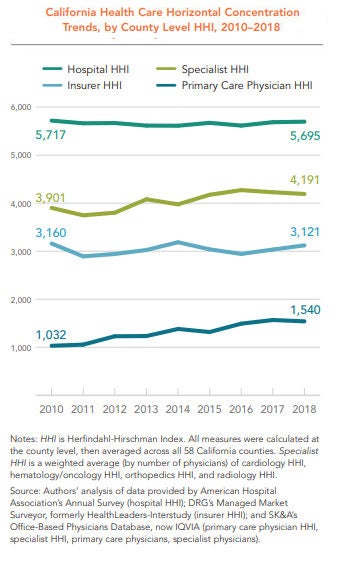
To measure market consolidation, the CHCF study relied on the Herfindahl-Hirschman Index (HHI), a metric used by the US Department of Justice and the Federal Trade Commission. An HHI of between 1,500 and 2,500 is considered moderately concentrated, and 2,500 or above is considered highly concentrated. According to this measure, horizontal concentration is high in California among hospitals, insurance companies, and specialist providers (and moderately high among primary care physicians), even though the level of concentration in all but primary care has remained relatively flat from 2010 to 2018.

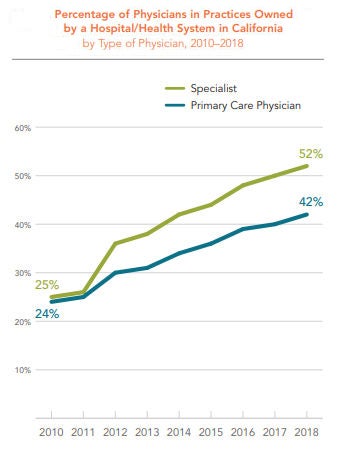
The percentage of physicians in practices owned by a hospital or health system increased dramatically in California between 2010 and 2018 — from 24% in 2010 to 42% in 2018. The percentage of specialists in practices owned by a hospital or health system rose even faster, from 25% in 2010 to 52% in 2018.
Consolidation Is Not Clinical Integration

While this study defined and quantified the extent of consolidation across several industry segments in California, it is important to note that it did not define, quantify, or evaluate clinical integration within the state. Clinical integration has been defined by others in many ways, but generally involves arrangements for coordinating and delivering a wide range of medical services across multiple settings.

As the CHCF study authors point out, other analysis has shown that various types of clinical integration can lead to broader adoption of health information technology and evidence-based care management processes. Data from the Integrated Healthcare Association suggests that certain patient benefit designs and provider risk-sharing arrangements associated with clinical integration can lead to higher quality and lower costs.

Crucially, an emerging body of law (PDF) suggests that clinical integration does not require formal ownership and joint bargaining with payers.

Relationship Between Consolidation and Health Insurance Premiums

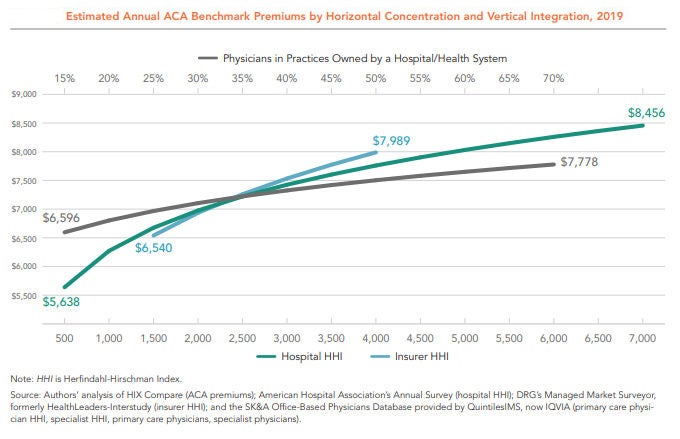
Among the six variables analyzed in the CHCF study, three showed a positive and statistically significant association with higher premiums: insurance company mergers, hospital mergers, and the percentage of primary care physicians in practices owned by hospitals and health systems. The remaining three variables studied — specialist provider mergers, primary care provider mergers, and the percentage of specialists in practices owned by a hospital and health system — were statistically insignificant.

The figure below shows the independent relationship between market concentration and premiums for these three variables. As the lines move left to right, concentration increases — that is, fewer individual insurers, hospitals, or providers occupy the market. The vertical axis shows the average premiums associated with each level of market concentration. In short, regardless of the industry structure represented by the other variables, insurer consolidation, hospital consolidation, and hospital-physician mergers each lead to higher premiums.

Unexplained Price Variation and Growth

Health insurance premiums rise when the underlying cost of medical care increases. California ranks as the 16th most expensive state on average in terms of the seven common services the researchers studied, after adjusting for wage differences across states. Among all states, California has the eighth-highest prices for normal childbirth, defined as vaginal delivery without complications. Childbirth is the most common type of hospital admission, and the relatively standardized procedure is comparable across states.

Even within California, prices vary widely and are growing rapidly. For example, the 2016 average wage-adjusted price for a vaginal delivery was twice as high in Rating Area 9 (which has Monterey as its largest county) as it was in Rating Area 19 (San Diego) — $22,751 versus $11,387. (See next figure.) Prices for the service are increasing rapidly across counties — rising anywhere from 29% in San Francisco from 2012 to 2016 to 40% in Orange County over the same period.

The authors of the CHCF report investigated the impact of various types of consolidation on the prices of individual medical services in California. For cesarean births without complications, a 10% rise in hospital HHI is associated with a 1.3% increase in price.

Potential Policy Responses to Consolidation

While the study shows significant associations between various types of market concentration and the prices consumers pay, policymakers should carefully consider implementing steps that restrain the inflationary impact of consolidation while allowing the benefits of clinical integration to proliferate. To that end, the authors of the CHCF report offered a series of recommendations, which include:

Enforce antitrust laws. Federal and state governments should scrutinize proposed mergers and acquisitions to evaluate whether the net result is procompetitive or anticompetitive.

Restrict anticompetitive behaviors. Anticompetitive behaviors, such as all-or-nothing and anti-incentive contract terms, should be addressed through legislation or the courts in markets where providers are highly concentrated.

Revise anticompetitive reimbursement incentives. Reimbursement policies that reduce competition, such as Medicare rules that implicitly reward hospital-owned physician groups, should be adjusted.

Reduce barriers to market entry. Policies that restrict who can participate in the health care market, such as laws prohibiting nurse practitioners from practicing independently from a physician, should be changed when markets are concentrated.

Regulate provider and insurer rates. If antitrust enforcement is not successful and significant barriers to market entry exist — including those in small markets unable to support a competitive number of hospitals and specialists — regulating provider and insurer rates should be considered.

Encouraging meaningful competition in health care markets is an exceedingly difficult task for policymakers. It is no easier to promote the benefits of clinical integration while restraining the inflationary aspects of economic consolidation through public policy. Despite these challenges, the rapid rise in health care premiums and prices in the state require a fresh look at the consequences of widespread horizontal and vertical consolidation in California.


Top 5 Differences Between NFPs and For-Profit Hospitals

https://www.healthleadersmedia.com/finance/top-5-differences-between-nfps-and-profit-hospitals

Image result for Non-Profit and For-Profit Hospitals

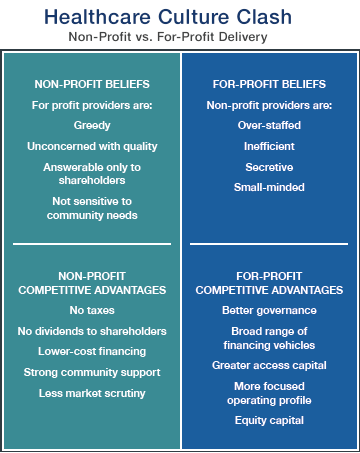
Although nonprofit and for-profit hospitals are fundamentally similar, there are significant cultural and operational differences, such as strategic approaches to scale and operational discipline.

All hospitals serve patients, employ physicians and nurses, and operate in tightly regulated frameworks for clinical services. For-profit hospitals add a unique element to the mix: generating return for investors.

This additional ingredient gives the organizational culture at for-profits a subtly but significantly different flavor than the atmosphere at their nonprofit counterparts, says Yvette Doran, chief operating officer at Saint Thomas Medical Partners in Nashville, TN.

“When I think of the differences, culture is at the top of my list. The culture at for-profits is business-driven. The culture at nonprofits is service-driven,” she says.

Doran says the differences between for-profits and nonprofits reflect cultural nuances rather than cultural divides. “Good hospitals need both. Without the business aspects on one hand, and the service aspects on the other, you can’t function well.”

There are five primary differences between for-profit and nonprofit hospitals.

1. Tax Status

The most obvious difference between nonprofit and for-profit hospitals is tax status, and it has a major impact financially on hospitals and the communities they serve.

Hospital payment of local and state taxes is a significant benefit for municipal and state governments, says Gary D. Willis, CPA, a former for-profit health system CFO who currently serves as CFO at Amedisys Inc., a home health, hospice, and personal care company in Baton Rouge, LA. The taxes that for-profit hospitals pay support “local schools, development of roads, recruitment of business and industry, and other needed services,” he says.

The financial burden of paying taxes influences corporate culture—emphasizing cost consciousness and operational discipline, says Andrew Slusser, senior vice president at Brentwood, TN-based RCCH Healthcare Partners.

“For-profit hospitals generally have to be more cost-efficient because of the financial hurdles they have to clear: sales taxes, property taxes, all the taxes nonprofits don’t have to worry about,” he says.

“One of the initiatives we’ve had success with—in both new and existing hospitals—is to conduct an Operations Assessment Team survey. It’s in essence a deep dive into all operational costs to see where efficiencies may have been missed before. We often discover we’re able to eliminate duplicative costs, stop doing work that’s no longer adding value, or in some cases actually do more with less,” Slusser says.

2. Operational Discipline

With positive financial performance among the primary goals of shareholders and the top executive leadership, operational discipline is one of the distinguishing characteristics of for-profit hospitals, says Neville Zar, senior vice president of revenue operations at Boston-based Steward Health Care System, a for-profit that includes 3,500 physicians and 18 hospital campuses in four states.

At Steward, we believe we’ve done a good job establishing operational discipline. It means accountability. It means predictability. It means responsibility. It’s like hygiene. You wake up, brush your teeth, and this is part of what you do every day.”

A revenue-cycle dashboard report is circulated at Steward every Monday morning at 7 a.m., including point-of-service cash collections, patient coverage eligibility for government programs such as Medicaid, and productivity metrics, he says. “There’s predictability with that.”

A high level of accountability fuels operational discipline at Steward and other for-profits, Zar says.

There is no ignoring the financial numbers at Steward, which installed wide-screen TVs in most business offices four years ago to post financial performance information in real-time. “There are updates every 15 minutes. You can’t hide in your cube,” he says. “There was a 15% to 20% improvement in efficiency after those TVs went up.”

3. Financial Pressure

Accountability for financial performance flows from the top of for-profit health systems and hospitals, says Dick Escue, senior vice president and chief information officer at the Hawaii Medical Service Association in Honolulu.

Escue worked for many years at a rehabilitation services organization that for-profit Kindred Healthcare of Louisville, Kentucky, acquired in 2011. “We were a publicly traded company. At a high level, quarterly, our CEO and CFO were going to New York to report to analysts. You never want to go there and disappoint. … You’re not going to keep your job as the CEO or CFO of a publicly traded company if you produce results that disappoint.”

Finance team members at for-profits must be willing to push themselves to meet performance goals, Zar says.

“Steward is a very driven organization. It’s not 9-to-5 hours. Everybody in healthcare works hard, but we work really hard. We’re driven by each quarter, by each month. People will work the weekend at the end of the month or the end of the quarter to put in the extra hours to make sure we meet our targets. There’s a lot of focus on the financial results, from the senior executives to the worker bees. We’re not ashamed of it.”

“Cash blitzes” are one method Steward’s revenue cycle team uses to boost revenue when financial performance slips, he says. Based on information gathered during team meetings at the hospital level, the revenue cycle staff focuses a cash blitz on efforts that have a high likelihood of generating cash collections, including tackling high-balance accounts and addressing payment delays linked to claims processing such as clinical documentation queries from payers.

For-profit hospitals routinely utilize monetary incentives in the compensation packages of the C-Suite leadership, says Brian B. Sanderson, managing principal of healthcare services at Oak Brook, IL–based Crowe Horwath LLP.

“The compensation structures in the for-profits tend to be much more incentive-based than compensation at not-for-profits,” he says. “Senior executive compensation is tied to similar elements as found in other for-profit environments, including stock price and margin on operations.”

In contrast to offering generous incentives that reward robust financial performance, for-profits do not hesitate to cut costs in lean times, Escue says.

“The rigor around spending, whether it’s capital spending, operating spending, or payroll, is more intense at for-profits. The things that got cut when I worked in the back office of a for-profit were overhead. There was constant pressure to reduce overhead,” he says. “Contractors and consultants are let go, at least temporarily. Hiring is frozen, with budgeted openings going unfilled. Any other budgeted, but not committed, spending is frozen.”

4. Scale

The for-profit hospital sector is highly concentrated.

There are 4,862 community hospitals in the country, according to the American Hospital Association. Nongovernmental not-for-profit hospitals account for the largest number of facilities at 2,845. There are 1,034 for-profit hospitals, and 983 state and local government hospitals.

In 2016, the country’s for-profit hospital trade association, the Washington, DC–based Federation of American Hospitals, represented a dozen health systems that owned about 635 hospitals. Four of the FAH health systems accounted for about 520 hospitals: Franklin, TN-based Community Hospital Systems (CHS); Nashville-based Hospital Corporation of America; Brentwood, TN–based LifePoint Health; and Dallas-based Tenet Healthcare Corporation.

Scale generates several operational benefits at for-profit hospitals.

“Scale is critically important,” says Julie Soekoro, CFO at Grandview Medical Center, a CHS-owned, 372-bed hospital in Birmingham, Alabama. “What we benefit from at Grandview is access to resources and expertise. I really don’t use consultants at Grandview because we have corporate expertise for challenges like ICD-10 coding. That is a tremendous benefit.”

Grandview also benefits from the best practices that have been shared and standardized across the 146 CHS hospitals. “Best practices can have a direct impact on value,” Soekoro says. “The infrastructure is there. For-profits are well-positioned for the consolidated healthcare market of the future… You can add a lot of individual hospitals without having to add expertise at the corporate office.”

The High Reliability and Safety program at CHS is an example of how standardizing best practices across the health system’s hospitals has generated significant performance gains, she says.

“A few years ago, CHS embarked on a journey to institute a culture of high reliability at the hospitals. The hospitals and affiliated organizations have worked to establish safety as a ‘core value.’ At Grandview, we have hard-wired a number of initiatives, including daily safety huddles and multiple evidence-based, best-practice error prevention methods.”

Scale also plays a crucial role in one of the most significant advantages of for-profit hospitals relative to their nonprofit counterparts: access to capital.

Ready access to capital gives for-profits the ability to move faster than their nonprofit counterparts, Sanderson says. “They’re finding that their access to capital is a linchpin for them. … When a for-profit has better access to capital, it can make decisions rapidly and make investments rapidly. Many not-for-profits don’t have that luxury.”

5. Competitive Edge

There are valuable lessons for nonprofits to draw from the for-profit business model as the healthcare industry shifts from volume to value.

When healthcare providers negotiate managed care contracts, for-profits have a bargaining advantage over nonprofits, Doran says. “In managed care contracts, for profits look for leverage and nonprofits look for partnership opportunities. The appetite for aggressive negotiations is much more palatable among for-profits.”


Hospitals of All Sizes Experience Profitability Declines in August

https://www.healthleadersmedia.com/finance/hospitals-all-sizes-experience-profitability-declines-august?spMailingID=16366319&spUserID=MTg2ODM1MDE3NTU1S0&spJobID=1740190718&spReportId=MTc0MDE5MDcxOAS2

Both expense and volume performance were mixed for the month, according to Kaufman Hall.

For only the second time this year, hospitals of all sizes experienced monthly profitability declines, primarily due to “softening volumes,” according to a Kaufman Hall report released Tuesday.

In the month of August, both overall hospital operating EBITDA margins and operating margins fell by 9.4% and 11.4% year-over-year, respectively.

Kaufman Hall compared the August stagnation to the challenges hospitals faced in June, specifically referencing the ineffective approaches to adjust expenses when patient volumes sputter.

Delving into geographic differences, Midwest hospitals continue to show more resiliency than other areas, according to the report.

Hospitals in the northeast and Mid-Atlantic regions witnessed the largest declines in August, a 15.8% year-over-year drop in operating EBITDA margin, while the Great Plains posted profitability of 16.7% above budget.

Despite a relatively promising year thus far where hospitals rebounded from market volatility in 2018, provider organizations hit the financial skids in August due to inconsistent volume metrics.

Most volume metrics took a hit, with discharges, adjusted discharges, emergency department visits, and operating room minutes falling by more than 1.2% each.

Meanwhile, adjusted patient days and average length of stay increased by more than 1.6% as well.

Additionally, expense metrics were mixed for most hospitals, as total expenses per adjusted discharge rose 4% year-over-year, while labor expenses for the same metric increased 2.4%.

Purchased service expenses per adjusted discharge rose 6.1% while non-labor expenses and supply expenses for the same metric rose more than 3.5%.

On the non-operating side, the U.S. labor market continued its strong performance in the face of global headwinds and fears about a potential recession in the coming months.

Kaufman Hall described August as “weak month” for investment assets, noting that investment portfolio returns for hospitals declined 0.46%, the first monthly decline since May.


Hospitals, insurers object to rule posting their negotiated rates

https://www.healthcarefinancenews.com/news/hospitals-object-posting-negotiated-rates-and-other-payment-rules?mkt_tok=eyJpIjoiWkdNMU56WmxabVl3TWpRMSIsInQiOiI0dlhaYUJpT2xBU0FqeDNmWkRlZHVZYnRsZ2xBK3pxMmN6RG5kS3Q1UWgrWFYyNllIK2lLZEYzclRDWUYyTFwvOGdhUzRVSnlscG5MQjBtY0NwT2d1TjZHdXJYRUlYRGszVEhrQmY5b0xhRDlFTWNTNUEwWnVvWGUwZXE3ME9kdGgifQ%3D%3D

CMS is proposing that hospitals make public their payer-specific negotiated charges for a limited set of “shoppable” services.

Hospitals and insurers have made clear their opposition to the Centers for Medicare and Medicaid Services proposed rule requiring the disclosure of their privately negotiated contract rates.

CMS is proposing that hospitals make public their payer-specific negotiated charges for a limited set of “shoppable” services or face civil monetary penalties, in a rule to go into effect on January 1, 2020. Comments were due by September 27.

Under the rule, hospitals would display payer-specific negotiated charges for at least 300 shoppable services, including 70 selected by CMS and 230 by the provider.

The American Hospital Association called it the wrong approach, even though it said it supported ensuring patients have the information they need, including knowing what their expected out-of-pocket costs would be. However, the AHA said, “Instead of helping patients estimate their out-of-pocket obligations, it would introduce confusion and fuel anticompetitive behavior among commercial health insurers in an already highly-concentrated insurance industry, seriously limiting the choices available to patients.”

America’s Essential Hospitals said, “We are particularly concerned that the agency’s proposals regarding the public posting of charges, in particular the posting of negotiated rates, offer little benefit to the consumer, add substantial burden to hospitals, and pose harm to competition, potentially driving up prices.”

America’s Health Insurance plans said that forcing disclosure of privately and competitively negotiated rates will not provide consumers with information that is actionable or helpful. I

“Instead,”AHIP said, “it will hamper competitive negotiations and push healthcare prices and premiums higher for patients, consumers, businesses and taxpayers. This proposed rule also has significant implications for, and is interconnected with, other proposed rules regarding interoperability of health care data. We are concerned that unknown entities will have open access to the data, with few restrictions on how they may use it.”

WHY THIS MATTERS

CMS released the proposals on July 29 in the 2020 hospital outpatient prospective payment and ambulatory surgical center payment rule.

The rule also has three additional proposed policies that run afoul of the law, the AHA said.

Specifically, the AHA opposes completion of the phase-in of payment reductions for the hospital outpatient clinic visit in excepted off-campus provider-based departments to the “physician fee schedule equivalent” rate of 40% of the outpatient prospective payment system rate.

The AHA said the proposal “exceeds the Administration’s legal authority and should be abandoned.”

The AHA has already won a case in court on the government’s site neutral payment policy.

“On the clinic visit policy, we remind CMS that the agency was recently found by the courts to have exceeded its statutory authority when it cut the payment rate for clinic services at excepted off-campus provider-based departments,” the AHA said.

Hospitals also object to continuing the current policy that pays for separately payable drugs acquired through the 340B drug savings program at the rate of average sales price minus 22.5%.

And the AHA objects to the implementation of a prior authorization process for five categories of outpatient department services.

THE LARGER TREND

On September 17, a federal judge ruled in favor of the AHA and hospital organizations, saying CMS exceeded its statutory authority when it reduced payments for hospital outpatient services provided in off-campus provider-based departments that were grandfathered under the Bipartisan Budget Act of 2015.

The AHA, joined by the Association of American Medical Colleges and several member hospitals, had filed the lawsuit in December.

ON THE RECORD

America’s Essential Hospitals said, “These cuts deter hospitals from expanding access in communities with the most need for healthcare services and run counter to CMS’ goal of integrated, coordinated healthcare.

“Taken together, these proposals would have a chilling effect on beneficiary access to care while also increasing regulatory burden,” the AHA said.


Unprecedented Growth in Healthcare Workforce Demand in the 2020s: US Bureau of Labor Statistics

https://www.amnhealthcare.com/unprecented-growth-in-healthcare-workforce-demand-in-the-2020s/?utm_source=pardot&utm_medium=email&utm_campaign=hb-09-2019

The latest data from the US Bureau of Labor Statistics portray a very challenging decade ahead for healthcare organizations trying to find the nurses, physicians, and other healthcare professionals they need.

While healthcare shows the fastest and largest new job growth compared to any other industry, the most alarming data may be the projected annual job openings in key professions, which are many times greater than the numbers of new jobs.

The Bureau of Labor Statistics (BLS) Employment Projections states that the aging population of the United States is the reason behind the growth in healthcare employment and job openings: “Increased demand for healthcare services from an aging population and people with chronic conditions will drive much of the expected employment growth.”

Employment in healthcare occupations is projected to grow 14% from 2018 to 2028, much faster than the average for all occupations, adding about 1.9 million new jobs — more than any other industry. Registered nurses, the occupation with the third highest job growth from 2018-2028, are projected to grow from 3,059,800 to 3,431,300, an increase of 371,500 new jobs.

The aging population also is driving retirements in the healthcare industry, which, along with other job separations, is fueling intense growth in job openings in healthcare. The latest projections show an average of 650,300 job openings per year for all healthcare practitioners and technical occupations from 2018-2028. There will be 210,400 nurse job openings each year, which represents an increase of about 6,000 annual nurse job openings a year from the 2016-2026 employment projections.

The tsunami of retirements among Baby Boomer nurses and other practitioners is coupled with immense opportunities to seek new and better jobs in the superheated healthcare jobs marketplace. The result is a huge and growing number of job openings, many of which cannot be filled.

Data from another BLS survey, Job Openings and Labor Turnover Survey, show that job openings outnumber job hires in healthcare by 2:1. There are approximately a half million unfilled healthcare jobs.

The upcoming decade is expected to see a worsening of this problem. By 2030, all Baby Boomers will have reached 65; the generation will be nearing full retirement. By 2035, the number of people over 65 in the United States will be greater than the number under 18 – for the first time in the nation’s history. The result of growth in retirement-age people and relative stasis in the number of young people will be that there will not be enough people to fill the work shoes of retirees – in healthcare and all professions.


NorthBay Medical Center in Solano County to open $225 million expansion

https://www.dotmed.com/news/story/48531?s=newsreg

Related image

NorthBay Healthcare is set to unveil its five-year, three-phase $225 million expansion and rehab of the NorthBay Medical Center.

The 77,000-square-foot North Wing level II trauma center, located in Fairfield, California, will be open for business in October, according to the North Bay Business Journal.

The ED has been enlarged and a new welcome pavilion has also been added, as well as the final phase, which adds 22 beds, eight surgical suites, a 16-bed post-anesthesia care unit, diagnostic imaging services, and a new 6,000-square-foot kitchen and café, according to the journal.

“The North Wing perfectly illustrates dedication to offering advanced medicine right here for our community,” said B. Konard Jones, president and CEO, in a statement. “We’ve never been content to be just another community hospital. Instead, generations of NorthBay leaders vigorously pursued a path to clinical excellence, without sacrificing community service and compassionate care for every patient, every visit, every day.”

After the board of directors of NorthBay Healthcare approved a $205 million bond in 2016, work began on the North Wing project.

In its first phase, came the pavilion, which began operations in 2016. The second phase, which was finished in February, included redoing and enlarging the ED to add a CT scanner and 10 new treatment bays.

“We can (now) deliver modern medicine close to where patients live,” Jones told the journal, adding, “people should not have to cross a bridge or travel hours to get complex medical care.”

The project architects are Ratcliff Architects of Emeryville and the general contractor is DRP Construction.

NorthBay Healthcare was in the news in August when it earned Magnet status from the American Nurses Credentialing Center, according to regional publication The Reporter.

“It is my honor and privilege to officially notify you that the Commission on Magnet has voted unanimously to credential NorthBay Healthcare Group as a Magnet Organization,” Sharon Pappas, RN, Magnet Recognition Program Commission executive committee member told those on the conference call hearing the news at the time.

This marks the second time since 2014 that the organization has won this recognition, according to the news site.

“The depth and breadth of engagement and support is exemplary,” Pappas told the audience during the call, adding, “this organization is unique. It goes above and beyond in its message to celebrate the value of nursing. You are a national role model for nursing excellence.”

“I’m so proud of our nursing team members for their ongoing commitment to nursing excellence, as well as the entire organization for participation and commitment in achieving this wonderful honor,” said vice president and chief nursing officer Traci Duncan, according to The Reporter. “Our nursing staff and nurse leaders helped create our Magnet environment using relationship-based care and our professional practice model. I’m honored to be a part of this team and this organization.”


New Hampshire AG rebuffs Partners acquisition

https://www.modernhealthcare.com/mergers-acquisitions/new-hampshire-ag-rebuffs-partners-acquisition?utm_source=modern-healthcare-daily-dose-tuesday&utm_medium=email&utm_campaign=20190924&utm_content=article6-readmore

New Hampshire officials opposed Partners HealthCare‘s continued expansion into the state, claiming that the health system’s proposed acquisition of Exeter Health Resources would diminish competition.

Partners’ Massachusetts General Hospital’s plans to acquire Exeter (N.H.) Health Resources, an independent system that includes a hospital, a physician group, home health and hospice agency, and a real estate management subsidiary. Exeter would merge with Dover, N.H.-based Wentworth-Douglass Hospital, which Mass General acquired in 2017, to create NewCo, a New Hampshire not-for-profit entity. NewCo was also the name used for the first iteration of what is now Beth Israel Lahey Health.

After a year-long review by the Consumer Protection and Antitrust Bureau, Attorney General Gordon MacDonald said the combination would violate state law requiring free and fair competition.

“New Hampshire patients already pay some of the highest prices for health care in the country,” he said in prepared remarks. “Based on our investigation, we have concluded that this transaction implicates our laws protecting free and fair competition and therefore threatens even higher health care costs to be borne by New Hampshire consumers.”

The AG’s Charitable Trusts Unit report followed a notice of intent to take civil enforcement action issued on Sept. 13 by the Consumer Protection and Antitrust Bureau.

Partners officials said they look to continue talks with the attorney general to allay antitrust concerns.

“We remain fully committed to seeing this transaction through and are confident that the Attorney General’s Office will ultimately determine that our affiliation will pass antitrust review based on the thorough review that the expert economists have completed on this proposal,” Dr. Peter Slavin, Massachusetts General Hospital president, said in prepared remarks.

In a public forum last year, Exeter officials said that the new regional health system would bolster their electronic health record capabilities and streamline care, offer scale to grow services, and enhance care quality.

Economists counter that hospital consolidation often inflates prices thanks to reduced competition and that so-called efficiencies don’t often reach expectations.

Under the deal, NewCo would be substituted as the sole member of Exeter Health Resources and Wentworth-Douglass Hospital. Mass General would become the sole member of NewCo, giving it significant control over the governance and operations, which is a matter of “considerable interest to this state,” the report said.

Exeter Hospital, a 100-bed hospital with outpatient programs in surgery, radiation, oncology and cardiac catheterization, and Wentworth-Douglass Hospital are within 18 miles of each other and provide similar inpatient and outpatient services, according to the report. Both Exeter and Wentworth-Douglass own a significant number of physician practices, such as Exeter’s 140-doctor group that offers primary care, pediatrics, orthopedics, gastroenterology and other specialties. Within the seacoast region, there are a limited number of healthcare entities of size and breadth similar to Exeter and Wentworth-Douglass that also own physician practices, the report said.

“Should EHR, WDH and MGH take further steps to consummate the transaction despite the objection set forth in this report, the Charitable Trusts Unit will bring judicial proceedings and seek injunctive relief,” New Hampshire authorities said in the report.

Partners has continued to try to expand into neighboring states, with varying success. The Boston-based integrated health system was targeting an entry point into the Rhode Island market through a deal with Care New England, adding Lifespan to the proposed talks early last year. It later dropped Lifespan and ultimately nixed the entire deal in June.

Establishing a presence in Rhode Island was an emphasis of Dr. David Torchiana, former president and CEO of Partners. Torchiana retired in April, making way for Dr. Anne Klibanski, who took on the interim CEO role in February and officially became the system’s first female chief executive in June.

Partners has been criticized for its high prices stemming from higher than average inpatient and academic medical center utilization. Beth Israel Deaconess Medical Center and Lahey Health said that a significant driver behind their merger late last year was to keep Partners in check.

Partners reported operating income of $309.9 million on operating revenue of $13.31 billion in 2018, up from $52.6 million in operating income on $13.37 billion of operating revenue in 2017, according to Modern Healthcare’s Health System Financials database.

Through three quarters of its fiscal 2019, Partners reported operating income of $450 million on total operating revenue of to $10.4 billion. That was up from $275 million of operating income on $10 billion of total operating revenue over the same period the year prior.


Trinity Health may issue $1.7 billion in debt

https://www.modernhealthcare.com/finance/trinity-health-may-issue-17-billion-debt?utm_source=modern-healthcare-daily-dose-tuesday&utm_medium=email&utm_campaign=20190924&utm_content=article3-readmore

Image result for mountain of money

Trinity Health, based in Livonia, Mich., is considering the refinancing of $1.7 billion in debt, with $1.4 billion of that amount likely to take the form of taxable bonds.

The debt under consideration for refinancing represents about 22% of the system’s $6.3 billion in total long-term debt.

The remaining $300 million in debt may or may not be issued as a tax-exempt security, but would be issued to cover the cost of the acquisition, construction, renovation and equipping of new and existing Trinity Health facilities or the refinancing of such expenditures, according to a municipal bond filing.

Not-for-profit hospitals typically borrow in the tax-exempt market but because of new refunding restrictions or depending on market conditions, they may elect to borrow in what is typically a higher cost environment.

In February, Trinity issued $383 million worth of tax-exempt fixed-rate hospital revenue with $78.9 million of that used for refunding of bonds. During the first nine months of fiscal 2019, which ended March 31, Trinity reported $14.3 billion in operating revenue and profit of $457.9 million, according to Modern Healthcare’s financial database.

Earlier this month, Trinity and an anesthesia group reached a settlement following a contract dispute, reported Crain’s Detroit Business.

In August, the system named Cassandra Willis-Abner as senior vice president of diversity and inclusion and chief experience officer; Marcus Shipley as Trinity’s chief information officer and senior vice president of innovation; and Dr. Mouhanad Hammami its senior vice president of safety net transformation, community benefit, and community health and well-being.


Kaiser strike called off as company, unions reach tentative agreement

https://www.healthcaredive.com/news/kaiser-strike-called-off-as-company-unions-reach-tentative-agreement/563523/

UPDATE: Sept. 25, 2019: Following two days of discussion, Kaiser Permanente has come to an agreement with the Coalition of Kaiser Permanente Unions, which has called off the strike. Under the terms of the four-year tentative agreement, some 85,000 unionized Kaiser employees will receive guaranteed annual wage increases through 2023, additional education, training and advancement opportunities, a defined benefit pension plan, higher travel reimbursement and incentives for using Kaiser’s mail-order prescription service.

The coalition of unions and Kaiser reached a consensus Tuesday following roughly five months of bargaining. The agreement still needs to be ratified by coalition union members. Voting is expected to be completed by the end of October and, if approved, the contract will have an effective date of Oct. 1.

Arlene Peasnall, Kaiser’s interim chief human resources officer, said the company and its workforce “may disagree at times, but we have always been able to work through our challenges to align on common goals,” she said.

Dive Brief:

  • An overwhelming majority of Kaiser Permanente workers voted to authorize a strike in October over the not-for-profit integrated health system’s labor practices. It will be one of the largest strikes in the last two decades if the system and the union coalition fail to come to an understanding.
  • The final unions voted over the weekend, bringing the total of U.S. Kaiser employees in support of the strike to almost 51,000 (97% of all Kaiser coalition union members). Three percent, or 1,348 workers, voted ‘no’ on the strike.
  • The Coalition of Kaiser Permanente Unions are meeting with Kaiser leadership Monday and Tuesday for a two-day bargaining session. If no agreement is reached, the strike is scheduled to begin Oct. 14 and run for seven days.

Dive Insight:

The final votes on a Kaiser Permanente strike trickled in over the weekend. The last three unions located in Washington, D.C. and Southern California finished voting on Friday, though a Coalition representative declined to break down votes by individual union.

Union leaders counted 50,884 ‘yes’ votes in support of the strike and 1,348 ‘no’ votes, accounting for 97% and 3% of workers represented by unions under the coalition, respectively.

Kaiser, which has previously blamed worker support for the strike on “misleading” ballot questions, said it would continue to work with the union coalition toward a mutually beneficial outcome. For example, the not-for-profit giant’s most recent contract proposal for its Colorado workers offers guaranteed wage increases and no changes to pension benefits.

“We are offering a proposal that’s fair, equitable, and aligned with our other union agreements,” Arlene Peasnall, Senior Vice President for Human Resources at Kaiser told Healthcare Dive. “We hope the Coalition will not call a strike on October 14. However, we are preparing to deal with all scenarios.”

Support for the strike has continued to mount over the past few months, with labor interests across the country skewering the Oakland, California-based nonprofit provider for soaring profits and what they see as unfair labor practices.

Along with sitting on more than $37 billion in reserves, Kaiser took in more than $5.2 billion in income in the first half of the year alone, heightening scrutiny of the system.

California Governor Gavin Newsom, a Democrat, signed a bill into law earlier this month mandating Kaiser be more transparent within its financial disclosures, including breaking down expenses and revenue on a per-facility basis, revenue by type of payer and rate increases by type of medical service provided starting in 2020.

It’s been almost a full year since the Kaiser workforce’s national contract expired. Kaiser was charged by the National Labor Relations Board for failing to bargain in good faith in December, and union employees have been working without a national contract ever since.

However, it appears matters have come to a head, with the strike garnering support from California community leaders, religious figures and influential politicians, including House Speaker Nancy Pelosi, presidential hopeful Senator Kamala Harris, D-Calif., Sens. Ron Wyden, D-Ore. and Jeff Merkley, D-Ore., and Rep. Maxine Waters, D-Calif.