


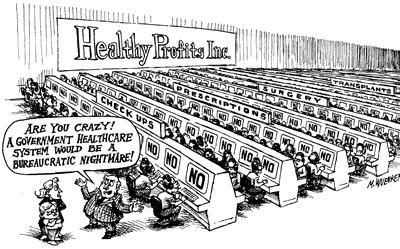
Cartoon – Rising Healthcare Costs

A new report confirms concerns about healthcare costs, as it shows per-person spending is increasing faster than per-capita gross domestic product.
Between 2014 and 2018, per-person yearly spending, for those with employer-sponsored insurance, climbed from $4,987 to $5,892, an 18.4% increase, according to the 2018 Health Care Cost and Utilization Report released Thursday. The average annual rate of 4.3% outpaced growth in per-capita GDP, which increased at an average 3.4% over the same period.
There’s an exception from 2017 to 2018, when per-capita GDP grew slightly faster than healthcare spending per person.
The $5,892 total includes amounts paid for medical and pharmacy claims but does not subtract manufacturer rebates for prescription drugs.
Healthcare spending grew 4.4% in 2018, slightly above growth in 2017 of 4.2%, and the third consecutive year of growth above 4%.
After adjusting for inflation, spending rose by $610 per person between
2014 and 2018.
The cost estimates are consistent with National Health Expenditure data from the Centers for Medicare and Medicaid Services, the report said.
WHAT’S THE IMPACT
Higher prices for medical services were responsible for about three-quarters, 74%, of the spending increase above inflation. These increases were across all categories of outpatient and professional services.
Average prices grew 2.6% in 2018. While that is the lowest rate of growth over the period, consistent year-over-year increases mean that prices were 15% higher in 2018 than 2014.
The increase for outpatient visits and procedures was $87 in 2018, the largest annual increase between 2014 and 2018.
Average out-of-pocket price for ER visits increased more sharply than other subcategories of outpatient visits, though all saw an increase in the average amount for which patients were responsible
Professional service spending per person rose $86 in 2018, reflecting an acceleration in spending growth consistent with previous years’ trends, according to the report.
Inpatient services and prescription drugs also saw an increase in spending per person.
Inpatient admissions increased $24 in 2018, a smaller annual increase than in 2016 or 2017, but above the rise in 2015.
Per-person spending on prescription drugs rose $50, similar to increases in 2016 and 2017, but smaller than the rise in 2015. The total does not reflect manufacturer rebates.
On average, Americans with employer-sponsored insurance spent
$155 out-of-pocket on prescription drugs in 2018.
Prices rose, as did utilization, which grew 1.8% from 2017 to 2018, the fastest pace during the five-year period. And because of the higher price levels, the effect of the increase in utilization in 2018 on total spending was higher than it would have been in 2014.
Higher utilization may be the result of a population that got slightly older between 2014 and 2018. The population also became slightly more female.
People with job-based insurance saw their out-of-pocket costs rise by an average of 14.5%, or $114, between 2014 and 2018.
THE LARGER TREND
As most Americans have job-based health insurance, this data is critical for understanding overall health costs in the United States, the report said.
An estimated 49% of the U.S. population, about 160 million people, had employer-based health insurance in 2018, based on Census data.
The report combined data from large insurers, using 4,000 distinct
age/gender/geography combinations. It contains previously unreported information drawn from 2.5 billion insurance claims.
Claims data is the most comprehensive source of real-world evidence available to researchers as databases collect information on millions of doctors’ visits, healthcare procedures, prescriptions, and payments by insurers and patients, giving researchers large sample sizes, the report said.



https://www.axios.com/what-matters-2020-health-care-costs-7139f124-d4f7-44a1-afc2-6d653ceec77d.html

Americans worry a lot about how to get and pay for good health care, but the 2020 presidential candidates are barely talking about what’s at the root of these problems: Almost every incentive in the U.S. health care system is broken.
Why it matters: President Trump and most of the Democratic field are minimizing the hard conversations with voters about why health care eats up so much of each paycheck and what it would really take to change things.


Hospitals continue to turn to M&A to navigate tricky industry headwinds, including lowering reimbursement and flatlining admissions as patients increasingly turn to alternate, cheaper sites of care. Provider trade associations maintain consolidation lowers costs and improves operations, which trickles down to better care for patients.
Though volume of deals has ebbed and flowed, hospital M&A overall has steadily increased over the past decade. The hospital sector in 2018 saw 90 deals, according to consultancy Kaufman Hall, up 80% from just 50 such transactions in 2009.
Thursday’s study analyzed CMS data on hospital quality and Medicare claims from 2007 through 2016 and data on hospital M&A from 2009 to 2013 to look at hospital performance before and after acquisition, compared with a control group that didn’t see a change in ownership.
American Hospital Association General Counsel Melinda Hatton took aim at the study’s methods to refute its findings, especially its reliance on a common measure of patient experience called HCAHPS.
“Using data collected from patients to make claims about quality fails to recognize that it is often incomplete, as patients are not required to and do not always respond comprehensively,” Hatton told Healthcare Dive in a statement. “The survey does not capture information on the critical aspects of care as it is delivered today.”
The results contradict a widely decried AHA-funded study last year conducted by Charles River Associates that found consolidation improves quality and lowers revenue per admission in the first year prior to integration. The research came quickly under fire by academics and patient advocates over potential cherrypicked results.
A spate of previous studies found hospital tie-ups raise the price tag of care on payers and patients. Congressional advisory group MedPAC found both vertical and horizontal provider consolidation are correlated with higher healthcare costs, the brunt of which is often borne by consumers in the form of higher premiums and out-of-pocket costs.
A 2018 study published in the Quarterly Journal of Economics found prices rose 6% after hospitals were acquired, partially due to limiting market competition. Groups like the left-leaning Center for American Progress have called for increased scrutiny from antitrust regulators as a result, but — despite snowballing M&A — there’s been little change in antitrust regulation since the 1980s. The Federal Trade Commission won several challenges to hospital consolidation in the 2010s, but the agency only contests 2% to 3% of mergers annually, according to MedPAC analysts.
Providers, like most actors across the healthcare ecosystem, are increasingly under fire for high prices and predatory billing practices. President Donald Trump’s administration finalized a rule late last year that would force hospitals to reveal secret negotiated rates with insurers, relying on the assumption that transparency would shame both actors into lowering prices.
A cadre of provider groups led by the AHA sued HHS over the regulation, arguing it violates the First Amendment and would place undue burden on hospitals, while potentially stifling competition. The lawsuit is currently being reviewed by the U.S. District Court for the District of Columbia.
https://www.healthcaredive.com/news/hospital-ma-spurs-rising-healthcare-costs-medpac-finds/566858/

Dive Insight:
Hospital consolidation has become a major point of concern for policymakers, antitrust regulators and patient advocacy groups. A slew of prior studies have found unchecked provider M&A contributes to higher healthcare costs, with the brunt often borne by consumers in the form of higher premiums and out-of-pocket costs.
Since 2003, the number of “super-concentrated” markets has increased from 47% to 57%, according to the MedPAC analysis of CMS and American Hospital Association data. Those markets, with a high amount of consolidation, rarely see new providers enter, which stifles competition, and are rarely reviewed by the government.
There’s been little change in antitrust regulation since the 1980s and, though the Federal Trade Commission has won several challenges to hospital consolidation in the 2010s, the agency only challenges 2% to 3% of mergers annually.
MedPAC also found super-concentrated insurance markets actually led to lower costs per discharge compared to lower levels of payer concentration, deflating somewhat hospital lobbies’ arguments that payer consolidation is driving prices higher.
Committee members called for more analysis of how macro trends like an aging population and federal policy could be driving consolidation and impacting prices, leading some to call for a revamp of the hospital payment framework itself.
“We have to change the way hospitals are paid. I don’t see another solution,” said Brian DeBusk, CEO of Tennesse-based DeRoyal Industries, a medical manufacturer. “Are you going to undo a thousand hospital mergers? Are you going to enact rate setting? I don’t see another way.”
MedPAC also looked at vertical integration, where hospitals snap up physicians practices downstream. According to the Physician Advocacy Institute, only 26% of physician practices were owned by hospitals in 2012, but by last year that number had spiked to 44%.
Since 2012, billing has shifted from physician offices to hospital outpatient departments, especially in specialty practices. In chemotherapy administration, for example, physician offices saw almost 17% less volume between 2012 and 2018, while outpatient centers saw a 53% increase in volume, according to MedPAC.
Physicians in hospital-owned practices also refer more patients to the hospital’s facilities and, despite a common stumping point that integration improves quality through care coordination, its effect on quality is “ambiguous,” MedPAC analyst Dan Zabinski said Thursday at the committee’s November meeting.
Despite the mountain of evidence, the AHA published a widely-decried study in September claiming acquired hospitals see a reduction in operating expenses and a statistically significant drop in readmission and mortality rates. The study was criticized for not using actual claims data in its analysis among other methodological and conflict of interest concerns.
Republican leaders in the House Energy and Commerce Committee asked MedPAC to study provider consolidation in August, and the body’s full findings will be included in its March report to Congress.
 HENRY KOTULA