Pre And Post Coronavirus Unemployment Rates By State, Industry, Age Group, And Race

https://www.forbes.com/sites/mikepatton/2020/06/28/pre-and-post-coronavirus-unemployment-rates-by-state-industry-age-group-and-race/#65c42c6555eb

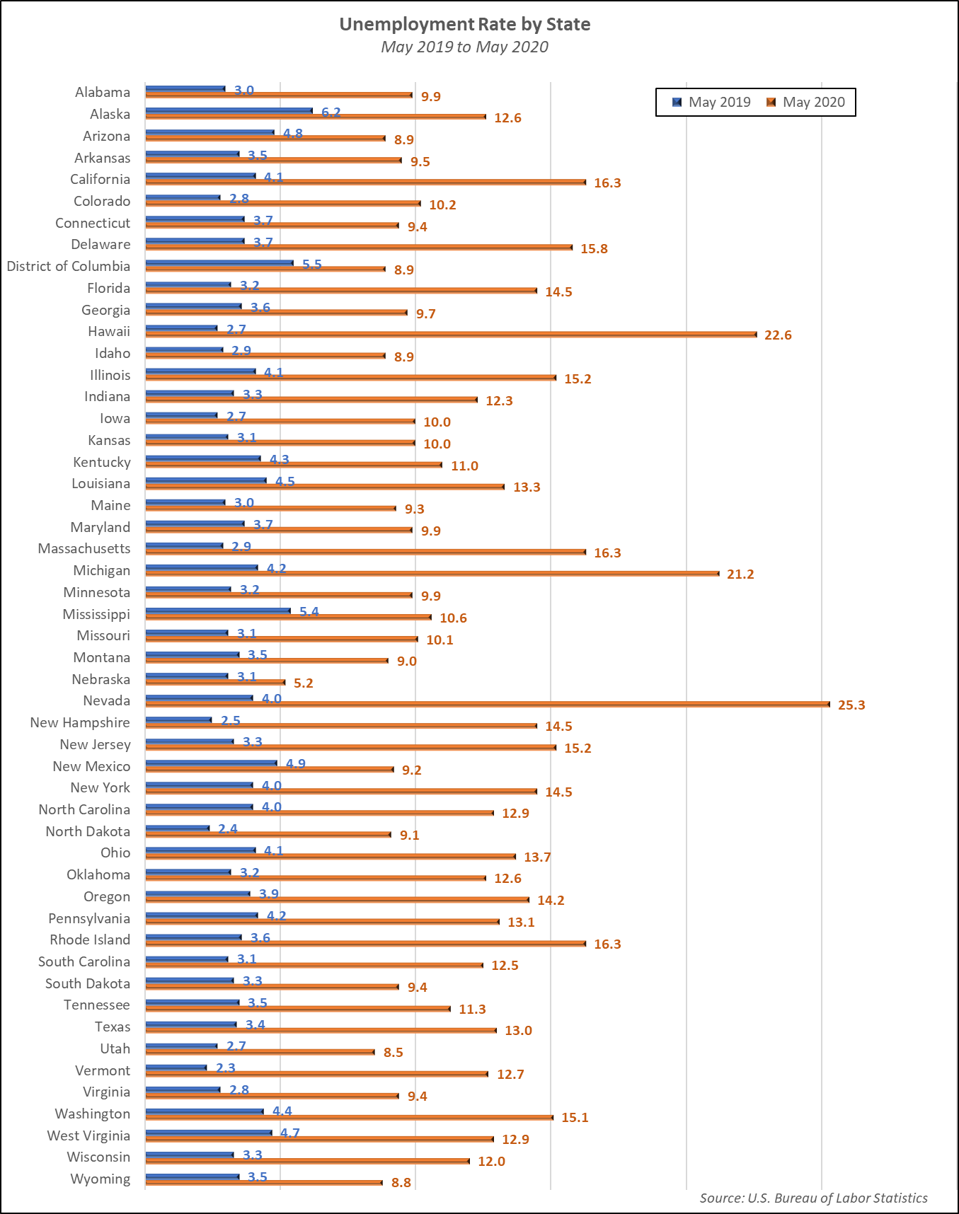
Unemployment by State-May 2019 to May 2020

The coronavirus has decimated the U.S. economy and benched nearly 40 million American workers. In the past several days, the U.S. has logged its highest number of new Covid-19 cases since the pandemic began. These combined with other factors, which we will discuss, is jeopardizing the future employment of millions of workers and the viability of thousands of businesses. Here’s how unemployment has increased for every state, industry, age group, and race, and why.

Unemployment by State

The coronavirus and subsequent stay at home orders hit the labor force especially hard. As states attempted to reopen, a resurgence in the virus is causing many businesses to close again, some by choice, others by government mandate.

Nevada has been hit the hardest as the unemployment rate in the Silver State rose from 4.0% in May 2019 to a whopping 25.3% in May 2020. Nevada’s economy is heavily reliant on leisure and hospitality, which had the brunt of the job losses. Hawaii, the second hardest hit state saw unemployment rise from 2.7% in May 2019 to 22.6% in May 2020. Which is the only other state with unemployment above 20% in May 2020? Michigan, where unemployment rose from 4.2% to 21.2% year over year. What state has fared best? Nebraska, which also has one of the most diverse economies of all states. Deriving nearly 50% of its total GDP from five different industries, unemployment in the Cornhusker State rose from 3.1% to a modest 5.2% from May 2019 to May 2020. Unemployment numbers for all states are shown in the following chart.

Unemployment by Industry

As mentioned in the previous section, the states that have fared best either have a more diverse economy or do not rely heavily on industries that have been hardest hit by the coronavirus. The most negatively affected is the leisure and hospitality industry where unemployment rose 618% from a low of 5.0% in May 2019 to a staggering 35.9% in May 2020. At a distant second, but still reeling, is the wholesale and retail trade industry, which saw unemployment rise from 4.2% to 15.1% during the same period. The rest of the industries are listed in the following chart.
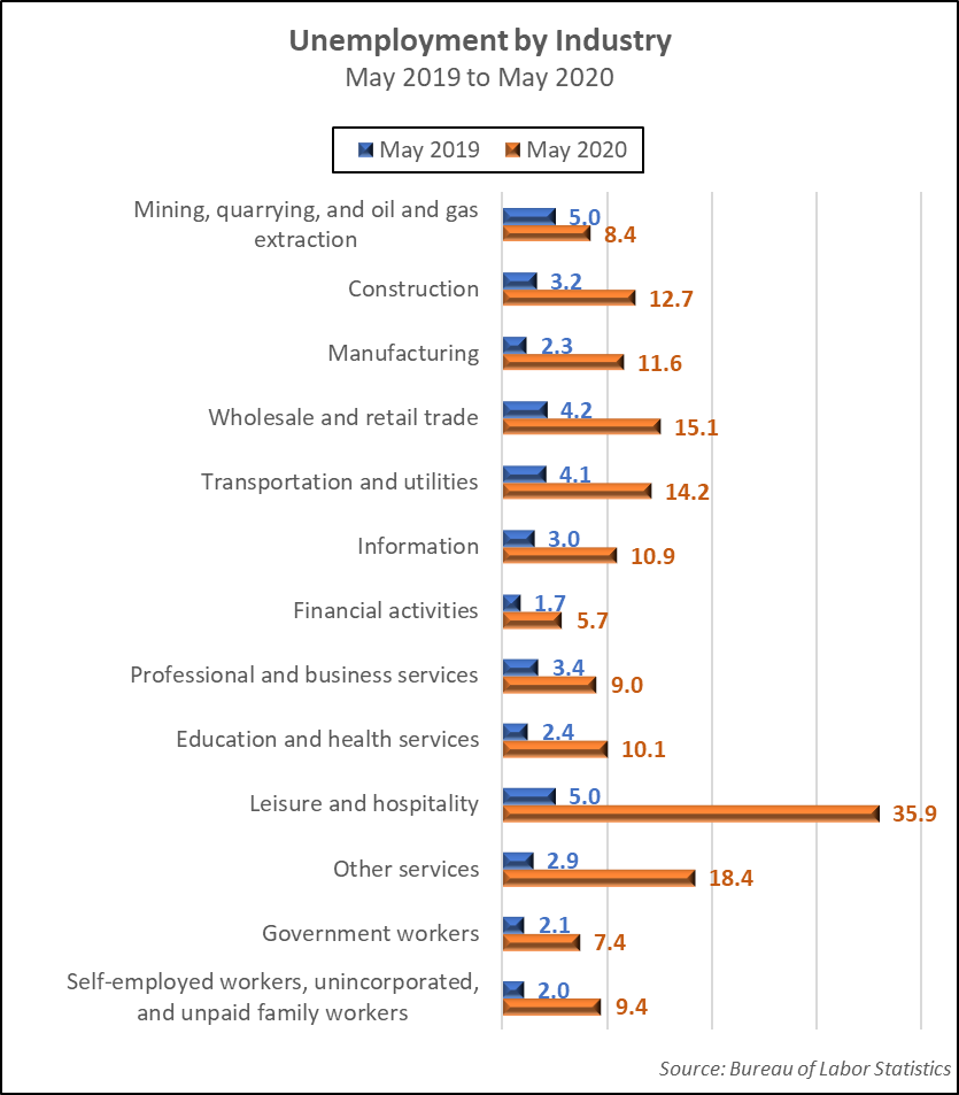
Unemployment by Industry-May 2019 to May 2020

Unemployment by Age Group

Businesses need two things to exist: workers and customers. Without customers, there is no need for workers or the business for that matter. Some businesses require highly skilled workers while others operate well using unskilled labor. It is this unskilled labor group that has been hardest hit.

The greatest rise in unemployment is among workers under age 25. This is likely due to three factors. Younger workers typically have fewer marketable skills, less work experience, and less seniority. Many of these workers are in industries that have felt the greatest pain. Unemployment rates by age group are contained in the following chart.
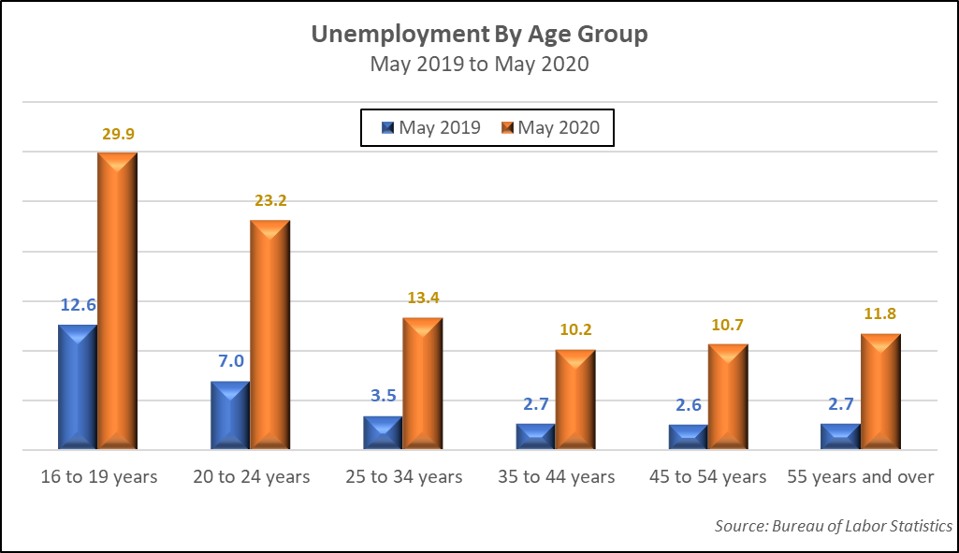
Unemployment by Age Group-May 2019 to May 2020

Unemployment by Race/Ethnicity

Question: Prior to Covid-19, was unemployment among blacks / African Americans at a record low as President Trump has claimed? Using the available data, which extends back to January 1972, the answer is yes. This new record low was achieved in October and November of 2019 when unemployment among black or African American workers fell to 5.1%. The previous record low was 5.2% in December 1973. The current rate is 16.8%, which is less than the highest rate of 20.7% logged in December 1982. The most recent high in unemployment for this group was 19.3% in March 2010. It has been steadily declining since then. Numbers for White, Asian, and Hispanic or Latino and black or African American workers are listed in the following chart.
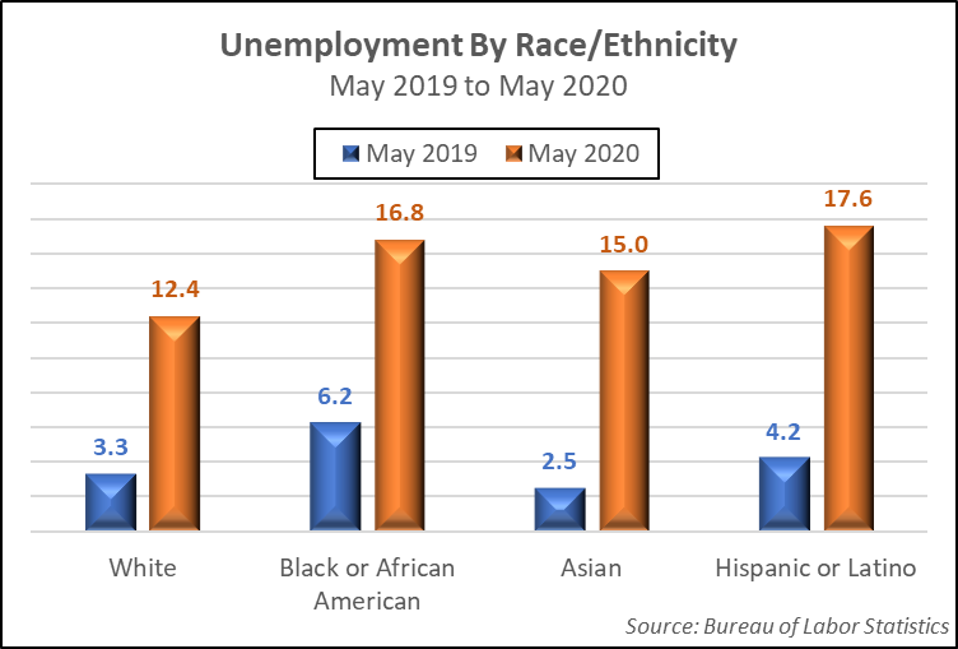
Unemployment by Race or Ethnicity-May 2019 to May 2020

Businesses need workers, workers need businesses, and both depend on customers. Since the pandemic began, consumer demand has fallen sharply. With the probability that a vaccine will not be available until early 2021 at the soonest, plus a disregard for recommended safety protocols by many individuals, namely wearing masks and social distancing, it is highly unlikely that the economy will return to normal for several years.

Will the president continue to hold rallies? Will he set an example by wearing a mask? Will the protests and violence continue? Will other large gatherings continue? Unless Americans make a collective and conscious choice to mask up and social distance, we will be forced to live in a depressed economy for longer than necessary. The choice is up to us.
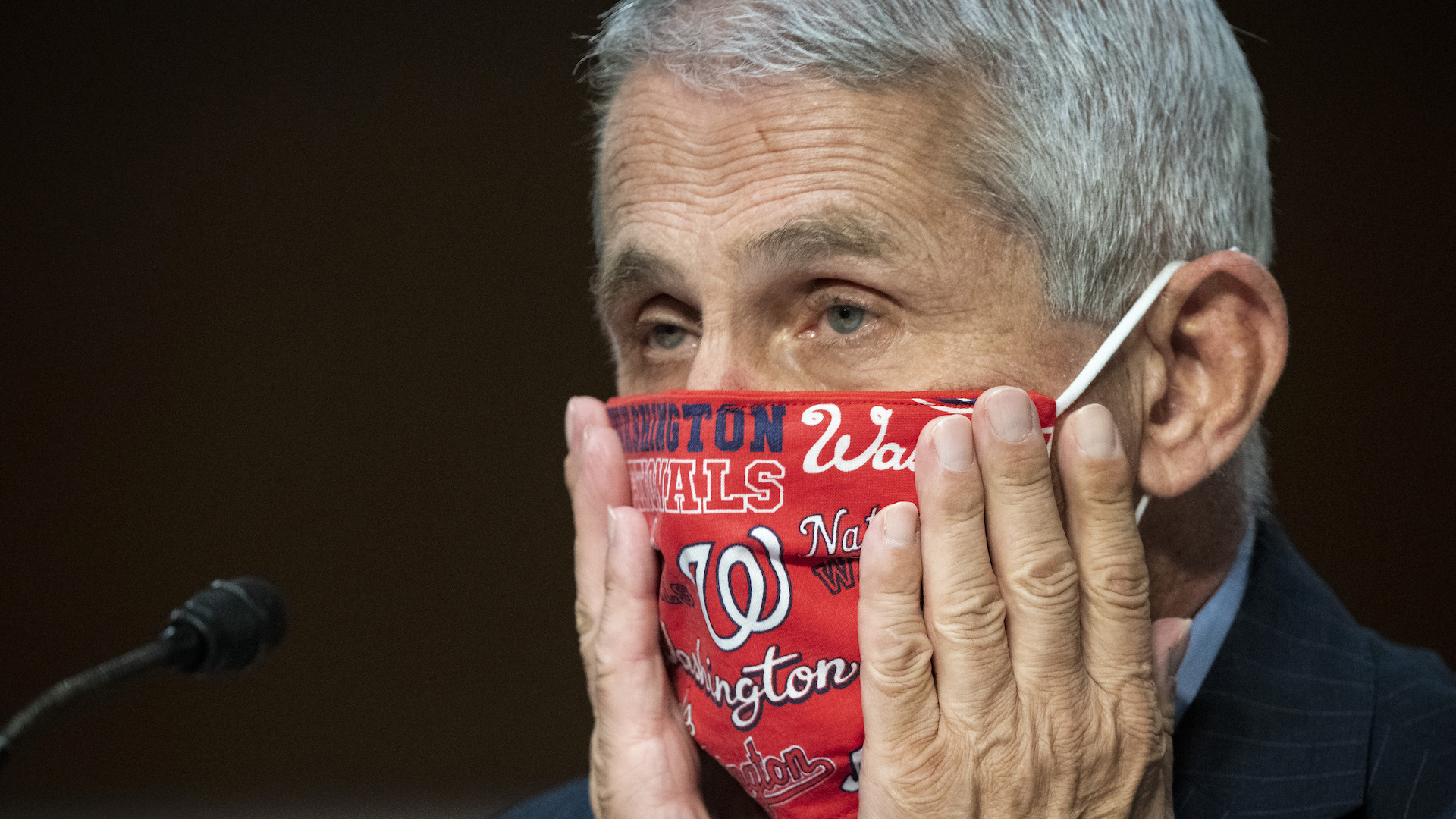


Fauci testifies new coronavirus cases could ‘go up to 100,000 a day if this does not turn around’

https://www.washingtonpost.com/nation/2020/06/30/coronavirus-live-updates-us/?utm_campaign=wp_post_most&utm_medium=email&utm_source=newsletter&wpisrc=nl_most

Coronavirus update: Fauci testifies new U.S. cases could 'go up to ...

Anthony S. Fauci, the nation’s top infectious-diseases expert, gave a dire warning Tuesday in a Senate committee hearing held as coronavirus infections surge in many parts of the United States.

“We are now having 40-plus thousand new cases a day. I would not be surprised if we go up to 100,000 a day if this does not turn around. And so I am very concerned,” Fauci said in response to questioning from Sen. Elizabeth Warren (D-Mass.) on what the overall U.S. death toll is likely to be.

While the U.S. wrestles with safely reopening, the European Union confirmed Americans will not be allowed to travel to the bloc of 27 countries when it reopens to some foreign travel Wednesday. The United States is leading the world in both officially confirmed infections and fatalities as it continues to see surges in new cases, hospitalizations and deaths in many states.

Nearly 10.3 million coronavirus cases have been detected worldwide, with roughly 2.6 million infections reported in the United States. At least 124,000 people have died of covid-19 in the United States, and the global death count is hovering near 505,000.

Here are some significant developments:

  • Former vice president and presumptive Democratic presidential nominee Joe Biden said during a speech that President Trump ‘failed’ Americans in his response to the coronavirus pandemic. Biden also released a plan to combat the virus: beefed-up testing and contacting tracing, using the Defense Production Act and organizing a global, coordinated approach for treatment and vaccines.
  • More Republican leaders advocated for the use of face masks in public, including House Minority Leader Kevin McCarthy (Calif.) — who encouraged President Trump to don one — and Senate Majority Leader Mitch McConnell. In addition, Health and Human Services Secretary Alex Azar said the rise in cases can be stopped if Americans wear facial coverings in public, along with practicing social distancing and proper personal hygiene.
  • Social distancing will not be enforced July 3 at the Mount Rushmore fireworks display that Trump will attend, South Dakota Gov. Kristi L. Noem (R) said Monday. Noem also said masks will be provided to the 7,500 participants, but they will not be required to wear them.
  • The number of people hospitalized for covid-19 is surging in seven states, according to data tracked by The Washington Post. In Texas, Arizona, Nevada, South Carolina, Montana, Georgia and California, seven-day averages are up at least 25 percent from last week.
  • Chinese researchers announced the discovery of a new strain of swine flu among workers at a slaughterhouse and warned it should be monitored in case human-to-human transmission starts.


Labs warn COVID-19 testing demand will top capacity soon as new hotspots emerge

https://www.healthcaredive.com/news/labs-warn-covid-19-testing-demand-will-top-capacity-hotspots-new-surge/580730/

Dive Brief:

  • With the spike in coronavirus cases in Southern and Western states, commercial laboratories say they do not have the capacity to keep up with growing demand for their testing services and predict longer turnaround times for results over the coming weeks.
  • The American Clinical Laboratory Association, which represents LabCorp, Quest Diagnostics and other labs, said Saturday its members have seen a steady increase in the volume of COVID-19 test orders recently, specifically calling out the fact that critical testing materials are in short supply.
  • Quest on Thursday issued its own warning that despite the rapid expansion of its testing capacity, demand has been growing faster. In particular, the lab giant noted that orders for molecular diagnostic services have increased by about 50% over the past three weeks.

Dive Insight:

U.S. commercial labs had made “significant strides” during the coronavirus pandemic by expanding testing capacity from about 100,000 tests per day in early April to more than 300,000 currently, according to ACLA.

But newly emerging hotspots like Arizona, California and Texas are putting a strain on labs and an already limited supply of testing materials, the group said.

While labs nationwide are trying to increase capacity by purchasing more testing machines and attempting to secure additional test materials from suppliers, ACLA President Julie Khani cautioned, “the reality of this ongoing global pandemic is that testing supplies are limited” and “every country across the globe is in need of essential testing supplies, like pipettes and reagents, and that demand is likely to increase in the coming months.”

Khani said ACLA has been in talks with the Trump administration and supply chain partners about the challenges labs face as they try to increase their level of respective COVID-19 testing abilities to meet the anticipated increase in U.S. demand for tests over the coming weeks.

In the absence of a solution, Khani warned that significant demand “will likely exceed” labs’ testing capacities and “could extend turnaround times for test results.”

For its part, Quest’s statement on Thursday described the U.S. coronavirus outbreak as an “evolving” situation that is putting a “strain” on the company’s COVID-19 testing resources.

“Today, we have the capacity to perform approximately 110,000 of these tests a day (770,000 a week). Despite the rapid expansion of our testing capacity, demand for testing has been growing faster,” according to Quest.

Currently, Quest’s average turnaround time for test results are one day for hospital patients, pre-operative patients in acute care settings, and symptomatic healthcare workers, and two to three days for all other patient populations. However, the company warned that “given increased demand, we expect average turnaround times near term to extend in excess of 3 days.”

Nonetheless, Quest said it is taking actions to try to increase COVID-19 testing scale, with the goal of being able to perform 150,000 tests per day. Toward that end, the company is installing additional testing platforms in its network of U.S. labs and said it is collaborating with independent labs who currently have underused capacity.

Quest’s rival LabCorp was not immediately available for comment on its testing capacity amid reports of demand increasing across the country.


Pandemic Graphic of the Day

Image may contain: text

Live updates: U.S. sets another single-day record for new coronavirus cases, surpassing 40,000 for first time

https://www.washingtonpost.com/nation/2020/06/26/coronavirus-live-updates-us/?fbclid=IwAR2rv7BC74tY4bLlGXlh70tcuv3V3vGz52MCFrCX2FYdMvhkOxd_XJoUsgM&utm_campaign=wp_main&utm_medium=social&utm_source=facebook

Coronavirus latest: Global coronavirus infections top 1 million ...

The United States has set a record for new covid-19 cases for the third time in three days, passing the 40,000 mark for the first time, according to tracking by The Washington Post.

Twelve states set their own records for the average number of new cases reported over the past seven days: Arizona, California, Florida, Georgia, Mississippi, Missouri, Oklahoma, South Carolina, Tennessee, Texas, Idaho and Utah.

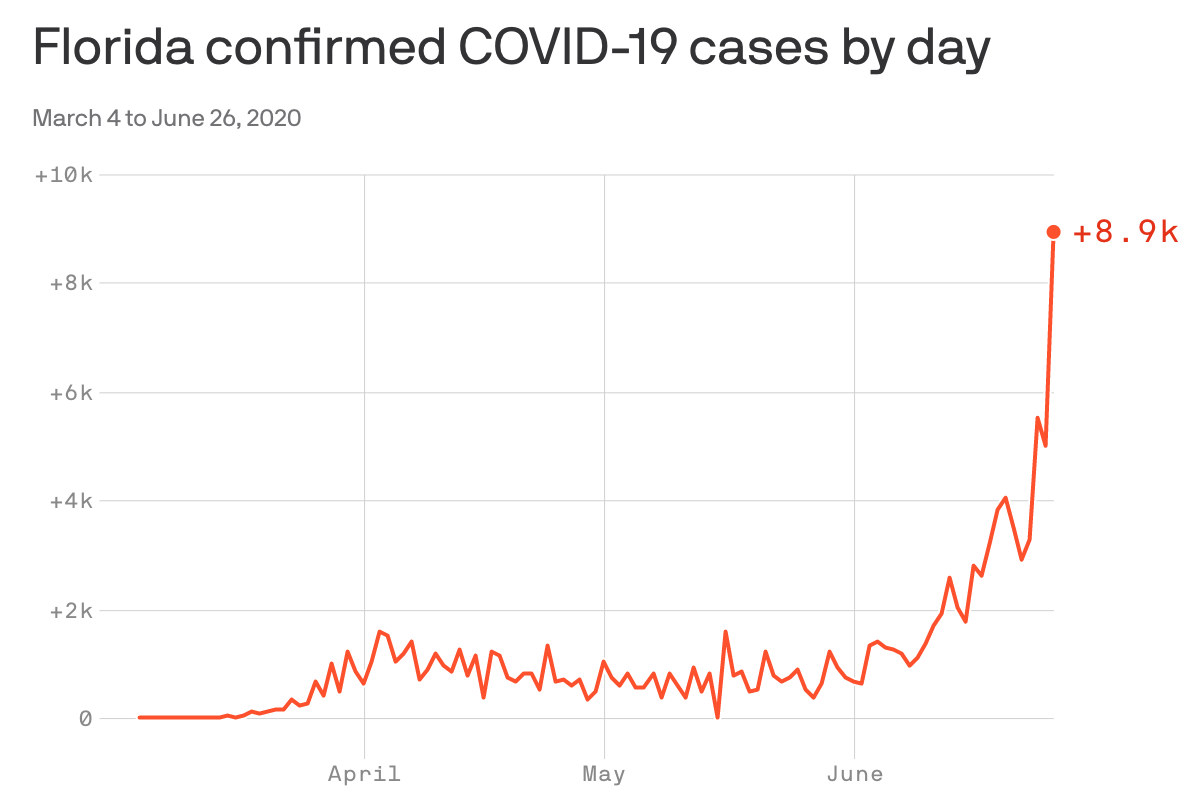
Six states set new single-day highs, led by Florida with 8,942 cases, more than 60 percent higher than its previous high set on Wednesday. Georgia, South Carolina, Tennessee, Idaho and Utah also set new single-day records.

Florida announced Friday morning that bars must close immediately, a move echoed by Texas, a state also dealing with a surge in cases and nearing its capacity to care for those suffering.

“The trajectory that we’re on right now has our hospitals being overwhelmed, probably about mid-July,” Austin Mayor Steve Adler (D) said during an appearance on CNN.

Texas Gov. Greg Abbott (R) issued an executive order that revives restrictions on bars, restaurants and certain types of outdoor recreation, one day after suggesting he would not.

Here are some significant developments:

  • The Dow Jones industrial average slid 730.05 points, about 2.8 percent, as rising coronavirus infections roiled investors Friday.
  • Vice President Pence said during a White House coronavirus task force news briefing that it is “very encouraging news” that half of the increasing cases in Florida and Texas are among Americans under 35, because younger people tend to have less-serious outcomes.
  • The Trump administration official coordinating tests for the novel coronavirus did a partial pivot Friday, announcing that the government would briefly extend its management of five testing sites in Texas, a state with a recent spike of cases and hospitalizations.
  • Anthony S. Fauci, the nation’s leading infectious-disease doctor, urged Americans to see their role in taking safety precautions as a “societal responsibility.” He begged them not to let their guards down even if the risk to their own health is considered minimal, because they can still transport it.
  • In another sign that hopes of a swift economic recovery may be losing steam, the number of homeowners delaying their mortgage payments shot up by 79,000.
  • Portugal is reinstating lockdown measures for about 700,000 people in 19 civil parishes around Lisbon next week after a worrying rise in cases in communities in the capital’s outskirts.

Six states set record number of new cases

As the United States logged a record number of infections Friday, six states announced their own new single-day high case totals: Georgia, Utah, South Carolina, Tennessee, Idaho and Florida.

Georgia reported four straight days of more than 1,700 new infections and two days in a row of records. The 1,900 cases reported by state health officials Friday surpassed the previous record, 1,714 cases, announced Thursday.

The seven-day average of new infections also hit a new high — 1,569 — and has been rising steadily since late May. That figure is up about 77 percent from a week ago and nearly 115 percent since Memorial Day.

In Utah, the single-day case total hit 676 and set a record for the fourth day in a row. The rolling average has also been on a steady upward swing for 10 days.

Current hospitalizations of Utah’s confirmed covid-19 patients are rising quickly, from 149 a week ago to 174 on Friday. Hospitalizations were at 102 when the month began.

South Carolina’s 1,301 new cases and 1,094 rolling average also set records. The state started the month with an average of 281 daily cases.

Tennessee announced 1,410 new infections, surpassing its previous record number of single-day cases by more than 200.

Current hospitalizations are also rising in South Carolina and Tennessee.

In addition to the states that set records, Louisiana has joined the states with rapidly increasing case numbers. Health officials announced 1,354 new cases Friday, compared with 523 two weeks ago and none two weeks before that.


Florida reports massive single-day increase of 9,000 coronavirus cases

https://www.axios.com/florida-single-day-increase-coronavirus-cases-a6d5578b-527c-4be4-88e6-eb7289a7be97.html?stream=health-care&utm_source=alert&utm_medium=email&utm_campaign=alerts_healthcare

Florida reports massive single-day increase of 9,000 coronavirus ...

Florida on Friday reported nearly 9,000 new coronavirus cases in 24 hours totaling 122,960 cases.

Why it matters: The state is one of many that are experiencing a fresh surge of infections.

Go deeper: The coronavirus surge is real, and it’s everywhere


Jobless claims: Another 1.48 million Americans file for unemployment benefits

https://finance.yahoo.com/news/coronavirus-covid-weekly-initial-jobless-claims-june-20-195644738.html

More than three months into the COVID-19 crisis in the U.S., countless Americans are still unemployed. According to the U.S. Labor Department, weekly initial jobless claims data showed yet another week of claims exceeding 1 million.

Another 1.48 million Americans filed for unemployment benefits in the week ending June 20, exceeding economists’ expectations for 1.32 million. The prior week’s figure was revised higher to 1.54 million from the previously reported 1.51 million claims. While this week’s report marked 12 consecutive weeks of deceleration, more than 47 million Americans have filed for unemployment insurance over the past 14 weeks.

“Jobless claims are not falling fast enough,” Renaissance Macro’s Neil Dutta said in an email Thursday. “Everything we have seen in the last week or two between rising case counts/hospitalizations, stalling economic progress in some important states, government job cuts, means one thing: the Phase 4 of fiscal stimulus must be bigger. Things should be better in 3-4 weeks, but the news will get worse before it gets better. Take some chips off the table and reload the chamber for August.”

Continuing claims, which lags initial jobless claims data by one week, totaled 19.52 million in the week ending June 13, down from 20.29 million in the week ending June 6. Consensus expectations were for 20 million continuing claims.

“Initial jobless claims continue to moderate only gradually,” Nomura economist Lewis Alexander wrote in a note Wednesday. “While the labor market remains exceptionally weak, signs of gradual improvement suggest another month of NFP gains during June.”

In the week ending June 20, California reported the highest number of jobless claims at an estimated 287,000 on an unadjusted basis, up from 241,000 in the previous week. Georgia had 124,000, down from 132,000, Florida reported 93,000, New York had roughly 90,000 and Texas reported 89,000 jobless claims.

Additionally, Pandemic Unemployment Assistance (PUA) program claims, which include those who were previously ineligible for unemployment insurance such as self-employed and contracted workers, was also closely monitored in Thursday’s report.

PUA claims totaled 728,120 on an unadjusted basis in the week ending June 20, down from the prior week’s 770,920.

As states reopen their economies, cases and hospitalization figures are back on the rise. As of Thursday morning, there were more than 9.4 million cases and 483,000 COVID-19 deaths around the world, according to Johns Hopkins University data. The U.S. had 2.3 million cases and 121,000 deaths.


Coronavirus Cases may be 10x higher than official count says CDC

https://www.axios.com/newsletters/axios-vitals-59e9ac1a-ab86-4f8a-917a-8c9d52f5835f.html?utm_source=newsletter&utm_medium=email&utm_campaign=newsletter_axiosvitals&stream=top

NC coronavirus update June 25: North Carolina's mask mandate goes ...

The real number of U.S. coronavirus cases could be as high as 23 million — 10 times the 2.3 million currently confirmed cases — the Centers for Disease Control and Prevention told reporters yesterday, Axios’ Marisa Fernandez reports.

Between the lines: The new estimate is based on antibody testing, which indicates whether someone has previously been infected by the virus regardless of whether they had symptoms.

  • “This virus causes so much asymptomatic infection. The traditional approach of looking for symptomatic illness and diagnosing it obviously underestimates the total amount of infections,” CDC director Robert Redfield said.

The agency also expanded its warnings of which demographic groups are at risk, which now include younger people who are obese and who have underlying health problems.

  • The shift reflects what states and hospitals have been seeing since the pandemic began, which is that young people can get seriously ill from COVID-19.

The new guidance also categorizes medical conditions that can affect the severity of illness:

  • Conditions that increase risk: Chronic kidney disease; chronic obstructive pulmonary disease; obesity; weakened immune system from solid organ transplant; serious heart conditions, such as heart failure, coronary artery disease or cardiomyopathies; sickle cell disease; Type 2 diabetes.
  • Conditions that may increase risk: Chronic lung diseases, including moderate to severe asthma and cystic fibrosis; high blood pressure; a weakened immune system; neurologic conditions, such as dementia or history of stroke; liver disease; pregnancy.


Coronavirus Dashboard

https://www.axios.com/coronavirus-latest-news-quick-highlights-57a186a3-7547-45bf-852a-83019849d8d5.html

Coronavirus dashboard: Catch up fast - Axios


  1. Global: Total confirmed cases as of 9 a.m. ET: 9,635,935 — Total deaths: 489,922 — Total recoveries — 4,861,715 — Map.
  2. U.S.: Total confirmed cases as of 9 a.m ET: 2,422,312 — Total deaths: 124,415 — Total recoveries: 663,562 — Total tested: 29,207,820 — Map.
  3. Public health: America’s workers still aren’t protected from the coronavirus — Gilead says coronavirus drug should likely cost no more than $2,800.
  4. White House: Trump administration asks Supreme Court to overturn ACA during pandemic.
  5. Sports: Universities cut sports teams, as they struggle with coronavirus fallout.


The U.S. divide on coronavirus masks

https://www.axios.com/political-divide-coronavirus-masks-1053d5bd-deb3-4cf4-9570-0ba492134f3e.html

Politics, not public health, drive Americans' attitudes toward ...

Mask-wearing has become the latest partisan division in an increasingly politically divided pandemic.

Why it matters: It’s becoming increasingly clear that wearing even a basic cloth mask is one of the most effective ways to prevent the spread of COVID-19. But whether or not people are willing to wear one has less to do with the risk of the pandemic than their political affiliation.

By the numbers: Results from months of the Axios-Ipsos coronavirus polls show a clear and growing political divide between Democrats and Republicans on mask-wearing habits.

  • Nationally, the percentage of Democrats who reported wearing a mask all the time when leaving home rose from 49% between April 10 and May 4 to 65% between May 8 and June 22.
  • During the same time period, the percentage of Republicans who reported constant mask-wearing rose from 29% to just 35%.

Context: The political divide Americans are reporting on mask use echoes one seen within nearly all levels of the government.

  • President Trump has not been seen to wear a mask, and he told Axios last week that attendees at his Tulsa campaign event on June 20 should “do what they want” on masks, which were not required at the rally.
  • Governors in many red states like Nebraska have refused to mandate facial masks in public, even as cases have begun to rise in recent weeks. At the same time, leaders in blue states — especially those that grappled with large outbreaks of COVID-19 — have urged residents to wear masks, with California Gov. Gavin Newsom mandating their use last week as cases in the state passed 4,000 a day.
  • The situation is even more divided at the local level, with leaders of red towns in blue states pushing back against mask mandates, and vice versa.

Flashback: Some of the blame for the divide can be traced back to muddled public health messaging on mask use in the early stages of the pandemic, when Americans were urged not to go out and buy masks in bulk because of concerns that there wasn’t enough personal protective equipment for front-line health care workers.

  • Those fears were real, as government virus expert Anthony Fauci pointed out in congressional testimony on Tuesday. And public health officials worried that pushing masks would inadvertently encourage Americans to continue going out in public at a moment when lockdowns demanded they stay inside.
  • Like the divide among experts on whether mass protests would increase coronavirus cases, just the perception that health advice might be based on politics rather than science gives cover to those who would forego masks, especially since the outbreak itself initially seemed like a blue state problem.

Health experts now know that cloth masks are most effective not so much at protecting individuals from infection as protecting the community from infected individuals. But that makes masks as much about social signaling as they are about public health.

  • Conservatives who prize individual autonomy over social responsibility experience “a massive pushback of psychological resistance” when presented with mask mandates, says Steven Taylor, the author of “The Psychology of Pandemics.”
  • That reaction is reinforced “if leaders like Trump downplay the significance of COVID-19 or if they won’t wear masks,” says Taylor. As a result, wearing a mask in conservative communities means visibly going against public opinion, while the opposite is true in communities where mask use is common.
  • The Axios-Ipsos data reflects this reality, showing that while Republicans in blue states use masks less than Democrats, they wear them at higher rates than Republicans in red states, just as Democrats in red states use masks at lower rates than Democrats in blue states.

What to watch: The one factor that seems capable of breaking the political deadlock is the outbreak itself. As cases have skyrocketed in red states like Arizona recently, there’s been a significant increase in Google searches for masks.