The U.S. will “without a doubt” have more coronavirus infections and deaths in the fall and winter if effective testing, contact tracing and social distancing measures are not scaled up to adequate levels, NIAID director Anthony Fauci testified on Tuesday.
He also said that the “consequences could be really serious” for states and cities that reopen without meeting federal guidelines.
Sen. Mitt Romney (R-Utah) criticized the Trump administration’s coronavirus testing coordinator Adm. Brett Giroir at a Senate hearing Tuesday, accusing him of framing U.S. testing data in a politically positive light: “I find our testing record nothing to celebrate whatsoever.”
Millions of Americans are risking their lives to feed us and bring meals, toiletries and new clothes to our doorsteps — but their pay, benefits and working conditions do not reflect the dangers they face at work, Axios’ Erica Pandey reports.
House Democrats released Tuesday their phase 4 $3 trillion coronavirus relief proposal that would provide billions of additional aid to state and local governments, hospitals and other Democratic priorities.
The American Federation of Teachers launched several capstone lesson plans Tuesday to help K-12 teachers measure student progress during school closures and overcome the challenges of a remote learning setting.
Grocery staples in the U.S. cost more in the last month than in almost 50 years, according to new data out Tuesday from the U.S. Bureau of Labor Statistics.
A new study by economists at the University of Illinois, Harvard Business School, Harvard University and the University of Chicago projects that more than 100,000 small businesses have permanently closed since the coronavirus pandemic was declared in March, the Washington Post reports.
Solving the mystery of how the coronavirus impacts children has gained sudden steam, as doctors try to determine if there’s a link between COVID-19 and kids with a severe inflammatory illness, and researchers try to pin down their contagiousness before schools reopen.
Driving the news: New York state’s health department is investigating 100 cases of the illness in children, Gov. Andrew Cuomo said at a Tuesday press briefing, Axios’ Orion Rummler reports.
Three children in the state have died: an 18-year-old girl, a 5-year-old boy, and a 7-year-old boy. The state’s hospitals had previously reported 85 cases on Sunday.
Doctors have described children “screaming from stomach pain” while hospitalized for shock, Jane Newburger of Boston Children’s Hospital told the Washington Post.
In some, arteries in their hearts swelled, similar to Kawasaki disease, a rare condition most often seen in infants and small children that causes blood vessel inflammation, she said.
Researchers remain uncertain if this is being caused by COVID-19, but most children appear to have a link. Some affected children have tested positive for coronavirus antibodies, suggesting that the inflammation is “delayed,” Nancy Fliesler of Boston Children’s Hospital wrote on Friday.
What’s next: The CDC is funding a $2.1 million study of 800 children who have been hospitalized after testing positive for the coronavirus through Boston Children’s Hospital. The study aims to understand why some children are more vulnerable to the disease.
CORONAVIRUS cases in Germany have almost trebled in the past 24 hours sparking fears of a second wave of COVID-19 infections.
Health authorities in Germany have reported more than 900 new cases of the deadly coronavirus less than a week after lockdown restrictions were relaxed by German Chancellor Angela Merkel. The Robert Koch Institute for public health and disease control has reported 933 new COVID-19 infections on Tuesday – an increase from just 357 on Monday.
According to the Institute the infection rate – the so-called “R” rate – has been above one for the past three days.
The rate means on average one person will potentially transmit the virus to one other individual.
The Institute for public health estimated the “R” rate was at 1.07 on Monday and 1.13 on Sunday.
The number indicates that 100 infected people would on average infect 107 others.
Today, the R rate once again dipped just below one with an estimated value of 0.94, but the latest spike in cases will worry some.
Despite the rise in the rate in recent days, the Robert Koch Institute said: “So far, we do not expect a renewed rising trend.”
Last Thursday Ms Merkel outlined a scenario at which the country would need to apply an “emergency brake” and re-impose restrictions.
The lockdown measures would be introduced again if a second wave of new infections were reported at a rate of 50 per 100,000 people.
Since Ms Merkel’s announcement, however, three districts across Germany have used the emergency measures to halt the virus.
The states of North Rhine-Westphalia and Schleswig-Holstein were forced to re-introduce lockdown after outbreaks of coronavirus at meat processing plants.
One district in the state of Thuringia is also understood to have implemented the emergency measures after outbreaks in care homes.
Just six days ago the German Chancellor announced measures to lift the lockdown by opening more shops and outlining the gradual re-opening of schools.
Shops and gyms have been allowed to begin trading providing social distancing measures were enforced.
The Chancellor also announced most Germans will be allowed to meet people from outside their households for the first time.
Top flight Bundesliga matches are also set to begin behind closed-doors this upcoming weekend.
Ms Merkel has been under increasing pressures to kick-start the faltering German economy with widespread protests taking place at the weekend in major cities including Munich.
Surprising new research may help keep people safe from coronavirus in restaurants, as states begin to loosen rules and reopen. As Omar Villafranca discovered, there’s something important beyond masks and social distancing that restaurants might need to consider: air currents.
It’s one of those moments that, even as it occurs, seems definitive. The country’s leading infectious-disease expert, Anthony S. Fauci, offering testimony before a Senate committee about a virus that’s infected more than a million Americans — but doing so remotely, because of his own contact with an infected individual. Speaking from quarantine, Fauci will offer a grim warning: Attempting to return economic activity to normal levels too quickly will “result in needless suffering and death” and itself result in negative effects for the economy.
Fauci’s warning stands in obvious contrast to the assertions of his boss, President Trump. As he has so often over the course of the pandemic, Trump waves away questions about whether states are ready to resume normal economic activity, insisting that many places are ready to gear back up. His White House released a set of recommendations for doing so, recommendations to which Fauci will refer. But even as those recommendations were introduced, Trump undercut them. He quickly embraced anti-social-distancing protests in states with blue governors — states where things were not yet ready to return to normal.
The recommendations espoused by Fauci (and, ostensibly, Trump) set an initial baseline of data that states should meet before taking even introductory steps toward reopening their economies. They’re centered on three categories benchmarks: coronavirus symptoms, actual cases and hospital capacity. The initial presentation from the White House explained how those benchmarks could be met:
For the first two, we have publicly available data that allows us to evaluate how states are doing. In the case of demonstrated symptoms, the data are somewhat old, with the most recent metrics reflecting the week of May 2. What’s more, data on the number of people showing up to emergency rooms with symptoms reflecting possible covid-19 cases (the disease caused by the coronavirus) are compiled only by region. Nonetheless, we can get a sense for how many people in each place are showing symptoms as well as up-to-date information on the number of cases and positive tests in each state.
By now, many states appear to meet the benchmarks on these two conditions. (Again, given the limits on the symptomatic data, it’s tricky to say how each fares in the moment.) A number of states that have already begun to reopen, though, don’t. In Texas, for example, the number of new cases is up and the percent of positive tests is flat. In Georgia, the number of new cases is flat and the rate of positive tests has been variable. Both states are nonetheless reopening.
Georgia’s been in the process of reopening for about three weeks, despite missing the basic benchmarks even when that process began. Gov. Brian Kemp (R) made a blanket determination that things could get back to normal, ignoring the sort of regionalized shifts that Trump himself has advocated.
New York, the state hit hardest by the virus, has implemented a deliberate, region-by-region plan for reopening. Gov. Andrew M. Cuomo (D) has outlined seven different criteria in each region of the state before it can resume some normal economic activity (though not all). (Among those? A program sufficient to trace the contacts of individuals with newly confirmed infections.) As of Monday, only three regions met the seven conditions. New York City hit four of the seven.
This is presumably how states are encouraged to reopen to avoid Fauci’s most dire predictions. It’s no guarantee that outbreaks won’t emerge, but New York’s plan is predicated on safety over normalcy while Georgia’s appears to be the opposite.
That’s the important context for Fauci’s testimony. His warnings about moving slowly are not new — though, in the past, they’ve mostly been tempered by the looming physical presence of a president who’s not very interested in diluting his optimistic economic assumptions. Fauci’s language about the ramifications is strong, but the message is consistent.
It also comes a bit too late for states such as Georgia — at least at the official level. One effect of the effort to get the state back to normal is that many Georgians aren’t ready to do so. Economic data shows that, despite businesses being open, they’re often not seeing many customers. The state’s residents are skeptical about getting back to normal. A new Post-Ipsos poll suggests that they are also skeptical of their governor.
Those participating in protests against social distancing are a small minority. Most Americans understand the thrust of Fauci’s concerns and are willing to support continued social distancing measures. While governors are occasionally skipping over the guidelines offered by Fauci and his team, the consumers who can return the economy to normal are still wary — and may be the best audience for Fauci’s warnings.
To help Californians and state policymakers understand evolving demands on the state’s health care system during the COVID-19 pandemic, CHCF is working with survey firms on two fronts. CHCF and global survey firm Ipsos are assessing residents’ desire for COVID-19 testing and their access to health care services. CHCF and Truth on Call, a physician market-research firm, are surveying hospital-based critical care, emergency department, and infectious disease physicians about staffing and the availability of testing, personal protective equipment (PPE), intensive care unit beds, and ventilators. Download the charts and data for your own presentations and analyses.
Californians’ support for sheltering in place to curb the spread of coronavirus remains strong, according to a new tracking poll from CHCF and survey firm Ipsos.
For the second time in two weeks, Californians were asked which of the following statements came “closest to your opinion” of the state’s pandemic response:
Californians should continue to shelter in place for as long as is needed to curb the spread of coronavirus, even if it means continued damage to the economy.
Californians should stop sheltering in place to stimulate the economy even if it means increasing the spread of coronavirus.
This week, 71% of Californians want to continue the statewide order, compared to 75% two weeks ago. The change is within the statistical margin of error. This week, 17% say to stop sheltering in place, and 12% say they don’t know or have no opinion. Seventy-three percent of Californians with incomes at or below 138% of the federal poverty guidelines (PDF) support the stay-at-home orders.
Support for sheltering in place is strong among Californians no matter the setting in which they live. Seventy-three percent of urban residents support continuing to stay at home compared to 72% of rural Californians, and 68% of suburban residents.
As public officials plan greater use of “contact tracing” in future phases of COVID-19 containment efforts, Californians were asked which of the following came closest to their opinion about sharing personal information with public health officials:
I am willing to share personal information about my health, movements, and contacts with local and state public health officials in order to help them understand and combat the spread of coronavirus.
I am not willing to share personal information about my health, movements, and contacts with local and state public health officials under any circumstances.
Sixty percent of state residents are willing to share personal information to help stop the spread of the coronavirus, while 21% are unwilling to share information under any circumstances, and 18% don’t know or have no opinion. These results have changed little in two weeks. Forty-nine percent of Black Californians (not shown) and 50% of Californians with low incomes are willing to share information.
Public officials are discussing moving from broad shelter-in-place strategies to more targeted quarantine-and-isolate approaches to COVID-19 containment. In this week’s tracking survey, CHCF and Ipsos asked Californians who live with at least one other person about their capacity to physically separate themselves from others in their home. According to the most recent US Census data, 11% of Californians live alone.
Eighty-one percent of those who live with at least one other person say they have access to a separate bedroom at home, and 58% say they have access to both a separate bedroom and a separate bathroom. Among Californians with low incomes, 74% of those who live with at least one other person have access to a separate bedroom, and 38% have access to a separate bedroom and a separate bathroom. Sixteen percent of all Californians surveyed and 22% of Californians with low incomes do not have access to a separate bedroom.
Californians say they continue to engage in recommended behaviors to slow the spread of the new coronavirus. Eighty-four percent say they avoid unnecessary trips out of the home “all of the time” or “most of the time.” With regard to other public health behaviors:
81% of Californians say they routinely wear a mask in public spaces all or most of the time.
93% say they stay at least six feet away from others in public spaces all or most of the time.
93% say they wash their hands frequently with soap and water all or most of the time.
Compared with previous editions of the tracking survey, the percentage of Californians who would like to get tested increased. This week, 17% of those surveyed say they haven’t sought a test but would like to get one, up from 11% in the first survey in March.
As in findings in previous rounds of the tracking survey, 2.7% of Californians report they were tested in the preceding seven days. More Californians with low incomes report trying and failing to get tested than those overall (5.8% vs. 2.4%).
The share of Californians seeing health care providers by phone or video continues to rise. This week, 8% of Californians report seeing a provider by phone or video. The portion of Californians seeing a health care provider in person in the previous week has fallen by half, from 10% to 5% since this poll began in March.
The growth in telehealth appointments is more pronounced for Californians with low incomes, with 11% reporting that they saw a provider by phone or video in the previous seven days compared to 1.7% in late March.
Over the previous seven days, 70% of Californians say their mental health is “about the same” as before. This response is unchanged from two weeks ago. The percentage of respondents saying their mental health has gotten “a little” or “a lot” worse declined from 22% to 18%. This change is within the margin of error.
Less than 1% of Californians say they have lost health insurance coverage in the last month. Fifteen percent are “very” or “somewhat” worried about losing coverage, and among Californians with low incomes, 27% are worried about losing health insurance coverage.
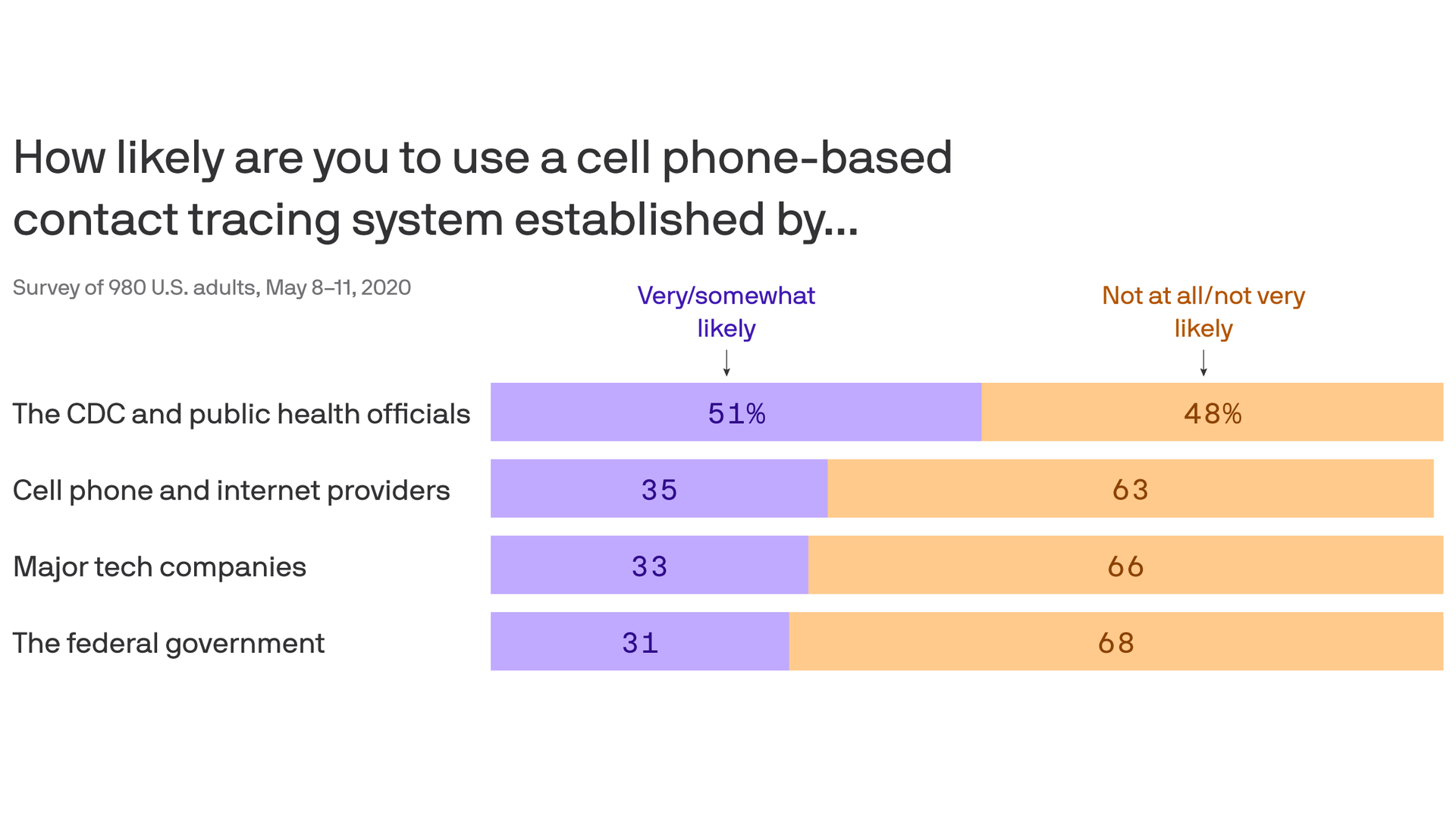
In a best-case scenario, just half of Americans would participate in a voluntary coronavirus “contact tracing” program tracked with cell phones, according to the latest installment of the Axios-Ipsos Coronavirus Index.
Why it matters: A strong contact tracing program — identifying people who have the virus and isolating those who have come into contact with them — is the key to letting other people get back to their lives, according to public health experts.
The findings underscore deep resistance to turning over sensitive health information, and mistrust about how it could be used.
The only way to get even half of Americans to participate would be for public health officials to run the program, not the White House or tech or phone companies.
What they’re saying: “The whole concept of American democracy is about local control and civil liberties, individual liberties,” said Cliff Young, president of Ipsos U.S. Public Affairs.
“At the end of the day, I think there will be an American solution to contact tracing,” but if the survey results are any guide, “it’s not going to be a centralized authority saying, ‘And now we’re going to have contact tracing.'”
These findings come as tech companies develop software to try to halt the spread, and public health officials train thousands to conduct the tracing.
The big picture: Even as the death toll rises and infections breach the White House firewall, Week 9 of our national survey also finds more people itching to return to work as they used to know it — and bending guidelines to see family and friends.
64% say returning to their pre-coronavirus lives would be a large or moderate risk. Just 30% say that’s worth the risk right now.
But four in 10 say they think returning to their normal place of employment would post only a small risk, or no risk.
63% consider airplane travel or mass transit to be a large risk, down from 73% a month ago.
Nine in 10 say they’re still practicing social distancing, but just 36% say they’re self quarantining, down from a peak of 55% in Week 4.
32% say they’ve visited family or friends in the past week, the highest share in seven weeks.
These shifts in behavior come even as growing shares of Americans know people in their own communities who have tested positive and the number of confirmed cases in the U.S. has topped 1.3 million, with roughly 80,000 deaths.
About a third know someone who has tested positive — and of those, nearly half say they know a person in their own community who has tested positive.
“People are getting antsy,” Young said. “They know there’s this risk, but … people’s mental health and social health are challenged and they’re just feeling restless.”
“You can only keep cooped up for so long.”
Between the lines: Most don’t see the virus as an immediate existential threat to themselves. This week, we asked whether people had prepared or updated their wills or living wills since the pandemic began. More than nine in 10 said no.
For contact tracing involving cell phone tracking, Democrats surveyed are more open than Republicans to the notion of opt-in reporting.
68% of Democrats say they’d participate if the Centers for Disease Control and Prevention (CDC) was in charge, compared with 58% of independents and 32% of Republicans.
Those numbers plunged if the federal government more broadly were in charge, but Democrats remained the most likely to participate — 39% compared with 34% of independents and 23% of Republicans.
That’s despite the fact that Democrats are less trusting than others of the Trump administration to protect their families.
Men are slightly more likely than women to trust tech companies with the information.
Be smart: Some reporting initiatives may need to be mandatory or person-to-person to get high enough levels of participation to be worthwhile.
President Trump claimed at a press briefing Monday that any American who “wants” a coronavirus test can get one — contradicting his testing coordinator Adm. Brett Giroir, who just moments earlier said that tests are mostly reserved for people who “need” one because they present symptoms or are participating in contact tracing.
Why it matters: Trump used the briefing largely to celebrate the country’s success in ramping up testing capacity, at one point boasting that “we have met the moment and we have prevailed” in regards to testing. But questions still remain about how Americans will be able to safely return to work if asymptomatic people don’t have access to testing.
Between the lines: The White House, meanwhile, has proven to be a microcosm of what a country with high-quality testing, surveillance and isolation capability can look like.
Giroir explained that people who are in close contact with the president are tested regularly using the 15-minute Abbotts lab device, even if they’re asymptomatic.
This is how the White House was able to diagnose Pence press secretary Katie Miller and isolate officials like Anthony Fauci who came into contact with her.
What they’re saying: “Right now in America, anybody who needs a test gets a test in America, with the numbers we have,” Giroir said. “If you’re symptomatic with a respiratory illness, that is an indication for a test and you can get a test. If you need to be contact traced, you can get a test.”
“And we hope — not hope — we are starting to have asymptomatic surveillance, which is very important. Again, that’s over 3 million tests per week. That is sufficient for everyone who needs a test — symptomatic, contact tracing and, to our best projections, the asymptomatic surveillance we need.”
“I think we have been clear all along that we believe and the data indicate we have enough testing to do the phase one gradual reopening that has been supported in the president’s plan and the task force’s plan. It has to be a phased reopening.”
Earlier in the briefing, when asked when Americans can get tested every day like White House senior staff can, Trump responded: “Very soon.”
He later said: “If people want to get tested, they get tested. We have the greatest capacity in the world, not even close. If people want to get tested they get tested, but for the most part, they shouldn’t want to get tested.”
“There is no reason. They feel good. They don’t have sniffles. They don’t have sore throats. They don’t have any problem.”
The bottom line: Trump and Giroir’s statements blurred the line between two different concepts, as The Daily Beast’s Sam Stein points out. People who “need” a test because they have symptoms or were in contact with an infected person can get one, but the number of tests “needed” to safely reopen the country is not yet sufficient.
Ubiquity of social media has made it easier to spread or even create COVID-19 falsehoods, making the work of public health officials harder.
This is part of our Coronavirus Update series in which Harvard specialists in epidemiology, infectious disease, economics, politics, and other disciplines offer insights into what the latest developments in the COVID-19 outbreak may bring.
When a disease outbreak grabs the public’s attention, formal recommendations from medical experts are often muffled by a barrage of half-baked advice, sketchy remedies, and misguided theories that circulate as anxious people rush to understand a new health risk.
The current crisis is no exception. The sudden onset of a new, highly contagious coronavirus has unleashed what U.N. Secretary-General António Guterres last week called a “pandemic of misinformation,” a phenomenon that has not gone unnoticed as nearly two-thirds of Americans said they have seen news and information about the disease that seemed completely made up, according to a recent Pew Research Center study.
What distinguishes the proliferation of bad information surrounding the current crisis, though, is social media. Kasisomayajula “Vish” Viswanath, Lee Kum Kee Professor of Health Communication at the Harvard T.H. Chan School of Public Health, said the popularity and ubiquity of the various platforms means the public is no longer merely passively consuming inaccuracies and falsehoods. It’s disseminating and even creating them, which is a “very different” dynamic than what took place during prior pandemics MERS and H1N1.
The sheer volume of COVID-19 misinformation and disinformation online is “crowding out” the accurate public health guidance, “making our work a bit more difficult,” he said.
“Misinformation could be an honest mistake or the intentions are not to blatantly mislead people,” like advising others to eat garlic or gargle with salt water as protection against COVID-19, he said. Disinformation campaigns, usually propagated for political gain by state actors, party operatives, or activists, deliberately spread falsehoods or create fake content, like a video purporting to show the Chinese government executing residents in Wuhan with COVID-19 or “Plandemic,” a film claiming the pandemic is a ruse to coerce mass vaccinations, which most major social media platforms recently banned.
In order to be effective, especially during a crisis, public health communicators have to be seen as credible, transparent, and trustworthy. And there, officials are falling short, said Viswanath.
“People are hungry for information, hungry for certitude, and when there is a lack of consensus-oriented information and when everything is being contested in public, that creates confusion among people,” he said.
“When the president says disinfectants … or anti-malaria drugs are one way to treat COVID-19, and other people say, ‘No, that’s not the case,’ the public is hard-pressed to start wondering, ‘If the authorities cannot agree, cannot make up their minds, why should I trust anybody?’”
Mainstream media coverage has added to the problem, analysts say. At many major news outlets, reporters and editors with no medical or public health training were reassigned to cover the unfolding pandemic and are scrambling to get up to speed with complex scientific terminology, methodologies, and research, and then identify, as well as vet, a roster of credible sources. Because many are not yet knowledgeable enough to report critically and authoritatively on the science, they can sometimes lean too heavily on traditional journalism values like balance, novelty, and conflict. In doing so, they lift up outlier and inaccurate counterarguments and hypotheses, unnecessarily muddying the water.
“People are hungry for information, hungry for certitude, and when there is a lack of consensus-oriented information and when everything is being contested in public, that creates confusion among people.”
— Kasisomayajula Viswanath
“What I have found is a remarkable degree of consensus among people who understand the science of this disease around what the fundamental issues are and then disagreements about trade-offs and policies,” said Jha, who is a frequent commentator on news programs. “The idea of covering the science in a two-sided way on areas where there really isn’t any disagreement has struck me as very, very odd, and it keeps coming up over and over again.”
Then there is the problem of political bias. This has been especially true at right-leaning media outlets, which have largely repeated news angles and viewpoints promoted by the White House and the president on the progress of the pandemic and the efficacy of the administration’s response, boosting unproven COVID-19 treatments and exaggerating the availability of testing and safety equipment and prospects for speedy vaccine development.
Tara Setmayer, a spring 2020 Resident Fellow at the Institute of Politics and former Republican Party communications director, said what’s coming from Fox News and other pro-Trump media goes well beyond misinformation. Whether downplaying the views of government experts on COVID-19’s lethality, blaming China or philanthropist Bill Gates for its spread, or cheering shutdown protests funded by Republican political groups, it’s all part of “an active disinformation campaign,” she said, aimed at deflecting the president’s responsibility as he wages a reelection campaign.
But turning around those who buy into false information is not as simple as piercing epistemic bubbles with facts, said Christopher Robichaud, senior lecturer in ethics and public policy at Harvard Kennedy School (HKS) who teaches the Gen Ed course “Ignorance, Lies, Hogwash and Humbug: The Value of Truth and Knowledge in Democracies.”
Over time, bubble dwellers can become cocooned in a media echo chamber that not only feeds faulty information to audiences, but anticipates criticisms in order to “prebut” potential counterarguments that audience members may encounter from outsiders, much the way cult leaders do.
“It’s not enough to introduce new pieces of evidence. You have to break through their strategies to diminish that counterevidence, and that’s a much harder thing to do than merely exposing people to different perspectives,” he said.
While Facebook, Twitter, and YouTube have all recently ramped up efforts to take down COVID-19 misinformation following public outcry, social media platforms “fall short” when it comes to curbing the flow, said Joan Donovan, who leads the Technology and Social Change Project at HKS.
Since the national shift to remote work, many social media firms are relying more heavily on artificial intelligence to patrol misinformation on their platforms, instead of human moderators, who tend to be more effective, said Donovan. So many users suddenly searching and posting about one specific topic can “signal jam search algorithms, which cannot tell the difference usually between truth and lies.”
These firms are reluctant to spark a regulatory backlash by policing their platforms too tightly and angering one or both political parties.
“So they are careful to take action on content that is deemed immediately harmful (like posts that say to drink chemicals), but are reticent to enforce moderation on calls for people to break the stay-at-home orders,” said Donovan.
Viswanath said public health officials cannot, and should not, chase down and debunk every bit of misinformation or conspiracy theory, lest the attention lends them some credence. The public needs to more closely scrutinize and be “much more skeptical” about what they’re reading and hearing, particularly online, and not try to keep up with the very latest COVID-19 research. “You don’t need to know everything,” he said.
Putting the onus entirely on the public, however, is “unfair and it won’t work,” said Viswanath. Institutions, like social media platforms, have to take more responsibility for what’s out there.
Public health organizations should be running effective communication surveillance of social media to monitor which rumors, ideas, and issues most worry the public, what is understood and misunderstood about various diseases and treatments, and what myths are circulating or being actively promoted in the community. And they need to have a strategy in place to counter what they’re picking up. “You cannot control this, but you can at least manage some of this,” Viswanath said.
Though some COVID-19 misinformation and conspiracy theories are outlandish or even dangerously inaccurate, Robichaud said it’s a mistake to dismiss those who believe them as people who don’t care about the truth.
Many cognitive biases get in the way of even the best truth-seeking strategies, so perhaps we could all benefit from a little more intellectual humility in this time of such great uncertainty, he said.
“Most of us are, at best, experts in a tiny, tiny area. But we don’t navigate the world as if that were true. We navigate the world as if we’re experts about a whole bunch of things that we’re not,” he said. “A little intellectual humility can go a long way. And I say that as a professor: It’s true of us, and it’s also true of the public at large.”
Solutions for COVID-19 are being developed at the same time as knowledge about the disease evolves, a serious challenge for doctors treating patients and for researchers trying to create vaccines and treatments.
Why it matters: What was first thought of as a respiratory infection now appears much more complex, making efforts to tackle the disease more complicated.
“We’re laying the track as the train is moving and the train is coming very fast,” says Mark Poznansky, director of the Vaccine & Immunotherapy Center at Massachusetts General Hospital. “That is an extraordinary place to be at the global level.”
What’s happening: When the world first encountered COVID-19 four months ago, it was deemed a respiratory infection that hammers the lungs. That’s still the case but in recent weeks, clinicians have been reporting wide-ranging manifestations of the disease in some people.
Some of this could be that, with enough cases, there are outliers and anomalies. But that underscores that doctors and researchers are learning as they go.
Details: Renal failure, sepsis, damaged blood vessels, skin lesions, stroke, gastrointestinal problems and blood clots in the lungs and kidneys are being seen in some COVID-19 patients.
20% of hospitalized patients in one study in Wuhan, China had heart damage.
31% of people with the disease studied in a Danish ICU had blood clots.
“It comes across more as a systemic disease exhibited initially as a respiratory disease,” says Poznansky. It’s unclear whether the cause is the virus itself, the immune system’s response to it, or the treatment received.
That has implications for developing vaccines. The goal is to prevent infection but not exacerbate the immune effects in response to the virus.
“Is [a vaccine] protective or not in a context where we don’t know what exactly defines a protective immune response to COVID-19?” asks Poznansky.
The evolving understanding underscores the need to have multiple vaccines in development. (The current count is 123, per the Milken Institute’s tracker.)
What to watch: The changing percent of the disease will feature in regulatory discussions.
“This is the question companies will be discussing with regulators: which surrogate endpoints are acceptable as a proxy for going all the way to the worst possible outcomes in a patient?” says Phyllis Arthur, vice president of infectious diseases and diagnostics policy at biotech trade organization BIO.
The bottom line: Pandemics bring a potent mix of uncertainty and urgency to science that experts say requires both nimbleness and rigor to navigate.
“This is what a pandemic is like. It’s uncomfortable,” says Arthur. “You need to move swiftly and do good, solid, evidence-based, risk-benefit ratio assessments and understand what you know and don’t know, and make evidence based policy decisions knowing you don’t have perfect information.”






 HENRY KOTULA