Talk vs. Action

55 Inspiring Quotes from U.S. Presidents That Will Change Your Life

Importance of Honesty and Ethics in our Communities

Image may contain: 1 person, standing

Kenyan runner Abel Mutai was just a few feet from the finish line, but became confused with the signage and stopped, thinking he had completed the race. A Spanish runner, Ivan Fernandez, was right behind him and, realizing what was happening, started shouting at the Kenyan to continue running. Mutai didn’t know Spanish and didn’t understand.
Realizing what was taking place, Fernandez pushed Mutai to victory.
A journalist asked Ivan, “Why did you do that?” Ivan replied,
“My dream is that someday we can have a kind of community life where we push and help each other to win.”
The journalist insisted “But why did you let the Kenyan win?” Ivan replied, “I didn’t let him win, he was going to win. The race was his.” The journalist insisted, and again asked, “But you could have won!”
Ivan looked at him and replied,
“But what would be the merit of my victory?
What would be the honor in that medal?
What would my Mother think of that?”
Values are passed on from generation to generation.
This election year, what values are we teaching our children?
Let us not teach our kids the wrong ways and means to WIN.
Instead, let us pass on the beauty and humanity of a helping hand.
Because honesty and ethics are WINNING!

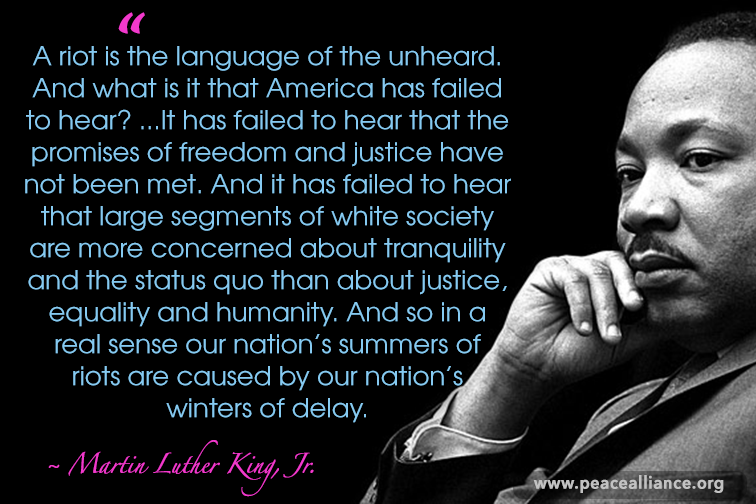
“What is it that America has failed to hear?”

https://mailchi.mp/9f24c0f1da9a/the-weekly-gist-june-5-2020?e=d1e747d2d8

The Peace Alliance's tweet - ""A riot is the language of the ...

“What is it that America has failed to hear?” asked Dr. Martin Luther King, Jr. in March of 1968, calling riots the “language of the unheard”. “It has failed to hear that the promises of freedom and justice have not been met.” Stubbornly, shamefully, we continue to turn a deaf ear: to structural racism; to institutionalized inequality; to a pandemic of police brutality and bigotry that chokes off the breath of black Americans as surely as a virus in the lungs or a boot on the neck. But the sound in the streets is thunderous.

We in healthcare must listen. We must hear that what killed George Floyd, and Breonna Taylor, and Eric Garner, and Tamir Rice, and Philando Castile, and Trayvon Martin, and Ahmaud Arbery, and countless others, as surely as the terrible actions of any single person, was the pervasive, insidious virus of racism, long since grown endemic in our country.

This week’s protests are a kind of ventilator, providing emergency breath for a national body in crisis. We must work—urgently—on the therapeutics of structural change and the vaccines of education and understanding.

At Gist Healthcare we are listening, and learning. As a team, we’ve committed to each other to be attentive, invested, empathetic allies, and to dedicate our individual and collective time, talents and treasure to antiracist work, in healthcare and beyond. Our contribution may not be large, and it will never be enough, but at least we hope it will be positive. We’d like to hear your thoughts and suggestions as well. For the moment, and for our colleagues, friends, and families, we stand with the protestors.

Black Lives Matter.


Cartoon – Economic Stimulus vs. Leadership

Family leadership and organisational leadership: what's the ...

Fed chair Powell warns of “lasting” economic damage without more stimulus

https://www.axios.com/fed-jerome-powell-coronavirus-spending-e71d88c5-09ec-4410-b08f-3d4ad6304db0.html

Fed chair Powell warns of "lasting" economic damage without more ...

Federal Reserve Chairman Jerome Powell said Congress may need to do more to prevent a worse economic downturn triggered by the coronavirus pandemic, in an interview with the Peterson Institute’s Adam Posen on Wednesday.

Why it matters: Powell warned of dire economic consequences without additional stimulus. While the Fed has responded to the pandemic with the most aggressive policy actions in the central bank’s history, it doesn’t have the power to get money directly in the hands of Americans and businesses in the form of grants like Congress does.

The backdrop: The coronavirus has pushed the economy into a downturn not seen since the Great Depression, with a record number of Americans out of work.

  • Congress and the Fed have unleashed trillions of dollars in coronavirus aid to support the economy.
  • House Democrats proposed another $3 trillion in stimulus this week, but more spending is facing resistance from Republican members of Congress.

What they’re saying: “Additional fiscal support could be costly, but worth it if it helps avoid long-term economic damage and leaves us with a stronger recovery,” Powell said.

  • “It’s not the time to prioritize” concerns about fiscal spending, Powell said.

Powell warned about the long-lasting damage a steep, prolonged downturn could have on the economy, including permanent scarring to the most vulnerable workers in the labor force.

  • In a Fed survey set to be released tomorrow, Powell said 40% of people making less than $40,000/year who were employed in February, lost their job in March.


Fauci’s warning about reopening may have more influence over Americans than governors

https://www.washingtonpost.com/politics/2020/05/12/faucis-warning-about-reopening-may-have-more-influence-over-americans-than-governors/?fbclid=IwAR0eDoGHpOUI1Ty2RdCoKcxSzwne2NscJfoVGQXnEH8ud2s5MEKIunzXuRA

White House coronavirus expert Dr Anthony Fauci says world may ...

It’s one of those moments that, even as it occurs, seems definitive. The country’s leading infectious-disease expert, Anthony S. Fauci, offering testimony before a Senate committee about a virus that’s infected more than a million Americans — but doing so remotely, because of his own contact with an infected individual. Speaking from quarantine, Fauci will offer a grim warning: Attempting to return economic activity to normal levels too quickly will “result in needless suffering and death” and itself result in negative effects for the economy.

Fauci’s warning stands in obvious contrast to the assertions of his boss, President Trump. As he has so often over the course of the pandemic, Trump waves away questions about whether states are ready to resume normal economic activity, insisting that many places are ready to gear back up. His White House released a set of recommendations for doing so, recommendations to which Fauci will refer. But even as those recommendations were introduced, Trump undercut them. He quickly embraced anti-social-distancing protests in states with blue governors — states where things were not yet ready to return to normal.

The recommendations espoused by Fauci (and, ostensibly, Trump) set an initial baseline of data that states should meet before taking even introductory steps toward reopening their economies. They’re centered on three categories benchmarks: coronavirus symptoms, actual cases and hospital capacity. The initial presentation from the White House explained how those benchmarks could be met:

For the first two, we have publicly available data that allows us to evaluate how states are doing. In the case of demonstrated symptoms, the data are somewhat old, with the most recent metrics reflecting the week of May 2. What’s more, data on the number of people showing up to emergency rooms with symptoms reflecting possible covid-19 cases (the disease caused by the coronavirus) are compiled only by region. Nonetheless, we can get a sense for how many people in each place are showing symptoms as well as up-to-date information on the number of cases and positive tests in each state.

By now, many states appear to meet the benchmarks on these two conditions. (Again, given the limits on the symptomatic data, it’s tricky to say how each fares in the moment.) A number of states that have already begun to reopen, though, don’t. In Texas, for example, the number of new cases is up and the percent of positive tests is flat. In Georgia, the number of new cases is flat and the rate of positive tests has been variable. Both states are nonetheless reopening.

Georgia’s been in the process of reopening for about three weeks, despite missing the basic benchmarks even when that process began. Gov. Brian Kemp (R) made a blanket determination that things could get back to normal, ignoring the sort of regionalized shifts that Trump himself has advocated.

New York, the state hit hardest by the virus, has implemented a deliberate, region-by-region plan for reopening. Gov. Andrew M. Cuomo (D) has outlined seven different criteria in each region of the state before it can resume some normal economic activity (though not all). (Among those? A program sufficient to trace the contacts of individuals with newly confirmed infections.) As of Monday, only three regions met the seven conditions. New York City hit four of the seven.

This is presumably how states are encouraged to reopen to avoid Fauci’s most dire predictions. It’s no guarantee that outbreaks won’t emerge, but New York’s plan is predicated on safety over normalcy while Georgia’s appears to be the opposite.

That’s the important context for Fauci’s testimony. His warnings about moving slowly are not new — though, in the past, they’ve mostly been tempered by the looming physical presence of a president who’s not very interested in diluting his optimistic economic assumptions. Fauci’s language about the ramifications is strong, but the message is consistent.

It also comes a bit too late for states such as Georgia — at least at the official level. One effect of the effort to get the state back to normal is that many Georgians aren’t ready to do so. Economic data shows that, despite businesses being open, they’re often not seeing many customers. The state’s residents are skeptical about getting back to normal. A new Post-Ipsos poll suggests that they are also skeptical of their governor.

Those participating in protests against social distancing are a small minority. Most Americans understand the thrust of Fauci’s concerns and are willing to support continued social distancing measures. While governors are occasionally skipping over the guidelines offered by Fauci and his team, the consumers who can return the economy to normal are still wary — and may be the best audience for Fauci’s warnings.


Resilience, dedication, conviction: Hospital CEOs write thank-you notes to staff

https://www.beckershospitalreview.com/hospital-management-administration/resilience-dedication-conviction-hospital-ceos-write-thank-you-notes-to-staff.html?utm_medium=email

Words of appreciation: Thank-you notes from 15 health system CEOs ...

Healthcare workers have been on the front lines of the COVID-19 pandemic, providing care to ill patients and battling the public health crisis from various angles. In honor of these workers, Becker’s asked hospital and health system CEOs to share notes to their staff and team members.

Michael Apkon, MD, PhD
President and CEO
Tufts Medical Center & Floating Hospital for Children (Boston)

At Tufts Medical Center, we see some of the sickest people in Boston. Our teams routinely surround each of these patients with the extraordinary care and services they need to get well.

This pandemic is unprecedented.  I know our staff are balancing the concerns that we all have for our families and friends, our own health, as well as the changes to our lives outside of work at the same time they do everything they can to provide the level of care people have come to trust from our organization. I can tell you that over my 30 years in this industry, I have not seen more dedication, innovation and willingness to help than I have during these past few months, as we fight a largely unknown enemy.

I could not be more proud of our doctors, nurses, technologists, transporters, housekeepers, cooks, public safety officers and all others who have been vital to the care of all of our patients, including those with a COVID-19 diagnosis. I know that people are coming together across our industry in nearly every city and town. Many thanks to each of our team members and to the healthcare workers around our country as well as to their families, who have had to worry day after day about their loved one on the front lines. Please know your partners, mothers, fathers, sister, brother, sons or daughters have played a critical role in saving lives, and we are doing everything we can to keep them safe.

Marna Borgstrom
CEO Yale New Haven (Conn.) Health

During these unprecedented times I welcome the opportunity to reflect on all that our staff at Yale New Haven Health are doing for each other and for our communities. We have a team of more than 27,000 hardworking and talented people to care for communities in Connecticut, New York and Rhode Island. I am truly humbled and honored to work alongside these amazing individuals.

Our staff, like healthcare workers everywhere, are being tasked in seemingly conflicting ways during this pandemic. Not only are they continuing to do their jobs by caring for the sickest patients, but they are also managing extremely challenging issues at home. Children of all ages are home from school, some need to be home-schooled. Businesses are closed, impacting many spouses and other family members. Staff worry that they may not have an adequate amount of protective equipment and supplies while at work.

But Yale New Haven Health staff are strong, they are resilient and most of all they are caring. As we do everything in our power to keep our staff safe, they are doing everything in their power to care for very ill patients in a world where new information is coming in real time and changing rapidly. We all hope and pray that this pandemic will end soon, but until it does, we are all in this together. I have never been more proud to work with this this wonderful Yale New Haven Health team.

Audrey Gregory, PhD, RN
CEO of the Detroit Medical Center

We know that the current situation around COVID-19 is unnerving, and as things continue to change rapidly every day, it can also be overwhelming.

I want to take this opportunity to thank all the front-line staff at every level in our organization and at healthcare facilities all across the country.

I also would like to say thank you to all of the providers, including residents, fellows and advanced practice providers. I recognize the commitment that you have to provide care to our patients. Not only do I want to acknowledge that, I never want to take that for granted. As healthcare workers, this is the time that we courageously stay on the front lines.

Please be safe and do your part to protect each other. If you have any flu-like symptoms such as fever, cough, sore throat, body aches or shortness of breath, please stay home. I know that as healthcare workers we have a tendency to ignore symptoms, and work through them, so that we do not let the team down. This is the time that I implore you not to do so.

Thank you for your commitment and dedication to the patients and families that depend on us during this challenging time.

R. Guy Hudson, MD
CEO of Swedish Health Services (Seattle)

As we come together to fight this unprecedented pandemic, I am continually impressed by the resilience, professionalism and dedication of our community’s healthcare workers, first responders and other providers of essential services. Without their selfless commitment to serving others, we would not be able to weather this crisis.

Though we have yet to see the full costs that COVID-19 will exact on our region, I am confident that our community will continue to come together, support each other and manage through this situation with resolve.

I am grateful to the community’s outpouring of support for healthcare providers on the front lines, including the 13,000 dedicated caregivers at Swedish. It is often in times of crisis that our humanity, resilience and compassion shine brightest.

The pandemic poses the greatest risk to the most vulnerable members of our community. There are hundreds of nonprofits and other organizations that are doing heroic work to help our neighbors who struggle with mental illness, housing instability, food insecurity and other challenges. Their efforts are more critical than ever and need our support.

In this unchartered territory, I find strength in the dedication and conviction of the caregivers I have the privilege to work alongside. Providing care to our community in a time like this is exactly why we chose careers in healthcare. In the face of this pandemic, we will continue to serve the needs of our community, and we will not waver in our commitment to our patients.

To all our Swedish caregivers: I am proud to work with you.

Alan Kaplan, MD
CEO of UW Health (Madison, Wis.)

We find ourselves in an unprecedented time. We are preparing for a global pandemic, an insidious virus, that is already at our doorstep. To do this, the physicians and staff at UW Health are adjusting every aspect of our standard service to care for those who need us now, to prevent the spread of COVID-19 and to save as many lives as possible.

Despite these dire circumstances, I remain optimistic and proud. The faculty and staff at UW Health, from our diligent technicians to our expert physicians and nurses, are all working incredibly hard to ensure we are doing everything in our power to care for the communities we serve. Your early actions and quick flexibility gave our health system the best chance to manage this crisis. I am especially impressed by the ongoing collaboration, because it shows how much we are capable of accomplishing together. This work is highly valued and deeply appreciated, both within our walls and beyond.

I know this is a trying time for everyone in our organization and so many others around the world. Much of our specialty care has been put on hold, clinics have closed, and regular schedules are nonexistent. I appreciate the long hours and commitment it takes to serve patients and the public good in a time like this. For those on the frontlines of COVID-19, know that our entire organization and our community are proud of the work you are doing.

Finally, I hope you all do what you can to stay healthy, refresh and take time for yourself and to be with loved ones however possible during this new and challenging time. Thank you for everything you do. You are a daily inspiration.

Sarah Krevans
President and CEO of Sutter Health (Sacramento, Calif.)

The healthcare profession attracts those who want to make a difference in the lives of others. They all have a higher calling and always rise to the challenges in front of them. This happens every day, but it’s very apparent during this time in our history. There is no part of our organization that is untouched by this public health emergency. And yet, our teams stand tall. They don’t back down. From front-line health workers, to food and nutrition services staff, to information services personnel — they are committed to keeping our communities safe. Words will never be able to adequately thank them for their dedication, their perseverance and their heart, but all of us across our organization are forever grateful.

Jody Lomeo
President and CEO of Kaleida Health (Buffalo, N.Y.)

As we face these historic and challenging times, it is vitally important that we come together and stick together as a community. It’s just as important that we remain unified as the Kaleida Health family.

That said, let me thank everyone for their incredible dedication and teamwork this past week.

This is an unprecedented issue for healthcare providers to have to deal with; yet the response by the organization as a whole is what we have come to expect: nothing short of remarkable and solely focused on taking care of our community.

On behalf of a grateful community, the board of directors and the Kaleida Health leadership team, we thank you all for your incredible dedication these past few weeks. I have said it numerous times this week: You are the true heroes of this pandemic. And while our way of life has been forever changed, one constant that remains the same: the outstanding work that is done by the Kaleida Health team!

A special note of gratitude goes out to all of those who have volunteered to care for COVID-19 patients within their respective hospitals and across the Kaleida Health system. We could not do this without you!

In closing, thanks again. Stay healthy, stay safe.

We remain #KaleidaStrong.

Elizabeth Nabel, MD
President of Brigham Health (Boston)

We face an unprecedented challenge — possibly the greatest we will ever experience in our careers, maybe even our lifetimes. I am inspired by the indomitable dedication, courage and innovative spirit of our medical and scientific community as we navigate through these most trying events. From providers working on the front lines of patient care to investigators racing to discover an effective treatment for COVID-19, we are surrounded by countless demonstrations of commitment, collaboration and compassion. We will get through this together and come out on the other side stronger than ever.


New Zealand isn’t just flattening the curve. It’s squashing it.

https://www.washingtonpost.com/world/asia_pacific/new-zealand-isnt-just-flattening-the-curve-its-squashing-it/2020/04/07/6cab3a4a-7822-11ea-a311-adb1344719a9_story.html?fbclid=IwAR0G_nNMxXlu82cnEElI4E3napU5ug5XyMQqeiFyhfl0Cx_aIH4K91GwdUY&utm_campaign=wp_main&utm_medium=social&utm_source=facebook

New Zealand isn't just flattening the curve. It's squashing it. #1 ...

 It’s been less than two weeks since New Zealand imposed a coronavirus lockdown so strict that swimming at the beach and hunting in bushland were banned. They’re not essential activities, plus we’ve been told not to do anything that could divert emergency services’ resources.

People have been walking and biking strictly in their neighborhoods, lining up six feet apart while waiting to go one-in-one-out into grocery stores, and joining swaths of the world in discovering the vagaries of home schooling.

It took only 10 days for signs that the approach here — “elimination” rather than the “containment” goal of the United States and other Western countries — is working.

The number of new cases has fallen for two consecutive days, despite a huge increase in testing, with 54 confirmed or probable cases reported Tuesday. That means the number of people who have recovered, 65, exceeds the number of daily infections.

“The signs are promising,” Ashley Bloomfield, the director-general of health, said Tuesday.

The speedy results have led to calls to ease the lockdown conditions, even a little, for the four-day Easter holiday, especially as summer lingers on.

But Prime Minister Jacinda Ardern is adamant that New Zealand will complete four weeks of lockdown — two full 14-day incubation cycles — before letting up. She has, however, given the Easter Bunny special dispensation to work this weekend.

How has New Zealand, a country I still call home after 20 years abroad, controlled its outbreak so quickly?

When I arrived here a month ago, traveling from the epicenter of China via the hotspot of South Korea, I was shocked that officials did not take my temperature at the airport. I was told simply to self-isolate for 14 days (I did).

But with the coronavirus tearing through Italy and spreading in the United States, this heavily tourism-reliant country — it gets about four million international visitors a year, almost as many as its total population — did the previously unthinkable: it shut its borders to foreigners on March 19.

Two days later, Ardern delivered a televised address from her office — the first time since 1982 that an Oval Office-style speech had been given — announcing a coronavirus response alert plan involving four stages, with full lockdown being Level 4.

A group of influential leaders got on the phone with her the following day to urge moving to Level 4.

“We were hugely worried about what was happening in Italy and Spain,” said one of them, Stephen Tindall, founder of the Warehouse, New Zealand’s largest retailer.

“If we didn’t shut down quickly enough, the pain was going to go on for a very long time,” he said in a phone interview. “It’s inevitable that we will have to shut down anyway, so we would rather it be sharp and short.”

On the Monday, March 23, Ardern delivered another statement and gave the country 48 hours to prepare for a Level 4 lockdown. “We currently have 102 cases,” she said. “But so did Italy once.”

From that Wednesday night, everyone had to stay at home for four weeks unless they worked in an essential job such as health care, or were going to the supermarket or exercising near their home.

There have been critics and rebels. The police have been ordering surfers out of the waves. The health minister was caught — and publicly chastised by Ardern, who said she would have fired him if it weren’t disruptive to the crisis response — for mountain biking and taking his family to the beach.

But there has been a sense of collective purpose. The police phone line for nonemergencies has been overwhelmed with people calling to “dob in,” as we say here, others they think are breaching the rules.

The response has been notably apolitical. The center-right National Party has clearly made a decision not to criticize the government’s response, and in fact to help it.

These efforts appear to be paying off.

After peaking at 89 on April 2, the daily number of new cases ticked down to 67 on Monday and 54 on Tuesday. The vast majority of cases can be linked to international travel, making contact tracing relatively easy, and many are consolidated into identifiable clusters.

Because there is little evidence of community transmission, New Zealand does not have huge numbers of people overwhelming hospitals. Only one person, an elderly woman with existing health problems, has died.

The nascent slowdown reflected “a triumph of science and leadership,” said Michael Baker, a professor of public health at the University of Otago and one of the country’s top epidemiologists.

“Jacinda approached this decisively and unequivocally and faced the threat,” said Baker, who had been advocating for an “elimination” approach since reading a World Health Organization report from China in February.

“Other countries have had a gradual ramp-up, but our approach is exactly the opposite,” he said. While other Western countries have tried to slow the disease and “flatten the curve,” New Zealand has tried to stamp it out entirely.

Some American doctors have urged the Trump administration to pursue the elimination approach.

In New Zealand’s case, being a small island nation makes it easy to shut borders. It also helps that the country often feels like a village where everyone knows everyone else, so messages can travel quickly.

New Zealand’s next challenge: Once the virus is eliminated, how to keep it that way.

The country won’t be able to allow people free entry into New Zealand until the virus has stopped circulating globally or a vaccine has been developed, said Baker. But with strict border control, restrictions could be gradually relaxed and life inside New Zealand could return to almost normal.

Ardern has said her government is considering mandatory quarantine for New Zealanders returning to the country post-lockdown. “I really want a watertight system at our border,” she said this week, “and I think we can do better on that.”