The Perfect Storm facing the Healthcare Workforce: Eight Current Issues frame the Challenge

Tonight at midnight, thousands of federal workers face the possibility their jobs will be eliminated as part of the Department of Government Efficiency (DOGE) federal cost reduction initiative under Elon Musk’ leadership. Already, thousands who serve in federal healthcare roles at the NIH, CDC and USAID have been terminated and personnel in agencies including CMS, HHS and the FDA are likely to follow.

The federal healthcare workforce is large exceeding more than 2.5 million who serve agencies and programs as providers, clerks, administrators, scientists, analysts, counselors and more. More than half work on an hourly basis, and 95% work outside DC in field offices and clinics. For the vast majority, their work goes unnoticed except when “government waste” efforts like DOGE spring up. In those times, they’re relegated to “expendables” status and their numbers are cut.

The same can be said for the larger private U.S. healthcare workforce. Per the U.S. Bureau of Labor Statistics, industry employment was 21.4 million, or 12.8% of total U.S. employment in 2023 and is expected to reach 24 million by 2030. It’s the largest private employer in the U.S. economy and includes many roles considered “expendable” in their organizations.

Facts about the U.S. healthcare workforce:

  • More than 70% of the healthcare workforce work in provider settings including 7.4 million who work in hospitals.
  • More than half work in non-clinical roles.
  • Home health aides is the highest growth cohort and hospitals employ the biggest number (7.4 million).
  • 29% of physicians and 15% of nurses are foreign born, almost three-fourths of the workforce are women, two-thirds are non-Hispanic whites, and the majority are older than 50.
  • Its licensed professions enjoy public trust ranking among Gallup’s highest rated though all have declined:
 % 2023‘19-‘23’23 Rank % 2023‘19-‘23’23 Rank
Nurses78-71Pharmacists55-96
Dentists59-2 Psychiatrists36-79
Medical doctors56-95Chiropractors33-810

The Perfect storm

The healthcare workforce is unsteady: while stress and burnout are associated with doctors and nurses primarily, they cut across every workgroup and setting.

Eight fairly recent issues complicate efforts to achieve healthcare workforce stability:

Increased costs of living: 

Consumers are worried about their costs of living: it hits home hardest among young, low-income households including dual eligible seniors for whom gas, food and transportation are increasing faster than their incomes, and rents exceed 50% of their income. The healthcare workforce takes a direct hit: one in five we employ cannot pay their own medical bills.

Slowdown in consolidation: 

The Federal Trade Commission’s new pre-merger notification mandate that went in effect today essentially requires greater pre-merger/acquisition disclosures and a likely slowdown in deals.  Organizations anticipating deals might default to layoffs to strengthen margins while the regulatory consolidation dust settles. Expendables will take a hit.

Uncertainty about Medicaid cuts: 

In the House’ budget reconciliation plan, Medicaid cuts of up to $880 billion/10 years are contemplated. A cut of that magnitude will accelerate closure of more than 400 rural hospitals already at risk and throw the entire Medicaid program into chaos for the 79 million it serves—among them 3 million low-hourly wage earners in the healthcare workforce and at least 2 million in-home unpaid caregivers who can’t afford paid assistance. The impact of Medicaid cuts on the healthcare workforce is potentially catastrophic for their jobs and their health.

Heightened attention to tax exemptions for not-for-profit hospitals: 

Large employers sent this recommendation to Congressional leaders last week as spending cuts were being considered: “Nonprofit hospitals, despite their tax-exempt status, frequently prioritize profits over patient care. Many have deeply questionable arrangements with for-profit entities such as management companies or collections agencies, while others have “joint ventures” with Wall Street hedge funds or other for-profit provider or staffing companies. Nonprofit hospitals often shift the burden of their costs onto taxpayers and the communities they serve by overcharging for health care services, or abusing programs intended to provide access to low-cost care and prescription drugs for low-income patients. By eliminating nonprofit hospital status, resources could be more evenly distributed across the healthcare system, ensuring that hospitals are held accountable for their charitable care both to their communities and the tax laws that govern them.” Pressures on NFP hospitals to lower costs and operate more transparently are gaining momentum in state legislatures and non-healthcare corporate boardrooms. Belt tightening is likely. Layoffs are underway.

Heightened attention to executive compensation in healthcare organizations: 

Executive compensation, especially packages for CEO’s, is a growing focus of shareholder dissent, Congressional investigation, media coverage and employee disgruntlement. Compensation committee deliberations and fair market comparison data will be more publicly accessible to communities, rank and file employees, media, regulators and payers intensifying disparities between “labor” and “management”.

Increased tension between providers and insurers:

Health insurers are now recovering from 2 years of higher utilization and lower profits; hospitals did the same in 2022 and 2023. Neither is out of the woods and both are migrating to tribal warfare based on ownership (not-for-profit vs. investor owned vs. government owned), scale and ambition. Bigger, better-capitalized organizations in their ranks are faring better while many struggle. The workforce is caught in the crossfire.

Increased pressure on private equity-backed employers to exit: 

The private equity market for healthcare services has experienced a slow recovery after 2 disappointing years peppered by follow-on offerings in down rounds. Exit strategies are front and center to PE sponsors; workforce stability and retention is a means to an end to consummate the deal—that’s it.

The AI Yellow Brick Road: 

Last and potentially the most disruptive is the role artificial intelligence will play in redefining healthcare tasks and reorganizing the system’s processes based on large-language models and massive investments in technology. Job insecurity across the entire healthcare workforce is more dependent on geeks and less on licensed pro’s going forward.

These eight combine to make life miserable most days in health human resource management. DOGE will complicate matters more. It’s a concern in every sector of healthcare, and particularly serious in hospitals, medical practices, long-term and home care settings.

‘Modernizing the healthcare workforce’ sounds appealing, but for now, navigating these issues requires full attention. They require Board understanding and creative problem-solving by managers. And they merit a dignified and respectful approach to interactions with workers displaced by these circumstances: they’re not expendables, they’re individuals like you and me.

Pace of Downgrades Slowed in 2024: Five Key Takeaways

https://www.kaufmanhall.com/insights/blog/pace-downgrades-slowed-2024-five-key-takeaways

Downgrades continued to outpace upgrades in 2024 although at a lower rate than in 2023. When combining the rating actions of the three rating agencies, the number of downgrades (95) declined while the number of upgrades (37) increased, compared to 116 and 33, respectively, in 2023. Many of the downgrades reflected ongoing expense pressure that exceeded revenue growth, even as volumes headed back to pre-pandemic levels and the use of contract labor declined. Other downgrades reflected outsized increases in debt to fund pivotal growth strategies. Most of the upgrades reflected mergers of lower-rated hospitals into higher-rated systems. Rating affirmations remained the majority rating action in 2024, as in prior years.

Key takeaways include:

  1. The ratio of downgrades to upgrades narrowed at Moody’s (2.0-to-1 in 2024 from 3.2-to-1 in 2023) and Fitch (1.5-to-1 from 3.5-to-1). S&P saw a wider spread in the ratio: 4.5-to-1 in 2024 from 3.8-to-1 in 2023.
  2. Downgrades reflected a wide swath of hospitals, from small independent providers to large regional systems. Large academic medical centers and children’s hospitals saw downgrades, even with exclusive tertiary services that provided differentiation with payers. Shared, recurring downgrade factors included weaker financial performance, payer mix shifts to more governmental and less commercial, and thinner reserves. Many of the downgrades were concentrated along the two coasts: California and the Pacific Northwest and New York and Pennsylvania. Many of the ratings were already in low or below investment grade categories.
  3. Multi-notch downgrades continued in 2024, ranging from two to four notch movements in one rating action. One of the hospitals that experienced a four-notch downgrade subsequently defaulted on an interest payment (Jackson Hospital & Clinics, AL). Multi-notch upgrades reflected mergers into higher-rated systems, the largest being a seven-notch upgrade of a small, single-site hospital into a 19-hospital system in the Midwest.
  4. Five hospitals experienced multiple rating actions in 2024, with rating committees convening not once but two and three times during the year. These were distressed credits whose financial performance and reserve levels dropped materially from quarter to quarter, a characteristic of high-yield or speculative rated borrowers.
  5. While some of the upgrades followed mergers, other upgrades reflected improved financial performance and stable or growing liquidity. Likewise, some of the upgraded hospitals began receiving new supplemental funds known as Direct Payment Programs (DPPs). Unlike other supplemental funds, DPPs are subject to annual federal and state approval, making their long-term reliability uncertain. Numerous types of providers saw upgrades—including academic medical centers, independent hospitals and regional health systems—and were located across the U.S. Most of the upgraded hospitals (excluding those involved in mergers) were already investment grade.

As in past years, rating affirmations represented the overwhelming majority of rating actions in 2024. This is welcome news for the industry as many hospitals and health systems will turn to the bond market to borrow for their capital projects. Investors’ view of the industry should be bolstered by the change in industry outlooks. S&P moved to Stable from Negative and Fitch moved to Neutral from Deteriorating in December 2024, joining Moody’s revision to Stable from Negative in 2023.

We expect rating affirmations will again be the majority rating action in 2025. However, even with the stability viewed by the agencies, we expect downgrades to outpace upgrades given a growing reliance on government payers, labor challenges and a competitive environment. Policy and funding changes will also cast uncertainty into the mix in 2025 and may cause credit deterioration in future years.

Rating Agencies Upgrade Not-for-Profit Hospital Outlook

https://www.kaufmanhall.com/insights/infographic/rating-agencies-upgrade-not-profit-hospital-outlook

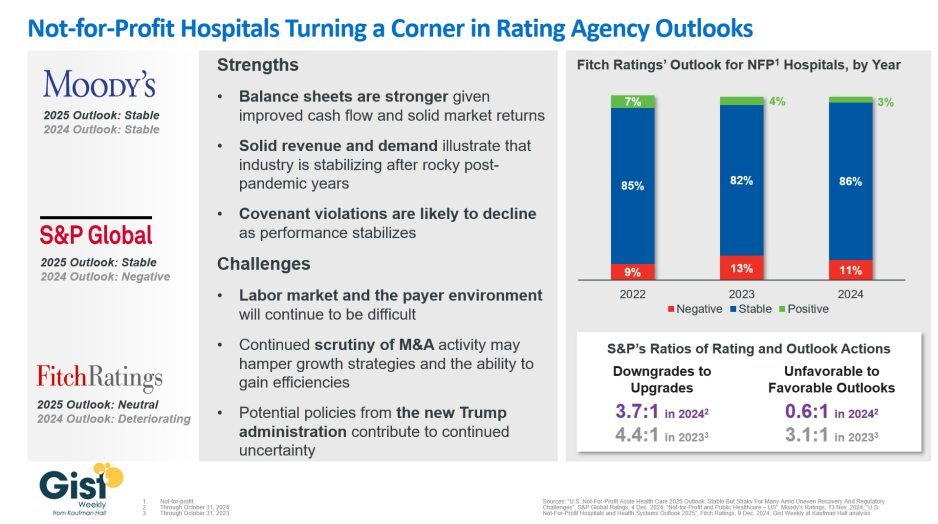
In late 2023, S&P Global and Fitch Ratings viewed the not-for-profit (NFP) hospital sector as negative or deteriorating, reflecting the difficult financial position many were in following the pandemic.

In recent weeks, S&P and Fitch upgraded their 2025 sector outlook for NFP hospitals to stable and neutral respectively, joining Moody’s Ratings, which held stable from last year.

This week’s graphic illustrates the rating agencies’ latest views on NFP hospitals, which point to a promising but uneven recovery for the industry.

Overall, the reports detail that stronger balance sheets, solid revenues, and improved demand have reduced the likelihood of covenant violations and strengthened NFP hospitals’ positions. 

However, challenges persist that could impede further progress. The labor market, payer environment, antitrust enforcement, and a new administration all present complications for the continued recovery of NFP hospitals. Nonetheless, the reports indicate significant improvement for the industry since the post-pandemic ratings downturn.

Fitch’s report noted that the share of NFP hospitals with a stable outlook has reached a three-year high. Meanwhile, S&P reported that there are now almost twice as many NFP hospitals with favorable outlooks compared to unfavorable ones, a dramatic flip from 2023, which had a 3.1:1 ratio of unfavorable to favorable outlooks. 

These ratings changes reflect the hard work put in by NFP hospitals across the country to improve their financial performance and find new ways to serve their communities sustainably. 

However, the recovery remains “shaky” and incomplete, and hospitals still face a long road ahead as they reconfigure to a new normal.

U.S. Healthcare in 2025 and Beyond: Three Major Predictions

With days before voters decide the composition of the 119th U.S. Congress and the next White House occupant, the immediate future for U.S. healthcare is both predictable and problematic:

It’s predictable that…

1-States will be the epicenter for healthcare legislation and regulation; federal initiatives will be substantially fewer.

At a federal level, new initiatives will be limited: continued attention to hospital and insurer consolidation, drug prices and the role of PBMs, Medicare Advantage business practices and a short-term fix to physician payments are likely but little more. The Affordable Care Act will be modified slightly to address marketplace coverage and subsidies and CMSs Center for Medicare and Medicaid Innovation (CMMI) will test new alternative payment models even as doubt about their value mounts. But “BIG FEDERAL LAWS” impacting the U.S. health system are unlikely.

But in states, activity will explode:  for example…

  • In this cycle, 10 states will decide their abortion policies joining 17 others that have already enacted new policies.
  • 3 will vote on marijuana legalization joining 24 states that have passed laws.
  • 24 states have already passed Prescription Drug Pricing legislation and 4 are considering commissions to set limits.
  • 40 have expanded their Medicaid programs
  • 35 states and Washington, D.C., operate CON programs; in 12 states, CONs have been repealed.
  • 14 have legislation governing mental health access.
  • 5 have passed or are developing commissions to control health costs.
  • And so on.

Given partisan dysfunction in Congress and the surprising lack of attention to healthcare in Campaign 2024 (other than abortion coverage), the center of attention in 2025-2026 will be states. In addition to the list above, attention in states will address protections for artificial intelligence utilization, access to and pricing for weight loss medications, tax exemptions for not-for-profit health systems, telehealth access, conditions for private equity ownership in health services, constraints on contract pharmacies, implementation of site neutral payments, new 340B accountability requirements and much more. In many of these efforts, state legislatures and/or Governors will go beyond federal guidance setting the stage for court challenges, and the flavor of these efforts will align with a state’s partisan majorities: as of September 30th, 2024, Republicans controlled 54.85% of all state legislative seats nationally, while Democrats held 44.19%. Republicans held a majority in 56 chambers, and Democrats held the majority in 41 chambers. In 2024, 27 states are led by GOP governors and 23 by Dems and 11 face voters November 5.  And going into the election, 22 states are considered red, 21 are considered blue and 7 are tagged as purple.

The U.S. Constitution affirms Federalism as the structure for U.S. governance: it pledges the pursuit of “life, liberty and the pursuit of happiness” as its purpose but leaves the lion’s share of responsibilities to states to figure out how. Healthcare may be federalism’s greatest test.

2-Large employers will take direct action to control their health costs.

Per the Kaiser Family Foundation’s most recent employer survey, employer health costs are expected to increase 7% this year for the second year in a row. Willis Towers Watson, predicts a 6.4% increase this year on the heels of a 6% bump last year. The Business Group on Health, which represents large self-insured employers, forecasts an 8% increase in 2025 following a 7% increase last year. All well-above inflation, ages and consumer prices this year.

Employers know they pay 254% of Medicare rates (RAND) and they’re frustrated. They believe their concerns about costs, affordability and spending are not taken seriously by hospitals, physicians, insurers and drug companies. They see lackluster results from federal price transparency mandates and believe the CMS’ value agenda anchored by accountable care organizations are not achieving needed results. Small-and-midsize employers are dropping benefits altogether if they think they can. For large employers, it’s a different story. Keeping health benefits is necessary to attract and keep talent, but costs are increasingly prohibitive against macro-pressures of workforce availability, cybersecurity threats, heightened supply-chain and logistics regulatory scrutiny and shareholder activism.

Maintaining employee health benefits while absorbing hyper-inflationary drug prices, insurance premiums and hospital services is their challenge. The old playbook—cost sharing with employees, narrow networks of providers, onsite/near site primary care clinics et al—is not working to keep up with the industry’s propensity to drive higher prices through consolidation.

In 2025, they will carefully test a new playbook while mindful of inherent risks. They will use reference pricing, narrow specialty specific networks, technology-enabled self-care and employee gainsharing to address health costs head on while adjusting employee wages. Federal and state advocacy about Medicare and Medicaid funding, insurer and hospital consolidation and drug pricing will intensify. And some big names in corporate America will step into a national debate about healthcare affordability and accountability.

Employers are fed up with the status quo. They don’t buy the blame game between hospitals, insurers and drug companies. And they don’t think their voice has been heard.

3-Private equity and strategic investors will capitalize on healthcare market conditions. 

The plans set forth by the two major party candidates feature populist themes including protections for women’s health and abortion services, maintenance/expansion of the Affordable Care Act and prescription drug price controls. But the substance of their plans focus on consumer prices and inflation: each promises new spending likely to add to the national deficit:

  • Per the Non-Partisan Committee for a Responsible Federal Budget, over the next 10 years, the Trump plan would add $7.5 trillion to the deficit; the Harris plan would add $3.5 trillion.
  • Per the Wharton School at the University of Pennsylvania, Harris’ proposals would add $1.2 trillion to the national deficits over 10 years and Trump’s proposals would add $5.8 trillion over the same period

Per the Congressional Budget Office, federal budget deficit for FY2024 which ended September 30 will be $1.8 trillion– $139 billion more than FT 2023. Revenues increased by an estimated $479 billion (or 11 percent). Revenues in all major categories, but notably individual income taxes, were greater than they were in fiscal year 2023. Outlays rose by an estimated $617 billion (or 10 percent). The largest increase in outlays was for education ($308 billion). Net outlays for interest on the public debt rose by $240 billion to total $950 billion.

The federal government spent $6.75 trillion in 2024, a 10% increase from the prior year. Spending on Social Security (22% of total spending) and healthcare programs (28.5% of total spending) also increased substantially. The U.S. debt as of Friday was $37.77 trillion, or $106 thousand per citizen.

The non-partisan Congressional Budget Office (CBO) reports that federal debt held by the public averaged 48.3 % of GDP for the half century ending in 2023– far above its historic average. It projects next year’s national debt will hit 100% for the first time since the US military build-up in the second world war. And it forecast the debt reaching 122.4% in 2034 potentially pushing interest payments from 13% of total spending this year to 20% or more.

Adding debt is increasingly cumbersome for national lawmakers despite campaign promises, and healthcare is rivaled by education, climate and national defense in seeking funding through taxes and appropriations. Thus, opportunities for private investors in healthcare will increase dramatically in 2025 and 2026. After all, it’s a growth industry ripe for fresh solutions that improve affordability and cost reduction at scale.

Combined, these three predictions foretell a U.S. healthcare system that faces a significant pressure to demonstrate value.

They require every healthcare organization to assess long-term strategies in the likely context of reduced funding, increased regulation and heightened attention to prices and affordability. This is problematic for insiders accustomed to incrementalism that’s protected them from unwelcome changes for 3 decades.  

Announcements last week by Walgreens and CVS about changes to their strategies going forward reflect the industry’s new normal: change is constant, success is not. In 2025, regardless of the election outcome, healthcare will be a major focus for lawmakers, regulators, employers and consumers.  

The Healthcare Economy: Three Key Takeaways that Frame Public and Private Sector Response

Last week, 2 important economic reports were released that provide a retrospective and prospective assessment of the U.S. health economy:

The CBO National Health Expenditure Forecast to 2032: 

“Health care spending growth is expected to outpace that of the gross domestic product (GDP) during the coming decade, resulting in a health share of GDP that reaches 19.7% by 2032 (up from 17.3% in 2022). National health expenditures are projected to have grown 7.5% in 2023, when the COVID-19 public health emergency ended. This reflects broad increases in the use of health care, which is associated with an estimated 93.1% of the population being insured that year… During 2027–32, personal health care price inflation and growth in the use of health care services and goods contribute to projected health spending that grows at a faster rate than the rest of the economy.”

The Congressional Budget Office forecast that from 2024 to 2032:

  • National Health Expenditures will increase 52.6%: $5.048 trillion (17.6% of GDP) to $7,705 trillion (19.7% of GDP) based on average annual growth of: +5.2% in 2024 increasing to +5.6% in 2032
  • NHE/Capita will increase 45.6%: from $15,054 in 2024 to $21,927 in 2032
  • Physician services spending will increase 51.2%: from $1006.5 trillion (19.9% of NHE) to $1522.1 trillion (19.7% of total NHE)
  • Hospital spending will increase 51.6%: from $1559.6 trillion (30.9% of total NHE) in 2024 to $2366.3 trillion (30.7% of total NHE) in 2032.
  • Prescription drug spending will increase 57.1%: from 463.6 billion (9.2% of total NHE) to 728.5 billion (9.4% of total NHE)
  • The net cost of insurance will increase 62.9%: from 328.2 billion (6.5% of total NHE) to 534.7 billion (6.9% of total NHE).
  • The U.S. Population will increase 4.9%: from 334.9 million in 2024 to 351.4 million in 2032.

The Bureau of Labor Statistics CPI Report for May 2024 and Last 12 Months (May 2023-May2024): 

“The Consumer Price Index for All Urban Consumers (CPI-U) was unchanged in May on a seasonally adjusted basis, after rising 0.3% in April… Over the last 12 months, the all-items index increased 3.3% before seasonal adjustment. More than offsetting a decline in gasoline, the index for shelter rose in May, up 0.4% for the fourth consecutive month. The index for food increased 0.1% in May. … The index for all items less food and energy rose 0.2% in May, after rising 0.3 % the preceding month… The all-items index rose 3.3% for the 12 months ending May, a smaller increase than the 3.4% increase for the 12 months ending April. The all items less food and energy index rose 3.4 % over the last 12 months. The energy index increased 3.7%for the 12 months ending May. The food index increased 2.1%over the last year.

Medical care services, which represents 6.5% of the overall CPI, increased 3.1%–lower than the overall CPI. Key elements included in this category reflect wide variance: hospital and OTC prices exceeded the overall CPI while insurance, prescription drugs and physician services were lower.

  • Physicians’ services CPI (1.8% of total impact): LTM: +1.4%
  • Hospital services CPI (1.0% of total impact): LTM: +7.3%
  • Prescription drugs (.9% of total impact) LTM +2.4%
  • Over the Counter Products (.4% of total impact) LTM 5.9%
  • Health insurance (.6% of total) LTM -7.7%

Other categories of greater impact on the overall CPI than medical services are Shelter (36.1%), Commodities (18.6%), Food (13.4%), Energy (7.0%) and Transportation (6.5%).

Three key takeaways from these reports:

  • The health economy is big and getting bigger. But it’s less obvious to consumers in the prices they experience than to employers, state and federal government who fund the majority of its spending. Notably, OTC products are an exception: they’re a direct OOP expense for most consumers. To consumers, especially renters and young adults hoping to purchase homes, the escalating costs of housing have considerably more impact than health prices today but directly impact on their ability to afford coverage and services. Per Redfin, mortgage rates will hover at 6-7% through next year and rents will increase 10% or more.
  • Proportionate to National Health Expenditure growth, spending for hospitals and physician services will remain at current levels while spending for prescription drugs and health insurance will increase. That’s certain to increase attention to price controls and heighten tension between insurers and providers.
  • There’s scant evidence the value agenda aka value-based purchases, alternative payment models et al has lowered spending nor considered significant in forecasts.

The health economy is expanding above the overall rates of population growth, overall inflation and the U.S. economy. GDP.  Its long-term sustainability is in question unless monetary policies enable other industries to grow proportionately and/or taxpayers agree to pay more for its services. These data confirm its unit costs and prices are problematic.

As Campaign 2024 heats up with the economy as its key issue, promises to contain health spending, impose price controls, limit consolidation and increase competition will be prominent.

Public sector actions

will likely feature state initiatives to lower cost and spend taxpayer money more effectively.

Private sector actions

will center on employer and insurer initiatives to increase out of pocket payments for enrollees and reduce their choices of providers.

Thus, these reports paint a cautionary picture for the health economy going forward. Each sector will feel cost-containment pressure and each will claim it is responding appropriately. Some actually will.

PS: The issue of tax exemptions for not-for-profit hospitals reared itself again last week.

The Committee for a Responsible Federal Budget—a conservative leaning think tank—issued a report arguing the exemption needs to be ended or cut.  In response,

the American Hospital Association issued a testy reply claiming the report’s math misleading and motivation ill-conceived.

This issue is not going away: it requires objective analysis, fresh thinking and new voices.  For a recap, see the Hospital Section below.

Surprising U.S. economy is powering better global outlook, World Bank says

The global economy is in better shape than it was at the start of the year, thanks largely to the performance of the United States, the World Bank said in its latest forecast Tuesday. But the sunnier outlook could cloud over if major central banks — including the Federal Reserve — keep interest rates at elevated levels.

Global growth is expected to reach an annual rate of 2.6 percent this year, up from a January forecast of 2.4 percent, the bank said. The global economy is drawing closer to a “soft landing” after recent price spikes, with average inflation dropping to a three-year low amid continuing growth, bank economists said.

While Americans’ unhappiness with high prices remains a key vulnerability for President Biden’s reelection bid, the World Bank now expects the U.S. economy to grow at an annual rate of 2.5 percent, nearly a full percentage point higher than it predicted in January.

The United States is the only advanced economy growing significantly faster than the bank anticipated at the start of the year.

“Globally, overall things are better today than they were just four or five months ago,” said Indermit Gill, the World Bank’s chief economist. “A big part of this has to do with the resilience of the U.S. economy.”

The bank credited “U.S. dynamism” with helping stabilize the global economy, despite the highest interest rates in years and wars in Ukraine and the Middle East. Employers added 272,000 jobs in May, topping analysts’ estimates, the Labor Department reported last week.

Expected global growth this year and next, however, will remain below the pre-pandemic average of 3.1 percent. Three out of four developing countries are now expected to grow more slowly than the bank forecast in January, leaving them little hope of narrowing the income gap with richer nations.

Despite their mostly upbeat tone, bank officials warned that central banks including the Fed are likely to move slowly to begin reversing the past two years of interest rate increases. That means global interest rates will remain high, averaging around 4 percent over the next two years, roughly twice the average recorded during the two decades before the pandemic.

Global inflation should ease to 3.5 percent this year, before dropping to 2.9 percent next year. But the decline is proving more gradual than the bank anticipated. And any deterioration that causes monetary authorities to delay cuts in borrowing costs could strip 0.3 percentage points from the forecast growth rates.

“This is a major risk confronting the global economy — interest rates remaining higher for longer and an already weak growth outlook becoming weaker,” Gill said.

Bank officials also flagged global trade — which is on course this year to complete its weakest half-decade since the 1990s — as a concern. Trading nations in 2024 have implemented more than 700 restrictions on merchandise trade and nearly 160 barriers to services trade.

“Trade restrictive measures have skyrocketed. They have more than doubled since the pre-pandemic period,” Gill said.

Rising protectionism risks becoming a drag on the global economy’s already modest pace of growth. Popular support in many countries for tariffs on imported goods and industrial subsidies that favor domestic production could further constrict trade flows that are already under pressure from the U.S.-China rivalry and other geopolitical risks.

“The world might become stuck in the slow lane,” said Ayhan Kose, the bank’s deputy chief economist.

Among those likely to suffer if key interest rates stay higher for longer are the 40 percent of developing countries at risk of a debt crisis. Many borrowed heavily to fund pandemic-related health care and subsequently to cover food and fertilizer bills that soared following the war in Ukraine.

They have little immediate prospect of securing debt relief and now risk losing out on trade gains as larger economies turn inward, Gill said.

Dow Jones Industrial Average hits 40,000 for the 1st time

The Dow Jones Industrial Average crossed 40,000 for the first time in history on Thursday.

This is a significant and symbolic milestone for the index that tracks 30 of the most valuable publicly traded companies in the U.S.

The Dow is now up about 6% so far this year.

The recent rally in the Dow, S&P 500 and Nasdaq has been fueled by data showing inflation is cooling, which would allow the Federal Reserve to begin its long-awaited interest rate cuts.

Inflation data released on Wednesday showed that price increases slowed slightly from the annual rate recorded in the previous month, ending a surge of inflation that stretches back to the beginning of 2024.

In recent months, the Fed had all but abandoned its previous forecast of three quarter-point rate cuts this year. But the slowdown of price hikes offered hope of rekindling those plans.

“The combination of the Fed likely to be lowering interest rates because inflation is moderating with a resilient economy is a beautiful scenario for a bull market,” Ed Yardeni, the president of market advisory firm Yardeni Research and former chief investment strategist at Deutsche Bank’s U.S. equities division, told ABC News.

“It’s more enjoyable to say the market is going to these nice, round numbers in record-high territory than coming back down to them,” Yardeni added.

The inflation news on Wednesday sent each of the major stock indexes up more than 5% for the day, propelling all of them to record highs. In early trading on Thursday, the Dow had ticked up a quarter of a percentage point.

Observers have also attributed this year’s stock market rally to the rise in value of some major tech firms, driven largely by enthusiasm about artificial intelligence.

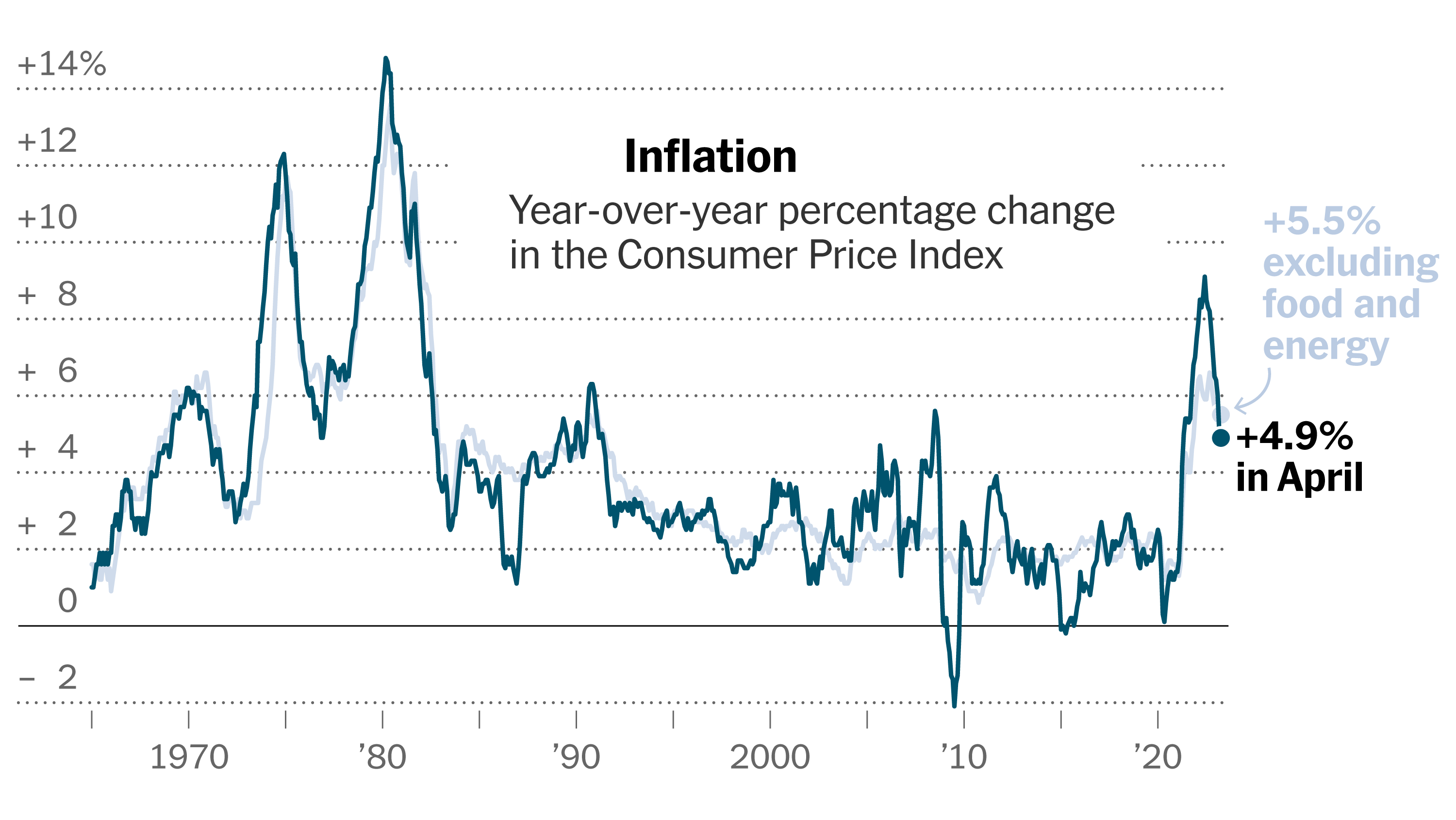
Inflation cools, reassuring Fed after unexpectedly hot gains in Q1

The yield on the benchmark 10-year Treasury note fell on investor speculation that slower inflation will prompt the Fed to sooner cut borrowing costs.

Dive Brief:

  • The consumer price index excluding volatile food and energy prices rose last month at the slowest pace this year, giving Federal Reserve policymakers some relief from a barrage of first-quarter data that shook confidence inflation will steadily slow to their 2% goal.
  • So-called core CPI gained 0.3% in April compared with 0.4% during the prior month, and eased to 3.6% on an annual basis from 3.8% in March, the Bureau of Labor Statistics said Wednesday. Shelter costs rose 0.4% last month, pushing up core CPI more than any other category. Prices for transportation, apparel and medical care also increased.
  • “Inflation should show some signs of more material disinflation over the coming months as upside surprises in Q1 reverse and shelter inflation continues to soften, particularly” during the second half of this year, David Page, head of macroeconomic research at AXA IM, said in a report.

Dive Insight:

Fed Chair Jerome Powell has repeatedly said this month that unexpectedly high first-quarter inflation eroded his confidence that price pressures are falling steadily enough to warrant a reduction in the highest federal funds rate in 23 years.

“I would say my confidence in that is not as high as it was, having seen these readings in the first three months of the year,” Powell said Tuesday.

Investor speculation that cooling inflation will prompt the Fed to sooner trim borrowing costs pushed down the yield on the benchmark Treasury note on Wednesday by about 0.1 percentage point to 3.86%. Equity prices rose.

“Today’s data may be a relief relative to past months, and that should reduce any fears that the Fed might have to raise rates,” Eric Winograd, developed market research director at AllianceBernstein, said in an email.

Still, “today’s data are not good enough to move the policy needle,” Winograd said, forecasting that the central bank will not cut the main interest rate until the fourth quarter.

“Unless the labor market weakens appreciably, it will take several months of inflation steadily decelerating before the Fed will be comfortable cutting rates,” he said.

Traders in interest rate futures put 69% odds that the Fed will trim the main interest rate by at least 0.5 percentage point by the end of this year, compared with 57% odds on Tuesday, according to the CME FedWatch Tool.

“The Fed is making progress, but taming inflation is taking time,” Scott Helfstein, head of investment strategy at Global X, said in an email response to questions.

“The Fed will probably be patient,” Helfstein said, forecasting either no change to the federal funds rate this year or at most a quarter-point cut in December. “A stable rate and inflation environment, most importantly, is good for companies.”

Powell predicted that inflation will eventually slow to a more moderate pace. “I expect that inflation will move back down on a monthly level, on a monthly basis, to levels that were more like the lower readings we were having last year,” Powell said Tuesday.

A separate report Wednesday showed consumers may be pocketing their wallets in response to higher borrowing costs and the waning of savings built during the pandemic.

Retail sales in April were unchanged from March, the Census Bureau said, releasing data that was lower than expected by economists. Growth in retail sales in March was marked down to 0.6% from 0.7%.

Still, “the consumer is okay,” Helfstein said, predicting that “economic growth will likely be driven by corporate investment through the back part of the year.”

Inflation pressures ease in April as consumer prices rise at slowest pace in three months

https://finance.yahoo.com/news/inflation-pressures-ease-in-april-as-consumer-prices-rise-at-slowest-pace-in-three-months-123222215.html

US consumer price increases cooled during the month of April, according to the latest data from the Bureau of Labor Statistics released Wednesday morning.

The Consumer Price Index (CPI) rose 0.3% over the previous month and 3.4% over the prior year in April, a slight deceleration from March’s 3.5% annual gain in prices and 0.4% month-over-month increase.

April’s monthly increase came in lower than economist forecasts of a 0.4% uptick. The annual rise in prices matched estimates, according to data from Bloomberg, and marked the slowest gain in three months.

On a “core” basis, which strips out the more volatile costs of food and gas, prices in April climbed 0.3% over the prior month and 3.6% over last year — cooler than March’s data. Both measures met economist expectations.

Investors now anticipate two 25 basis point cuts this year, down from the six cuts expected at the start of the year, according to updated Bloomberg data.

Markets rose following the data’s release, with the 10-year Treasury yield (^TNX) falling about 6 basis points to trade around 4.38%.

“The lack of a nasty surprise this time around is welcomed,” Bankrate senior economist analyst Mark Hamrick wrote in reaction to the print. Still, Hamrick added, “with the 3.4% year-over-year headline increase and 3.6% in the core (excluding food and energy), these remain irritatingly high. The status of the battle against inflation requires that interest rates remain elevated in the near-term.”

Following the data’s release, markets were pricing in a roughly 53% chance the Federal Reserve begins to cut rates at its September meeting, according to data from the CME FedWatch Tool. That’s up from about a 45% chance the month prior.

Shelter, gas prices remain sticky

Notable call-outs from the inflation print include the shelter index, which rose 5.5% on an unadjusted, annual basis, a slowdown from March. The index rose 0.4% month over month and was the largest factor in the monthly increase in core prices, according to the BLS.

Sticky shelter inflation is largely to blame for higher core inflation readings, according to economists.

The index for rent and owners’ equivalent rent (OER) each rose 0.4% on a monthly basis, matching March’s rise. Owners’ equivalent rent is the hypothetical rent a homeowner would pay for the same property.

Lodging away from home decreased 0.2% in April after rising 0.1% in March.

Energy prices continued to rise in April, buoyed by higher gas prices. The index jumped another 1.1% last month, matching March’s increase. On a yearly basis, the index climbed 2.6%.

Gas prices rose 2.8% from March to April after climbing 1.7% the previous month.

The food index increased 2.2% in April over the last year, with food prices flat from March to April. The index for food at home decreased 0.2% over the month while food away from home rose another 0.3%.

Other indexes that increased in April included motor vehicle insurance, medical care, apparel, and personal care. Motor vehicle insurance, a standout in March’s report after the category jumped 2.6%, climbed another 1.8% in April.

The indexes for used cars and trucks, household furnishings and operations, and new vehicles were among those that decreased over the month, according to the BLS.

Inside the very good GDP report

Forget the much-discussed prospect of a soft landing for the U.S. economy. In 2023, there was no landing at all.

Why it matters: 

Big economic rules broke last year. The latest data to confirm that is the new GDP report showing very strong economic growth to conclude 2023, even amid a big cooldown in inflation.

  • Mainstream economists and policymakers believed a period of below-trend growth would be necessary to make progress on inflation.
  • Instead, above-trend growth in 2023 coincided with inflation falling sharply, reflecting improvement in the economy’s supply potential.

Driving the news: 

The economy expanded at a 3.3% annualized rate in the fourth quarter, well above the 2% forecasters expected. That followed the previous quarter’s blockbuster 4.9% growth.

  • GDP was 3.1% higher in the fourth quarter than a year earlier.
  • That represents an acceleration from 0.7% GDP growth in 2022, and trounced the growth rates of most other advanced countries — and the 1.8%-ish rate that economists consider the United States’ long-term trend.

Details: 

The fourth quarter’s hot growth resulted from bustling activity across the economy.

  • Consumers spent more on goods and services, with personal consumption expenditures rising at a 2.8% annualized pace. That was responsible for nearly 2 percentage points of the fourth quarter’s GDP rise.
  • Businesses spent on equipment, factories and intellectual property at a solid pace, with nonresidential fixed investment increasing at 1.9% — up from the previous quarter.

The intrigue: 

For two years now, Fed officials have spoken of the need for a period of below-trend growth to bring inflation into line. Now, they face the decision of whether to cut rates — to essentially declare victory on inflation — even as below-trend growth is nowhere to be seen.

  • A flourishing labor market, strong productivity gains and supply-side improvements — more workers joining the workforce, for instance — has (at least so far) meant the economy can keep growing at a solid pace without risking a pickup in price pressure.
  • [W]e had significant supply-side gains with strong demand,” Fed chair Jerome Powell said in his December press conference, adding that potential growth may have been higher than usual “just because of the healing on the supply side.”
  • “So that was a surprise to just about everybody,” Powell said.

What they’re saying: 

“This report feels like a supersonic Goldilocks: very strong GDP reading with cool inflation,” Beth Ann Bovino, chief economist at U.S. Bank, tells Axios. “Good news is good news.”

  • “With high productivity levels, we can have strong growth with less inflation. That was the case during the last soft landing in the 90s,” Bovino adds.