COVID-19, Unemployment Compensation, and State Medicaid Expansion Decisions

https://www.rwjf.org/en/library/research/2020/05/covid-19-unemployment-compensation-and-state-medicaid-expansion-decisions.html?utm_source=The+Fiscal+Times&utm_campaign=04962bd706-EMAIL_CAMPAIGN_2020_05_29_09_07&utm_medium=email&utm_term=0_714147a9cf-04962bd706-390702969

COVID-19, Unemployment Compensation, and State Medicaid Expansion ...

Some Workers Losing Jobs and Health Insurance Remain Ineligible for Subsidized Coverage.

Store closed sign.

People who have lost jobs due to COVID-19 and live in states that haven’t expanded Medicaid are at a disadvantage when it comes to accessing affordable health insurance coverage.

The Issue

More than 70 percent of the 7.4 million workers with pre-pandemic employer-based insurance through industries now vulnerable to high rates of unemployment were found to be eligible for some assistance with health insurance (Medicaid or marketplace subsidies) if they lost their jobs. However, eligibility differs significantly between workers in states that have and have not expanded Medicaid.

Authors expand upon earlier work to show how varied levels of unemployment insurance provided through the Federal Pandemic Unemployment Compensation program affects eligibility for subsidized coverage.

Key Findings

Authors find that whether unemployment compensation is included in determining eligibility for Medicaid and Affordable Care Act (ACA) marketplace subsidies affects workers living in states that expanded Medicaid differently than those living in states that do not.

  • If the additional federal unemployment compensation was not used to determine eligibility for health insurance assistance, 78 percent of expansion state workers in the most vulnerable industries would be eligible for assistance compared to 59 percent of their counterparts in the 15 nonexpansion states.

  • Under current law, more than 70 percent of expansion and nonexpansion state workers with pre-pandemic employer-based insurance through industries now vulnerable to high rates of unemployment would be eligible for some assistance with health insurance if they lost their jobs.

Conclusion

The current limits on marketplace subsidies mean that fewer workers are likely to be eligible for financial assistance in getting or maintaining health insurance coverage. At the same time, additional funds could help them meet other pressing needs. This research suggests that eligibility for financial assistance above 400 percent of the federal poverty level under current rules would address this problem.

About the Urban Institute

The nonprofit Urban Institute is dedicated to elevating the debate on social and economic policy. For nearly five decades, Urban scholars have conducted research and offered evidence-based solutions that improve lives and strengthen communities across a rapidly urbanizing world. Their objective research helps expand opportunities for all, reduce hardship among the most vulnerable, and strengthen the effectiveness of the public sector. Visit the Urban Institute’s Health Policy Center for more information specific to its staff and its recent research.  


All 50 states have partially reopened; U.S. death toll surpasses 90,000

https://www.washingtonpost.com/nation/2020/05/20/coronavirus-update-us/?utm_campaign=wp_post_most&utm_medium=email&utm_source=newsletter&wpisrc=nl_most

NC coronavirus update May 18: Wake County leaders meet to discuss ...

Ready or not, the United States is reopening. All 50 states have started easing coronavirus-related restrictions — even though many of them do not meet federal benchmarks — leading public health experts to warn that a new surge of infections could be imminent.

As the U.S. death toll surpassed 90,000, White House officials continued to defend the push to reopen and optimistically predicted a swift economic recovery. As part of the focus on states’ efforts to revive their economies, Vice President Pence on Wednesday traveled to Florida while Trump was set to host the governors of Arkansas and Kansas at the White House.

Here are some significant developments:

  • Trump ramped up his rhetoric against China, claiming on Twitter that the nation’s “incompetence” was responsible for “this mass Worldwide killing!” Secretary of State Mike Pompeo also denounced China as a “brutal authoritarian regime” and described its relationship with the director of the World Health Organization as “troubling.”
  • A worker at a mink farm in the Netherlands may have contracted the novel coronavirus from an animal there, the country’s agricultural minister said. If confirmed, this is would be first recorded incident of animal-to-human transmission. 
  • A church in Houston and another in Georgia are closing for a second time after faith leaders and congregants tested positive for the virus shortly after the two churches reopened.
  • The president drew criticism for saying Tuesday it’s “a badge of honor” that America leads the world with more than 1.5 million confirmed cases of the novel coronavirus because “it means our testing is much better.” The United States has more than 30 percent of the world’s known coronavirus infections but accounts for less than 5 percent of the global population.
  • The Centers for Disease Control and Prevention laid out a detailed, delayed road map for reopening schools, child-care facilities, restaurants and mass transit, weeks after governors began opening states on their own terms.
  • The president privately expressed opposition to extending unemployment benefits for workers affected by the pandemic.


Medicaid Providers At The End Of The Line For Federal COVID Funding

https://khn.org/news/medicaid-providers-at-the-end-of-the-line-for-federal-covid-funding/

Medicaid Providers At The End Of The Line For Federal COVID ...

Casa de Salud, a nonprofit clinic in Albuquerque, New Mexico, provides primary medical care, opioid addiction services and non-Western therapies, including acupuncture and reiki, to a largely low-income population.

And, like so many other health care providers that serve as a safety net, its revenue — and its future — are threatened by the COVID-19 epidemic.

“I’ve been working for the past six weeks to figure out how to keep the doors open,” said the clinic’s executive director, Dr. Anjali Taneja. “We’ve seen probably an 80% drop in patient care, which has completely impacted our bottom line.”

In March, Congress authorized $100 billion for health care providers, both to compensate them for the extra costs associated with caring for patients with COVID-19 and for the revenue that’s not coming in from regular care. They have been required to stop providing most nonemergency services, and many patients are afraid to visit health care facilities.

But more than half that money has been allocated by the Department of Health and Human Services, and the majority of it so far has gone to hospitals, doctors and other facilities that serve Medicare patients. Officials said at the time that was an efficient way to get the money beginning to move to many providers. That, however, leaves out a large swath of the health system infrastructure that serves the low-income Medicaid population and childrenCasa de Salud, for example, accepts Medicaid but not Medicare.

State Medicaid directors say that without immediate funding, many of the health facilities that serve Medicaid patients could close permanently. More than a month ago, bipartisan Medicaid chiefs wrote the federal government asking for immediate authority to make “retainer” payments — not related to specific care for patients — to keep their health providers in business.

“If we wait, core components of the Medicaid delivery system could fail during, or soon after, this pandemic,” wrote the National Association of Medicaid Directors.

So far, the Trump administration has not responded, although in early April it said it was “working rapidly on additional targeted distributions” for other providers, including those who predominately serve Medicaid patients.

In an email, the Centers for Medicare & Medicaid Services said officials there will “continue to work with states as they seek to ensure continued access to care for Medicaid beneficiaries through and beyond the public health emergency.”

CMS noted that states have several ways of boosting payments for Medicaid providers, but did not directly answer the question about the retainer payments that states are seeking the authority to make. Nor did it say when the funds would start to flow to Medicaid providers who do not also get funding from Medicare.

The delay is frustrating Medicaid advocates.

“This needs to be addressed urgently,” said Joan Alker, executive director of Georgetown University’s Center for Children and Families in Washington, D.C. “We are concerned about the infrastructure and how quickly it could evaporate.”

In the administration’s explanation of how it is distributing the relief funds, Medicaid providers are included in a catchall category at the very bottom of the list, under the heading “additional allocations.”

“To not see anything substantive coming from the federal level just adds insult to injury,” said Todd Goodwin.

He runs the John F. Murphy Homes in Auburn, Maine, which provides residential and day services to hundreds of children and adults with developmental and intellectual disabilities. He said his organization — which has already furloughed almost 300 workers and spent more than $200,000 on COVID-related expenses including purchases of essential equipment such as masks and protective equipment that will not be reimbursable — has not been eligible for any of the various aid programs passed by Congress. It gets most of its funding from Medicaid and public school systems.

The organization has tapped a line of credit to stay afloat. “But if we’re not here providing these services, there’s no Plan B,” he said.

Even providers who largely serve privately insured patients are facing financial distress. Dr. Sandy Chung is CEO of Trusted Doctors, which has about 50 physicians in 13 offices in the Northern Virginia suburbs around Washington, D.C. She said about 15% of its funding comes from Medicaid, but the drop off in private and Medicaid patients has left the group “really struggling.”

“We’ve had to furlough staff, had to curtail hours, and we may have to close some locations,” she said.

Of special concern are children because Medicaid covers nearly 40% of them across the county. Chung, who also heads the Virginia chapter of the American Academy of Pediatrics, said that vaccination rates are off 30% for infants and 75% for adolescents, putting them and others at risk for preventable illnesses.

The biggest rub, she added, is that with the economy in free fall, more people will qualify for Medicaid coverage in the coming weeks and months.

“But if you don’t have providers around anymore, then you will have a significant mismatch,” she said.

Back in Albuquerque, Taneja is working to find whatever sources of funding she can to keep the clinic open. She secured a federal loan to help cover her payroll for a couple of months, but worries what will happen after that. “It would kill me if we’ve survived 15 years in this health care system, just to not make it through COVID,” she said.


States brace for ‘nearly certain’ Medicaid budget shortfalls amid COVID-19

https://www.healthcaredive.com/news/states-brace-for-nearly-certain-medicaid-budget-shortfalls-amid-covid-19/578120/

Coronavirus updates: Virus reaches all 50 states, stock futures fall

Dive Brief:

  • Most states with budget projections expect Medicaid shortfalls due to rising spending as more people lose jobs and enroll into the safety net insurance for low-income Americans due to the COVID-19 pandemic, according to a new Kaiser Family Foundation survey.
  • Almost all states with enrollment projections and more than half with spending projections expect program growth to surpass pre-pandemic estimates. Nearly all states anticipate growth will accelerate even more in the 2021 fiscal year, KFF found. As a result of that growth, 17 of 19 states with budget projections report a shortfall is “nearly certain” or “likely” for the upcoming fiscal year.
  • The survey comes as Congress once again considers raising the federal match rate for Medicaid in the $3 trillion Health and Economic Recovery Omnibus Emergency Solutions Act, passed by the House of Representatives on Friday.​

Dive Insight:

Medicaid is often the top line spending item in state budgets, sending states scrambling for ways to reduce spend in the safety net health insurance program, including controversial block grants for funding.

At the start of the 2020 fiscal year, states anticipated modest Medicaid spending growth, and flat enrollment growth due to the strong economy. That forecast quickly shifted as the coronavirus spread in the U.S., which lost some 21 million jobs in April as businesses shutter their doors in compliance with stay-at-home orders, sending the unemployment rate to 15%.  

Because the U.S. generally couples coverage to employment, skyrocketing job loss could make an estimated 17 million people newly eligible for Medicaid and 6 million eligible for subsidies in the Affordable Care Act marketplaces by January 2021.

Medicaid officials from 38 states shared their budget projections with KFF for the survey. States that did not respond were still gathering data about the coronavirus or didn’t have updated enrollment or spending projections for the 2020 or 2021 fiscal years, KFF researchers Robin Rudowitz and Elizabeth Hinton said.

Thirty-two of 34 states with enrollment projections think enrollment will exceed initial projections in 2020, and 30 of 31 states anticipate that growth in 2021 will outpace the current fiscal year.

States are more mixed on spending projections. Over half of states with projections, 18 of 32, expect 2020 Medicaid spending to exceed pre-pandemic estimates. Eight states anticipate no change, and the remaining six project slightly lowered spending due to lower healthcare utilization as non-essential services have largely ground to a halt.

State Medicaid officials are more in lockstep when it comes to 2021 spending projections. Nearly all states with projections — 29 of 30 — think Medicaid spending rates in 2021 will increase over 2020.

Without greater support from the federal government, the survey hints states will face significant spending cuts for Medicaid for the upcoming fiscal year, which begins July 1 for most states. Multiple groups, including the National Governors Association and the National Association of State Medicaid Directors, have called for a higher federal match rate.

One of the first legislative packages designed to mitigate the fallout of COVID-19, the Families First Coronavirus Response Act passed March 18, authorized a 6.2 percentage point increase in the rate for Medicaid if states meet certain requirements. States can’t increase premiums or restrict eligibility standards and must cover COVID-19 testing and treatment without cost-sharing.

The HEROES Act passed by Democrats in the House on Friday would increase the match rate by 14 percentage points from July 1, 2020, through June 30, 2021, along with benchmarking an additional $100 billion for providers.

However, Senate Majority Leader Mitch McConnell, R-Ky., and President Donald Trump have said they’re in no rush to pass another round of legislation adding to the more than $3 trillion Congress has approved so far.


Another 3 million Americans filed for unemployment last week

https://www.axios.com/jobless-claims-coronavirus-3-million-460364c8-be73-437c-b99c-fa7d75aad87e.html?stream=top&utm_source=alert&utm_medium=email&utm_campaign=alerts_all

Data: U.S. Employment and Training Administration via FRED; Chart: Andrew Witherspoon/Axios

Data: U.S. Employment and Training Administration via FRED; Chart: Andrew Witherspoon/Axios

Another 2.98 million Americans filed for unemployment last week, the Labor Department said on Thursday.

Why it matters: The coronavirus is still forcing a historically high number of Americans out of work. In two months alone, more than 36 million people have filed jobless claims.

Between the lines: The pace of new applications has slowed from its peak in March, but the weekly numbers are still way higher than before businesses shuttered to contain the outbreak.

  • There are more jobless workers that haven’t been able to get their application through. State unemployment offices are racing to get through an avalanche of unemployment filings — with states like New York processing more claims in the past few months than they have in years.
  • Measuring the backlog is “like trying to measure the ocean, it’s constantly moving,” New York Labor Department commissioner Roberta Reardon said in a press call yesterday.
  • While more Americans than ever before are eligible for unemployment, including gig workers, some states are just beginning to scale up to accept those applications.

By the numbers: The total number of people continuing to receive unemployment benefits — after initially applying — rose, bringing the total to a record 22.8 million.

  • A decrease in this figure would be an indication that Americans are returning back to work.

The bottom line: Goldman Sachs estimates the unemployment rate will hit 25%, matching the peak level of joblessness during the Great Depression.


Window of Opportunity is Closing for Coronavirus Response

https://www.axios.com/rick-bright-testimony-opening-statement-6817ae7a-5196-4357-b83c-d3ff96990efd.html?stream=health-care&utm_source=alert&utm_medium=email&utm_campaign=alerts_healthcare

Window of opportunity – definition and meaning – Market Business News

A top vaccine doctor who was ousted from his position in April is expected to testify Thursday that the Trump administration was unprepared for the coronavirus, and that the U.S. could face the “darkest winter in modern history” if it doesn’t develop a national coordinated response, according to prepared testimony first obtained by CNN.

The big picture: Rick Bright, the former head of the Biomedical Advanced Research and Development Authority (BARDA), will tell Congress that leadership at the Department of Health and Human Services ignored his warnings in January, February and March about a potential shortage of medical supplies.

  • He will testify that HHS “missed early warning signals” and “forgot important pages from our pandemic playbook” early on — but that “for now, we need to focus on getting things right going forward.”
  • Bright’s testimony also reiterates claims from a whistleblower report he filed last week that alleges he was ousted over his attempts to limit the use of hydroxychloroquine — an unproven drug touted by President Trump — to treat the coronavirus.

What he’s saying: Bright will testify he urged HHS to ramp up production of
masks, respirators and medical supplies as far back as January. Those warnings were dismissed, Bright says, and he was “cut out of key high-level meetings to combat COVID-19.”

  • “I continue to believe that we must act urgently to effectively combat this deadly disease. Our window of opportunity is closing. If we fail to develop a national coordinated response, based in science, I fear the pandemic will get far worse and be prolonged, causing unprecedented illness and fatalities.”

Bright will call for a national strategy to combat the virus, including “tests that are accurate, rapid, easy to use, low cost, and available to everyone who needs them.”

  • “Without clear planning and implementation of the steps that I and other experts have outlined, 2020 will be darkest winter in modern history.”

Read Bright’s prepared statement.


The latest in the U.S.

https://www.axios.com/newsletters/axios-vitals-72173ec6-3383-4391-afbb-a5ed682e5d7a.html?utm_source=newsletter&utm_medium=email&utm_campaign=newsletter_axiosvitals&stream=top

COVID-19 in the U.S.

As of May 12, 2020, 11pm EDT

Deaths       Confirmed Cases

82,376           1,369,574

Trump and some top aides question accuracy of coronavirus death ...


The U.S. will “without a doubt” have more coronavirus infections and deaths in the fall and winter if effective testing, contact tracing and social distancing measures are not scaled up to adequate levels, NIAID director Anthony Fauci testified on Tuesday.

  • He also said that the “consequences could be really serious” for states and cities that reopen without meeting federal guidelines.

Sen. Mitt Romney (R-Utah) criticized the Trump administration’s coronavirus testing coordinator Adm. Brett Giroir at a Senate hearing Tuesday, accusing him of framing U.S. testing data in a politically positive light: “I find our testing record nothing to celebrate whatsoever.”

Millions of Americans are risking their lives to feed us and bring meals, toiletries and new clothes to our doorsteps — but their pay, benefits and working conditions do not reflect the dangers they face at work, Axios’ Erica Pandey reports.

House Democrats released Tuesday their phase 4 $3 trillion coronavirus relief proposal that would provide billions of additional aid to state and local governments, hospitals and other Democratic priorities.

The American Federation of Teachers launched several capstone lesson plans Tuesday to help K-12 teachers measure student progress during school closures and overcome the challenges of a remote learning setting.

Grocery staples in the U.S. cost more in the last month than in almost 50 years, according to new data out Tuesday from the U.S. Bureau of Labor Statistics.

A new study by economists at the University of Illinois, Harvard Business School, Harvard University and the University of Chicago projects that more than 100,000 small businesses have permanently closed since the coronavirus pandemic was declared in March, the Washington Post reports.


Coronavirus likely forced 27 million off their insurance

https://www.axios.com/newsletters/axios-vitals-72173ec6-3383-4391-afbb-a5ed682e5d7a.html?utm_source=newsletter&utm_medium=email&utm_campaign=newsletter_axiosvitals&stream=top

The coronavirus pandemic is hitting Main Street and triggering ...

Roughly 27 million people have likely have lost job-based health coverage since the coronavirus shocked the economy, according to new estimates from the Kaiser Family Foundation.

Why it matters: Most of these people will be able sign up for other sources of coverage, but millions are still doomed to be uninsured in the midst of a pandemic, Axios’ Bob Herman reports.

By the numbers: For the 27 million people who are losing their job-based coverage, about 80% have other options, said Rachel Garfield, a health policy expert at the Kaiser Family Foundation and lead author of the report.

  • Roughly half are eligible for Medicaid or the Children’s Health Insurance Program.
  • Another third are eligible for subsidized health plans on the Affordable Care Act’s marketplaces.
  • The remaining 20% are pretty much out of luck because they live in a state that didn’t expand Medicaid or are ineligible for other kinds of subsidized coverage.
  • House Speaker Nancy Pelosi’s latest coronavirus relief bill would fully subsidize the cost of maintaining an employer plan through COBRA — an option that would otherwise be prohibitively expensive for many people. But that’s a long way from becoming law.

The bottom line: The coronavirus is blowing up health insurance at a time when people need it most.


Eligibility for ACA Health Coverage Following Job Loss

Eligibility for ACA Health Coverage Following Job Loss
Eligibility for ACA Health Coverage Following Job Loss – Methods ...

The economic consequences of the coronavirus pandemic have led to historic level of job loss in the United States. Social distancing policies required to address the crisis have led many businesses to cut hours, cease operations, or close altogether. Between March 1st and May 2nd, 2020, more than 31 million people had filed for unemployment insurance. Actual loss of jobs and income are likely even higher, as some people may be only marginally employed or may not have filed for benefits. Some of these unemployed workers may go back to work as social distancing curbs are relaxed, though further job loss is also possible if the economic downturn continues or deepens.

In addition to loss of income, job loss carries the risk of loss of health insurance for people who were receiving health coverage as a benefit through their employer. People who lose employer-sponsored insurance (ESI) often can elect to continue it for a period by paying the full premium (called COBRA continuation) or may become eligible for Medicaid or subsidized coverage through the Affordable Care Act (ACA) marketplaces. Over time, as unemployment benefits end, some may fall into the “coverage gap” that exists in states that have not expanded Medicaid under the ACA.

In this analysis, we examine the potential loss of ESI among people in families where someone lost employment between March 1st, 2020 and May 2nd, 2020 and estimate their eligibility for ACA coverage, including Medicaid and marketplace subsidies, as well as private coverage as a dependent (see detailed Methods at the end of this brief). To illustrate eligibility as their state and federal unemployment insurance (UI) benefits cease, we show eligibility for this population as of May 2020 and January 2021, when most will have exhausted their UI benefits.

What are coverage options for people losing ESI?

Eligibility for health coverage for people who lose ESI depends on many factors, including income while working and family income while unemployed, state of residence, and family status. Some people may be ineligible for coverage options, and others may be eligible but opt not to enroll. Some employers may temporarily continue coverage after job loss (for example, through the end of the month), but such extensions of coverage are typically limited to short periods.

Medicaid: Some people who lose their jobs and health coverage—especially those who live in states that expanded Medicaid under the ACA— may become newly eligible1 for Medicaid if their income falls below state eligibility limits (138% of poverty in states that expanded under the ACA). For Medicaid eligibility, income is calculated based on other income in the family plus any state unemployment benefit received (though the $600 per week federal supplemental payment available through the end of July is excluded). Income is determined on a current basis, so prior wages for workers recently unemployed are not relevant. In states that have not expanded Medicaid under the ACA, eligibility is generally limited to parents with very low incomes (typically below 50% of poverty and in some states quite a bit less); thus many adults may fall into the “coverage gap” that exists for those with incomes above Medicaid limits but below poverty (which is the minimum eligibility threshold for marketplace subsidies under the ACA). Undocumented immigrants are ineligible for Medicaid, and recent immigrants (those here for fewer than five years) are ineligible in most cases.

Marketplace: ACA marketplace coverage is available to legal residents who are not eligible for Medicaid and do not have an affordable offer of ESI; subsidies for marketplace coverage are available to people with family income between 100% and 400% of poverty. Some people who lose ESI may be newly-eligible for income-based subsidies, based on other family income plus any state and new federal unemployment benefit received (including the $600 per week federal supplement, unlike for Medicaid).2 While current income is used for Medicaid eligibility, annual income for the calendar year is used for marketplace subsidy eligibility. Advance subsidies are available based on estimated annual income, but the subsidies are reconciled based on actual income on the tax return filed the following year. People who lose ESI due to job loss qualify for a special enrollment period (SEP) for marketplace coverage.3 As with Medicaid, undocumented immigrants are ineligible for marketplace coverage or subsidies. However, recent immigrants, including those whose income makes them otherwise eligible for Medicaid, can receive marketplace subsidies.

ESI Dependent Coverage: People who lose jobs may be eligible for ESI as a dependent under a spouse or parent’s job-based coverage. Some people may have been covered as a dependent prior to job loss, and some may switch from their own coverage to coverage as a dependent.

COBRA: Many people who lose their job-based insurance can continue that coverage through COBRA, although it is typically quite expensive since unemployed workers generally have to pay the entire premium – employer premiums average $7,188 for a single person and $20,576 for a family of four – plus an additional 2%. People who are eligible for subsidized coverage through Medicaid or the marketplaces are likely to opt for that coverage over COBRA, though COBRA may be the only option available to some people who are income-ineligible for ACA coverage.

Short-term plans: Short-term plans, which can be offered for up to a year and can sometimes be renewed under revised rules from the Trump administration, are also a potential option for people losing their employer-sponsored insurance. These plans generally carry lower premiums than COBRA or ACA-compliant coverage, as they often provider more limited benefits and usually deny coverage to people with pre-existing conditions. Even when coverage is issued, insurers generally may challenge benefit claims that they believe resulted from pre-existing medical problems; given the long latency between initial infection and sickness with COVID-19, these plans are riskier than usual during the current pandemic. People cannot use ACA subsidies toward short-term plan premiums.

Our analysis examines eligibility for Medicaid, marketplace subsidies, and dependent ESI coverage. We do not estimate enrollment in COBRA, short-term plans, or temporary continuation of ESI. See Methods for more details.

How does coverage and eligibility change following job loss?

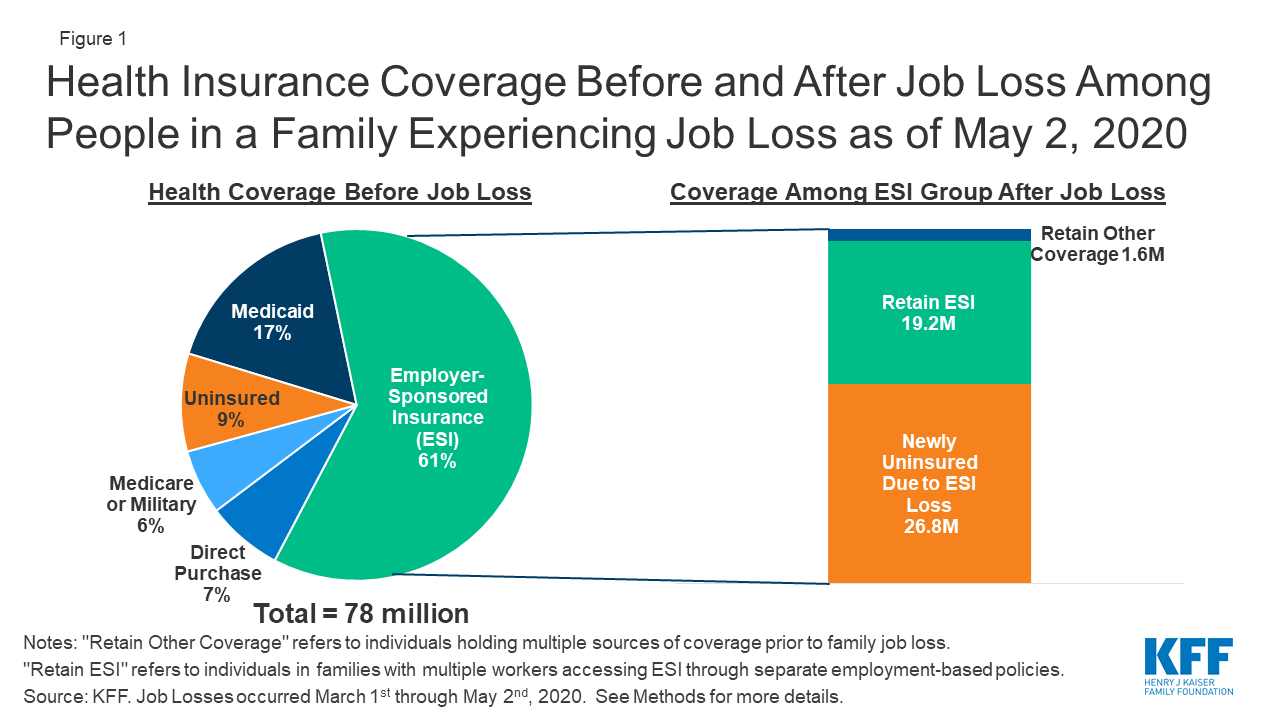
Between March 1st, 2020 and May 2nd, 2020, we estimate that nearly 78 million people lived in a family in which someone lost a job. Most people in these families (61%, or 47.5 million) were covered by ESI prior to job loss. Nearly one in five (17%) had Medicaid, and close to one in ten (9%) were uninsured. The remaining share either had direct purchase (marketplace) coverage (7%) or had other coverage such as Medicare or military coverage (6%) (Figure 1).
Eligibility for ACA Health Coverage Following Job Loss | The Henry ...

We estimate that, as of May 2nd, 2020, nearly 27 million people could potentially lose ESI and become uninsured following job loss (Figure 1). This total includes people who lost their own ESI and those who lost dependent coverage when a family member lost a job and ESI. Additionally, some people who otherwise would lose ESI are able to retain job-based coverage by switching to a plan offered to a family member: we estimate that 19 million people switch to coverage offered by the employer of a working spouse or parent. A very small number of people who lose ESI (1.6 million) also had another source of coverage at the same time (such as Medicare) and retain that other coverage. These coverage loss estimates are based on our assumptions about who likely filed for UI as of May 2nd, 2020 and the availability of other ESI options in their family (see Methods for more detail).

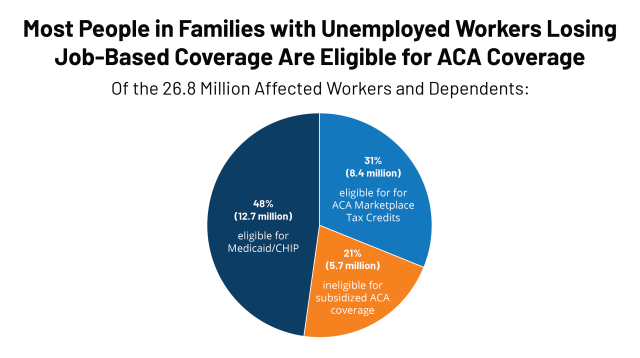
Among people who become uninsured after job loss, we estimate that nearly half (12.7 million) are eligible for Medicaid, and an additional 8.4 million are eligible for marketplace subsidies, as of May 2020 (Figure 2). In total, 79% of those losing ESI and becoming uninsured are eligible for publicly-subsidized coverage in May. Approximately 5.7 million people who lose ESI due to job loss are not eligible for subsidized coverage, including almost 150,000 people who fall into the coverage gap, 3.7 million people ineligible due to family income being above eligibility limits, 1.3 million people who we estimate have an affordable offer of ESI through another working family member, and about 530,000 people who do not meet citizenship or immigration requirements. We project that very few people fall into the coverage gap immediately after job loss (as of May 2020) because wages before job loss plus unemployment benefits (including the temporary $600 per week federal supplement added by Congress) push annual income for many unemployed workers in non-expansion states above the poverty level, making them eligibility for ACA marketplace subsidies for the rest of the calendar year.
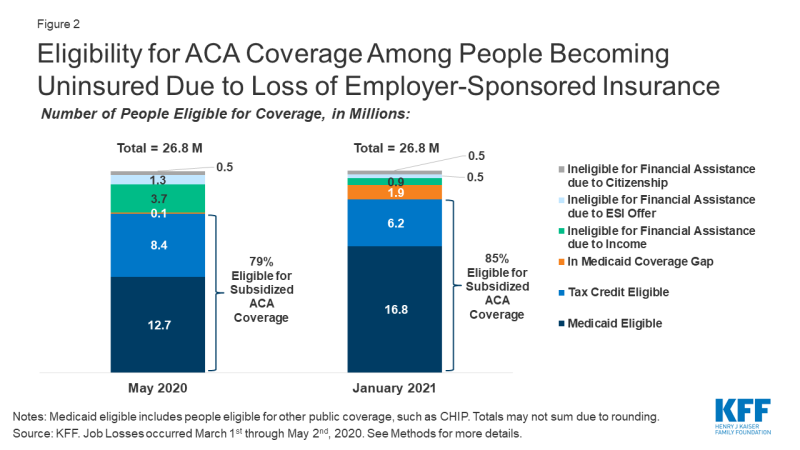
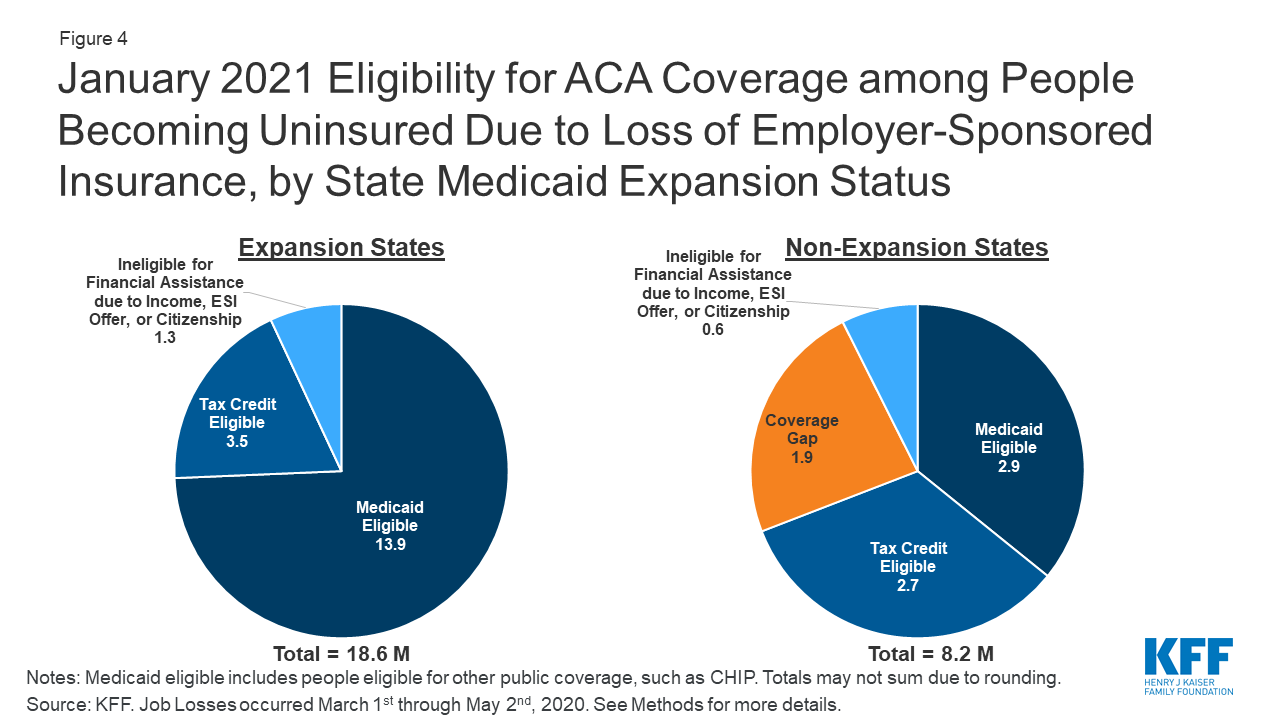
By January 2021, when UI benefits cease for most people, we estimate that eligibility shifts to nearly 17 million being eligible for Medicaid and about 6 million being eligible for marketplace subsidies (Figure 2), assuming those who are recently unemployed have not found work. Many unemployed workers who are eligible for ACA marketplace subsidies during 2020 would instead be eligible for Medicaid or fall into the coverage gap during 2021. The number in the coverage gap grows to 1.9 million (an increase of more than 80% of its previous size), and the number ineligible for coverage due to income shrinks to 0.9 million.

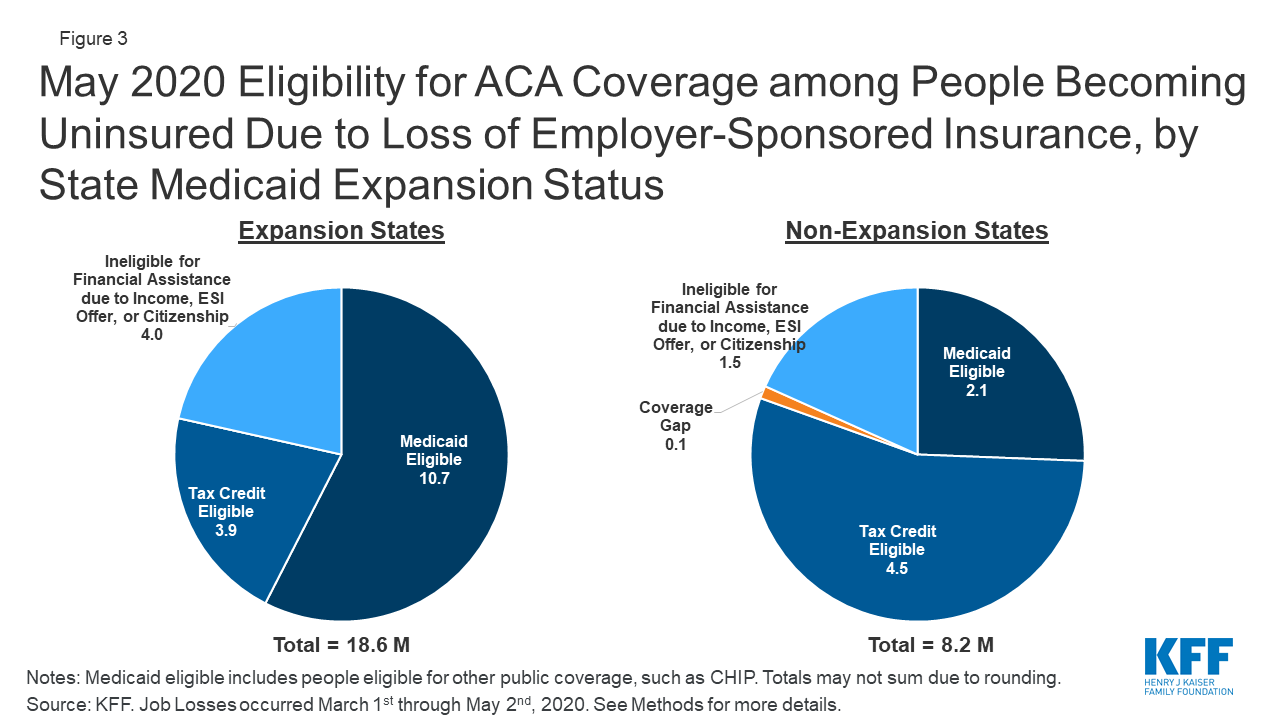
Estimates of coverage loss and eligibility vary by state, depending largely on underlying state employment by industry and Medicaid expansion status. Not surprisingly, states in which the largest number of people are estimated to lose ESI are large states with many people working in affected industries (Appendix Table 1). Eight states (California, Texas, Pennsylvania, New York, Georgia, Florida, Michigan, and Ohio) account for just under half (49%) of all people who lose ESI. Five of the top eight states have expanded Medicaid, and people eligible for Medicaid among the potentially newly uninsured as of May 2020 in these five states account for 40% of all people in that group nationally. Overall, patterns by state Medicaid expansion status show that people in expansion states are much more likely to be eligible for Medicaid, while those in non-expansion states are more likely to qualify for marketplace subsidies (Figure 3). However, the number of people qualifying for marketplace subsidies is similar across the two sets of states, as more people live in expansion states. Three states that have not expanded Medicaid, including Texas, Georgia, and Florida, account for 30% of people who become marketplace tax credit eligible nationally in May 2020. Assuming unemployment extends into 2021 when UI benefits would likely expire for most families, the proportion eligible for Medicaid would increase in expansion states while non-expansion states may see more nonelderly adults moving into the Medicaid coverage gap (Figure 4; Appendix Table 2).
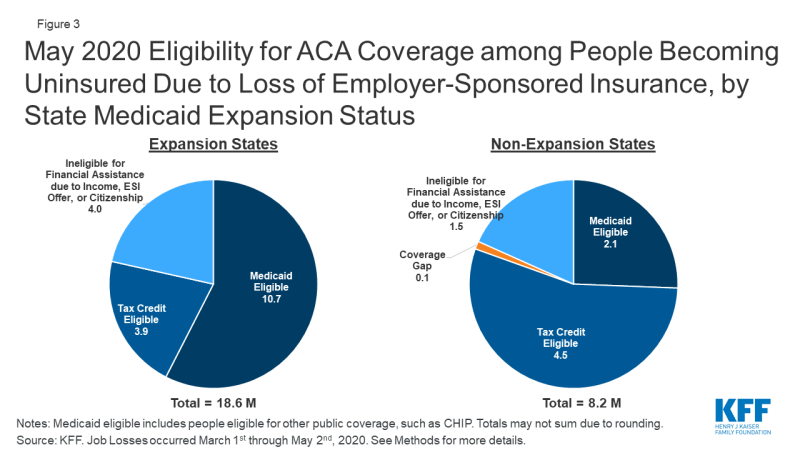
Figure 3: May 2020 Eligibility for ACA Coverage among People Becoming Uninsured Due to Loss of Employer-Sponsored Insurance, by State Medicaid Expansion Status
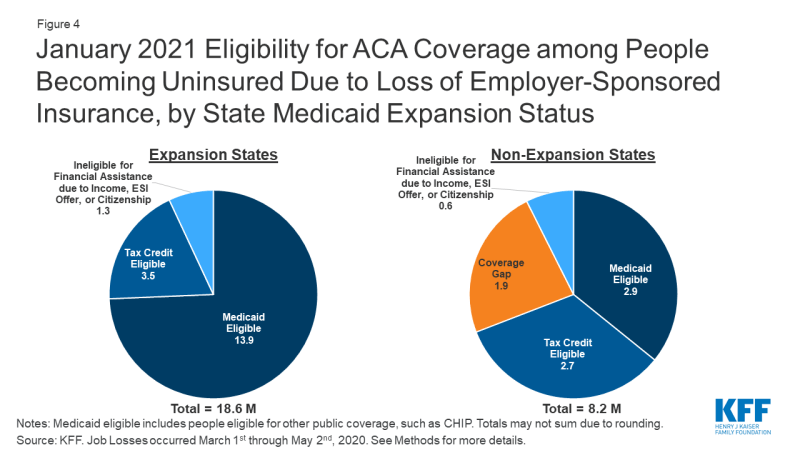
Figure 4: January 2021 Eligibility for ACA Coverage among People Becoming Uninsured Due to Loss of Employer-Sponsored Insurance, by State Medicaid Expansion Status

Nearly 7 million people losing ESI and becoming uninsured are children, and the vast majority of them are eligible for coverage through Medicaid or CHIP. Within the 26.8 million people losing ESI and becoming uninsured in May 2020, 6.1 million are children. Because Medicaid/CHIP income eligibility limits for children are generally higher than they are for adults, the vast majority of these children are eligible for Medicaid/CHIP in May 2020 (5.5 million, or 89%) or January 2021 (5.8 million, or 95%).

Discussion

Given the health risks facing all Americans right now, access to health coverage after loss of employment provides important protection against catastrophic health costs and facilitates access to needed care. Unemployment Insurance filings continue to climb each week, and it is likely that people will continue to lose employment and accompanying ESI for some time, though some of them will return to work as social distancing curbs are loosened. The ACA expanded coverage options available to people, and we estimate that the vast majority of people who lose ESI due to job loss will be eligible for ACA assistance either through Medicaid or subsidized marketplace coverage. However, some people will fall outside the reach of the ACA, particularly in January 2021 when UI benefits cease for many and some adults fall into the Medicaid coverage gap due to state decisions not to expand coverage under the ACA.

Both ACA marketplace subsidies and Medicaid are counter-cyclical programs, expanding during economic downturns as people’s incomes fall. In return for additional federal funding to help states finance their share of Medicaid cost during the public health crisis, states must maintain eligibility standards and procedures that were in effect on January 1, 2020 and must provide continuous eligibility through the end of the public health emergency, among other requirements. These provisions may help eligible individuals enroll in and maintain Medicaid, particularly in light of state and federal actions prior to the crisis to increase eligibility verification requirements or transition people off Medicaid.

Our estimates only examine eligibility among people who lost ESI due to job loss and potentially became uninsured. Additional uninsured individuals—including some of the 9% of the 78 million individuals in families where someone lost employment—may also be eligible for Medicaid or subsidized coverage. It is possible that contact with state UI systems may lead them to seek and enroll in coverage, even if they were eligible for financial assistance before job loss but uninsured.

It is unclear whether people losing ESI and becoming uninsured will enroll in new coverage. We did not estimate take-up or enrollment in coverage options but rather only looked at eligibility for coverage. Even before the coronavirus crisis, there were millions of people eligible for Medicaid or marketplace subsidies who were uninsured. Eligible people may not know about coverage options and may not seek coverage; others may apply for coverage but face challenges in navigating the application and enrollment process. Still others may find marketplace coverage, in particular, unaffordable even with subsidies. As policymakers consider additional efforts to aid people, expanding outreach and enrollment assistance, which have been reduced dramatically by the Trump Administration, could help people maintain coverage as they lose jobs.

This is the first economic downturn during which the ACA will be in place as a safety net for people losing their jobs and health insurance. The Trump Administration is arguing in case before the Supreme Court that the ACA should be overturned; a decision is expected by next Spring. The ACA has gaps, and for many the coverage may be unaffordable. However, without it, many more people would likely end up uninsured as the U.S. heads into a recession.


States face economic death spiral from Coronavirus

https://www.axios.com/coronavirus-states-economy-295ac091-9dc2-4852-be67-d070ec268d8c.html

YEAR-OVER-YEAR CHANGE IN STATE TAX REVENUES

April 2020 vs. April 2019, select states

States face economic death spiral from coronavirus - Business Insider


Early numbers show how significantly the coronavirus is devastating states’ revenue streams — and could force choices between raising taxes or gutting services and laying off public employees.

Why it matters: Even as some states move toward reopening, the economic ramifications of having shut down will haunt them far into the future.

  • When states can reopen, and how quickly industries are able to bounce back, could either worsen or improve projections.

What to watch: Sens. Bob Menendez (D-N.J.) and Bill Cassidy (R-La.) plan to introduce bipartisan legislation as soon as next week that would create a $500 billion fund designed to help struggling state and municipality budgets in the wake of COVID-19.

  • “If there was another way to do this, I’d rather do it the other way,” Cassidy tells Axios. “But what I don’t want to happen is all this money spent for families and for employers to go to waste because cities cannot provide essential services.”
  • Menendez tells Axios: “This is the time to step up to the plate.”

By the numbers: The Urban Institute has been compiling lost revenue data as states make it publicly available. So far, there are figures for about one in four states that compare this April’s state income and sales tax revenue collections against those from April 2019.

  • The data shows collections dropping between 20% and more than 50%, depending on the state, senior researcher Lucy Dadayan tells Axios — and those figures could get worse as new data comes in.
  • South Dakota is an outlier in the states the Urban Institute has tracked so far, in that revenues actually appear up for April. That may be largely because it is one of very few states that did not issue a stay at home order. But experts expect to see revenue declines next month.
  • Although it has not yet released April sales tax numbers to enable a year-over-year comparison, California’s staggering tax revenue loss due to COVID-19 has led to an expected $54.3 billion budget shortfall through FY 2021 — including a $13.4 billion shortfall this fiscal year, the governor announced Thursday. That’s with a $21 billion surplus last year.
  • New York also has yet to release April tax revenue data, but its latest budget projection has the state short as much as $13.3 billion in FY 2021, according to Dadayan’s analysis of most recent state budget projections. Illinois is looking at a more than $4.6 billion shortfall for next fiscal year.
  • Arizona is projecting to be short more than half a billion dollars for this fiscal year.
  • The projected shortfalls for FY 2020, which ends at the end of June for most states, is arguably a bigger problem because there isn’t much time left to make changes, per Axios’ Dan Primack.

The big picture: Democratic-leaning cities have seen the highest case and death rates. But red and blue states alike are facing serious budget shortfalls.

  • That’s why some Republican senators are getting behind efforts to provide federal dollars to help states balance budgets.
  • Even after accounting for state emergency savings accounts — which in many states were at an all-time high — 33 states will likely need to fill budget gaps of 5% or more, according to a recent analysis by Moody’s Analytics.
  • 21 states would need to fill gaps of 10% or more.
  • “Anybody is going to be overwhelmed by this — even states who were well prepared,” Dan White, director of government consulting and fiscal policy research at Moody’s Analytics, tells Axios.

Between the lines: Much of the burden will likely be pushed on struggling local governments’ plates, White said.

  • Cities have also lost smaller revenue sources such as hotel occupancy fees, inspection fees and construction fees.
  • Some could be forced to lay off public workers needed to combat the virus and keep the public safe — such as firefighters, paramedics, public hospital workers.
  • It’s either that or raise taxes in the midst of high unemployment and financial insecurity. “That’s the death spiral,” said Menendez, who has been talking with mayors across his state.
  • New York City Mayor Bill de Blasio has already said he may have to start furloughing municipal employees if the city doesn’t receive federal funds to help fill budget gaps.

Some state and local governments will wait to make tough budget decisions in the hopes that they get needed funds from Congress, which is in heated negotiations around the fourth stimulus package.

Republican lawmakers have been hesitant to provide this much federal help to states, but they’ve been warming to the idea.

  • Menendez says he expects several Republican senators besides Cassidy to sign on to their proposal.