Patients Caught In Crossfire Between Giant Hospital Chain, Large Insurer

Patients Caught In Crossfire Between Giant Hospital Chain, Large Insurer

After Zoe Friedland became pregnant with her first child, she was picky about choosing a doctor to guide her through delivery.

“With so many unpredictable things that can happen with a pregnancy, I wanted someone I could trust,” Friedland said. That person also had to be in the health insurance network of Cigna, the insurer that covers Friedland through her husband’s employer.

Friedland found an OB-GYN she liked, who told her that she delivered only at Sequoia Hospital in Redwood City, California, a part of San Francisco-based Dignity Health. Friedland and her husband, Bert Kaufman, live in Menlo Park, about 5 miles from the hospital, so that was not a problem for them — until Dec. 12.

That’s the day Friedland and Kaufman received a letter from Cigna informing them their care at Sequoia might not be covered after Jan. 1. The insurance company had not signed a contract for 2020 with the hospital operator, which meant Sequoia and many other Dignity medical facilities around the state would no longer be in Cigna’s network in the new year.

Suddenly, it looked as if having their first baby at Sequoia could cost Friedland and Kaufman tens of thousands of dollars.

“I was honestly shocked that this could even happen because it hadn’t entered my mind as a possibility,” Friedland said.

She and her husband are among an estimated 16,600 people caught in a financial dispute between two gigantic health care companies. Cigna is one of the largest health insurance companies in the nation, and Dignity Health has 31 hospitals in California, as well as seven in Arizona and three in Nevada. The contract fight affects Dignity’s California and Nevada hospitals, but not the ones in Arizona.

“The problem is price,” Cigna said in a statement just before the old contract expired on Dec. 31. “Dignity thinks that Cigna customers should pay substantially more than what is normal in the region, and we think that’s just wrong.”

Tammy Wilcox, a senior vice president at Dignity, said, “At a time when many nonprofit community hospitals are struggling, Cigna is making billions of dollars in profits each year. Yet Cigna is demanding that it pay local hospitals even less.”

In 2018, the most recent full year for which earnings data is available, Cigna generated operating income of $3.6 billion on revenue of approximately $48 billion. Dignity Health reported operating income of $529 million on revenue of $14.2 billion in its 2018 fiscal year.

It’s possible Cigna and Dignity can still reach an agreement. Both sides said they will keep trying, though no talks are scheduled.

Disagreements between insurers and health systems that leave patients stranded are a perennial problem in U.S. health care. Glenn Melnick, a professor of health economics at the University of Southern California, said such disputes, which are disruptive to consumers, are often settled.

Melnick believes Dignity is using an “all or nothing” strategy in contract negotiations, meaning either all its facilities are in the insurer’s network or none are.

“This allows them to increase their market power to get higher prices, which is not necessarily good for consumers,” Melnick said.

Dignity replied in an emailed statement: “We do not require payers to contract with all or none of Dignity Health’s providers. We do try to make sure patients have access to the full range of Dignity Health services and facilities in each of our communities.”

Dignity faces a number of legal and financial challenges while it works to implement a February 2019 merger with Englewood, Colorado-based Catholic Health Initiatives that created one of the nation’s largest Catholic hospital systems — known as CommonSpirit Health.

California Attorney General Xavier Becerra approved the deal with conditions, including that Dignity’s California hospitals spend $10 million in the first three years on services for people experiencing homelessness and offer free care to more low-income patients.

The requirement to treat more poor patients at no charge followed a period, from 2011 to 2016, in which Dignity’s charity care declined about 35% while its net income was $3.2 billion.

Last October, CommonSpirit announced an operating loss of $582 million on revenue of nearly $29 billion for the 2019 fiscal year, its first annual financial statement after the merger took effect. Much of the loss was due to merger-related costs and special charges.

The same month, Dignity completed a five-year “corporate integrity agreement” with the U.S. Office of the Inspector General following an investigation into how it billed the government for hospital inpatient stays. Dignity said it “fully complied” with the agreement.

Dignity is also defending itself in a class-action lawsuit alleging that it bills uninsured patients at grossly inflated rates even though it claims to provide “affordable” care at “the lowest possible cost.”

More recently, an appeals court judge ruled Dignity could not charge higher prices — often a lot higher than state-set rates — for treating enrollees of L.A. Care’s Medi-Cal health plan at its Northridge Hospital Medical Center.

Dignity disagreed with the court’s ruling in that case, saying that although the Northridge facility did not have a contract with L.A. Care, many of the health plan’s enrollees who initially sought emergency treatment there stayed in the hospital for additional care after they had been stabilized. The hospital “seeks appropriate reimbursement for providing this care,” Dignity said.

If Dignity does not reach an agreement with Cigna, its hospitals, outpatient surgery centers and medical groups in most of California will soon be out-of-network for many Cigna enrollees. In-network coverage for Open Access (OAP) and Preferred Provider (PPO) ended Feb. 1, and for HMO patients it is set to end April 1.

Peter Welch, president and general manager for Cigna in Northern California and the Pacific Northwest, said Cigna can provide “adequate access” to other hospitals and doctors.

Certain Cigna enrollees can apply to continue visiting Dignity facilities and doctors under California’s Continuity of Care law, enacted in 2014. Eligible enrollees include patients with chronic conditions, those already scheduled for pre-authorized services, people in need of emergency care and pregnant women in their third trimester.

Friedland and Kaufman applied, hoping she would be able to continue seeing her Dignity-affiliated OB-GYN at in-network rates.

On Jan. 22, less than a month from Friedland’s Feb. 15 due date, they received written confirmation that their request had been approved. They wouldn’t have to shop for a new doctor or face stiff medical bills after all.

Early Tuesday evening, Friedland gave birth to a baby girl, Eliza, who entered the world 11 days earlier than expected, weighing in at 7 pounds, 3 ounces.

“While the ordeal was stressful, and the communication fraught, we were happy to receive confirmation of continuity of care and that it ended in the best possible way — with the birth of our healthy baby daughter with the provider where we established care,” Kaufman said. “For the sake of those caught in the middle and now having to start relationships with new health care providers, we hope the two sides can come to an agreement.”



For 2020, California Goes Big On Health Care

https://khn.org/news/for-2020-california-goes-big-on-health-care/

https://www.comstocksmag.com/kaiser-health-news/2020-california-goes-big-health-care

California is known for progressive everything, including its health care policies, and, just a few weeks into 2020, state leaders aren’t disappointing.

The politicians’ health care bills and budget initiatives are heavy on ideas and dollars — and on opposition from powerful industries. They put California, once again, at the forefront.

The proposals would lower prescription drug costs, increase access to health coverage, and restrict and tax vaping. But most lawmakers agree that homelessness will dominate the agenda, including proposals to get people into housing while treating some accompanying physical and mental health problems.

“This budget doubles down on the war on unaffordability — from taking on health care costs and having the state produce our own generic drugs to expanding the use of state properties to build housing quickly,” Gov. Gavin Newsom said in a letter to the legislature, which accompanied the $222.2 billion budget proposal he unveiled last Friday. About a third of that money would be allocated to health and human services programs.

But even with a Democratic supermajority in the legislature, these proposals aren’t a slam-dunk. “There are other factors that come into play, like interest groups with strong presence in the Capitol,” including Big Pharma and hospitals, said Shannon McConville, a senior researcher at the nonpartisan Public Policy Institute of California.

Drug Pricing

Newsom’s plan to create a state generic drug label is perhaps his boldest health care proposal in this year’s budget, as it would make California the first state to enter the drug-manufacturing business. It may also be his least concrete.

Newsom wants the state to contract with one or more generics manufacturers to make drugs that would be available to Californians at lower prices. Newsom’s office provided little detail about how this would work or which drugs would be produced. The plan’s cost and potential savings are also unspecified. (Sen. Elizabeth Warren of Massachusetts, who is seeking the Democratic presidential nomination, proposed a similar plan at the federal level.)

Because the generics market is already competitive and generic drugs make up a small portion of overall drug spending, a state generic-drug offering would likely result in only modest savings, said Geoffrey Joyce, director of health policy at USC’s Leonard D. Schaeffer Center for Health Policy & Economics.

However, it could make a difference for specific drugs such as insulin, he said, which nearly doubled in price from 2012 to 2016. “It would reduce that type of price gouging,” he said.

Representatives of Big Pharma said they’re more concerned about a Newsom proposal to establish a single market for drug pricing in the state. Under this system, drug manufacturers would have to bid to sell their medications in California, and would have to offer prices at or below prices offered to any other state or country.

Californians could lose access to existing treatments and groundbreaking drugs, warned Priscilla VanderVeer, vice president for the Pharmaceutical Research and Manufacturers of America, the industry’s lobbying arm.

This proposal could “let the government decide what drugs patients are going to get,” she said. “When the governor sets an artificially low price for drugs, that means there will be less money to invest in innovation.”

Newsom’s drug pricing proposals build on his executive order from last year directing the state to negotiate drug prices for the roughly 13 million enrollees of Medi-Cal, the state’s Medicaid program for low-income residents. He also ordered a study of how state agencies could band together — and, eventually, with private purchasers such as health plans — to buy prescription drugs in bulk.


Homelessness

California has the largest homeless population in the nation, estimated at more than 151,000 people in 2019, according to the U.S. Department of Housing and Urban Development. About 72% of the state’s homeless slept outside or in cars rather than in shelters or temporary housing.

Newsom has asked for $1.4 billion in the 2020-21 state budget for homelessness, most of which would go to housing and health care. For instance, $695 million would boost health care and social services for homeless people via Medi-Cal. The money would fund programs such as recuperative care for homeless people who need a place to stay after they’ve been discharged from the hospital, and rental assistance if a person’s homelessness is tied to high medical costs.

A separate infusion of $24.6 million would go to the Department of State Hospitals for a pilot program to keep some people with mental health needs out of state hospitals and in community programs and housing.


Surprise Bills

California has some of the strongest protections against surprise medical bills in the nation, but millions of residents remain vulnerable to exorbitant charges because the laws don’t cover all insurance plans.

Surprise billing occurs when a patient receives care from a hospital or provider outside of their insurance network, and then the doctor or hospital bills the patient for the amount insurance didn’t cover.

Last year, state Assembly member David Chiu (D-San Francisco) introduced legislation that would have limited how much hospitals could charge privately insured patients for out-of-network emergency services. The bill would have required hospitals to work directly with health plans on billing, leaving the patients responsible only for their in-network copayments, coinsurance and deductibles.

But he pulled the measure because of strong opposition from hospitals, which criticized it as a form of rate setting.

Chiu said he plans to resume the fight this year, likely with amendments that have not been finalized. But hospitals remain opposed to the provision that would cap charges, a provision that Chiu says is essential.

“We continue to fully support banning surprise medical bills, but we believe it can be done without resorting to rate setting,” said Jan Emerson-Shea, a spokesperson for the California Hospital Association.


Medi-Cal For Unauthorized Immigrants

California is the first state to offer full Medicaid benefits to income-eligible residents up to age 26, regardless of their immigration status.

Now Democrats are proposing another first: California could become the first to open Medicaid to adults ages 65 and up who are in the country illegally.

Even though Medicaid is a joint state-federal program, California must fund full coverage of unauthorized immigrants on its own.

Newsom set aside $80.5 million in his 2020-21 proposed budget to cover about 27,000 older adults in the first year. His office estimated ongoing costs would be about $350 million a year.

Republicans vocally oppose such proposals. “Expanding such benefits would make it more difficult to provide health care services for current Medi-Cal enrollees,” state Sen. Patricia Bates (R-Laguna Niguel) said in a prepared statement.


Vaping

Dozens of California cities and counties have restricted the sale of flavored tobacco products in an effort to curb youth vaping.

But last year, state legislators punted on a statewide ban on flavored tobacco sales after facing pressure from the tobacco industry.

Now, state Sen. Jerry Hill (D-San Mateo) is back with his proposed statewide flavor ban, which may have more momentum this year. Since last summer, a mysterious vaping illness has sickened more than 2,600 people nationwide, leading to 60 deaths, according to the Centers for Disease Control and Prevention. In California, at least 199 people have fallen ill and four have died.

Hill’s bill would ban retail sales of flavored products related to electronic cigarettes, e-hookahs and e-pipes, including menthol flavor. It also would prohibit the sale of all flavored smokable and nonsmokable tobacco products, such as cigars, cigarillos, pipe tobacco, chewing tobacco, snuff and tobacco edibles.

Newsom has also called for a new tax on e-cigarette products — $2 for each 40 milligrams of nicotine, on top of already existing tobacco taxes on e-cigarettes. The tax would have to be approved by the legislature as part of the budget process and could face heavy industry opposition.

Tobacco-related bills are usually heard in the Assembly Governmental Organization Committee, “and that is where a lot of tobacco legislation, quite frankly, dies,” said Assembly member Jim Wood (D-Healdsburg), who supports vaping restrictions.


Pros and Cons of Different Public Health Insurance Options

https://www.commonwealthfund.org/publications/journal-article/2018/nov/pros-cons-public-options-2020-democratic

Image result for Pros and Cons of Different Public Health Insurance Options

Options for Expanding Health Care Coverage

It is more than likely that Democratic candidates for the 2020 presidential election will propose some type of public health insurance plan. In one of two Commonwealth Fund–supported articles in Health Affairs discussing potential Democratic and Republican health care plans for the 2020 election, national health policy experts Sherry Glied and Jeanne Lambrew assess the potential impact and trade-offs of three approaches:


  • Incorporating public-plan elements into private plans through mechanisms such as limits on profits, additional rules on how insurers operate, or the use of Medicare payment rates.
  • Offering a public plan — some version of Medicare or Medicaid, for example — alongside private plans. Such a plan could be offered to specific age groups, like adults 50 to 64 who are not yet eligible for Medicare, to enrollees in the Affordable Care Act’s (ACA) marketplaces, or to everyone under 65, including those working for self-insured employers. It also could be made available in regions of the country where there is little health care competition.
  • Replacing the current health care financing system with a “Medicare for all” single-payer system administered by the federal government. Some single-payer proposals would allow consumers to purchase supplementary private insurance to help pay for uncovered services.


Issues for Consideration in 2020

The authors find trade-offs in each type of public plan. First, a single-payer system would significantly increase the federal budget and require new taxes, a politically challenging prospect. On the other hand, federal spending might decrease if a public plan were added to the marketplace or if public elements were added to private plans. In 2013, the Congressional Budget Office estimated that a public plan, following the same rules as private plans, would reduce federal spending by $158 billion over 10 years, while offering premiums 7 percent to 8 percent lower than private plans. A single-payer approach would lower administrative costs and profits, and likely reduce health care prices as well. By assuming control over the financing of health care, the federal government could reduce administrative complexity and fragmentation. On the flip side, the more than 175 million Americans who are privately insured would need to change insurance plans.


public–private choice model would help ensure that an affordable health plan option is available to Americans. While politically appealing, this option presents implementation challenges: covered benefits, payment rates, and risk-adjustments all need to be carefully managed to ensure a fair but competitive marketplace. A targeted choice option might be adopted by candidates interested in strengthening the ACA marketplaces in specific regions or for specific groups (as with the Medicare at 55 Act). It would benefit Americans whose current access to affordable coverage is limited, but the same technical challenges associated with a more comprehensive choice model would apply.


Finally, to lower prices for privately insured individuals, public plan tools such as deployment of Medicare-based rates could be applied to private insurance, either across the board or specifically for high-cost claims, prescription drugs, or other services. The major challenge here is setting prices that would appropriately compensate providers.


The Big Picture

Under the ACA, the percentage of Americans who had health insurance had reached an all-time high (91 percent) in 2016, an all-time high, and preexisting health conditions ceased to be an obstacle to affordable insurance. But Americans remain concerned about high out-of-pocket spending and access to providers, and fears over losing preexisting-condition protections have grown. While most Democratic presidential candidates will likely defend the ACA and seek to strengthen it, most recognize that fortifying the law will not be enough to cover the remaining uninsured, rein in rising spending, and make health care more affordable.


While the health reform proposals of Democratic candidates in 2020 will likely differ dramatically from those of Republican candidates, recent grassroots support for the ACA’s preexisting condition clause may indicate a willingness by both political parties to support additional government intervention in private insurance markets.


Sutter Health to pay $575M to settle antitrust case

https://www.beckershospitalreview.com/legal-regulatory-issues/sutter-health-to-pay-575m-to-settle-antitrust-case.html?origin=CFOE&utm_source=CFOE&utm_medium=email

Image result for Sutter Health to pay $575M to settle antitrust case

Sutter Health, a 24-hospital system based in Sacramento, Calif., has agreed to pay $575 million to settle an antitrust case brought by employers and California Attorney General Xavier Becerra.

The settlement resolves allegations that Sutter Health violated California’s antitrust laws by using its market power to overcharge patients and employer-funded health plans. The class members alleged Sutter Health’s inflated prices led to $756 million in overcharges, according to Bloomberg Law.

Under the terms of the settlement, Sutter will pay $575 million to employers, unions and others covered under the class action. The health system will also be required to make several other changes, including limiting what it charges patients for out-of-network services, halting measurers that deny patients access to lower-cost health plans, and improving access to pricing, quality and cost information, according to a Dec. 20 release from Mr. Becerra.

To ensure Sutter is complying with the terms of the settlement, the health system will be required to cooperate with a court-approved compliance monitor for at least 10 years.

Mr. Becerra said the settlement, which he called “a game changer for restoring competition,” is a warning to other organizations.

This first-in-the-nation comprehensive settlement should send a clear message to the markets: if you’re looking to consolidate for any reason other than efficiency that delivers better quality for a lower price, think again. The California Department of Justice is prepared to protect consumers and competition, especially when it comes to healthcare,” he said.

A Sutter spokesperson told The New York Times that the settlement did not acknowledge wrongdoing. “We were able to resolve this matter in a way that enables Sutter Health to maintain our integrated network and ability to provide patients with access to affordable, high-quality care,” said Flo Di Benedetto, Sutter’s senior vice president and general counsel, in a statement to The Times.

The settlement must be approved by the court. A hearing on the settlement is scheduled for Feb. 25, 2020.


Study: Costs from out-of-network billing at in-network hospitals top $40B

https://www.fiercehealthcare.com/hospitals-health-systems/study-finds-billions-costs-from-out-network-billing-for-care-delivered-at?mkt_tok=eyJpIjoiT0RRM1ltSTFaVGd5WmpSaiIsInQiOiJ1K01YRU9EcDFWZWNYYW5ES0JkMDZ3RisxZWdBTlRtSzJTTVwvdVVOMFgrNE1SXC90SjdLQk8rRW1kOXFralJ4SE4rbVwvVThIeFNTYUpqWmxCYTAwOWZyR1FcL0RcL0xVN21Rbkh5aVZlXC83allyU08yeWNZbXB1dHl6SjZia1BmTzNRVCJ9&mrkid=959610

surprise bill

The problem of large and unexpected surprise healthcare bills dominated health headlines in 2019.

Now, a new study to be published in the January print issue of Health Affairs put a figure on how much it’s costing when patients are unwittingly treated by out-of-network providers in in-network hospitals: $40 billion annually.

Led by Zack Cooper, a researcher in the Yale School of Public Health and the department of economics, the study found at in-network hospitals, nearly 12% of anesthesiology care, more than 12% of care involving a pathologist, 5.6% of claims for radiologists and 11.3% of cases involving an assistant surgeon were billed out of network.

“When physicians whom patients do not choose and cannot avoid can bill out of network for care delivered within in-network hospitals, it exposes patients to financial risk and undercuts the functioning of health care markets,” the authors wrote in the study. “The ability to bill out of network allows these specialists to negotiate artificially high in-network rates.

The researchers’ estimates show that if these specialists were not able to bill out of network, it would lower physician payments for privately insured patients by 13.4% and reduce total healthcare spending for people with employer-sponsored insurance by 3.4%. That works out to about $40 billion a year, they said.

The authors used 2015 data from a large commercial insurer for their analysis. The study was funded by the Laura and John Arnold Foundation and the Tobin Center for Economic Policy at Yale University.

Out-of-network billing is more prevalent at hospitals in concentrated hospital and insurance markets and at for-profit hospitals, the authors said.  

“Any policy addressing out-of-network billing must achieve two aims: protect patients from financial harm and introduce a competitively set price for physician services or identify the amount insurers must pay providers if a policyholder is treated by an out-of-network physician,” the authors said in a statement. “Our proposed policy solution—requiring hospitals to sell a package of facility and physician services—would protect patients, restore a competitively determined price for physician services, and lower commercial health spending.” 


Gainesville health system paying patients’ out-of-network costs

https://www.albanyherald.com/news/gainesville-health-system-paying-patients-out-of-network-costs/article_5a82d58a-f4f1-11e9-b7b5-8bebc4253708.html

gainesville hospital.jpg

With a contract impasse in its third week, a Gainesville-based health system is spending millions of dollars so that thousands of patients are not having to pay more when visiting the system’s doctors and hospitals.

Northeast Georgia Health System’s contract with Anthem ended Sept. 30, which means that since then, Georgians with Anthem insurance have been out of network for NGHS facilities and physicians.

But in an unusual move, the Northeast Georgia system is making up the financial difference between in-network and out-of-network prices through Dec. 31. That way, Anthem patients won’t pay higher fees when visiting NGHS medical providers, the system said.

“While it will cost millions of dollars per month to protect our patients from out-of-network costs, we’d rather do that than agree to a proposal that would jeopardize the health of our community for years to come,’’ Steve McNeilly, vice president of managed care for NGHS, said.

Most contract disputes between health systems and insurers get resolved before the end of the previous deal, although some agreements come just hours before the end of the expiring pact. The terminated contract between NGHS and Anthem is an exception, and this particular stalemate doesn’t show any sign of progress. Neither side has mentioned any negotiations or even indicated that talks are being scheduled.

The standoff comes at a time when many Georgians are entering their open enrollment period for the 2020 health plan year.

Anthem is by far the state’s biggest health insurer. Northeast Georgia’s hospitals in Gainesville, Braselton, Winder and Dahlonega, as well as its urgent care facilities and many physician group locations, are now out of network for Anthem patients.

“Anthem has only contacted NGHS once since the end of September – and that was only to inform us that they would be processing all claims as out-of-network,’’ McNeilly said. He said Northeast Georgia has proposed a contract with concessions, but that Anthem “refuses to take any meaningful action.’’

“Unfortunately, it appears that Anthem intends for us to be out of network for an extended period of time, so we’re urging patients to switch to a different health insurance plan during open enrollment,’’ McNeilly added.

Northeast Georgia said patients can call its Patient Access Service Center at (770) 219-7678 to get a personalized estimate of hospital charges for upcoming surgeries or procedures. If patients have questions about charges for physician office visits, they can call their physician’s office for more information, NGHS said.

Anthem said Monday that it is “standing firm for our consumers who need greater affordability.’’

The latest proposals from NGHS would increase costs “well above other health systems in the state,’’ Christina Gaines, an Anthem spokeswoman, said. “These increases place a significant burden on consumers because any substantial price increase in the services at these facilities would be directly reflected in increases in medical expenses covered by employer-sponsored group health plans, as well as to member premiums and cost share amounts.’’

What NGHS proposed “was simply not sustainable’’ for Anthem members, she said.

“We provided a revised proposal to them two days before the contract expired and did not receive a response,’’ Gaines said. “We are willing to resume talks so we can come to a new agreement that is fair, provides flexibility and protects affordability.”

Anthem said it can’t guarantee that Northeast Georgia will continue to charge patients the same rates as under the previous contract.

“To protect against unexpected balance billing, and other expenses associated with out-of-network providers, we are urging members to use in-network physicians and facilities,’’ Gaines said. “Anthem continues to have a broad, statewide provider network that delivers access to other quality health care options that remain in-network for our consumers.” Anthem directed consumers to visit www.anthem.com/nghs for information.

Craig Savage, a consultant with CMBC Advisors in North Carolina, said he had not heard previously of a hospital-based system covering the cost gap for patients who are forced out of network by a contract dispute.

“I think it’s a demonstration of good faith to patients,’’ Savage said. “It puts a little marketing pressure on Anthem.’’

But he added that even losing the business of 40,000 patients is “not going to have a huge [financial] impact on Anthem in Georgia.’’

And Savage said the contract standoff may put pressure on local physicians who could lose many patients to another insurer during open enrollment season.


Market Consolidation on Trial

Market Consolidation on Trial

Image result for Market Consolidation on Trial

California Attorney General Xavier Becerra alleges that Sutter Health used its pre-eminent market power to artificially inflate prices. Photo: Rich Pedroncelli/Associated Press

As a jury trial draws near in a major class-action lawsuit alleging anticompetitive practices by Northern California’s largest health system (PDF), a new CHCF study shows the correlation between the prices consumers pay and the extensive consolidation in the state’s health care markets. Importantly, the researchers estimated the independent effect of several types of industry consolidation in California — such as health insurers buying other insurers and hospitals buying physician practices. The report, prepared by UC Berkeley researchers, also examines potential policy responses.

While other states have initiated antitrust complaints against large hospital systems and medical groups in the past, the case against Sutter Health is unique in both the expansive nature of the alleged conduct and in the scale of the potential monetary damages. The complaint goes beyond claims of explicit anticompetitive contract terms and argues that by virtue of its very size and structure, the Northern California system imposed implicit or “de facto” terms that led to artificially inflated prices. Sutter Health vigorously denies the allegations.

The formation of large health systems like Sutter is neither new (PDF) nor unique to California (PDF). Several factors seem to be encouraging their growth, including payment models that place health care providers at financial risk for the cost of care, increased expectations from policymakers and payers around the continuum of patient needs that must be managed, and economies of scale for investments in information technology and administrative services. Some market participants also point to consolidation in other parts of the health care system, such as health plans and physician groups, as encouragement for their own mergers.

Economic Consolidation in California

In general, economists study two major categories of market consolidation:

  • Horizontal consolidation: Entities of the same type merge, such as the merger of two hospitals or insurance companies, or the merger of providers into a physician network.
  • Vertical consolidation: Entities of different types merge, such as when a hospital purchases a physician practice or when a pharmacy buys an insurance company.

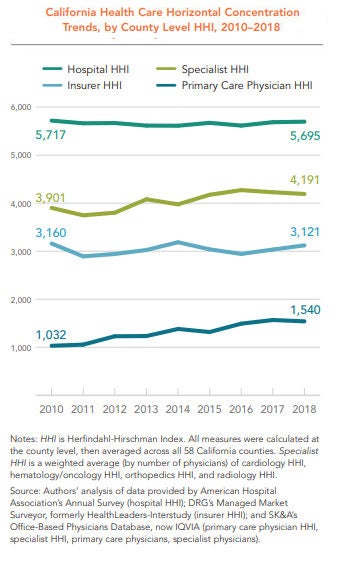
To measure market consolidation, the CHCF study relied on the Herfindahl-Hirschman Index (HHI), a metric used by the US Department of Justice and the Federal Trade Commission. An HHI of between 1,500 and 2,500 is considered moderately concentrated, and 2,500 or above is considered highly concentrated. According to this measure, horizontal concentration is high in California among hospitals, insurance companies, and specialist providers (and moderately high among primary care physicians), even though the level of concentration in all but primary care has remained relatively flat from 2010 to 2018.

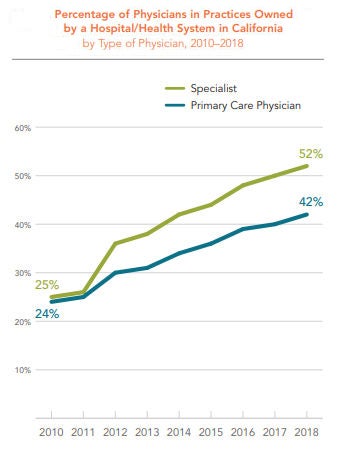
The percentage of physicians in practices owned by a hospital or health system increased dramatically in California between 2010 and 2018 — from 24% in 2010 to 42% in 2018. The percentage of specialists in practices owned by a hospital or health system rose even faster, from 25% in 2010 to 52% in 2018.
Consolidation Is Not Clinical Integration

While this study defined and quantified the extent of consolidation across several industry segments in California, it is important to note that it did not define, quantify, or evaluate clinical integration within the state. Clinical integration has been defined by others in many ways, but generally involves arrangements for coordinating and delivering a wide range of medical services across multiple settings.

As the CHCF study authors point out, other analysis has shown that various types of clinical integration can lead to broader adoption of health information technology and evidence-based care management processes. Data from the Integrated Healthcare Association suggests that certain patient benefit designs and provider risk-sharing arrangements associated with clinical integration can lead to higher quality and lower costs.

Crucially, an emerging body of law (PDF) suggests that clinical integration does not require formal ownership and joint bargaining with payers.

Relationship Between Consolidation and Health Insurance Premiums

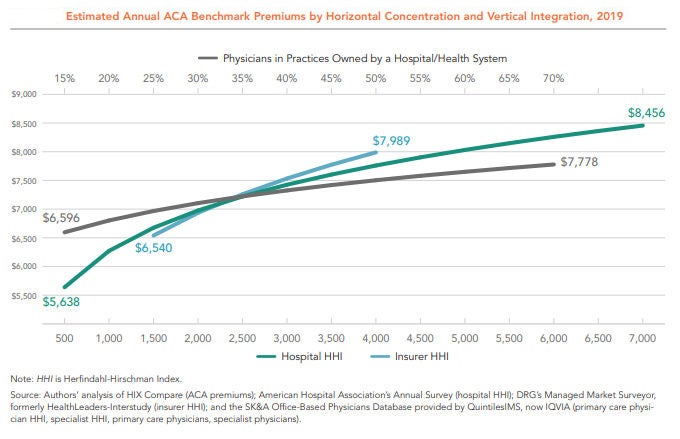
Among the six variables analyzed in the CHCF study, three showed a positive and statistically significant association with higher premiums: insurance company mergers, hospital mergers, and the percentage of primary care physicians in practices owned by hospitals and health systems. The remaining three variables studied — specialist provider mergers, primary care provider mergers, and the percentage of specialists in practices owned by a hospital and health system — were statistically insignificant.

The figure below shows the independent relationship between market concentration and premiums for these three variables. As the lines move left to right, concentration increases — that is, fewer individual insurers, hospitals, or providers occupy the market. The vertical axis shows the average premiums associated with each level of market concentration. In short, regardless of the industry structure represented by the other variables, insurer consolidation, hospital consolidation, and hospital-physician mergers each lead to higher premiums.

Unexplained Price Variation and Growth

Health insurance premiums rise when the underlying cost of medical care increases. California ranks as the 16th most expensive state on average in terms of the seven common services the researchers studied, after adjusting for wage differences across states. Among all states, California has the eighth-highest prices for normal childbirth, defined as vaginal delivery without complications. Childbirth is the most common type of hospital admission, and the relatively standardized procedure is comparable across states.

Even within California, prices vary widely and are growing rapidly. For example, the 2016 average wage-adjusted price for a vaginal delivery was twice as high in Rating Area 9 (which has Monterey as its largest county) as it was in Rating Area 19 (San Diego) — $22,751 versus $11,387. (See next figure.) Prices for the service are increasing rapidly across counties — rising anywhere from 29% in San Francisco from 2012 to 2016 to 40% in Orange County over the same period.

The authors of the CHCF report investigated the impact of various types of consolidation on the prices of individual medical services in California. For cesarean births without complications, a 10% rise in hospital HHI is associated with a 1.3% increase in price.

Potential Policy Responses to Consolidation

While the study shows significant associations between various types of market concentration and the prices consumers pay, policymakers should carefully consider implementing steps that restrain the inflationary impact of consolidation while allowing the benefits of clinical integration to proliferate. To that end, the authors of the CHCF report offered a series of recommendations, which include:

Enforce antitrust laws. Federal and state governments should scrutinize proposed mergers and acquisitions to evaluate whether the net result is procompetitive or anticompetitive.

Restrict anticompetitive behaviors. Anticompetitive behaviors, such as all-or-nothing and anti-incentive contract terms, should be addressed through legislation or the courts in markets where providers are highly concentrated.

Revise anticompetitive reimbursement incentives. Reimbursement policies that reduce competition, such as Medicare rules that implicitly reward hospital-owned physician groups, should be adjusted.

Reduce barriers to market entry. Policies that restrict who can participate in the health care market, such as laws prohibiting nurse practitioners from practicing independently from a physician, should be changed when markets are concentrated.

Regulate provider and insurer rates. If antitrust enforcement is not successful and significant barriers to market entry exist — including those in small markets unable to support a competitive number of hospitals and specialists — regulating provider and insurer rates should be considered.

Encouraging meaningful competition in health care markets is an exceedingly difficult task for policymakers. It is no easier to promote the benefits of clinical integration while restraining the inflationary aspects of economic consolidation through public policy. Despite these challenges, the rapid rise in health care premiums and prices in the state require a fresh look at the consequences of widespread horizontal and vertical consolidation in California.


Can Washington deliver on drug costs amid impeachment probe?

https://apnews.com/1c5c5dc43950421a9ab4ff7edb9fe678?omnicid=CFC1688174&mid=henrykotula@yahoo.com

Major legislation to reduce prescription drug costs for millions of people may get sidelined now that House Democrats have begun an impeachment inquiry of President Donald Trump. Proposals had been moving in Congress, but there are more ways for the process to break down than to succeed. Still, nobody says they’re giving up.

Some questions and answers about the legislation and its uncertain prospects:


Q: Why, now, is there a big push to lower drug prices?

A: Some would say it’s overdue. Drug prices emerged as the public’s top health care concern near the end of the Obama administration as people with health insurance got increasingly worried about their costs.

In the 2016 campaign, Trump and Democrat Hillary Clinton called for authorizing Medicare to negotiate prices. But after Trump won the White House, his focus shifted to the failed Republican drive to repeal the Affordable Care Act. A year went by before the administration reengaged on prescription drugs .

Now, facing the 2020 election, Trump and lawmakers of both parties in Congress have little to show for all their rhetoric about high drug prices. For there to be a deal , enough Democrats and Republicans have to decide they’re better off delivering results instead of election-year talking points.


Q: What are the major plans on the table?

A: On the political left is House Speaker Nancy Pelosi’s plan authorizing Medicare to negotiate prices for the costliest drugs. In the middle is bipartisan legislation from Sens. Chuck Grassley, R-Iowa, and Ron Wyden, D-Ore., to restrain drug price increases. The wild card is Trump. He doesn’t share the traditional Republican aversion to government as price negotiator and keeps complaining that it’s unfair for Americans to pay more than patients in other countries.

There’s significant overlap among the major approaches.

Trump, the Senate bill, and Pelosi would all limit what Medicare enrollees pay annually in prescription copays. That would be a major change benefiting more than 1 million seniors with high costs.

Pelosi and the Senate bill would require drugmakers to pay rebates if they raise their prices to Medicare beyond the inflation rate. Long-available medicines like insulin have seen steep price hikes.

Pelosi and the administration would use lower international prices to determine what Medicare pays for at least some drugs. Pelosi is echoing Trump’s complaint that prices are unfair for Americans.

“If they wanted to do a deal, it’s sitting right there in front of them,” said John Rother, president of the National Coalition on Health Care, an umbrella group representing a cross-section of organizations.


Q: How would any of these plans reduce what I pay for prescription drugs?

A: Under Pelosi’s bill, private purchasers such as health insurers and employer-sponsored plans would be able to get the same price that Medicare negotiates. Medicare would focus on the costliest medications for individual patients and the health care system as whole.

People on Medicare could be the biggest winners. There’s consensus that seniors should get an annual limit on out-of-pocket costs for medications — $2,000 in the Pelosi bill or $3,100 in the Senate bill. Older people are the main consumers of prescription medicines.


Q: What would “Medicare for All” do about drug prices?

A: Under Medicare for All, the government would negotiate prices for prescription drugs.

Whether or not they support Medicare for All, Democratic presidential candidates are calling for Medicare to negotiate prices.


Q: Why are drug prices so much higher in the U.S. than in other countries?

A: It’s not the case for all drugs. U.S. generics are affordable for the most part.

The biggest concern is over cutting-edge brand-name drugs that can effectively manage life-changing diseases, or even cure them. Drugs with a $100,000 cost are not unusual any more. In other countries, governments take a leading role in setting prices.

In the U.S., some government programs such as Medicaid and the veterans’ health system get special discounts. But insurers and pharmacy benefit managers negotiate on behalf of Medicare and private health plans. Federal law protects the makers of a new drug from generic competition, which gives the manufacturer a lot of leverage.

Pharmaceutical companies say high initial prices are justified to recoup the costs of research and development.

However, a major case study — the 2015 Senate investigation of costly breakthrough drugs for hepatitis C infection — found that drugmaker Gilead Sciences priced the medication to maximize profits, not to foster access.


Q: What’s the outlook for drug pricing legislation?

A: Impeachment could suck the air out of the room.

“It is extremely difficult to get things done in that type of environment, and certainly for a president who is largely incapable of compartmentalizing,” said longtime Democratic health care adviser Chris Jennings. “Having said that, the work of policymakers in power must include being responsive to here-and-now domestic problems.”

Trump has pointedly refrained from criticizing Pelosi’s bill even as other Republicans called it “socialist.”

Pelosi’s legislation had its first committee consideration last week, and the leading Democrat on that committee promoted it using Trump-like rhetoric that it’s unfair for Americans to pay more. The bill will get a floor vote, and it could gain political momentum if a pending budget analysis finds big savings.

Democrats would be hard-pressed to drop their demand for Medicare negotiations. But could Trump agree to a more limited form of negotiations than what’s now in Pelosi’s bill? Could he sell that to Senate Republicans?

“It boils down to the crude political calculus of whether in the end this will help my side,” said health economist Joe Antos of the business-oriented American Enterprise Institute. “Will Democrats be able to stomach Donald Trump taking credit for all of this? On the Trump side, it is going to be more of a legacy issue for him.”


Sutter Antitrust Class Action Could Upend Industry Consolidation

https://news.bloomberglaw.com/health-law-and-business/sutter-antitrust-class-action-could-upend-industry-consolidation

Health-care consolidation and antitrust allegations are the focus of litigation that alleges Sutter Health Systems uses its Northern California dominance to force higher fees out of employer-funded health plans and consumers.

Jury selection begins Sept. 23 in San Francisco in a case that could translate into more than a billion-dollar liability for California’s third-largest hospital system. Sutter denies the allegations.

Employers, payors, and the health-care industry are closely watching the case. Success in California could spill into other states and undermine consolidation efforts by other health-care providers, observers said.

“If I’m a system somewhere else and these guys lose, these class-action lawyers I assume are going to start putting pins in the map around the country and say, ‘OK let’s go look at Utah, Florida, other parts of California’” that have dominant players, said Glenn Melnick, a health-care economist at the University of Southern California. “They have a template now.”

Total Revenue Hit $13 Billion in 2018

Sutter Health is a California behemoth, consisting of 24 acute care hospital facilities, 36 ambulatory surgery centers, nine cancer centers, six specialty care centers, nine major physician organizations, with 12,000 physicians and 53,000 employees located in 19 counties in Northern California. The system reported $13 billion in revenue in 2018.

“There is no evidence that Sutter has hurt competition, as demonstrated by the fact that new hospitals continue to open and existing facilities continue to expand in markets that Sutter Health serves, including in the San Francisco Bay Area and the greater Sacramento region,” Sutter said in a statement.

Northern California has experienced more rapid consolidation of hospital, physician, and insurance markets from 2010 to 2016 than Southern California, University of California Berkeley researchers found. And inpatient prices were 70% higher, outpatient prices 17%-55% higher depending on physician specialty, and Affordable Care Act premiums 35% higher in the northern part of the state.

Sutter inflated prices by an average 15.5% between 2003 and 2016, a United Food & Commercial Workers & Employers Benefit Trust expert analysis said. The UFCW trust sued Sutter first, followed by the state. For trial purposes, the court joined California’s lawsuit with the UFCW class action.

The inflated prices translated into $756 million in overcharges, the state and class members allege. More than 90% of class members for which measurements were available paid higher average prices at Sutter than class members paid for services at other California hospitals, they said.

Patients Protected, Sutter Says

The hospital system says its offerings shield patients from unforeseen expenses.

“Our broad provider network gives patients greater choice and predictability and protects patients from surprise billing. It also prevents patients from paying more in co-pays and deductibles for out-of-network doctor and hospital visits,” Sutter’s statement said.

Treble damages and attorneys’ fees are available if the UFCW and state win under the Cartwright Act, California’s antitrust law. The union trust fund, representing a class of large California employers who self insure their health-care costs, seeks damages from the jury while the California Attorney General wants to stop the practices alleged.

Jury selection is set for Sept. 23-24 with a two-week break while the parties argue over issues including sealing contracts negotiated with third parties including Anthem Inc., Blue Shield of California Inc., United Healthcare Services Inc., Teamsters Benefit Trust, Apple Inc., and HealthNet of California Inc. The trial is expected to last 60-90 days.

Consolidation Concerns

Health-care costs are one of the most important concerns in the U.S., said Jaime King, associate dean of the University of California Hastings School of Law and director of the Concentration on Law and Health Sciences.

“I know that attorneys general in other states are paying very close attention to what’s happening because concentration is not something that is just happening in California—it’s happening all over the country. If successful we will start to see a rollout of lots of similar cases across country,” King said.

“I think we will see ripple effects that go well into the future,” she said.

The case has implications especially in Northern California and could have legs elsewhere, Attorney General Xavier Becerra (D) said.

“Does this have an impact outside California? I would say that most everything that California does has an impact on this country and dare say the world. We hope that in our effort to pursue lower costs and higher quality of care in health care that the beneficiaries are not just Californians but people throughout the country,” Becerra said.


Hospital Giant Sutter Health Faces Legal Reckoning Over Medical Pricing

https://khn.org/news/sutter-health-antitrust-lawsuit-hospital-consolidation-medical-pricing/?fbclid=IwAR25Fe5xyq6Ne2lq_tuTo-r5ft4mUaLBLN7TLaMIo_cl5gJ59lMBNXwB33A

Economists and researchers long have blamed the high cost of health care in Northern California on the giant medical systems that have gobbled up hospitals and physician practices — most notably Sutter Health, a nonprofit chain with 24 hospitals, 34 surgery centers and 5,000 physicians across the region.

Now, those arguments will have their day in court: A long-awaited class-action lawsuit against Sutter is set to open Sept. 23 in San Francisco Superior Court.

The hospital giant, with $13 billion in operating revenue in 2018, stands accused of violating California’s antitrust laws by leveraging its market power to drive out competition and overcharge patients. Health care costs in Northern California, where Sutter is dominant, are 20% to 30% higher than in Southern California, even after adjusting for cost of living, according to a 2018 study from the Nicholas C. Petris Center at the University of California-Berkeley cited in the complaint.

The case was initiated in 2014 by self-funded employers and union trusts that pay for worker health care. It since has been joined with a similar case brought last year by California Attorney General Xavier Becerra. The plaintiffs seek up to $900 million in damages for overpayments that they attribute to Sutter; under California’s antitrust law, the award can be tripled, leaving Sutter liable for up to $2.7 billion.

The case is being followed closely by industry leaders and academics alike.

“This case could be huge. It could be existential,” said Glenn Melnick, a health care economist at the University of Southern California. If the case is successful, he predicted, health care prices could drop significantly in Northern California. It also could have a “chilling effect” nationally for large health systems that have adopted similar negotiating tactics, he said.

The case already has proved controversial: In November 2017, San Francisco County Superior Court Judge Curtis E.A. Karnow sanctioned Sutter after finding it had intentionally destroyed 192 boxes of documents sought by plaintiffs, “knowing that the evidence was relevant to antitrust issues.” He wrote: “There is no good explanation for the specific and unusual destruction here.”

Antitrust enforcement is more commonly within the purview of the Federal Trade Commission and U.S. Department of Justice. “One of the reasons we have such a big problem [with consolidation] is that they’ve done very little. Enforcement has been very weak,” said Richard Scheffler, director of the Nicholas C. Petris Center. From 2010 to 2017, there were more than 800 hospital mergers, and the federal government has challenged just a handful.

“We feel very confident,” said Richard Grossman, lead counsel for the plaintiffs. “Sutter has been able to elevate their prices above market to the tune of many hundreds of millions of dollars.”

Or, as Attorney General Becerra put it at a news conference unveiling his 2018 lawsuit: “This is a big ‘F’ deal.”

Sutter vigorously denies the allegations, saying its large, integrated health system offers tangible benefits for patients, including more consistent high-quality care. Sutter also disputes that its prices are higher than other major health care providers in California, saying its internal analyses tell a different story.

“This lawsuit irresponsibly targets Sutter’s integrated system of hospitals, clinics, urgent care centers and affiliated doctors serving millions of patients throughout Northern California,” spokeswoman Amy Thoma Tan wrote in an emailed statement. “While insurance companies want to sell narrow networks to employers, integrated networks like Sutter’s benefit patient care and experience, which leads to greater patient choice and reduces surprise out-of-network bills to our patients.”

There’s no dispute that for years Sutter has worked aggressively to buy up hospitals and doctor practices in communities throughout Northern California. At issue in the case is how it has used that market dominance.

According to the lawsuit, Sutter has exploited its market power by using an “all-or-none” approach to contracting with insurance companies. The tactic — known as the “Sutter Model” — involves sitting down at the negotiating table with a demand: If an insurer wants to include any one of the Sutter hospitals or clinics in its network, it must include all of them. In Sutter’s case, several of its 24 hospitals are “must-haves,” meaning it would be almost impossible for an insurer to sell an insurance plan in a given community without including those facilities in the network.

“All-or-none” contracting allows hospital systems to demand higher prices from an insurer with little choice but to acquiesce, even if it might be cheaper to exclude some of the system’s hospitals that are more expensive than a competitor’s. Those higher prices trickle down to consumers in the form of higher premiums.

The California Hospital Association contends such negotiations are crucial for hospitals struggling financially. “It can be a great benefit to small hospitals and rural hospitals that don’t have a lot of bargaining power to have a larger group that can negotiate on their behalf,” said Jackie Garman, the CHA’s legal counsel.

Sutter also is accused of preventing insurers and employers from tiering benefits, a technique used to steer patients to more cost-effective options. For example, an insurer might charge $100 out-of-pocket for a procedure at a preferred surgery center, but $200 at a more expensive facility. In addition, the lawsuit alleges that for years Sutter restricted insurers from sharing information about its prices with employers and workers, making it nearly impossible to compare prices when selecting a provider.

Altogether, the plaintiffs allege, such tactics are anti-competitive and have allowed Sutter to drive up the cost of care in Northern California.

Hospitals in California and other regions across the country have watched the success of such tactics and taken note. “All the other hospitals want to emulate [Sutter] to get those rates,” said Anthony Wright, executive director of the advocacy group Health Access.

A verdict that finds such tactics illegal would “send a signal to the market that the way to compete is not to be the next Sutter,” said Wright. “You want them to compete instead by providing better quality service at a lower price, not just by who can get bigger and thus leverage a higher price.”

Along with damages, Becerra’s complaint calls for dismantling the Sutter Model. It asks that Sutter be required to negotiate prices separately for each of its hospitals — and prohibit officials at different hospitals from sharing details of their negotiations. While leaving Sutter intact, the approach would give insurers more negotiating room, particularly in communities with competing providers.

Consolidation in the health care industry is likely here to stay: Two-thirds of hospitals across the nation are part of larger medical systems. “It’s very hard to unscramble the egg,” said Melnick.

California legislators have attempted to limit the “all or nothing” contracting terms several times, but the legislation has stalled amid opposition from the hospital industry.

Now the courts will weigh in.