Cartoon – 2020 Major League Baseball

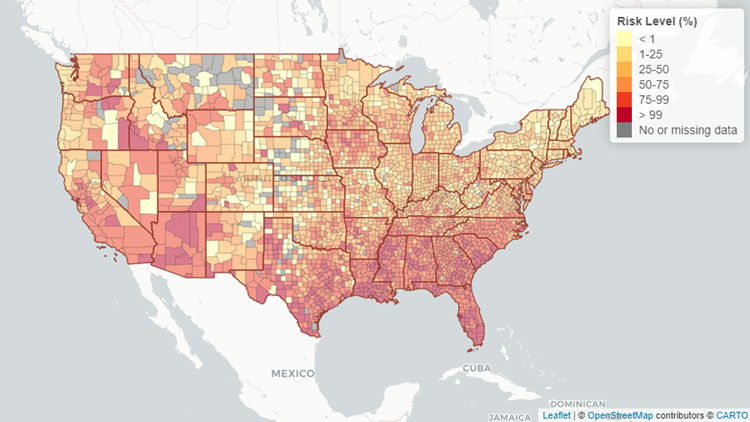
This map shows the risk level of attending an event, given the event size and location.
The risk level is the estimated chance (0-100%) that at least 1 COVID-19 positive individual will be present at an event in a county, given the size of the event.
Based on seroprevalence data, we assume there are ten times more cases than are being reported (10:1 ascertainment bias). In places with more testing availability, that rate may be lower.
Choose an event size and ascertainment bias below:

Sure, none of that is certain, but Monday morning’s news that at least 14 members of the Miami Marlins and their staff have tested positive for the novel coronavirus in recent days was a Category 5 covid-19 hurricane alert. You couldn’t have a worse MLB start or a grimmer predictor for other games.
With lots of inherent social distancing, baseball was supposed to be the easiest major American team sport to resume, just as leagues in Japan and South Korea have functioned smoothly for months. But MLB couldn’t go even a week without the serious prospect that its 60-game season should be canceled.
“Hey, I’m going to be honest with you: I’m scared. I really am,” said Washington Nationals Manager Dave Martinez, 55, who has a heart condition.
Why is MLB creating a situation where Dusty Baker, 71, the survivor of multiple life-threatening conditions in the past 15 years, manages Houston every day while Texas is a national coronavirus hot spot?
Martinez added that before long his team may see more players “opt out,” as Ryan Zimmerman and Joe Ross already have. Once the defections start, the cascade won’t stop until the sport must call a halt.
“Now we REALLY get to see if MLB is going to put players health first,” tweeted Los Angeles Dodgers left-hander David Price, who passed on $11.8 million by opting out of this partial season. “Remember when [Commissioner Rob] Manfred said players health was PARAMOUNT?! Part of the reason I’m at home right now is because players health wasn’t being put first. I can see that hasn’t changed.”
Underneath all the discussions and elaborate plans to reopen various sports — MLB, the NBA and NHL now, and the NFL and college football by the end of next month — has been one naive assumption: If the virus hit a team, it would infect one or two players. Maybe three. But the sense was things still would be manageable. You could still field a team.
When did this become the highest of all human goals?
The danger and the damage would not be “too bad.” In this, we see Americans’ national tendency toward willful pandemic ignorance being played out on a small, crystal-clear stage so everyone can get the message.
For months, we have watched healthy people, mostly young, swarm into bars or hit the beaches with an apparent sense that community spread was a fiction or not something that applied to them. Maybe, the fantasy went, one person in the wrong bar would get the virus.
Now we learn differently. Now we see the truth.
Over a dozen Marlins and counting.
The immediate consequences of the Marlins’ outbreak were the postponements of their home opener against the Baltimore Orioles and the Philadelphia Phillies’ home game against the New York Yankees, who would have been occupying the clubhouse those Marlins just showered and dressed in Sunday.
The wider effect: Back to normal, or even semi-normal, in sports was shattered just days after being reintroduced.
What does this mean?
Some events have ambiguous consequences. We won’t know their impact for some time. But in rare cases, one event may have enormous impact, just as the positive virus test for the NBA’s Rudy Gobert in mid-March resulted in the shutdown of every major sport within 48 hours.
This is such a moment — but perhaps bigger.
Why are we here? The answer is simple yet inexplicably unacknowledged in wide swaths of this country: The pandemic is not under control until you stop it, suppress it, dominate it and crush the curve.
Though many other countries have done it, America has not come within a million miles of that outcome.
As I pointed out in a column last week, when a league says, Given what we are seeing with covid-19 hitting our teams, maybe we should cancel the season, the correct response is “get rid of the word ‘maybe.’ ”
The entire American experience of this pandemic has been: Don’t embolden the virus by acknowledging its threat. Try to outrun it, hide from it, say it’s not so bad and will go away.
That just breeds a disaster, and now that disaster has hit MLB just days into its season. The Cincinnati Reds also have multiple positive tests. The Atlanta Braves have been without two catchers who have symptoms, though no positive tests. Nationals star Juan Soto is inactive after a positive test.
Do we need a longer list?
You can’t be much healthier, as a group, than a pro baseball team. You can’t be much better protected or tested more often than an MLB team. The Marlins are close to the safest possible case. And now, less than a week into their season, at least half of the team has the coronavirus!
That is what is meant by “community spread.” That is what is meant by an “outbreak” in an epidemic. All of us have worried that one or two players — or people in the MLB community — would have bad outcomes from the virus if a 60-game season was played. Time to blow up that assumption. If half of the Marlins team can test positive within a few days, then the scale of danger to health — the number of people who may get sick and the severity of the damage they may suffer, including prime-of-life pro athletes — just shot through the ceiling.
Our assumptions, while well-intentioned, have been blown to pieces. And in short order, so will the season of one, or perhaps several, of our sports.
The Marlins are just the latest — but one of the most vivid — illustrations of what America is facing. And how little we are willing to take seriously the true measure of our fearsome enemy.

After spending a May day preparing her classroom to reopen for preschoolers, Ana Aguilar was informed that the tots would not have to wear face masks when they came back. What’s more, she had to sign a form agreeing not to sue the school if she caught COVID-19 or suffered any injury from it while working there.
Other teachers signed the form distributed by the Montessori Schools of Irvine, but Aguilar said she felt uncomfortable, although it stipulated that staff members would be masked. At 23, she has a compromised immune system and was also worried that she could pass the coronavirus on to her fiancé and other family members.
Aguilar refused to sign, and a week later she was fired. “They said it was my choice to sign the paper, but it wasn’t really my choice,” said Aguilar, who’s currently jobless and receiving $276 a week in unemployment benefits. “I felt so bullied.”
As employers in California and across the country ask employees to return to the workplace, many have considered and some are requiring employees to sign similar waivers, employment lawyers say. And many employees, mostly lower-wage and minority workers in essential jobs, are calling lawyers to complain about the waivers.
“These are illegal agreements that are totally unfair to workers,” said Christian Schreiber, a San Francisco lawyer who represents Aguilar and other employees.
The California State Legislature last year passed a law, AB-51, prohibiting employers from requiring employees or job applicants to sign away their right to pursue legal claims or benefits under state law. The law, which also prohibits firing any employee for refusing to sign, is being challenged in court by business groups.
Only a few employers have forced employees to sign liability waivers, at least partly because these waivers likely would be held unenforceable by courts, lawyers who represent employers say.
“Courts don’t recognize them because of the unequal bargaining power between employers and employees,” said Isaac Mamaysky, a partner at the Potomac Law Group in New York City. “With so many unemployed, people would sign just about anything to get a job.”
Another reason they are considered unenforceable: Workers who get sick or injured on the job generally are compensated through state workers’ compensation systems rather than through the courts, and state laws don’t allow employers to force employees to sign away their right to pursue workers’ comp claims, Mamaysky said.
Companies may have the right to require nonemployees working on their premises to sign COVID waivers. When the New York Stock Exchange reopened in late May, it made floor traders sign a form clearing the exchange of liability if they contracted COVID-19. That was legally permissible because the traders were not exchange employees, an NYSE spokesman said. He declined to say whether any traders have become infected with the virus.
The Las Vegas-based restaurant chain Nacho Daddy, which did require employees to surrender their right to sue over COVID-19, reportedly fired some who refused. Following negative media coverage, Nacho Daddy removed the language that waived legal rights and instead had employees agree to follow safety rules such as masking and social distancing. The company did not respond to a request for comment.
Having employees agree to comply with safety rules is a more common and legally acceptable approach than waivers.
“I suggest my clients go to this reasonable middle ground: Here’s what we promise to you, here’s what we want you to promise to us,” said David Barron, an employment lawyer with Cozen O’Connor in Houston.
Business groups hope Senate Majority Leader Mitch McConnell will make liability waivers unnecessary. He has proposed a Senate bill with broad liability protection for employers for five years against a range of coronavirus-related claims, and says he won’t back any COVID relief bill that doesn’t include such protections. President Donald Trump has said he supports the liability protection.
At least 10 states already have enacted laws providing some form of immunity for businesses from lawsuits brought by employees and others who contract COVID-19. Similar bills are pending in about 10 more states, according to the National Employment Law Project. The California Assembly is considering a liability protection bill for public K-12 schools.
Federal legislation to provide COVID liability relief for employers should protect only those that follow applicable health and safety guidelines, said John Abegg, executive vice president of the U.S. Chamber Institute for Legal Reform, which supports McConnell’s proposal.
But even if McConnell is able to overcome Democratic opposition and pass liability protection as part of a new pandemic economic relief bill, that still wouldn’t shield employers from lawsuits claiming gross negligence or reckless or intentional conduct in failing to implement COVID-19 safety precautions.
Across the country, hospitals and nursing homes, as well as companies like McDonald’s, Walmart and Safeway, have been hit with wrongful death lawsuits filed by families of employees who died from the virus. They typically cite egregious conduct that goes beyond ordinary negligence, potentially erasing any statutory liability relief.
Nearly 50 COVID-related lawsuits have been filed relating to conditions of employment, including exposure to the coronavirus or the lack of protective equipment, according to data collected by the law firm Hunton Andrews Kurth.
In many states, alleging intentional misconduct also may allow workers harmed by COVID-19, and their families, to file lawsuits rather than go through the workers’ compensation system, and thus seek bigger damage awards.
For instance, a suit filed in Alameda County Superior Court in June by the widow of a longtime employee of Safeway’s distribution center in Tracy, California, alleged that the company had concealed a COVID-19 outbreak from workers and informed them that personal protective equipment was not recommended, contrary to guidelines from federal and state authorities.
“I don’t know of any jurisdiction that would allow a waiver against intentional misconduct,” said Louis DiLorenzo, head of the labor and employment practice for Bond Schoeneck & King in New York, who represents employers. “That would encourage misconduct.”
Worker advocates argue that lawsuits like the one against Safeway should be encouraged — rather than blocked by waivers or immunity laws — to bring to light serious public safety problems. Cases against McDonald’s in Oakland and Chicago — in which workers claimed the restaurants had created a “public nuisance” by not taking steps to adequately protect workers and customers from COVID-19 — resulted in court orders in late June for those McDonald’s restaurants to implement safety measures such as masks, social distancing and temperature checks.
“A very tiny number of cases are being filed by workers, and those cases are valuable,” said Hugh Baran, a staff lawyer at the National Employment Law Project. “These are the kinds of claims we should want workers to bring.”
Schreiber said he contacted the Montessori school about Aguilar’s firing, and it offered to reinstate her without having her sign the waiver. But Aguilar declined, saying the school was putting teachers at risk by not requiring pupils to wear masks. The school then offered her six weeks of severance pay, which she is considering.
By refusing to sign the waiver or accept her job back, she said, she was standing up for all the teachers at the school, many of whom have children and can’t afford to lose their job.
“I liked my job and I needed the paycheck,” Aguilar said. “But making you sign these papers is telling you that whatever happens, they really don’t care.”
https://www.ranker.com/list/maps-mash-v1/mel-judson?format=slideshow&slide=25