GEISINGER OFFERS DEBT-FREE PRIMARY CARE MEDICAL SCHOOL

https://www.healthleadersmedia.com/clinical-care/geisinger-offers-debt-free-primary-care-medical-school?spMailingID=16548061&spUserID=MTg2ODM1MDE3NTU1S0&spJobID=1760517984&spReportId=MTc2MDUxNzk4NAS2

Program offered for medical students who’ll commit to primary care at the Pennsylvania-based health system after graduating.


KEY TAKEAWAYS

The program will pick 40 first- and second-year students in each medical class through a competitive application process.

Selection criteria include  financial need, academic merit, diversity, and predictors of whether the applicant will stay in Geisinger’s service area.

The program will provide full coverage of tuition and fees plus a monthly $2,000 stipend through four years of medical school. 

Geisinger and Geisinger Commonwealth School of Medicine have created the Geisinger Primary Care Scholars Program that will offer debt-free medical school and living assistance to medical students who agree to work within primary care at the health system after they graduate.

Medical students often carry $200,000 or more in debt, which pushes them into higher-paying specialties. Geisinger President and CEO Jaewon Ryu, MD, says that removing the financial strain in exchange for a four-year commitment to practice at Geisinger will make it easier for more med students to pursue primary care.

“At Geisinger, we’ve been able to prove that by focusing on primary care we can improve outcomes, lower costs and improve satisfaction among patients and providers,” Ryu said.

“We’ve built some innovative programs that expand upon the notion of what is primary care and where it is delivered. With all of these different offerings, we are thrilled to welcome anyone who shares this passion around new and exciting ways to deliver this core care,” Ryu said.

“So, it’s only natural that we extend that commitment to training the next generation of physicians. These scholars have the opportunity to learn and later work in Geisinger’s innovative primary care environment without the worry of how they will pay for their education,” he said.

The program will pick 40 first- and second-year students in each incoming medical class through a competitive application process. Selection criteria include demonstrated financial need, academic merit, diversity, passion for serving their communities, and predictors of whether the applicant is likely to stay in Geisinger’s service area.

The program will provide full coverage of tuition and fees plus a monthly $2,000 stipend through the four years of medical school.

“I can’t think of a better opportunity for these scholars to pursue their commitment to primary care than by providing debt-free medical schooling,” said Steven J. Scheinman, MD, executive vice president and chief academic officer at Geisinger and Dean of the Geisinger Commonwealth School of Medicine.

Last year Geisinger started the Abigail Geisinger Scholars Program. Which gives 10 students in each class up to four years of tuition in the form of a loan, which is forgiven upon completion of a service commitment as a Geisinger physician in any specialty.

“I CAN’T THINK OF A BETTER OPPORTUNITY FOR THESE SCHOLARS TO PURSUE THEIR COMMITMENT TO PRIMARY CARE THAN BY PROVIDING DEBT-FREE MEDICAL SCHOOLING. ”


Gainesville health system paying patients’ out-of-network costs

https://www.albanyherald.com/news/gainesville-health-system-paying-patients-out-of-network-costs/article_5a82d58a-f4f1-11e9-b7b5-8bebc4253708.html

gainesville hospital.jpg

With a contract impasse in its third week, a Gainesville-based health system is spending millions of dollars so that thousands of patients are not having to pay more when visiting the system’s doctors and hospitals.

Northeast Georgia Health System’s contract with Anthem ended Sept. 30, which means that since then, Georgians with Anthem insurance have been out of network for NGHS facilities and physicians.

But in an unusual move, the Northeast Georgia system is making up the financial difference between in-network and out-of-network prices through Dec. 31. That way, Anthem patients won’t pay higher fees when visiting NGHS medical providers, the system said.

“While it will cost millions of dollars per month to protect our patients from out-of-network costs, we’d rather do that than agree to a proposal that would jeopardize the health of our community for years to come,’’ Steve McNeilly, vice president of managed care for NGHS, said.

Most contract disputes between health systems and insurers get resolved before the end of the previous deal, although some agreements come just hours before the end of the expiring pact. The terminated contract between NGHS and Anthem is an exception, and this particular stalemate doesn’t show any sign of progress. Neither side has mentioned any negotiations or even indicated that talks are being scheduled.

The standoff comes at a time when many Georgians are entering their open enrollment period for the 2020 health plan year.

Anthem is by far the state’s biggest health insurer. Northeast Georgia’s hospitals in Gainesville, Braselton, Winder and Dahlonega, as well as its urgent care facilities and many physician group locations, are now out of network for Anthem patients.

“Anthem has only contacted NGHS once since the end of September – and that was only to inform us that they would be processing all claims as out-of-network,’’ McNeilly said. He said Northeast Georgia has proposed a contract with concessions, but that Anthem “refuses to take any meaningful action.’’

“Unfortunately, it appears that Anthem intends for us to be out of network for an extended period of time, so we’re urging patients to switch to a different health insurance plan during open enrollment,’’ McNeilly added.

Northeast Georgia said patients can call its Patient Access Service Center at (770) 219-7678 to get a personalized estimate of hospital charges for upcoming surgeries or procedures. If patients have questions about charges for physician office visits, they can call their physician’s office for more information, NGHS said.

Anthem said Monday that it is “standing firm for our consumers who need greater affordability.’’

The latest proposals from NGHS would increase costs “well above other health systems in the state,’’ Christina Gaines, an Anthem spokeswoman, said. “These increases place a significant burden on consumers because any substantial price increase in the services at these facilities would be directly reflected in increases in medical expenses covered by employer-sponsored group health plans, as well as to member premiums and cost share amounts.’’

What NGHS proposed “was simply not sustainable’’ for Anthem members, she said.

“We provided a revised proposal to them two days before the contract expired and did not receive a response,’’ Gaines said. “We are willing to resume talks so we can come to a new agreement that is fair, provides flexibility and protects affordability.”

Anthem said it can’t guarantee that Northeast Georgia will continue to charge patients the same rates as under the previous contract.

“To protect against unexpected balance billing, and other expenses associated with out-of-network providers, we are urging members to use in-network physicians and facilities,’’ Gaines said. “Anthem continues to have a broad, statewide provider network that delivers access to other quality health care options that remain in-network for our consumers.” Anthem directed consumers to visit www.anthem.com/nghs for information.

Craig Savage, a consultant with CMBC Advisors in North Carolina, said he had not heard previously of a hospital-based system covering the cost gap for patients who are forced out of network by a contract dispute.

“I think it’s a demonstration of good faith to patients,’’ Savage said. “It puts a little marketing pressure on Anthem.’’

But he added that even losing the business of 40,000 patients is “not going to have a huge [financial] impact on Anthem in Georgia.’’

And Savage said the contract standoff may put pressure on local physicians who could lose many patients to another insurer during open enrollment season.


California will be first state to train doctors in how their counsel can prevent gun deaths

https://www.sacbee.com/news/politics-government/capitol-alert/article236257503.html

Image result for California will be first state to train doctors in how their counsel can prevent gun deaths

The state of California will pay $3.85 million to researchers at the University of California, Davis, to develop the nation’s first program to train health care professionals to help their patients reduce firearm-related injury and death, university officials announced Tuesday.

Gov. Gavin Newsom approved the funding on Friday when he signed Assembly Bill 521 . Money will go toward educating a variety of California providers, including practicing physicians, mental health care professionals, physician assistants, nurse practitioners, nurses, health professions students and other specialists.

Dr. Amy Barnhorst, a UC Davis Health psychiatrist, will oversee the training. She has spent a good deal of her career studying gun violence, suicide and public mental health.

“Medical and mental health providers are uniquely positioned to respond to and prevent firearm-related harm,” Barnhorst said. “Many have asked for more information on when and how to discuss firearms with patients and what to do when patients have access to guns and are at high risk for harming themselves or others.”

Barnhorst and other UC Davis researchers look into how to prevent violence, what causes it, and the consequences of it at the Violence Prevention Research Program. This research program is home to the UC Firearm Violence Research Center.

Around the nation, physicians have called for meaningful policy changes to address the public health risk of gun violence in the wake of mass shootings like those at the Gilroy Garlic Festival in July and the Borderline Bar and Grill in Thousand Oaks last November. California reported 3,184 gun-related deaths in 2017, including 1,610 suicides and 1,435 homicides, according to data from the U.S. Centers for Disease Control and Prevention.

Researchers from UCD’s Violence Prevention Research Program, Stanford University and other institutions teamed up to publish guidelines in the Annals of Internal Medicine on how the nation’s physicians could begin to have conversations with patients at risk of harm.

Dr. Garen Wintemute, the program’s director, said the new law allows Barnhorst and other team members to build upon this work.

Physicians can, for instance, counsel patients on safe storage practices or how to initiate gun violence restraining orders or how to intervene on behalf of individuals with mental health issues. To emphasize the importance of these conversations, researchers cited data in the Annals of Internal Medicine that show that as many as 30 percent of firearms owners keep at least one gun loaded but not locked up.

“California health professionals are committed to making firearm violence prevention part of their practices, and we are very excited by the opportunity to equip them with the knowledge and skills they need,” Wintemute said.

In addition to training physicians, Wintemute said, UC Davis will continue its rigorous search for specific gaps in knowledge and structural barriers that prevent society from being able to reduce the threat of gun violence.

Assemblyman Marc Berman, D-Palo Alto, co-authored AB 521 with Assembly members Cecilia Aguiar-Curry, D-Winters; David Chiu, D-San Francisco; Jesse Gabriel, D-San Fernando Valley; Todd Gloria, D-San Diego; Marc Levine, D-Marin County; and Mark Stone, D-Monterey Bay; as well as state Sens. Anthony Portantino, D-La Canada Flintridge, and Scott Wiener, D-San Francisco.


Health care’s fraud and abuse laws are getting overhauled

https://www.axios.com/health-care-fraud-abuse-stark-law-antikickback-changes-fd354212-9583-44c7-85e4-86e4690cc56e.html

Doctors dressed in blue operate on a patient in a surgical suite.

The Trump administration is proposing to loosen regulations that prohibit doctors from steering patients insured by federal programs to facilities where they have a financial interest and that outlaw health care companies from offering bribes and kickbacks in exchange for patient referrals.

Why it matters: The industry has long clamored for an overhaul to these laws, which companies say obstruct their goals of providing “value-based care.” But critics worry the broad and vague changes could engender more fraud and abuse than there already is.

Driving the news: The Department of Health and Human Services would create new exemptions for the physician self-referral law and the federal anti-kickback statute — decades-old, complex laws that forbid payments that encourage unnecessary care and increase taxpayer costs.

  • Hospitals, doctors, nursing homes and other entities would be able to create “value-based arrangements,” and those deals could include exchanging bonuses or other types of “remuneration” without running afoul of referral laws.
  • For example, under these exemptions, a hospital could provide a nursing home with a behavioral health nurse for certain discharged patients, or a hospital could donate cybersecurity technology to a physician’s office.
  • Many exemptions already exist, including for organizations called “accountable care organizations” that try to keep a patient’s care within a narrow set of hospitals and doctors, but these changes would go much further.

Between the lines: The overarching concern is everyone’s definition of “value” is different. How will regulators know whether providers are acting in good faith to coordinate care, or if they are using “value-based care” as a cover to control patient referrals and enrich themselves?

A major exclusion: Pharmaceutical companies, medical device firms, labs and medical equipment makers are cut out from the changes because the federal government is afraid those companies would “misuse the proposed safe harbors.”

  • Pharma lobbyists, in particular, have pushed hard to change the law so drug companies could directly subsidize drug copays for Medicare and Medicaid patients, even though federal officials have said that practice “masks the high prices those companies charge for their drugs.”
  • HHS Secretary Alex Azar told reporters the government may consider separate regulations for value-based drug contracts, even though the evidence of those deals’ effectiveness is limited at best.

The bottom line: These changes come at the same time that hospitals, physicians, pharmaceutical companies and others are paying out billions of dollars every year in fraud settlements.

  • Public comments are due Dec. 31, and if this comment process is anything like the initial requests that asked for guidance, the industry will be heavily involved.


Market Consolidation on Trial

Market Consolidation on Trial

Image result for Market Consolidation on Trial

California Attorney General Xavier Becerra alleges that Sutter Health used its pre-eminent market power to artificially inflate prices. Photo: Rich Pedroncelli/Associated Press

As a jury trial draws near in a major class-action lawsuit alleging anticompetitive practices by Northern California’s largest health system (PDF), a new CHCF study shows the correlation between the prices consumers pay and the extensive consolidation in the state’s health care markets. Importantly, the researchers estimated the independent effect of several types of industry consolidation in California — such as health insurers buying other insurers and hospitals buying physician practices. The report, prepared by UC Berkeley researchers, also examines potential policy responses.

While other states have initiated antitrust complaints against large hospital systems and medical groups in the past, the case against Sutter Health is unique in both the expansive nature of the alleged conduct and in the scale of the potential monetary damages. The complaint goes beyond claims of explicit anticompetitive contract terms and argues that by virtue of its very size and structure, the Northern California system imposed implicit or “de facto” terms that led to artificially inflated prices. Sutter Health vigorously denies the allegations.

The formation of large health systems like Sutter is neither new (PDF) nor unique to California (PDF). Several factors seem to be encouraging their growth, including payment models that place health care providers at financial risk for the cost of care, increased expectations from policymakers and payers around the continuum of patient needs that must be managed, and economies of scale for investments in information technology and administrative services. Some market participants also point to consolidation in other parts of the health care system, such as health plans and physician groups, as encouragement for their own mergers.

Economic Consolidation in California

In general, economists study two major categories of market consolidation:

  • Horizontal consolidation: Entities of the same type merge, such as the merger of two hospitals or insurance companies, or the merger of providers into a physician network.
  • Vertical consolidation: Entities of different types merge, such as when a hospital purchases a physician practice or when a pharmacy buys an insurance company.

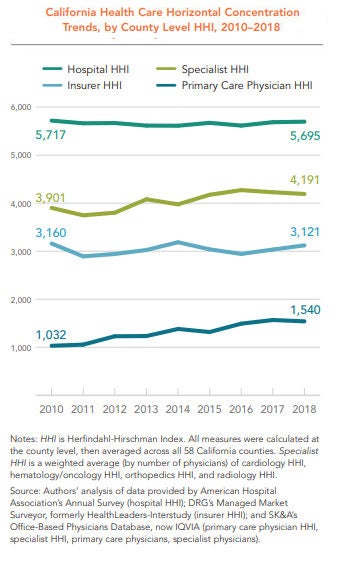
To measure market consolidation, the CHCF study relied on the Herfindahl-Hirschman Index (HHI), a metric used by the US Department of Justice and the Federal Trade Commission. An HHI of between 1,500 and 2,500 is considered moderately concentrated, and 2,500 or above is considered highly concentrated. According to this measure, horizontal concentration is high in California among hospitals, insurance companies, and specialist providers (and moderately high among primary care physicians), even though the level of concentration in all but primary care has remained relatively flat from 2010 to 2018.
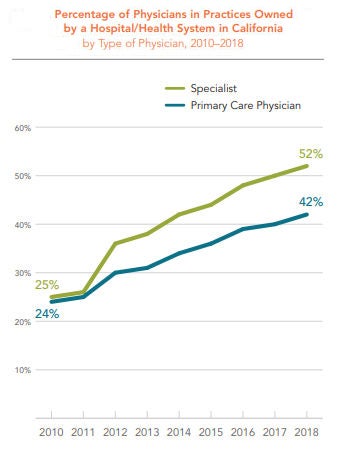
The percentage of physicians in practices owned by a hospital or health system increased dramatically in California between 2010 and 2018 — from 24% in 2010 to 42% in 2018. The percentage of specialists in practices owned by a hospital or health system rose even faster, from 25% in 2010 to 52% in 2018.
Consolidation Is Not Clinical Integration

While this study defined and quantified the extent of consolidation across several industry segments in California, it is important to note that it did not define, quantify, or evaluate clinical integration within the state. Clinical integration has been defined by others in many ways, but generally involves arrangements for coordinating and delivering a wide range of medical services across multiple settings.

As the CHCF study authors point out, other analysis has shown that various types of clinical integration can lead to broader adoption of health information technology and evidence-based care management processes. Data from the Integrated Healthcare Association suggests that certain patient benefit designs and provider risk-sharing arrangements associated with clinical integration can lead to higher quality and lower costs.

Crucially, an emerging body of law (PDF) suggests that clinical integration does not require formal ownership and joint bargaining with payers.

Relationship Between Consolidation and Health Insurance Premiums

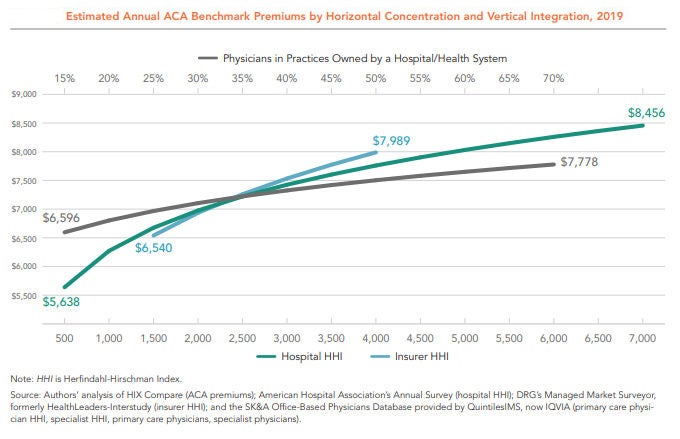
Among the six variables analyzed in the CHCF study, three showed a positive and statistically significant association with higher premiums: insurance company mergers, hospital mergers, and the percentage of primary care physicians in practices owned by hospitals and health systems. The remaining three variables studied — specialist provider mergers, primary care provider mergers, and the percentage of specialists in practices owned by a hospital and health system — were statistically insignificant.

The figure below shows the independent relationship between market concentration and premiums for these three variables. As the lines move left to right, concentration increases — that is, fewer individual insurers, hospitals, or providers occupy the market. The vertical axis shows the average premiums associated with each level of market concentration. In short, regardless of the industry structure represented by the other variables, insurer consolidation, hospital consolidation, and hospital-physician mergers each lead to higher premiums.
Unexplained Price Variation and Growth

Health insurance premiums rise when the underlying cost of medical care increases. California ranks as the 16th most expensive state on average in terms of the seven common services the researchers studied, after adjusting for wage differences across states. Among all states, California has the eighth-highest prices for normal childbirth, defined as vaginal delivery without complications. Childbirth is the most common type of hospital admission, and the relatively standardized procedure is comparable across states.

Even within California, prices vary widely and are growing rapidly. For example, the 2016 average wage-adjusted price for a vaginal delivery was twice as high in Rating Area 9 (which has Monterey as its largest county) as it was in Rating Area 19 (San Diego) — $22,751 versus $11,387. (See next figure.) Prices for the service are increasing rapidly across counties — rising anywhere from 29% in San Francisco from 2012 to 2016 to 40% in Orange County over the same period.

The authors of the CHCF report investigated the impact of various types of consolidation on the prices of individual medical services in California. For cesarean births without complications, a 10% rise in hospital HHI is associated with a 1.3% increase in price.

Potential Policy Responses to Consolidation

While the study shows significant associations between various types of market concentration and the prices consumers pay, policymakers should carefully consider implementing steps that restrain the inflationary impact of consolidation while allowing the benefits of clinical integration to proliferate. To that end, the authors of the CHCF report offered a series of recommendations, which include:

Enforce antitrust laws. Federal and state governments should scrutinize proposed mergers and acquisitions to evaluate whether the net result is procompetitive or anticompetitive.

Restrict anticompetitive behaviors. Anticompetitive behaviors, such as all-or-nothing and anti-incentive contract terms, should be addressed through legislation or the courts in markets where providers are highly concentrated.

Revise anticompetitive reimbursement incentives. Reimbursement policies that reduce competition, such as Medicare rules that implicitly reward hospital-owned physician groups, should be adjusted.

Reduce barriers to market entry. Policies that restrict who can participate in the health care market, such as laws prohibiting nurse practitioners from practicing independently from a physician, should be changed when markets are concentrated.

Regulate provider and insurer rates. If antitrust enforcement is not successful and significant barriers to market entry exist — including those in small markets unable to support a competitive number of hospitals and specialists — regulating provider and insurer rates should be considered.

Encouraging meaningful competition in health care markets is an exceedingly difficult task for policymakers. It is no easier to promote the benefits of clinical integration while restraining the inflationary aspects of economic consolidation through public policy. Despite these challenges, the rapid rise in health care premiums and prices in the state require a fresh look at the consequences of widespread horizontal and vertical consolidation in California.


DOJ breaks up alleged genetic testing fraud scheme estimated at $2.1 billion

https://www.healthcarefinancenews.com/news/doj-breaks-alleged-genetic-testing-fraud-scheme-estimated-21-billion?mkt_tok=eyJpIjoiWkdNMU56WmxabVl3TWpRMSIsInQiOiI0dlhaYUJpT2xBU0FqeDNmWkRlZHVZYnRsZ2xBK3pxMmN6RG5kS3Q1UWgrWFYyNllIK2lLZEYzclRDWUYyTFwvOGdhUzRVSnlscG5MQjBtY0NwT2d1TjZHdXJYRUlYRGszVEhrQmY5b0xhRDlFTWNTNUEwWnVvWGUwZXE3ME9kdGgifQ%3D%3D

The defendants ordered unnecessary tests that were reimbursed by Medicare, with laboratories sharing the profit, DOJ says.

The U.S. Department of Justice has charged 35 people with unlawfully charging Medicare $2.1 billion in what it said is one of the largest healthcare fraud schemes in history.

The 35 alleged offenders were charged in five separate federal districts, and were linked to dozens of telemedicine firms and laboratories focused on genetic testing for cancer. The people charged, including nine doctors and one other medical professional, cumulatively billed Medicare billions for cancer genetic tests, the DOJ said in a press release.

The charges were a culmination of coordinated law enforcement activities over the past month that were led by the Criminal Division’s Health Care Fraud Unit, resulting in charges against more than 380 individuals who allegedly billed federal healthcare programs for more than $3 billion, and allegedly prescribed and dispensed approximately 50 million controlled substance pills in Houston, across Texas, the West Coast, the Gulf Coast, the Northeast, Florida and Georgia, and the Midwest.

These include charges against 105 defendants for opioid-related offenses, and charges against 178 medical professionals.

The investigation targeted an alleged scheme involving the payment of illegal kickbacks and bribes by CGx laboratories in exchange for the referral of Medicare beneficiaries by medical professionals working with fraudulent telemedicine companies for expensive, and medically unnecessary, cancer genetic tests.

According to the DOJ, the targets of the scheme were primarily seniors, who were approached at health fairs, at their homes during door-to-door visits, or through telemarketing calls. The “recruiters,” as they were called, would approach seniors about supposedly free cancer screenings or generic cheek swab tests, and the recruiters would then obtain the seniors’ Medicare information for the purposes of fraudulent billing or identify theft.

The recruiter would then get a doctor to sign off on a genetic so a lab would process it, and then pay a kickback in exchange for ordering the test. The lab would process the test and bill Medicare, and once it was reimbursed, would share the proceeds with the recruiter, according to the charges.

Often, the test results were not provided to the beneficiaries, or were worthless to their actual doctors. Some of the defendants allegedly controlled a telemarketing network that lured hundreds of thousands of elderly and/or disabled patients into a criminal scheme that affected victims across the U.S.

The defendants allegedly paid doctors to prescribe CGx testing, either without any patient interaction or with only a brief phone conversation with patients they had never met or seen.

WHAT’S THE IMPACT

In addition to the DOJ charges, the Centers for Medicare and Medicaid Services, Center for Program Integrity said it took adverse administrative action against cancer genetic testing companies and medical professionals who submitted more than $1.7 billion in claims to the Medicare program.

The DOJ Criminal Division, along with the U.S. Department of Health and Human Services Office of Inspector General and the FBI, spearheaded the investigation.

The DOJ calls the scheme one of the largest it has ever handled.

THE LARGER TREND

Since its inception in March 2007, the Medicare Fraud Strike Force, which maintains 15 strike forces operating in 24 districts, has charged nearly 4,000 defendants who have collectively billed the Medicare program for more than $16 billion.

In addition, CMS, working in conjunction with the Health and Human Services Office of the Inspector General, are taking steps to increase accountability and decrease the presence of fraudulent providers.

The newest Medicare fraud scheme is the second to be uncovered in the last month. Earlier in September, a telemedicine CEO pleaded guilty to one count of conspiracy to defraud the United States and pay and receive healthcare kickbacks and one count of conspiracy to commit money laundering in a scheme estimated at $424 million.

ON THE RECORD

“Unfortunately, audacious schemes such as those alleged in the indictments are pervasive and exploit the promise of new medical technologies such as genetic testing and telemedicine for financial gain, not patient care,” said Deputy Inspector General for Investigations Gary L. Cantrell of HHS-OIG. “Instead of receiving quality care, Medicare beneficiaries may be victimized in the form of scare tactics, identity theft, and in some cases, left to pay out of pocket.  We will continue working with our law enforcement partners to investigate those who steal from federal healthcare programs and protect the millions of Americans who rely on them.”

“Healthcare fraud and related illegal kickbacks and bribes impact the entire nation,” said Assistant Director Terry Wade of the FBI’s Criminal Investigative Division. “Fraudulently using genetic testing laboratories for unnecessary tests erodes the confidence of patients and costs taxpayers millions of dollars. These investigations revealed some medical professionals placing their greed before the needs of the patients and communities they serve. Today’s law enforcement actions reinforce that the FBI, along with its partners, will continue to pursue and stop this type of illegal activity.”