We’re a year into the coronavirus pandemic, so the math that undergirds its risks should by now be familiar. We all should know, for example, that the ability of the virus to spread depends on it being able to find a host, someone who is not protected against infection. If you have a group of 10 people, one of whom is infected and nine of whom are immune to the virus, it’s not going to be able to spread anywhere.
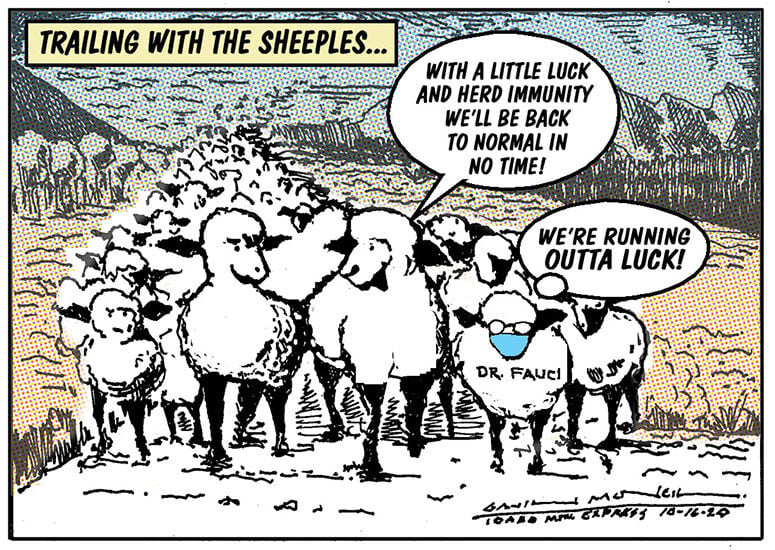
That calculus is well known, but there is still some uncertainty at play. To achieve herd immunity — the state where the population of immune people is dense enough to stamp out new infections — how many people need to be protected against the virus? And how good is natural immunity, resistance to infection built through exposure to the virus and contracting covid-19, the disease it causes?
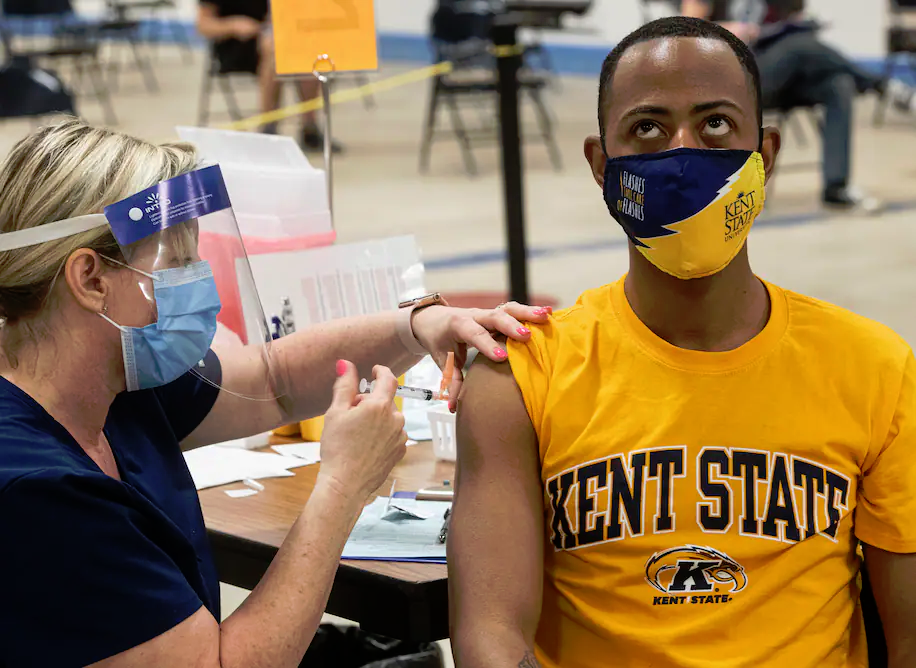
The safe way to increase the number of immune people, thereby probably protecting everyone by limiting the ability of the virus to spread, is through vaccination. More vaccinated people means fewer new infections and fewer infections needed to get close to herd immunity. The closer we get to herd immunity, the safer people are who can’t get vaccinated, such as young children (at least for now).
The challenge the world faces is that the rollout of vaccines has been slow, relatively speaking. The coronavirus vaccines were developed at a lightning pace, but many parts of the world are still waiting for supplies sufficient to broadly immunize their populations. In the United States, the challenge is different: About a quarter of adult Americans say they aren’t planning on getting vaccinated against the virus, according to Economist-YouGov polling released last week.
That’s problematic in part because it means we’re less likely to get to herd immunity without millions more Americans becoming infected. Again, it’s not clear how effective natural immunity will be over the long term as new variants of the virus emerge. So we might continue to see tens of thousands of new infections each day, keeping the population at risk broadly by delaying herd immunity and continuing to add to the pandemic’s death toll in this country.
But we also see from the Economist-YouGov poll the same thing we saw in Gallup polling earlier this month: The people who are least interested in being vaccinated are also the people who are least likely to be concerned about the virus and to take other steps aimed at preventing it from spreading.
In the Economist-YouGov poll, nearly three-quarters of those who say they don’t plan on being vaccinated when they’re eligible also say they’re not too or not at all worried about the virus.
That makes some perverse sense: If you don’t see the virus as a risk, you won’t see the need to get vaccinated. Unfortunately, it also means you’re going to be less likely to do things like wear a mask in public.
Or you might be more likely to view as unnecessary precautions such as avoiding close-quarter contact with friends and family or traveling out of state.
About a quarter of adults hold the view that they won’t be vaccinated when eligible. That’s equivalent to about 64 million Americans.
Who are they? As prior polls have shown, they’re disproportionately political conservatives. At the outset of the pandemic, there was concern that vaccine skepticism would heavily be centered in non-White populations. At the moment, though, the rate of skepticism among those who say they voted for Donald Trump in 2020 and among Republicans is substantially higher than skepticism overall.
That shows up in another way in the Economist poll. Respondents were asked whose medical advice they trusted. Among those who say they don’t plan to get the vaccine, half say they trust Trump’s advice a lot or somewhat — far more than the advice of the Centers for Disease Control and Prevention or the country’s top infectious-disease expert Anthony S. Fauci.
If we look only at Republican skeptics, the difference is much larger: Half of Republican skeptics say they have a lot of trust in Trump’s medical advice.
The irony, of course, is that Trump sees the vaccine as his positive legacy on the pandemic. He’s eager to seize credit for vaccine development and has — sporadically — advocated for Americans to get the vaccine. (He got it himself while still president, without advertising that fact.) It’s his supporters, though, who are most hostile to the idea.
Trump bears most of the responsibility for that, too. Over the course of 2020, worried about reelection, he undercut containment efforts and downplayed the danger of the virus. He undermined experts such as Fauci largely out of concern that continuing to limit economic activity would erode his main argument for his reelection. Over and over, he insisted that the virus was going away without the vaccine, that it was not terribly dangerous and that America should just go about its business as usual — and his supporters heard that message.
They’re still listening to it, as the Economist poll shows. One result may be that the United States doesn’t reach herd immunity through vaccinations and, instead, some large chunk of those tens of millions of skeptics end up being exposed to the virus. Some of them will die. Some may risk repeat infections from new variants against which a vaccine offers better protection. Some of those unable to get vaccinated may also become sick from the virus because we haven’t achieved herd immunity, suffering long-term complications from covid-19.
Trump wants his legacy to be the rollout of the vaccine. His legacy will also probably include fostering skepticism about the vaccine that limits its utility in containing the pandemic.
LIMA, Peru — The doctor watched the patients stream into his intensive care unit with a sense of dread.
For weeks, César Salomé, a physician in Lima’s Hospital Mongrut, had followed the chilling reports. A new coronavirus variant, spawned in the Amazon rainforest, had stormed Brazil and driven its health system to the brink of collapse.Now his patients, too, were arriving far sicker, their lungs saturated with disease, and dying within days. Even the young and healthy didn’t appear protected.
The new variant, he realized, was here.
“We used to have more time,” Salomé said. “Now, we have patients who come in and in a few days they’ve lost the use of their lungs.”
The P.1 variant, which packs a suite of mutations that makes it more transmissible and potentially more dangerous, is no longer just Brazil’s problem. It’s South America’s problem — and the world’s.
In recent weeks, it has been carried across rivers and over borders, evading restrictive measures meant to curb its advance to help fuel a coronavirus surge across the continent. There is mounting anxiety in parts of South America that P.1 could quickly become the dominant variant, transporting Brazil’s humanitarian disaster — patients languishing without care, a skyrocketing death toll — into their countries.
“It’s spreading,” said Julio Castro, a Venezuelan infectious-disease expert. “It’s impossible to stop.”
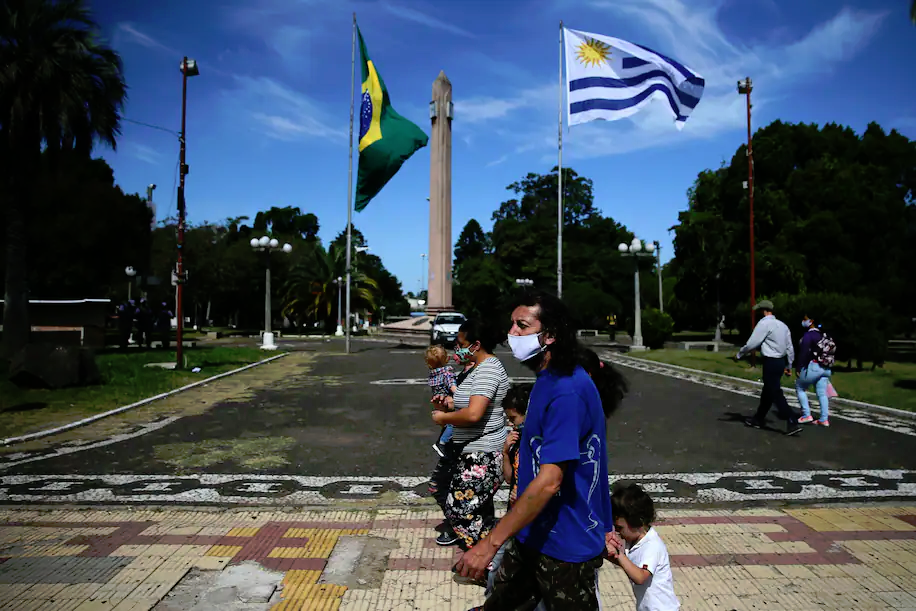
In Lima, scientists have detected the variant in 40 percent of coronavirus cases. In Uruguay, it’s been found in 30 percent. In Paraguay, officials say half of cases at the border with Brazil are P.1. Other South American countries — Colombia, Argentina, Venezuela, Chile — have discovered it in their territories. Limitations in genomic sequencing have made it difficult to know the variant’s true breadth, but it has been identified in more than two dozen countries, from Japan to the United States.
Hospital systems across South America are being pushed to their limits. Uruguay, one of South America’s wealthiest nations and a success story early in the pandemic, is barreling toward a medical system failure. Health officials say Peru is on the precipice, with only 84 intensive care beds left at the end of March. The intensive care system in Paraguay, roiled by protests last month over medical shortcomings, has run out of hospital beds.
“Paraguay has little chance of stopping the spread of the P.1 variant,” said Elena Candia Florentín, president of the Paraguayan Society of Infectious Diseases.
“With the medical system collapsed, medications and supplies chronically depleted, early detection deficient, contact tracing nonexistent, waiting patients begging for treatment on social media, insufficient vaccinations for health workers, and uncertainty over when general and vulnerable populations will be vaccinated, the outlook in Paraguay is dark,” she said.
How P.1 spread across the region is a distinctly South American story. Nearly every country on the continent shares a land border with Brazil. People converge on border towns, where crossing into another country can be as simple as crossing the street. Limited surveillance and border security have made the region a paradise for smugglers. But they have also made it nearly impossible to control the variant’s spread.
“We share 1,000 kilometers of dry border with Brazil, the biggest factory of variants in the world and the epicenter of the crisis,” said Gonzalo Moratorio, a Uruguayan molecular virologist tracking the variant’s growth. “And now it’s not just one country.”
The Brazilian city of Tabatinga, deep in the Amazon rainforest, where officials suspect the virus crossed into Colombia and Peru, is emblematic of the struggle to contain the variant. The city of 70,000 was swept by P.1 earlier this year. Many in the area have family ties in several countries and are accustomed to crossing borders with ease — canoeing across the Amazon River to Peru or walking into Colombia.
“People ended up bringing the virus from one side to the other,” said Sinesio Tikuna Trovão, an Indigenous leader. “The crossing was free, with both sides living right on top of one another.”
Now that the variant has infiltrated numerous countries, stopping its spread will be difficult. Most South American countries, with the exception of Brazil, adopted stringent containment measures last year. But they have been undone by poverty, apathy, distrust and exhaustion. With national economies battered and poverty rising sharply, public health experts fear more restrictions will be difficult to maintain. In Brazil, despite record death numbers, many states are lifting restrictions.(SOUND FAMILIAR)
That has left inoculation as the only way out. But coronavirus vaccines are South America’s white whale: often discussed, but rarely seen. The continent hasn’t distributed its own vaccine or negotiated a regional agreement with pharmaceutical companies. It’s one of the world’s hardest-hit regions but has administered only 6 percent of the world’s vaccine doses, according to the site Our World in Data. (The outlier is Chile, which is vaccinating residents more quickly than anywhere in the Americas — but still suffering a surge in cases.)
“We should not only blame the policy response,” said Luis Felipe López-Calva, the United Nations Development Program’s regional director for Latin America and the Caribbean. “We have to understand the vaccine market.”
“And there is a failure in the market,” he said.
The vaccine has become so scarce, López-Calva said, that officials are imposing restrictions on information. It’s nearly impossible to know how much governments are paying for doses. Some regional blocs, such as the African Union and the European Union, have negotiated joint contracts. But in South America, it has been every country for itself — diminishing the bargaining power for each one.
“This has been harmful for these countries, and for the whole world to stop the virus,” López-Calva said. “Because it’s never been more clear that no one is protected until everyone is protected.”
Paulo Buss, a prominent Brazilian scientist, said it didn’t have to be like this. He was Brazil’s health representative to the Union of South American Nations, which negotiated several regional deals with pharmaceutical companies before the coronavirus pandemic. But that union came apart amid political differences just before the arrival of the virus.
“It was the worst possible moment,” Buss said. “We’ve lost capacity and our negotiation attempts have been fragmented. Multi-lateralism was weakened.”
Vaccine scarcity has led to line-jumping scandals all over South America, but particularly in Peru. Hundreds of politically connected people, including cabinet ministers and former president Martín Vizcarra, snagged vaccine doses early. Now people are calling for criminal charges.
As officials bicker and the vaccination campaign is delayed, the variant continues to spread. P.1 accounts for 70 percent of cases in some parts of the Lima region, according to officials. Last week, the country logged the highest daily case count since August — more than 11,000. On Saturday, the country recorded 294 deaths, the most in a day since the start of the pandemic.
Peruvians have been stunned by how quickly the surge overwhelmed the health-care system. Public health analysts and government officials had believed Peru was prepared for a second wave. But it wasn’t ready for the variant.
“We did not expect such a strong second wave,” said Percy Mayta-Tristan, director of research at the Scientific University of the South in Lima. “The first wave was so extensive. The presence of the Brazilian variant helps explain why.”
Some countries have stockpiles. Others have nothing. Getting a vaccine means living in the right place — or knowing the right people.
A 16-year-old in Israel can get a vaccine.
So can a 16-year-old in Mississippi.
And an 18-year-old in Shanghai.
But a 70-year-old in Shanghai can’t get one. Older people are at high risk for severe illness from Covid-19. But Chinese officials have been reluctant to vaccinate seniors, citing a lack of clinical trial data. Neither can an 80-year-old in Kenya. Low vaccine supply in many countries means only health care employees and other frontline workers are eligible, not the elderly.
Nor a 90-year-old in South Korea. Koreans 75 and older are not eligible until April 1. Only health care workers and nursing-home residents and staff are currently being vaccinated. The government initially said it was awaiting assurances that the AstraZeneca vaccine was safe and effective for older groups.
Anyone in Haiti.
Anyone in Papua New Guinea.
Anyone in these 67 countries. These countries have not reported any vaccinations, according to Our World in Data. Official figures can be incomplete, but many countries are still awaiting their first doses.
It wasn’t supposed to be like this: Covax, the global vaccine-sharing initiative, was meant to prevent unequal access by negotiating vaccine deals on behalf of all participating nations. Richer nations would purchase doses through Covax, and poorer nations would receive them for free.
But rich nations quickly undermined the program by securing their own deals directly with pharmaceutical companies. In many countries, they have reserved enough doses to immunize their own multiple times over.
Anyone who can afford a smartphone or an internet connection in India and is over 60 can get one. Mostly wealthy Indians are being inoculated in New Delhi and Mumbai, hospitals have reported, since vaccine appointments typically require registering online. Less than half of India’s population has access to the internet, and even fewer own smartphones.
And anyone who can pay $13,000 and travel to the U.A.E. for three weeks and is 65 or older or can prove they have a health condition.
A member of Congress in the United States. Friends of the mayor of Manaus, Brazil. Lawmakers in Lebanon. A top-ranking military leader in Spain. The extended family of the deputy health minister in Peru. The security detail to the president of the Philippines. Government allies with access to a so-called “V.I.P. Immunization Clinic” in Argentina. Around the world, those with power and connections have often been first in line to receive the vaccine — or have cut the line altogether.
A smoker in Illinois can get one.But not a smoker in Georgia.
A diabetic in the United Kingdom can. A diabetic in Connecticut can’t.
Countries have prioritized different underlying health conditions, with the majority focusing on illnesses that may increase the risk of severe Covid-19. In the U.S., health issues granted higher priority differ from state to state, prompting some people to travel across state borders.
A pregnant woman in New York.Not a pregnant woman in Germany. Up to two close contacts of a pregnant woman in Germany. Pregnant women were barred from participating in clinical trials, prompting many countries to exclude them from vaccine priority groups. But some experts say the risks to pregnant women from Covid-19 are greater than any theoretical harm from the vaccines.
A grocery worker in Texas, no. A grocery worker in Oklahoma, yes.
Many areas aim to stop the virus by vaccinating those working in frontline jobs, like public transit and grocery stores. But who counts as essential depends on where you live.
A police officer in the U.K. A police officer in Kenya. A postal worker in California. A postal worker in North Carolina. A teacher in Belgium. A teacher in Campeche, Mexico. Other jobs have been prioritized because of politics: Mexico’s president made all teachers in the southern state of Campeche eligible in a possible bid to gain favor with the teacher’s union.
Medical staff at jails and prisons in Colombia. A correctional officer in Tennessee. A prisoner in Tennessee. A prisoner in Florida. The virus spread rapidly through prisons and jails, which often have crowded conditions and little protective equipment. But few places have prioritized inoculating inmates.
An undocumented farm worker in Southern California. A refugee living in a shelter in Germany. An undocumented immigrant in the United Kingdom. Britain has said that everyone in the country is eligible for the vaccine, regardless of their legal status.
A Palestinian in the West Bank without a work permit. Despite leading the world in per-capita vaccinations, Israel has so far not vaccinated most Palestinians, unless they have permits to work in Israel or settlements in the occupied West Bank.
An adult in Bogotá, Colombia. An adult in the Amazonian regions of Colombia that border Brazil. In most of Colombia, the vaccine is only available to health care workers and those over 80.
But the government made all adults in Leticia, Puerto Nariño, Mitú and Inírida eligible, hoping to prevent the variant first detected in Brazil from arriving in other areas. A police officer in Mexico City. A teacher in rural Mexico.The government of populist president Andrés Manuel López Obrador has prioritized vaccinating the poor and those in rural communities, despite the country’s worst outbreaks occurring in major cities.
Native populations not federally recognized in the United States. The pandemic has been particularly deadly for Native Americans. But only tribes covered by the Indian Health Service have received vaccine doses directly, leaving about 245 tribes without a direct federal source of vaccines. Some states, including Montana, have prioritized all Native populations.
Indigenous people living on official indigenous land in Brazil.
These 43 countries, mostly high income, are on pace to be done in a year. These 148 countries, mostly low income, are on pace to take until next year or even longer. Countries like the U.S. continue to stockpile tens of millions of vaccine doses, while others await their first shipments.
“The vaccine rollout has been inequitable, unfair, and dangerous in leaving so many countries without any vaccine doses at all,” said Gavin Yamey, director of Duke University’s Center for Policy Impact in Global Health.
“It’s a situation in which I, a 52-year-old white man who can work from home and has no pre-existing medical conditions, will be vaccinated far ahead of health workers or a high-risk person in a middle- or low-income country.”
America’s billionaires have added a staggering $1.1 trillion to their collective wealth since the pandemic began.Their combined fortunes now sit at $4.1 trillion — $1.7 trillion more than the amount of wealth held by the bottom half of Americans.
Meanwhile, the country’s poverty rate increased by 2.4 percentage points in the latter half of 2020 — the largest increase in poverty since the 1960s. And to think that Senate Republicans are decrying a $1.9 trillion COVID relief bill as too expensive.
Please. America’s billionaires alone could finance most of that bill, just with the increase in their wealth over the last 10 months. An emergency wealth tax that used their $1.1 trillion windfall to pay for the COVID survival plan would put these billionaires back to where they were 10 months ago (still very comfortable, to say the least) while helping the rest of America survive.
This is the sort of trickle-down economics that could actually work. What do you think?
Crafting successful public health measures depends on the ability of top scientists to gather data and report their findings unrestricted to policymakers.
State of play: But concern has spiked among health experts and physicians over what they see as an assault on key science protections, particularly during a raging pandemic. And a move last week by President Trump, via an executive order, is triggering even more worries.
What’s happening: If implemented, the order creates a “Schedule F” class of federal employees who are policymakers from certain agencies who would no longer have protection against being easily fired— and would likely include some veteran civil service scientists who offer key guidance to Congress and the White House.
“This much-needed reform will increase accountability in essential policymaking positions within the government,” OMB director Russ Vought tells Axios in a statement.
What they’re saying: Several medical associations, including the Infectious Diseases Society of America, strongly condemned the action, and Democrats on the House oversight panel demanded the administration “immediately cease” implementation.
“If you take how it’s written at face value, it has the potential to turn every government employee into a political appointee, who can be hired and fired at the whim of a political appointee or even the president,” says University of Colorado Boulder’s Roger Pielke Jr.
Protections for members of civil service allow them to argue for evidence-based decision-making and enable them to provide the best advice, says CRDF Global’s Julie Fischer, adding that “federal decision-makers really need access to that expertise — quickly and ideally in house.”
Between the lines: Politics plays some role in science, via funding, policymaking and national security issues.
The public health system is a mix of agency leaders who are political appointees, like HHS Secretary Alex Azar, and career civil servants not dependent on the president’s approval, like NIAID director Anthony Fauci.
“Public health is inherently political because it has to do with controlling the way human beings move around,” says University of Pennsylvania’s Jonathan Moreno.
Yes, but: The norm is to have a robust discussion — and what has been happening under the Trump administration is not the norm, some say.
“Schedule F is just remarkable,” Pielke says. “It’s not like political appointees editing a report, [who are] working within the system to kind of subvert the system. This is an effort to completely redefine the system.”
The Center for Strategic and International Studies’ Stephen Morrison says that the administration has been defying normative practices, including statements denigrating scientists, the CDC and FDA.
The big picture: Public trust in scientists,which tends to be high, is taking a hit, not only due to messaging from the administration but also from public confusion over changes in guidance, which vacillated over masks and other suggestions.
Public health institutions “need to have the trust of the American people. In order to have the trust of the American people, they can’t have their autonomy and their credibility compromised, and they have to have a voice,” Morrison says.
“If you deny CDC the ability to have briefings for the public, and you take away control over authoring their guidance, and you attack them and discredit them so public perceptions of them are negative, you are taking them out of the game and leaving the stage completely open for falsehoods,” he adds.
“All scientists don’t agree on all the evidence, every time. But what we do agree on is that there’s a process. We look at what we know, we decide what we can clearly recommend based on what we know, sometimes when we learn more, we change our recommendations, and that’s the scientific process,” Fischer says.
What’s next: The scientific community is going to need to be proactive on rebuilding public trust in how the scientific process works and being clear when guidance changes and why it has changed, Fischer says.








 HENRY KOTULA