Some defiant U.S. churches plan Easter services, ignoring public health guidelines

https://www.reuters.com/article/us-health-coronavirus-easter-usa/some-defiant-u-s-churches-plan-easter-services-ignoring-public-health-guidelines-idUSKCN21S10Y

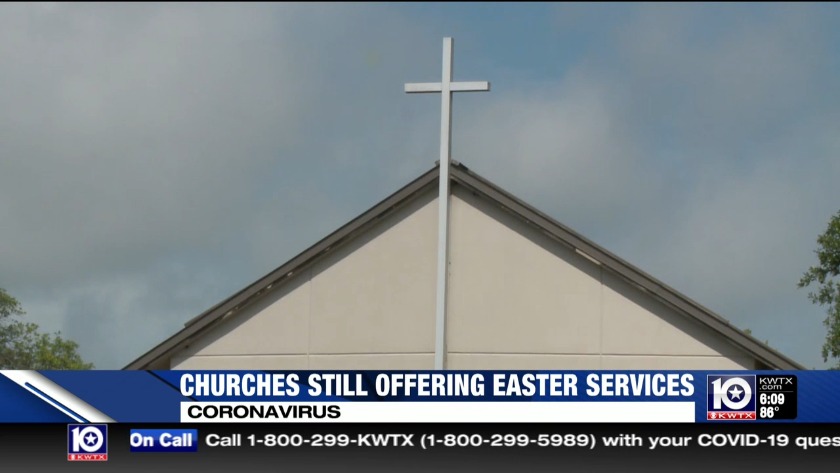
Churches still offering Easter services

A handful of holdout U.S. churches plan to hold in-person services on Easter Sunday, saying their right to worship in person outweighs public health officials’ warnings against holding large gatherings during the coronavirus outbreak.

Most U.S. churches are expected to be closed on Sunday, and a broad majority of observant Americans are expected to follow authorities’ recommendations to avoid crowds to limit the spread of the potentially lethal COVID-19 respiratory disease caused by the new coronavirus.

But not all of them.

“Satan and a virus will not stop us,” said the Reverend Tony Spell, 42, pastor of the evangelical Life Tabernacle Church near Baton Rouge, Louisiana. He expects a crowd of more than 2,000 to gather in worship at his megachurch on Sunday.

“God will shield us from all harm and sickness,” Spell said in an interview. “We are not afraid. We are called by God to stand against the Antichrist creeping into America’s borders. We will spread the Gospel.”

The COVID-19 pandemic has claimed more than 14,700 lives across the United States and infected more than 431,700 people, with officials predicting the worst is yet to come.

Major U.S. religious institutions, including Roman Catholic dioceses and major Protestant denominations, will hold religious services online as well as through local broadcast radio and television, with just a handful of ministers and priests preaching sermons and reading liturgies to rows of empty pews.

Indeed, some major religious-liberty legal advocacy groups, whose mission is to challenge restrictions on freedom of religion, have not raised objections to the closures, saying churches have been treated the same as other major institutions and that safety comes first.

In Idaho, Ammon Bundy, who has led multiple standoffs against authorities in acts of protest against the federal government, plans to gather hundreds of people for an Easter observance, in defiance of public health advice, according to multiple media reports.

Another holdout church, the evangelical Cross Culture Center in Lodi, California, about 70 miles (110 km) southwest of San Francisco, plans another service even after its members found their church doors locked against them last weekend.

Lay preacher Jon Duncan, 43, who has led the evangelical center for more than 10 years, said that under city orders, his landlord changed the locks and shut them out Sunday morning.

Lodi police officers was standing by the door, because they were defying both local and state “stay-at-home” orders and a court order from the San Joaquin County Public Health Services.

Instead, Duncan held brief curbside prayers with his congregants as they showed up for the 11 a.m. service.

“It is disappointing because we have a valid lease, but we won’t be stopped,” he said. “God commands us to meet and that’s what we’re going to do Easter.”

Duncan expects he and his flock of about 80 regular attendees will be locked out on Easter too, so he has picked an alternate site to meet. He and his attorney declined to disclose the new location to the public for fear of becoming a spectacle instead of a holy service.

The church’s attorney, Dean Broyles, has lodged a complaint against the city, and implored California’s governor in a letter to lift the ban on large church gatherings.

Duncan said he is steadfast in his decision.

“We don’t believe our rights are eroded by a virus,” he said. “We will stand together before God even against the gates of hell.”


Pandemic spurs court fights over mail-in voting

https://thehill.com/regulation/court-battles/492135-pandemic-spurs-court-fights-over-mail-in-voting?userid=12325

Pandemic spurs court fights over mail-in voting | TheHill

Election officials are scrambling ahead of the November vote to ramp up alternative methods like mail-in voting as the coronavirus pandemic raises concerns about the safety of in-person voting.

That dash to expand polling options could bring a new wave of court fights around the 2020 election, legal experts say. As states move to bolster balloting options — or face challenges to such plans — both sides in the debate are likely to take those decisions to court.

And when Election Day arrives, questions over the handling of mail-in ballots could lead to more court fights.

“We do not want the election resolved in the courts and so I hope it does not come to that,” said Richard Pildes, a law professor at New York University.

Legal experts say the nightmare scenario would be a situation resembling the Supreme Court’s decision on Bush v. Gore, which was seen as an ideological one that undermined both the legitimacy of the court and the 2000 presidential election results among critics of the decision.

“We know that the current partisan divide over the legitimacy of the U.S. Supreme Court can be timed to the release of the Bush v. Gore decision,” said Charles Stewart, a political science professor and election expert at MIT. “So, we have to be worried both about the legitimacy of the result and the legitimacy of the courts.”

States are hoping to avoid the situation Wisconsin faced this week where widespread in-person voting took place, despite last-minute efforts to avoid that outcome amid a virus that had infected some 2,500 and killed nearly 80 in the state by the Tuesday vote.

“There’s nonstop work being done by election officials to plan for November,” Stewart said.

The hope is that the pandemic will have abated enough to allow for in-person voting, which could be done more safely if early voting is expanded to reduce crowding on Voting Day. But given the fears over inciting a second wave of infections, that may not be advisable by the fall.

All states allow at least some mail-in balloting for select voters. While some states have relatively expansive mail voting systems, others have few provisions.

The fight over expanding voting options has already sparked legal battles. Texas is one of the states that has cases pending in court over efforts to expand mail-in balloting.

Under the current state election rules in Texas, only voters with a “qualifying reason” — advanced age, disability, incarceration or planned travel — can mail in ballots, despite public health guidance to avoid public gatherings. But a lawsuit filed by Texas Democrats ahead of the July primary runoff seeks to have that criteria expanded by including social distancing as a qualifying disability.

Progress toward developing a voting failsafe by November is likely to be uneven among the states given that not all are beginning from the same starting point, and because the push has increasingly become riven by partisan politics.

States that have a head start will be better off, though, experts said.

“States that already have a well-developed vote-by-mail program may well have the capacity to supersize it, and states that don’t may well have the capacity to provide some incremental vote-by-mail capacity,” said Justin Levitt, a professor at Loyola Law School.

“But it will be a herculean task for a state without much vote-by-mail capacity to get to almost everyone voting by mail by November. That takes expertise and systems, equipment and personnel, and the capacity to print a lot more ballots. And it is not easy to get any of those quickly.”

Lorraine Minnite, a political science professor at Rutgers University-Camden, put it even more starkly.

“A large-scale change in procedure hastily administered will likely not run smoothly even under the best of conditions,” she said.

Experts warn that expanded mail-in voting could lead to more voter errors and omissions, create more opportunities for fraud or coercion, and pose special challenges for those who move frequently or lack a permanent address. 

Edward Foley, a law professor at Ohio State University, said that if states are too slow to mail out ballots, litigation could arise from those issues.

“The most likely problem to trigger litigation would be if voters request absentee ballots on time, but election officials because they are overwhelmed with the high volume of absentee ballot requests fail to send the ballots to voters in time for voters to return them by the legally specified deadline,” Foley said.

“This, then, creates a problem of wrongful disenfranchisement of eligible voters, through no fault of the voters but because of the government’s own problems, and requires a court to come up with an appropriate remedy,” he added.

Rick Hasen, a professor of law and political science at the University of California Irvine, said that more courts may be drawn into a battle similar to the one playing out in Texas over whether voting by mail should require a valid excuse.

“There are a number of issues courts may address related to the vote by mail and the coronavirus,” he said. “Do states have to expand ballot deadlines to deal with a flood of absentee ballots? Do voters have a right to be told their absentee ballots have been rejected and given the opportunity to ‘cure’ a problem for rejecting a ballot like a purported signature mismatch?”

According to Levitt, one common thread among states is the urgent need for money to ramp up mail-in operations.

“The single most important piece is funding,” he said. “There are a lot of logistics between here and there, including space and machinery and people to process mail ballots, and that takes money.”  

The more than $2 trillion coronavirus stimulus package included $400 million for states to expand early voting, election by mail and for other election matters.

“The recent funding from Congress is an extremely welcome start, but only barely a start,” he added. “There needs to be much more, and quickly: it does little good to get more funding for this in October.”


Fauci: ‘Looks like’ US deaths will be lower than original projection

Fauci: ‘Looks like’ US deaths will be lower than original projection

Fauci: 'Looks like' US deaths will be lower than original ...

Dr. Anthony Fauci said Wednesday morning that he thinks the number of U.S. deaths from coronavirus will end up being less than the original projection of 100,000 to 200,000. 

Fauci, the government’s top infectious disease expert, attributed the drop to the success of social distancing measures that have directed people to stay home and closed many businesses.

“Although one of the original models projected 100- to 200,000 deaths, as we’re getting more data and seeing the positive effect of mitigation, those numbers are going to be downgraded,” Fauci said on Fox News. “I don’t know exactly what the numbers are going to be, but right now it looks like it’s going to be less than the original projection.”

By the end of March, the White House was projecting 100,000 to 240,000 deaths as America’s best-case scenario for the pandemic.

Centers for Disease Control and Prevention Director Robert Redfield made similar comments on Tuesday, saying he expected the number of deaths to be “much lower” than what was predicted by the models.

A closely watched University of Washington model is now projecting about 60,000 deaths in the U.S. 

Despite some hopeful signs, Fauci emphasized that now is not the time to ease up on social distancing measures, the best way to keep improving the outlook. 

“We’re going to start to see the beginning of a turnaround, so we need to keep pushing on the mitigation strategies because there’s no doubt that that’s having a positive impact,” he said.

“Now’s not the time to pull back at all,” he added. “It’s a time to intensify.”

President Trump has been eager to reopen the economy, and Fauci said planning for that is underway at the White House, where late Tuesday night there was a meeting on the subject in the Roosevelt Room.

“If in fact we are successful it makes sense to at least plan what a reentry into normality would look like,” Fauci said. “That doesn’t mean we’re going to do it right now, but it means we need to be prepared to ease into that. And there’s a lot of activity going on.”


Trump says IG report finding hospital shortages is ‘just wrong’

https://thehill.com/policy/healthcare/491454-trump-says-ig-report-finding-hospital-shortages-is-just-wrong?utm_source=&utm_medium=email&utm_campaign=28856

Hospital Experiences Responding to the COVID-19 Pandemic: Results ...

President Trump on Monday claimed that an inspector general report finding “severe” shortages of supplies at hospitals to fight the novel coronavirus is “just wrong.”

Trump did not provide evidence for why the conclusions of the 34-page report are wrong.

He implied that he is mistrustful of inspectors general more broadly. He recently fired the inspector general of the intelligence community, which has drawn outrage from Democrats.

“Did I hear the word inspector general?” Trump said in response to the reporter’s question about the findings.

“It’s just wrong,” Trump said of the report.

The inspector general report, released earlier Monday, was based on a survey of 323 randomly selected hospitals across the country.

It found “severe” shortages of tests and wait times as long as seven days for hospitals. It also found “widespread” shortfalls of protective equipment such as masks for health workers, something that doctors and nurses have also noted for weeks.

“The level of anxiety among staff is like nothing I’ve ever seen,” one hospital administrator said in the report.

Brett Giroir, an assistant secretary of Health and Human Services, noted that the report’s survey of hospitals was conducted March 23 to March 27. He said testing had improved since then and that it was “quite a long time ago.”

Trump asked who the inspector general of the Department of Health and Human Services is.

“Where did he come from, the inspector general?” Trump said, adding, “What’s his name?”

The office is currently led by Christi Grimm, the principal deputy inspector general.

According to her online biography, Grimm joined the inspector general’s office in 1999. 
Trump said the U.S. has now done more testing than any other country. “We are doing an incredible job on testing,” he said.
He also berated the reporter asking the question, saying testing has been a success.
“You should say, ‘Congratulations. Great job’ instead of being so horrid,” Trump said.
The American Hospital Association (AHA) on Monday said the inspector general report was accurate.

The report “accurately captures the crisis that hospitals and health systems, physicians and nurses on the front lines face of not having enough personal protective equipment (PPE), medical supplies and equipment in their fight against COVID-19,” the AHA said.

https://oig.hhs.gov/oei/reports/oei-06-20-00300.pdf?utm_source=&utm_medium=email&utm_campaign=28856


Wisconsin Election: Voters Find Long Lines and Closed Polling Sites

Wisconsin Election: Voters Find Long Lines and Closed Polling ...

The state is the first to hold a major election with in-person voting since stay-at-home orders were widely instituted because of the coronavirus.

Many voters say they never received the absentee ballots they requested.

  • Wisconsin is the first state to hold a major election with in-person voting despite stay-at-home orders for Americans protecting themselves from the coronavirus.

  • Polls will close at 9 p.m. Eastern time. Long lines have been seen in cities like Milwaukee, which has only five polling places open, and social distancing is a concern.

  • Wisconsin is holding its presidential primary between former Vice President Joseph R. Biden Jr. and Senator Bernie Sanders. Mr. Biden had a strong lead in a recent, widely respected poll.

  • The state’s elections commission has ordered municipal clerks not to release any results until April 13, in compliance with a federal court ruling.

  • Wisconsin Democrats wanted to extend absentee voting and even postpone the election altogether, but Republicans successfully blocked both in court. As a result, Democratic turnout is likely to be depressed because of the virus and the deadlines for absentee voting. A crucial seat on the State Supreme Court is on the ballot.

A morning of voting brings disruption and confusion.

MILWAUKEE — After a morning of voting across Wisconsin, in an election that has drawn derision from public health experts and inflamed partisan tensions, a picture is emerging of long lines, some flaring tempers and a dose of chaos and confusion in the state’s most heavily populated areas.

Voters in Milwaukee, the state’s Democratic base and most populous city, have experienced significant disruptions at polling places. Election workers in the city expected more than 50,000 voters on Tuesday, but the number of polling locations was drastically reduced, from more than 180 to just five. Some voters waited in line for more than two hours, spread out over blocks as they tried to practice social distancing to guard against the coronavirus.

In other parts of the state, especially in smaller communities that tend to be less Democratic, the in-person voting process was running relatively smoothly, with wait times more closely resembling a normal election.

Democratic officials in Wisconsin have lashed out at Republicans, saying they created an atmosphere that amounts to voter suppression with a key statewide Supreme Court race on the ballot. It remains to be seen how the disruptions could affect the Democratic presidential primary contest between Mr. Biden and Mr. Sanders.

Many voters say their absentee ballots never arrived.

Across Wisconsin, would-be voters complained that the absentee ballots they requested had never arrived in the mail, even though figures released by the state seemed to indicate the problem was not widespread.

Representative Gordon Hintz, the Democratic minority leader in the State Assembly, said there may have been a glitch in the system, perhaps because of overwhelmed elections offices. “It appears that people who requested their ballots between March the 20th and 24th, or maybe the 25th, have not received their ballots,” Mr. Hintz said.

Official state figures showed that of 1,282,762 ballots requested, 1,273,374 had been sent, a shortfall of about 9,000.

But Mr. Hintz estimated that hundreds, it not thousands, of voters in his Oshkosh district alone had not received the ballots they asked for, leaving them in a predicament over whether to vote in person and risk contracting or spreading the coronavirus.

One of them was Mr. Hintz himself, who had decided not to vote Tuesday because the ballot he requested on March 22 had not arrived. The Wisconsin Elections Commission’s website says it was mailed to him on March 24.

Roger Luhn, a psychiatrist in Milwaukee, said Tuesday that he was also among the voters who had not received an absentee ballot.

“According to the website, they mailed the ballot to me on March 23,” said Dr. Luhn, who is medical director of a psychiatric hospital. “Yesterday, I gave up. I called the election commission. They put you on extended hold.”

Dr. Luhn said he would not go to the polls on Tuesday out of concern for his family, his patients and his fellow staff members. “There is no good outcome for today’s election,” he said. “No matter what happens, not enough people will have had an opportunity to safely cast their ballots.”

Voters encounter long lines — and social distancing.

The effects of shuttering so many polling sites in Milwaukee were immediately apparent on Tuesday morning: Across the city, lines stretched for blocks even before 7 a.m. local time.

On the South Side of the city, the parking lot of Alexander Hamilton High School was already full as daylight broke. By 8 a.m., more than 300 voters waited in a line that snaked through the parking lot and down the street.

At other locations nearby that would have normally been open for voting, signs were posted directing voters to Hamilton High School. But many of the locations were in heavily immigrant neighborhoods, predominantly Spanish or Hmong, and the only signs posted were in English.

At Marshall High School, in the northern part of Milwaukee, the line stretched for more than three blocks, with voters keeping six feet of space between each other. Most wore masks or other facial coverings.

The northern part of the city, which is predominantly black, has been hit the hardest by the coronavirus. Yet hundreds of voters had already queued by early morning.

The lines weren’t limited to Milwaukee. In Waukesha, a suburb just outside of Milwaukee, only one polling location was open for a city of 70,000. A similarly long line wrapped around a parking lot, as cones denoting a safe distance between voters helped break up the line.

A woman sick with coronavirus is unable to vote.

Hannah Gleeson is a health care worker who lives in Milwaukee, is 17 weeks pregnant and recently tested positive for the coronavirus. She says she has voted in every election she has been eligible for — “I enjoy going in person. I like getting my sticker,” she said — but since contracting the virus she realized that going to a polling place would not be an option.

“I feel like especially right now, when there are so many things that can make you feel hopeless, voting is one of the only things that is still within your power,” Ms. Gleeson, 34, said.

So she requested an absentee ballot a week ago, well within the deadlines set by the state. But she never received one. When she saw that the U.S. Supreme Court had struck down an extension of the deadlines, she called the state elections commission.

“They kind of said, yeah, that really sucks, hopefully you’ll have better luck with the next election,” Ms. Gleeson said. She said that some friends in Milwaukee had also not received ballots: one who made a request on March 26, and another on March 9.

Now, Ms. Gleeson and her husband, who is not showing symptoms but is also isolating himself since Ms. Gleeson is sick, are not able to vote, or at least not able to do so without putting hundreds of people at risk. “I’ve always said that every vote matters, every vote counts, and it’s your one chance to have your voice heard,” she said. “And it’s now something that I really feel has been taken away from me, and my husband as well.”

A missing absentee ballot snaps a 30-year voting streak.

In the city of Oshkosh, where officials have implemented curbside voting, Brian Binder, 49, was one of many Wisconsin voters who reported not receiving the absentee ballots they applied for. Mr. Binder’s wife, who applied at the same time, received hers.

“There’s a large number of people who just did not get them,” said Mr. Binder, an employee of a food packaging company.

As a result of all the confusion and the coronavirus, Mr. Binder said he would not vote in this election, breaking a 30-year streak.

“I vote in every election, local primaries, since I was 18. I’m a person that takes it very seriously, your right and your responsibility to vote. However, given the situation with the virus I’m not sure I want to endanger myself or other people at the polls,” said Mr. Binder, who has been working from home for the past two weeks.

He also expressed frustration with the state’s deeply entrenched political division.

“I feel that this is something they shouldn’t play politics with,” said Mr. Binder, a lifelong Republican who said his support for the party had waned since President Trump’s election. “I don’t know why we couldn’t postpone to keep people safe. I don’t know what the goal was.”

Partisan brawling and a logistical tangle have led to chaos.

Like so much else in Wisconsin over the last decade, the state’s coronavirus response and opinions about moving the election broke along partisan lines.

Democrats, aiming to expand turnout especially in the state’s largest cities, Milwaukee and Madison, sought to expand mail voting and delay the election until June. Republicans, wary of affording new powers to a Democratic governor and content with suppressing turnout in urban centers where the coronavirus has struck hardest, refused to entertain proposals for relief.

“Thousands will wake up and have to choose between exercising their right to vote and staying healthy and safe,” Gov. Tony Evers said Monday after the state’s Supreme Court blocked his effort to postpone the election.

But Dean Knudson, a Republican former state legislator who is chairman of the Wisconsin Elections Commission, said late Monday that voters who wished to participate in Tuesday’s contest would have no recourse but to venture to the polls — even if they had requested but had not yet received an absentee ballot.

“If they haven’t got their ballot in the mail,” he said, “they are going to have to go to the polling place tomorrow.”

Other Republicans have played down the danger to public health of voting during a pandemic. One Republican county chair, Jim Miller of Sawyer County, said the process would be similar to people picking up food to eat during the state’s stay-at-home order.

“If you can go out and get fast food, you can go vote curbside,” Mr. Miller said. “It’s the same procedure.”

Why are Wisconsin Republicans so adamant about holding Tuesday’s elections?

It’s not just a presidential primary on the ballot in Wisconsin. Also at stake is the makeup of the Wisconsin Supreme Court — the very court that struck down Mr. Evers’s effort to delay Tuesday’s elections.

Statewide races in Wisconsin tend to be close, and Supreme Court elections, which come with 10-year terms, are often even closer.

Last year Brian Hagedorn, a conservative judge, defeated a liberal challenger by less than 6,000 votes out of 1.2 million cast. In 2011, another conservative, David T. Prosser Jr., won by 7,000 votes after officials in Waukesha County found 14,000 overlooked ballots the day after the election.

For now, conservatives hold five of seven seats on the officially nonpartisan court. The incumbent in Tuesday’s contest, Justice Daniel Kelly, was appointed to replace Justice Prosser by Gov. Scott Walker in 2016 and is seeking his first full term. He faces Jill Karofsky, a liberal circuit court judge.

President Trump has posted several messages on Twitter endorsing Justice Kelly in recent days.

If Justice Kelly wins, it will cement the conservative majority’s ability to block future Democratic efforts to change the state’s strict voting laws and litigate an expected stalemate over congressional and state legislative boundaries during post-2020 redistricting.

Liberals would need to flip just one of the conservatives’ votes if Judge Karofsky wins. Unless a justice retires or resigns, they would not have an opportunity to win a court majority until the 2023 elections.

Polls will close at 9 p.m. Eastern, but that’s unlikely to be the end of the elections.

Though voting may end on Tuesday night, there will most likely be a new round of lawsuits challenging both the results and the disenfranchisement of many voters. Many allied groups in Wisconsin were already gathering accounts of voters unable to get a ballot or vote in anticipation of litigation.

Adding to the uncertainty, the results themselves will most likely be delayed by almost a full week: The Wisconsin Elections Commission has directed local municipal and county clerks not to release results until next Monday afternoon, in compliance with a federal court ruling.

“Instead of having Iowa-style results where no one knows what to expect, if we stick to this we’re going to have a clean election tomorrow but we’re not going to report the results until the following week,” said Mr. Knudson, the elections commission chairman.


‘We are not immune’: Henry Ford Health says 734 employees positive for COVID-19

https://www.beckershospitalreview.com/workforce/we-are-not-immune-henry-ford-health-says-734-employees-positive-for-covid-19.html?utm_medium=email

Detroit hospital: More than 600 employees tested positive for ...

More than 700 employees of Detroit-based Henry Ford Health System have tested positive for COVID-19, the health system confirmed to Becker’s.

Adnan Munkarah, MD, executive vice president and chief clinical officer, said Henry Ford has tested nearly 2,500 employees since tracking began March 12, and the majority have tested negative. However, as of April 6, 734 employees, or 2.1 percent of the health system’s workforce, have tested positive. Positive cases include employees not working directly on the front lines or those who contracted the virus in the community.

In announcing the update, Dr. Munkarah pointed to the health system’s strict adherence to the use of personal protective equipment during the pandemic, as well as other measures that have been put in place to protect employees and patients. Those measures include a universal mask policy for employees and visitors and the prioritization of testing for employees exhibiting even mild symptoms.

“As a health system caring for a large majority of our region’s COVID-19 patients, we know we are not immune to potential exposure and we remain grateful for the courage and dedication of our entire team,” said Dr. Munkarah.

Michigan is one of the states hardest hit by the pandemic. As of 7:25 a.m. CDT April 7, there were 17,221 confirmed cases of COVID-19 in the state.  


TED Esther Choo. Emergency physician and public health advocate. Life on the medical front lines of the pandemic

https://www.ted.com/about/programs-initiatives/ted-connects-community-hope

Doctors give OHSU's Esther Choo a standing ovation for gender bias ...

Esther Choo is an emergency physician and associate professor at the Oregon Health & Science University. She is a popular science communicator who has used social media to talk about racism and sexism in healthcare. She was the president of the Academy of Women in Academic Emergency Medicine and is a member of the American Association of Women Emergency Physicians.

As the coronavirus pandemic sweeps the globe, it’s hard to know where to turn or what to think. TED Connects is a free, live, daily conversation series featuring experts whose ideas can help us reflect and work through this uncertain time with a sense of responsibility, compassion and wisdom.


Special Report: Doctors embrace drug touted by Trump for COVID-19, without hard evidence it works

https://www.reuters.com/article/us-health-coronavirus-usa-hydroxychloroq/special-report-doctors-embrace-drug-touted-by-trump-for-covid-19-without-hard-evidence-it-works-idUSKBN21O2VO

Special Report: Doctors embrace drug touted by Trump for COVID-19 ...

The decades-old drug that President Donald Trump has persistently promoted as a potential weapon against COVID-19 has within a matter of weeks become a standard of care in areas of the United States hit hard by the pandemic — though doctors prescribing it have no idea whether it works.

Doctors and pharmacists from more than half a dozen large healthcare systems in New York, Louisiana, Massachusetts, Ohio, Washington and California told Reuters they are routinely using hydroxychloroquine on patients hospitalized with COVID-19. At the same time, several said they have seen no evidence that the drug, used for years to treat malaria and autoimmune disorders, has any effect on the virus.

Use of hydroxychloroquine has soared as the United States has quickly become the epicenter of the pandemic. More than 355,000 people in the United States have tested positive for the novel coronavirus, and more than 10,000 have died. The federal government estimates that as many as 240,000 people in the country may die from the disease before the outbreak is over.

Facing those numbers, and in the absence of any known effective treatments, doctors on the frontlines said they began using hydroxychloroquine and the related chloroquine on patients who are deteriorating based on a few small studies suggesting a possible benefit. Some said they had come under pressure from patients to use the therapies widely touted by Trump and other supporters.

“I may take it,” Trump said on Saturday, referring to hydroxychloroquine, though he has twice tested negative for coronavirus, according to the White House. “We’re just hearing really positive stories, and we’re continuing to collect the data.”

Potential side effects of hydroxychloroquine include vision loss and heart problems. But doctors interviewed by Reuters say they are comfortable prescribing the drug for a short course of several days for coronavirus patients because the risks are relatively low and the therapies are inexpensive and generally available.

However, protocols directing how these drugs should be used vary from one hospital to another, including when to introduce them and whether to combine them with other drugs. In addition, some studies showing promise involve patients who took the therapies for mild or early-stage illness. Many of those people are likely to recover from the virus on their own.

Patients admitted to the hospital in the United States are generally much sicker than the mildly ill cases cited in such studies when they receive therapy. These factors, doctors said, have made it difficult for them to determine whether the drugs are making a difference. “I have seen hundreds of patients with severe COVID and most of these people are on hydroxychloroquine,” Dr Mangala Narasimhan, regional director of critical care at Northwell Health, a 23-hospital system in New York, said in an email. “In my opinion, although it is very early, I do not see a dramatic improvement from the hydroxychloroquine in these patients.” Dr Daniel McQuillen, an infectious disease specialist at Lahey Hospital & Medical Center in Burlington, Massachusetts, said he has prescribed a course of hydroxychloroquine for about 30 COVID-19 patients so far because the drug has shown “a little bit of antiviral activity.” But he has not seen “marked improvement for patients.”

“Anecdotally, it may have had limited effect in patients with milder disease,” McQuillen said. The therapy “has had no effect in limiting or slowing progression of our patients that have been at or near ICU level when they arrived.”

‘SEE WHAT STICKS’

The experience of David Lat, a legal recruiter and commentator who founded the blog Above the Law, reflects the mixture of hope and uncertainty surrounding the drugs now being pursued as possible coronavirus treatments.

Since early March, the 44-year-old New Yorker has chronicled his near-fatal infection with coronavirus in social media posts followed by thousands of people. Lat’s case has resonated with a U.S. audience that has begun to recognize the risk that coronavirus poses not only to elderly patients with serious medical conditions, but also to generally healthy younger adults.

After more than a week of worsening symptoms, Lat was admitted to NYU Langone Medical Center on March 16 and later placed on a ventilator. On March 28, he shared on Facebook that his doctors had taken him off of the ventilator and had moved him out of intensive care after his condition improved dramatically.

In an exchange of text messages with Reuters, Lat said he was treated with hydroxychloroquine and the antibiotic azithromycin. He also received the experimental therapy clazakizumab, which aims to regulate an overreaction by the body’s immune system thought to trigger the respiratory distress seen in severe COVID-19. After the story was published, Lat clarified that he received a fourth therapy, the antiviral Kaletra, not Kevzara, as he had initially recalled.

“The doctors haven’t concluded what caused my recovery,” Lat said. “The state of coronavirus research is very much ‘throw stuff against a wall and see what sticks’ – but when something does stick, in terms of a good patient outcome, you’re not sure what stuck.” Lat’s doctors were not immediately available to comment on his treatment.

Some doctors have been vocal in advocating the drug. Dr Vladimir Zelenko, a general practitioner in upstate New York, has claimed that a three-drug cocktail of hydroxychloroquine, azithromycin and zinc sulfate has helped mitigate the infection in nearly 200 hundred of his patients before they became sick enough to require hospitalization. His recommendations have attracted the attention of Trump’s supporters. Zelenko wasn’t immediately available for comment.

Despite such encouraging reports, hard evidence that any of the therapies now under study will work is weeks and possibly months way.

Early, but mixed, data has emerged from COVID-19 trials of the malaria drugs in China. A research team in Marseilles, France, has published data showing that out of 80 mild COVID-19 patients treated with hydroxychloroquine and azithromycin, 93 percent had no detectable levels of the virus after eight days.

Doctors have questioned the value of the Marseille study and several papers from China as being too small or poorly designed to offer hard evidence of benefit. Most do not compare outcomes of patients who received the malaria therapies with people who did not, considered the most reliable measure of a drug’s effectiveness. Last week, doctors in Paris reported that they tried to replicate the results of the Marseille study and failed. Results from a trial conducted in Wuhan, China, were released that included a control group of patients who did not receive the anti-malarial therapy for comparison. But critics questioned why information on the trial’s main goal — detecting viral load — was not disclosed, and said data was missing for some patients. More rigorous U.S.-led trials are now underway. But most focus on whether the drugs can help prevent illness in people exposed to the coronavirus, such as healthcare workers or relatives of confirmed patients, and not people who are already sick. Randomized, controlled trials of the drugs are being conducted in other countries, including China, Brazil and Norway.

Until the evidence is in, “each institution is setting their own treatment guidelines,” said Dr Otto Yang, an infectious disease specialist at the University of California, Los Angeles Medical Center. “There is simply no data,” he said. “It is a matter of opinion, and opinions differ.”

GAME-CHANGER?

Trump is deeply invested in the idea that the malaria drugs will show a benefit, and personally pressured federal health officials to make them available, Reuters reported on Saturday. The president announced on Twitter last month that hydroxychloroquine, when combined with azithromycin, has the potential to become “one of the biggest game changers in the history of medicine.”


New Zealand isn’t just flattening the curve. It’s squashing it.

https://www.washingtonpost.com/world/asia_pacific/new-zealand-isnt-just-flattening-the-curve-its-squashing-it/2020/04/07/6cab3a4a-7822-11ea-a311-adb1344719a9_story.html?fbclid=IwAR0G_nNMxXlu82cnEElI4E3napU5ug5XyMQqeiFyhfl0Cx_aIH4K91GwdUY&utm_campaign=wp_main&utm_medium=social&utm_source=facebook

New Zealand isn't just flattening the curve. It's squashing it. #1 ...

 It’s been less than two weeks since New Zealand imposed a coronavirus lockdown so strict that swimming at the beach and hunting in bushland were banned. They’re not essential activities, plus we’ve been told not to do anything that could divert emergency services’ resources.

People have been walking and biking strictly in their neighborhoods, lining up six feet apart while waiting to go one-in-one-out into grocery stores, and joining swaths of the world in discovering the vagaries of home schooling.

It took only 10 days for signs that the approach here — “elimination” rather than the “containment” goal of the United States and other Western countries — is working.

The number of new cases has fallen for two consecutive days, despite a huge increase in testing, with 54 confirmed or probable cases reported Tuesday. That means the number of people who have recovered, 65, exceeds the number of daily infections.

“The signs are promising,” Ashley Bloomfield, the director-general of health, said Tuesday.

The speedy results have led to calls to ease the lockdown conditions, even a little, for the four-day Easter holiday, especially as summer lingers on.

But Prime Minister Jacinda Ardern is adamant that New Zealand will complete four weeks of lockdown — two full 14-day incubation cycles — before letting up. She has, however, given the Easter Bunny special dispensation to work this weekend.

How has New Zealand, a country I still call home after 20 years abroad, controlled its outbreak so quickly?

When I arrived here a month ago, traveling from the epicenter of China via the hotspot of South Korea, I was shocked that officials did not take my temperature at the airport. I was told simply to self-isolate for 14 days (I did).

But with the coronavirus tearing through Italy and spreading in the United States, this heavily tourism-reliant country — it gets about four million international visitors a year, almost as many as its total population — did the previously unthinkable: it shut its borders to foreigners on March 19.

Two days later, Ardern delivered a televised address from her office — the first time since 1982 that an Oval Office-style speech had been given — announcing a coronavirus response alert plan involving four stages, with full lockdown being Level 4.

A group of influential leaders got on the phone with her the following day to urge moving to Level 4.

“We were hugely worried about what was happening in Italy and Spain,” said one of them, Stephen Tindall, founder of the Warehouse, New Zealand’s largest retailer.

“If we didn’t shut down quickly enough, the pain was going to go on for a very long time,” he said in a phone interview. “It’s inevitable that we will have to shut down anyway, so we would rather it be sharp and short.”

On the Monday, March 23, Ardern delivered another statement and gave the country 48 hours to prepare for a Level 4 lockdown. “We currently have 102 cases,” she said. “But so did Italy once.”

From that Wednesday night, everyone had to stay at home for four weeks unless they worked in an essential job such as health care, or were going to the supermarket or exercising near their home.

There have been critics and rebels. The police have been ordering surfers out of the waves. The health minister was caught — and publicly chastised by Ardern, who said she would have fired him if it weren’t disruptive to the crisis response — for mountain biking and taking his family to the beach.

But there has been a sense of collective purpose. The police phone line for nonemergencies has been overwhelmed with people calling to “dob in,” as we say here, others they think are breaching the rules.

The response has been notably apolitical. The center-right National Party has clearly made a decision not to criticize the government’s response, and in fact to help it.

These efforts appear to be paying off.

After peaking at 89 on April 2, the daily number of new cases ticked down to 67 on Monday and 54 on Tuesday. The vast majority of cases can be linked to international travel, making contact tracing relatively easy, and many are consolidated into identifiable clusters.

Because there is little evidence of community transmission, New Zealand does not have huge numbers of people overwhelming hospitals. Only one person, an elderly woman with existing health problems, has died.

The nascent slowdown reflected “a triumph of science and leadership,” said Michael Baker, a professor of public health at the University of Otago and one of the country’s top epidemiologists.

“Jacinda approached this decisively and unequivocally and faced the threat,” said Baker, who had been advocating for an “elimination” approach since reading a World Health Organization report from China in February.

“Other countries have had a gradual ramp-up, but our approach is exactly the opposite,” he said. While other Western countries have tried to slow the disease and “flatten the curve,” New Zealand has tried to stamp it out entirely.

Some American doctors have urged the Trump administration to pursue the elimination approach.

In New Zealand’s case, being a small island nation makes it easy to shut borders. It also helps that the country often feels like a village where everyone knows everyone else, so messages can travel quickly.

New Zealand’s next challenge: Once the virus is eliminated, how to keep it that way.

The country won’t be able to allow people free entry into New Zealand until the virus has stopped circulating globally or a vaccine has been developed, said Baker. But with strict border control, restrictions could be gradually relaxed and life inside New Zealand could return to almost normal.

Ardern has said her government is considering mandatory quarantine for New Zealanders returning to the country post-lockdown. “I really want a watertight system at our border,” she said this week, “and I think we can do better on that.”