Henry Ford Health to furlough 2,800 workers

https://www.beckershospitalreview.com/finance/henry-ford-health-to-furlough-2-800-workers.html?utm_medium=email

Henry Ford furloughing 2,800 employees due to COVD-19 financial ...

Financial damage from the COVID-19 pandemic is forcing Detroit-based Henry Ford Health System to furlough 2,800 workers, the health system announced April 22. 

The six-hospital system decided to furlough employees who are not directly involved in patient care after recording a $43 million loss in operating income in March due to the cancellation of elective procedures, temporary site closures, and expenses related to personal protective equipment and other supplies needed to care for COVID-19 patients. The health system expects more significant losses in April and May.

“I know that news concerning furloughs is painful — especially for an organization like ours, whose greatest strength has always been our people,” Henry Ford President and CEO Wright Lassiter III wrote in an email to employees. “We value each team member’s unique contribution and this decision does not change that. But, we must face these realities head on.”

In addition to the furloughs, the health system’s executives and senior leaders will begin contributing 10 percent to 25 percent of their salaries to funds created to support employees.

Henry Ford Health reported a net operating loss of $36.2 million for the first three months of this year, compared to operating income of $39.4 million in the same period of 2019. 


Mayo Clinic furloughs, cuts hours of 30,000 employees to help offset $3B in pandemic losses

https://www.beckershospitalreview.com/finance/mayo-clinic-furloughs-cuts-hours-of-30-000-employees-to-help-offset-3b-in-pandemic-losses.html?utm_medium=email

Information for Orlando Residents - Orlando - Mayo Clinic

Rochester, Minn.-based Mayo Clinic said it will furlough or cut the hours of about 30,000 staff members to help offset about $3 billion in losses incurred by the COVID-19 pandemic, according to The Post Bulletin.

Mayo Clinic announced that it would need to take several cost cutting measures, including furloughs, earlier in April. However, the system didn’t disclose the number of employees that would be affected.

The temporary reduction in workforce is one of the ways the system is working to offset a $3 billion loss from the pandemic. Even with the cost-cutting measures, Mayo anticipates a $900 million shortfall this year.

The furloughs or reduced hours affect about 42 percent of Mayo Clinic’s 70,000 employees across its campuses in Arizona, Florida and Minnesota. 

Affected employees will still receive healthcare benefits.

The furloughs will begin in May and be spread throughout the rest of the year, Mayo Clinic spokesperson Ginger Plumbo told the publication. The duration of the furlough will vary depending on the hospital unit, she added.

The furloughs will not affect physicians at the system, but physicians will receive a 10 percent wage reduction. In addition, senior managers will receive pay cuts of 15 percent and top executives will take a 20 percent reduction.

The furloughs, cut hours and wage reductions are expected to save $1.4 billion.

Mayo Clinic also has been taking other cost-cutting measures, including a hiring freeze and halting major construction projects.

Mayo Clinic is also tapping into its reserves to bring $900 million in cash to the system.


Operating margins plummet at US hospitals, Kaufman Hall says

https://www.healthcaredive.com/news/Kaufman-hospitals-operating-margin-decline/576491/

Third Quarter Investment Report: Moving Into Choppy Waters « CPEA ...

Dive Brief:

  • Operating margins at the nation’s hospitals have plummeted due to large-scale volume and revenue declines coupled with flat to rising expenses, according to a new report from Kaufman Hall.
  • Based on March data from more than 800 U.S. hospitals, average operating margins dropped 150% year over year, plunging non-profit hospitals, which historically operate on already thin margins, into troublesome territory.
  • The data paint a dire picture for U.S. hospitals. “These initial numbers only reflect the first two weeks of the COVID-19 response and likely indicate more negative results in the future,” Jim Blake, managing director at Kaufman Hall, said in a statement.

Dive Insight:

Hospitals depend heavily on elective surgeries for revenue, but had to cancel or postpone many of them starting last month in order to preserve coveted COVID-19 resources such as personal protective equipment, beds and staff.

Those measures have upended the financial health of the entire industry in a matter of just weeks, according to new data and analysis from Kaufman Hall.

“We anticipate April will be significantly worse, and at this point, no one knows how long hospitals will continue on their current path,” Blake said.

Despite the ongoing pandemic, patient volumes overall have plunged. During March, the median hospital occupancy rate was 53%, with operating room minutes down 20% year-over-year and emergency room visits down 15% year over year, according to the report.

At the same time, hospitals’ labor expenses were up 3% year over year, and non-labor expenses were up 1%. In order to rein in operating costs, some health systems have begun to furlough or lay off workers.

While non-profit systems are especially vulnerable given their razor-thin margins, major for-profit systems are also struggling financially.

HCA Healthcare, Community Health Systems and Tenet Healthcare have all pulled their 2020 guidance in response to the pandemic. In its first quarter report Tuesday, HCA attributed a steep decrease in volumes and 45% drop in profit to the pandemic.

And Jefferies analyst wrote in a note Tuesday they are reducing their volume and earnings expectations for those companies for this year and 2021 based on the pandemic. “Our belief is that high unemployment translates to reduced commercial insurance coverage and disposable income to fund co-pays/deductibles, which results in fewer physician visits and procedures,” they wrote.

Under these circumstances, the federal government has attempted to financially support struggling hospitals through ongoing coronavirus relief legislation.

First came accelerated Medicare payments based on reimbursement data, in the form of loans that providers will have to pay back.

Separately, the Coronavirus Aid, Relief, and Economic Security Act passed by Congress in March benchmarked $100 billion in funding to provide financial support to struggling hospitals.

$30 billion first round was announced April 8 and given to providers based on historic Medicare payments. A second round of CARES act funding for systems in hot spots is next, although the timing is unclear.

On Tuesday the Senate approved a separate $484 billion aid package, the Paycheck Protection Program and Health Care Enhancement Act, that would send an additional $75 billion in emergency funds to hospitals. It also allocates $25 billion to expand testing for the virus across the country.

The White House expressed support for the package. It still needs House approval, which could happen as soon as this week.

The latest package comes in response to depleted funding for the Small Business Administration’s Paycheck Protection Program. Upon replenishing those funds, smaller health systems may be eligible for forgivable PPP loans used to meet payroll and other operating costs, but only if they have 500 or fewer employees.


Health Care Workers Stand Up To People Protesting Stay-At-Home Orders

https://nowthisnews.com/news/health-care-workers-stand-up-to-people-protesting-stay-at-home-orders

View image on Twitter

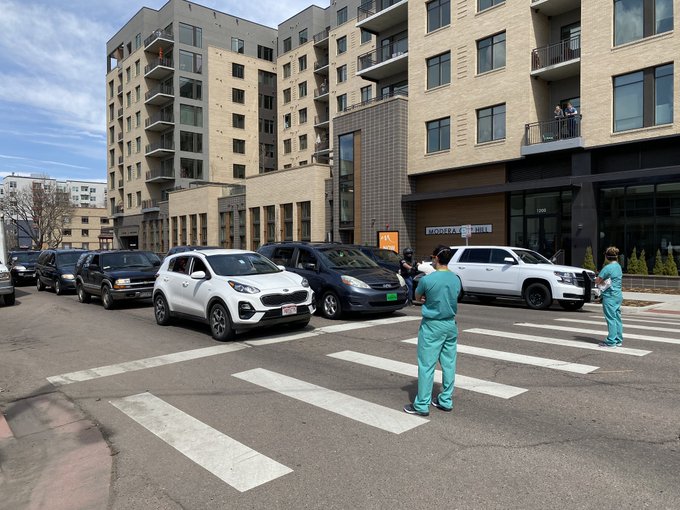
Remarkable scene at 12th and Grant, where two healthcare workers from a Denver-area hospital — they declined to say which or give their names — are standing in the crosswalk during red lights as a “reminder,” they say, of why shutdown measures are in place.

Two health care workers blocked a parade of protesters in Denver, Colorado on Sunday, who were storming the capitol to protest the state’s stay-at-home order.

Powerful images and videos of the standoff were widely shared on social media of the two unidentified people wearing scrubs and N95 masks, standing in a crosswalk blocking protesters’ vehicles. The two were identified as health care workers by photographers on the scene. 

One video shared by Twitter user Marc Zenn, captured cars lined up and beeping their horns at the two medical workers, with a woman hanging out of her vehicle’s window shouting “Go to China if you want communism. Go to China,” and “You get to go to work, why can’t we?”

View image on Twitter

They say they’ve been treating COVID patients for weeks. Today most of the people driving by have been “very aggressive,” they say. I’ve been standing here for a few minutes and already seen two people get in their faces.

Hundreds of people showed up on foot and in their vehicles for two separate protests in Colorado’s capitol on Sunday. The protests were reportedly planned by ReOpen Colorado and “various Libertarian parties,” according to a local Denver news outlet. People attending the march were shown carrying American flags, “Don’t Tread on Me” flags, and signs about reopening businesses and schools.

“Coloradans have a first amendment right to protest and to free speech, and the Governor hopes that they are using social distancing and staying safe,” Colorado Gov. Jared Polis’ office said in a statement. “No one wants to reopen Colorado businesses and lift these restrictions more than the Governor, but in order to do that, Coloradans have to stay home as much as possible during this critical period, wear masks and wash their hands regularly to slow the spread of this deadly virus.”

As of Monday morning, Colorado has more than 9,700 cases of COVID-19, leading to at least 420 deaths, according to the Johns Hopkins coronavirus tracker. The state of Colorado is set to continue its stay-at-home order until at least April 26, to slow the transmission of the virus.  

Colorado isn’t the only state where protesters are demonstrating against their government’s stay-at-home orders—Several other states held protests over the weekend including Utah, Idaho, and Washington state. Last week, parts of Michigan, New York, Ohio, Virginia, North Carolina, and others also saw a wave of demonstrators

President Trump encouraged the protesters last week during his Friday press briefing and in tweets which said to “liberate” multiple states holding protests.

In a Politico poll, 81% of Americans agreed we “should continue to social distance for as long as is needed to curb the spread of coronavirus, even if it means continued damage to the economy.” An NBC News poll found that 60% of responders agreed with keeping at-home restrictions.


Cartoon – Job Opportunity

Political Cartoon: “Overheard In The Unemployment Line” by Joel ...

What is work sharing and how can it help the labor market?

https://www.brookings.edu/blog/up-front/2020/04/16/what-is-work-sharing-and-how-can-it-help-the-labor-market/?utm_campaign=Brookings%20Brief&utm_source=hs_email&utm_medium=email&utm_content=86505163

What is work sharing and how can it help the labor market?

When economic conditions worsen, as they did beginning in March 2020 because of the COVID-19 pandemic, employers often respond by laying off their employees. This can lead to very undesirable outcomes for society at large. Research shows that losing a job often causes decreased long-term earnings, health problems, and other adverse outcomes, the effects of which can last generations (Abraham and Houseman 2014). Layoffs create future costs for employers as well—once demand picks back up, firms will have to expend valuable resources on significant search, hiring, and training costs.

The U.S. unemployment insurance (UI) system can help. Its core function is to replace some of the earnings of workers who have lost their jobs, helping them to stay afloat during tough economic times. But the UI system can also support workers and employers as they reduce, rather than eliminate, employees’ work hours.

WHAT IS WORK SHARING?

A program called work sharing, or short-time compensation, encourages employers to temporarily reduce the hours of their employees rather than lay them off during an economic downturn. Work sharing allows employers to keep their skilled workforce and reestablish a full-time schedule when economic conditions improve. With this approach, employees continue to be paid for the hours they work, collecting pro-rated unemployment benefits that help cover the work hours they lose. For example, employers could reduce everyone’s hours by 20 percent and employees would qualify for 20 percent of the weekly unemployment benefit amount.

In a Hamilton Project proposal, economists Katharine Abraham and Susan Houseman described reforms that would facilitate the use of work sharing. The importance of these reforms for addressing the current economic downturn was discussed further in a recent webcast titled, “Unemployment Insurance during the COVID-19 Pandemic: Reducing the Impact of this Economic Downturn.”

WHAT IS THE RATIONALE FOR WORK SHARING? HOW MANY JOBS COULD IT SAVE?

Work sharing provides employers a way to respond to a decrease in demand by cutting back on hours rather than laying workers off. This approach maintains employer-employee connections, minimizing layoffs and supporting workers who have their hours reduced. Work sharing can be particularly helpful when the drop in demand is expected to be temporary, as many think likely for this pandemic-caused recession.

The value of preserving relationships between employers and employees is twofold. First, it can avoid huge spikes in permanent job losses that are financially ruinous for many families. Workers continue their employment, albeit with reduced hours, and avoid many of the damaging effects of losing a job (like loss of health insurance coverage). Second, both employers and workers will avoid costly search, hiring, and training once demand eventually picks back up.

Throughout the Great Recession, when only 17 states offered the option, use of work-sharing was very limited. Abraham and Houseman estimate that if work sharing had been available for the entire country during the Great Recession—and take-up rates had been similar to our European counterparts—work-sharing programs could have saved up to 1 million jobs, or 1 in 8 of the net jobs that were lost during the Great Recession.

HOW WIDESPREAD ARE WORK-SHARING PROGRAMS?

Today, 26 states, covering nearly 70 percent of the workforce, have operational work-sharing programs in place. But work sharing has been little used in the earliest days of this recession. As of the week ending in March 28, just 0.3 percent of the more than 8.2 million people claiming UI benefits received work-sharing benefits.

To expand coverage, Abraham and Houseman propose that Congress pass legislation that requires states to have a work-sharing program as a part of their UI system to participate in the federal–state UI system. Further, in order to encourage state take-up, they propose that the U.S. Department of Labor modify its funding formula to more accurately fund state administrative burdens associated with implementing and promoting work-sharing programs.

WHAT ELSE CAN BE DONE TO MAKE IT EASY FOR EMPLOYERS TO USE THE PROGRAM?

First, states could look for opportunities to expedite the process of starting up a work-sharing plan and paying benefits. Second, states could remove policies that tend to discourage the use of work sharing and push employers toward layoffs. For example, some states bar employers who have heavily used the UI system in the past from participating in work-sharing programs. Additionally, some states impose higher effective UI tax rates on employers who choose work-share programs than if they laid off their workers. Designed to prevent abuse of the UI system, these policies may discourage work sharing, especially during downturns. Abraham and Houseman recommend that Congress add a prohibition against the use of these policies to the existing criteria for state eligibility to participate in the federal–state UI system.

HOW CAN WORK-SHARING PROGRAMS BE FURTHER INCORPORATED INTO THE EXISTING UI SYSTEM?

Under current law, sharp increases in a state’s unemployment rate trigger extensions to the benefits available in that state; the federal government covers half the cost of those extensions. That same federal-state program could enhance the use of work sharing. Abraham and Houseman propose that the federal government cover half the cost of work-sharing programs when UI extended benefits are triggered in a state. As explained below, Congress has recently gone beyond this proposal, but only on a temporary basis.

HOW IS WORK SHARING ADDRESSED IN THE CORONAVIRUS AID, RELIEF, AND ECONOMIC SECURITY ACT (CARES ACT)?

The CARES Act, signed into law on March 25, 2020, encourages states and employers to use work-sharing programs. The federal government will reimburse 100 percent of the cost of short-time compensation benefits paid in states that have work-sharing programs in place. For those states that do not have a work-sharing program, the CARES act includes funds to pay for short-time benefits at a 50 percent federal coverage rate. Finally, the CARES Act allocates grant funding for states to promote and improve the implementation and administration of work-sharing programs.


These Charts Put the Historic U.S. Job Losses in Perspective

These Charts Put the Historic U.S. Job Losses in Perspective

These Charts Put the Historic U.S. Job Losses in Perspective

These Charts Put the Historic U.S. Job Losses in Perspective

When recessions hit, it’s not unusual to see millions of jobs lost.

Such episodes are a regular part of the business cycle and when they occur, most businesses do their best to tough things out. Then, as time progresses, it gradually becomes clear that spending must be curtailed, budget cuts must be made, and workers must unfortunately be sent home.

This economic process normally takes months, or even years, to unwind.

But, the COVID-19 pandemic has thrown a wrench into the economic status quo, creating a situation that is incomparable to any previous downturn. Instead of a gradual economic transition to slower growth prospects, business operations have suddenly screeched to a halt with no clear window to resume.

Beyond Comparison

The Great Lockdown of the economy has been completely unprecedented, both in terms of the speed of the shutdown and its impact on jobs.

As a result, the statistics being released are completely surreal. Perhaps the best example of this is number for initial jobless claims in the U.S., which tops 22 million over the last four weeks.

Worst U.S. Job Losses on Record (Four Week Period)

Year Description Peak Jobless claims (4-wk total) % of U.S. Population
1975 Stagflation 2.24 million 1.0%
1980 Fed tightening (Volcker) 2.52 million 1.1%
1982 Double-dip recession 2.70 million 1.2%
1991 Early 1990s recession 2.00 million 0.8%
2001 Dotcom Bust 1.96 million 0.7%
2009 Great Recession 2.64 million 0.9%
2020 The Great Lockdown 22.03 million 6.7%

As you can see above, the number is 10x higher than many of the worst four-week job losses on record, so historical comparisons don’t come close.

In other words, if you were using recent recessions as a potential barometer of how bad things could get for jobless claims, the numbers coming from COVID-19 crisis just blew up your model.

The Recession Time Machine

To get further context on the numbers above, it’s worth jumping in a time machine to revisit what happened to job numbers in previous recessions:

  • Stagflation and Oil Shocks (1973-75)
    This recession put an end to the Post WWII global economic expansion, and was characterized by the 1973 oil embargo, the aftermath of the Nixon Shock, and the collapse of the Bretton Woods system of international finance. Unemployment and inflation were both high (stagflation), and the unemployment rate in the U.S. reached 9.0% in May 1975.
  • The Double-Dip Recession (1980, 1981-1982)
    This “W-shaped” recession saw economic contraction first in 1980, only to return again in 1981. This corresponded with the Iranian Revolution, as well as Fed chair Paul Volcker’s aggressive policy to rein in inflation with high interest rates. Unemployment peaked at 10.8% in 1982 — the highest rate seen since the Great Depression.
  • The Great Recession (2009)
    The most recent recession in memory peaked with 10.0% in unemployment in October 2009. It took until 2016 for unemployment to fall back to pre-recession levels.

Finally, it’s worth noting that during the Great Depression (1929-1933), unemployment reached a historic high of 24.9%. To get to a comparable equivalent in modern times, there would need to be 41 million Americans out of work permanently.

Room for Optimism

Although the initial jobless claims are staggering and clearly without modern precedent, there is a case to be made for cautious optimism.

Many of the aforementioned recessions took months or years to culminate, with peak job losses occurring at the tail end of each recession. The current crisis, now being called “The Great Lockdown”, caused many businesses to shut doors suddenly and against their will. It also corresponded with unexpected closures of national borders and the halting of regular trade activity around the world.

When and if normal economic activity resumes, it’ll be interesting to see how much of the damage is temporary.


Beginning the long, winding journey back from coronavirus

https://mailchi.mp/39947afa50d2/the-weekly-gist-april-17-2020?e=d1e747d2d8

45cat - The Beatles - The Long And Winding Road / For You Blue ...

It was another brutal week in the coronavirus pandemic, with more than 2.1M cases and nearly 150,000 deaths worldwide. The US continued to be the hardest-hit country, reaching a daily record 4,591 deaths from COVID-19 on Thursday. The national death toll is now more than 35,000, though there are signs that the number of new cases in the US has begun to plateau, raising hopes that the worst days may be drawing to a close. Meanwhile, with strict stay-at-home measures continuing in most places across the country, the economic toll of the virus mounted. New unemployment claims rose by another 5.2M, bringing the estimated number of American jobs claimed by the virus to 22M, eliminating a decade’s worth of job growth, and raising the unemployment rate to an estimated 17 percent.

As the growth in new cases flattened, attention turned this week to plans to “reopen” the American economy. Despite insisting early in the week that he alone would decide when and how to reopen the country, President Trump yesterday unveiled a set of non-binding, “Opening Up America Again” guidelines for state and local officials to use in judging when to loosen restrictions. The guidelines suggest a three-stage, gated approach, gradually allowing individuals and employers to return to normal activities based on criteria including disease trends, hospital capacity, and the availability of robust testing. Progressing from one stage to the next is predicated on maintaining a downward trajectory in new cases—with any signs of a resurgence indicating a need to reimpose restrictions.

Missing from the White House plan are specific details about how states, cities, and healthcare providers are to procure and pay for the many millions of tests and extensive contact tracing that will need to be available to allow businesses, public transport systems, and other essential services to resume activity. By week’s end, about 3.5M coronavirus tests had been conducted nationally, but the daily number of tests conducted has plateaued, and the test-positivity rate is still troublingly high. Public health experts continue to warn that testing must ramp up significantly before any steps toward reopening can be considered, a difficult challenge given widespread reports of shortages of testing supplies and trained lab technicians. To bolster testing capacity, the Centers for Medicare and Medicaid Services (CMS) this week nearly doubled the amount it will pay laboratories to analyze tests using high-throughput equipment.

Three coalitions of states—in the Northeast, Midwest, and West Coast—were formed this week to coordinate regional efforts to reopen the economy. Among the issues they’ll need to address: interstate travel restrictions, coordinated purchasing of critical supplies, investments in contact tracing capabilities, and ongoing surveillance of the virus’ spread. With federal agencies taking a back seat to states (“You are going to call your own shots,” the President told governors on a call this week), it became clear that the road back from the coronavirus pandemic will be circuitous, with a patchwork of different timelines and approaches in different locations based on local conditions and resources.

In the words of William Gibson, “The future is here—it’s just not very evenly distributed.”