


Cartoon – Leadership by Words


It’s open enrollment season again. From now through Dec. 7, about 65 million Americans are facing the annual question of which Medicare options will give them the best health coverage. An onslaught of television and radio ads, emailed promotions, texts and mailers serve as reminders, though not necessarily clarifying ones.
“It’s a very consequential decision, and the most important thing is to be informed,” said Jeannie Fuglesten Biniek, a senior policy analyst at the Kaiser Family Foundation and a co-author of a recent literature review comparing Medicare Advantage and traditional Medicare.
If you are navigating this decision for yourself or for a loved one, here are some of the important factors to consider.
Medicare — the federally funded health care program — has been in place since 1965. Since then, an expanding array of Medicare Advantage plans have become available. For 2023, the typical beneficiary can choose from 43 Advantage plans, the Kaiser Family Foundation has reported.
Medicare Advantage plans, like traditional Medicare, are funded by the federal government, but they are offered though private insurance companies, which receive a set payment for each enrollee. The idea is to help control costs by allowing these insurers, who must cover the same services as traditional Medicare, to keep some of the federal payment as profit if they can provide care less expensively.
The biggest providers of Advantage plans are Humana and United Healthcare, and they and others market aggressively to persuade seniors to sign up or switch plans. A new U.S. Senate report found that some of these Advantage plan practices are deceptive; for example, some marketing firms sent Medicare beneficiaries mailers made to look like government websites or letters. This has confused many seniors, and Medicare officials have promised to increased policing.
But the marketing has paid off for insurers. The proportion of eligible Medicare beneficiaries enrolled in Medicare Advantage plans has hit 48 percent. By next year, most beneficiaries will likely be Advantage enrollees.
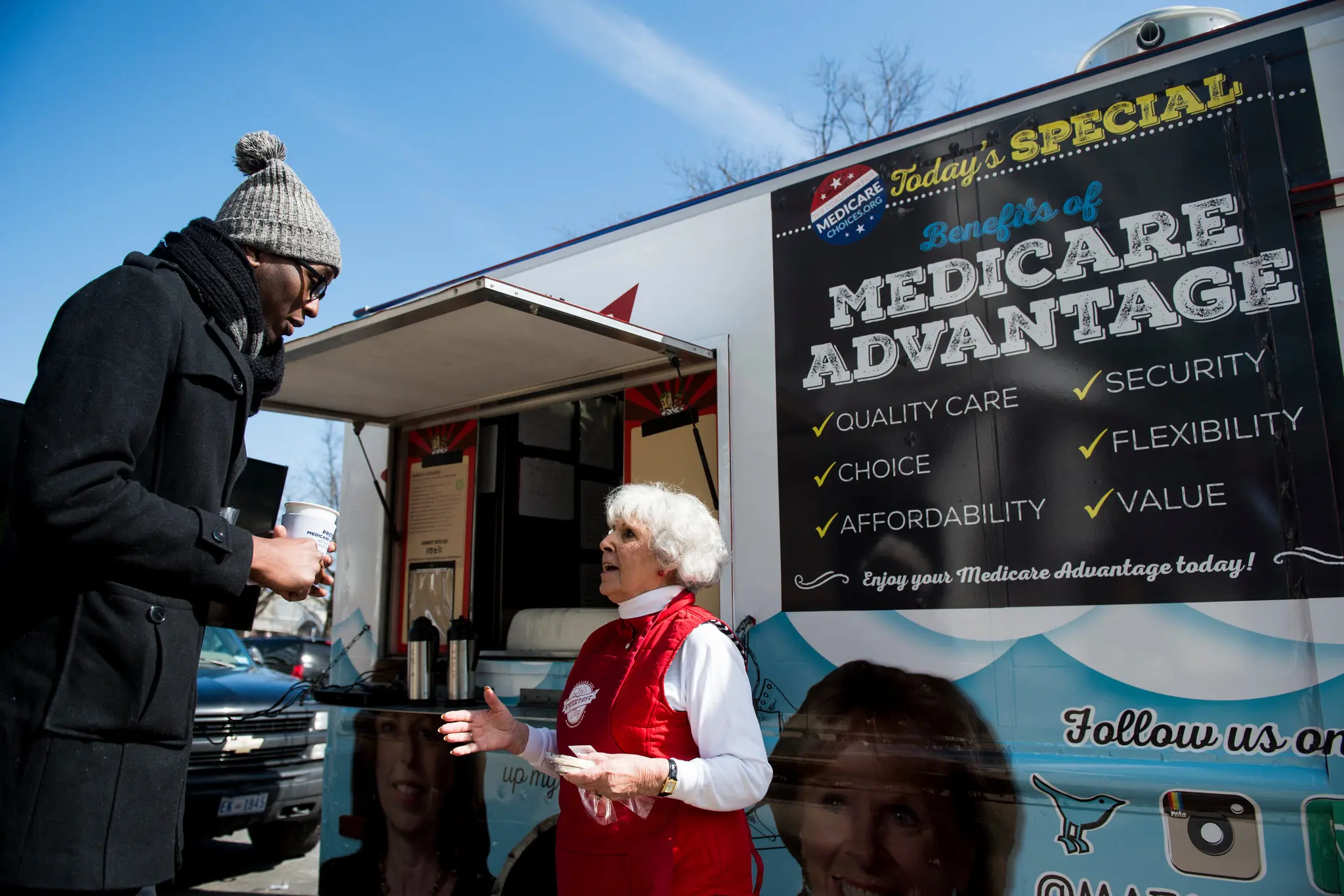
The two plans operate quite differently, and the health and financial consequences can be dramatic. Each has, well, advantages — and disadvantages.
Jeannie Fuglesten Biniek, a senior policy analyst at the Kaiser Family Foundation, is a co-author of a recent literature review comparing Medicare Advantage and traditional Medicare. One important finding, Dr. Biniek said: “Both Medicare Advantage and traditional Medicare beneficiaries reported that they were satisfied with their care — a large majority in both groups.”
Advantage plans offer simplicity. “It’s one-stop shopping,” she added. “You get your drug plan included, and you don’t need a separate supplemental policy,” the kind that traditional Medicare beneficiaries often buy, frequently called Medigap policies.
Medicare Advantage may appear cheaper, because many plans charge low or no monthly premiums. Unlike traditional Medicare, Advantage plans also cap out-of-pocket expenses. Next year, you’ll pay no more than $8,300 in in-network expenses, excluding drugs — or $12,450 with the kind of plan that permits you to also use out-of-network providers at higher costs.
Only about one-third of Advantage plans (called P.P.O.s, or preferred provider organizations) allow that choice, however. “Most plans operate like an H.M.O. — you can only go to contracted providers,” said David Lipschutz, the associate director of the Center for Medicare Advocacy.
Advantage enrollees may also be drawn to the plan by benefits that traditional Medicare can’t offer. “Vision, dental and hearing are the most popular,” Mr. Lipschutz said, but plans may also include gym memberships or transportation.
“We caution people to look at what the scope of the benefits actually are,” he added. “They can be limited, or not available, to everyone in the plan. Dental care might cover one cleaning and that’s it, or it may be broader.” Most Advantage enrollees who use these benefits still wind up paying most dental, vision or hearing costs out of pocket.
One big downside is that these insurers require “prior authorization,” or approval in advance, for many procedures, drugs or facilities.
“Your doctor or the facility says that you need more care” — in a hospital or nursing home, say — “but the plan says, ‘No, five days, or a week, two weeks, is fine,’” said David Lipschutz, the associate director of the Center for Medicare Advocacy. Then you must either forgo care or pay out of pocket.
Advantage participants who are denied care can appeal, and those who do so see the denials reversed 75 percent of the time, according to a 2018 report by the Department of Health and Human Services’s Office of Inspector General. But only about 1 percent of beneficiaries or providers file appeals, “which means there’s a lot of necessary care that enrollees are going without,” Mr. Lipschutz said.
Another report this spring by the inspector general’s office determined that 13 percent of services denied by Advantage plans met Medicare coverage rules and would have been approved under traditional Medicare.
Advantage plans can also be problematic if you are traveling or spending part of each year away from home. If you live in Philadelphia but get sick on vacation in Florida, all local providers may be out of network. Check to see how the plan you’re using or considering treats such situations.

“The big pro is that there are no networks,” Jeannie Fuglesten Biniek, a senior policy analyst at the Kaiser Family Foundation, said of traditional Medicare. “You can see any doctor that accepts Medicare,” as most do, and use any hospital or clinic. Traditional Medicare beneficiaries also largely avoid the delays and frustrations of prior authorization.
But traditional Medicare sets no cap on out-of-pocket expenses, and its 20 percent co-pay can add up quickly for hospitalizations or expensive tests and procedures. So most beneficiaries rely on supplemental insurance to cover those costs; either they buy a Medigap policy or they have supplementary coverage through an employer or Medicaid. Medigap policies are not inexpensive; a Kaiser Family Foundation survey found that they average $150 to $200 a month.
The Kaiser literature review found that traditional Medicare beneficiaries experienced fewer cost problems than Advantage beneficiaries if they had supplementary Medigap policies — but if they didn’t, they were more likely to report problems like delaying care for cost reasons or having trouble paying medical bills.
Traditional Medicare also provides somewhat better access to high-quality hospitals and nursing homes. David Meyers, a health services researcher at Brown University, and his colleagues have been tracking differences between original Medicare and Medicare Advantage for years, using data from millions of people.
The team has found that Advantage beneficiaries are 10 percent less likely to use the highest quality hospitals, four to eight percent less likely to be admitted to the highest quality nursing homes and half as likely to use the highest-rated cancer centers for complex cancer surgeries, compared to similar patients in the same counties or ZIP codes.
In general, patients with high needs — people who were frail, limited in activities of daily living or had chronic conditions — were more apt to switch to traditional Medicare than those who were not high-need.
“When you’re healthier, you may run into fewer of the limitations of networks and prior authorization,” Dr. Meyers said. “When you have more complex needs, you come up against those more frequently.”
Another downside to traditional Medicare, though, is that it does not include drug coverage. For that, you need to buy a separate Part D plan.
What should I know about drug plans?

Unlike most Medicare Advantage plans, traditional Medicare does not include drug coverage. For that, you must buy a separate Part D plan.
For 2023, beneficiaries can typically choose between 24 stand-alone Part D plans, at premiums that range from $6 to $111 a month and average $43 for policies available nationwide, said Juliette Cubanski, the deputy director of the program on Medicare policy at the Kaiser Family Foundation.
“If you’re the person who doesn’t take many medications or only uses generics, the best strategy might be to sign up for the plan with the lowest premium,” Dr. Cubanski said. “But if you take a lot of medications, the most important thing is whether the drugs you take, especially the most expensive ones, are covered by the plan.”
Different plans cover different drugs (which can change from year to year) and place them in different pricing tiers, so how much you pay for them varies. And, to make comparisons more dizzying, certain pharmacy chains are “preferred” by certain plans, so you could pay more at CVS than at Walmart for the same drug, or vice versa.
How does Part D work? First, most stand-alone plans have a deductible: $505 in 2023. You pay that amount out of pocket before coverage kicks in.
Then, a Part D plan, either stand-alone or as part of a Medicare Advantage plan, usually establishes five tiers for drugs. The cheapest two tiers, for generic drugs, could be free or run up to about $20 per prescription. Next comes a tier for preferred brand-name drugs, probably $30 to $45 per prescription in 2023.
Drugs on the next highest tier, for nonpreferred brand-name drugs, usually involve coinsurance — paying a percentage of the drug’s list price — rather than a flat co-pay. For national stand-alone plans, that ranges from 34 to 50 percent, Dr. Cubanski said.
Drugs that cost more than $830 a month are considered specialty drugs, the highest-priced tier. You only pay 25 percent of the price, but because these are so expensive, your costs rise.
Once your total drug costs reach $4,660 (for 2023), including out of pocket costs and what your plan paid, you have entered the so-called coverage gap phase and will pay 25 percent of the cost, regardless of tier.
Finally, when your costs reach $7,400 — including what you’ve paid, plus the value of manufacturer discounts — you have hit the threshold for catastrophic coverage. After that, you pay just 5 percent.
You can, but be careful.
Switching between Medicare Advantage plans is fairly easy. But switching from traditional Medicare to an Advantage plan can cause a major problem: You relinquish your Medigap policy, if you had one. Then, if you later grow dissatisfied and want to switch back from Advantage to traditional Medicare, you may not be able to replace that policy. Medigap insurers can deny your application or charge high prices based on factors like pre-existing conditions.
(There are some exceptions. For instance, people who drop a Medigap policy to enroll in an Advantage plan for the first time can repurchase it, or buy another Medigap policy, if they switch back to traditional Medicare within a year.)
“Many people think they can try out Medicare Advantage for a while, but it’s not a two-way street,” said David Lipschutz, the associate director of the Center for Medicare Advocacy. Except in four states that guarantee Medigap coverage at set prices — New York, Massachusetts, Connecticut and Maine — “it’s one type of insurance that can discriminate against you based on your health,” he said.
The fact is, few consumers do any real comparison shopping, or shift their coverage in either direction. Dozens of lawsuits charging Medicare Advantage insurers with fraudulently inflating their profits apparently haven’t made much difference to consumers, either.
In 2020, only 3 in 10 Medicare beneficiaries compared their current plans with others, a recent Kaiser Family Foundation survey reported. Even fewer beneficiaries changed plans, which might reflect consumer satisfaction — or the daunting task of trying to evaluate the pluses and minuses.

You will find plenty of information on the Medicare.gov website, including the Part D plan finder, where you can input the drugs you take and see which plan gives you the best and most economical coverage. The toll-free 1-800-MEDICARE number can also assist you.
Perhaps the best resources, however, are the federally funded State Health Insurance Assistance Programs, where trained volunteers can help consumers assess both Medicare and drug plans.
These programs “are unbiased and don’t have a pecuniary interest in your decision making,” said David Lipschutz, the associate director of the Center for Medicare Advocacy. But their appointments tend to fill up quickly at this time of year, and the annual open enrollment period ends on Dec. 7. Don’t delay.
https://altarum.org/publications/november-2022-health-sector-economic-indicators-briefs

Altarum’s monthly Health Sector Economic Indicators (HSEI) briefs analyze the most recent data available on health sector spending, prices, employment, and utilization. Support for this work is provided by a grant from the Robert Wood Johnson Foundation. Below are highlights from the November 2022 briefs.
Health spending growth continues to lag GDP growth
Health care price growth remains moderate amid slowing economywide inflation
Health care job growth remains strong while health care wage growth moderates

A viral hurricane is making landfall on health care systems battered by three pandemic years. With the official start of winter still weeks away, pediatric hospitals are facing crushing caseloads of children sick with RSV and other viral illnesses. Schools that promised a “return to normal” now report widespread absences and even closures from RSV and flu in many parts of the country, contributing to parents missing work in record numbers. With this year’s flu season beginning some six weeks early, the CDC has already declared a flu epidemic as hospitalizations for influenza soared to the highest point in more than a decade.
A storm of these proportions should demand not only crisis clinical measures, but also community prevention efforts. Yet instead of deploying public health strategies to weather the storm, the U.S. is abandoning them.
Even before the arrival of the so-called tripledemic, U.S. health systems were on the brink. But as the fall surge of illness threatens to capsize teetering hospitals, the will to deploy public health measures has also collapsed. Pediatricians are declaring “This is our March 2020” and issuing pleas for help while public health efforts to flatten the curve and reduce transmission rates of Covid-19 — or any infectious disease — have effectively evaporated. Unmanageable patient volumes are seen as inevitable, or billed as the predictable outcome of an “immunity debt,” despite considerable uncertainty surrounding the scientific underpinnings and practical utility of this concept.
The Covid-19 pandemic should have left us better prepared for this moment. It helped the public to understand that respiratory viruses primarily spread through shared indoor air. Public health practices to stop the spread of Covid-19 — such as masking, moving activities outdoors, and limiting large gatherings during surges — were incorporated into the daily routines of many Americans. RSV and flu are also much less transmissible than Covid-19, making them easier to control with common-sense public health practices.
Instead of dialing up those first-line practices as pediatric ICUs overflow and classrooms close, though, the U.S. is relying on its precious and fragile last lines of defense to combat the tripledemic: health care professionals and medical facilities.
Warnings and advisories recently issued by U.S. public health leaders, clinical leaders, politicians, and the media have consistently neglected to mention masking as a powerful short-term public health strategy that can blunt the surge of viral illness. Instead, recent guidance has exclusively promoted handwashing and cough etiquette. These recommendations run counter to recent calls to build on improved understanding of the transmission of respiratory viruses.
In the U.S.’s efforts to “move on” from thinking about Covid, it has created a “new normal” that is deeply abnormal — one in which we normalize resorting to crisis measures, such as treating patients in tents, instead of using common-sense public health strategies. Treating Covid like the flu — or the flu like Covid — has effectively meant that we treat neither illness as if it were a serious threat to health systems and to public health. Mobilizing Department of Defense troops and Federal Emergency Management Agency personnel to cover health system shortfalls is apparently more palatable than asking people to wear masks.
The tripledemic has already claimed its first child deaths in the U.S., adding to a large ongoing death toll from Covid. Allowing health systems to reach the brink of collapse will lead to many more preventable deaths among pediatric and other vulnerable patients who can’t access the care they need.
By any accounting, these losses are shocking and tragic. But they should strike us as particularly abhorrent and shameful because the tripledemic is a crisis that leaders, health agencies, and institutions have, in a sense, chosen. Over the past year, the Biden administration and its allies have repeatedly encouraged the public to stand down on public health measures, with the President even stating in September that “the pandemic is over.” By moving real risks out of view and failing to push for more robust measures to mitigate Covid, these messages have put the country on a path to its present circumstances, in which pediatric RSV patients are transferred to hospitals hundreds of miles away because there is no capacity to treat them in their own communities.
Living with viruses should mean embracing simple public health measures rather than learning to live with staggering levels of illness and death. Leaders in public health and medicine should issue timely and appropriate guidance that reflects the latest science instead of second-guessing the prevailing winds in public opinion. Instead of self-censoring their recommendations out of fear of political consequences, they should continue to promote the full range of public health strategies, including masking in crowded indoor public places during surges.
The tripledemic should bring renewed urgency to policies that will reduce the toll of seasonal illness on health, education, and the economy. Improvements in indoor air quality in public spaces, including schools, child care centers, and workplaces, can limit the spread of diseases and have many demonstrated health and economic benefits, yet the U.S. continues to lack standards to guide infrastructure or workplace safety standards. Paid leave enabling workers to stay home when they are ill can reduce the transmission of disease as well as loss of income, yet the U.S. is one of the only high-income countries without universal paid sick leave or family medical leave.
Greater effort must also be made to increase vaccination coverage for flu and Covid and bring an RSV vaccine online as quickly as possible. Only about half of high-risk adults under 65 received a flu shot last year, a gap that can be closed with more energetic vaccination campaigns. Reducing annual flu deaths using a broader range of strategies enabled by the pandemic — rather than pegging Covid deaths to them — should be the goal.
Amid the many sobering stories of the tripledemic, there is some good news. As the experience of Covid-19 has shown, it is possible to limit the toll of respiratory viruses like flu and RSV. However, this work requires resources, appropriate policies, and political will. Americans don’t need to accept winter disease surges and overrun health systems as an inevitable new normal. Instead, the country should see the tripledemic as a call to reinvigorate public health strategies in response to these threats to the health of our communities.

Consolidation continues across the healthcare industry with many hospitals and health systems looking to complete planned acquisitions or sales by the end of 2022 or early 2023.
Here are 15 planned hospital or health system sales that Becker’s Hospital Review has reported on in the last month:
1-2. El Segundo, Calif.-based Pipeline Health System, which filed for Chapter 11 bankruptcy in October, has agreed to sell two hospitals — Weiss Memorial Hospital in Chicago and West Suburban Medical Center in Oak Park, Ill. — to Princeton, N.J.-based Ramco Healthcare Holdings and Resilience Healthcare.
Pending approval of a motion submitted Nov. 22 to the U.S. Bankruptcy Court for the Southern District of Texas, Resilience is expected to assume operations of the two hospitals on Dec. 2.
Since acquiring ownership of the hospitals in 2019, Pipeline said it has invested $60 million to improve facilities, add technology and expand clinical programs. The hospitals employ a combined total of 1,700 employees.
3-4. The Centurion Foundation, an Atlanta-based nonprofit organization, has inked an asset purchase agreement to acquire the CharterCare Health Partners system from Los Angeles-based Prospect Medical Holdings.
Two hospitals are included in the transaction: Providence, R.I.-based Roger Williams Medical Center and Our Lady of Fatima Hospital. The change in control application process is expected to be submitted to the Rhode Island Department of Health and the state attorney general before the end of 2022.
5. West Reading, Pa.-based Tower Health plans to sell Chestnut Hill Hospital in Philadelphia to Temple University Health System for $28 million. The news comes less than a year after the health system closed two other hospitals: Brandywine Hospital in Coatesville, Pa., and Jennersville Hospital in West Grove, Pa.
Tower Health plans to rebuild around its flagship Reading Hospital and the two other hospitals it acquired for $423 million from Franklin, Tenn.-based Community Health Systems: Phoenixville Hospital and Pottstown Hospital. It also owns St. Christopher’s Hospital for Children in Philadelphia in a joint venture with Drexel University.
6. As of Nov. 14, potential buyers can submit offers for Singing River Health System, a three-hospital system with locations in Ocean Springs, Pascagoula and Gulfport, Miss.
Supervisors from Jackson County — which owns the health systems — gave the green light for proposals to sell Singing River Health System. Potential buyers have until March 10 to submit their bids.
7-9. New Orleans-based LCMC Health plans to acquire three Tulane University hospitals — New Orleans-based Tulane Medical Center; Covington, La.-based Lakeview Regional Medical Center; and Metairie, La.-based Tulane Lakeside Hospital — from Nashville, Tenn.-based HCA Healthcare.
LCMC Health will purchase the three hospitals for $150 million, expanding its portfolio to nine hospitals in the New Orleans area. The two parties hope to finalize the deal by the end of 2022 or early 2023.
10-12. Peoria, Ill.-based UnityPoint Health – Central Illinois and Des Moines, Iowa-based UnityPoint Health plans to spin off three Illinois hospitals to Urbana, Ill.-based Carle Health.
The transaction results in Carle Health taking over as the parent organization of UnityPoint Health – Central Illinois, which includes Peoria-based Methodist and Procter, and Pekin (Ill.) Hospitals and affiliated clinics, Peoria-based UnityPlace and Methodist College.
An April 1 closing date is anticipated, pending all regulatory approvals.
13. Hill Country Memorial Hospital in Fredericksburg, Texas, has entered into an agreement to become part of San Antionio-based Methodist Healthcare System.
Hill Country Memorial has 15 locations, including a hospital, an urgent care clinic, and primary and specialty care offices. Methodist Healthcare — a 50-50 co-ownership between HCA Healthcare and Methodist Healthcare Ministries of South Texas — has more than 30 facilities, including eight hospitals and nine freestanding emergency departments.
The transaction is expected to be completed in early 2023.
14. Orlando (Fla.) Health plans to acquire Sabanera Health Dorado, an acute care hospital in Puerto Rico.
The hospital will change its name to Doctors’ Center Hospital-Orlando Health Dorado, according to Orlando Health, which will team up with four additional hospitals operated by the Doctors’ Center Hospital team. The operation of all five hospitals will remain with the Doctors’ Center Hospital group.
15. Tacoma, Wash.-based MultiCare Health System and Yakima (Wash.) Valley Memorial reached an acquisition agreement, according to an Oct. 21 news release shared with Becker’s Hospital Review.
Terms of the agreement include Memorial becoming a wholly owned subsidiary of MultiCare, MultiCare investing in new programs, installing an integrated electronic health record, and providing a sustainable future for Yakima’s only hospital. The transaction is subject to routine regulatory approval and closing conditions.

Nearly 3.4 million people have signed up for 2023 Affordable Care Act insurance coverage since the start of open enrollment on Nov. 1, a record-setting pace that is a 17% boost over last year, new federal data shows.
The signup data released Tuesday by the Centers for Medicare and Medicaid Services shows a major hike in new signups on HealthCare.gov.
“We are off to a strong start — and we will not rest until we can connect everyone possible to healthcare coverage this enrollment season,” Department of Health and Human Services Secretary Xavier Becerra said in a statement Tuesday.
The nearly 3.4 million in signups represents activity through Nov. 19 on HealthCare.gov, which is used by residents in 33 states to pick an ACA plan, and through Nov. 12 for the 16 states and District of Columbia that run their own marketplaces.
There are 655,000 people who are new to the exchanges that picked a plan already, making up 19% of the total plan signups so far. CMS added that 2.7 million people who already have 2022 coverage renewed or selected a new plan for 2023.
“These plan selection numbers represent a 17% increase in total plan selections over last year,” CMS said in a release.
There is especially major growth on HealthCare.gov, which has seen 493,216 new enrollees compared to 354,137 for the same time period last year.
“Providing quality, affordable health care options remains a top priority,” said CMS Administrator Chiquita Brooks-LaSure in a statement. “The numbers prove that our focus is in the right place.”
The new signups come as the Biden administration made new investments in expansions for marketing and outreach, including record-setting funding for the ACA navigator program. Administration officials are hoping for another robust period of signups thanks to enhanced subsidies to lower insurance costs.
“Four out of five people will be able to find a plan for $10 or less after tax credits,” CMS said.
The boosted tax credits were supposed to expire after this year but have been extended into 2025 by the Inflation Reduction Act.
The 2022 coverage year saw a record 14.5 million signups. The latest open enrollment for HealthCare.gov for 2023 coverage will run through Jan. 15.
https://www.fiercehealthcare.com/providers/q3-2022-nonprofit-health-system-earnings

Motley earnings numbers from more than a dozen major nonprofit health systems show third-quarter operating incomes landing on both sides of zero, though issues such as labor shortages, limited volume recovery and worsening payer mix look to be a constant across much of the sector.
Baylor Scott & White led the pack with a $257 million operating income for the period ended Sept. 30, 2022, though it was closely followed by Sutter Health’s $244 million.
Baylor is among the outlier systems whose financials have been holding strong through the last few years, and the quarter’s 7.7% operating margin represents a slight improvement over the 7.4% of its 2022 fiscal year (ended June 30). It attributed the quarter’s 5.6% year-over-year (YoY) increase in consolidated total operating revenue to a blend of premium revenue increases, higher surgical volumes and favorable service mix that “returned to and/or exceeded pre-COVID levels.”
Sutter’s operations have been back and forth this year with a $91 million Q1 gain and a $51 million Q2 loss before the most recent quarter’s $244 million. Though it’s still well behind its numbers from last year, the organization’s leadership highlighted the quarter’s relatively flat salaries and progress toward long-term financial resiliency.
“Significant challenges remain, including inflationary pressures, supply chain uncertainties, increased labor costs and staffing shortages, and rising drug prices,” a spokesperson said regarding the numbers. “Our priorities include preparing for seismic infrastructure updates, reinvesting in our communities and supporting our clinicians in service to our mission.”
Topping the other end of the spectrum was Bon Secours Mercy Health and Providence’s respective $141 million and $164 million operating losses—though the latter’s could be viewed as an improvement in light of the $934 million it was down during the prior two quarters.
Both of those systems highlighted a continuation of the inflationary and labor trends that had increased their expenses during the year’s earlier quarters.
Providence, for instance, noted an additional $526 million of agency and overtime expenses during the past nine months in comparison to 2021. Bon Secours Mercy said in its filing that the economic pressures offset improvements to patient volumes that had “approached historical pre-pandemic levels.”
Other operating results of note included: UPMC, whose health services division logged a $103 million operating loss but was buoyed by the integrated system’s insurance services division; Intermountain Healthcare, which is fresh off a merger that helped boost its revenue by 28% and its expenses by 35%; and Advocate Aurora Health, which inched closer to its own pending merger with a narrow 0.2% operating margin.
Regardless of how they stuck the landing, virtually every system reported feeling the continued impact of labor shortages. Banner Health was among that list, reporting a 7% Year after Year increase in year-to-date contract labor costs and noting that understaffing in certain locations negatively impacted capacity and patient volumes.
The reports also suggest some heterogeneity across the patient volume metrics of different markets as demand for non-COVID care continued to recover. Several systems noted their surgical or elective volumes have yet to return to pre-pandemic levels, and some highlighted worsened case mixes that limited year-over-year revenue growth.
Similar to earlier quarters, across-the-board non-operating losses weighed heavily on the organizations’ bottom lines. Nearly every system posted a nine-figure investment loss during the quarter, though a nearly $1.7 billion net investment loss at Kaiser Permanente easily took the cake.
The investment losses led to 11 of the 13 nonprofits to notch a negative net income during the three months ended Sept. 30. See below for a breakdown of the numbers (and note that for systems reporting year-to-date results, third quarter numbers represent the difference between nine-month and six-month totals).
| Total Operating Revenues | Total Operating Expenses | Operating Income | Net Income | |
|---|---|---|---|---|
| Kaiser Permanente | 24,253 | 24,328 | -75 | -1,550 |
| CommonSpirit Health | 9,011 | 8,988 | 23 | -397 |
| Providence | 6,866 | 7,031 | -164 | -612 |
| UPMC | 6,376 | 6,449 | 114 | -260 |
| Mayo Clinic | 4,117 | 3,960 | 157 | -312 |
| Sutter Health | 3,985 | 3,741 | 244 | 103 |
| AdventHealth | 3,971 | 3,910 | 60 | -305 |
| Intermountain Healthcare | 3,685 | 3,685 | 0 | -582 |
| Advocate Aurora Health | 3,657 | 3,649 | 8 | -311 |
| Baylor Scott & White | 3,335 | 3,078 | 257 | 135 |
| Banner Health | 3,069 | 3,096 | -26 | -198 |
| Bon Secours Mercy Health | 2,768 | 2,909 | -141 | -328 |
| SSM Health | 2,330 | 2,403 | -73 | -93 |

Driven in large part by the growth of Medicare Advantage, a number of startups are vying to create the next value-based care model for senior care in patients’ homes, Axios’ Sarah Pringle reports.
Why it matters: As we recently reported in our Elder Care Crisis Deep Dive, there is a shortfall of enough cash and caregivers to handle the massive amount of aging baby boomers reaching their senior years.
State of play: Senior care-related startups commanding fresh rounds of investor funding this year include Upward Health, Biofourmis, ConcertoCare, and Vytalize Health.
Reality check: Scaling remains a challenge for new models looking to shake up the senior care market.
Be smart: While most elderly adults would prefer to age in place, there is still a need for institutional care settings like nursing homes, which presents its own major challenges, Sarah writes.
https://www.axios.com/2022/11/26/china-covid-outbreak-lockdown-economy

A new COVID calamity is hammering China, with a surge in infections prompting a return of lockdowns, including in some manufacturing areas that supply the West.
Why it matters: In addition to the human misery for the world’s most populous country, the effects will be felt around the globe, Axios China author Bethany Allen-Ebrahimian reports from Taipei.
Rare protests broke out today in China’s far western Xinjiang region. Crowds shouted at hazmat-suited guards after a deadly fire triggered anger by prolonged COVID lockdowns, Reuters reports.
What’s happening: The moment of truth for China’s zero-COVID policy has finally come.

Reality check: China’s doctors have warned Xi Jinping that the healthcare system isn’t prepared for the huge outbreak likely to follow the easing of strict anti-COVID measures, the Financial Times reports.
The big picture: “Zero COVID” restrictions have damaged the economy and undermined people’s trust in government.
Between the lines: Chinese leaders made a huge, politically motivated mistake. They resisted the import of Western-made mRNA vaccines (including Pfizer and Moderna) for its citizens. These vaccines were only recently made available to foreigners.
 HENRY KOTULA