


Cartoon – Merits of Job Security





Stanford and Lucile Packard Children’s hospitals in Palo Alto, Calif., and the Committee for Recognition of Nursing Achievement reached a tentative agreement on a three-year contract for about 5,000 nurses represented by the union, according to hospital and union statements.
The sides reached the agreement April 29, the fifth day of a strike, and union members approved it May 1.
“After extensive discussions, we were able to reach consensus on a contract that reflects our shared priorities and enhances existing benefits supporting our nurses’ health, well-being and ongoing professional development,” Stanford said in its latest negotiations update.
With the new agreement, striking nurses will return to work May 3.
Meanwhile, in a news release shared with Becker’s, the union highlighted parts of the agreement, including improvements it said “ensure high patient acuity is reflected in staffing.”
The agreement also includes a combined 7 percent base wage increase in 2022 (a 5 percent increase followed by a 2 percent increase) for nurses, 5 percent in 2023 and 5 percent in 2024, as well as funds specifically for mental healthcare of workers, according to the union.
As part of the labor deal, the hospitals also agreed to continue medical benefits for striking nurses without disruption, the union said.
“From day one of our contract negotiations, CRONA nurses have been unified in our goals of improving staffing and making our profession more sustainable,” Colleen Borges, president of CRONA and pediatric oncology nurse at Packard hospital, said in the release. “We stood strong behind our demands for fair contracts that give us the resources and support we need to take care of ourselves, our families and our patients. We are proud to provide world-class patient care — and are glad the hospitals have finally listened to us.”
Dale Beatty, DNP, RN, chief nurse executive and vice president of patient care services for Stanford Health Care, and Jesus Cepero, PhD, RN, senior vice president of patient care and chief nursing officer for Stanford Children’s Health, acknowledged on the Stanford negotiations page that reaching an agreement has been challenging.
Now “we can all take pride in this agreement. And we are proud of our team for maintaining continuity of care for our patients,” they said.
More information on negotiations is available here and here.

St. Louis-based Ascension reported higher expenses in the three months ended March 31 and ended the quarter with a loss, according to financial documents filed April 29.
The 143-hospital system reported operating revenue of $6.69 billion in the first three months of this year, up from $6.56 billion in the same period of 2021.
Ascension’s operating expenses climbed to $7.34 billion in the first three months of 2022, up from $6.59 billion in the same period a year earlier. The increase was attributed to several factors, including higher salaries, wages and supply expenses.
Looking at the first nine months of the current fiscal year, Ascension’s operating expenses increased 8.7 percent year over year. Staffing challenges, increased use of contract labor and overtime spend pushed Ascension’s total salaries, wages and benefits up 10.1 percent year over year in the nine months ended March 31.
Ascension ended the most recent quarter with an operating loss of $671.14 million, compared to an operating loss of $16.71 million in the same period last year.
After factoring in nonoperating items, Ascension reported a net loss of $884.74 million for the three months ended March 31. A year earlier, the health system posted net income of $957.32 million. For the first nine months ended March 31, Ascension reported net income of $145.21 million, compared to $4.77 billion in the same period a year earlier.
As of March 31, Ascension had 295 days cash on hand, compared to 336 days as of June 30, 2021.

https://mailchi.mp/df8b77a765df/the-weekly-gist-may-6-2022?e=d1e747d2d8
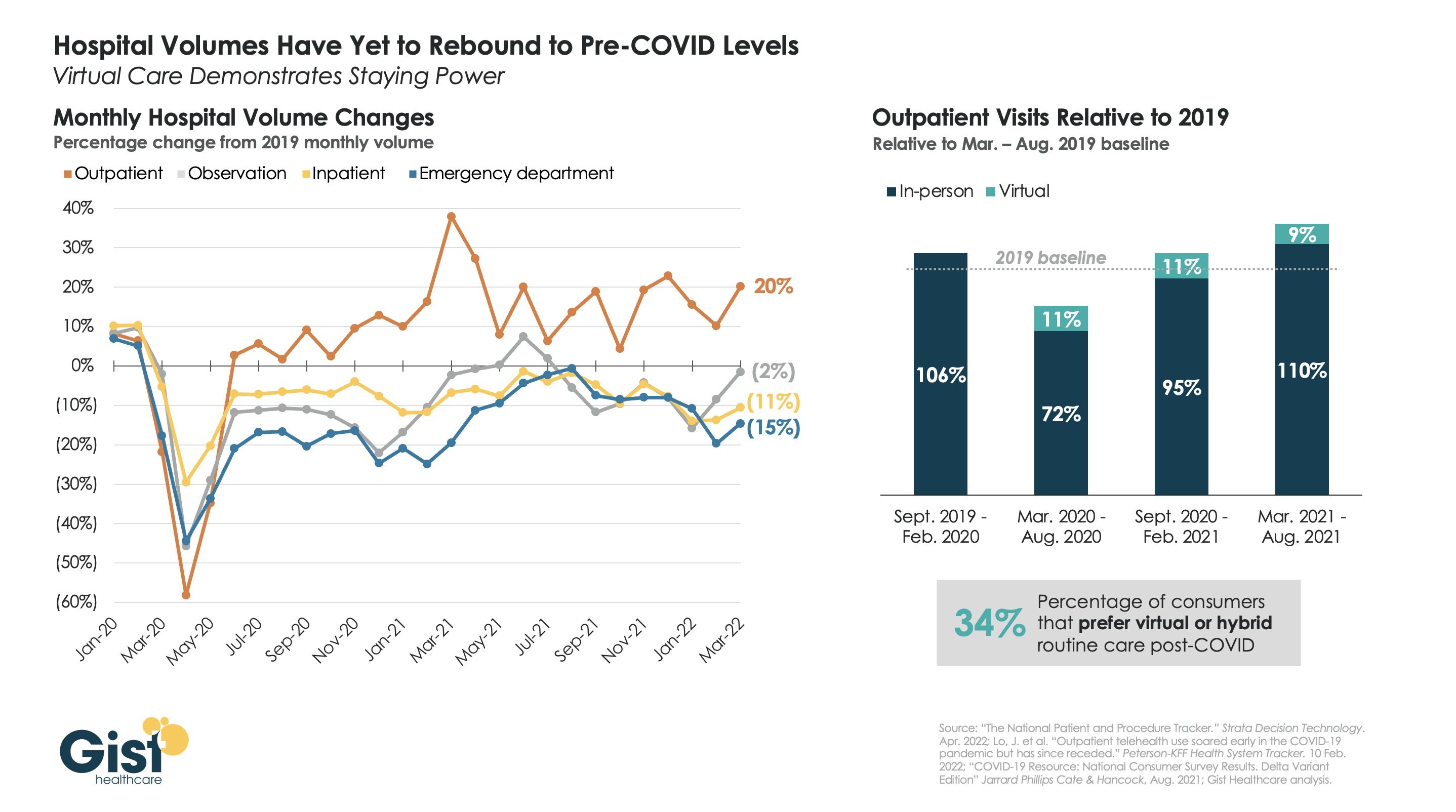
More than two years after the pandemic’s onset, some types of hospital volume still haven’t returned to pre-pandemic levels. The graphic above uses recent data from analytics firm Strata Decision Technology to track monthly hospital volume across various care settings.
While outpatient volume continues to exceed pre-COVID levels, inpatient, emergency department (ED), and observation volume is still below the 2019 baseline. The unpredictability of volume trends is likely to continue, as COVID continues to ebb and flow regionally, and care continues to shift outpatient.
By contrast, the volume of virtual care visits has remained consistent, even as consumers return to in-person outpatient visits, driving up the overall level above the pre-pandemic baseline. Some of this increase in outpatient visit volume has been driven by consumers turning to urgent care clinics or doctors’ offices—either in-person or virtually—for their lower-acuity care needs.
While temporary reimbursement and licensing policies for telehealth have been the main stumbling blocks for many organizations’ longer-term planning for virtual visits, about half of states have now implemented permanent payment parity for telemedicine. As such, provider organizations that are still taking a “wait and see approach” must develop an economically sustainable virtual care model to reduce costs and meet evolving consumer demands.
 HENRY KOTULA