After serving time, fraudster cautions against PPP, other emergency loans

Taking money hastily can create more problems than it solves if the additional resources aren’t tethered to need.

Taking a paycheck protection program (PPP) loan or other federally backed assistance to get through the pandemic will make your problem worse if you don’t have a realistic plan for the money, a former business owner convicted of federal loan fraud says in a White Collar Week podcast.

Jeff Grant, whose 20-person law firm was struggling when the federal government made emergency loans available after the 9/11 terrorist attacks, said he rushed to get the money without thinking through how best to use it. The result was a 13-month jail stint.

“It was raw desperation,” said Grant, who today focuses on helping other white collar criminals navigate a post-crime life. “At that point I was losing my business. I would have done anything for any gasp of air to try to save my business.”

EIDL loan

Grant applied for a $250,000 loan under the Small Business Administration’s (SBA) Economic Injury Disaster Loan (EIDL) program, a resource that, along with the Paycheck Protection Program (PPP), the federal government has once more made available, this time for pandemic-hit businesses.

To increase his chances of getting the money, he said on his application that his business was located across the street from Ground Zero in Manhattan, when it wasn’t — a form of wire fraud — and he used the money to pay off his personal debt — a form of money laundering, because the program’s debt covenants restricted the money for use only in the business.

“I had run up [my credit card debt] in the months prior [to 9/11], trying to save my business,” he said. “I was paying 24% interest on the credit cards. The EIDL loan was about 3%. It seemed to make sense: replace the 24% money with 3% money.”

For two years afterward, Grant said, he had no idea he was being investigated

“Risk of an audit never entered my mind,” he said. “It was immediately after 9/11: a huge problem for the nation. I was just this little guy who was never going to have to account for anything.”

In addition to his business struggles, Grant was wrestling with personal problems that had jeopardized his law license. Facts emerging from bar association proceedings related to his practice may have led the government to investigate him, he said. 

“I just got a phone call from two federal agents who told me there was a warrant out for my arrest,” he said. 

Rather than fight the charges, he admitted his crime.

“Just like a business decision, you work from the end-result back,” he said. “I knew I had done something wrong. I wanted to pay for my crime. I made full restitution. A lot of people spend a lot of time and money trying to wriggle out of it, but we’re in a world where over 95% of criminal prosecutions result in plea bargains. There are virtually no trials. The government gives you a disincentive to defend yourself at trial and an incentive to resolve it quickly.”

Vast sums of money

Against the pandemic backdrop, Grant said, the kind of fraud he committed after 9/11 is probably much greater today, with hundreds of billions of federal loan funds available to struggling businesses, essentially on an honor system, since applicants simply check a box to certify their eligibility. 

“One of my concerns is, people are just kind of wading in [to these programs],” he said.

Unlike EIDL loans, PPP loans don’t have to be paid back if the proceeds are used for eligible purposes, like payroll and operating expenses. 

The government is making almost $300 billion in PPP assistance available under the latest funding round, enacted in December. Applications close at the end of the first quarter. Prior to this latest round, the program had made some $500 billion available, so more than $800 billion could be circulating by the end of the first quarter.

Grant advises against using the funds, even though they’re easy to access, to shore up a business that was either struggling before the pandemic or doesn’t have a realistic plan for getting through it, because the cash infusion can’t solve a systemic problem. 

“You fall prey to magical thinking,” he said. “Money usually exacerbates problems without a good plan.”

He later worked with a nonprofit that, to attract customers, charged less than it recouped to provide services. As a result, the more services it provided, the more money it lost. It took out a $1 million state grant.

“Without fixing the business model, it blew through the $1 million in 18 months,” he said. 

Economy shrank 3.5 percent in 2020

https://thehill.com/policy/finance/536247-economy-shrank-35-percent-in-2020

How fish and shrimps could be recruited as underwater spies | | News For  Tomorrow

The U.S. economy shrank 3.5 percent in 2020 as the coronavirus pandemic shuttered businesses, schools and events, marking the first annual contraction since the Great Recession, according to data released by the Commerce Department on Thursday.

U.S. gross domestic product (GDP) suffered its largest annual decline since 1946 due to the coronavirus pandemic, according to the Commerce Department release. The outbreak of COVID-19 caused the steepest economic collapse since the Great Depression, wiping out more than 20 million jobs and years of economic growth within two months.

U.S. GDP increased by an annualized rate of 4 percent in the final three months of 2020, according to the data released Thursday, following an annualized gain of 33.4 percent in the third quarter and a 31.4 percent annualized decline in the second quarter. But the economic rebound staged in the second half of 2020 has been dampened by the continued rapid spread of COVID-19 throughout the country.

The U.S. economy came into 2020 remarkably strong. Unemployment reached a 50-year low of 3.5 percent in the previous year, inflation remained low and the U.S. had just set a record for the longest economic expansion in its modern history. While the U.S. was likely to face some headwinds from slowing economies overseas, the stunning emergence of the coronavirus pandemic shattered the strong labor market and forced thousands of businesses to shutter.

Consumer spending — which makes up nearly two-thirds of the U.S. economy — fell 2.6 percent in 2020, driven mainly by a 3.4 percent decline in spending on services. Spending on goods rose 0.8 percent, however, as purchases shifted from gatherings to products that could be used during lockdowns.

Economists expect the U.S. economy to bounce back quickly in the second half of 2021, assuming enough Americans are vaccinated to prevent large coronavirus outbreaks. Both economists and health experts insist that a full return to normal is not possible until the pandemic is defeated. 

Roughly 9 million jobs lost during the onset of the pandemic have yet to be recovered, and those without work have struggled to get by with swaths of the economy still largely shut down by the virus. The federal government approved more than $4 trillion to fund pandemic response and economic rescue in 2020, though Democratic lawmakers and many economists say more is still needed.

President Biden and congressional Democrats are pushing to pass another $1.9 trillion COVID-19 bill meant to ramp up vaccine distribution and offer more economic relief to those in the greatest need.

Republican lawmakers have not ruled out passing another relief bill, but most object to the size and scope of Biden’s proposal after approving a $900 billion measure in December.

Treasury Secretary Janet Yellen and Federal Reserve Chairman Jerome Powell have both warned lawmakers that the risks of holding back on necessary fiscal relief are far greater than adding more to the national debt or risking an increase in inflation.

“I’m much more worried about falling short of a complete recovery and losing peoples’ careers and lives and the damage that will do to productive capacity than about the possibility of higher inflation,” Powell said Wednesday.

‘Really difficult nut to crack’: MedPAC torn over telehealth regs post-COVID-19

https://www.healthcaredive.com/news/really-difficult-nut-to-crack-medpac-torn-over-telehealth-regs-post-covi/593466/

Dive Brief:

  • Members of an influential congressional advisory committee on Medicare are torn on how best to regulate telehealth after the COVID-19 public health emergency, hinting at the difficulty Washington faces as it looks to impose guardrails on virtual care without restricting its use after the pandemic ends.
  • During a Thursday virtual meeting, the Medicare Payment Advisory Commission expressed its support of telehealth broadly, but many members noted snowballing use of the new modality could create more fraud and abuse in the system down the line.
  • Key questions of how much Medicare reimburses for telehealth visits and what type of visits are paid for won’t be easily answered, MedPAC commissioners noted. “This is a really, really difficult nut to crack,” Michael Chernew, MedPAC chairman and a healthcare policy professor at Harvard Medical School, said.

Dive Insight:

Virtual care has kept much of the industry running during the coronavirus pandemic, allowing patients to receive needed care at home. Much of this was possible due to the declaration of a public health emergency early 2020, allowing Medicare to reimburse for a greater swath of telehealth services and nixing other restrictions on virtual care.

However, much of that freedom is only in place for the duration of the public health emergency, leaving regulators and legislators scrambling to figure which new flexibilities they should codify, and which perhaps are best left in the past along with COVID-19.

It’s a tricky debate as Washington looks to strike a balance between keeping access open and costs low.

In a Thursday meeting, MedPAC debated a handful of policy proposals to try and navigate this tightrope. Analysts floated ideas like making some expansions permanent for all fee-for-service clinicians; covering certain telehealth services for all beneficiaries that can be received in their homes; and covering telehealth services if they meet CMS’ criteria for an allowable service.

But many MedPAC members were wary of making any concrete near-term policy changes, suggesting instead the industry should be allowed to test drive new telehealth regulations after COVID-19 without baking them in permanently. 

I don’t think what we’ve done with the pandemic can be considered pilot testing. I think a lot of this is likely to go forward no matter what we do because the gate has been opened, and it’s going to be really hard to close it,” Marjorie Ginsburg, founder of the Center for Healthcare Decisions, said. But “I see this just exploding into more fraud and abuse than we can even begin imagining.”

Paul Ginsburg, health policy chair at the Brookings Institution, suggested a two-year pilot of any changes after the public health emergency ends.

However, it would be “regressive” to roll back all the gains virtual care has made over the past year, according to Jonathan Perlin, CMO of health system HCA.

“These technologies are such a part of the environment that at this point, I fear [it] would be anachronistic not to accept that reality,” Perlin said.

Among other questions, commissioners were split on how much Medicare should pay for telehealth after the pandemic ends. 

That parity debate is perhaps the biggest question mark hanging over the future of the industry. Detractors argue virtual care services involve lower practice costs, as remote physicians not in an office don’t need to shell out for supplies and staff. Paying at parity could distort prices, and cause fee-for-service physicians to prioritize delivering telehealth services over in-person ones, some commissioners warned.

Other MedPAC members pointed out a lower payment rate could stifle technological innovation at a pivotal time for the healthcare industry.

MedPAC analysts suggested paying lower rates for virtual care services than in-person ones, and paying less for audio-only services than video.

Commissioners agreed audio-only services should be allowed, but that a lower rate was fair. Commissioner Dana Gelb Safran, SVP at Well Health, suggested CMS should consider outlining certain services where video must be used out of clinical necessity.

Previously, telehealth services needed a video component to be reimbursed. Proponents argue expanded access to audio-only services will improve care access, especially for low-income populations that might not have the broadband access or technology to facilitate a video visit.

Another major concern for commissioners is how permanently expanding telehealth access would affect direct-to-consumer telehealth giants like Teladoc and Amwell. If all telehealth services delivered at home are covered, that could allow the private companies to “really take over the industry,” Larry Casalino, health policy chief in the Weill Cornell Department of Healthcare Policy and Research, said.

Because of the lower back-end costs for virtual care than in-office services, paying vendors the same rate as in-office physicians could drive a lot of brick-and-mortar doctors out of business, commissioners warned.

Here’s which Trump-era health policies Biden could roll back — without help from Congress

https://www.healthcaredive.com/news/heres-what-trump-era-health-policies-biden-could-roll-back-without-help/592912/

How To Roll-Back Data in a Temporal Table

The nearest-term 2021 actions will likely center on bolstering the ACA and Medicaid, after the Trump administration took aim at both.

Even with Democrats’ surprise flipping of the Senate, enacting big healthcare policies in Congress will be a heavy lift given the razor-thin margin in that body and division within the party on strategy.

A clearer path for incoming president Joe Biden is to focus on reversing policies enacted by President Donald Trump at the executive level. Trump’s tenure has been defined in large part by a chipping away at key tenets of the Affordable Care Act, curtailing the Medicaid program and sweeping deregulations critics allege harm consumer protections.

The nearest-term actions the incoming administration is likely to take will center on bolstering the landmark health law and Medicaid, both of which has drawn more bipartisan backing in recent years. Below are what the Biden health administration is likely to roll back quickly after inauguration Wednesday.

Boosting Affordable Care Act marketplace

One of Biden’s first moves may be to open a special enrollment period to sign up for coverage during COVID-19, combined with more outreach and enrollment assistance, Cynthia Cox, director of the ACA program at the Kaiser Family Foundation, said.

Beyond COVID-19, it’s likely the Biden administration will restore federal spending on navigation, marketing and outreach for exchange plans. For example, the Trump administration reduced the minimum number of navigator programs in each state using the federal marketplace to one. Biden could return it to two, and might also bring back the requirement that navigators have a physical presence in their service area.

Biden is also likely to unilaterally shore up standards for brokers, and take steps to bolster the exchange website healthcare.gov.

The Trump administration in December proposed a rule encouraging states to privatize their health insurance marketplaces instead of using healthcare.gov, which will make it more difficult for consumers to shop between plans and could divert people to subpar coverage, Tara Straw, senior policy analyst at the Center on Budget and Policy Priorities, wrote in a December blog post.

The rule doubles down on the administration’s approval of a Georgia waiver to privatize its marketplace in November, but would allow states to follow suit and rely entirely on third-party brokers without a waiver.

That rule is not yet final, so Biden’s HHS will likely remove it from the Federal Register to avoid fragmenting marketplace functions.

Biden could also beef up consumer protections and standards for web brokers, which also sell skimpy short-term health insurance and other non-ACA-compliant coverage.

Biden is also likely to re-expand the annual enrollment period. In 2017, the Trump administration shortened the annual enrollment period to 45 days. Biden’s HHS could use rulemaking to return that period to three full months.

The incoming administration could also reverse previous CMS guidance on Section 1332 waivers that let states subvert or sidestep ACA protections on coverage and cost. The Trump administration proposed a rule in November to codify the waiver standards in regulation but — despite a recent wave of proposed and final regulations as the Trump administration hustles to preserve its health agenda — the rule has not yet been finalized, so HHS could remove it from the Federal Register as well.

By nixing the rule, Biden could also help reverse Trump administration cuts from 2018 that slashed user fees on healthcare.gov plans. The November proposed rule would further decimate the fees, which finance a large swath of marketplace operating expenses, to 2.25% in 2022, versus 3% in 2021 and 3.5% last year.

One key tenet of Biden’s health agenda is to expand ACA subsidies to more low-income Americans, something he can’t do without Congress. However, Biden could use administrative processes to reverse a Trump-era method for indexing marketplace subsidies that kicked in for the 2020 plan year, which led to a small reduction in the financial aid.

Dialing back short-term and association health plans

Biden’s HHS could also roll back the controversial expansion of short-term health plans, bare-bones coverage that isn’t required to cover the 10 essential health benefits under the ACA.

Short-term plans were created as inexpensive stop-gap insurance that could last for up to three months, giving consumers peace of mind while they shopped more comprehensive coverage. However, in 2018, the Trump administration expanded the duration of the plans to 12 months, with a three-year renewal period, and also allowed all consumers — not just those who couldn’t afford other options — to purchase them.

HHS touted the expansion as giving consumers more options, while noting they weren’t meant for everyone. yearlong investigation by House Democrats found the plans widely discriminate against women and people with pre-existing conditions, and had major coverage limitations leaving unwitting consumers susceptible to surprise medical bills.

The Biden administration could enact stricter limits against the sale of the plans. Through additional rulemaking, HHS could limit future enrollment or make it harder to renew short-term coverage, enact stronger consumer protections or beef up standards to limit their sale.

Though actions around limiting new people coming into the plans are likely, Biden may wait to see if Congress takes up the issue, experts say.

A growing number of Americans in the individual healthcare market have subscribed the inexpensive coverage amid skyrocketing medical costs. Roughly 3 million consumers bought the plans in 2019, a 27% growth from 2018, the investigation found. The explosive growth in use makes it a bit less likely Biden’s HHS would pursue immediate, unilateral movement in the space, for fear of kicking Americans off their coverage.

Biden could also reverse Trump’s regulatory changes that have been friendly to association health plans, which allow small businesses or groups to band together to offer coverage. Though the ACA enhanced oversight of the coverage, the Trump administration in June 2018 issued a rule exempting them from rules regulating individual and small-group employer coverage.

As a result, association health plans were allowed to exclude or charge more on the basis of gender, age or other factors.

A federal court invalidated the rule later that year, and some states took legislative or regulatory actions to discourage the use of association health plans. However, the plans —which cover an estimated 3 million Americans — are still not required to cover all essential health benefits, making them a likely target for the Biden administration.

“It is something that we’re going to see some action on pretty soon, but it’s challenging. You don’t want to take those plans away from people, especially during a pandemic,” Cox said.

Expanding Medicaid coverage, eligibility

The Trump administration has given red states new avenues to constrict their Medicaid programs, which provide safety-net health insurance to some 75 million Americans.

Biden will likely first revise state demonstration waiver policies to expand coverage. Among other measures, Biden could get rid of past CMS guidance allowing states to play with Medicaid eligibility through work requirements, controversial programs tying coverage eligibility to work or volunteering hours, and to cap program funding.

Tennessee this month became the first state to receive a federal green light to convert its Medicaid funding to a block grant, following controversial CMS guidance issued early last year. Republicans tout block grants as a way to lower costs, while Democrats oppose the models as capped funding could lead to restricted benefits down the line, especially during times of emergency like a pandemic or natural disaster.

It’s more difficult to roll back a waiver if it’s already been approved, but Biden could put restrictions on it or reverse the decision before it goes into effect, experts say, though Tennessee would have an opportunity to object.

There are also actions Biden could take to reinstate certain beneficiary protections, which would require regulatory changes, KFF researchers say. Those include revising or stopping pending proposals that would change how Medicaid eligibility is determined in a way that would probably result in previously eligible people losing coverage by enacting more documentation requirements; change the government’s methodology for recouping improper payments; and reduce enhanced federal funding for eligibility workers.

Biden’s administration could also tweak regulations that have already been finalized, including the final Medicaid managed care rule for 2020 that relaxed network adequacy, beneficiary protections and quality oversight.

Hospital Uncompensated Care Costs Grew to $41.61B in 2019

Uncompensated Care Costs Fell in Nearly Every State as ACA's Major Coverage  Provisions Took Effect | Center on Budget and Policy Priorities

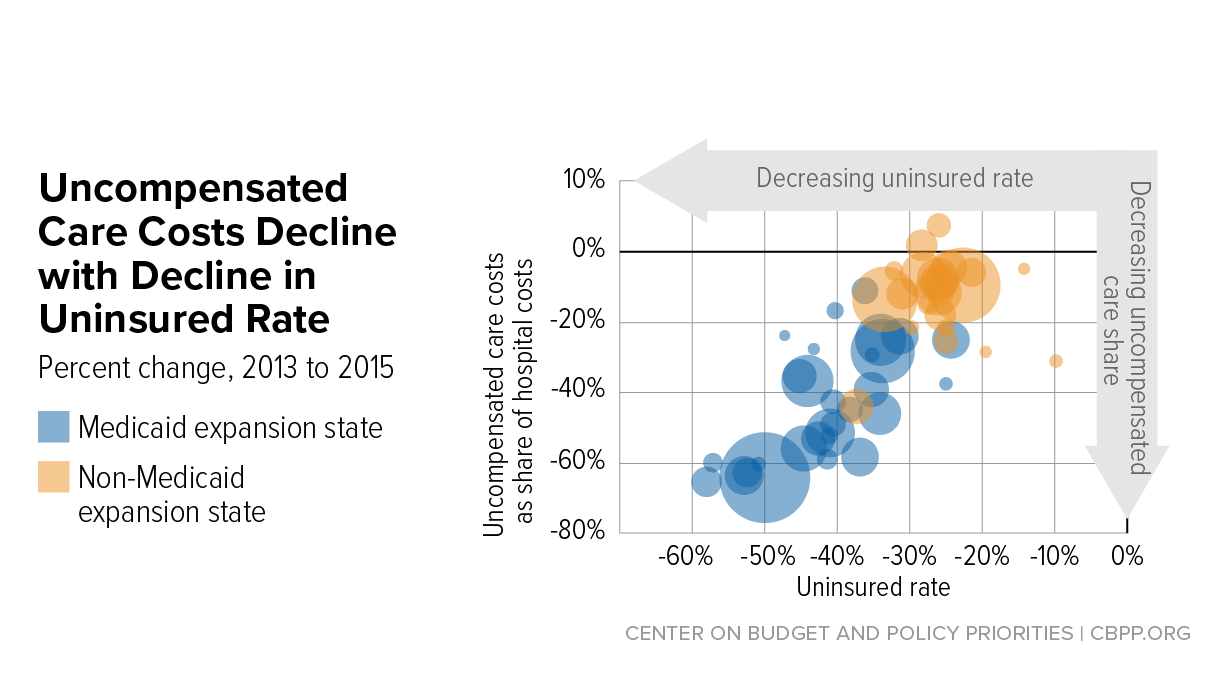
Hospital uncompensated care costs were up from $41.3B in 2018 and $38.4B in 2017, revealing an upward trend, according to AHA data.

Hospital uncompensated care costs increased right before the COVID-19 pandemic hit, according to new data from the American Hospital Association (AHA).

AHA data showed that hospitals incurred a new high of $41.61 billing in uncompensated care costs in 2019, the most recent year for which the group had complete data.

Uncompensated care costs in 2019 were up from $41.3 billion in 2018 and $38.4 billion in 2017 and were the second-highest per AHA records. Hospitals reported the most uncompensated care costs in 2013 when they incurred $46.8 billion.

Hospital uncompensated care costs decreased after the all-time high in 2013, but have recently started to tick back up after holding steady at $38.4 in 2016 and 2017.

In just the last 20 years, hospitals of all types have provided more than $660 billion in uncompensated care to patients, AHA reported. And that figure does not fully account for other ways in which provides provide financial assistance to patients of limited means, the group stated.

Each year, AHA aggregates data on uncompensated care, or care provided for which no reimbursement is received by hospitals from patients or payers. The data comes from the group’s Annual Survey of Hospitals, a comprehensive report of hospital financial data.

Uncompensated care is the sum of a hospital’s bad debt and financial assistance it provides, AHA explained.

Bad debt occurs when a hospital does not expect to obtain reimbursement for care provided, such as when patients are unable to pay their financial responsibility and do not qualify for financial assistance or are unwilling to pay their bills.

Hospitals also provide varying levels of financial assistance, AHA added. Financial assistance supports patients who cannot afford to pay and qualify for support from the hospital based on policies it has established based on the facility’s mission, financial condition, and geographic location, among other factors.

Combined, bad debt and financial assistance charges total a hospital’s uncompensated care charges, which is then multiplied by a hospital’s cost-to-charge ratio to determine total uncompensated care costs.

AHA noted that it expressed uncompensated care in costs versus charges because of significant variations in hospital payer mixes. Publishing the information as costs rather than charges enables better comparison across hospitals, the group said.

Nearly half of hospitals (48 percent) have seen bad debt and uncompensated care increase recently as a result of the ongoing COVID-19 pandemic, an analysis from consulting firm Kaufman Hall revealed.

More than 40 percent of hospitals also reported increases in percentage of uninsured or self-pay patients (44 percent) and the percentage of Medicaid patients (41 percent), which both contribute to unfunded or underfunded care at hospitals.

“The challenges brought on by the COVID-19 pandemic have affected nearly every aspect of hospital financial and clinical operations,” Lance Robinson, a managing director at Kaufman Hall, said at the time. “Organizations have responded to the challenge by adjusting their operations and strengthening important community relationships.”

Hospital uncompensated care costs – and bad debt as a result – are likely to increase in 2020 as hospitals come to terms with the impact COVID-19 has had on their financial health.

Already, hospitals have lost an estimated $323 billion in 2020 as a result of the COVID-19 pandemic, according to earlier projections from AHA.

About half of US hospitals also started the year in the red, AHA and Kaufman Hall stated in a recent report. The organizations predicted that hospital margins would sink to -7 percent in the second half of 2020 without comprehensive financial support from the government, but could decrease to a low of -11 percent if COVID-19 continued to periodically surge as it has.

Biden’s most ambitious health policy: a public option plan

https://www.healthcaredive.com/news/bidens-most-ambitious-health-policy-a-public-option-plan/593342/

“It could fundamentally change how healthcare is priced in the U.S.,” said Cynthia Cox, vice president of the Kaiser Family Foundation.

President-elect Joe Biden will seek to bolster the Affordable Care Act after his predecessor chipped away at the signature legislation, but he also has grander legislative priorities of his own for the health sector.

His most ambitious plan is to create a so-called public option plan, available to all Americans to purchase even if they already have coverage through their employers. It holds the potential to alter how millions get healthcare and put pressure on prices, experts told Healthcare Dive.

“It could fundamentally change how healthcare is priced in the U.S.,” Cynthia Cox, vice president of the Kaiser Family Foundation, told Healthcare Dive.

Still, even with control of Congress and the White House, the plan may take a backseat as the pandemic continues to sicken and kill a record number of people. And while the idea has drawn more support among Democrats in recent years, powerful interests like private insurers and providers will push back against the proposal, while some progressives have their eye on the more ambitious Medicare for All.

A public plan for all

Simply put, a public option plan would give consumers a government-run choice for insurance, a market that can be tightly consolidated, leaving consumers with few carriers to choose from, especially in certain regions of the country.

“If your insurance company isn’t doing right by you, you should have another, better choice,” Biden has touted via his website.

Biden’s proposal allows anyone to buy a public option plan, even those now with employer plans. It is not limited to those only those on the exchanges, or consumers without employer plans.

Biden has said a public option plan will lower prices for patients because the government would be negotiating lower prices with healthcare providers. That theory relies on providers accepting these lower rates and electing to be in-network with the public plan.

The public option plan would reimburse providers less than typical commercial plans, which tend to pay the highest rates to providers for services compared to other government programs such as Medicaid and Medicare.

Ultimately, it is a more direct way to regulate healthcare prices in the U.S., Cox said.

As such, it will face fierce opposition from providers who typically treasure commercial insurance over other government plans as it tends to generate less revenue for hospitals and payers who see the option as competition.

A public option plan was included in early drafts during the construction of the ACA, though at the time it was limited to those without employer coverage. The idea gained support because policymakers were unsure how many private plans would sell plans on exchange. Plus, at the time, the idea was that it would offer premium pricing pressure and more choices in areas that potentially did not attract any on-exchange carriers. 

In 2013, the Congressional Budget Office scrutinized the impact of adding a public plan to the exchanges. At the time, CBO’s estimates expected premiums to be lower than private plans by 7% and 8% on average. And CBO estimates showed it would reduce the federal deficit in a few ways, mainly through a decrease in subsidies as consumers opted for the public plan.

In the end, though, the idea was nixed to gain backing from moderate Democrats as Republicans villified it as a government takeover of healthcare.

Not bold enough for far-left Democrats

While the public option was called too far left at the time of the ACA, it now may not be progressive enough for those in the liberal wing of the party, as ideas like Medicare for All have become more mainstream.

The shock of the COVID-19 pandemic may hasten calls for a bigger revamp, having laid bare the deep inequities in the nation’s healthcare system. Both death and infection rates are higher for people of color compared with their White counterparts.

At the same time, millions have likely lost insurance coverage as the economic upheaval caused by the pandemic resulted in historic job losses. Many Americans receive health coverage through work.

Earlier periods of upheaval paved the way for bold social programs such as those that followed the Great Depression via President Franklin D. Roosevelt’s New Deal.

Prior to the pandemic, a public option was seen as more palatable for some than a “Medicare for All” option, a favored policy among the more progressive wing of the Democratic party. It was a heavily debated topic during the Democratic primary, during which Biden cautioned that such a plan would mean eliminating the ACA, a signature policy he helped enact as vice president.

A public option plan, while an ambitious measure, is not as industry-altering as Medicare for All, which would force Americans onto a single system and eliminate the private insurance market. A wing of the party’s progressive group continues to advocate for Medicare for All.

The Democrats currently have a 10-vote margin in the House, and an even slimmer margin in the Senate with Vice President-elect Kamala Harris serving as the tiebreaker.

Some had suggested those farther left in the party should withhold their votes for Nancy Pelosi as speaker of the House in exchange for securing a floor vote on Medicare for All. Pelosi ultimately retained her speakership position.

But Rep. Alexandria Ocasio-Cortez, D-N.Y., batted down such ideas as premature on Twitter due to the lack of Democratic votes to pull off such a move successfully.  

“So you issue threats, hold your vote, and lose. Then what?” Ocasio-Cortez tweeted on Dec. 11.

Reconciliation

Even with Democrats in control of Congress and the White House, don’t expect any sweeping healthcare legislative changes like Medicare for All, experts say.

The margins are so slim in the Senate it leaves one avenue to pass legislation: through so-called budget reconciliation. That avenue comes with complicated rules, generally limiting the kind of bills that can be passed to those with an impact on revenue, spending or deficits.

Given that hurdle alone, industry analysts don’t expect a public plan to pass through Congress, instead pointing to more incremental changes, which eases market fears of broad changes.

Plus, the pandemic will be absorbing most of the attention as the 46th president tries to stamp out the pandemic.

“Not to be overly simplistic, but I don’t think healthcare is on the front page of priorities,” David Windley, an analyst with Jefferies, said, pointing to Biden’s transition website, which does not call out other healthcare policy goals aside from tackling the pandemic.

It sets the table for a unique first term, Andy Slavitt, former CMS acting administrator under President Barack Obama, said. Slavitt will serve as a senior adviser to Biden’s COVID-19 response.

“For the first time in a long time, healthcare will not be a big first-term agenda item for the Congress,” Slavitt said during a healthcare conference last week. He expects Biden to focus on building back the ACA through administrative action and rule making as opposed to legislative battles in Congress.

“I don’t think Biden is looking to pick big divisive fights to the extent that healthcare looks like a big divisive fight. It doesn’t strike me that that’s where he wants to be,” Slavitt said.

Biden ramps up vaccine distribution to 200 million doses by the end of summer

https://www.healthcarefinancenews.com/news/biden-ramps-vaccine-distribution-200-million-doses-end-summer

Biden administration to buy 200 million more doses of Covid vaccine -  POLITICO

The death toll from the pandemic is projected to climb to 500,000 by the end of  February.

President Joe Biden yesterday announced he is ramping up COVID-19 vaccine distribution to have 200 million doses delivered by the end of the summer.

This is an additional 100 million doses Biden set as his goal for his first 100 days in office.

In remarks yesterday, Biden directed COVID-19 Response Coordinator Jeff Zeints to work with the Department of Health and Human Services to increase the nation’s total supply. 

“And we believe that we’ll soon be able to confirm the purchase of an additional 100 million doses for each of the two FDA-authorized vaccines: Pfizer and Moderna,” Biden said. “That’s 100 million more doses of Pfizer and 100 million more doses of Moderna — 200 million more doses than the federal government had previously secured. Not in hand yet, but ordered. We expect these additional 200 million doses to be delivered this summer.”

After review of the current vaccine supply from manufacturing plants, the federal government believes it can increase overall weekly vaccination distribution to states, tribes, and territories from 8.6 million doses to a minimum of 10 million doses, starting next week.  

But the pandemic is expected to get worse before it gets better, Biden said, with experts predicting the death toll as likely to top 500,000 by the end of  February.

But the brutal truth is: It’s going to take months before we can get the majority of Americans vaccinated. Months. In the next few months, masks — not vaccines — are the best defense against COVID-19,” he said.

WHY THIS MATTERS

The increases in the total vaccine order in the United States from 400 million ordered to 600 million doses will be enough vaccine to fully vaccinate 300 Americans by the end of the summer or the beginning of fall, Biden said.  

“It’ll be enough to fully vaccinate 300 [million] Americans to beat this pandemic — 300 million Americans,” he said. “And this is an aggregate plan that doesn’t leave anything on the table or anything to chance, as we’ve seen happen in the past year.”

Biden’s team said they found the vaccine program to be in worse shape than they thought it would be and that they were starting from scratch.

“But it’s also no secret that we have recently discovered, in the final days of the transition — and it wasn’t until the final days we got the kind of cooperation we needed — that once we arrived, the vaccine program is in worse shape than we anticipated or expected,” Biden said. 

Governors have been guessing at what they’ll receive for vaccine shipments, the president said.

The federal  government is working with the private industry to ramp up production of vaccine and protective equipment such as syringes, needles, gloves, swabs and masks. The team has already identified suppliers and is working with them to move the plan forward.

Also, the Federal Emergency Management Agency is being directed to to stand up the first federally-supported community vaccination centers and to make  vaccines available to thousands of local pharmacies beginning in early February.

THE LARGER TREND

Last week, Biden signed a declaration to begin reimbursing states 100% for the use of their National Guard to help the COVID-19 relief effort, both in getting sites set up and in using some of their personnel to administer the vaccines. 

Biden has also said he wants to expand testing, which will help reopen schools and businesses.

He has formalized the Health Equity Task Force to ensure that the most vulnerable populations have access to vaccines. 

He is also pushing for a $1.9 trillion relief package.

My Parents Will Be Vaccinated Long Before Me. Can They Come Visit?

Can I Visit People Who Are Vaccinated During COVID-19? | Time

Welcome to COVID Questions, TIME’s advice column. We’re trying to make living through the pandemic a little easier, with expert-backed answers to your toughest coronavirus-related dilemmas. While we can’t and don’t offer medical advice—those questions should go to your doctor—we hope this column will help you sort through this stressful and confusing time. Got a question? Write to us at covidquestions@time.com.

Today, E.B. in New York asks:

My parents and in-laws will hopefully be vaccinated soon. My husband and toddler and I don’t expect to be vaccinated for quite some time. How should we think about whether it’s safe to spend time together in a mixed-vaccinated group? Could they get on a plane and fly to visit with us unmasked and indoors? Or is there enough risk that we should wait until we are all vaccinated (which may be a very long time especially with children in the mix)? Or split the difference and take some precautions?

To state the obvious, we are in a strange limbo state right now. The vaccines we’ve eagerly awaited for almost a year are here, and yet…nothing about our daily lives has really changed. Unfortunately, that’s going to be the case for a bit longer.

“The end is in sight,” says Dr. Colleen Kelley, a vaccine researcher and associate professor of infectious diseases at the Emory University School of Medicine in Georgia. “I just don’t know that it’s right now.”

Your loved ones getting vaccinated is unequivocally a step forward, Kelley says. It would certainly be safer to visit with your parents or in-laws after they’ve gotten both vaccine doses, but the safest plan is to wait until you and your husband are also vaccinated, she says.

The two coronavirus vaccines currently authorized for use in the U.S.—those made by Pfizer-BioNTech and Moderna—are both extremely effective at preventing people from getting sick with COVID-19. That’s a huge benefit on its own, especially for people at high risk of severe illness, such as elderly adults and people with underlying medical conditions.

But the outstanding question is whether COVID-19 vaccines also stop people from getting asymptomatically infected with the virusEarly evidence suggests both shots offer at least some protection against asymptomatic infection, and many experts are optimistic about their chances of stopping transmission, but the data are still coming together.

If the shots turn out not to stop asymptomatic infections entirely, even your vaccinated parents could feasibly get your family sick if they picked something up while traveling to see you. Or, if you happened to be exposed to the virus, your parents could potentially carry it and pass it to others. And, while the authorized COVID-19 vaccines are very effective, there is always a tiny chance of them failing, leaving your parents at risk of illness.

These are all worst-case scenarios, of course. But given the uncertainty and the extent to which COVID-19 is still spreading in the U.S., Kelley says you should wait a little while longer to visit with your parents and in-laws. If that’s not possible, you should take the same precautions you’ve been hearing about for a year: quarantining beforehand, and ideally staying outdoors and masked when possible.

Here’s the good news, though. Once you and your husband are fully vaccinated (along with more of the general population), Kelley says you can feel much better about spending time with other vaccinated people indoors and unmasked—even if your toddler isn’t yet vaccinated.

As you suggest, it may be a while before kids younger than 16 are eligible for COVID-19 vaccination, since pharmaceutical companies haven’t yet finished testing their shots on younger children. But “if the toddler is the only one who’s not vaccinated, I would say that’s a pretty darn safe scenario,” Kelley says.

Luckily, young kids rarely get seriously ill with COVID-19, so once all the adults in the room are fully protected, Kelley says you can feel pretty comfortable with your parents or in-laws coming for a visit.

“We’re not going to get to a zero-risk situation,” Kelley says, “but we are going to get to places that are safer and safer.”

Report American Billionaires have added more than 1 trillion in wealth during pandemic

Report: American Billionaires Have Added More Than $1 Trillion In Wealth During Pandemic

America’s billionaires have added a staggering $1.1 trillion to their collective wealth since the pandemic began. Their combined fortunes now sit at $4.1 trillion — $1.7 trillion more than the amount of wealth held by the bottom half of Americans.

Meanwhile, the country’s poverty rate increased by 2.4 percentage points in the latter half of 2020 — the largest increase in poverty since the 1960s. And to think that Senate Republicans are decrying a $1.9 trillion COVID relief bill as too expensive.

Please. America’s billionaires alone could finance most of that bill, just with the increase in their wealth over the last 10 months. An emergency wealth tax that used their $1.1 trillion windfall to pay for the COVID survival plan would put these billionaires back to where they were 10 months ago (still very comfortable, to say the least) while helping the rest of America survive.

This is the sort of trickle-down economics that could actually work. What do you think?