8 hospitals laying off workers

https://www.beckershospitalreview.com/finance/8-hospitals-laying-off-workers-101520.html?utm_medium=email

Facing a financial squeeze, hospitals nationwide are cutting jobs

The financial challenges caused by the COVID-19 pandemic have forced hundreds of hospitals across the nation to furlough, lay off or reduce pay for workers, and others have had to scale back services or close. 

Lower patient volumes, canceled elective procedures and higher expenses tied to the pandemic have created a cash crunch for hospitals. U.S. hospitals are estimated to lose more than $323 billion this year, according to a report from the American Hospital Association. The total includes $120.5 billion in financial losses the AHA predicts hospitals will see from July to December. 

Hospitals are taking a number of steps to offset financial damage. Executives, clinicians and other staff are taking pay cuts, capital projects are being put on hold, and some employees are losing their jobs. More than 260 hospitals and health systems furloughed workers this year and dozens others have implemented layoffs. 

Below are eight hospitals and health systems that announced layoffs since Sept. 1, most of which were attributed to financial strain caused by the pandemic. 

1. Citing a need to offset financial losses, Minneapolis-based M Health Fairview said it plans to downsize its hospital and clinic operations. As a result of the changes, 900 employees, about 3 percent of its 34,000-person workforce, will be laid off.

2. Lake Charles (La.) Memorial Health System laid off 205 workers, or about 8 percent of its workforce, as a result of damage sustained from Hurricane Laura. The health system laid off employees at Moss Memorial Health Clinic and the Archer Institute, two facilities in Lake Charles that sustained damage from the hurricane.

3. Burlington, Mass.-based Wellforce laid off 232 employees as a result of operating losses linked to the COVID-19 pandemic. The health system, comprised of Tufts Medical Center, Lowell General Hospital and MelroseWakefield Healthcare, experienced a drastic drop in patient volume earlier this year due to the suspension of outpatient visits and elective surgeries. In the nine months ended June 30, the health system reported a $32.2 million operating loss. 

4. Baptist Health Floyd in New Albany, Ind., part of Louisville, Ky.-based Baptist Health, eliminated 36 positions. The hospital said the cuts, which primarily affected administrative and nonclinical roles, are due to restructuring that is “necessary to meet financial challenges compounded by COVID-19.”

5. Cincinnati-based UC Health laid off about 100 employees. The job cuts affected both clinical and non-clinical staff. A spokesperson for the health system said no physicians were laid off. 

6. Mercy Iowa City (Iowa) announced in September that it will lay off 29 employees to address financial strain tied to the COVID-19 pandemic. 

7. Springfield, Ill.-based Memorial Health System laid off 143 employees, or about 1.5 percent of the five-hospital system’s workforce. The health system cited financial pressures tied to the pandemic as the reason for the layoffs. 

8. Watertown, N.Y.-based Samaritan Health announced Sept. 8 that it laid off 51 employees and will make other cost-cutting moves to offset financial stress tied to the COVID-19 pandemic.


How to gauge your hospital’s financial health

https://www.beckershospitalreview.com/how-to-gauge-your-hospital-s-financial-health.html

How to gauge your hospital's financial health

Some rural hospitals that were already struggling are now in serious financial trouble due to the coronavirus.

The suspension of elective surgery and non-urgent care in most states led to an abrupt drop in patient volumes and hospital revenue. That loss, combined with the cost of preparing for COVID-19 protections for patients and employees, has forced rural hospitals into deeper distress. It’s especially important in these challenging circumstances to keep a close eye on key metrics that gauge a hospital’s financial health. By monitoring indicators, creating transparency and responding swiftly to warning signals of financial distress, hospitals can stave off bankruptcy or closure and establish a new path toward long-term sustainability. 

A Shared Responsibility

Signs that a hospital is headed for, or already in, financial distress include obvious indicators such as declining revenues or a dip in patient volume. Although some distress signals seem loud and clear, problems persist at many hospitals due to lack of communication and financial assessment across the enterprise. Too often, it’s left to the CFO to monitor overall financial health by measuring against budgets and recent trends. However, a regular review of key metrics should be a shared responsibility for the entire healthcare leadership team.

Five Data Points to Review

Hospitals may need to adjust key targets to bring them in line with what’s realistically achievable while the pandemic persists, particularly when it comes to productivity, PPE costs and net revenue metrics. Think wisely and as a team about how to reassess targets. The following data points should be monitored regularly. 

  1. Aggregate volume and provider utilization trends. This data can offer a big-picture perspective to leaders and managers across departments.
  2. Operating ratios, including expenses as a percentage of net operating revenue. Make sure costs such as labor, supplies and purchased services remain in check. 
  3. Labor costs relative to patient volume. Measure productivity in each department against department specific staffing targets as well as the overall FTE per adjusted occupied bed target for the hospital as a whole.
  4. Patient revenue indicators. These include bad debt percentage and net to gross percentage by payer class. Are there shifts in payer mix that need to be addressed?
  5. Liquidity ratios. These include net days in patient accounts receivable and cash collections as a percentage of net revenue. What steps can be taken to improve cash flow?

Information Gathering

Hospital leadership should conduct a monthly review of the key measures listed above. In addition, procedures should be put in place by the hospital’s finance department, with input from department managers, to produce accurate monthly stats and financial performance metrics to facilitate these periodic reviews. Annually, take a closer look at these financial indicators, as these will form the basis of strategic planning. 

Federal Funding

The COVID-19 crisis reinforces the need for financial diligence and discipline. Rural hospitals received federal funding to help them during the crisis, and this created another layer of data to monitor. Whether in the form of a CARES Act grant, a PPP loan or some other type of funding, these outlays must be closely controlled, properly managed and restricted in use so the hospital does not run out of cash. In certain cases, the federal government will require hospitals to document the use of funds. For example, for CARES Act stimulus payments, hospitals must provide attestation (quarterly beginning in July) that funds are used for COVID-related costs and COVID-related loss of revenue. In any case, CHC recommends that hospitals set up a tracking system to account for these funds. Download a financial dashboard to help.

Connect the Dots

Regular reviews of financial indicators can identify operational best practices, support strategic planning efforts, create accountability, and, if necessary, redirect financial sustainability efforts. The COVID-19 crisis accelerates the timeline during which financial improvements must be made. 

The most critical element of this entire process is answering, “Why?” This means finding the root causes for financial difficulties. Another critical element is clear communication of expectations and goals across hospital leadership in order to accomplish desired changes. The team, armed with data and clear objectives, can then get to the root of any problems. 

Kaiser blasts 30% price hike sought by Oregon system

https://www.beckershospitalreview.com/finance/kaiser-blasts-30-price-hike-sought-by-oregon-system.html?utm_medium=email

Kaiser Permanente Blasts 30% Price Hikes Sought By Salem Health | The Lund  Report

Oakland, Calif.-based Kaiser Permanente says the 30 percent price hike Salem (Ore.) Health is seeking for Kaiser insurance members in the Salem market is too steep. Salem Health argues the increase is justified, according to The Lund Report

Kaiser and Salem Health last negotiated their agreement seven years ago. Salem Health says it’s seeking a steep increase because prices under the current agreement lag the market by 30 percent. 

“Over the past year, Salem Health has consistently communicated with Kaiser the need for a new, market-based contract,” Salem Health said in a statement to The Lund Report

The old contract expired two weeks ago, and talks between Kaiser and Salem Health are at a stalemate. Kaiser says the price hike is unreasonable and excessive. 

“These overinflated prices are unnecessary, and they are not the direction we want to be going regionally and nationally,” Caroline King, MD, a physician leader at Kaiser in Salem, told The Lund Report. “And so if we feel there is a player in the market that is doing this, it is for us to speak up.” 

Any agreement entered into between the organizations will affect the healthcare costs of about 40,000 Kaiser insurance members in the Salem market, according to the report. 

Experts Slam The White House’s ‘Herd Immunity’ Plan

Experts warn Trump's misinformation about coronavirus is dangerous

The White House is reportedly embracing a herd-immunity approach focused on “protecting the elderly and the vulnerable” but experts are calling the plan dangerous, “unethical”, and equivalent to “mass murder”.

The news comes following a petition titled The Great Barrington Declaration, which argued against lockdowns and school and business closures and got almost 500,000 signatures – although some of them were fake.

“Current lockdown policies are producing devastating effects on short and long-term public health,” the declaration states, adding, “The most compassionate approach that balances the risks and benefits of reaching herd immunity, is to allow those who are at minimal risk of death to live their lives normally to build up immunity to the virus through natural infection, while better protecting those who are at highest risk. We call this Focused Protection.”

Essentially, herd immunity is when enough people are immune to a disease, like Covid-19, that the disease can’t be transmitted as easily and thus provides indirect protection.

It’s been rumoured that the government has been leaning towards this plan of action for some time now, although this is the first real admission.

In response to today’s news, experts around the world have been voicing their concerns.

And this isn’t the first time we’ve heard experts say herd immunity is not a good idea.

For example, the head of the World Health Organization said Monday that allowing the novel coronavirus to spread in an attempt to reach herd immunity was “simply unethical.”

Similarly, the National Institutes of Health (NIH) director Francis Collins also denounced herd immunity as a viable plan.

“What I worry about with this is it’s being presented as if it’s a major alternative view that’s held by large numbers of experts in the scientific community. That is not true. This is a fringe component of epidemiology. This is not mainstream science. It fits into the political views of certain parts of our confused political establishment,” he said in an interview.

Not to mention studies continue to show that Sweden’s attempts at herd immunity have failed and have resulted in a higher Covid-19 death toll than expected.

As more research comes out, scientists are starting to learn that Covid-19 immunity, even in those who were severely infected, can fade after a few weeks.

This is why we’ve seen cases of reinfection and why many experts are advising against a herd immunity plan.  

Currently less than 10% of the population in the U.S. are immune to Covid-19 but for herd immunity to be achieved most experts estimate between 40% to 80% of the population would need to be infected.

To put that into context, that means around 197 million people would need to be infected in America. And assuming that the Covid-19 fatality rate is somewhere between 0.5% and 1%, based on numbers from the World Health Organization (WHO), more than 1 million people would die – at minimum.

William Haseltine, Chair and President of ACCESS Health International, told CNN “herd immunity is another word for mass murder. We are looking at two to six million Americans dead – not just this year but every year.”  

This is an unmitigated disaster for our country – to have people at the highest levels of our government countermanding our best public health officials. We know this epidemic can be put under control. Other countries have done it. We are doing the opposite.”

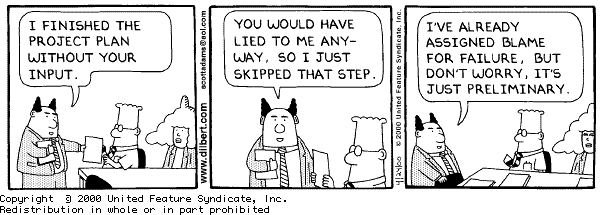
Cartoon – Pandemic Leadership

Cartoon – Leadership Today | HENRY KOTULA

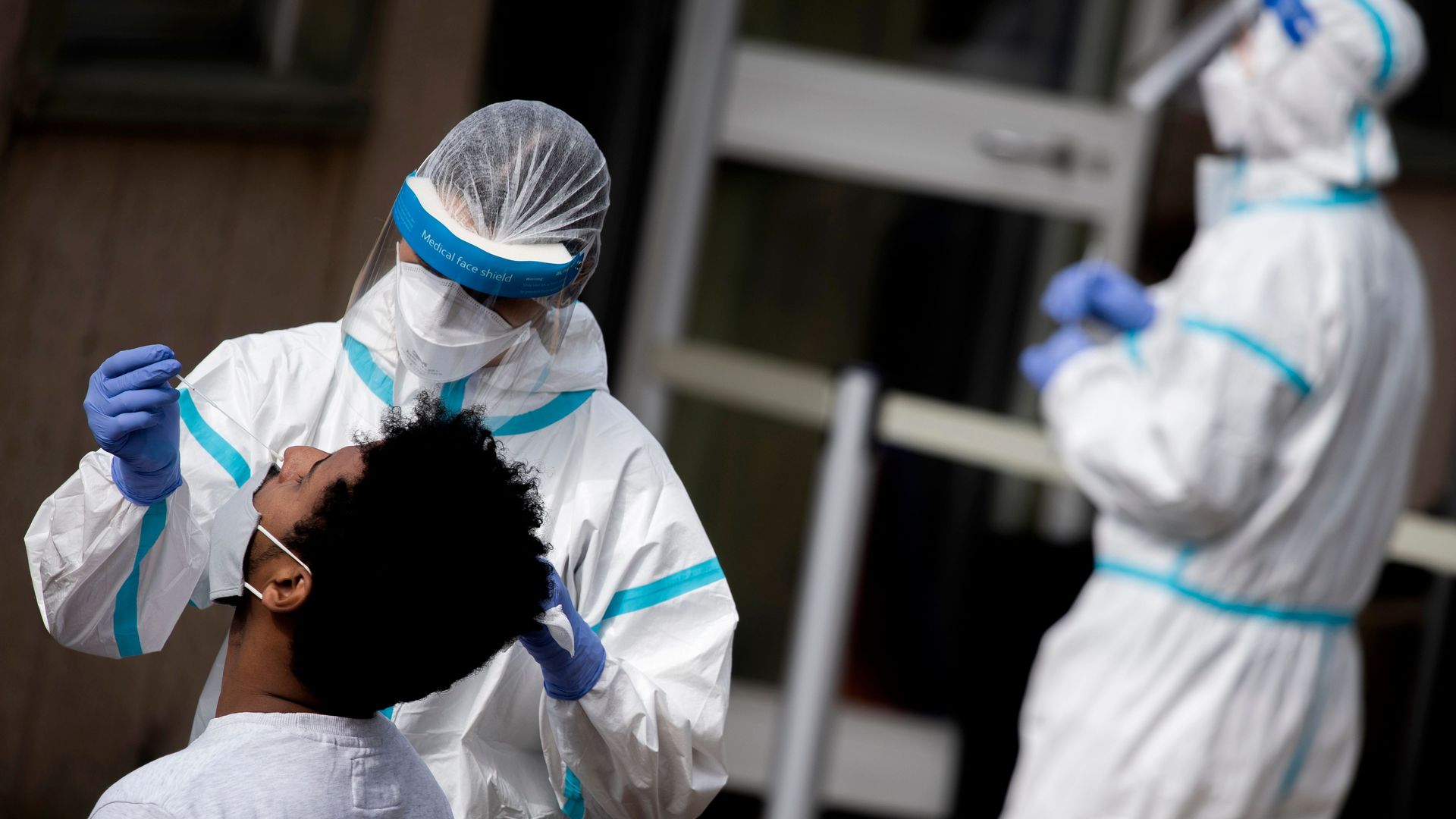
The huge return on investing in coronavirus tests

Report: Government spending on testing and tracing pays for itself more  than 30 times over - Axios

Government spending on testing and contact tracing pays for itself more than 30 times over, according to yet another paper published in JAMA (good series!).

What they found: Harvard economists David Cutler and Lawrence Summers calculated the total cost of the coronavirus pandemic at more than $16 trillion in the U.S. alone. Of that, about $7 trillion is attributable to loss of life and long-term impairment from the disease, Axios’ Felix Salmon writes.

  • Enhanced testing and tracing would cost about $6 million per 100,000 inhabitants, they calculate. Out of that population, 14 lives would be saved, on which they place a value of $96 million, and 33 critical and severe cases would be avoided, representing savings of $80 million.
  • That adds up to $176 million in benefits from $6 million in costs — before taking into account any second-order effects from even fewer cases down the road.

The bottom line: “Currently, the U.S. prioritizes spending on acute treatment,” write Cutler and Summers, “with far less spending on public health services and infrastructure.”

  • Going forward, they write, “a minimum of 5% of any COVID economic relief intervention should be devoted to such health measures.”