The Three In-bound Truth Bombs set to Explode in U.S. Healthcare

In Sunday’s Axios’ AM, Mike Allen observed “Republicans know immigration alone could sink Biden. So, Trump and House Republicans will kill anything, even if it meets or exceeds their wishes. Biden knows immigration alone could sink him. So he’s willing to accept what he once considered unacceptable — to save himself.”

Mike called this a “truth Bomb” and he’s probably right: the polarizing issue of immigration is tantamount to a bomb falling on the political system forcing well-entrenched factions to re-think and alter their strategies.

In 2024, in U.S. healthcare, three truth bombs are in-bound. They’re the culmination of shifts in the U.S.’ economic, demographic, social and political environment and fueled by accelerants in social media and Big Data.

Truth bomb: The regulatory protections that have buoyed the industry’s growth are no longer secure. 

Despite years of effectively lobbying for protections and money, the industry’s major trade groups face increasingly hostile audiences in city hall, state houses and the U.S. Congress.

The focus of these: the business practices that regulators think protect the status quo at the public’s expense. Example: while the U.S. House spent last week in their districts, Senate Committees held high profile hearings about Medicare Advantage marketing tactics (Finance Committee), consumer protections in assisted living (Special Committee on Aging), drug addiction and the opioid misuse (Banking) and drug pricing (HELP). In states, legislators are rationalizing budgets for Medicaid and public health against education, crime and cybersecurity and lifting scope of practice constraints that limit access.

Drug makers face challenges to patents (“march in rights”) and state-imposed price controls. The FTC and DOJ are challenging hospital consolidation they think potentially harmful to consumer choice and so. Regulators and lawmakers are less receptive to sector-specific wish lists and more supportive of populist-popular rules that advance transparency, disable business relationships that limit consumer choices and cede more control to individuals. Given that the industry is built on a business-to-business (B2B) chassis, preparing for a business to consumer (B2C) time bomb will be uncomfortable for most.

Truth bomb: Affordability in U.S. is not its priority.

The Patient Protection and Affordability Act 2010 advanced the notion that annual healthcare spending growth should not exceed more than 1% of the annual GDP.  It also advanced the premise that spending should not exceed 9.5% of household adjusted gross income (AGI) and associated affordability with access to insurance coverage offering subsidies and Medicaid expansion incentives to achieve near-universal coverage. In 2024, that percentage is 8.39%.

Like many elements of the ACA, these constructs fell short: coverage became its focus; affordability secondary.

The ranks of the uninsured shrank to 9% even as annual aggregate spending increased more than 4%/year. But employers and privately insured individuals saw their costs increase at a double-digit pace: in the process, 41% of the U.S. population now have unpaid medical debt: 45% of these have income above $90,000 and 61% have health insurance coverage. As it turns out, having insurance is no panacea for affordability: premiums increase just as hospital, drug and other costs increase and many lower- and middle-income consumers opt for high-deductible plans that expose them to financial insecurity. While lowering spending through value-based purchasing and alternative payments have shown promise, medical inflation in the healthcare supply chain, unrestricted pricing in many sectors, the influx of private equity investing seeking profit maximization for their GPs, and dependence on high-deductible insurance coverage have negated affordability gains for consumers and increasingly employers. Benign neglect for affordability is seemingly hardwired in the system psyche, more aligned with soundbites than substance.

Truth bomb: The effectiveness of the system is overblown.

Numerous peer reviewed studies have quantified clinical and administrative flaws in the system.  For instance, a recent peer reviewed analysis in the British Medical Journal concluded “An estimated 795 000 Americans become permanently disabled or die annually across care settings because dangerous diseases are misdiagnosed. Just 15 diseases account for about 50.7% of all serious harms, so the problem may be more tractable than previously imagined.”

The inadequacy of personnel and funding in primary and preventive health services is well-documented as the administrative burden of the system—almost 20% of its spending.  Satisfaction is low. Outcomes are impressive for hard-to-diagnose and treat conditions but modest at best for routine care. It’s easier to talk about value than define and measure it in our system: that allows everyone to declare their value propositions without challenge.

Truth bombs are falling in U.S. healthcare. They’re well-documented and financed. They take no prisoners and exact mass casualties.

Most healthcare organizations default to comfortable defenses. That’s not enough. Cyberwarfare, precision-guided drones and dirty bombs require a modernized defense. Lacking that, the system will be a commoditized public utility for most in 15 years.

PS: Last week’s report, “The Holy War between Hospitals and Insurers…” (The Keckley Report – Paul Keckley) prompted understandable frustration from hospitals that believe insurers do not serve the public good at a level commensurate with the advantages they enjoy in the industry. However, justified, pushback by hospitals against insurers should be framed in the longer-term context of the role and scope of services each should play in the system long-term. There are good people in both sectors attempting to serve the public good. It’s not about bad people; it’s about a flawed system.

The Five Most Interesting Transactions Announced in 2023

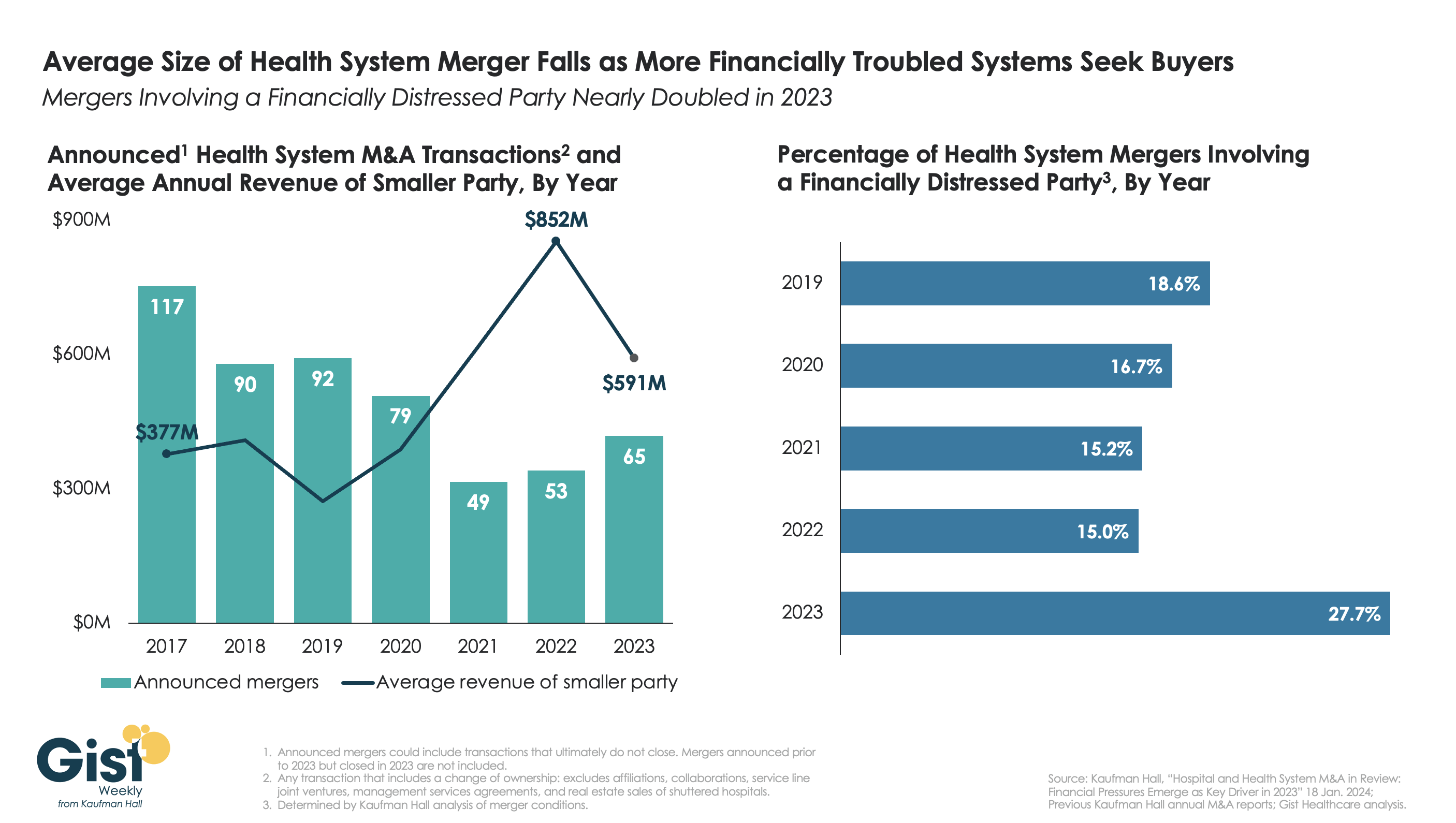
Earlier this month, we released our year-end report on hospital and health system M&A activity in 2023. As a follow-up to that report, here are our thoughts on the five most interesting transactions announced in the past year.[1]

  1. The creation of Risant Health and its planned acquisition of Geisinger Health. This was the transaction that created the most buzz in 2023, promising the formation of a platform—supported by Kaiser Permanente—dedicated to the advancement of value-based care. Risant Health will be created by the Kaiser Foundation Hospitals and will acquire Geisinger as its first member. It will seek to add additional systems to the platform once the acquisition of Geisinger has been finalized.
  2. Novant Health’s acquisition of three hospitals from Tenet Healthcare. This transaction represented several of the 2023 M&A trends highlighted in our year-end report. It offers an example of for-profit health system portfolio realignmentTenet announced that the proceeds of the sale—a pre-tax book gain of approximately $1.6 billion—will be used primarily for debt retirement. It also offers an example of regional market development, as Novant continues to expand its network in North and South Carolina. And with a valuation of the deal at 16 times adjusted EBITDA—based on the $2.4 billion sale price and $150 million adjusted EBITDA reported in the press release—this transaction reflects the value of investing in high-growth markets: in this case, coastal South Carolina.
  3. Henry Ford Health System’s joint venture with Ascension. Offering another example of regional market development, this transaction, when finalized, would also provide an example of how secular and faith-based organizations can work together in partnership. The press release announcing the transaction noted that both organizations “are committed to working to maintain the Catholic identity of the Ascension Michigan facilities included in the transaction.”
  4. The combination of BJC Health System and Saint Luke’s Health System. This transaction, announced in May 2023, closed on January 1, 2024, and provides an example of the cross-market transactions that have emerged as a significant trend in hospital and health system M&A. Also—given the relatively close geographic alignment of the two systems—it provides another example of regional market development. It is the largest of the regional development transactions called out in our year-end report: others included the Novant/Tenet transaction described above, as well as the combination of Froedtert Health and ThedaCare in eastern Wisconsin and Vandalia Health’s development of a statewide network in West Virginia.[2]
  5. Centura Health’s acquisition of Steward Health’s Utah care sites. In another example of a for-profit system divesting its interest in a geographic market, Steward Health announced the sale of its Utah care sites—including five hospitals and more than 35 medical group clinics—to Centura Health, which is part of CommonSpirit Health. CommonSpirit will own the assets, which will be managed by Centura Health. For Centura, the transaction offers an opportunity to enter the growing Utah market, which has demographics similar to its home base in Colorado.

We are early in the year, but 2024 has started with a bang: the announced acquisition of Summa Health, based in Akron, Ohio, by General Catalyst’s Healthcare Assurance Transformation Corporation (HATCo).[3]  The acquisition, when completed, would launch HATCo on its path to fulfill one of the three goals set forth during the October 2023 announcement of its formation: “acquiring and operating a health system for the long term where we can demonstrate the blueprint of [healthcare] transformation for the rest of the industry.”

The Leadership Theories of Coach John Wooden: “Be Quick—But Don’t Hurry”

The struggle continues as hospital executives work overtime to return their organizations to necessary profitability, essential competitiveness, and offering an appropriate level of clinical access.

As noted in this blog several months ago, management guru Peter Drucker always maintained that hospitals were the hardest of all American organizations to run successfully. If Drucker were still alive, he would—without question—double down on that observation.

The question must be asked whether historical hospital leadership structures and strategies are still adequate to cope with a fast-changing healthcare industry that features a different level of financial problems, an unrecognizable workforce, and a shape-shifting patient population? This is a leadership question that requires a thoughtful and sophisticated answer.

To paraphrase Albert Einstein, we cannot solve our hospital management problems with the same level of leadership that created them.

So, we are collectively on the hunt for leadership and managerial solutions. The leadership ideas must be different, original, and challenge conventional thinking. Successful healthcare executives these days must be active readers and learners. Winning ideas are everywhere but you need to be both curious and aggressive to find them.

In that regard, let’s turn our curiosity toward the theories and teachings of Coach John Wooden. For our younger readers, John Wooden was the coach of the of the UCLA men’s basketball program from 1948 to 1975. During that time, he won 10 NCAA national championships in 12 years and at one point his teams won 88 games in a row. ESPN’s “Page 2” readers voted him the greatest coach of all time.

But John Wooden wasn’t just a basketball coach; he was a manager, an executive, a teacher, and a philosopher. There was nothing random or laissez-faire about his approach to leadership. Coach Wooden led through a series of principles that he applied with absolute consistency.

Players changed, the opposition changed, and external factors changed, but Coach Wooden’s essential approach to leadership did not vary or change.

The central tenet of Coach Wooden’s leadership philosophy was the somewhat Zen-like principle of “be quick—but don’t hurry.”

At first blush, this organizing principle doesn’t seem to make much sense, especially to the casual reader. John Wooden believed and taught that there were two keys to successful performance, both in sports and otherwise. First, quickness and a sense of urgency was absolutely necessary to winning in a competitive environment. But for Coach Wooden, quickness itself was not sufficient for consistent success. Quickness had to be accompanied by emotional and professional balance in order to achieve team and organizational excellence. So, from Coach Wooden’s perspective, a great athlete or a great executive had to not just move and think quickly, but also had to make sure that he or she was moving to a place of personal balance. Coach Wooden believed that this concept of personal balance was the key to real success at both the team and individual level. To find that place of balance you needed to be quick, but to retain that balance you had to be sure not to hurry. In other words, “be quick—but don’t hurry.”

“Be quick—but don’t hurry” was the central principle of John Wooden’s leadership style but “be quick—but don’t hurry” was also the platform on which an entire management and leadership theory was built. This led to other key Wooden tenets including:

  1. Focus on Effort, Not Winning. Amazingly for a coach that won 10 national championships, the UCLA players always said that Coach Wooden never talked much about winning. Instead, he talked about individual and team effort. He talked about the process, the belief that the right leadership combined with exceptional effort would inevitably deliver remarkable results.
  2. A Good Leader Is First a Teacher. John Wooden’s first job out of college was teaching high school English. And for the rest of his career, he always thought of himself as a teacher. Wooden taught through four components: demonstration, imitation, correction, and repetition. Coach Wooden had this absolutely right from my perspective: To be a great leader and executive, you almost always have to be a great teacher first.
  3. Teamwork Is a Necessity. Bill Walton, one of Coach Wooden’s most accomplished and greatest players, said it best: “Coach Wooden challenged us to believe that something special could come from the group effort. We live in a society that is constantly pushing us to be individual, to be selfish. But Coach Wooden constantly focused on the group, and how there could be no success unless everybody believed in the same goal and everybody came out of there feeling good about the success of others.”
  4. Failing to Prepare Is Preparing to Fail. This quote is often attributed to Coach Wooden, but it was first said by Benjamin Franklin. Coach Wooden was extraordinarily well-prepared. Even after years and years of amazing and unprecedented success, Coach Wooden still scripted each and every practice. He was famous for arriving to practice early to make sure everything was in order and that, in fact, he and the team were completely prepared to get the most out of that afternoon. Hospitals and health systems have “practices” as well: They are called “meetings.” What is the standard for preparation in your hospital organization? What is the quality of the work both before and after meetings? What is the level of preparation for consequential meetings such as rating agency presentations, Board approval of major initiatives, and important discussions with external parties? The longer my consulting and business career goes on, the more I have come to believe in and rely on impeccable preparation.

This blog covers just a few of Coach Wooden’s many approaches to and commentaries on management and leadership. But the above observations are a useful start. It is important to disclose that this blog post was guided by and drew quotes from an excellent book, Be Quick—But Don’t Hurry: Finding Success in the Teachings of a Lifetime, which was written by Andrew Hill (a former UCLA player) with the assistance of John Wooden. The book was published by Simon & Schuster in 2001 but as readers can easily see, the book by Messrs. Hill and Wooden remains absolutely relevant today. The book is a short read but will prove to be a good use of your time and your curiosity.

Learn and be smart. Those are the key attributes for today’s healthcare executives. Yesterday’s executive techniques are no longer getting the job done. Hospital leaders must be better in order to deal with the long list of obstacles that are preventing hospital success. Coach Wooden invented a unique roadmap to executive learning and leadership. That Wooden roadmap is definitely “old school,” but that roadmap and its attendant theories and methods are absolutely worth your attention.

Expanding beyond patient experience 

https://mailchi.mp/cd8b8b492027/the-weekly-gist-january-26-2024?e=d1e747d2d8

In this week’s graphic, we highlight the importance of broadening the domain of health system experience initiatives beyond patients to include consumers and even employees.

While reimbursements tied to HCAHPS (Hospital Consumer Assessment of Healthcare Providers and Systems) and CG-CAHPS (Clinician and Group Consumer Assessment of Healthcare Providers and Systems) scores have made patient experience a main focus for years, an increasingly consumer-driven healthcare industry means that health systems must consider the experience of all consumers in their markets, with the hopes of meeting their needs and eventually welcoming them as new—or retuning—patients. 

Embracing this mindset requires focusing on the entirety of a consumer’s interactions with the health system and the tracking of non-traditional metrics that measure the strength and value of their relationship to the system. Some systems are expanding their experience purview even further by also focusing on the working conditions and morale of their providers and other staff, as a healthy workplace environment serves to better both the patient and consumer experience. Easily accessible services and positive interactions with providers and other staff can determine a consumer’s view of their experience before any care is actually delivered. 

Cultural and strategic shifts that integrate experience from the top down into all operational facets of the health system will ultimately strengthen consumer loyalty, employee retention, and the financial health of the system.

Is our collaborative culture slowing down our ability to act quickly? 

https://mailchi.mp/cd8b8b492027/the-weekly-gist-january-26-2024?e=d1e747d2d8

“We have a collaborative culture; it’s one of our system’s core values. But it takes us far too long to make decisions.” A health system CEO made this comment at a recent meeting, giving voice to a dilemma many system executives are no doubt facing. Of course, leaders want their teams to collaborate—in any important decision, we want to hear different voices, consider diverse points of view, and incorporate various areas of expertise.

On the other hand, collaboration takes time, which we don’t have right now. It also can add complexity, be the enemy of clear direction, and muddy accountability. This CEO went on to make an essential connection: “My concern is that this protracted decision making isn’t just a process problem, but that it’s showing up in our results. 

Take performance improvement—we all quickly agreed we need to cut costs, but it’s taking far too long for us to act, and I fear we’ll have trouble holding the new line over time.” She further mused 

“I wonder if this problem is, at least in part, due to how we make decisions. We don’t make them quickly enough, they aren’t clear enough, and we don’t have the most effective system of accountability.”


On one hand, traditional hospital culture is rightly grounded in the safety, hierarchy, and tradition of a do-no-harm world. But on the other hand, today’s economic, technological, and competitive environments require an approach to operations, revenue, and growth that has the aggressiveness of a Fortune 50 company. This should not be an either-or situation. Health systems can uphold a culture of safety while also fostering nontraditional values that will drive the organization assertively toward the future – all while committing to change.

Big pharma entering the direct-to-consumer (DTC) prescription fray

https://mailchi.mp/cd8b8b492027/the-weekly-gist-january-26-2024?e=d1e747d2d8

Recently published in Stat, this article outlines how the launch of telehealth platforms by pharmaceutical companies, most notably Eli Lilly’s LillyDirect, portends a gamechanger for DTC prescription marketing

Spurred by the escalating demand for Eli Lilly’s Zepbound and Mounjaro GLP-1 drugs, LillyDirect connects consumers with a third-party telehealth provider for prescriptions, an online pharmacy for fulfillment, and in-house payment support through streamlined coupon applications and prior authorization troubleshooting. In exchange, Eli Lilly gets access to reams of patient data, in addition to boosted sales. Pharma companies insist that the platforms have proper firewalls in place, as no money directly changes hands between them and their affiliated telehealth providers.

The Gist: With so manyothercompanies hopping on the GLP-1 virtual prescription bandwagon, it’s no wonder why pharma companies are opting to enter the market directly. What LillyDirect offers is not fundamentally different than platforms like Ro or Teladoc: using telehealth to blur the lines between prescription and over-the-counter medications by empowering consumers to seek out the care they want. 

However, Eli Lilly’s control of the drug supply, ability to offer coupons, relationships with pharmacy benefit managers, and inherent brand association with the drugs give it a leg up on the competition. 

By replacing “talk to your doctor about” with “visit our website for”, these consumer-focused platforms perpetuate the ongoing fragmentation of care and risk tapping into the potentially harmful side of consumerization in healthcare.

Intermountain’s Saltzer Health seeks buyer or risks closure

https://mailchi.mp/cd8b8b492027/the-weekly-gist-january-26-2024?e=d1e747d2d8

Saltzer Health, a Meridian, ID-based multispecialty group with over 100 providers that’s been owned by Intermountain Health since 2020, shared this week that it will shut down if it cannot find a buyer within the next two months, due to its ongoing financial and economic challenges. Beyond the rising costs of care that have plagued provider organizations across the country, Saltzer leaders pointed to a lack of progress around contracts and market relationships in its Boise, ID service area as contributing factors. The group announced that it’s in active negotiations with other healthcare companies potentially interested in purchasing some of its assets, and is optimistic it can avoid full closure.

Saltzer has experienced several ownership changes in recent years: Intermountain bought the group from development firm Ball Ventures Ahlquist in 2020, which had purchased it from Change Healthcare in 2019. Change acquired it two years prior after a Federal Trade Commission (FTC) challenge led to Saltzer’s divestment from St. Luke’s Health System. 

The Gist: It’s notable that Intermountain appears uninterested in continuing to grow its presence as a provider in the Boise market, suggesting the system is opting to instead focus its resources on faster growing markets like Denver, which it unlocked through its purchase of SCL Health in 2022.

Given that the FTC previously signaled opposition to Saltzer’s acquisition by a local health system, and a dominant regional integrated delivery system is no longer interested in the group, a nontraditional buyer—like a vertically integrated payer—may use this as an opportunity to enter the Treasure Valley and attempt to steal market share from Intermountain’s Select Health insurance arm.

General Catalyst to buy Summa Health

https://mailchi.mp/cd8b8b492027/the-weekly-gist-january-26-2024?e=d1e747d2d8

Last week, venture capital firm General Catalyst announced its plan to acquire Summa Health, an Akron, OH-based integrated delivery system with three hospitals, a large medical group, a health plan, and an annual revenue of around $2B. The terms of the deal were not disclosed, though General Catalyst previously indicated it aimed to spend $1-3B to acquire a health system.

Pending regulatory approval, Summa will convert to a for-profit entity and become a fully owned subsidiary of General Catalyst’s recently launched Health Assurance Transformation Corporation (HATCo).

HATCo, under the leadership of former Intermountain Health CEO Marc Harrison, was founded with the intention of acquiring a health system to serve as a blueprint for General Catalyst’s vision of healthcare transformation.

The Gist: While there’s a dearth of evidence for what kind of health system makes a good venture capital investment, Summa’s concentrated footprint of integrated delivery assets, robust Medicare Advantage plan, and position in an aging, yet competitive, market certainly seem attractive given HATCo’s stated goals. 

If it closes, the partnership will provide Summa with an influx of capital and General Catalyst with a “proving ground” for both its vision of healthcare transformation and its portfolio of technology solutions. But while it’s one thing to get Summa’s board to sign on, General Catalyst will now have to reckon with other important stakeholders. 

Summa’s physicians will be the gatekeepers of change at the local level, and their buy-in will be required for any continued push toward value-based care or successful product roll-out. 

And, behind the scenes, General Catalyst will have to convince its investors that this longer-term play to rethink care delivery will offer financial returns worth the wait.