Do Medicare Advantage Networks Vary by Plan within Contract?

Medicare Advantage (MA) is the private insurance alternative to traditional Medicare. MA organizations contract with Centers for Medicare and Medicaid Services (CMS) to offer eligible beneficiaries residing in a defined geographic service area (a collection of counties) a selection of private plans. Insurers may offer multiple plans across different plan types under one contract. The service area is defined at the contract-level, and for most MA plans, service areas can include a single county or a collection of multiple counties. (There are other types of plans for which there are constraints on the boundaries of the service area, but these don’t account for very much of MA enrollment.)

As MA-offering insurers contract with CMS, they establish networks that govern patient liability for seeing in- and out-of-network providers. Consequently, plans will vary in their cost-sharing structures and benefit designs as they assume different levels of liability for the cost of out-of-network providers. Overall, plans will cover the cost of care (less copays and deductibles) for patients seeing providers in-network, and certain plan types may require that patients pay more for out-of-network services or receive referrals/prior authorization from primary care providers (PCP) to see specialists.

The most common plan types offered by MA insurers include the following:

  • Preferred Provider Organizations (PPOs) are considered the most flexible type of plan in providing access to care and covering it out-of-network. PPO enrollees can use out-of-network providers for covered services without a referral from a PCP, albeit at greater cost to them than in-network providers.
  • Health Maintenance Organizations (HMOs), in comparison to PPOs, are more restrictive plans that provide less access to care and less coverage for out-of-network providers, with the exception of emergency, urgent, and dialysis care. HMO members are required to select a PCP and must get authorization for most specialty services. For any out-of-network services received, the patient bears the full cost, up to the traditional Medicare rate.
  • Health Maintenance Organization Point-of- Service (HMO-POS) are a hybrid plan between PPOs and HMOs. Like an HMO, members must select a PCP for care coordination, but they do not need a referral for specialty services. (However, some services may require prior authorization for coverage.) Like a PPO, this plan does provide some coverage for out-of-network providers.

The differences across plan types in access to and cost sharing for out-of-network providers leads to the important question, do MA networks vary by plan within contract? For example, in Figure 1 below, do the beneficiaries enrolled in Plan 1 or 2 under Contract A have the same set of in- and out-of-network providers (likewise for the beneficiaries in Plans 1-3 under contract B)? More specifically, what if Plan 1 is an HMO and Plan 2 is a HMO-POS plan, do they share the same network?

Figure 1: CMS Medicare Advantage and Part D Contract and Plan Enumeration (2010). Source: https://ncvhs.hhs.gov/wp-content/uploads/2014/05/100719p08.pdf

The simple answer seems to be: not necessarily, though more recent regulations attempt to push insurers toward having the same networks across plans within contracts.

For instance, prior to 2019, CMS only reviewed the adequacy of an MA organization’s contracted network under a “triggering event,” like if an organization were to operate a new plan, expand coverage to additional service areas, or in a response to inadequate network complaints. The scope of CMS’ review varied depending on the triggering event that occurred. In some cases, CMS could only conduct partial reviews of a contract’s network, looking at a select set of specialties or counties. A study by the US Government Accountability Office found that between 2013 and 2015, CMS had reviewed less than 1% of all networks. Without regular scrutiny by regulators, it seems likely that networks varied across plans within contracts.

Under the current MA Network Adequacy Criteria Guidance, CMS assesses network adequacy requirements both under triggering events (as explained above) and, separate from that, on a triennial-basis at the contract-level. CMS has previously commented in the 2021 Final Rule that this approach allows them to assess the adequacy of organizations’ networks across all of their plan types (HMOs, PPOs, SNPs) and consider the broadest availability of providers and facilities for an organization. Again, this suggests that insurers may vary networks across plans within contracts.

There are at least two scenarios for which we know certain plans can and likely do have different networks compared with other plans in the contract.

  • Special Needs Plans (SNPs) are plans designed for individuals with specific diseases or characteristics, such as those who are dual-eligible, have institutional care needs, or have a chronic condition. SNPs can be allowed by regulators to augment the contract’s network to integrate care management teams and specialty providers to accommodate beneficiaries’ complex care needs under the plan’s Model of Care. While SNPs may be granted additional flexibility to alter the contract-level networks established, CMS does not allow SNPs to narrow or shrink that network. They can only expand it.
  • Provider Specific Plan (PSPs) are plans often found under large, integrated medical groups or provider groups that are the primary bearers of risk. PSP enrollees have access to a smaller subset of in-network providers. Since this plan type has a network of fewer providers than the overall contracted network, organizations must request to offer a PSP from CMS and attest that these plans are in compliance with network adequacy requirements.

Future work with Vericred provider-network data could be one approach to exploring variations in networks among plans under the same contract and service area, beyond the cases listed above. If networks are varying across HMO, PPO, and HMO-POS plans within contracts, it would be interesting to explore just how different they are from one another. Moreover, as CMS reviews continues to review network adequacy requirements at the contract-level (and if networks do differ by plan), one should consider the breadth of the network that organizations are submitting for evaluation. To what extent all plans in a contract are in compliance with network adequacy rules warrants future investigation.

When a Medicaid Card Isn’t Enough

tradeoffs.org/2022/05/17/medicaid-physician-access/

A certain segment of the health policy world spends a lot of time trying to get more states to expand Medicaid and reduce underinsurance.

But are we doing enough to make sure care is accessible once people enroll? One issue is access to physicians, who are less likely to treat patients on Medicaid than Medicare or private insurance because Medicaid payment rates are lower.

A new paper in Health Affairs by Avital Ludomirsky and colleagues looked at how well the networks of physicians supposedly participating in Medicaid reflect access to care. The researchers used claims data and provider directories from Medicaid managed care plans (the private insurers that most states contract with to run their Medicaid programs) in Kansas, Louisiana, Michigan and Tennessee from 2015 and 2017 to assess how the delivery of care to Medicaid patients was distributed among participating doctors. Their results were striking:

  • One-quarter of primary care physicians provided 86% of the care; one-quarter of specialists provided 75%.
  • One-third of both types of physicians saw fewer than 10 Medicaid patients per year, hardly contributing any “access” at all.
  • There was only one psychiatrist for every 8,834 Medicaid enrollees after excluding those seeing fewer than 10 Medicaid patients per year. This is especially concerning given that the COVID-19 pandemic has worsened mental health in the U.S., particularly among children

The authors note that their study only covers primary care and mental health providers in four states, so it is not necessarily generalizable to other states or specialties. But these results are still concerning.   

States have so-called network adequacy standards for their Medicaid managed care plans that are supposed to make sure there are enough providers. These standards typically rely on either a radius (a certain number of providers for a geographic area) or ratio (number of providers per enrollee), but the authors’ findings show these methods fall short if they are based on directories alone.

The authors specifically recommend states use claims-based assessments like the ones in the study and “secret shopper” programs — like this recently published one from Maryland by Abigail Burman and Simon Haeder — to better evaluate whether plans are offering adequate access to physicians. We absolutely need people to have coverage, but it needs to be more than just a card in their wallet.

Hospitals urge Justice Department to probe insurers over routine denials

The American Hospital Association, on behalf of its nearly 5,000 healthcare organizations, is urging the Justice Department to probe routine denials from commercial health insurance companies. 

Specifically, the AHA is asking the Justice Department to establish a task force to conduct False Claims Act investigations into the insurers that routinely deny payments to providers, according to a May 19 letter to the department. 

The request from the AHA comes after HHS’ Office of Inspector General released a report April 27 that found Medicare Advantage Organizations sometimes delayed or denied enrollees’ access to services although the provider’s prior authorization request met Medicare coverage rules. 

“It is time for the Department of Justice to exercise its False Claims Act authority to both punish those MAOs that have denied Medicare beneficiaries and their providers their rightful coverage and to deter future misdeeds,” the AHA said in a letter to the Justice Department. “This problem has grown so large — and has lasted for so long — that only the prospect of civil and criminal penalties can adequately prevent the widespread fraud certain MAOs are perpetrating against sick and elderly patients across the country.”

Read the full letter here.

Mass General Brigham to cut spending by $70M a year

Boston-based Mass General Brigham submitted a cost-reduction plan to Massachusetts regulators May 16, which includes a promise to cut healthcare spending by $70 million a year. 

The health system was ordered by the Massachusetts Health Policy Commission in January to develop a plan to reduce costs after the watchdog determined it had pushed healthcare spending above acceptable levels in the last few years. Specifically, the commission found that Mass General Brigham had substantially higher-than-average commercial spending from 2014 to 2019. The health system spent $293 million those years, more than any other provider in the state.

To achieve its spending reduction goal, Mass General Brigham said it would focus on four items: cutting prices, reducing utilization, shifting care to lower-cost sites and expanding value-based care. 

A key savings driver in Mass General Brigham’s plan is to lower outpatient and ConnectorCare rates to improve affordability. ConnectorCare is a program of subsidized private health insurance plans for patients whose family income doesn’t exceed 300 percent of the federal poverty level and who are not eligible for MassHealth, Medicare or other affordable health coverage. The health system expects to save about $53.8 million in spending a year through reducing these rates.

“Mass General Brigham is committed to expanding access to consumers, particularly in ambulatory care. To achieve improved access, we are focused on decreasing the price variation between Mass General Brigham pricing and the marketplace,” Mass General Brigham said in the performance improvement plan. 

The health system said it expects to save $10.8 million in spending a year by reducing unnecessary hospitalizations, emergency room visits and post-acute care and reducing use of high-cost outpatient imaging. 

The health system said it expects to save $5.3 million in spending a year by shifting care to lower-cost settings, such as moving to “hospital at home,” expanding telehealth or using other ambulatory sites. 

In addition to reducing utilization, shifting care to lower-cost sites and reducing price, Mass General Brigham said it is committed to expanding value-based care.

Mayo Clinic posts $142M operating gain, bucking national trend

Rochester, Minn.-based Mayo Clinic ended the first quarter of 2022 with an operating gain, unlike many health systems across the U.S. 

In the quarter ended March 31, Mayo Clinic recorded revenue of $3.9 billion, representing about a 7 percent increase compared to the same period one year prior. The health system saw a boost in medical service revenue and grant revenue, according to its financial report released May 19.

Mayo Clinic’s expenses also rose in the first quarter of 2022 to $3.8 billion. In the comparable quarter in 2021, Mayo Clinic’s expenses were $3.4 billion. The health system attributed the 10 percent expense increase to a boost in salaries and wages as well as supply costs. 

Mayo Clinic ended the first quarter of this year with an operating gain of $142 million. In the same quarter last year, Mayo posted operating income of $243 million.

The health system also recorded nonoperating losses of $369 million in the first quarter of 2022

Despite losses from nonoperating items, Mayo Clinic ended the quarter with $17.5 billion in net assets, up from $13.2 billion recorded in the same period one year prior.

“The year 2022 begins with new challenges that follow nearly two years of pandemic operations,” Mayo Clinic said in the financial report. “Workforce shortages and corresponding labor cost inflation, persistent supply chain disruptions and shortages, a higher interest rate environment, and capital market volatility have all taken center stage for management attention.”

CEO resignations hit record high

Dozens of hospital CEOs have resigned this year as a record number of chiefs across all industries have exited their roles, according to a May 18 Challenger, Gray & Christmas report. 

Nearly 520 CEOs left their posts between Jan. 1 and the end of April, the highest total since the executive outplacement and coaching firm began tracking CEO changes in 2002. The total is up 18 percent from the 440 CEO exits announced in the same period of 2021. 

Thirty-six hospital CEOs exited their roles in the first four months of this year. That’s up from the 20 hospital chiefs who resigned in the same period last year, according to the report. 

CEOs are leaving their positions and businesses are making changes at the top for several reasons, Challenger, Gray & Christmas Senior Vice President Andrew Challenger said. 

“Inflation, staffing shortages, and possible recession concerns are giving more cause for companies to reevaluate leadership,” Mr. Challenger said. “This, after years of companies trying to figure out the right formula to attract and retain talent and create a culture of inclusion, issues that often start at the top.”

Hospitals feel the brain drain

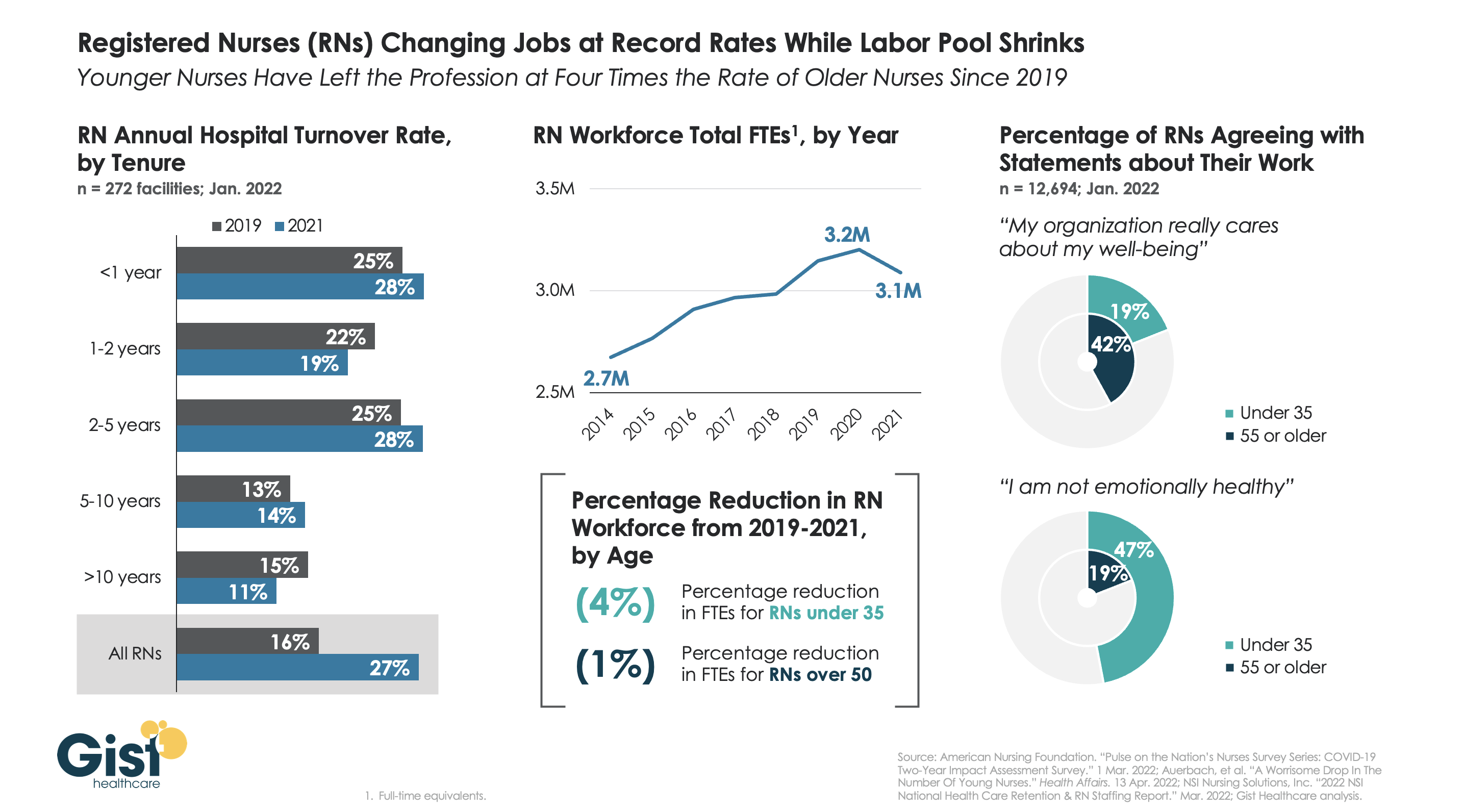
Hospitals are feeling an enduring consequence of experienced employees’ early retirements and resignations: collective knowledge loss. 

“Even when missing people can be replaced, missing knowledge cannot,” Ed Yong wrote for The Atlantic May 18. 

Beyond hospitals’ challenges in recruiting and retaining employees are the stubborn and sometimes subtle problems resulting from decreasing median tenure within their organizations. The ripple effects of losing older, seasoned employees to resignations or early retirements can be harder to quantify, but are nonetheless felt by colleagues who stay, newcomers to the organization, and patients and their families.  

Team tenure is a significant determinant to the cost and quality of hospital care. For example, a one-year increase in the average tenure of registered nurses on a hospital unit was associated with a 1.3 percent decrease in length of stay, a 2014 study from researchers at Columbia University School of Nursing and Columbia Business School found. 

“I don’t think the public really understands how great the loss of this generational knowledge is,” Kelley Cabrera, a nurse based in New York, told Mr. Yong. She described the six-week orientation for her current job, led by some people who had been in the ER for less than a year, as “shockingly short.” 

“When inexperienced recruits are trained by inexperienced staff, the knowledge deficit deepens, and not just in terms of medical procedures,” Mr. Yong wrote. “The system has also lost indispensable social savvy — how to question an inappropriate decision, or recognize when you’re out of your depth — that acts as a safeguard against medical mistakes. And with established teams now ruptured by resignations, many healthcare workers no longer know — or trust — the people at their side.”

National data on average tenure in healthcare has not yet caught up to compare with pre-pandemic longevity numbers. The median years of tenure with current employers for healthcare practitioners and technical occupations was 4.7 years in 2020, according to the most recent data from the U.S. Bureau of Labor Statistics, ticking up to five years for workers in hospitals.

The benefits of lengthy tenures are felt at the front lines as well as hospitals’ most senior levels. Marc Boom, MD, CEO of Houston Methodist, told Becker’s this year the cumulative tenure of the health system’s executive team was a game changer throughout the pandemic. At the start of the pandemic, Dr. Boom had been CEO for more than eight years and at the institution for almost 22. The executive team of nine leaders, including him, collectively shared more than 150 years of tenure with Houston Methodist. The team had worked together without any changes for about seven years, when the most recent person joined. 

This longevity lends itself to major systemwide decisions almost feeling instinctive due to their familiarity working together. “I had a team that was very tenured,” Dr. Boom said. “To work with people who you’ve known for a long period of time — you know the ins and outs, the strengths and weaknesses. You have almost an understood language. You can talk in five-word sentences, move on and everyone goes and does their thing. There are a lot of advantages to that.”

Trinity Health’s operating income slips 79% as labor costs soar


Higher labor costs put pressure on Trinity Health’s margins in the first nine months of fiscal year 2022, according to financial documents released May 20. 

Livonia, Mich.-based Trinity Health posted revenue of $15.13 billion in the nine months ended March 31, up from $15.12 billion in the same period a year earlier. The health system said net patient service revenue was up 3.3 percent year over year, primarily because of increased volume and payment rates. 

Patient volumes continue to fluctuate with COVID-19 pandemic surge and recovery waves and patient volumes are returning but have yet to return to pre-pandemic levels,” the system said in an earnings release. 

Trinity Health’s operating expenses for the first nine months of fiscal year 2022 increased by 4.8 percent year over year to $15.12 billion. The increase was attributed to a $679.8 million increase in labor costs. Contract labor expenses increased 154.2 percent during the nine-month period. 

Trinity Health reported operating income of $139.7 million in the first nine months of fiscal year 2022, down 79 percent from operating income of $653.9 million in the same period a year earlier. Operating income in the first nine months of the current fiscal year included a $128.7 million gain on the sale of Gateway Health Plan. 

After factoring in investments and nonoperating items, Trinity posted net income of $43 million for the first nine months of fiscal year 2022, down from $3.19 billion in the same period a year earlier.

6 hospital, health system deals called off this year

Six health system and hospital deals have been canceled so far this year, whether it be a scrapped merger or acquisition or the unwinding of a partnership.

1. Proposed Dartmouth Health, GraniteOne Health merger canceled
Lebanon, N.H.-based Dartmouth Health and Manchester, N.H.-based GraniteOne Health are canceling their proposed merger after the state Attorney General’s Office said the move would violate the New Hampshire constitution, according to VTDigger.

2. Hackensack Meridian, Englewood withdraw merger plans
Edison, N.J.-based Hackensack Meridian Health and Englewood (N.J.) Health have dropped their merger plans, a spokesperson for Hackensack Meridian told Becker’s.

3. Canyon Atlantic ends bid to buy 2 Pennsylvania hospitals
The prospective buyer of two shuttered Pennsylvania hospitals has filed a motion to end litigation to purchase the facilities, The Daily Local reported March 8.

4. Lifespan, Care New England withdraw merger application
The boards of Lifespan and Care New England — both based in Providence, R.I. — have decided to withdraw their merger application after the Federal Trade Commission made an announcement Feb. 17 it would file suit to block the deal.

5. Hoag, Providence to split: 5 things to know
Hoag Memorial Hospital Presbyterian in Newport Beach, Calif., and Providence, a Catholic health system based in Renton, Wash., said they would end their affiliation in January.

6. Trinity Health won’t buy Tower Health hospital
Trinity Health Mid-Atlantic has abandoned its plan to buy Tower Health’s Chestnut Hill Hospital in Philadelphia, according to the Philadelphia Inquirer.