Pandemic spurs national union activity among hospital workers

https://www.healthcaredive.com/trendline/labor/28/?utm_source=HD&utm_medium=Library&utm_campaign=Vituity&utm_term=Healthcare%20Dive#story-1

When COVID-19 cases swelled in New York and other northern states this spring, Erik Andrews, a rapid response nurse at Riverside Community Hospital in southern California, thought his hospital should have enough time to prepare for the worst.

Instead, he said his hospital faced staffing cuts and a lack of adequate personal protective equipment that led around 600 of its nurses to strike for 10 days starting in late June, just before negotiating a new contract with the hospital and its owner, Nashville-based HCA Healthcare.

“To feel like you were just put out there on the front lines with as minimal support necessary was incredibly disheartening,” Andrews said. Two employees at RCH have died from COVID-19, according to SEIU Local 121RN, the union representing them.

A spokesperson for HCA told Healthcare Dive the “strike has very little to do with the best interest of their members and everything to do with contract negotiations.”

Across the country, the pandemic is exacerbating labor tensions with nurses and other healthcare workers, leading to a string of disputes around what health systems are doing to keep front-line staff safe. The workers’ main concerns are adequate staffing and PPE. Ongoing or upcoming contract negotiations could boost their leverage.

But many of the systems that employ these workers are themselves stressed in a number of ways, above all financially, after months of delayed elective procedures and depleted volumes. Many have instituted furloughs and layoffs or other workforce reduction measures.

Striking a balance between doing union action at hospitals and continuing care for patients could be an ongoing challenge, Patricia Campos-Medina, co-director of New York State AFL-CIO/Cornell Union Leadership Institute.

“The nurses association has been very active since the beginning of the crisis, demanding PPE and doing internal activities in their hospitals demanding proper procedures,” Campos-Medina said. “They are front-line workers, so they have to be thoughtful in how they continue to provide care but also protect themselves and their patients.”

At Prime Healthcare’s Encino Hospital Medical Center, just outside Los Angeles, medical staff voted to unionize July 5, a week after the hospital laid off about half of its staff, including its entire clinical lab team, according to SEIU Local 121RN, which now represents those workers.

One of the first things the newly formed union will fight is “the unjust layoffs of their colleagues,” it said in a statement.

A Prime Healthcare spokesperson told Healthcare Dive 25 positions were cut. “These Encino positions were not part of front-line care and involved departments such as HR, food services, and lab services,” the system said.

Hospital service workers elsewhere who already have bargaining rights are also bringing attention to what they deem as staffing and safety issues.

In Chicago, workers at Loretto Hospital voted to authorize a strike Thursday. Those workers include patient care technicians, emergency room technicians, mental health staff and dietary and housekeeping staff, according to SEIU Healthcare Illinois, the union that represents them. They’ve been bargaining with hospital management for a new contract since December and plan to go on strike July 20.

Loretto Hospital is a safety-net facility, catering primarily to “Black and Brown West Side communities plagued with disproportionate numbers of COVID illnesses and deaths in recent months,” the union said.

The “Strike For Black Lives” is in response to “management’s failure to bargain in good faith on critical issues impacting the safety and well-being of both workers and patients — including poverty level wages and short staffing,” according to the union.

A Loretto spokesperson told Healthcare Dive the system is hopeful that continuing negotiations will bring an agreement, though it’s “planning as if a strike is eminent and considering the best options to continue to provide healthcare services to our community.”

Meanwhile in Joliet, Illinois, more than 700 nurses at Amita St. Joseph Medical Center went on strike July 4.

The Illinois Nurses Association which represents Amita nurses, cited ongoing concerns about staff and patient safety during the pandemic, namely adequate PPE, nurse-to-patient ratios and sick pay, they want addressed in the next contract. They are currently bargaining for a new one, and said negotiations stalled. The duration of the strike is still unclear.

However, a hospital spokesperson told Healthcare Dive, “Negotiations have been ongoing with proposals and counter proposals exchanged.”

The hospital’s most recent proposal “was not accepted, but negotiations will continue,” the system said.

INA is also upset with Amita’s recruitment of out-of-state nurses to replace striking ones during the COVID-19 pandemic.

It sent a letter to the Illinois Department of Financial and Professional Regulation, asserting the hospital used “emergency permits that are intended only for responding to the pandemic for purposes of aiding the hospital in a labor dispute.”


ANALYSIS: ADMINISTRATION’S CORONAVIRUS ADVICE IS SECRET, FRAGMENTED AND CONTRADICTORY

Analysis: Trump administration’s coronavirus advice is secret, fragmented and contradictory

Analysis: Trump administration's coronavirus advice is secret, fragmented  and contradictory – Center for Public Integrity

ANALYSIS: TRUMP ADMINISTRATION’S CORONAVIRUS ADVICE IS SECRET, FRAGMENTED AND CONTRADICTORY

Dr. Deborah Birx speaks to reporters in the rotunda of the State Capitol in Lincoln, Neb., Aug. 14, 2020, after meeting with Gov. Pete Ricketts and community and state health officials. (AP Photo/Nati Harnik)

Private calls and unpublished reports leave many Americans and local officials in the dark.


INTRODUCTION

This is a news analysis from the Center for Public Integrity.

From behind a podium and a black mask, Tulsa mayor G.T. Bynum faced the press. It was late July, and one percent of his city had tested positive for COVID-19 since the beginning of the pandemic.


A reporter had a question: What did Bynum have to say about the newly leaked White House Coronavirus Task Force document that recommended Tulsa close bars and limit gatherings to 10 people?

The “alleged White House document” was “never officially presented to us … by either the federal government or the state government,” the mayor said. But he was familiar with the document’s recommendations, having read them online. “All of that remains very much on the table.” 

Fast-forward a month, at a press conference that looked exactly like the last, and Bynum still hadn’t received any of the weekly reports from the White House. “It was news to me that there had been eight different reports. I only knew about the one that was leaked to the media,” he said. “That’s all data that, of course, we would like to know.”

Indeed, the White House reports — chock full of local data and recommendations — would be useful for many city leaders, many of whom still don’t know what percentage of coronavirus tests in their metro areas are positive. But Bynum and others didn’t have that information. The White House was sending each state’s report directly to its governor and a select group of other officials instead of distributing the documents widely or posting them publicly.

The nation’s coronavirus response must be “locally executed, state managed, federally supported,” White House officials have said repeatedly. In fact, much of their public health advice has been secret, segmented and inconsistent. Federal guidance isn’t always reaching the local officials it’s meant to support. And scattershot messages mean that average citizens weighing visits to grandparents or countless other daily risks have limited  — and sometimes conflicting — information from the officials they are expected to trust.


THE SUMMER OF SECRET WARNINGS

In late June, the White House Coronavirus Task Force began sending reports to governors showing how their states were faring in the pandemic. Dr. Deborah Birx, a leader of the task force, held the documents aloft at a press conference July 8, but they weren’t distributed to reporters. Birx said several states were in the coronavirus “red zone — with high numbers of cases — and should take special precautions, but Vice President Mike Pence delivered the primary message of the press conference: Reopen schools.

Later that month, the Center for Public Integrity obtained a copy of the compiled report for all 50 states and published it, revealing that 18 states were in the red zone. The next morning, presidential adviser Kellyanne Conway suggested Public Integrity, a  30-year-old nonprofit, nonpartisan newsroom, had nefarious motives for disclosing public information: “I don’t know about that particular document, and respectfully the Center for Public Integrity is an outside organization that I’m sure doesn’t support the president’s election,” she told reporters.

A spokesman for Pence, Devin O’Malley, later acknowledged the document’s authenticity. But the White House still didn’t release the reports and stayed mum on why it was keeping them secret. Weeks later, White House spokesman Judd Deere sent an email to Public Integrity that didn’t quite answer the question: “The White House Coronavirus Task Force is providing tailored recommendations weekly to every governor and health commissioner for their states and counties,” he wrote. “Local leaders are best positioned to make on-the-ground decisions for their communities … The United States will not be shut down again.”

Meanwhile, Birx hit the road, zigzagging across the country to meet with governors in person and privately urge some of them to ratchet up virus precautions. On closed-to-the-press conference calls with state and local officials, Birx warned individual cities that they should take “aggressive action” to curb the coronavirus, according to recordings obtained by Public Integrity.

But officials from those cities weren’t always on the calls: Baltimore and Cleveland leaders missed a call in which Birx pinpointed them. And some of them weren’t getting the reports she was referencing. In late August, the most recent White House report the Arkansas Department of Health had was three weeks old. 

Public health experts say the reports should be public. “This is a pandemic,” Harvard epidemiologist Bill Hanage told Public Integrity in July. “You cannot hide it under the carpet.”

Dr. David Rubin, who has provided epidemiological modeling to the task force as director of PolicyLab at the Children’s Hospital of Philadelphia Research Institute, is also befuddled as to why the reports are secret. “I think we’d be in a lot different place today if we had national standards around certain things,” he said. But he doesn’t blame Birx or other scientists working with the White House. “They’re playing the hand that they were dealt.”


CUSTOM-MADE OR CONFUSING?

In mid-March, a 4×6” blue-and-white postcard appeared in mailboxes across the nation, emblazoned with “President Trump’s Coronavirus Guidelines for America” and both the White House and Centers for Disease Control and Prevention logos. On the back were a dozen lines of advice, including: “Even if you are young, or otherwise healthy, you are at risk and your activities can increase the risk for others.”

The postcard appeared in the days when the president, vice president, Birx and National Institute of Allergy and Infectious Diseases Director Anthony Fauci together updated the nation daily on television about the state of the coronavirus. The administration had already pressed the mute button on the CDC (though the agency posted guidance online, it wasn’t giving the regular briefings it had in past epidemics), but the White House was still attempting to send out a cohesive public health message.  

Then, as the economy cratered, Trump shifted gears to reopening and pushed responsibility for the pandemic response to the states. After decades of relying on national entities for public health advice and regulation — the CDC, the Food and Drug Administration, the surgeon general and others — America handed responsibility for infectious-disease containment to the states. 

Doing so allows governors to respond to their unique virus conditions, defenders of the administration said. The U.S. needs “a decentralized approach” said Heritage Foundation visiting fellow Doug Badger, because states have police powers to enforce lockdowns and because they are “better suited to responding to this pandemic, where there is great variation between and within states. […] There’s no one-size-fits-all policy.” Indeed, epidemics unfold at different rates in different geographies, and it makes sense to adjust advice based on whether people live close together or far apart, and how widely the virus is spreading in their communities.

But experts say that even though some public health warnings should be specific to local areas, many messages, such as the need to wear masks, should be nationally consistent. Contradictory guidance undermines trust, and the virus exploits the communities with weakest defenses. “Diseases don’t care about national or state borders,” said Jessica Malaty Rivera, Science Communication Lead at the Covid Tracking Project, a volunteer organization collecting pandemic data. “You can’t look at this in a fragmented way otherwise we’re going to continue this fragmented progress.”


“Diseases don’t care about national or state borders.”

JESSICA MALATY RIVERA, SCIENCE COMMUNICATION LEAD AT THE COVID TRACKING PROJECT


And some think the Trump administration’s advice isn’t as tailored or helpful as it should be. “For weeks, the Trump Administration has been issuing these cookie-cutter reports based on little or no review of existing regulations or conditions on the ground, while failing to pull together a national strategy for COVID-19 testing, contact tracing, and response,” Charles Boyle, a spokesman for Oregon Gov. Kate Brown, wrote in an email. “None of the recommendations in these weekly reports have been paired with the resources or the federal support to implement them.”

In addition, Trump’s desire for state leadership has been selective. After weeks of insisting on a governor-led response, in July Trump Tweeted, “SCHOOLS MUST OPEN IN THE FALL!!!” and threatened to withhold federal funding from school districts that did not open their doors. 


WHO DO YOU LISTEN TO?

Splitting public health advice into pieces means that some of those fragments don’t line up. On a private call with state and local leaders earlier this month, Birx said colleges should be testing students as they return to campus, and even be prepared to do 5,000 or 10,000 tests in one day. But the CDC hasn’t endorsed such testing because its effectiveness hasn’t been “systematically studied.”

Nowhere has the fractured advice been more evident than on the topic of how to reopen K-12 schools. The CDC in May issued guidelines, but later replaced them with a more lenient version after the president objected. After insisting schools open their doors, Trump acknowledged that some hot spots may need to delay opening. CDC director Robert Redfield said that schools should go virtual if their areas have more than 5 percent test positivity — a threshold that only 17 states and the District of Columbia met as of Aug. 26 according to a New York Times tracker. Birx has stayed noticeably quiet on the topic. The secret reports from her task force recently endorsed West Virginia’s school reopening guidelines, which say schools must switch to virtual learning if daily new cases in a county exceed 25 per 100,000 residents.

All this leaves local officials with a dizzying set of choices and advice, stuck making the decisions others don’t want blame for.

“This really stinks for local health departments,” said Lori Tremmel Freeman, CEO of the National Association of County and City Health Officials. “Everybody wants to relinquish authority to the local health department. The authority ends up coming and going depending on how hard it is to address the issue. And it just is not fair to them.”

In addition, perhaps due in part to the mixed messaging, whatever advice the White House does have isn’t always followed. In Arkansas, where the task force has recommended that bars close, they remain open. In Georgia, where the task force recommended a state mask mandate, Gov. Brian Kemp sued to block Atlanta from requiring face coverings, though he later relented. In Tennessee in July, Gov. Bill Lee ignored Birx’s suggestion that he close bars, limit indoor dining and mandate masks.

All this has meant that in the first major pandemic in a century, despite the feeble and disjointed efforts of the White House to corral them, the United States were not united, not even in the messages sent to citizens. That has some experts worried about what’s to come in the fall, when the reluctance of some to be vaccinated could mean the nation fails to reach the threshold for herd immunity that would protect everyone. Rivera, of the Covid Tracking Project, is “absolutely terrified” about that possibility; united messaging is key when trying to help people understand the scientific rigor behind a vaccine, she said. “All it takes is one rumor to completely shift public health behavior.”


HELP FROM THE FOURTH ESTATE

In Tulsa, Bynum can now see all the White House reports. That’s because Public Integrity published a recent Oklahoma report, and local journalists pressed the governor on why he hadn’t handed it out. Last week he agreed to post all of the state’s White House reports.

In other parts of the country, people still don’t know what White House experts are saying about their states or counties. The federal map of red, yellow and green zones — an easy-to-understand stoplight that could help people quickly decide whether to cross state lines, for example — remains off limits to the public. President Trump resumed daily coronavirus briefings this month, but Birx remains relegated to private calls and local press briefings on her treks across states. The CDC continues its silence; Fauci is recovering from a vocal cord surgery and can’t speak.

For more than a century, Congress has given the federal government a prominent role in helping stop the spread of disease from state to state. Americans can debate whether governors or the president should make the big decisions in this particular pandemic. But neither statute nor scientific wisdom puts limits on the federal government’s ability to dole out health advice. And there is no national security reason to make such advice secret.


Covid-19 has killed more police officers this year than all other causes combined, data shows

https://www.washingtonpost.com/business/2020/09/02/coronavirus-deaths-police-officers-2020/?utm_campaign=wp_main&utm_medium=social&utm_source=facebook&fbclid=IwAR3KWZcuMmVXy_R7mDh_m58_BLdQkz6rw5iU9nsii950Bx46lwc0nbfC3p4

By one estimate, coronavirus deaths among law enforcement are likely to surpass those of 9/11.

In a speech this week in Pittsburgh, Joe Biden linked the Trump administration’s mismanagement of the coronavirus to its handling of protests and riots with a surprising statistic: “More cops have died from covid this year than have been killed on patrol,” he said.

The Democratic presidential nominee’s claim is true, according to data compiled by the Officer Down Memorial Page and the National Law Enforcement Officers Memorial Fund, two nonprofits that have tracked law enforcement fatalities for decades.

As of Sept. 2, on-the-job coronavirus infections were responsible for a least 100 officer deaths, more than gun violence, car accidents and all other causes combined, according to the Officer Down group. NLEOMF reported a nearly identical number of covid-related law enforcement deaths.

NLEOMF reported a nearly identical number of covid-related law enforcement deaths. It also noted that fatalities due to non-covid causes are actually down year-over-year, undermining President Trump’s claims that “law enforcement has become the target of a dangerous assault by the radical left.”

Both organizations only count covid deaths “if it is determined that the officer died as a result of exposure to the virus while performing official duties,” as the National Law Enforcement Officers Memorial Fund put it. “Substantive evidence will be required to show the death was more than likely due to the direct and proximate result of a duty-related incident.”

In addition to the 100 confirmed coronavirus fatalities listed on the Officer Down website, the nonprofit said it is in the process of verifying an additional 150 officer deaths due to covid-19 and presumed to have been contracted in the line of duty, said Chris Cosgriff, executive director of ODMP, in an email.

“By the end of this pandemic, it is very likely that COVID will surpass 9/11 as the single largest incident cause of death for law enforcement officers,” he wrote. Seventy-one officers were killed in the attacks on the twin towers, one officer was killed on United Flight 93, and more than 300 have passed away since then as a result of cancer contracted in the wake of the attacks, according to ODMP.

At the state level, Texas stands out for having the highest number of law enforcement covid fatalities with at least 21, according to NLEOMF. At least 16 of those represent officers with the Texas Department of Criminal Justice, which manages the state’s correctional facilities. Louisiana has 12 covid-related officer deaths. Florida, New Jersey and Illinois round out the top five with eight each.

According to both organizations, officers in correctional facilities account for a substantial number of covid-related law enforcement deaths, reflecting the dire epidemiological situation in many of the nation’s prisons and jails.

“Corrections officers and Corrections Departments have been hit harder than regular police agencies,” Cosgriff said. According to the Marshall Project, a nonprofit criminal justice news site, more than 100,000 U.S. prison inmates have tested positive for coronavirus and at least 928 have died. There have been an additional 24,000 cases and 72 deaths among prison staff.

ODMP’s tally includes police officers, sheriff’s deputies, correctional officers, federal law enforcement officers and military police officers killed outside of military conflict. NLEOMF’s inclusion criteria are similar.

This year, Trump signed the Safeguarding America’s First Responders Act of 2020, which guarantees law enforcement officers and their survivors federal benefits if the officer is killed or disabled by covid. For legal purposes, the legislation presumes that covid cases among officers were contracted in the line of duty.


Amazon Is Hiring an Intelligence Analyst to Track ‘Labor Organizing Threats’

https://www.vice.com/en_us/article/qj4aqw/amazon-hiring-intelligence-analyst-to-track-labor-organizing-threats?fbclid=IwAR2HPsGNDFctpmNzBb_6Su9yof5SN_ke-E9cG0vHwgseLJw8UaQmarmGoPk

Amazon is looking to hire two people who can focus on keeping tabs on labor activists within the company.

Amazon is looking to hire two intelligence analysts to track “labor organizing threats” within the company.

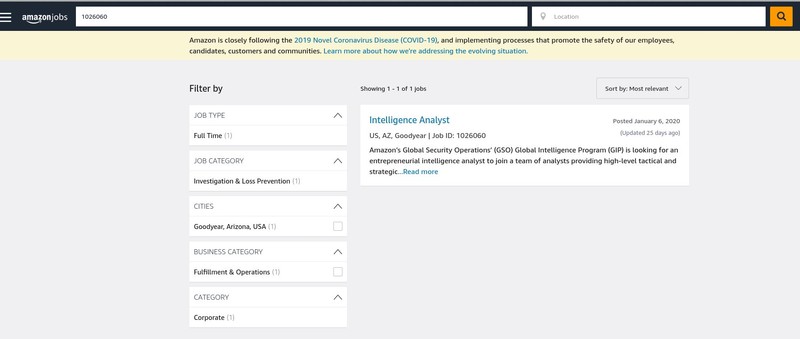
The company recently posted two job listings for analysts that can keep an eye on sensitive and confidential topics “including labor organizing threats against the company.” Amazon is looking to hire an “Intelligence Analyst” and a “Sr Intelligence Analyst” for its Global Security Operations’ (GSO) Global Intelligence Program (GIP), the team that’s responsible for physical and corporate security operations such as insider threats and industrial espionage. 

The job ads list several kinds of threats, such as “protests, geopolitical crises, conflicts impacting operations,” but focuses on “organized labor” in particular, mentioning it three times in one of the listings. 

Amazon has historically been hostile to workers attempting to form a union or organize any kind of collective action. Last year, an Amazon spokesperson accused unions of exploiting Prime Day “to raise awareness to their cause” and increase membership dues. Earlier this year, the company fired Christian Smalls, a Black employee who led a protest at a fulfillment center in New York over Amazon’s inadequate safety measures in the early days of the COVID-19 pandemic. During a meeting with Amazon CEO Jeff Bezos, company executives discussed plans to smear Smalls calling him “not smart, or articulate.”  

These job listings show Amazon sees labor organizing as one of the biggest threats to its existence.

Do you work at Amazon, did you used to, or do you know anything else about the company? We’d love to hear from you. Using a non-work phone or computer, you can contact Lorenzo Franceschi-Bicchierai securely on Signal at +1 917 257 1382, on Wickr at lorenzofb, OTR chat at lorenzofb@jabber.ccc.de, or email lorenzofb@vice.com.

After this story was published, Amazon deleted the job listings and company spokesperson Maria Boschetti said in an email that “the job post was not an accurate description of the role— it was made in error and has since been corrected.” The spokesperson did not respond to follow-up questions about the alleged mistake. The job listing, according to Amazon’s own job portal, had been up since January 6, 2020.

Dania Rajendra, the Director of the Athena Coalition, an alliance of dozens of grassroots labor groups that organize amazon workers, criticized the listing.

“Workers, especially Black workers, have been telling us all for months that Amazon is targeting them for speaking out. This job description is proof that Amazon intends to continue on this course,” Rajendra told Motherboard in a statement. “The public deserves to know whether Amazon will continue to fill these positions, even if they’re no longer publicly posted.”

On Monday, the Open Markets Institute, a nonprofit that studies monopolies, published a report on Amazon’s employee surveillance efforts, claiming that these practices “create a harsh and dehumanizing working environment that produces a constant state of fear, as well as physical and mental anguish.” 

After a week of the jobs being posted online, 71 people have applied to the Intelligence Analyst position, and 24 people to the Sr Intelligence Analyst job, according to Linkedin. The first job was posted in the Amazon Jobs portal in January, the second job on July 21, according to the company’s site.

UPDATE Sept. 1, 12:04 p.m. ET: Shortly after this story was published, Amazon removed the listings from its job portal.


Coronavirus Metric, The Case Fatality, Is Unreliable

https://www.npr.org/2020/07/24/894818106/trumps-favorite-coronavirus-metric-the-case-fatality-is-unreliable?fbclid=IwAR3Zfo29Yhv49yu7ORp9ytjSc8f6uqlhXP0BEFvBGOBUcvXZH0dYrJha2Sc

blog | Teksten, Wijsheid


As the number of coronavirus cases started spiking again this month, the White House keyed in on a different number — one that paints a more rosy picture of the pandemic: the case fatality rate.

When asked about rising cases at a recent briefing, press secretary Kayleigh McEnany quickly parried. “We’re seeing the fatality rate in this country come down,” said McEnany. “That is a very good thing.”

The case fatality rate is the result of a simple mathematical calculation: the number of deaths divided by the number of diagnosed coronavirus cases. But it’s also a moving target. Case numbers are rising fast; deaths are a lagging indicator, running several weeks behind.

“Measuring … mortality rates on any given day is not a reliable way of communicating about this pandemic,” said Dr. Tom Inglesby, director of the Johns Hopkins Center for Health Security.

It is possible that innovations in treatment methods and therapeutic drugs have helped improve the survivability of COVID-19. It is also possible that with more young people being infected in this latest round, they are less likely to die. But medical experts warn it is also just too soon to be sure. And, they say, it’s an unreliable and misleading metric.

But that hasn’t stopped President Trump from boasting about the figure.

“Our case fatality rate has continued to decline and is lower than the European Union and almost everywhere else in the world,” Trump said Tuesday at his first White House coronavirus briefing in nearly three months.

In his interview on Fox News Sunday with Chris Wallace, Trump asked his staff to bring him the “death chart.” He said “the death chart is much more important” as Wallace ticked through 75,000 daily cases and 1,000 daily deaths.

Trump had that chart displayed behind him during the briefing. But this isn’t a metric public health experts have been using.

Inglesby says that by a more direct measure (the sheer number of deaths), and even adjusted for population size, the U.S. is not doing well compared to other countries around the world.

“What national leaders have the obligation to tell people is just the direct truth,” Inglesby said. “If we give them a false sense that things are getting better when they’re not, then they’re going to make decisions that increase the risk of transmission. And they’re also going to stop having confidence in the information they’re being given.”

Focusing on the fatality rate also glosses over other serious problems with the coronavirus, says Dr. David Relman, who specializes in immunology and infectious diseases at Stanford. He says about 20% of people get really sick with potential long-term health consequences. Plus, he says, the coronavirus is stressing the medical system. And as long as it is uncontained, the virus is holding the economy back. So, as he sees it, talking about the case fatality rate is counterproductive.

“What you do instead when you pull out one little piece and dangle it in front of people is to confuse and distract and undermine the overall message,” said Relman.

He says people need to take this virus seriously and take precautions, and that is a sacrifice that requires leaders to get the public on board. For Trump, accentuating the positive might have short-term political benefits, but there are longer-term risks.

“I think it was a mistake early on to be dismissive of the seriousness of it and that it was just going to go away,” said Mike DuHaime, a Republican strategist.

DuHaime gives Trump credit for coming out this week and treating the coronavirus more seriously than he has in the past, telling people to wear masks and avoid crowds. But he readily acknowledges that Trump has gone through other brief spurts urging the public to sacrifice to slow the spread of the virus, only to reverse himself, downplay the severity and pressure states to reopen.

“In order for him to succeed here politically, his credibility has to be as strong as possible,” said DuHaime, who now works at the firm Mercury.

Trump’s credibility has taken a major hit through this crisis. According to the latest Pew Poll, only 30% of Americans trust Trump to get the facts right on the virus. And Trump’s approval rating has tanked too, something he is attempting to repair with the resumed daily briefings.

“At the end of the day, he just needs to do a good job. I know that sounds simplistic, but when you’re an incumbent running for reelection, doing a good job is really the most important thing,” said DuHaime. “And to this point people haven’t seen him do a good job on what they think is the greatest challenge of his presidency.”

DuHaime points out that people are checking the numbers every day — the number of new cases in their city and state, the number of hospitalizations and deaths. Those numbers are all readily available and easier to find than the case fatality rate.


Unemployment Claims Are ‘Stubbornly High’ as Layoffs Persist

Rise in Unemployment Claims Signals an Economic Reversal - The New York  Times

Just over one million Americans filed new claims for state jobless benefits last week, the latest sign that the economy is losing momentum just as federal aid to the unemployed has been pulled away.

Weekly claims briefly dipped below the one million mark early this month, offering a glimmer of hope in an otherwise gloomy job market. But filings jumped to 1.1 million the next week, and stayed above one million last week, the Labor Department said Thursday.

“It’s devastating how stubbornly high initial claims are,” said Julia Pollak, a labor economist at the employment site ZipRecruiter. “There are still huge numbers of layoffs taking place.”

Another 608,000 people filed for benefits under the federal Pandemic Unemployment Assistance program, which offers aid to independent contractors, self-employed workers and others not covered by regular state programs. That number, unlike the figures for state claims, is not seasonally adjusted.

Other recent indicators also suggest that the recovery is faltering. Job growth slowed in July, and real-time data from private-sector sources suggests that hiring has slumped further in August. On Tuesday, American Airlines said it will furlough 19,000 workers on Oct. 1, the latest in a string of such announcements from major corporations.

“It is worrying because it does signal that these large companies are pessimistic about the state of the recovery and don’t think that we are going to be returning to normal anytime soon,” said Daniel Zhao, senior economist at the career site Glassdoor.

Unemployment filings have fallen sharply since early April, when 6.6 million applied for benefits in a single week. But even after that decline, weekly filings far exceed any previous period. Close to 30 million Americans are receiving benefits under various state and federal programs.

The rate of job losses remains high as government support for the unemployed is waning. A $600-a-week federal supplement to state unemployment benefits expired at the end of July, and efforts to replace it have stalled in Congress. President Trump announced this month that he was using his executive authority to give jobless workers an additional $300 or $400 a week, but few states have begun paying out the new benefit.

Economists warn that the loss of federal support could act as a brake on the recovery. Nancy Vanden Houten, lead economist for the forecasting firm Oxford Economics, estimated that the lapse in extra unemployment benefits would reduce household income by $45 billion in August. That could lead to a drop in consumer spending and further layoffs, she said.

The benefit initiated by Mr. Trump would use federal emergency funds to provide $300 a week in extra payments to most unemployed workers. (States can choose to chip in an additional $100 a week, but few are doing so.) As of Wednesday, 34 states had been approved for grants under the program, known as Lost Wages Assistance.

Arizona, the first state to turn the grants into payments, sent $252.6 million to about 400,000 recipients last week, a sum that included retroactive payments for the first two weeks of August. Texas this week has paid out $424 million and expects to deliver nearly $1 billion more to cover the first three weeks of benefits. A handful of other states are paying benefits or expect to begin doing so within days.

Most, however, said it could take until mid-September or later.

Once the money starts flowing, it may not last long. Mr. Trump’s order authorized spending up to $44 billion, which federal officials said last week would cover four or five weeks of payments. That means jobless workers in many states may receive a lump sum covering several weeks of retroactive benefits, but nothing more without congressional action.

A crowd thronged a temporary unemployment office in Kentucky in June. Adapting computer systems to new benefits has been a crucial factor in processing claims.

On the surface, the new lost wages program looks like the earlier $600-a-week federal supplement, just cut in half. But there are subtle differences: The program has a different funding source (the Federal Emergency Management Agency instead of the Labor Department) and new restrictions (people receiving less than $100 a week in regular benefits don’t qualify).

Those kinds of adjustments would be trivial on a modern computer system. But many state unemployment systems are running on computers that are anything but modern.

In Oklahoma, for example, the unemployment system uses a 40-year-old mainframe computer that turns even minor adjustments into a major programming task. As a result, even though the state was among the first to apply for the $300 benefit this month, it doesn’t expect to begin paying the new benefit until late September.

“The fact that I’m working with a mainframe from 1978 to process claims is just crippling to the agency,” said Shelley Zumwalt, interim executive director of the agency that oversees Oklahoma’s unemployment system. “We are just holding that system together with masking tape and chewing gum.”

When the pandemic hit, Arizona, too, was stuck with archaic computer systems. It built a new system virtually from scratch to begin paying out federally funded emergency benefits, and it was among the last states to do so.

But the approach left Arizona better able to handle curveballs like the new $300 benefit.

“Through that chaos, we created a pandemic unemployment system,” said Michael Wisehart, director of the Arizona Department of Economic Security.

Christy Miller says there are three things that shape her identity: making people laugh, making people strong and lifting heavy objects. She can’t do any of those right now, and she isn’t sure when she will be able to again.

Ms. Miller, 49, is a standup comedian in New York, where comedy clubs have been closed since March. She is also a personal trainer and an amateur power lifter — activities she has had to give up because gyms, too, remain closed in the city.

The $600-a-week supplement to her unemployment pay didn’t just allow her to pay rent and buy food. It also freed up the time and mental energy for her to learn video production, podcasting and other skills to help her survive the pandemic-driven shutdown of her industry.

“I would give up the $600 a week any day for this coronavirus to go away and get back to work,” she said. “But the $600 has allowed me not to be homeless, to learn more computer stuff that I never would have learned or had the time to learn.”

None of those ventures are producing much income yet, though. She saved as much of her unemployment benefits as she could, and has enough to cover rent through the end of the year. But other bills are another matter. And there is little guarantee that her business will bounce back before her savings run out.

“If they don’t fix this pandemic thing, I may have to leave New York because I can’t afford to stay here,” she said.

Kris Fusco is finally back at work. That doesn’t mean her coronavirus worries are behind her.

When Ms. Fusco’s employer — a small, family-owned business in Massachusetts that rents musical instruments to students — laid her off in March, she expected to be out of work for a couple of weeks. That got extended to April, then to June. Eventually one of the owners called her to tell her they didn’t know when they could reopen.

“I said, ‘You do what you need to do to keep your business afloat, and I’m just going to hold on as long as I can,’” she said. Fortunately, her employer called her back shortly after the $600 supplement expired. She returned to work last week, and, despite some nervousness about going into the office with the virus still spreading, she said she was grateful for the paycheck.

But Ms. Fusco, 50, doesn’t know how long her good fortune will last. With many schools still teaching remotely or canceling activities like band, she worries that her company’s business will suffer. Already, she has noticed a large number of instruments being returned.

“It’s very worrisome for me because I can see the snowball effect from Covid-19 all around me,” she said. “It’s always lurking right behind my eyeballs that in six months I might be out of a job again.”


Unemployed struggle to cover basic expenses following CARES expiration: poll

Unemployed struggle to cover basic expenses following CARES expiration: poll

The number of jobless people saying that unemployment insurance does not cover basic expenses including food, clothing, housing and transportation nearly doubled after key benefits expired in July.

new survey from Morning Consult found that 50 percent of unemployed people said their benefits fell short of covering basic expenses, up from 27 percent in July.

The $600 in extra weekly benefits that Congress passed in March expired at the end of July, leaving many with significantly lower payments.

Republicans argued the $600 increase was too high and discouraged people from returning to work. Democrats countered that at a time of record high unemployment and limited job openings, the extra pay was unlikely to prevent jobs from getting filled.

A month later, negotiations between the White House and congressional Democrats remain stalled. Senate Republicans are setting a goal of voting on a more limited package of COVID-19 relief measures next week, though Speaker Nancy Pelosi (D-Calif.) has dismissed the idea of approving a limited bill.

An executive order by President Trump to provide $300 in additional benefits to a more limited pool of recipients has lagged in implementation, with only a handful of states able to start making new payments.

In the meantime, the pandemic continues to stifle the economy.

CNBC poll found that 14 percent of those surveyed had completely wiped out their emergency savings during the pandemic, and 39 percent were forced to take some sort of emergency measures to shore up their finances.

Among those who took emergency measures, 17 percent tapped into savings, 11 percent borrowed money, 6 percent stopped retirement contributions and 4 percent moved in with a family member.


What makes a Bad Vaccine?

A Covid-19 vaccine, amazingly, is close. Why am I so worried?

A mere six months after identifying the SARS-CoV-2 virus as the cause of Covid-19, scientists are on the precipice of a having a vaccine to fight it. Moderna and the National Institutes of Health recently announced the start of a Phase 3 clinical trial, joining several others in a constructive rivalry that could save millions of lives.

It’s a truly impressive a feat and a testament to the power of basic and applied medical sciences. Under normal circumstances, vaccine approvals are measured in decades. Milestones that once took months or years have been achieved in days or weeks. If these efforts are successful, the Covid-19 vaccine could take a place alongside the Apollo missions as one of history’s greatest scientific achievements.

I’m optimistic. And yet, as someone who studies drug development, I want to temper expectations with a dose of realism and perhaps a bit of angst. Behind the proud declarations, many science and medical professionals have been whispering concerns. These whispers have escalated into a murmur. It’s time to cry them loudly:

Hey, Food and Drug Administration: Don’t be rash! Premature approval of a sub-standard Covid-19 vaccine could have dire implications, and not just for this pandemic. It could harm public health for years, if not generations, to come.

Unfortunately, elements now in place make such a disastrous outcome not only possible but in fact quite likely. Specifically, the FDA and its staff of chronically overworked and underappreciated regulators will face enormous public and political pressure to approve a vaccine. Whether or not one worries about an “October surprise” aimed at the upcoming election, regulators will be pressed hard. Some will stand firm. Some may resign in protest. But others could break and allow a bad vaccine to be released.

What makes a “bad vaccine”? Insufficient protection against the disease it is designed for, unwanted side effects, or some combination of the two. If an approved Covid-19 vaccine turns out to be ineffective, this could unintentionally promote wider spread of the disease by individuals who presume they were protected from it. Likewise, a negative experience with one vaccine might discourage the use of other vaccines that are far more safe and effective, whether they are for Covid-19 or other vaccine-preventable diseases.

Some things take time. Under normal circumstances, ensuring that a vaccine’s effects are safe and durable requires years of study and monitoring. And there is some evidence that natural immune responses to SARS-CoV-2 infection could be transient, making sustained investigation all the more necessary. A merely short-term effect could encourage vaccinated individuals to resume risky behaviors, which would all but guarantee that the epidemic endures. And if unintended side effects turn out to include, for instance, chronic inflammatory or autoimmune disease, a bad vaccine could impart lifelong damage.

But wait, there’s worse! A bad Covid-19 vaccine could further undermine confidence in the many safe, reliable vaccines already in our public health arsenal. Vaccine skepticism and anti-science bias, propagated by B-list celebrities and Russian troll farms, have been gaining strength all year. Combined with disappointing Covid-19 outcomes, such malign forces could facilitate the reemergence of once-vanquished foes — polio, measles, mumps, rubella, diphtheria, whooping cough, and tetanus — that once killed multitudes of children each year.

These are enormous risks. Placing all of our bets on a small set of untried vaccine technologies would be gobsmackingly foolish. Yet this is exactly what we are now doing. Most of the high-profile names capturing headlines are pursuing comparatively minor variations on a theme of genetic vaccines (those delivered via DNA or RNA). If one approach happens to work, the odds are higher the others will work as well. Disappointing results from one candidate, though, might presage failure across the board.

Rather than investing in a balanced portfolio of vaccines with different approaches — not to mention different therapies, devices, and diagnostics for treating Covid-19 — too many observers, too many companies, and too many governmental officials seem to be narrowly focused on hopes for a “savior” vaccine. Were that savior to fail, our national morale, already low, could plummet even further.

Don’t get me wrong. I, along with millions of Americans, want a Covid-19 vaccine. But we deserve one that’s been proven to be safe and effective.

It’s not too late to take a deep breath and devise a strategy to balance short- and long-term goals, including vaccination, improved diagnostics, and existing and novel treatments. We must support the FDA and hope that its scientists and physicians retain the strength and conviction to resist approving a substandard vaccine.

For encouragement, we should look to Frances Oldham Kelsey, a veritable patron saint of the FDA. In 1960, during her first month working for the agency, Kelsey was asked to approve a sedative called Kevadon, which had the potential to generate billions in revenue. Despite enormous pressure, Kelsey spotted a risk for toxicity and dug in her heels. She refused to rubber stamp the approval. Her actions saved the lives of countless babies. Kevadon, better known as thalidomide, proved to be one of the most dangerous and disfiguring drugs in history.

Kelsey passed away in 2015 at the age of 101. We must pray that her spirit inspires a new generation of FDA leaders with the courage to say, “No.”


America Doesn’t Have a Coherent Strategy for Asymptomatic Testing. It Needs One.

https://www.propublica.org/article/america-doesnt-have-a-coherent-strategy-for-asymptomatic-testing-it-needs-one?utm_source=sailthru&utm_medium=email&utm_campaign=dailynewsletter&utm_content=feature

While it battles a virus that can spread quickly via silent carriers, the United States has yet to execute a strategy for testing asymptomatic people. This is a problem — and ProPublica health reporter Caroline Chen explains why.

Dr. Sara Cody, health officer of Santa Clara County, California, was tired of seeing the same thing over and over again. Her contact tracers were telling people exposed to COVID-19 that they needed to get tested, but when some went to testing sites, health care providers turned them away because they didn’t have any symptoms.

This posed a problem for Cody’s work. Knowing if a contact was infected would help her department keep an accurate count of her county’s coronavirus infection rate; also, if a contact tested positive, it’d spur a new round of contact tracing from her staff, to help stop any further transmission from that asymptomatic carrier.

Cody decided to issue a countywide health officer order in June requiring certain health care facilities to provide testing for all close contacts, and also all front-line workers, such as mass transit drivers and retail workers, whether or not they had symptoms.

Then last week, the U.S. Centers for Disease Control and Prevention quietly changed guidelines on its website to say that people without symptoms did not necessarily need to be tested, even if they had been in contact with someone who had COVID-19. Cody was confused. ”Was it because there isn’t enough testing capacity?” she initially wondered. But there was no such explanation from the agency.

The CDC was met with a degree of pushback that was notable in its intensity; several states flat-out said they would not follow the guidelines, including California, where Gov. Gavin Newsom said, “I don’t agree with the new CDC guidance. Period. Full stop.”

The controversy surrounding the CDC guideline change is all just a symptom of a deeper issue that has plagued America’s coronavirus response: Even though we have spent more than half a year battling a virus whose insidious hallmark is its ability to spread through those with no symptoms, the country has not yet articulated a coherent strategy to test these silent carriers.

“The fact that we’re this far into the pandemic and we’re still talking about how to do asymptomatic testing and going back and forth on this is a major part of the reason why we’re struggling to open schools and colleges, and why people are still dying in prisons,” said Dr. Ashish Jha, dean of the Brown University School of Public Health.

The lack of consistent asymptomatic testing guidelines means that from state to state, county to county, a hodgepodge of strategies are being used with varying standards, testing methods and levels of access. Decisions are being made sometimes by people who have been thrust into the role of public-health officer with no training — school principals and college deans, leaders of companies and daycares and churches, who are just trying to do right by the people they are responsible for.

It’s unfair to ask them to have to come up with their own testing strategies, or to have to navigate the maze of their local health authority’s often shifting recommendations. There may be pros and cons to various strategies experts have proposed, with variables to consider like testing technologies, supply chains and federal funding, but perhaps the more urgent need at this point is picking a plan and actually seeing it through.

To understand why, we need to start with a clearer understanding of the pivotal role asymptomatic testing plays in containing this virus, particularly in the absence of a vaccine.

Why Asymptomatic Testing Is Important

Let’s start with the most basic question: Why do we bother testing in the first place? There are, broadly speaking, two reasons to use a test. The first is as a clinical diagnostic; the other is as a public health tool. Both are important, but for different reasons.

Doctors use a clinical diagnostic like a strep test to tell whether a patient is sick with a disease that can be treated with particular medicines. “The purpose of the test is based around doing one thing when it’s negative and doing another thing when it’s positive,” said Dr. Patrick O’Carroll, head of health systems strengthening at the Task Force for Global Health, who previously worked at the CDC for 18 years.

From this perspective, it seems pointless for an asymptomatic person who might have COVID-19 to take a test, because there’s not going to be any difference in how they will be treated — there are no symptoms to medicate. You might have even heard your doctor say, “Don’t bother taking a test if you only have mild symptoms, because I’m not going to tell you do anything different besides drinking fluids, taking Tylenol and resting.”

But from a public health standpoint, testing asymptomatic people can yield actionable information. COVID-19 is unlike many other diseases, in which a patient’s peak contagiousness coincides with the height of their symptoms. With COVID-19, about 40% of patients do not show any symptoms or have such mild ones that it would never have occurred to them that they had been infected. In a recent study of 192 young people with suspected COVID-19 in Boston, only half who tested positive had a fever.

Furthermore, studies have shown that among patients who do develop symptoms, viral load, which correlates with a patient’s contagiousness, is highest right before or at the time when symptoms start appearing. Put together, these features have explained why the coronavirus has been able to spread so perniciously across the globe. It’s one sneaky virus.

If an asymptomatic person tests positive, public health officials can ask them to isolate from others and begin the process of contact tracing in order to break chains of transmission. In the bigger picture, it also helps them keep tabs on where the virus is spreading in their city. (This is what’s known as “surveillance” in public health parlance: They’re not spying on you. They’re tracking the virus.)

“Since the beginning, testing has been the foundation of our response, because it tells us who is positive, where they are, in which demographic, and what the patterns are,” said Dr. Umair Shah, executive director for Harris County Public Health in Texas.

Understanding population prevalence also helps guide public health actions. For example, said O’Carroll, “if testing shows that only 2% of the population is positive, I’m going to call all of those people, interview them, put all of the contacts in quarantine and really try to stamp it out. But if I find that 30% are positive, then I really don’t have the resources to interview and chase down thousands and thousands of people — that’s when spread is too high for contact tracing to be useful.”

When testing is restricted to symptomatic patients, health officials will only have limited signals about the extent of the virus’s spread, leaving them to operate partially blind.

Standards Vary From State to State

There are two categories of asymptomatic people to consider: The first includes those who had close contact with someone who has already tested positive for the virus. The second includes people who don’t have any reason to believe they have been exposed. The first group is a higher testing priority, because there’s a far greater chance that they have been infected and can be spreading the virus.

In an ideal world, if testing were abundant and cheap and results were fast, we would test everyone daily and catch all of the asymptomatic carriers. But when there aren’t enough tests to go around, public health officials need to triage.

In the earliest stages of the pandemic, when there were hardly any tests available across the country, public health officials had to limit tests to the most urgent need — people with severe symptoms in hospitals. As tests became more available, they started to widen the criteria, first to people with symptoms, then to asymptomatic people with known exposure. Finally, in some areas of the country, anyone who wanted a test could get one, whether or not they had symptoms.

But to this day, the decisions have been made piecemeal. I reached out to health departments around the country, and found that testing criteria still vary depending on where you live.

In Delaware, close contacts are asked to get tested once, at the end of their 14-day quarantine period. The state lets anyone get tested, whether or not they were exposed or have symptoms. Maryland recommends that people who suspect they’ve been exposed to the virus get a test, whether they are symptomatic or not. Arkansas says it works to facilitate testing for all close contacts of positive cases, and also tries to provide testing for anyone in the state who wants a test, asymptomatic or not.

But Oregon and Wisconsin don’t recommend testing for asymptomatic people who have not had close contact with a confirmed case. (Oregon makes an exception for people in a high-risk category, such as agricultural workers.)

Some states have more nuance to their recommendations. New Jersey said testing is available to all, but noted that if you are asymptomatic, testing is recommended if you are a front-line worker, if you were in a large crowd with difficulty social distancing, if you are a member of a vulnerable population or if you recently traveled somewhere with a high COVID-19 infection rate.

Effective Contact Tracing Can’t Happen Without Efficient Testing

Within each state, however, guidelines aren’t always followed consistently by test providers. Cody, the health officer in California, isn’t the only one whose contact tracers are unable to get asymptomatic people tested.

Rebecca Fischer, an assistant professor at Texas A&M University School of Public Health, said she’s seen the same thing happen in Brazos County. “We call them and say, ‘How did the test go? And they’ll say, ‘They sent me away because I don’t have symptoms.’ and we’ll say, ‘You need to go back and say the health department sent you,’ and often they get turned away again.” Sometimes, Fischer said, the health department would have to give the person a letter to verify that they needed a test.

“We get on the local news station and plead with test providers to help us facilitate widespread testing,” Fischer said.

It’s unclear why providers are turning down asymptomatic patients. It may be, in part, due to the perceived purpose of the test. Dr. Michael Hochman, a primary care doctor and director of the Gehr Family Center for Health Systems Science and Innovation at the University of Southern California, said he thinks the value of testing contacts without symptoms is “modest” and would rather make them stay home for 14 days instead of come into a clinic for a test, “which is bringing them together with other people, the opposite of what you want.”

He worries that a false negative could give patients a misguided sense of security and prompt contacts to leave quarantine before they’re supposed to. Hochman says he sometimes has patients calling who say they have potential exposure and want a test, but when he explains to them that regardless of the result, they still will need to quarantine, the patients often then decide they won’t bother with a test.

Cody countered that many people don’t always adhere to the 14-day guidelines. “We’re not doing legal orders, so there’s not going to be perfect compliance,” she said. Given the opportunity to test and find out that an asymptomatic contact is positive is always preferable, she said, because people are more likely to take precautions and isolate properly, particularly around family members.

Without a Clear National Strategy, Confusion Abounds

Into this already chaotic environment came the CDC’s guidance change on Aug. 24.

Normally, when the agency updates its guidances, it gives a heads-up to state and local health departments, so they can decide how to adjust their own recommendations or how to communicate to the public, said Chrissie Juliano, executive director of the Big Cities Health Coalition, which represents large metropolitan health departments.

“Usually at minimum, there’s a big tent call … and normally at the top of the call, they say, we’re going to update this.”

But this time, it didn’t happen. “It was buried in an email,” she said. “If you hadn’t clicked on it, you wouldn’t have known.”

Previously, the CDC recommended testing for all close contacts of people with known COVID-19 infection, specifically noting that “because of the potential for asymptomatic and pre-symptomatic transmission, it is important that contacts … be quickly identified and tested.” The new guidance, however, said, “If you have been in close contact … you do not necessarily need a test unless you are a vulnerable individual or your health care provider or state or local public health officials recommend you take one.”

The new guidance for asymptomatic people who had no known exposure conveyed a number of different messages, depending on which part of the website you read. On one hand, it said, “If you do not have COVID-19 symptoms and have not been in close contact with an infected person: You do not need a test.”

But farther down the page, the site also said, “If there is significant spread of the virus in your community, state or local public health officials may request to test more asymptomatic ‘healthy people.’”

In the absence of explanation or context, confusion ensued.

Calling the new guidelines “vexing and hard to interpret,” Dr. Jeff Duchin, health officer for public health for Seattle & King County said in a statement that “testing asymptomatic close contacts of COVID-19 cases is important to identify cases and interrupt transmission and we intend to continue to do that pending additional information that would lead us to reconsider.”

When I asked the CDC to explain the change in guidance, it didn’t respond, instead pointing me toward the Department of Health and Human Services.

HHS sent me a statement from Adm. Brett Giroir, the federal testing czar, saying that the updated guidance “places an emphasis on testing individuals with symptomatic illness, those with a significant exposure or for vulnerable populations, including residents and staff in nursing homes or long term care facilities, critical infrastructure workers, healthcare workers and first responders, and those individuals (who may be asymptomatic) when prioritized by public health officials.”

The revised guidance did not appear to be generated internally by the CDC. Giroir later told reporters that the recommendations were approved by members of the White House coronavirus task force, saying, “We all worked together to make sure that there was absolute consensus that reflected the best possible evidence.” Dr. Anthony Fauci, however, said he was undergoing surgery and was not part of the discussion.

A few days later, CDC director Dr. Robert Redfield verbally softened the changes, saying that testing “may be considered” for asymptomatic contacts, though the guidelines online were not changed.

“Ultimately, it may not actually be a huge change,” said Juliano, but in practice it means that the federal government “is really pushing the decision down to states and local.”

“It means when public health says you should get tested, someone could say, ‘well, the CDC says it’s not necessary.’ It leads to public confusion, and you’re really putting state and local in a line of fire that’s not necessary.”

Use the Right Test for the Right Situation

Now that we’ve talked about the reasons it’s important to do asymptomatic testing, it’s time to think about resources. In recent months, many experts have been advocating that different types of tests be used for different purposes, in order to optimize available supplies and avoid testing delays.

The idea goes like this: We should save the most sensitive tests — known as PCR tests — for diagnostic purposes, when we need to be absolutely sure that a patient has COVID-19, because we’re going to be treating them or asking them to isolate, based on the results. So these tests should be used for people with COVID-19 symptoms and people who were known to be exposed to the virus.

But for public health purposes, when it comes to keeping tabs on how broadly the virus is spreading, we could instead be using slightly less sensitive — though not poor quality — rapid tests, known as antigen tests, which typically can provide results in minutes to hours. Such tests should be used for screening people en masse in settings like nursing homes, essential workplaces, and communities that have limited testing resources, proposes a team at Duke University’s Margolis Center for Health Policy. Any positives that turn up could then be confirmed with a PCR test.

The goal is to avoid the long testing turnaround times that the country was plagued with this summer. PCR tests, while highly accurate, usually require at least a day or two to return results even under optimal conditions, and require more specialized equipment, labs and staff. This summer, when the majority of tests were being shoved into the PCR queue, turnaround times stretched out, with some people waiting more than two weeks for test results.

This is not just an annoyance for individuals. It’s a massive public health problem, because a test that takes more than two days to come back is pretty much useless.

“Patients don’t know what to do in those two weeks, and guess what, we can’t do our contact tracing, so we can’t fight the pandemic — all of that gums up the system.” said Shah, of Harris County. Such long turnaround times are “shameful. It makes no sense.”

Dr. Mark McClellan, one of the authors of the Duke paper, said the government must set aside funding to pay for antigen tests in at-risk populations, including low-income, minority and immigrant communities, and public schools and colleges.

The University of Illinois is requiring all faculty, staff and students to participate in screening testing twice a week, using a rapid saliva-based test. Not every college has the resources to perform these routine tests, but advocates for this kind of testing point to the university to show that it isn’t a fantasy.

“It is feasible,” said Carl Bergstrom, a computational biologist at the University of Washington. “It’s just a matter of will.”

McClellan and his co-authors estimate that about 14 million people are in high-risk settings that need regular screening testing, requiring an average of two tests per week. “There needs to be a lot more financial support to get that capacity up, something like Operation Warp Speed, with the government going in jointly with manufacturers,” he said.

What We Need to Do: Pick a Plan, and See It Through

For now, though, the federal government doesn’t appear to embrace this vision. Testing czar Giroir told reporters in a call on Aug. 13, “I’m really tired of hearing, by people who are not involved in the system, that we need millions of tests every day. … You don’t need this degree of testing. You need strategic testing combined with smart policies.”

Giroir explained that the administration’s focus was testing symptomatic patients as well as vulnerable populations, such as nursing home residents, coupled with policies including mask wearing, social distancing and hand washing. “That plan is being implemented and that plan is working,” he told reporters.

Some public health experts say that approach won’t be enough to curb the pandemic.

“Masks are a very powerful tool for virus control, and they’re not completely off the table, but a lot of our population has not been able to adhere to them because it’s become politicized,” said Dr. Michael Mina, assistant professor of epidemiology at the Harvard T.H. Chan School of Public Health.

And while social distancing is important, said Jha, he doesn’t think that alone will work in places where people are regularly congregating, like schools. “It’s not the real world,” he said. “Do we really think kids will never get close to each other?”

Mina argues for an audacious plan that calls for far more testing than the U.S. has been capable of to date. His testing strategy, particularly when it comes to how it approaches asymptomatics, seems directly at odds with Giroir’s.

Mina envisions tests so cheap ($1 apiece) and so widely available (over the counter) that every American can test themselves at least twice a week. The tests we’d use are paper strips that require only a saliva sample. They would certainly be less sensitive than PCR tests, but sensitive enough to catch people when their viral load is highest, which is exactly when they are most infectious.

The technology for a cheap, rapid antigen test certainly exists: Abbott Laboratories’ $5 test, authorized by the U.S. Food and Drug Administration last week, goes a long way to prove this point. But Abbott’s test is intended to be used on symptomatic patients, and needs to be performed by a doctor. Mina wants people to be able to test themselves.

Mina’s vision has gained broad support in recent weeks by numerous public health experts, but would need buy-in from the federal government, particularly the FDA, to become reality.

Many other plans have been proposed, but at this point, more time has been spent talking about what we should be doing and debating the various options, rather than mustering the necessary regulatory, financial and political power to get any one of the plans fully executed.

“Choosing not to test those who are asymptomatic is like saying we won’t fight the fire until it reaches the second floor,” said Brian Castrucci, chief executive officer of health philanthropy the de Beaumont Foundation.

The pandemic has been raging across America for more than half a year. It’s past time we had a coherent national plan to put out the fire.


U.S. says it won’t join WHO-linked effort to develop, distribute coronavirus vaccine

https://www.washingtonpost.com/world/coronavirus-vaccine-trump/2020/09/01/b44b42be-e965-11ea-bf44-0d31c85838a5_story.html?utm_campaign=wp_main&utm_medium=social&utm_source=facebook&fbclid=IwAR31G0QRSO-t6-OnkJxpPFGyIv5d9EW7Zmq4nLVs63OzYf2yR5v1RJ5MtNA

The Trump administration said it will not join a global effort to develop, manufacture and equitably distribute a coronavirus vaccine, in part because the World Health Organization is involved, a decision that could shape the course of the pandemic and the country’s role in health diplomacy.

More than 170 countries are in talks to participate in the Covid-19 Vaccines Global Access (Covax) Facility, which aims to speed vaccine development and secure doses for all countries and distribute them to the most high-risk segment of each population.

The plan, which is co-led by the WHO, the Coalition for Epidemic Preparedness Innovations and Gavi, the vaccine alliance, was of interest to some members of the Trump administration and is backed by traditional U.S. allies, including Japan, Germany and the European Commission, the executive arm of the European Union.

But the United States will not participate, in part because the White House does not want to work with the WHO, which President Trump has criticized over what he characterized as its “China-centric” response to the pandemic.

“The United States will continue to engage our international partners to ensure we defeat this virus, but we will not be constrained by multilateral organizations influenced by the corrupt World Health Organization and China,” said Judd Deere, a spokesman for the White House.

The Covax decision, which has not been previously reported, is effectively a doubling down by the administration on its bet that the United States will win the vaccine race. It eliminates the chance to secure doses from a pool of promising vaccine candidates — a potentially risky strategy.

“America is taking a huge gamble by taking a go-it-alone strategy,” said Lawrence Gostin, a professor of global health law at Georgetown University.

Kendall Hoyt, an assistant professor at Dartmouth’s Geisel School of Medicine, said it was akin to opting out of an insurance policy.

The United States could be pursuing bilateral deals with drug companies and simultaneously participating in Covax, she said, increasing its odds of getting some doses of the first safe vaccine. “Just from a simple risk management perspective, this [Covax decision] is shortsighted, she said.

The U.S. move will also shape what happens elsewhere. The idea behind Covax is to discourage hoarding and focus on vaccinating high-risk people in every country first, a strategy that could lead to better health outcomes and lower costs, experts said.

U.S. nonparticipation makes that harder. “When the U.S. says it is not going to participate in any sort of multilateral effort to secure vaccines, it’s a real blow,” said Suerie Moon, co-director of the Global Health Center at the Graduate Institute of International and Development Studies in Geneva.

“The behavior of countries when it comes to vaccines in this pandemic will have political repercussions beyond public health,” she added. “It’s about, are you a reliable partner, or, at the end of the day, are you going to keep all your toys for yourself?”

Some members of the Trump administration were interested in a more cooperative approach but were ultimately overruled.

Health and Human Services Secretary Alex Azar and Deputy Secretary of State Stephen Biegun had interest in exploring some type of role in Covax, a senior administration official said, speaking on the condition of anonymity because they were not authorized to discuss the decision-making.

But there was resistance in some corners of the government and a belief that the United States has enough coronavirus vaccine candidates in advanced clinical trials that it can go it alone, according to the official and a former senior administration official who learned about it in private discussions.

The question of who wins the race for a safe vaccine will largely influence how the administration’s “America first” approach to the issue plays out.

An unlikely worst-case scenario, experts said, is that none of the U.S. vaccine candidates are viable, leaving the United States with no option since it has shunned the Covax effort.

Another possibility is that a U.S. vaccine does pan out, but the country hoards doses, vaccinating a large number of Americans, including those at low risk, while leaving other countries without.

Experts in health security see at least two problems with this strategy: The first is that a new vaccine is unlikely to offer complete protection to all people, meaning that a portion of the U.S. population will still be vulnerable to imported cases — especially as tourism and trade resume.

The second, related problem is that a U.S. recovery depends on economic recovery elsewhere. If large parts of the world are still in lockdown, the global economy is smarting and supply chains are disrupted, the United States will not be able to bounce back.

“We will continue to suffer the economic consequences — lost U.S. jobs — if the pandemic rages unabated in allies and trading partners,” said Thomas J. Bollyky, a senior fellow at the Council on Foreign Relations and the director of its global health program.

Proponents of a multilateral approach to global public health would like to see all countries coordinate through Covax. Perhaps unsurprisingly, interest is strongest from poor countries, while some larger economies are cutting deals directly with drugmakers.

WHO officials have argued that countries need not choose — they can pursue both strategies by signing bilateral deals and also joining Covax.

“By joining the facility at the same time that you do bilateral deals, you’re actually betting on a larger number of vaccine candidates,” Mariângela Simao, a WHO assistant director for drug and vaccine access, said at an Aug. 17 briefing.

If nothing else, the United States could pledge surplus vaccine doses to Covax to ensure they are distributed in a rational and equitable way, experts said.

Some cautioned against a focus on “winning” the race. Given the complexity of supply chains, vaccine development will necessarily be a global effort, regardless of whether countries want to cooperate.

The decision to steer clear of Covax comes at a time of tremendous change for health diplomacy.

The United States has long been the biggest donor to the WHO and a major funder of vaccine initiatives.

In the early days of the coronavirus pandemic, Trump praised both China and the WHO for their handling of the outbreak. But as the crisis intensified in the United States, he turned on the U.N. health agency.

In April, he announced a freeze on new U.S. funding. Not long after, the State Department started stripping references to the WHO from fact sheets and rerouting funds to other programs.

By July, the administration had sent a letter signaling its intent to withdraw from the WHO.

But untangling the United States from the agency it helped found and shape is not simple — and the terms of the separation are still being assessed.

It is not yet clear, for instance, whether a U.S. withdrawal means the United States will just stop its contributions to the WHO or whether it will stop funding any initiative linked to the agency in any way.

For instance, the White House no longer wants to work with the WHO, but the United States is a major supporter of Gavi, which co-leads the Covax project.

Asked to comment on the Covax decision, a State Department spokeswoman pointed to U.S. funding for Gavi, as well as money for such programs as UNICEF and the Global Fund to Fight AIDS, Tuberculosis and Malaria.

J. Stephen Morrison, director of the Global Health Policy Center at the Center for Strategic and International Studies, said the White House could still reverse course and join Covax, or at least let the Senate fund through Gavi — a political workaround.

“This just shows how awkward, contradictory and self-defeating all of this,” he said. “For the U.S. to terminate its relationship with the WHO in the middle of a pandemic is going to create an endless stream of self-defeating moments.”