The two sides of America’s coronavirus response

https://www.axios.com/us-coronavirus-vaccine-testing-science-b656e905-67d1-4836-863e-c91f739cfd1e.html

The two sides of America's coronavirus response - Axios

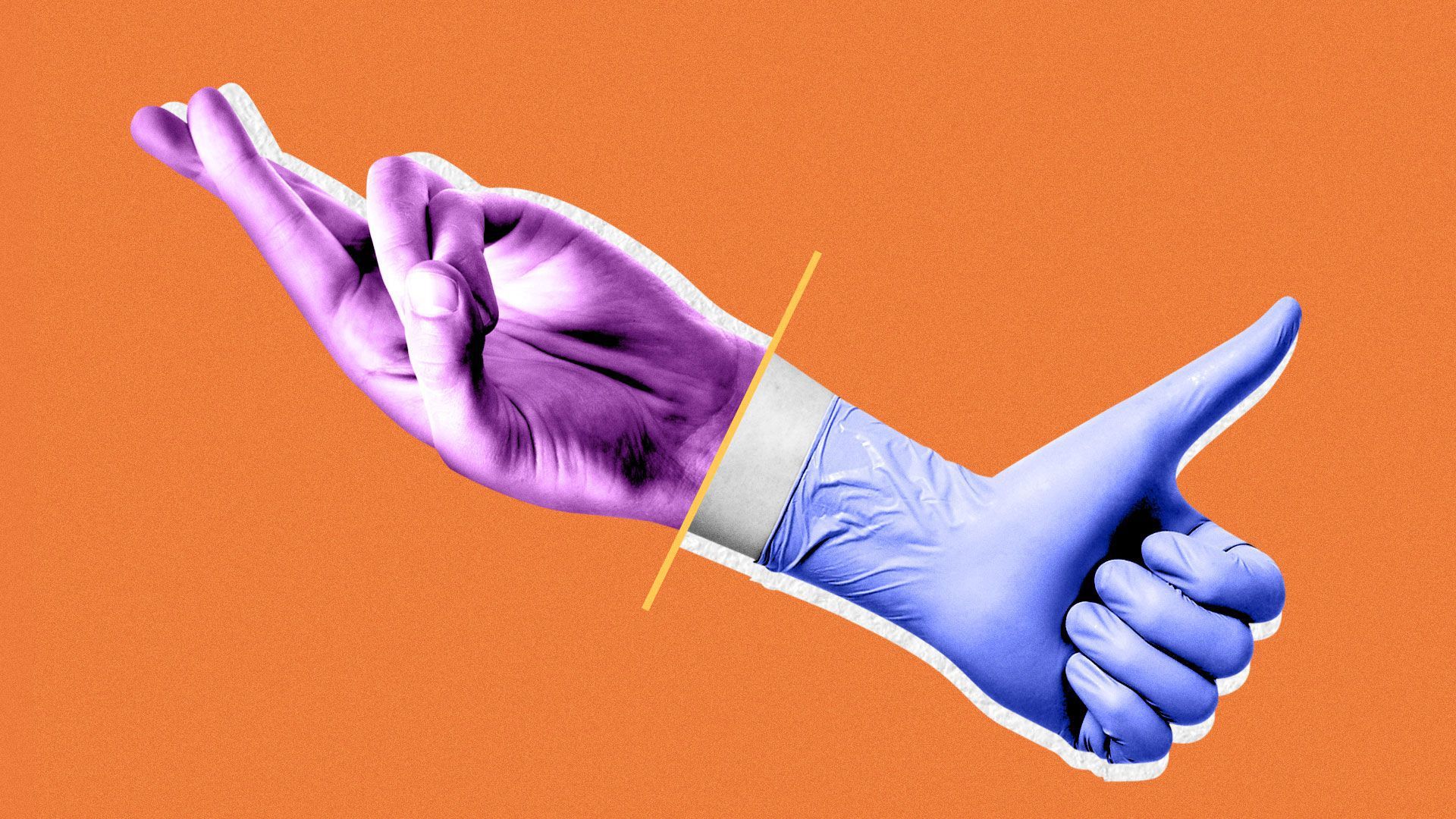
America’s bungled political and social response to the coronavirus exists side-by-side with a record-breaking push to create a vaccine with U.S. companies and scientists at the center.

Why it matters: America’s two-sided response serves as an X-ray of the country itself — still capable of world-beating feats at the high end, but increasingly struggling with what should be the simple business of governing itself.

What’s happening: An index published last week by FP Analytics, an independent research division of Foreign Policy, ranked the U.S. 31st out of 36 countries in its assessment of government responses to COVID-19.

  • That puts it below developed countries like New Zealand and Denmark, and also lower than nations with fewer resources like Ghana, Kenya and South Africa.
  • The index cited America’s limited emergency health care spending, insufficient testing and hospital beds and limited debt relief.

By the numbers: As my Axios colleague Jonathan Swan pointed out in an interview with President Trump, the U.S. has one of the worst per-capita death rates from COVID-19, at 50.29 per 100,000 population.

Yes, but: Work on a COVID-19 vaccine is progressing astonishingly fast, with the Cambridge-based biotech company Moderna and the National Institutes of Health announcing at the end of July that they had begun Phase 3 of the clinical trial.

  • Their efforts are part of a global rush to a vaccine, and while companies in the U.K. and China are jockeying for the lead, U.S. companies and the NIH’s resources and expertise have been key to the effort.
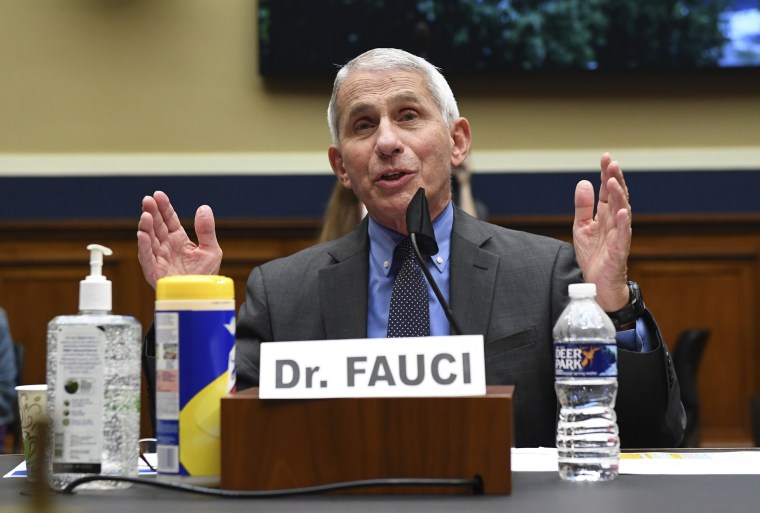
  • Anthony Fauci has said he expects “tens of millions” of doses to be available by early 2021, a little over a year after the novel coronavirus was discovered.
  • If that turns out to be the case, “the Covid-19 vaccine could take a place alongside the Apollo missions as one of history’s greatest scientific achievements,” epidemiologist Michael Kinch recently wrote in STAT.

So which is the real American response to COVID-19? The bungled testing policies, the politically driven rush to reopen, the tragic racial divide seen in the sick and the dead? Or the warp-speed work to develop a vaccine in a year when most past efforts took decades?

Be smart: It’s both.

The bottom line: It can often feel as if there are two Americas, and not even a virus that has spread around the world seems capable of bridging that gap.


U.S. doing a lot less coronavirus testing

https://www.axios.com/newsletters/axios-vitals-32689a40-e409-4547-8468-b03dc589c082.html

The two sides of America's coronavirus response - Axios

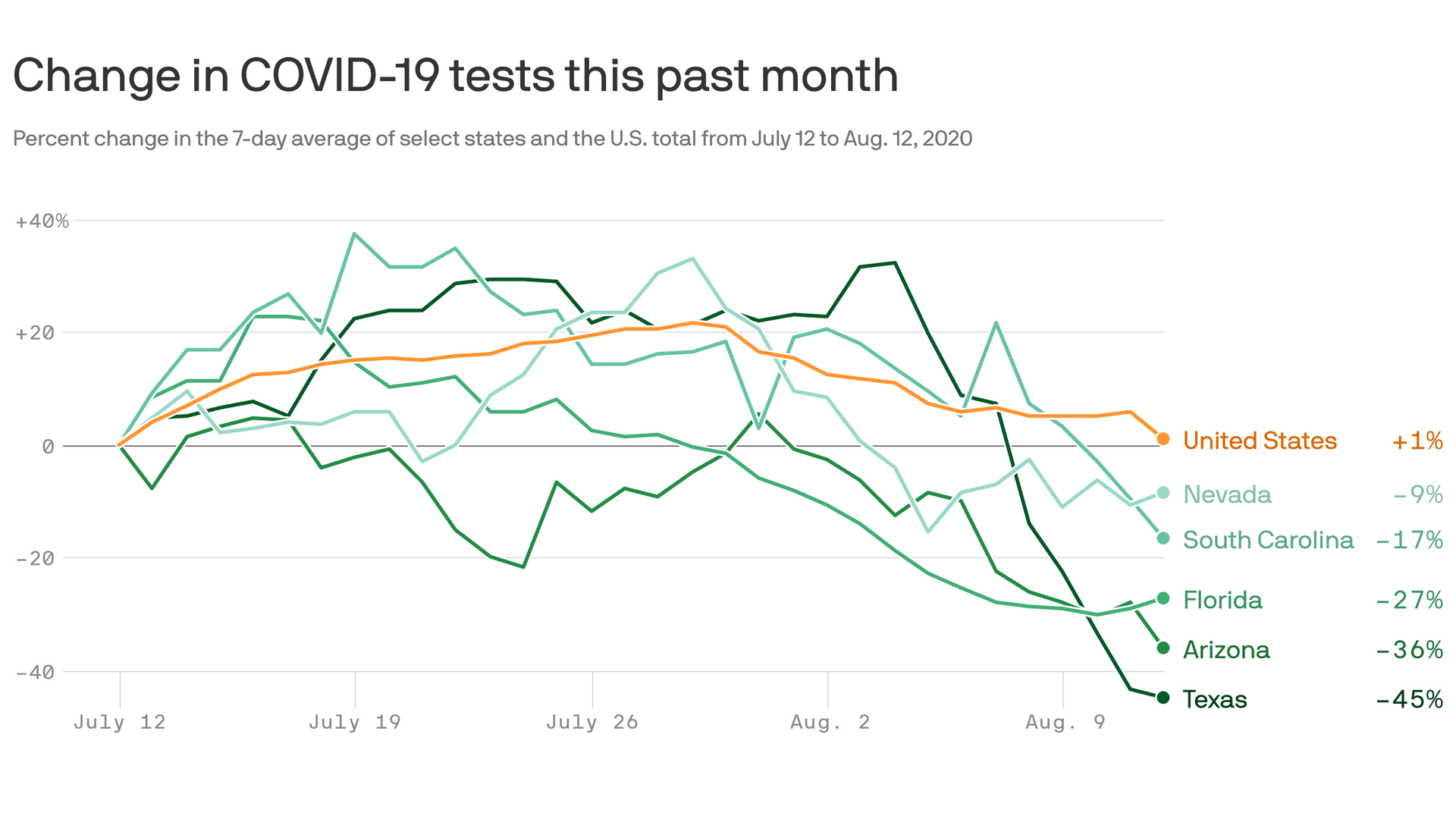
The U.S. is cutting back on coronavirus testing. Nationally, the number of tests performed each day is about 17% lower than it was at the end of July, and testing is also declining in hard-hit states.

Why it matters: This big reduction in testing has helped clear away delays that undermined the response to the pandemic. But doing fewer tests can also undermine the response to the pandemic.

By the numbers: At the end of July, America was doing more than 800,000 tests a day. This week, it’s hovered around 715,000.

  • Even as states with particularly bad outbreaks pull back on their testing, the proportion of tests coming back positive is still high — which would normally be an indication that they need to be doing more tests.
  • In Texas, 19% of tests are coming back positive, according to Nephron Research. In Florida, the rate of positive tests is 18%, and in Nevada, 17%.

Yes, but: Experts have said reducing the demand for testing may be the best way to alleviate long delays, which made tests all but useless. And that appears to be working.

Driving the news: The Department of Health and Human Services estimated this week that nearly 90% of all tests are being completed within three days — a big improvement from turnaround times that had been stretching well over a week.

  • Quest Diagnostics says its expected turnaround time is now 2–3 days, and less for priority patients. LabCorp announced a similar turnaround time last week.

The bottom line: The U.S. is averaging 50,000 new cases a day, and that high caseload is ultimately why the demand for testing is more than the system can handle.

  • We can’t get our caseload under control without fast, widespread testing, but we can’t achieve fast, widespread testing with such a high caseload.


Rely on the science and avoid the politics, Fauci says

https://www.cnn.com/2020/08/12/health/us-coronavirus-wednesday/index.html?utm_source=nl&utm_brand=wired&utm_mailing=WIR_Science_081220&utm_campaign=aud-dev&utm_medium=email&utm_term=WIR_Science&bxid=5db707423f92a422eaeaf234&cndid=54318659&esrc=bounceX&source=EDT_WIR_NEWSLETTER_0_SCIENCE_ZZ

Science Day

Although practices like wearing face coverings have been politicized, Dr. Anthony Fauci said Tuesday he has learned that in order to be a good public health leader in a crisis, you have to divorce yourself from politics, rely on science and be as transparent as possible.

“Completely divorce yourself from the kind of political undertones that sometimes go into an important outbreak like this,” Fauci, director of the National Institute of Allergy and Infectious Diseases, said as he was honored with a 2020 Citizen Leadership Award on Tuesday night by the Aspen Institute.
“You’ve got to stay away from that, lead by example, be perfectly honest and don’t be afraid to say you don’t know something when you don’t know it. I find that to be a very good formula when you’re dealing in a crisis.”
Even with the polarization, every state in the US passed at least one physical distancing measure in March to slow the spread, researchers from Harvard University and University College London said. Those measures worked, a new study found.
Physical distancing resulted in a reduction of more than 600,000 cases within just three weeks, according to the study, published Tuesday in the journal PLOS. Had there not been preventative interventions, the models suggest up to 80% of Americans would have been infected with Covid-19.
“In short, these measures work, and policy makers should use them as an arrow in their quivers to get on top of local epidemics where they are not responding to containment measures,” said the study’s co-author Dr. Mark J. Siedner in a news release.


US has averaged over 1,000 coronavirus deaths per day for 16 straight days

https://www.cnn.com/2020/08/12/health/us-coronavirus-wednesday/index.html?utm_source=nl&utm_brand=wired&utm_mailing=WIR_Science_081220&utm_campaign=aud-dev&utm_medium=email&utm_term=WIR_Science&bxid=5db707423f92a422eaeaf234&cndid=54318659&esrc=bounceX&source=EDT_WIR_NEWSLETTER_0_SCIENCE_ZZ

CCR - Who'll Stop The Rain song lyrics music lyrics | Great song ...

Coronavirus continues to spread at high rates across the US South, Midwest and West, even as the total number of new Covid-19 cases has declined since a summer surge.

Nationally, over the last seven days, the US is averaging just under 53,000 new cases of Covid-19 per day, down 11% from the week prior.
As a result of all those cases, deaths from the virus have remained high. The seven-day average of daily coronavirus deaths was just over 1,000 on Tuesday, the 16th consecutive day the US averaged over 1,000 deaths per day.
Adjusting for population, states in the Southeast are seeing the most new cases. Georgia and Florida — states led by Republican governors who have not issued face mask requirements — have the highest per capita new cases over the last seven days, followed by Alabama and Mississippi.
On Wednesday, Florida reported more than 8,000 new cases and 212 new deaths, according to data released by the Florida Department of Health.
Covid-19 causes worse outcomes for older people, but young people are not immune. In Florida, people under 44 make up about 57% of the state’s 545,000 cases, 20% of the state’s 31,900 hospitalizations, and 3% of the state’s 8,765 deaths, according to state data.
Robert Ruiz, 31 and the father of a 3-year-old, was one of the 265 people under 44 who died from coronavirus in Florida.
His sister, Chenique Mills, told CNN he was overweight and had seasonal asthma but otherwise did not smoke or drink and had no underlying health conditions.
“This is all really sudden, unexpected,” she said. “I (saw) him on Friday. I (saw) him on Saturday. He was fine, to say that he was up, and he was walking and he was eating. He was functioning. So for him to be gone on Sunday? It’s just a lot to take in.
“This virus is so serious. It really really is. And I think people (won’t) understand until it hits home, because I would be one to say that I took it really lightly until it hit home.”
The virus’s ongoing spread around the country has frustrated plans to safely reopen schools, forced college football conferences to postpone the lucrative fall season, and caused vast medical and economic pain.
And it will continue to rattle American society until people more seriously adopt recommended public health measures: social distancingavoiding large indoor gatheringshand-washingmask-wearingrapid testing and quarantining the sick.
“We have to figure out how to deal with this as a whole country because as long as there are cases happening in any part, we still have transit, especially now we have students going back to college,” said Dr. Michael Mina, assistant professor of epidemiology at Harvard T.H. Chan School of Public Health. “Any cases anywhere really keep risk pretty high all across the entirety of the United States.”


Fauci: ‘I seriously doubt’ Russia’s coronavirus vaccine is safe and effective

https://thehill.com/policy/healthcare/511615-fauci-seriously-doubt-russias-coronavirus-vaccine-is-safe-and-effective?utm_source=Sailthru&utm_medium=email&utm_campaign=Issue:%202020-08-12%20Healthcare%20Dive%20%5Bissue:29035%5D&utm_term=Healthcare%20Dive

The White House has pushed Fauci into a little box on the side

Anthony Fauci, the nation’s top infectious diseases expert, said Tuesday that he has serious doubts about Russia’s announcement that it has a vaccine ready to be used for the novel coronavirus.

“Having a vaccine and proving that a vaccine is safe and effective are two different things,” Fauci said during a panel discussion with National Geographic.

The comments came just hours after Russian President Vladimir Putin said that the country had become the first in the world to gain regulatory approval for a COVID-19 vaccine.

Putin said that the vaccine went through clinical testing and that it had proven to offer immunity to the deadly disease, which has infected more than 20 million people worldwide, according to a Johns Hopkins University database.

However, phase three trials for the drug have reportedly not been completed, triggering skepticism from international health experts about its usefulness. 

Fauci, the director of the National Institute of Allergy and Infectious Diseases and a key member of the White House coronavirus task force, said that he had seen no evidence supporting Putin’s position. 

“I hope that the Russians have actually, definitively proven that the vaccine is safe and effective. I seriously doubt that they’ve done that,” he said, adding that Americans need to understand that the process for gaining vaccine approval requires safety and efficacy. 

More than 100 possible vaccines are being developed around the world as part of efforts to offer immunity protection for the coronavirus. Moderna, in collaboration with the National Institutes of Health, launched a phase three trial for a vaccine in July, making it the first U.S. candidate to reach that stage.

Fauci has said that he’s “cautiously optimistic” that a COVID-19 vaccine will be ready by the end of the year. He told a House committee on July 31 that he was encouraged by everything he’s seen in the early data but that “there’s never a guarantee that you’re going to get a safe and effective vaccine.”

The World Health Organization said Tuesday that it was monitoring Russia’s progress in developing a COVID-19 vaccine. Progress in combating the virus “should not compromise safety,” the health agency said.

Former Food and Drug Administration Commissioner Scott Gottlieb echoed Fauci’s skepticism earlier Tuesday, noting in a tweet that Russia has been behind disinformation campaigns related to the pandemic. 

“Today’s news that they ‘approved’ a vaccine on the equivalent of phase 1 data may be another effort to stoke doubts or goad U.S. into forcing early action on our vaccines,” he said.

Russia is reportedly planning to offer its COVID-19 vaccine to medical personnel as soon as this month. It will be made available to the general public in October, according to Reuters


Coronavirus: Some college students returning to campus are being met with liability waivers

https://finance.yahoo.com/news/colleges-students-liability-waivers-112753572.html

Schools that are choosing to reopen amid the coronavirus pandemic are attempting to protect themselves against possible legal blowback with legal liability waivers.

From universities to K-12 districts, some schools are sending forms with titles such as “Assumption of Risk” and “Waiver of Liability” to fend off any lawsuits should students contract coronavirus on campus or in the classroom.

“Institutions are basically trying to have it both ways,” Kevin McClure, associate professor of higher education at the University of North Carolina Wilmington, told Yahoo Finance. “They’re trying to say: ‘We are opening in the midst of significant risk, and at the same time we want you — as students or faculty or staff — to assume that risk and to not hold us responsible for the decisions that we’ve made.’”

‘Students’ ability to take responsibility both for themselves and each other’

Generally, the waiver forms note two things: That there is a risk of contracting the coronavirus if a student appears on campus and that the decision to come back cannot be held against the school.

“I know the challenge these circumstances present, but I also know our students’ ability to take responsibility both for themselves and each other,” Damon Sims, vice president for Student Affairs at Penn State, said in a press release. “If ever there was a time for them to do so, now is that time. We will do all we can to encourage that outcome, and we expect them to do all they can to make it so. We are in this together.”

Students returning to Penn State’s University Park campus, which usually houses more that 45,000 undergraduate students, are required to fill out the following “coronavirus compact” prior to their arrival on Penn State’s campus

This is the reality of the current situation’

Saint Anselm College in New Hampshire is another college asking its students to sign a waiver.

The liberal arts school is planning to conduct its fall semester primarily in-person, an option 30% of schools have chosen. Classes start for 2,000 students on August 19, university spokesperson Paul Pronovost told Yahoo Finance.

Aside from the usual safety measures — from reducing density in housing, classroom, and common spaces, restricting visitors, implementing distancing — the school is also going to administer two coronavirus tests on students upon their arrival: A rapid test and a fuller test. Saint Anselm is also planning to do surveillance testing throughout the semester.

Beyond social distancing, testing, and contact tracing, the university wants students and parents to “accept” the unique schooling situation.

There’s “simply no way for the College – or any College or institution, for that matter – to guarantee that our campus will not see cases of COVID-19,” Pronovost said in an email. “We believe it is important for students and families to understand and accept that this is the reality of the current situation.”

The liability waiver notes that students “forever release and waive my right to bring suit against Saint Anselm College, its Board of Trustees, officers, directors, managers, officials, agents, employees, or other representatives in connection with exposure, infection, and/or spread of COVID-19 related to taking classes, living or participating in activities on the Saint Anselm College Campus.”

Colleges fear an avalanche of lawsuits 

The possibility of lawsuits worried colleges enough to lobby Congress for protections from liability.

Nearly 80 education groups sent a letter to congressional leaders back in May, stating that reopening schools involves not just “enormous uncertainty about COVID-19-related standards of care” but also the “corresponding fears of huge transactional costs associated with defending against COVID-19 spread lawsuits.”

Rutgers Law Professor Adam Scales argued that we may see an uptick in litigation, at least “until Congress or the courts firmly signal that COVID is not going to be ‘the new asbestos,’” adding that courts will not likely impose severe liability on public entities like schools.

“Just because a student can get into court does not mean the student can win,” Michael Duff, a law professor at the University of Wyoming, told Yahoo Finance. “So even if the waiver does not ‘work,’ and the student can get into court, there is no guarantee that a lawyer would take the case because the case may be weak.”

There is also the issue of proof.

“The idea that liability — whether caused by negligence or gross negligence — is easy to prove is a myth,” Duff said. “The student would first have to prove that the college did not act ‘reasonably’ in the COVID-19 context.”

Given that the definition of acting “reasonably” would not necessarily involve a college being perfect with its coronavirus mitigation, Duff added, gross negligence would be “a very hard thing to prove.”

At the same time, Scales added, a liability waiver could not serve as a “get-out-of-jail-free card” a school taken to court in a coronavirus-related case brought by a student.

‘A stark dilemma’

At the end of the day, McClure noted, colleges need students to return to campus and pay tuition to survive as institutions of higher education.

“I do genuinely believe that many institutions and the people running them want to do what’s right and keep people healthy,” McClure said. “On the other hand, there are the financial realities of attempting to keep an organization up and running, and an organization whose revenue is often very much tied to people coming to campus.”

Schools are thus faced with “a stark dilemma,” McClure added, of either bringing students and faculty back to campus or “make significant cuts because we are not able to pay our bills.”

That said, given that students are paying a lot more today than previous generations in terms of tuition and fees, there is a sentiment that “institutions actually have a greater duty of care to their students.”

That idea is being put to the test amid the coronavirus pandemic, McClure said, and the liability waivers — which essentially abandon the “duty of care” that these institutions should take — fly in the face of this “consumerist moment” in higher education.

“Anytime that you’ve got people that are forking over large amounts of money and making a significant investment,” McClure said, “you can expect that they’re going to want a certain level of service and are going to be unhappy when a company or an organization isn’t delivering their end of the deal.”


Cartoon – I can’t remember the last time the Cupboards were so bare!

Year in Economy Cartoons - Slideshows and Picture Stories ...

Cartoon – New Economic Stimulus Package

Obama's stimulus did NOT raise government spending - CSMonitor.com

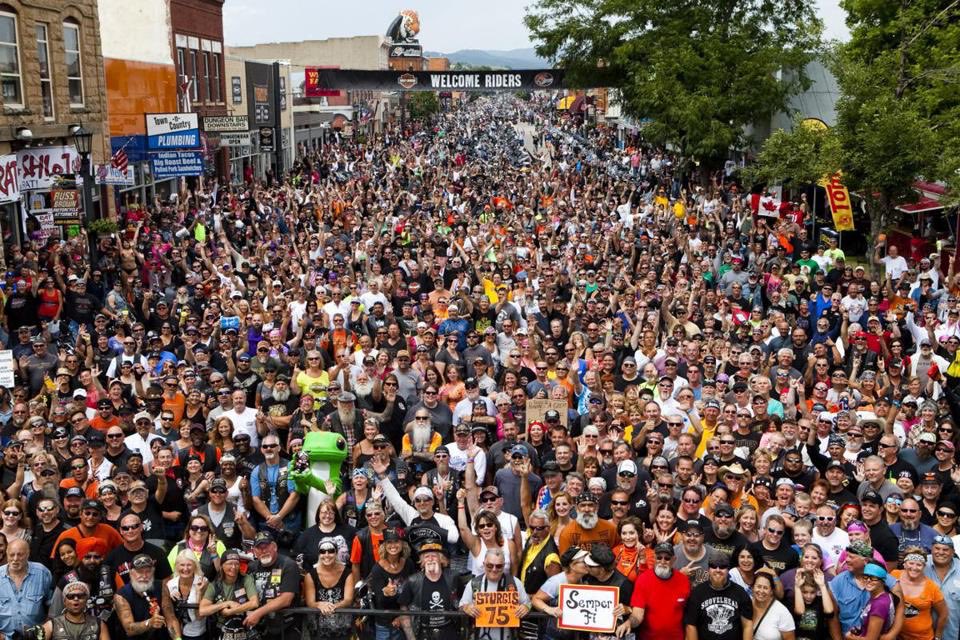
60% of Sturgis residents were against a motorcycle rally that brings in thousands but the city approved it. Here’s why

https://www.cnn.com/2020/08/10/us/sturgis-motorcycle-rally-residents-decision

Steven J. Frisch on Twitter: "I'm fearful of what is to come, as ...

Before deciding on whether to hold the 80th annual motorcycle rally in Sturgis, South Dakota, the local city council turned to its residents to get their take.

“There was a significant amount of discussion that the council had with residents, businesses and state health officials as well as local health officials,” Daniel Ainslie, the city manager, told CNN Sunday.
The city, home to fewer than 7,000, sent a survey to all households asking if they wanted the rally to proceed on its scheduled date. The massive event usually brings in crowds of about 500,000 over 10 days of drag races, contests and concerts. On its 75th anniversary, nearly three quarters of a million people showed.
A little more than 60% of people in the city voted against holding the event this week. But the city council approved it anyway.

https://www.washingtonpost.com/arts-entertainment/2020/08/10/smash-mouth-coronavirus-concert/?utm_campaign=wp_main&utm_medium=social&utm_source=facebook&fbclid=IwAR0EIjLLrhpAEXabcLb11uuVlYYSuluULzd13BPitPSQCW7m-KHfsL7ZNgE