


The FDA ended Monday its emergency use authorizations for two controversial drugs, hydroxychloroquine and chloroquine, as a potential coronavirus treatment.
Why it matters: Despite gaining President Trump’s adamant support and use, the drugs have failed in several clinical trials and have been found to possibly cause serious heart problems.
What they’re saying: The FDA said it believes the drugs “are unlikely to be effective in treating COVID-19” under the emergency use authorization.
Read the letter and memo regarding the revocation:


Despite a raft of data suggesting that wearing face masks (in conjunction with hand washing and social distancing) is effective in preventing person-to-person transmission of the coronavirus, the practice is still a partisan political issue in some places even as new cases continue to rise.
A new review published in The Lancet looked at 172 observational studies and found that masks are effective in many settings in preventing the spread of the coronavirus (though the results cannot be treated with absolute certainty since they were not obtained through randomized trials, the Washington Post notes).
Another recent study found that wearing a mask was the most effective way to reduce the transmission of the virus.
90% of Americans now say they’re wearing a mask in compliance with the CDC’s recommendations, up from 78% in April, according to a new poll conducted by NORC at the University of Chicago for the Data Foundation.
But despite the conclusive research and what seems to be a public consensus, masks remain a divisive subject.
As new coronavirus cases surge in Arizona, where cases have jumped 300% since the beginning of May, for instance, Governor Doug Ducey has not made it mandatory to wear masks in public, and in Orange County, California, officials on Friday rescinded a mask mandate after public backlash, even as cases rise; when cases peaked in April, on the other hand, New York made wearing a mask mandatory when people could not socially distance from others, and other states passed similar restrictions.
Part of the politicization of masks may have to do with resistance to heavy-handed government mandates, which in this case could cause people who are already skeptical of wearing face coverings to dig in their heels.
Lindsay Wiley, an American University Washington College of Law professor specializing in public health law and ethics, told NPR last month that stringent mask requirements “can actually cause people who are skeptical of wearing masks to double down.” And in turn, that “reinforce[s] what they perceive to be a positive association with refusing to wear a mask … that they love freedom, that they’re smart and skeptical of public health recommendations.”
Masks have also become a heavily politicized issue in recent weeks: Senate Majority Leader Mitch McConnell (R-Ky.) last month voiced his support of mask wearing in public, for instance, in contrast to President Trump and other GOP leaders who have portrayed masks as a sign of weakness. Trump infamously refused to wear a face mask as he toured a Ford facility in Michigan last month. When asked about the mask, he said that he wore one in private but “didn’t want to give the press the pleasure of seeing it.” House Speaker Nancy Pelosi has voiced her support for the practice: “real men wear masks,” she said earlier this month.
A video posted to Twitter on Friday showed a street in New York City’s East Village that was packed with people ignoring social distancing guidelines, most of whom were not wearing masks, drew widespread criticism. “When there’s a new spike people will blame the (masked) protests, but it’s really gonna be maskless crap like this,” one Twitter user wrote.
New York Governor Andrew Cuomo even weighed in on the scene. “Don’t make me come down there,” he tweeted.
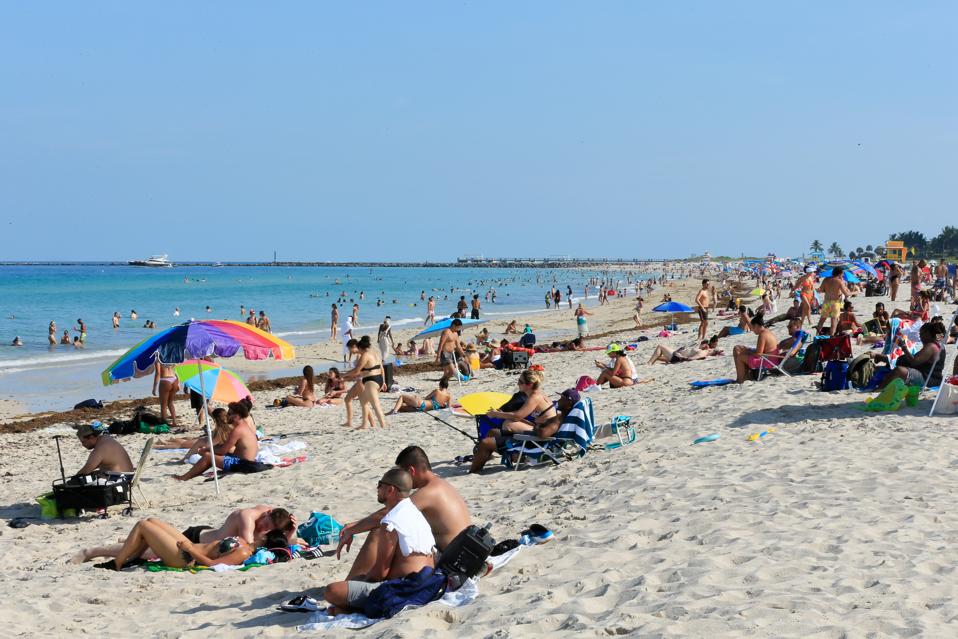
Some states are seeing a dramatic surge in new coronavirus infections even as reopening measures continue across the country, raising tough questions about whether those reopening efforts were premature and how officials will balance maintaining public safety with preventing more economic damage.
Texas and Florida—two of the first states to reopen—both hit new daily highs last week.
California also hit a record daily high last week, though one official attributed the spike to increased testing (Florida’s governor has also attributed his state’s spike to more testing).
Arkansas, Alabama, North Carolina, South Carolina, Utah and Alaska have also seen surging case numbers over the last week.
On Friday, the CDC released new forecasts that singled out six states—Arizona, Arkansas, Hawaii, North Carolina, Utah and Vermont—where the coronavirus death toll is likely to rise over the next month.
Some states and cities have walked back reopening measures in response to surging cases: Oregon’s governor put the reopening process on pause on Friday after the state saw its highest level of new cases since the start of the pandemic; Utah’s governor issued a similar order, as did the mayor of Nashville, Tennessee.
According to data compiled by Johns Hopkins, more than 2 million Americans have contracted Covid-19, the disease caused by the coronavirus, since the beginning of the pandemic, and more than 114,000 have died.
Even though news of states hitting record levels of coronavirus cases day after day might make it seem like the U.S. is headed for a second wave of the virus, the country is still situated very firmly within the “first wave.” New infections peaked around 36,000 cases a day in April, according to New York Times data, and over the last month the number of new daily cases has held relatively steady around 20,000. Cases in former hot spots like New York and New Jersey have fallen dramatically while cases in many areas of the South and West continue to rise. For a true “second wave” of the virus to be possible, the virus would need to subside and then reappear.
“We really never quite finished the first wave,” Dr. Ashish Jha, a professor of global health at Harvard University, told NPR. “And it doesn’t look like we are going to anytime soon.”

Dr. Anthony Fauci told a British newspaper Sunday that something resembling normal life in the U.S. would likely return in “a year or so,” with the coronavirus pandemic expected to require social distancing and other mitigation efforts through the fall and winter, although political divisiveness, reopening efforts and the George Floyd protests could add more layers of difficulty to the country’s recovery.
“I would hope to get to some degree of real normality within a year or so. But I don’t think it’s this winter or fall,” Fauci, director of the National Institute of Allergy and Infectious Diseases, told The Telegraph Sunday.
Fauci also told the newspaper that the travel ban from the U.K., the European Union, China and Brazil will likely stay in place for “months,” based on “what’s going on with the infection rate.”
Within the U.S., Florida, California and Texas hit all-time daily highs in reported Covid-19 cases, while the Centers for Disease Control predicted six states (Arizona, Arkansas, Hawaii, North Carolina, Utah and Vermont) will see higher death tolls over the next month.
U.S., where states that aren’t making them mandatory, like California, are seeing cases spike while New York, where the protective gear is required, has the country’s lowest spread rate.
“We’re seeing several states, as they try to reopen and get back to normal, starting to see early indications [that] infections are higher than previously,” Fauci said.
Over 2 million. That’s how many confirmed coronavirus cases are in the U.S., which leads the world both in the number of infections and casualties from the disease, according to data from Johns Hopkins University.
Despite Fauci’s immediate conservative outlook on when life can return to normal, he’s hopeful that multiple Covid-19 vaccines could be found by the end of 2020. “We have potential vaccines making significant progress. We have maybe four or five,” he told The Telegraph. Although “you can never guarantee success with a vaccine,” Fauci added, from “everything we have seen from early results, it’s conceivable we get two or three vaccines that are successful.”
The U.S. is not facing a second wave of coronavirus. “We really never quite finished the first wave,” according to Dr. Ashish Jha, a global health professor at Harvard. In an NPR interview, Jha said the first wave is unlikely to be finished “anytime soon.”
The World Health Organization designated the coronavirus outbreak as a pandemic on March 11, 2020. As of Sunday, the pandemic is approaching its fifth month, and few countries have had success in beating back their outbreaks. New Zealand has essentially returned to normal life after eliminating coronavirus, while countries like the U.S., the U.K. and Brazil, among others, continue to see new cases and report deaths.
Within the U.S., efforts to reduce cases and deaths, like mask wearing, have become partisan political issues. Desires both from elected officials and some citizens to reopen economies have also impacted the pandemic, as states that reopened earlier, like Florida, are seeing numbers of cases spike. Concerns that recent protests sparked by George Floyd’s killing will also further spread the coronavirus are present, but have not yet been proven, as symptoms can take up to 14 days to develop.

“We would like to warn everyone not to drop their guard even for a second in epidemic prevention control; we must be prepared for a prolonged fight with the virus,” Xu Hejian, a spokesman for the Beijing municipal government, said at a news conference Saturday.
“We have to stay alert to the risks of imported cases and to the fact that epidemic control in our city is complicated and serious and will be here for a long time,” he said.
/cloudfront-us-east-1.images.arcpublishing.com/dmn/HOLPLLCNCZGCVOECUBIPHZKKQE.jpg)
Coronavirus cases and hospitalizations are reaching alarming levels in some states.
What they’re saying: “Arizona is the new national hotspot for COVID-19 with more than 4,400 new cases in just the last 72 hours. Per capita, Arizona’s infection rate is now more than three times higher than New York state. It’s spreading like wildfire,” Rep. Greg Stanton tweeted last night.
The big picture: Several states have seen record numbers of new cases over the last few days, including Alabama, Alaska, Arizona, Arkansas, California, Florida, North Carolina, Oklahoma and South Carolina, Reuters reports.
The bottom line: There’s never been any reason to think that states with mild outbreaks in April weren’t at risk of having a crisis in June, especially states that haven’t taken lockdowns or social distancing as seriously.
 HENRY KOTULA