The AHA wants Congress to halt Medicare payment cuts and extend or make permanent certain waivers, among other requests.
The American Hospital Association has released a report on patient acuity that shows hospital patients are sicker and more medically complex than they were before the COVID-19 pandemic.
This is driving up hospital costs for labor, drugs and supplies, according to the AHA report.
Hospital patient acuity, as measured by average length of stay, rose almost 10% between 2019 and 2021, including a 6% increase for non-COVID-19 Medicare patients as the pandemic contributed to delayed and avoided care, the report said. For example, the average length of stay rose 89% for patients with rheumatoid arthritis and 65% for patients with neuroblastoma and adrenal cancer.
In 2022, patient acuity as reflected in the case mix index rose 11.1% for mastectomy patients, 15% for appendectomy patients and 7% for hysterectomy patients.
WHY THIS MATTERS
Mounting costs, combined with economy-wide inflation and reimbursement shortfalls, are threatening the financial stability of hospitals around the country, according to the AHA report.
The length of stay due to increasing acuity is occurring at a time of significant financial challenges for hospitals and health systems, which have still not received support to address the Delta and Omicron surges that have comprised the majority of all COVID-19 admissions, the AHA said.
The AHA is asking Congress to halt its Medicare payment cuts to hospitals and other providers; extend or make permanent certain waivers that improve efficiency and access to care; extend expiring health insurance subsidies for millions of patients; and hold commercial insurers accountable for improper and burdensome business practices.
THE LARGER TREND
Hospitals, through the AHA, have long been asking the federal government for relief beyond what’s been allocated in provider relief funds.
In January, the American Hospital Association sought at least $25 billion for hospitals to help combat workforce shortages and labor costs exacerbated by what the AHA called “exorbitant” rates on the part of some staffing agencies. The Department of Health and Human Services released $2 billion in additional funding for hospitals.
In March, the AHA asked Congress to allocate additional provider relief funds beyond the original $175 billion in the Coronavirus Aid, Relief and Economic Security Act.
Earlier this month, the Centers for Medicare and Medicaid Services increased what it originally proposed for payment in the Inpatient Prospective Payment system rule. The AHA said the increase was not enough to offset expenses and inflation.
Children, young adults will be impacted disproportionately, with 5.3 million children and 4.7 million adults ages 18-34 predicted to lose coverage.
Roughly 15 million people could lose Medicaid coverage when the COVID-19 public health emergency ends, and only a small percentage are likely to obtain coverage on the Affordable Care Act exchanges, according to a new report from the Department of Health and Human Services.
Using longitudinal survey data and 2021 enrollment information, HHS estimated that, based on historical patterns of coverage loss, this would translate to about 17.4% of Medicaid and Children’s Health Insurance Program (CHIP) enrollees leaving the program.
About 9.5% of Medicaid enrollees, or 8.2 million people, will leave Medicaid due to loss of eligibility and will need to transition to another source of coverage. Based on historical patterns, 7.9% (6.8 million) will lose Medicaid coverage despite still being eligible – a phenomenon known as “administrative churning” – although HHS said it’s taking steps to reduce this outcome.
Children and young adults will be impacted disproportionately, with 5.3 million children and 4.7 million adults ages 18-34 predicted to lose Medicaid/CHIP coverage. Nearly one-third of those predicted to lose coverage are Hispanic (4.6 million) and 15% (2.2 million) are Black.
Almost one-third (2.7 million) of those predicted to lose eligibility are expected to qualify for marketplace premium tax credits. Among these, more than 60% (1.7 million) are expected to be eligible for zero-premium marketplace plans under the provisions of the American Rescue Plan. Another 5 million would be expected to obtain other coverage, primarily employer-sponsored insurance.
An estimated 383,000 people projected to lose eligibility for Medicaid would fall in the coverage gap in the remaining 12 non-expansion states – with incomes too high for Medicaid, but too low to receive Marketplace tax credits. State adoption of Medicaid expansion in these states is a key tool to mitigate potential coverage loss at the end of the PHE, said HHS.
States are directly responsible for eligibility redeterminations, while the Centers for Medicare and Medicaid Services provides technical assistance and oversight of compliance with Medicaid regulations. Eligibility and renewal systems, staffing capacity, and investment in end-of-PHE preparedness vary across states.
HHS said it’s working with states to facilitate enrollment in alternative sources of health coverage and minimize administrative churning. These efforts could reduce the number of eligible people losing Medicaid, the agency said.
The Inflation Reduction Act of 2022extends the ARP’s enhanced and expanded Marketplace premium tax credit provisions until 2025, providing a key source of alternative coverage for those losing Medicaid eligibility, said HHS.
WHAT’S THE IMPACT?
While the model projects that as many as 15 million people could leave Medicaid after the PHE, about 5 million are likely to obtain other coverage outside the marketplace and nearly 3 million would have a subsidized Marketplace option. And some who lose eligibility at the end of the PHE may regain it during the unwinding period, while some who lose coverage despite being eligible may re-enroll.
The findings highlight the importance of administrative and legislative actions to reduce the risk of coverage losses after the continuous enrollment provision ends, said HHS. Successful policy approaches should address the different reasons for coverage loss.
Broadly speaking, one set of strategies is needed to increase the likelihood that those losing Medicaid eligibility acquire other coverage, and a second set of strategies is needed to minimize administrative churning among those still eligible for coverage.
Importantly, some administrative churning is expected under all scenarios, though reducing the typical churning rate by half would result in the retention of 3.4 million additional enrollees.
THE LARGER TREND
CMS has released a roadmap to ending the COVID-19 public health emergency as health officials are expecting the Biden administration to extend the PHE for another 90 days after mid-October.
The end of the PHE, last continued on July 15, is not known, but HHS Secretary Xavier Becerra has promised to give providers 60 days’ notice before announcing the end of the public health emergency.
A public health emergency has existed since January 27, 2020.
Hospitals are forced to absorb inflationary expenses, particularly related to supporting their workforce, AHA says.
The Centers for Medicare and Medicaid Services’ increase in the inpatient payment rate for 2023 is welcome but not enough to offset expenses, according to the American Hospital Association.
CMS set a 4.1% market basket update for 2023 in its final rule released Monday, calling it the highest in the last 25 years. The increase was due to the higher cost in compensation for hospital workers.
The final rule gave inpatient hospitals a 4.3% increase for 2023, as opposed to the 3.2% increase in April’s proposed rule.
WHY THIS MATTERS
CMS used more recent data to calculate the market basket and disproportionate share hospital payments, a move that better reflects inflation and labor and supply cost pressures on hospitals, the AHA said.
“That said, this update still falls short of what hospitals and health systems need to continue to overcome the many challenges that threaten their ability to care for patients and provide essential services for their communities,” said AHA Executive Vice President Stacey Hughes. “This includes the extraordinary inflationary expenses in the cost of caring hospitals are being forced to absorb, particularly related to supporting their workforce while experiencing severe staff shortages.”
The AHA would continue to urge Congress to take action to support the hospital field, including by extending the low-volume adjustment and Medicare-dependent hospital programs, Hughes said.
In late July, Senate and House members urged CMS to increase the inpatient hospital payment.
Premier, which works with hospitals, also said the 4.3% payment update falls short of reflecting the rising labor costs that hospitals have experienced since the onset of the pandemic.
“Coupled with record high inflation, this inadequate payment bump will only exacerbate the intense financial pressure on American hospitals,” said Soumi Saha, senior vice president of Government Affairs for Premier.
THE LARGER TREND
Recent studies show hospitals remain financially challenged since the COVID-19 pandemic’s effect on revenue and supply chain and labor expenses. Piled onto that has been inflation that has added to soaring expenses.
Hospital margins were up slightly from May to June, but are still significantly lower than pre-pandemic levels, according to a Flash Report from Kaufman Hall.
The effects of the pandemic on the healthcare industry have been profound, resulting in the creation of new business models, according to a report from McKinsey.
Transformational change is necessary as hospitals have been hit hard by eroding margins due to cost inflation and expenses, Fitch found.
With a closely divided Congress, President Biden has leaned heavily on regulatory actions to advance his healthcare priorities. With the midterm elections fast approaching, the graphic above assesses the impact of those actions, and outlines which legislative components Democrats may still try to pass before November.
From the start, the administration has signaled the importance of promoting competition in healthcare markets, and has devoted more scrutiny to hospital mergers—while leaving most attempts at vertical integration unchallenged. Through Medicaid waivers, it has worked to expand insurance coverage, rolling back Trump-era work requirements, expanding postpartum coverage, and encouraging states to experiment with public option plans on the Affordable Care Act (ACA) exchanges.
The Centers for Medicare and Medicaid Services (CMS) has continued the steady march toward value programs, revising the Direct Contracting model to factor in health equity. Despite these incremental moves, Medicare Advantage (MA) remains the focus of long-term efforts to control Medicare spending, and MA programs have seen payments boosts year-over-year.
Meanwhile, the fate of President Biden’s signature healthcare campaign promises remains in the hands of an intransigent Congress. Senate Democrats are currently trying to negotiate a deal on a bill allowing Medicare drug negotiations and extending ACA subsidies, an important provision to protect millions from receiving premium hike notices just weeks before Election Day.
On July 7, 2022, the Centers for Medicare & Medicaid Services (CMS) released the 2023 Medicare Physician Fee Schedule (MPFS) proposed rule, which includes payment provisions and policy changes to the Quality Payment Program (QPP) and Alternative Payment Model (APM) participation options and requirements for 2023.
MPFS Key Proposals and Additional Potential Medicare Reductions:
For 2023, CMS proposes a Conversion Factor (CF) of $33.0775 which is a decrease of $1.53 or -4.42% from the 2022 conversion factor of 34.6062.
This significant reduction in the CF accounts for the expiration of the 3.00% increase in PFS payments for CY 2022 as required by the Protecting Medicare and American Farmers from Sequester Cuts Act, in addition to the statutorily required budget neutrality adjustment to account for changes in Relative Value Units.
The separately calculated Anesthesia CF is proposed at 20.7191, a -3.91% decrease from the 2022 conversion factor of $21.5623.
Key Takeaways: CMS estimates an impact to allowed charges from policy changes in the rule as outlined below. These impacts are due in part due changes in the RVUs and the second year of the transition to clinical labor pricing updates.
(Please note: These estimates do not include the impact on payments from the expiration of the congressionally mandated 3.00% boost to the 2022 CF.)
Anesthesiology: -1%
Diagnostic Radiology: -3%
Interventional Radiology: -4%
Emergency Medicine: +1%
Critical Care: +1%
Nuclear Medicine: -3%
Pathology: -1%
Radiation Oncology/Therapy Centers: -1%
Internal Medicine: +3%
Independent Laboratory -1%
Additional Potential Medicare Reductions:
In addition to the proposed cut to the CF, the second of two sequestration cuts was implemented on July 1, 2022, at -1%, bringing the total sequestration cut to -2% which will continue without Congressional intervention.
Also, the lack of full funding of the American Rescue Plan meant that the Medicare program would contribute 4% under the “PAYGO” (Pay as You Go) rules and that cut will come back into the Medicare fee schedule in 2023. In total, hospital-based physicians face in the approximate range of -10% in 2023 without Congressional intervention.
Appropriate Use Criteria (AUC): CMS did not address the appropriate use criteria (AUC)/clinical decision support (CDS) mandate for advanced diagnostic imaging services in this rule. CMS posted an update on its website indicating that the current educational and operations testing period will continue beyond January 1, 2023, even if the COVID-19 public health emergency (PHE) ends in 2022. The notice states that the agency is unable to forecast when the payment penalty phase of the program will begin. Read more at CMS.gov.
Additional highlights of the MPFS Proposed Rule include: Evaluations and Management (E/M) Services: As part of the ongoing updates to E/M visits and the related coding guidelines that are intended to reduce administrative burden, the AMA CPT Editorial Panel approved revised coding and updated guidelines for Other E/M visits, effective January 1, 2023.
Like the approach CMS finalized in the CY 2021 MPFS final rule for office/outpatient E/M visit coding and documentation, CMS is proposing to adopt most changes in coding and documentation for Other E/M visits including: hospital inpatient, hospital observation, emergency department, nursing facility, home or residence services, and cognitive impairment assessment, effective January 1, 2023. This revised coding and documentation framework would include CPT code definition changes (revisions to the Other E/M code descriptors), and for the first time would mean that AMA CPT and CMS would follow the same coding guidelines, including:
• New descriptor times (where relevant). • Revised interpretive guidelines for levels of medical decision making. • Choice of medical decision making or time to select code level (except for services such as emergency department visits (time has never been a component of ED E/M services except critical care) and cognitive impairment assessment, which are not timed services). • Eliminated use of history and exam to determine code level (instead there would be a requirement for a medically appropriate history and exam).
Split (or Shared) Visits (Where services are performed by advance practice clinicians.) CMS had previously finalized in the 2022 MPFS final rule a new January 1, 2023 billing policy for instances in which a physician delivers an E/M service along with an advanced practice clinician (APC). Recall that E/M services billed under an APC reimburse at 85% of the MPFS unless there is a documented shared service by the supervising physician.
• The key determinant for deciding if there was a shared service is if the physician provided key elements of the history, exam, or medical decision making ─ OR half of the total time spent treating the patient. • There were significant concerns that in hospital-based settings, the rule (set for implementation on January 1, 2023) would have required only time as the determinative element, and that the majority of APC services would then be reimbursed at 85% of the fee schedule. After significant advocacy by multiple stakeholders, CMS has delayed the policy that would have based the determination of the billing practitioner solely on time. This policy is proposed for delay until January 1, 2024 while CMS collects additional input.
Expand Telehealth Coverage: • CMS is proposing making several services that are temporarily available as telehealth services for the PHE available through CY 2023 on a Category III basis, which will allow more time for collection of data that could support their eventual inclusion as permanent additions to the Medicare telehealth services list. • CMS is also proposing to extend the duration of time that services are temporarily included on the telehealth services list during the PHE, but are not included on a Category I, II, or III basis for a period of 151 days following the end of the PHE, in alignment with the Consolidated Appropriations Act, 2022 (CAA, 2022).
Highlights of the Quality Payment Program (QPP): CMS stated they are limiting proposals for traditional MIPS and focusing on further refining implementation of MIPS Value Pathways (MVPs). 2023 Proposed Performance Threshold and Performance Category Weights: The performance threshold for the 2023 performance year is proposed to be 75 points, same as 2022. • Beginning with 2023, CMS will no longer offer an exceptional performance adjustment. • The category weights for the 2023 performance year are proposed to remain the same as the 2022 weights: o Quality – 30%, o Cost – 30% o Promoting interoperability – 25% o Improvement Activities – 15%
Data Completeness Requirements: • For 2023, CMS is proposing quality measure submissions should continue to account for at least 70% of total exam volume – same as 2022.
• CMS proposed to increase this threshold to 75% beginning with the 2024 and 2025 performance years.
Quality Category – Measure Scoring System • Beginning with 2023 CMS will change the scoring range for benchmarked measures to 1 to 10 points, doing away with the 3-point floor. • Score existing non-benchmarked measures at 0 points even if data completeness is met • New measures will continue to be scored at a minimum of 7 points for their first year and a minimum of 5 points in their second year. • CMS is maintaining the small practice bonus of 6 points that is included in the Quality • performance category score. • CMS also continues to award small practices 3 points for submitted quality measures that do not meet case minimum requirements or do not have a benchmark.
MIPS Value Pathways (MVPs) CMS is proposing 5 new MVPs and revising the 7 previously established MVPs that would be available beginning with the 2023 performance year. • Advancing Cancer Care • Optimal Care for Kidney Health • Optimal Care for Patients with Episodic Neurological Conditions • Supportive Care for Neurodegenerative Conditions • Promoting Wellness
Advanced Alternative Payment Models For payment years 2019 through 2024, Qualifying APM Participants (QPs) receive a 5 percent APM Incentive Payment. After performance year 2022, which correlates with payment year 2024, there is no further statutory authority for a 5 percent APM Incentive Payment for eligible clinicians who become QPs for a year.
CMS is concerned that the statutory incentive structure under the QPP beginning in the 2023 performance year. corresponding 2025 payment year, could lead to a drop in Advanced APM participation, and a corresponding increase in MIPS participation. As a result, CMS concluded that it would forego action for the 2023 performance period and 2025 payment year. They instead are seeking public input in identifying potential options for the 2024 performance period and 2026 payment year of the QPP.
As part of the 2023 Physician Fee Schedule proposed rule, the Centers for Medicare & Medicaid Services (CMS) outlined major changes to the Medicare Shared Savings Program (MSSP), with the goals of increasing participation in the program and improving health equity.
The agency hopes their revisions to the benchmarking methodology, which will advantage smaller accountable care organizations (ACOs) and those enrolling large numbers of underserved beneficiaries, will change the trajectory of the program.
With participation among providers stagnating in recent years, the new rules represent a recognition from CMS that MSSP, in its current form, is likely to increase spending rather than generate significant savings. The rule also includes a 3.9 percent decrease in the “conversion factor” for physician payment, which has already drawn outrage from the American Medical Association and other physician groups.
The Gist:There is little reason to expect that these modifications—as significant as they are—will be meaningful to beneficiaries or to the Medicare program’s overall sustainability. Although it is heartening to see CMS admit that ACOs are on course to violate the statutory requirement that the program not increase spending, the proposed changes would net only $14.8B in savings over a twelve-year period—a rounding error for a program that spent $830B in 2020 alone. Meanwhile the 11M beneficiaries attributed to MSSP ACOs are dwarfed by the 28M enrolled in MA.
For many health systems and physician groups—particularly those who are most progressive in managing risk—MSSP is now a sideshow to their Medicare Advantage (MA) strategies. The federal government has made two “bets” on how to lower health spending for seniors, and the dollars spent on enticing insurers to grow their MA businesses (in the form of subsidies) far outweigh the effort to encourage provider participation in ACOs—a clear sign of Medicare’s priorities.
But with MA currently not generating savings compared to fee-for-service Medicare, cuts in per-beneficiary spending in MA will be necessary to achieve savings in the long term.
The American Hospital Association wants HHS to act quickly to ensure that affected hospitals receive withheld 340B program funds.
The organization’s June 28 letter to HHS comes after the Supreme Court recently overturned a $1.6 billion 340B payment cut.
The case centered around whether CMS has the authority to make cuts to the program under its Medicare Outpatient Prospective Payment System. Under the payment rule, HHS cut the reimbursement rate for covered drugs by 28.5 percent in 2018, but it later lowered the cut to 22.5 percent. The Supreme Court reversed a federal appeals court’s 2020 ruling that HHS had the authority to make the $1.6 billion annual reimbursement cut.
“Given the vital role that 340B hospitals play in serving vulnerable communities, they should be repaid the funds that have been withheld from them without delay,” the American Hospital Association said in the letter. “They also should be paid for all of the years (2018-2022) in which the Centers for Medicare & Medicaid Services (CMS) illegally cut reimbursement rates.”
The hospital group said it is concerned that despite the Supreme Court’s decision, the resolution of these issues “could be bogged down in needless litigation, and that hospitals will not be appropriately compensated at a time when they are weathering significant financial challenges on many fronts.”
In a unanimous decision, the Justices found that the Department of Health and Human Services (HHS) exceeded its legal authority when it cut Medicare reimbursement rates for outpatient drugs by 28.5 percent at 340B-eligible hospitals in 2018. The justices wrote that the Centers for Medicare and Medicaid Services (CMS) shouldn’t have cut payments to these hospitals without first surveying their average drug acquisition costs, as required by statute.
CMS must now figure out how to repay 340B hospitals the difference in reimbursement for 2018 and 2019, the two years the unlawful cuts were in effect, during which time it redistributed those savings to all hospitals in the form of higher reimbursement for outpatient services. (For an explainer on the mechanics of the 340B program, see our overview here, and for more details on this Supreme Court case, see our summary here.)
The Gist: This decision was a narrow ruling on administrative grounds, and did not touch on the larger policy debates concerning the 340B program. While 340B-eligible health systems can breathe a momentary sigh of relief, they are still facing significant, ongoing revenue disruptions as at least 17 pharmaceutical manufacturers are restricting discounted drug sales to contract pharmacies.
Scrutiny of the 340B program, which has grown to include over 40 percent of US hospitals, will continue to raise questions aboutwhether there are better ways to subsidize the operations of hospitals serving low-income patients, and to ensure that underserved patients have access to lifesaving treatments.
The U.S. Supreme Court sided with hospital groups June 15 in a case challenging HHS’ 340B payment cuts.
The case centered around whether CMS has the authority to make cuts to the program under its Medicare Outpatient Prospective Payment System. Under the payment rule, HHS cut the reimbursement rate for covered drugs by 28.5 percent in 2018, but it later lowered the reimbursement rate cut to 22.5 percent.
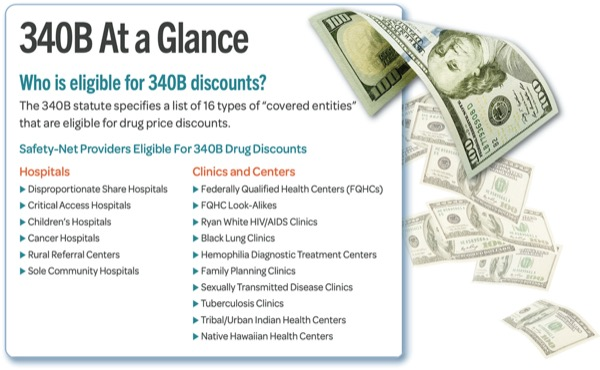
Under the 340B program, eligible hospitals can buy outpatient drugs at a discount. A hospital typically pays 20 percent to 50 percent below the average sales price for the drugs through the program.
The Supreme Court reversed a federal appeals court’s 2020 ruling that HHS had the authority to make the $1.6 billion annual reimbursement cut.
Justice Brett Kavanaugh, writing the opinion for the court’s unanimous decision, said that absent a survey of hospitals’ acquisition costs, HHS may not vary the reimbursement rate for 340B hospitals.
“HHS’s 2018 and 2019 reimbursement rates for 340B hospitals were therefore contrary to the statute and unlawful,” he wrote. The American Hospital Association, Association of American Medical Colleges and America’s Essential Hospitals said in a joint statement emailed to Becker’s following the decision that they look forward to working with HHS and the courts to develop a plan to reimburse 340B hospitals affected by the cuts while ensuring other hospitals are not disadvantaged as they also continue to serve their communities.
The Centers for Medicare and Medicaid Services (CMS) fined two of Atlanta-based Northside Hospital’s five facilities a total of $1.1M for failing to disclose their prices. Though only six percent of hospitals are fully in compliance with the federal rules that went into effect in January 2021, CMS has only sent 352 warning letters to date, and this week’s fines are the first the agency has issued.
The Gist: While these first fines are notable, it remains an open question whether the financial penalties for not complying with price transparency are stiff enough to motivate hospitals to submit their data. While more substantial than those under the Trump Administration, the current fines remain a rounding error for many hospitals, as they represent less than one percent of net patient revenue on average.
Market dynamics may be more of a factor in compliance than monetary penalties: a recent JAMA study found that hospitals in more competitive, urban markets were more likely to share prices.











 HENRY KOTULA