https://www.washingtonpost.com/news/powerpost/paloma/the-health-202/2020/05/05/the-health-202-social-distancing-hasn-t-been-as-effective-in-stemming-u-s-coronavirus-deaths-as-policymakers-had-hoped/5eb04b6d88e0fa594778ea5e/
%2Farc-anglerfish-washpost-prod-washpost%2FEAJ46XUOLMI6VEZCUKPHL374SM.jpg&w=908)
Social distancing isn’t having the effects many had hoped for.
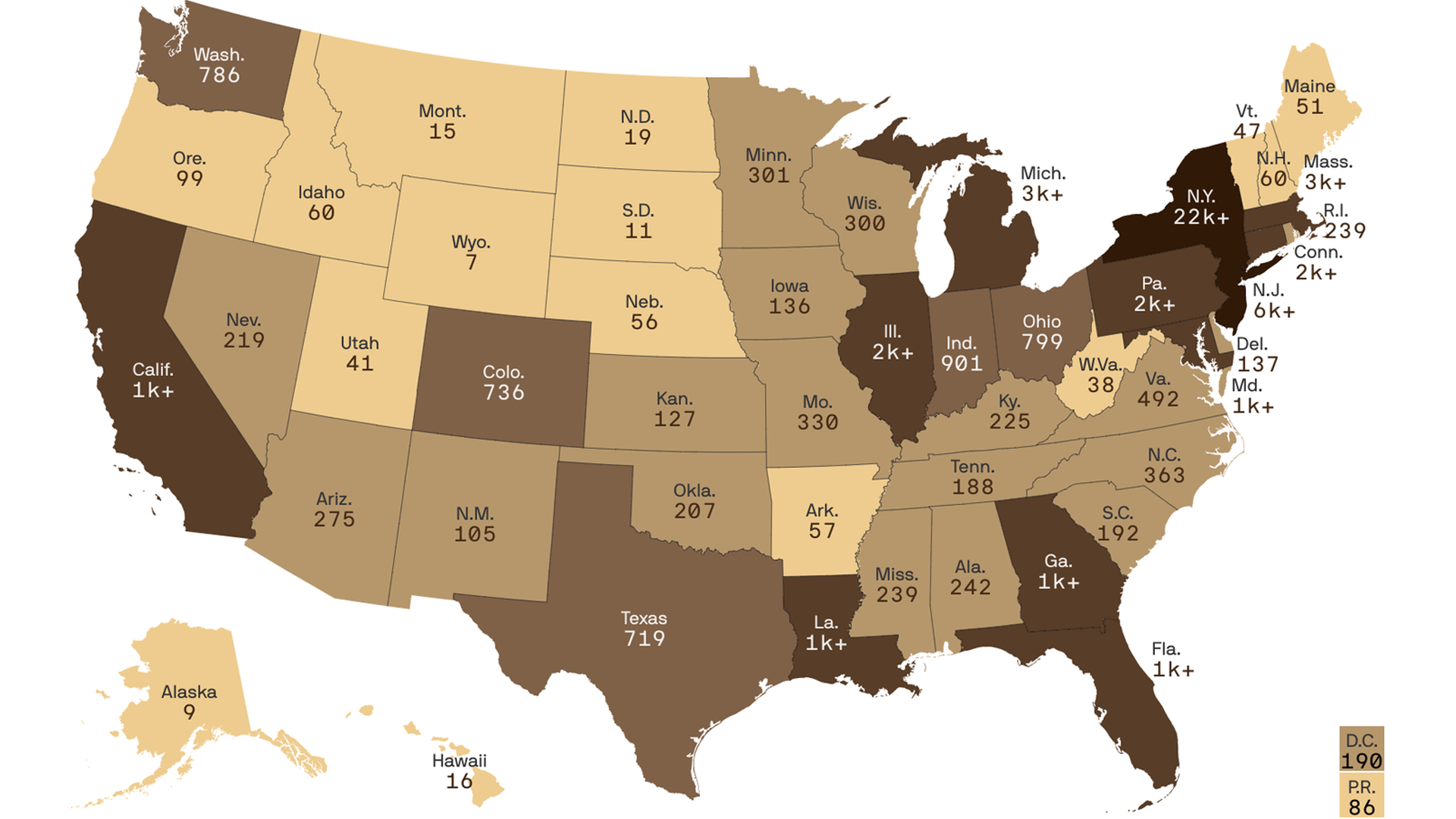
Despite encouraging signs on the nation’s East and West coasts, daily diagnosed cases of the novel coronavirus appear to still be on the rise in about 20 states. A number of rural counties have become unexpected hot spots in recent weeks, including in the Black Belt region of Mississippi and Alabama and in communities throughout Iowa and northern Texas around the Oklahoma panhandle. The country’s overall daily figures of diagnoses and deaths have plateaued, worrying health policymakers as many states move to reopen parts of their economy.
That steep curve of covid-19 cases in March and April isn’t receding the way it rose.
Hot spots are shifting geographically from New York City to areas around the country. For the past month, the figures have hovered around 30,000 diagnosed cases and around 2,000 deaths every day, former Food and Drug Administration commissioner Scott Gottlieb noted in a Wall Street Journal op-ed.
“Everyone thought we’d be in a better place after weeks of sheltering in place and bringing the economy to a near standstill,” he wrote. “Mitigation hasn’t failed; social distancing and other measures have slowed the spread. But the halt hasn’t brought the number of new cases and deaths down as much as expected or stopped the epidemic from expanding.”
President Trump, who last week suggested the novel coronavirus would disappear even without a vaccine, has now upgraded his prediction of fatalities to as many as 100,000 people. Nonetheless, he said in a New York Post interview yesterday that Americans are “starting to to feel good now. The country’s opening again. We saved millions of lives, I think.”
A leaked government report, still in draft version, predicts a spike in cases and deaths beginning on May 14.
The report, which the Centers for Disease Control quickly disavowed as an unfinished projection, suggests new cases could surge to 200,000 per day and daily American deaths could number more than 3,000 by June 1. That’s far more than what other models predict, but the Johns Hopkins epidemiologist who prepared it told my colleagues William Wan, Lenny Bernstein, Laurie McGinley and Josh Dawsey that 100,000 new cases per day by the end of the month isn’t out of the realm of possibility.
Former FDA commissioner Scott Gottlieb:
University of Michigan professor Justin Wolfers:
That’s not the only model showing discouraging figures for the month of May. A model out of the University of Washington, relied upon heavily by the administration, yesterday upgraded its U.S. fatality predictions for the virus’s first wave from 72,433 deaths to 134,475 deaths by Aug. 4.
These aren’t the trends many policymakers had hoped to see, after most Americans spent seven weeks at home under an unprecedented lockdown that has torched the once-booming economy and thrust millions into economic uncertainty. Protests against extended lockdowns are starting to mount around the country, and many governors have assembled and even embarked upon gradual plans to reopen businesses, schools and other public areas.
Nonetheless, a new Washington Post-University of Maryland poll out this morning shows sizable majority of Americans oppose the reopening of restaurants, retail stores and businesses.
Executive producer of 7News WHDH in Boston:
Social distancing did accomplish some important objectives. It undoubtedly saved the health-care system from being crushed by an overwhelming caseload of sick patients all at once.
And the United States is still outranked by half a dozen European countries when it comes to deaths per capita. The U.S. death rate is about 206 deaths per million people. That figure is 538 in Spain, 372 in France, 481 in Italy, 432 in the United Kingdom and 207 in Switzerland, according to a tally by Mother Jones.
But distancing clearly hasn’t been enough — at least the way it’s been carried out — to halt the spread of the highly contagious virus in some places.
New cases and deaths across the whole U.S. are about where they were 20 days ago, my colleague Philip Bump reports. He created a graphic where you can view the three-day averages of cases, deaths and tests performed by state (check it out here).
“The back of the mountain doesn’t look the way the front did,” Philip writes. “We saw a steady, exponential rise in confirmed cases and deaths each day for several weeks. But particularly with daily case totals, the period after the peak nationally has looked more like a plateau than a downward slide.”
Daily cases appear to be rising significantly in Delaware, Illinois, Indiana, Minnesota and Virginia. They’re also trending upward in Arizona, Colorado, D.C., Iowa, Kansas, Maryland, Mississippi, Nebraska, New Hampshire, New Mexico, North Carolina, Tennessee, Texas, Utah and Wisconsin.
Andy Slavitt, former head of the Centers for Medicare and Medicaid Services:
“There are so many emerging areas still throughout the country that our group has been trying to wave our hands about,” Marynia Kolak, a health and spatial data science researcher at the University of Chicago, told me.
Kolak and her colleagues are tracking covid-19 cases and deaths at the county level. They’ve been increasingly spotting clusters of the disease in rural areas. Kaiser Family Foundation researchers have also found that rural areas are experiencing a faster growth in cases, even as their total numbers remain far below those seen in urban settings.
One example: Five counties in Minnesota with significant meat-processing plants. State officials said about a quarter of cases reported over the weekend came from those counties.
One is Nobles County, home to a JBS USA pork processing plant in Worthington, with a population of around 22,000. It is scheduled to partially reopen this week, under an order by Trump to keep meat plants open.
The outbreaks in counties with meat-processing plants “illustrates how powerfully situations can change at the community level,” said Jan Malcolm, commissioner of Minnesota’s Department of Health.
Malcolm stressed how hard it is to stem the spread of the virus in these types of facilities.
“These are particularly challenging investigations,” Malcolm said. “Many of the workers involved don’t have phones, don’t provide phone numbers, aren’t answering calls. It’s been a very labor-intensive, shoe-leather kind of an approach.”




/GettyImages-142622448-5895c40f5f9b5874eeee3c2b.jpg)



 HENRY KOTULA