


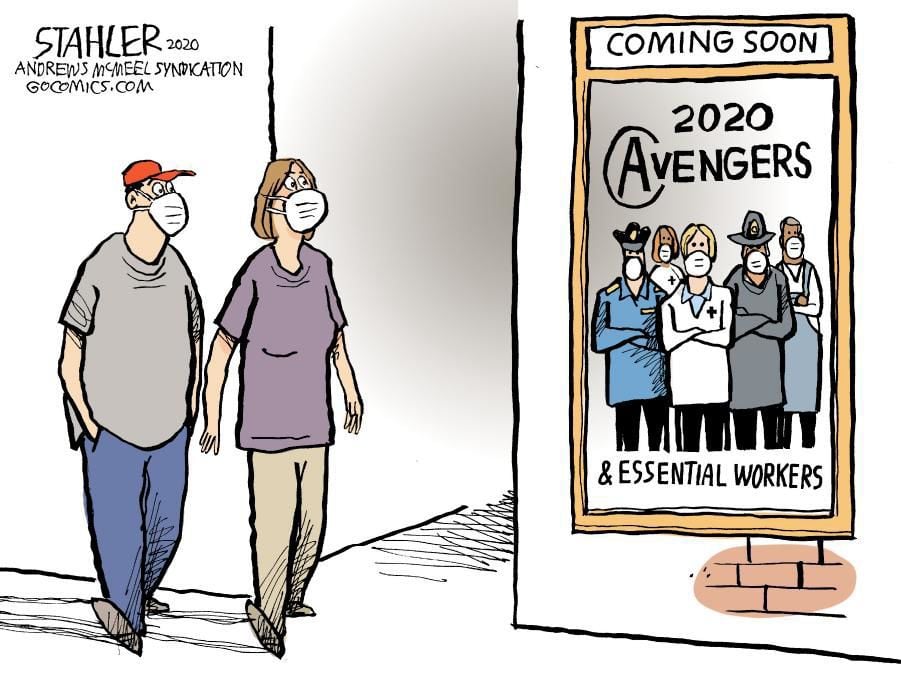
Cartoon – 2020 Halloween Candy


https://mailchi.mp/f2794551febb/the-weekly-gist-october-23-2020?e=d1e747d2d8

Overweight patients infected with COVID-19 have a higher risk of severe disease—but it turns out the pandemic may have brought a reprieve for overweight turkeys. According to a recent Washington Post piece, turkey farmers are facing a glut of, ahem, larger birds, as social distancing and reduced travel are expected to result in fewer people around the Thanksgiving dinner table, and fewer families springing for a 20-pound bird.
Farmers commit to their chicks as early as January, making a bet on the ratio of larger (male) toms versus smaller (female) hens to meet holiday demand, so many were locked into their plans before the pandemic hit. Demand for larger birds has also been hit by fewer orders for piece parts: with fall Renaissance festivals canceled, demand for turkey legs cratered. (Spare a thought for mead brewers as well.) Sadly, these soon-to-be-spared holiday heavyweights are unlikely to spend the winter roaming free—look for a rise in ground turkey supply a few months down the road.

Smaller birds for smaller gatherings: just another way our “Pandemic Thanksgiving” will look like none we’ve experienced before.
https://mailchi.mp/f2794551febb/the-weekly-gist-october-23-2020?e=d1e747d2d8

The upcoming election has huge implications for healthcare, far beyond how COVID is managed, ranging from how care is covered to how it’s delivered. The graphic above shows a continuum of potential policy outcomes of the November 3rd vote.
If President Trump wins a second term and Republicans control at least one house of Congress, there will likely be more attempts to dismantle the ACA, as well as continued privatization of Medicare coverage.
If Democrats win the presidency and sweep Congress, actions to expand the Affordable Care Act (ACA), or even create a national public option, are on the table—although major healthcare reform seems unlikely to occur until the second half of a Biden term.
In the short term, we’d expect to see more policy activity in areas of bipartisan agreement, like improving price transparency, ending surprise billing and lowering the cost of prescription drugs, regardless of who lands in the White House.
While healthcare emerged as the most important issue for voters in the 2018 midterm elections, the COVID pandemic has overshadowed the broader healthcare reform platforms of both Presidential candidates heading into the election. As shown in the gray box, many Americans view the election as a referendum on the Trump administration’s COVID response. Managing the pandemic is one of the most important issues for voters, especially Democrats, who now rank the issue above reducing the cost of healthcare or lowering the cost of drugs.
In many aspects, the COVID policies of Biden and Trump are almost diametrically opposed, especially concerning the role of the federal government in organizing the nation’s pandemic response.
The next administration’s actions to prevent future COVID-19 surges, ensure safe a return to work and school, accelerate therapies, and coordinate vaccine delivery will remain the most important aspect of healthcare policy well into 2021.
https://mailchi.mp/f2794551febb/the-weekly-gist-october-23-2020?e=d1e747d2d8
:no_upscale()/cdn.vox-cdn.com/uploads/chorus_asset/file/21986301/2_US_Positive.png)
In Thursday’s second and final Presidential debate, former Vice President Joe Biden warned that a “dark winter” lies ahead in the coronavirus pandemic, and with cases, hospitalizations, and deaths on the rise across the country, it now appears that we are headed into a “third wave” of infections that may prove worse than both the initial onset of COVID on the coasts and the summertime spike in the Sun Belt.
Yesterday more than 71,600 new cases were reported nationwide, nearing a late-July record. Thirteen states hit record-high hospitalizations this week, measured by weekly averages, most in the Midwest and Mountain West. Several Northeastern states, which had previously brought the spread of the virus under control, also experienced substantial increases in infections, leading schools in Boston to suspend all in-person instruction. Of particular concern is hospital capacity, which is already being strained in the more rural areas now being hit by COVID cases. With infection spikes more geographically widespread than in earlier waves, fewer medical workers are available to lend support to hospitals in other states, leading to concerns about hospital staffing as admissions rise.
As hospitalizations increase, so too will demand for therapeutics to help shorten the course and moderate the impact of COVID. This week, Gilead Sciences’ antiviral drug remdesivir, previously available under an Emergency Use Authorization (EUA) from the federal government, became the first drug to win full approval from the Food and Drug Administration (FDA) to treat patients hospitalized with COVID-19. The approval was based on clinical studies that showed that remdesivir can reduce recovery time, and also includes use for pediatric COVID patients under the age of 11.
Meanwhile, the FDA cleared AstraZeneca to resume US clinical trials of its coronavirus vaccine, which had been suspended for a month following an adverse patient event. It’s widely expected that one or more drug companies will submit their vaccine candidates for EUA sometime next month, although new polling data released this week indicates that the American public is growing more skeptical in their willingness to take an early vaccine against the virus, with only 58 percent of respondents saying they would get the shot when it first becomes available, down from 69 percent in August. (Only 43 percent of Black respondents say they would get the vaccine, compared to 59 percent of Whites—a racial divide that reveals deep distrust based on the history of inequities in the US healthcare system.)

In many respects, the coming month will surely prove to be a pandemic turning point, revealing the magnitude of the next wave of COVID, the direction of US public health policy, the prospects for reliable therapeutics, and the timing of a safe and effective vaccine. We’ll soon know whether we are, indeed, headed for a winter of darkness.

Poland has turned its largest stadium into an emergency field hospital. The numbers of Covid-19 patients in Belgium and Britain have doubled in two weeks. And doctors and nurses in the Czech Republic are falling ill at an alarming rate.
As new cases of the virus began to increase again across Europe last month, hospitals were initially spared the mass influx of patients they weathered earlier this spring. Some suggested that the virus had become less deadly, or that older, more vulnerable people would be shielded.
But a second wave of serious illness is here, new data released on Thursday shows, making it clear that the pandemic is still dangerous and that adherence to control measures over the next few weeks will be crucial in preventing hospitals from becoming overrun for a second time this year.
The number of Covid-19 patients in hospitals across the continent is still less than half of the peak in March and April, but it is rising steadily each week, according to data from the European Centre for Disease Prevention and Control. People across much of Europe — including larger countries like France, Italy, Poland and Spain — are now more likely to be hospitalized with Covid-19 than those in the United States.
Bruno Ciancio, the head of disease surveillance at the center, said he was concerned that some of the worst-hit countries now — including the Czech Republic, Poland and Bulgaria — were not as affected this spring, and may not have expanded their hospital capacity or intensive care units.
“The signals were all there in September,” said Mr. Ciancio. “At this point it’s very important that all member states prepare their hospitals to deal with the increase in demand that is coming.”
Hospitalization rates are a key measure of the pandemic’s severity. The rates rise and fall days or weeks behind the tallies of new infections. But infection figures depend heavily on each country’s testing capacity, while seriously ill people tend to enter hospitals whether they have been tested for the virus or not.
Europe’s current wave of infection is due in part to the relative normalcy it experienced this summer. Unlike the United States, where the epidemic rose to a second peak in July and a third peak this month, travelers moved around Europe, college students returned to campus and many large gatherings resumed, all while the virus kept spreading.
Now hospitals are scrambling to prepare for an onrush of Covid-19 patients, at a time when bed and intensive care capacity will already be under strain during the winter flu season.
In Poland, the government converted the country’s largest stadium into a temporary field hospital with room for 500 patients. Hospitals in France, especially in the Paris area, have started to postpone non-emergency surgeries, while others have called back staff on leave. More than one-fifth of Spain’s intensive care beds are occupied by Covid-19 patients, and in Madrid, that figure is closer to 40 percent.
And in the Czech Republic — where the current hospitalization rate surpasses the worst period in Britain — physicians are worried about a shortage of staff. “In some regions, about 10 percent of the medical staff is either already infected or in quarantine,” said Petr Smejkal, the chief of infectious diseases and epidemiology at the Institute of Clinical and Experimental Medicine in Prague.
Mr. Smejkal said the country also lacks specialty workers like respiratory therapists, and that most nurses are not trained to operate ventilators. “I am most worried about personnel, and keeping a safe ratio of doctors to patients and nurses to patients,” he added.
There is hope that no place will experience the level of death that Bergamo, Italy, New York City and Madrid suffered this spring. How the virus spreads is better understood now, and treatments have improved, giving sick people a better chance of survival. Testing has expanded across Europe, allowing countries to identify outbreaks earlier, when they are easier to contain.
But it is unclear how successful those control measures will be, or if political resistance and collective exhaustion over new restrictions will make it harder to get the virus under control for a second time.
Deaths in most of Europe remain at a fraction of the levels seen in the spring. But they have ticked slowly upwards over the last several weeks, and they tend to lag hospitalizations by about a month. Experts say additional increases in deaths are likely over the next couple of weeks.
https://covidtracking.com/data/charts/us-daily-positive

The public deserves the most complete data available about COVID-19 in the US. No official source is providing it, so we are.
Every day, our volunteers compile the latest numbers on tests, cases, hospitalizations, and patient outcomes from every US state and territory.

 HENRY KOTULA