Many workers don’t get new paid sick leave, because of ‘broad’ exemption for providers, report finds

https://www.washingtonpost.com/business/2020/08/11/paid-sick-leave/?utm_source=Sailthru&utm_medium=email&utm_campaign=Issue:%202020-08-12%20Healthcare%20Dive%20%5Bissue:29035%5D

Many health-care workers don't get new paid sick leave, because of ...

The New York attorney general sued the Labor Department in April over the agency’s interpretation of ‘health care provider’.

A government watchdog said in a report out Tuesday that the Labor Department “significantly broadened” an exemption allowing millions of health-care workers to be denied paid sick leave as part of the law Congress passed in March to help workers during the coronavirus pandemic.

Congress passed the Families First Coronavirus Response Act in March to ensure workers at small- and medium-size companies were able to take paid leave if they or a family member became sick with the coronavirus. The law exempts health-care providers as well as companies with more than 500 employees.

But an Office of the Inspector General report noted that a move by the Labor Department to more broadly expand how they categorize health-care providers ended up leaving far more workers without a guarantee of paid sick leave than the agency’s estimate of 9 million.

While existing federal statutes define health-care workers as doctors, someone practicing medicine or providing health-care services, the Labor Department’s exemption from paid sick leave included anyone employed at a doctor’s office, clinic, testing facility or hospital, including temporary sites. The report also found the agency also exempted companies that contract with clinics and hospitals, such as those that produce medical equipment or tests related to the coronavirus, the OIG found.

The report also suggested the Labor Department is not doing enough to enforce the paid-sick-leave provisions, as well as its existing laws on pay and overtime issues.

In an effort to be socially distant, the federal agency acknowledged it has been forgoing fact-finding, on-site investigations, where an investigator examines all aspects of whether an employer is complying with federal labor laws. Instead, the agency has been using conciliations, which are telephone-only reviews limited to looking into a single issue affecting one or a few employees, with no fact-finding.

Critics of the Labor Department’s more hands-off approach to the pandemic have seized on the report as another indication of the ways in which the Trump administration has abandoned its commitments to worker safety.

“The Inspector General’s report makes clear that the Department of Labor went out of its way to limit the number of workers who could take emergency paid leave,” Rep. Robert C. “Bobby” Scott (D-Va.), the chairman of the House Education Committee, said in a statement. “This absence of meaningful enforcement of our nation’s basic workplace laws creates a major risk to workers who are already vulnerable to exploitation amid record unemployment.”

Before the pandemic, limited or full on-site investigations, a more robust way the agency looked into pay and overtime issues, made up about 53 percent of its inquiries. But since March 18, only 19 percent of those inquiries have been on-site investigations.

Actions taken to enforce the sick-leave provisions in the Families First Coronavirus Response Act have skewed even further away from investigations: 85 percent have been resolved through conciliations.

The agency’s Wage and Hour Division responded to the OIG’s findings, noting that they were “developing and sharing models for conducting virtual investigations,” and that they also pledged to maintain a backlog of delayed on-site investigations to be tackled when it was safer to conduct those reviews.

But critics suggest the pandemic alone is not a sufficient excuse for the drop-off in investigations, some aspects of which could be done remotely.

“These numbers just look so different than the numbers that I’m used to seeing in terms of conciliations versus investigations,” said Sharon Block, a senior Obama administration labor department official. “It really does jump out. That 85 percent is just a really big number.”

The issue about expanding who gets to opt out of offering paid sick leave has been the subject of complaints, according to the OIG report, as well as a federal lawsuit filed by New York Attorney General Letitia James. That lawsuit argued that the Labor Department overstepped its authority by defining health-care providers in such broad terms, saying it could be skewed to include workers such as teaching assistants or librarians at universities, employees who work in food services or tech support at medical schools, and cashiers at hospital gift shops and cafeterias.

Judge J. Paul Oetken, of New York’s Southern District, struck down the Labor Department’s definition, as well as three other provisions last week — but confusion remains about whether his ruling applies only to employers in New York.

In an internal response to the OIG report, which predates the New York ruling, the Labor Department said that it agreed with many of the OIG’s recommendations and that it would continue to use its definition of health-care providers until the resolution of the federal lawsuit.

The Labor Department did not reply to requests for comment about whether it planned to contest the judge’s ruling, or the other findings in the report.

The inspector general pointed to other ways the department is not doing enough to adjust to the challenges of the post-outbreak world.

The OIG report said that while the agency’s Wage and Hour Division referenced the coronavirus in an operating plan in late May, it pointed out that the division “focuses more on what the agency has already accomplished rather than thinking proactively and describing how it will continue to ensure FFCRA compliance while still maintaining enforcement coverage,” the report noted.

The department did not provide any goals about the enforcement or provide any requirements for tracking and reporting the new violations created by the FFCRA.

“With the predicted surge of covid-19 cases nationwide in upcoming months as more Americans return to work and as a consequence, an anticipated increase in complaint call volume to WHD, it would be expedient of the agency to devise a detailed plan as to how it intends to address this issue,” the OIG noted.

The report is the latest to spotlight the Trump administration’s employer-friendly approach to worker safety and protections.

The Occupational Safety and Health Administration, the part of the Labor Department that investigates and is charged with upholding worker safety, has been criticized by workers and advocates for failing to issue citations for worker safety issues during the pandemic in significant numbers. It had only issued four citations out of more than 7,900 coronavirus-related complaints, according to figures from July 21.


‘A Smoking Gun’: Infectious Coronavirus Retrieved From Hospital Air

A Smoking Gun': Infectious Coronavirus Retrieved From Hospital Air ...

Airborne virus plays a significant role in community transmission, many experts believe. A new study fills in the missing piece: Floating virus can infect cells.

Skeptics of the notion that the coronavirus spreads through the air — including many expert advisers to the World Health Organization — have held out for one missing piece of evidence: proof that floating respiratory droplets called aerosols contain live virus, and not just fragments of genetic material.

Now a team of virologists and aerosol scientists has produced exactly that: confirmation of infectious virus in the air.

“This is what people have been clamoring for,” said Linsey Marr, an expert in airborne spread of viruses who was not involved in the work. “It’s unambiguous evidence that there is infectious virus in aerosols.”

A research team at the University of Florida succeeded in isolating live virus from aerosols collected at a distance of seven to 16 feet from patients hospitalized with Covid-19 — farther than the six feet recommended in social distancing guidelines.

The findings, posted online last week, have not yet been vetted by peer review, but have already caused something of a stir among scientists. “If this isn’t a smoking gun, then I don’t know what is,” Dr. Marr tweeted last week.

But some experts said it still was not clear that the amount of virus recovered was sufficient to cause infection.

The research was exacting. Aerosols are minute by definition, measuring only up to five micrometers across; evaporation can make them even smaller. Attempts to capture these delicate droplets usually damage the virus they contain.

“It’s very hard to sample biological material from the air and have it be viable,” said Shelly Miller, an environmental engineer at the University of Colorado Boulder who studies air quality and airborne diseases.

“We have to be clever about sampling biological material so that it is more similar to how you might inhale it.”

Previous attempts were stymied at one step or another in the process. For example, one team tried using a rotating drum to suspend aerosols, and showed that the virus remained infectious for up to three hours. But critics argued that those conditions were experimental and unrealistic.

Other scientists used gelatin filters or plastic or glass tubes to collect aerosols over time. But the force of the air shrank the aerosols and sheared the virus. Another group succeeded in isolating live virus, but did not show that the isolated virus could infect cells.

In the new study, researchers devised a sampler that uses pure water vapor to enlarge the aerosols enough that they can be collected easily from the air. Rather than leave these aerosols sitting, the equipment immediately transfers them into a liquid rich with salts, sugar and protein, which preserves the pathogen.

“I’m impressed,” said Robyn Schofield, an atmospheric chemist at Melbourne University in Australia, who measures aerosols over the ocean. “It’s a very clever measurement technique.”

As editor of the journal Atmospheric Measurement Techniques, Dr. Schofield is familiar with the options available, but said she had not seen any that could match the new one.

The researchers had previously used this method to sample air from hospital rooms. But in those attempts, other floating respiratory viruses grew faster, making it difficult to isolate the coronavirus.

This time, the team collected air samples from a room in a ward dedicated to Covid-19 patients at the University of Florida Health Shands Hospital. Neither patient in the room was subject to medical procedures known to generate aerosols, which the W.H.O. and others have contended are the primary source of airborne virus in a hospital setting.

The team used two samplers, one about seven feet from the patients and the other about 16 feet from them. The scientists were able to collect virus at both distances and then to show that the virus they had plucked from the air could infect cells in a lab dish.

The genome sequence of the isolated virus was identical to that from a swab of a newly admitted symptomatic patient in the room.

The room had six air changes per hour and was fitted with efficient filters, ultraviolet irradiation and other safety measures to inactivate the virus before the air was reintroduced into the room.

That may explain why the researchers found only 74 virus particles per liter of air, said John Lednicky, the team’s lead virologist at the University of Florida. Indoor spaces without good ventilation — such as schools — might accumulate much more airborne virus, he said.

But other experts said it was difficult to extrapolate from the findings to estimate an individual’s infection risk.

“I’m just not sure that these numbers are high enough to cause an infection in somebody,” said Angela Rasmussen, a virologist at Columbia University in New York.

“The only conclusion I can take from this paper is you can culture viable virus out of the air,” she said. “But that’s not a small thing.”

Several experts noted that the distance at which the team found virus is much farther than the six feet recommended for physical distancing.

“We know that indoors, those distance rules don’t matter anymore,” Dr. Schofield said. It takes about five minutes for small aerosols to traverse the room even in still air, she added.

The six-foot minimum is “misleading, because people think they are protected indoors and they’re really not,” she said.

That recommendation was based on the notion that “large ballistic cannonball-type droplets” were the only vehicles for the virus, Dr. Marr said. The more distance people can maintain, the better, she added.

The findings should also push people to heed precautions for airborne transmission like improved ventilation, said Seema Lakdawala, a respiratory virus expert at the University of Pittsburgh.

“We all know that this virus can transmit by all these modes, but we’re only focusing on a small subset,” Dr. Lakdawala said.

She and other experts noted one strange aspect of the new study. The team reported finding just as much viral RNA as they did infectious virus, but other methods generally found about 100-fold more genetic matter.

“When you do nasal swabs or clinical samples, there is a lot more RNA than infectious virus,” Dr. Lakdawala said.

Dr. Lednicky has received emails and phone calls from researchers worldwide asking about that finding. He said he would check his numbers again to be sure.

But ultimately, he added, the exact figures may not matter. “We can grow the virus from air — I think that should be the important take-home lesson,” he said.


Coronavirus: Some college students returning to campus are being met with liability waivers

https://finance.yahoo.com/news/colleges-students-liability-waivers-112753572.html

Schools that are choosing to reopen amid the coronavirus pandemic are attempting to protect themselves against possible legal blowback with legal liability waivers.

From universities to K-12 districts, some schools are sending forms with titles such as “Assumption of Risk” and “Waiver of Liability” to fend off any lawsuits should students contract coronavirus on campus or in the classroom.

“Institutions are basically trying to have it both ways,” Kevin McClure, associate professor of higher education at the University of North Carolina Wilmington, told Yahoo Finance. “They’re trying to say: ‘We are opening in the midst of significant risk, and at the same time we want you — as students or faculty or staff — to assume that risk and to not hold us responsible for the decisions that we’ve made.’”

‘Students’ ability to take responsibility both for themselves and each other’

Generally, the waiver forms note two things: That there is a risk of contracting the coronavirus if a student appears on campus and that the decision to come back cannot be held against the school.

“I know the challenge these circumstances present, but I also know our students’ ability to take responsibility both for themselves and each other,” Damon Sims, vice president for Student Affairs at Penn State, said in a press release. “If ever there was a time for them to do so, now is that time. We will do all we can to encourage that outcome, and we expect them to do all they can to make it so. We are in this together.”

Students returning to Penn State’s University Park campus, which usually houses more that 45,000 undergraduate students, are required to fill out the following “coronavirus compact” prior to their arrival on Penn State’s campus

This is the reality of the current situation’

Saint Anselm College in New Hampshire is another college asking its students to sign a waiver.

The liberal arts school is planning to conduct its fall semester primarily in-person, an option 30% of schools have chosen. Classes start for 2,000 students on August 19, university spokesperson Paul Pronovost told Yahoo Finance.

Aside from the usual safety measures — from reducing density in housing, classroom, and common spaces, restricting visitors, implementing distancing — the school is also going to administer two coronavirus tests on students upon their arrival: A rapid test and a fuller test. Saint Anselm is also planning to do surveillance testing throughout the semester.

Beyond social distancing, testing, and contact tracing, the university wants students and parents to “accept” the unique schooling situation.

There’s “simply no way for the College – or any College or institution, for that matter – to guarantee that our campus will not see cases of COVID-19,” Pronovost said in an email. “We believe it is important for students and families to understand and accept that this is the reality of the current situation.”

The liability waiver notes that students “forever release and waive my right to bring suit against Saint Anselm College, its Board of Trustees, officers, directors, managers, officials, agents, employees, or other representatives in connection with exposure, infection, and/or spread of COVID-19 related to taking classes, living or participating in activities on the Saint Anselm College Campus.”

Colleges fear an avalanche of lawsuits 

The possibility of lawsuits worried colleges enough to lobby Congress for protections from liability.

Nearly 80 education groups sent a letter to congressional leaders back in May, stating that reopening schools involves not just “enormous uncertainty about COVID-19-related standards of care” but also the “corresponding fears of huge transactional costs associated with defending against COVID-19 spread lawsuits.”

Rutgers Law Professor Adam Scales argued that we may see an uptick in litigation, at least “until Congress or the courts firmly signal that COVID is not going to be ‘the new asbestos,’” adding that courts will not likely impose severe liability on public entities like schools.

“Just because a student can get into court does not mean the student can win,” Michael Duff, a law professor at the University of Wyoming, told Yahoo Finance. “So even if the waiver does not ‘work,’ and the student can get into court, there is no guarantee that a lawyer would take the case because the case may be weak.”

There is also the issue of proof.

“The idea that liability — whether caused by negligence or gross negligence — is easy to prove is a myth,” Duff said. “The student would first have to prove that the college did not act ‘reasonably’ in the COVID-19 context.”

Given that the definition of acting “reasonably” would not necessarily involve a college being perfect with its coronavirus mitigation, Duff added, gross negligence would be “a very hard thing to prove.”

At the same time, Scales added, a liability waiver could not serve as a “get-out-of-jail-free card” a school taken to court in a coronavirus-related case brought by a student.

‘A stark dilemma’

At the end of the day, McClure noted, colleges need students to return to campus and pay tuition to survive as institutions of higher education.

“I do genuinely believe that many institutions and the people running them want to do what’s right and keep people healthy,” McClure said. “On the other hand, there are the financial realities of attempting to keep an organization up and running, and an organization whose revenue is often very much tied to people coming to campus.”

Schools are thus faced with “a stark dilemma,” McClure added, of either bringing students and faculty back to campus or “make significant cuts because we are not able to pay our bills.”

That said, given that students are paying a lot more today than previous generations in terms of tuition and fees, there is a sentiment that “institutions actually have a greater duty of care to their students.”

That idea is being put to the test amid the coronavirus pandemic, McClure said, and the liability waivers — which essentially abandon the “duty of care” that these institutions should take — fly in the face of this “consumerist moment” in higher education.

“Anytime that you’ve got people that are forking over large amounts of money and making a significant investment,” McClure said, “you can expect that they’re going to want a certain level of service and are going to be unhappy when a company or an organization isn’t delivering their end of the deal.”


Cartoon – I can’t remember the last time the Cupboards were so bare!

Year in Economy Cartoons - Slideshows and Picture Stories ...

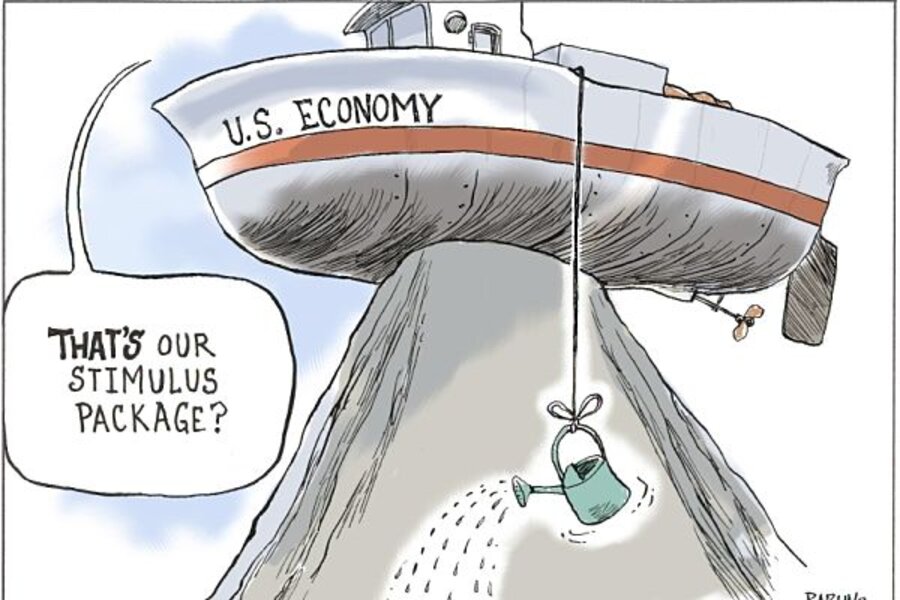
Cartoon – New Economic Stimulus Package

Obama's stimulus did NOT raise government spending - CSMonitor.com

60% of Sturgis residents were against a motorcycle rally that brings in thousands but the city approved it. Here’s why

https://www.cnn.com/2020/08/10/us/sturgis-motorcycle-rally-residents-decision

Steven J. Frisch on Twitter: "I'm fearful of what is to come, as ...

Before deciding on whether to hold the 80th annual motorcycle rally in Sturgis, South Dakota, the local city council turned to its residents to get their take.

“There was a significant amount of discussion that the council had with residents, businesses and state health officials as well as local health officials,” Daniel Ainslie, the city manager, told CNN Sunday.
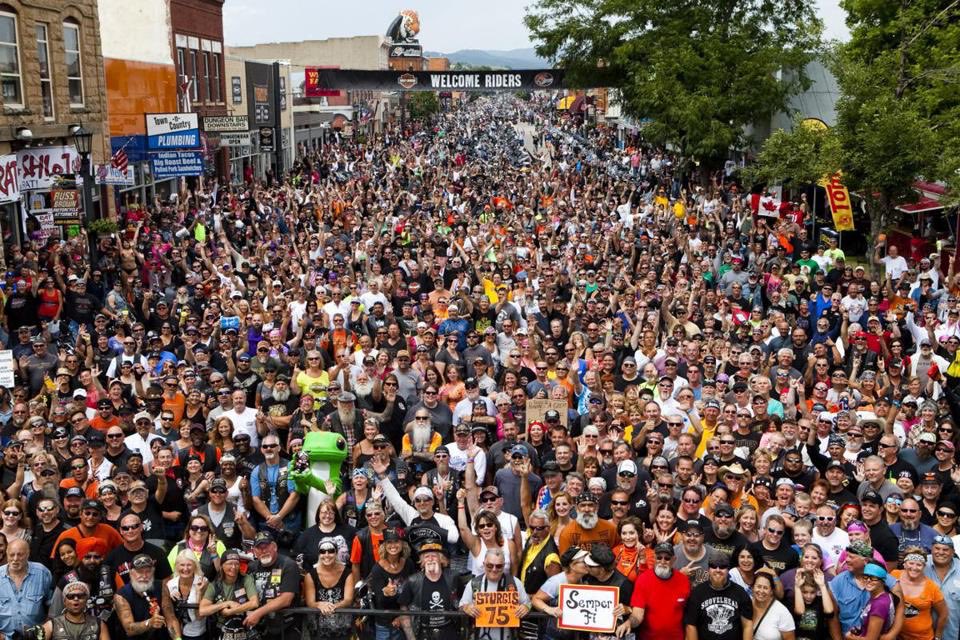
The city, home to fewer than 7,000, sent a survey to all households asking if they wanted the rally to proceed on its scheduled date. The massive event usually brings in crowds of about 500,000 over 10 days of drag races, contests and concerts. On its 75th anniversary, nearly three quarters of a million people showed.
A little more than 60% of people in the city voted against holding the event this week. But the city council approved it anyway.

https://www.washingtonpost.com/arts-entertainment/2020/08/10/smash-mouth-coronavirus-concert/?utm_campaign=wp_main&utm_medium=social&utm_source=facebook&fbclid=IwAR0EIjLLrhpAEXabcLb11uuVlYYSuluULzd13BPitPSQCW7m-KHfsL7ZNgE


The Health 202: Coronavirus keeps spreading. But at least we’ve learned more about it.

https://www.washingtonpost.com/politics/2020/08/11/health-202-coronavirus-keeps-spreading-least-we-learned-more-about-it/?utm_campaign=wp_the_health_202&utm_medium=email&utm_source=newsletter&wpisrc=nl_health202

Coronavirus: FI Strategy to Stop the Spread

Coronavirus infections are swelling in the United States, which hit 5 million cases over the weekend.

But so is the body of research on how the novel coronavirus spreads and affects people.

Dozens of studies have now been published in top medical journals, providing critical information to public health officials and medical professionals attempting to get a handle on the virus. More understanding of the virus is critical, as its aggressive spread around the country confounds President Trump’s efforts toward an economic rebound and threatens to keep schools and workplaces shuttered through the fall.

There’s a lot left to learn. But some of the blanks are starting to be filled in, now that researchers around the world have had six months to study it (check out The Post’s database of questions and answers about the pandemic).

Here are some things we learned about the virus over the summer — and some questions that persist:


Can asymptomatic people spread the virus?

Researchers are still trying to discover whether people without visible symptoms spread the virus at similar rates as those with symptoms. There’s been a considerable amount of confusion around this question, particularly after the World Health Organization appeared to suggest the virus isn’t spread asymptomatically — and then walked back its pronouncement the next day.

It seems clear that asymptomatic transmission does occur. People with no symptoms carry the same level of virus in their nose, throat and lungs as those with symptoms, according to a South Korean study of 303 people published last week in JAMA Internal Medicine.

The study was the first to distinguish between patients who didn’t develop symptoms initially and those who did develop symptoms later on — which can cause some confusion when looking at asymptomatic spread. Based on their observations, the researchers estimated that 30 percent of infected people never develop symptoms.

Anthony Fauci, director of the National Institute of Allergy and Infectious Diseases, said last week he thinks the figure is closer to 40 percent.

“The good news about covid-19 is that about 40 percent of the population have no symptoms when they get infected,” Fauci said, but he added that asymptomatic people “are propagating the outbreak, which means that you’re going to infect someone, who will infect someone, who then will have a serious consequence.”

Are some people immune to the virus without ever getting it?

There is some very early, tentative evidence suggesting a segment of the world’s population may have partial protection thanks to the immune system’s “memory” T cells, which are trained to recognize specific invaders.

People may derive this protection from standard childhood vaccinations or from previous infections by other coronaviruses, such as those that cause the common cold, my colleague Ariana Eunjung Cha reported.

“This might potentially explain why some people seem to fend off the virus and may be less susceptible to becoming severely ill,” National Institutes of Health Director Francis Collins remarked in a blog post last week.

“On a population level, such findings, if validated, could be far-reaching,” Ariana wrote. “ … In communities in Boston, Barcelona, Wuhan and other major cities, the proportion of people estimated to have antibodies and therefore presumably be immune has mostly been in the single digits. But if others had partial protection from T cells, that would raise a community’s immunity level much higher.”


How many untested Americans have already had the virus?

The head of the Centers for Disease Control and Prevention estimated in June that there were roughly 10 times more coronavirus infections in the United States than had been confirmed through testing.

There were just 2.4 million confirmed cases when CDC Director Robert Redfield made that estimate — which, if accurate, would have translated to 24 million cases at the time. Confirmed cases have since doubled, to more than 5 million — meaning the virus may have swept through tens of millions of people.

Redfield based his estimate on the results of antibody tests, which examine a person’s blood for indicators that the body fought off an infection, Lena H. Sun and Joel Achenbach wrote.


How does the virus travel?

Scientists initially thought the virus easily spread on surfaces, similar to how other viruses operate. That’s why much of the initial public health advice centered around hand-washing and disinfecting surfaces.

Now public health experts think SARS-CoV-2 is primarily spread through person-to-person contact.

In May, the CDC updated guidance on its “How COVID-19 Spreads” website to say that “the virus spreads easily between people.” The agency also acknowledged the virus may spread other ways, such as through touching contaminated objects or surfaces, but clarified “this is not thought to be the main way the virus spreads.”

“The virus travels through the droplets a person produces when talking or coughing,” Ben Guarino and Joel wrote. “An individual does not need to feel sick or show symptoms to spread the submicroscopic virus. Close contact means within about six feet, the distance at which a sneeze flings heavy droplets. Example after example have shown the microbe’s affinity for density. The virus has spread easily in nursing homes, prisons, cruise ships and meatpacking plants — places where many people are living or working in proximity.”


Do children spread it?

Children only rarely get seriously ill or die of covid-19, the disease the virus causes; data on hospitalizations and deaths make that clear. But whether — and to what extent — they can spread the virus to others asymptomatically is still murky.

Studies are also conflicting on whether the age of children affects their likelihood of spreading the virus. One study conducted at a Chicago hospital found children younger than 5 with mild to moderate cases of covid-19 had much higher levels of virus in their noses than older children and adults — suggesting they could be more infectious, Ariana, Haisten Willis and Chelsea Janes reported.

But a study out of South Korea examining household transmission seemed to reach an opposite conclusion. It found children under age 10 did not appear to pass on the virus readily, while those between 10 and 19 appeared to transmit the virus almost as much as adults did, my colleagues wrote.


Which organs does Covid-19 attack?

The lungs appear most susceptible to the virus. Researchers have also found the pathogen in parts of the brain, kidneys, liver, gastrointestinal tract, spleen and in the endothelial cells that line blood vessels, along with widespread clotting in many organsAriana and Lenny Bernstein reported.

But researchers have been surprised to discover little inflammation on the brain, despite previous reports about neurological symptoms related to the coronavirus. The same goes for the heart. While physicians warned for months about a cardiac complication they suspected was myocarditis, autopsy investigators found no evidence of the condition.


Executive Order On Housing Doesn’t Guarantee An Eviction Moratorium

https://www.forbes.com/sites/advisor/2020/08/10/trumps-executive-order-on-housing-doesnt-guarantee-an-eviction-moratorium/?tid=newsletter-dailydozen&utm_source=newsletter&utm_medium=email&utm_campaign=dailydozen&cdlcid=5d2c97df953109375e4d8b68#3a33cbc3359a

After negotiations for another stimulus package hit a dead end in Washington last week, President Donald Trump signed executive orders to extend relief in the meantime. One order, according to the president, would extend the federal eviction moratorium. 

The original moratorium, included in the CARES Act, prohibited landlords or housing authorities from filing eviction actions, charging nonpayment fees or penalties or giving notice to vacate. It expired on July 24 and only applied to federally subsidized or federally backed housing.

But housing advocates are pushing back, saying Trump’s executive order to extend an eviction moratorium actually does nothing at all—and keeps struggling Americans at risk of losing their housing. 


Details on the Order

Trump’s order doesn’t actually extend the federal eviction moratorium. Instead, it calls on the Department of Health and Human Services and the Centers for Disease Control and Prevention to “consider” whether an additional eviction ban is needed.

“The Secretary of Health and Human Services and the Director of CDC shall consider whether any measures temporarily halting residential evictions of any tenants for failure to pay rent are reasonably necessary to prevent the further spread of COVID-19 from one State or possession into any other State or possession,” reads the order.

Additionally, the executive order does not provide any new money to help struggling renters during the pandemic. Instead, it says the secretary of Treasury and the secretary of Housing and Urban Development—Steven Mnuchin and Ben Carson, respectively—can identify “any and all available federal funds” to provide temporary rental assistance to renters and homeowners who are facing financial hardships caused by COVID-19.

During a White House press briefing on Monday, Kayleigh McEnany said the president did “did what he can within his executive capacity…to prevent resident evictions.”At the time of publishing, officials mentioned in Trump’s executive order have not released guidelines on extending the federal eviction moratorium.


Housing Advocates React to Trump’s Eviction Order

Housing advocates have not reacted positively to Trump’s executive order, suggesting officials extend an eviction moratorium.

“The executive order that he signed this weekend is really nothing more than an empty shell that creates chaos and confusion, and it offers nothing more than false hope to renters who are at risk of eviction because that executive order does literally nothing to prevent or stop evictions,” Diane Yentel, president and CEO of the National Low Income Housing Coalition, said on Sunday during an MSNBC interview.

The House of Representatives included a more thorough plan to prevent evictions in its HEROES Act proposal. The proposal included $175 billion in rent and mortgage assistance and would replace the original federal eviction moratorium with a 12-month moratorium from all rental housing, not just federally subsidized ones. There also would be funds available to provide homeowners with assistance to cover mortgage and utility payments, property taxes or other resources to help keep Americans housed.

Sen. Richard Shelby (R-AL) introduced the Coronavirus Response Additional Supplemental Appropriations Act as part of the GOP’s HEALS Act proposal. Shelby’s bill included significantly less money for housing assistance than the HEROES Act—$3.2 billion—and would be used for tenant-based rental assistance. Shelby’s proposal did not include any language about extending the CARES Act eviction moratorium. 

A recent report by a group of housing advocates finds there could be as much as 40 million renters at risk of eviction in the coming months. The U.S. unemployment rate currently sits at 10.2%. 

Individuals who are struggling to pay rent might have assistance options available. Some cities and states have implemented their own eviction moratoriums—you can learn more about them by visiting the Eviction Lab at Princeton University. There are also legal aid options, like Just Shelter, that will help tenants who are facing eviction for low-cost or free.


Dr. Anthony Fauci says chance of coronavirus vaccine being highly effective is ‘not great’

https://www.cnbc.com/amp/2020/08/07/coronavirus-vaccine-dr-fauci-says-chances-of-it-being-highly-effective-is-not-great.html?utm_source=&utm_medium=email&utm_campaign=32192

KEY POINTS
  • White House coronavirus advisor Dr. Anthony Fauci that the chances of scientists creating a highly effective vaccine — one that provides 98% or more guaranteed protection — for the virus are slim.
  • Scientists are hoping for a coronavirus vaccine that is at least 75% effective, but 50% or 60% effective would be acceptable, too, he said.
  • The FDA has said it would authorize a coronavirus vaccine so long as it is safe and at least 50% effective.

White House coronavirus advisor Dr. Anthony Fauci said Friday that the chances of scientists creating a highly effective vaccine — one that provides 98% or more guaranteed protection — for the virus are slim.

Scientists are hoping for a coronavirus vaccine that is at least 75% effective, but 50% or 60% effective would be acceptable, too, Fauci, director of the National Institute of Allergy and Infectious Diseases, said during a Q&A with the Brown University School of Public Health. “The chances of it being 98% effective is not great, which means you must never abandon the public health approach.”

“You’ve got to think of the vaccine as a tool to be able to get the pandemic to no longer be a pandemic, but to be something that’s well controlled,” he said.

The Food and Drug Administration has said it would authorize a coronavirus vaccine so long as it is safe and at least 50% effective. Dr. Stephen Hahn, the FDA’s commissioner, said last month that the vaccine or vaccines that end up getting authorized will prove to be more than 50% effective, but it’s possible the U.S. could end up with a vaccine that, on average, reduces a person’s risk of a Covid-19 infection by just 50%.

“We really felt strongly that that had to be the floor,” Hahn said on July 30, adding that it’s “been batted around among medical groups.”

“But for the most part, I think, infectious disease experts have agreed that that’s a reasonable floor, of course hoping that the actual effectiveness will be higher.”

A 50% effective vaccine would be roughly on par with those for influenza, but below the effectiveness of one dose of a measles vaccination, which is about 93% effective, according to the Centers for Disease Control and Prevention.

Public health officials and scientists expect to know whether at least one of the numerous potential Covid-19 vaccines in development worldwide is safe and effective by the end of December or early next year, though there is never a guarantee. Drug companies Pfizer and Moderna both began late-stage trials for their potential vaccines last week and both expect to enroll about 30,000 participants.

Fauci has previously said he worries about the “durability” of a coronavirus vaccine, saying if Covid-19 acts like other coronaviruses, it may not provide long-term protection.

Health officials say there is no returning to “normal” until there is a vaccine. Fauci’s comment came a day after the World Health Organization cautioned about the development of vaccines, reiterating that there may never be a “silver bullet” for the virus, which continues to rapidly spread worldwide. The phase three trials underway do not necessarily mean that a vaccine is almost ready to be deployed to the public, the agency said.

“Phase three doesn’t mean nearly there,” Mike Ryan, executive director of the WHO’s emergencies health program, said during a virtual panel discussion with “NBC Nightly News” Anchor Lester Holt hosted by the Aspen Security Forum. “Phase three means this is the first time this vaccine has been put into the general population into otherwise healthy individuals to see if the vaccine will protect them against natural infection.”

While there is hope scientists will find a safe and effective vaccine, there is never a guarantee, WHO Director-General Tedros Adhanom Ghebreyesus said.

“We cannot say we have vaccines. We may or may not,” he said.

On Friday, Fauci reiterated that he is “cautiously optimistic” scientists will find a safe and effective vaccine. He also reiterated that the coronavirus may never be eliminated, but world leaders can work together to bring the virus down to “low levels.”

Some of Fauci’s comments have been at odds with President Donald Trump, who has repeatedly said the virus would “disappear.”

Trump, who is seeking reelection, said Thursday that it’s possible the United States could have a safe and effective vaccine for the coronavirus before the upcoming presidential election on Nov. 3.