Fed chair Powell warns of “lasting” economic damage without more stimulus

https://www.axios.com/fed-jerome-powell-coronavirus-spending-e71d88c5-09ec-4410-b08f-3d4ad6304db0.html

Fed chair Powell warns of "lasting" economic damage without more ...

Federal Reserve Chairman Jerome Powell said Congress may need to do more to prevent a worse economic downturn triggered by the coronavirus pandemic, in an interview with the Peterson Institute’s Adam Posen on Wednesday.

Why it matters: Powell warned of dire economic consequences without additional stimulus. While the Fed has responded to the pandemic with the most aggressive policy actions in the central bank’s history, it doesn’t have the power to get money directly in the hands of Americans and businesses in the form of grants like Congress does.

The backdrop: The coronavirus has pushed the economy into a downturn not seen since the Great Depression, with a record number of Americans out of work.

  • Congress and the Fed have unleashed trillions of dollars in coronavirus aid to support the economy.
  • House Democrats proposed another $3 trillion in stimulus this week, but more spending is facing resistance from Republican members of Congress.

What they’re saying: “Additional fiscal support could be costly, but worth it if it helps avoid long-term economic damage and leaves us with a stronger recovery,” Powell said.

  • “It’s not the time to prioritize” concerns about fiscal spending, Powell said.

Powell warned about the long-lasting damage a steep, prolonged downturn could have on the economy, including permanent scarring to the most vulnerable workers in the labor force.

  • In a Fed survey set to be released tomorrow, Powell said 40% of people making less than $40,000/year who were employed in February, lost their job in March.


COVID-19 by the numbers: 51 stats, dollar figures and dates for hospital leaders to know

https://www.beckershospitalreview.com/hospital-management-administration/covid-19-by-the-numbers-51-stats-dollar-figures-and-dates-for-hospital-leaders-to-know.html?utm_medium=email

Coronavirus death rate in US compared to countries like Italy ...

In recent months, hospitals and health systems across the U.S. have made dramatic changes to quickly respond to the COVID-19 pandemic. To help provide a more detailed picture of the COVID-19 pandemic and response efforts, Becker’s Hospital Review has compiled key stats, dollar figures and dates for hospital and health system leaders to know.

COVID-19 relief aid 

Congress has allocated $175 billion in relief aid to hospitals and other healthcare providers to cover expenses or lost revenues tied to the COVID-19 pandemic. 

The first $50 billion in funding from the Coronavirus Aid, Relief and Economic Security Act was delivered to hospitals in April. HHS distributed $30 billion based on Medicare fee-for-service reimbursements and another $20 billion based on hospitals’ share of net patient revenue.

In addition, HHS is sending $12 billion to 395 hospitals that provided inpatient care for 100 or more COVID-19 patients through April 10 and disbursing another $10 billion to hospitals, clinics and health centers in rural areas.

HHS recently provided a list of hospitals that received payments from the general distribution and rural targeted allocation of the provider relief fund as well as hospitals that received COVID-19 high-impact payments.

Below are the 10 health systems that received the most funding from the general distribution and rural targeted allocation of the provider relief fund based on data updated May 12. Each health system received payments and agreed to the terms and conditions for receiving relief aid as of May 6. 

1. Dignity Health: $180.3 million

2. NewYork-Presbyterian Hospital: $119 million

3. Cleveland Clinic: $103.3 million

4. Stanford Health Care: $102.4 million

5. Intermountain Healthcare: $97.9 million

6. Memorial Hermann Health System: $92.4 million

7. NYU Langone Hospitals: $92.1 million

8. Sutter Health: $82.7 million

9. County of Los Angeles: $80.8 million (County operates four hospitals)

10. Hackensack Meridian Health: $76.8 million


Below are the 10 hospitals that received the most funding from the $12 billion COVID-19 high-impact fund based on data updated May 8. 

1. Long Island Jewish Medical Center (New Hyde Park, N.Y.): $277.7 million

2. Holy Name Medical Center (Teaneck, N.J.): $213.4 million

3. Tisch Hospital (New York City): $203.2 million

4. Montefiore Hospital-Moses Campus (New York City): $156.7 million

5. Columbia University Irving Medical Center (New York City): $152.7 million

6. NewYork-Presbyterian Queens (New York City): $143.3 million

7. Mount Sinai Medical Center (New York City): $140.8 million

8. Sandra Atlas Bass Heart Hospital (Manhasset, N.Y.): $137.5 million

9. Maimonides Medical Center (New York City): $131.5 million

10. Weill Cornell Medical Center (New York City): $118.6 million


COVID-19 vulnerability 

Every state in the U.S. will be affected by COVID-19, but some are more vulnerable due to limited ability to mitigate and treat the virus, and to reduce its economic and social impacts, according to a COVID-19 vulnerability index created by the Surgo Foundation.

The Surgo Foundation, a privately funded think tank, created an index that combines indicators specific to COVID-19 with the CDC’s social vulnerability index, which measures the expected negative impact of disasters of any type. The Surgo Foundation’s index takes into account factors that fall into one of several categories, including socioeconomic status, minority status, housing type, epidemiologic factors and healthcare system factors. Each state and the District of Columbia received a score in each category and an overall score, with a higher score indicating that the state is more vulnerable. Read more about the methodology here.

Below are the 10 states with the highest composite scores based on the vulnerability index. 

1. Mississippi: 1

2. Louisiana: 0.98

3. Arkansas: 0.96

4. Oklahoma: 0.94

5. Alabama: 0.92

6. West Virginia: 0.9

7. New Mexico: 0.88

8. Nevada: 0.86

9. North Carolina: 0.84

10. South Carolina: 0.82


Where COVID-19 cases, deaths are decreasing most

An analysis from The New York Times based on county-level data shows some U.S. cities are seeing sustained decreases in COVID-19 cases and deaths.

Below are the top five metro areas where COVID-19 cases have decreased the most (relative to population) in the past week. The list reflects The New York Times‘ rankings as of May 13 at 6:30 a.m. CDT. 

1. Grand Island, Neb.
Change rate: -394 cases per 100,000 population

2. Waterloo-Cedar Falls, Iowa
Change rate: -265 cases per 100,000 population

3. Pine Bluff, Ark.
Change rate: -197 per 100,000 population

4. New York City area
Change rate: -184 cases per 100,000 population

5. Boston
Change rate: -139 cases per 100,000 population


Below are the top five metro areas where COVID-19 deaths have decreased the most in the past week. 

1. Grand Island, Neb.
Change rate: -11.8 deaths per 100,000 population

2. New York City area
Change rate: -11.1 deaths per 100,000 population

3. Fairfield County (Conn.)
Change rate: -9.7 deaths per 100,000 population

4. Hartford, Conn.
Change rate: -9.7 deaths per 100,000 population

5. Springfield, Mass.
Change rate: -9.5 deaths per 100,000 population


States resuming elective surgeries 

Below are the states that have allowed or announced plans to allow healthcare providers to resume elective surgeries as of May 13. There are different restrictions in each state, which are detailed in executive orders and other documents from the state. 

April 22
California
Texas
Utah

April 24
Oklahoma

April 26
Colorado

April 27
Arkansas
Indiana
Iowa
Kentucky
Louisiana
Mississippi
Pennsylvania

April 28
New York
West Virginia

April 30
Alabama
Tennessee

May 1
Arizona
Illinois
Ohio
Oregon
Virginia

May 4
Alaska
Florida
Nebraska

May 15
Vermont

May 18
Washington

May 31
South Dakota


The latest in the U.S.

https://www.axios.com/newsletters/axios-vitals-72173ec6-3383-4391-afbb-a5ed682e5d7a.html?utm_source=newsletter&utm_medium=email&utm_campaign=newsletter_axiosvitals&stream=top

COVID-19 in the U.S.

As of May 12, 2020, 11pm EDT

Deaths       Confirmed Cases

82,376           1,369,574

Trump and some top aides question accuracy of coronavirus death ...


The U.S. will “without a doubt” have more coronavirus infections and deaths in the fall and winter if effective testing, contact tracing and social distancing measures are not scaled up to adequate levels, NIAID director Anthony Fauci testified on Tuesday.

  • He also said that the “consequences could be really serious” for states and cities that reopen without meeting federal guidelines.

Sen. Mitt Romney (R-Utah) criticized the Trump administration’s coronavirus testing coordinator Adm. Brett Giroir at a Senate hearing Tuesday, accusing him of framing U.S. testing data in a politically positive light: “I find our testing record nothing to celebrate whatsoever.”

Millions of Americans are risking their lives to feed us and bring meals, toiletries and new clothes to our doorsteps — but their pay, benefits and working conditions do not reflect the dangers they face at work, Axios’ Erica Pandey reports.

House Democrats released Tuesday their phase 4 $3 trillion coronavirus relief proposal that would provide billions of additional aid to state and local governments, hospitals and other Democratic priorities.

The American Federation of Teachers launched several capstone lesson plans Tuesday to help K-12 teachers measure student progress during school closures and overcome the challenges of a remote learning setting.

Grocery staples in the U.S. cost more in the last month than in almost 50 years, according to new data out Tuesday from the U.S. Bureau of Labor Statistics.

A new study by economists at the University of Illinois, Harvard Business School, Harvard University and the University of Chicago projects that more than 100,000 small businesses have permanently closed since the coronavirus pandemic was declared in March, the Washington Post reports.


New urgency surrounding children and coronavirus

https://www.axios.com/newsletters/axios-vitals-72173ec6-3383-4391-afbb-a5ed682e5d7a.html?utm_source=newsletter&utm_medium=email&utm_campaign=newsletter_axiosvitals&stream=top

CDC adds 6 new possible coronavirus symptoms - Axios

Solving the mystery of how the coronavirus impacts children has gained sudden steam, as doctors try to determine if there’s a link between COVID-19 and kids with a severe inflammatory illness, and researchers try to pin down their contagiousness before schools reopen.

Driving the news: New York state’s health department is investigating 100 cases of the illness in children, Gov. Andrew Cuomo said at a Tuesday press briefing, Axios’ Orion Rummler reports.

  • Three children in the state have died: an 18-year-old girl, a 5-year-old boy, and a 7-year-old boy. The state’s hospitals had previously reported 85 cases on Sunday.

Doctors have described children “screaming from stomach pain” while hospitalized for shock, Jane Newburger of Boston Children’s Hospital told the Washington Post.

  • In some, arteries in their hearts swelled, similar to Kawasaki disease, a rare condition most often seen in infants and small children that causes blood vessel inflammation, she said.
  • Researchers remain uncertain if this is being caused by COVID-19, but most children appear to have a link. Some affected children have tested positive for coronavirus antibodies, suggesting that the inflammation is “delayed,” Nancy Fliesler of Boston Children’s Hospital wrote on Friday.

What’s next: The CDC is funding a $2.1 million study of 800 children who have been hospitalized after testing positive for the coronavirus through Boston Children’s Hospital. The study aims to understand why some children are more vulnerable to the disease.


Coronavirus likely forced 27 million off their insurance

https://www.axios.com/newsletters/axios-vitals-72173ec6-3383-4391-afbb-a5ed682e5d7a.html?utm_source=newsletter&utm_medium=email&utm_campaign=newsletter_axiosvitals&stream=top

The coronavirus pandemic is hitting Main Street and triggering ...

Roughly 27 million people have likely have lost job-based health coverage since the coronavirus shocked the economy, according to new estimates from the Kaiser Family Foundation.

Why it matters: Most of these people will be able sign up for other sources of coverage, but millions are still doomed to be uninsured in the midst of a pandemic, Axios’ Bob Herman reports.

By the numbers: For the 27 million people who are losing their job-based coverage, about 80% have other options, said Rachel Garfield, a health policy expert at the Kaiser Family Foundation and lead author of the report.

  • Roughly half are eligible for Medicaid or the Children’s Health Insurance Program.
  • Another third are eligible for subsidized health plans on the Affordable Care Act’s marketplaces.
  • The remaining 20% are pretty much out of luck because they live in a state that didn’t expand Medicaid or are ineligible for other kinds of subsidized coverage.
  • House Speaker Nancy Pelosi’s latest coronavirus relief bill would fully subsidize the cost of maintaining an employer plan through COBRA — an option that would otherwise be prohibitively expensive for many people. But that’s a long way from becoming law.

The bottom line: The coronavirus is blowing up health insurance at a time when people need it most.


Germany’s daily coronavirus cases nearly TRIPLE – states bring back tougher measures

https://www.express.co.uk/news/world/1281241/germany-coronavirus-cases-jump-lockdown-lift-tougher-lockdown-rules-angela-merkel?fbclid=IwAR0D6VbvvxIu4PUwUwMOu7AAKePOdxcUhZFyQybDdJTvEmosNZlrDeodLnM

coronavirus

CORONAVIRUS cases in Germany have almost trebled in the past 24 hours sparking fears of a second wave of COVID-19 infections.

Health authorities in Germany have reported more than 900 new cases of the deadly coronavirus less than a week after lockdown restrictions were relaxed by German Chancellor Angela Merkel. The Robert Koch Institute for public health and disease control has reported 933 new COVID-19 infections on Tuesday – an increase from just 357 on Monday.

According to the Institute the infection rate – the so-called “R” rate – has been above one for the past three days.

The rate means on average one person will potentially transmit the virus to one other individual.

The Institute for public health estimated the “R” rate was at 1.07 on Monday and 1.13 on Sunday.

The number indicates that 100 infected people would on average infect 107 others.

Today, the R rate once again dipped just below one with an estimated value of 0.94, but the latest spike in cases will worry some.

Despite the rise in the rate in recent days, the Robert Koch Institute said: “So far, we do not expect a renewed rising trend.”

Last Thursday Ms Merkel outlined a scenario at which the country would need to apply an “emergency brake” and re-impose restrictions.

The lockdown measures would be introduced again if a second wave of new infections were reported at a rate of 50 per 100,000 people.

Since Ms Merkel’s announcement, however, three districts across Germany have used the emergency measures to halt the virus.

The states of North Rhine-Westphalia and Schleswig-Holstein were forced to re-introduce lockdown after outbreaks of coronavirus at meat processing plants.

One district in the state of Thuringia is also understood to have implemented the emergency measures after outbreaks in care homes.

Just six days ago the German Chancellor announced measures to lift the lockdown by opening more shops and outlining the gradual re-opening of schools.

Shops and gyms have been allowed to begin trading providing social distancing measures were enforced.

The Chancellor also announced most Germans will be allowed to meet people from outside their households for the first time.

Top flight Bundesliga matches are also set to begin behind closed-doors this upcoming weekend.

Ms Merkel has been under increasing pressures to kick-start the faltering German economy with widespread protests taking place at the weekend in major cities including Munich.


Fauci’s warning about reopening may have more influence over Americans than governors

https://www.washingtonpost.com/politics/2020/05/12/faucis-warning-about-reopening-may-have-more-influence-over-americans-than-governors/?fbclid=IwAR0eDoGHpOUI1Ty2RdCoKcxSzwne2NscJfoVGQXnEH8ud2s5MEKIunzXuRA

White House coronavirus expert Dr Anthony Fauci says world may ...

It’s one of those moments that, even as it occurs, seems definitive. The country’s leading infectious-disease expert, Anthony S. Fauci, offering testimony before a Senate committee about a virus that’s infected more than a million Americans — but doing so remotely, because of his own contact with an infected individual. Speaking from quarantine, Fauci will offer a grim warning: Attempting to return economic activity to normal levels too quickly will “result in needless suffering and death” and itself result in negative effects for the economy.

Fauci’s warning stands in obvious contrast to the assertions of his boss, President Trump. As he has so often over the course of the pandemic, Trump waves away questions about whether states are ready to resume normal economic activity, insisting that many places are ready to gear back up. His White House released a set of recommendations for doing so, recommendations to which Fauci will refer. But even as those recommendations were introduced, Trump undercut them. He quickly embraced anti-social-distancing protests in states with blue governors — states where things were not yet ready to return to normal.

The recommendations espoused by Fauci (and, ostensibly, Trump) set an initial baseline of data that states should meet before taking even introductory steps toward reopening their economies. They’re centered on three categories benchmarks: coronavirus symptoms, actual cases and hospital capacity. The initial presentation from the White House explained how those benchmarks could be met:

For the first two, we have publicly available data that allows us to evaluate how states are doing. In the case of demonstrated symptoms, the data are somewhat old, with the most recent metrics reflecting the week of May 2. What’s more, data on the number of people showing up to emergency rooms with symptoms reflecting possible covid-19 cases (the disease caused by the coronavirus) are compiled only by region. Nonetheless, we can get a sense for how many people in each place are showing symptoms as well as up-to-date information on the number of cases and positive tests in each state.

By now, many states appear to meet the benchmarks on these two conditions. (Again, given the limits on the symptomatic data, it’s tricky to say how each fares in the moment.) A number of states that have already begun to reopen, though, don’t. In Texas, for example, the number of new cases is up and the percent of positive tests is flat. In Georgia, the number of new cases is flat and the rate of positive tests has been variable. Both states are nonetheless reopening.

Georgia’s been in the process of reopening for about three weeks, despite missing the basic benchmarks even when that process began. Gov. Brian Kemp (R) made a blanket determination that things could get back to normal, ignoring the sort of regionalized shifts that Trump himself has advocated.

New York, the state hit hardest by the virus, has implemented a deliberate, region-by-region plan for reopening. Gov. Andrew M. Cuomo (D) has outlined seven different criteria in each region of the state before it can resume some normal economic activity (though not all). (Among those? A program sufficient to trace the contacts of individuals with newly confirmed infections.) As of Monday, only three regions met the seven conditions. New York City hit four of the seven.

This is presumably how states are encouraged to reopen to avoid Fauci’s most dire predictions. It’s no guarantee that outbreaks won’t emerge, but New York’s plan is predicated on safety over normalcy while Georgia’s appears to be the opposite.

That’s the important context for Fauci’s testimony. His warnings about moving slowly are not new — though, in the past, they’ve mostly been tempered by the looming physical presence of a president who’s not very interested in diluting his optimistic economic assumptions. Fauci’s language about the ramifications is strong, but the message is consistent.

It also comes a bit too late for states such as Georgia — at least at the official level. One effect of the effort to get the state back to normal is that many Georgians aren’t ready to do so. Economic data shows that, despite businesses being open, they’re often not seeing many customers. The state’s residents are skeptical about getting back to normal. A new Post-Ipsos poll suggests that they are also skeptical of their governor.

Those participating in protests against social distancing are a small minority. Most Americans understand the thrust of Fauci’s concerns and are willing to support continued social distancing measures. While governors are occasionally skipping over the guidelines offered by Fauci and his team, the consumers who can return the economy to normal are still wary — and may be the best audience for Fauci’s warnings.


Americans hate contact tracing

https://www.axios.com/axios-ipsos-coronavirus-week-9-contact-tracing-bd747eaa-8fa1-4822-89bc-4e214c44a44d.html?utm_source=newsletter&utm_medium=email&utm_campaign=newsletter_axiosvitals&stream=top

Video: Transportation's looming overhaul - Axios

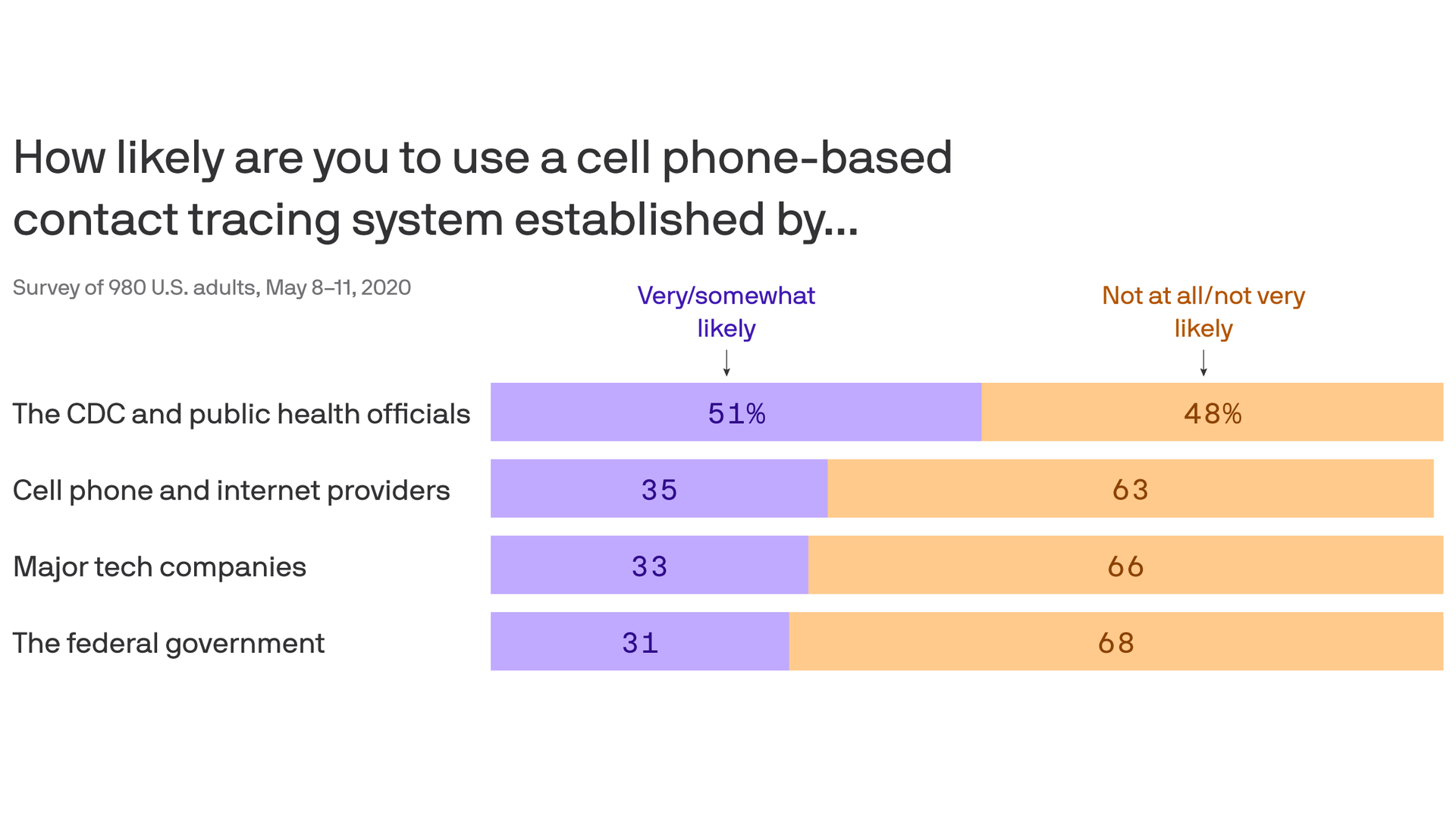
In a best-case scenario, just half of Americans would participate in a voluntary coronavirus “contact tracing” program tracked with cell phones, according to the latest installment of the Axios-Ipsos Coronavirus Index.

Why it matters: A strong contact tracing program — identifying people who have the virus and isolating those who have come into contact with them — is the key to letting other people get back to their lives, according to public health experts.

  • The findings underscore deep resistance to turning over sensitive health information, and mistrust about how it could be used.
  • The only way to get even half of Americans to participate would be for public health officials to run the program, not the White House or tech or phone companies.

What they’re saying: “The whole concept of American democracy is about local control and civil liberties, individual liberties,” said Cliff Young, president of Ipsos U.S. Public Affairs.

  • “At the end of the day, I think there will be an American solution to contact tracing,” but if the survey results are any guide, “it’s not going to be a centralized authority saying, ‘And now we’re going to have contact tracing.'”
  • These findings come as tech companies develop software to try to halt the spread, and public health officials train thousands to conduct the tracing.

The big picture: Even as the death toll rises and infections breach the White House firewall, Week 9 of our national survey also finds more people itching to return to work as they used to know it — and bending guidelines to see family and friends.

  • 64% say returning to their pre-coronavirus lives would be a large or moderate risk. Just 30% say that’s worth the risk right now.
  • But four in 10 say they think returning to their normal place of employment would post only a small risk, or no risk.
  • 63% consider airplane travel or mass transit to be a large risk, down from 73% a month ago.
  • Nine in 10 say they’re still practicing social distancing, but just 36% say they’re self quarantining, down from a peak of 55% in Week 4.
  • 32% say they’ve visited family or friends in the past week, the highest share in seven weeks.

These shifts in behavior come even as growing shares of Americans know people in their own communities who have tested positive and the number of confirmed cases in the U.S. has topped 1.3 million, with roughly 80,000 deaths.

  • About a third know someone who has tested positive — and of those, nearly half say they know a person in their own community who has tested positive.
  • “People are getting antsy,” Young said. “They know there’s this risk, but … people’s mental health and social health are challenged and they’re just feeling restless.”
  • “You can only keep cooped up for so long.”

Between the lines: Most don’t see the virus as an immediate existential threat to themselves. This week, we asked whether people had prepared or updated their wills or living wills since the pandemic began. More than nine in 10 said no.

For contact tracing involving cell phone tracking, Democrats surveyed are more open than Republicans to the notion of opt-in reporting.

  • 68% of Democrats say they’d participate if the Centers for Disease Control and Prevention (CDC) was in charge, compared with 58% of independents and 32% of Republicans.
  • Those numbers plunged if the federal government more broadly were in charge, but Democrats remained the most likely to participate — 39% compared with 34% of independents and 23% of Republicans.
  • That’s despite the fact that Democrats are less trusting than others of the Trump administration to protect their families.
  • Men are slightly more likely than women to trust tech companies with the information.

Be smart: Some reporting initiatives may need to be mandatory or person-to-person to get high enough levels of participation to be worthwhile.


Administration contradicts health officials on who can get a coronavirus test

https://www.axios.com/trump-coronavirus-testing-giroir-d83b4703-6d23-47ac-974e-972a8fc85702.html

Trump officials emphasize that coronavirus 'Made in China'

President Trump claimed at a press briefing Monday that any American who “wants” a coronavirus test can get one — contradicting his testing coordinator Adm. Brett Giroir, who just moments earlier said that tests are mostly reserved for people who “need” one because they present symptoms or are participating in contact tracing.

Why it matters: Trump used the briefing largely to celebrate the country’s success in ramping up testing capacity, at one point boasting that “we have met the moment and we have prevailed” in regards to testing. But questions still remain about how Americans will be able to safely return to work if asymptomatic people don’t have access to testing.

Between the lines: The White House, meanwhile, has proven to be a microcosm of what a country with high-quality testing, surveillance and isolation capability can look like.

  • Giroir explained that people who are in close contact with the president are tested regularly using the 15-minute Abbotts lab device, even if they’re asymptomatic.
  • This is how the White House was able to diagnose Pence press secretary Katie Miller and isolate officials like Anthony Fauci who came into contact with her.

What they’re saying: “Right now in America, anybody who needs a test gets a test in America, with the numbers we have,” Giroir said. “If you’re symptomatic with a respiratory illness, that is an indication for a test and you can get a test. If you need to be contact traced, you can get a test.”

  • “And we hope — not hope — we are starting to have asymptomatic surveillance, which is very important. Again, that’s over 3 million tests per week. That is sufficient for everyone who needs a test — symptomatic, contact tracing and, to our best projections, the asymptomatic surveillance we need.”
  • “I think we have been clear all along that we believe and the data indicate we have enough testing to do the phase one gradual reopening that has been supported in the president’s plan and the task force’s plan. It has to be a phased reopening.”

Earlier in the briefing, when asked when Americans can get tested every day like White House senior staff can, Trump responded: “Very soon.”

  • He later said: “If people want to get tested, they get tested. We have the greatest capacity in the world, not even close. If people want to get tested they get tested, but for the most part, they shouldn’t want to get tested.”
  • “There is no reason. They feel good. They don’t have sniffles. They don’t have sore throats. They don’t have any problem.”

The bottom line: Trump and Giroir’s statements blurred the line between two different concepts, as The Daily Beast’s Sam Stein points out. People who “need” a test because they have symptoms or were in contact with an infected person can get one, but the number of tests “needed” to safely reopen the country is not yet sufficient.


Cartoon – Sinking Fast

Uninsured Cartoons and Comics - funny pictures from CartoonStock