Healthcare System in Campaign 2024: Out of Sight, Out of Mind?

The GOP Presidential debate marked the unofficial start of the 2024 Presidential campaign. With the exception of continued funding for Ukraine, style points won over issue distinctions as each of the 8 White House aspirants sought to make the cut to the next debate September 27 at the Reagan Library in Simi Valley, CA.

For the candidates in Milwaukee, it’s about “Stayin’ Alive” per the BeeGee’s hit song: that means avoiding self-inflicted harm while privately raising money to keep their campaigns afloat. And, based on Debate One, with the exception of abortion, that means they’ll not face questions about their positions on the litany of issues that dominate healthcare these days i.e., drug prices, hospital consolidation, price transparency, workforce burnout and many others. In Milwaukee, healthcare was essentially ‘out of sight our of mind’ to the moderators and debaters despite being 18% of the U.S. economy and its biggest employer.

For now, each will enlist ghostwriters to produce position papers for their websites, and, on occasion, reporters will press for specifics to test their grasp on a topic but that’s about it. Based on last Wednesday’s 2-hour event, it’s unlikely general media outlets like Fox News (which also hosts Debate Two) will explore healthcare issues except for abortion.

That means healthcare will be subordinated to the economy, inflation, immigration and crime—the top issues to GOP voters—for most of the Presidential primary season.  

Next November, voters will also elect 34 US Senators, 435 members of the House of Representatives, 11 Governors and their representatives in 85 state legislative bodies. This will be the first election cycle after reapportionment of votes in the United States Electoral College following the 2020 United States census. Swing states (WI, MI, PA, NV, AZ, GA, FL, OH, CO, VA) will again be keys to the Presidential results since demographics and population shifts have increased the concentrations of each party’s core voters in so-called Blue States and Red States:

  • The Democratic voter core is diverse, educated and culturally liberal with its strongest appeal to African-AmericansLatinos, women, educated professionals and urban voters. Blue States are predominantly in the Northeast, Upper Midwest and West Coast regions.
  • The Republican voter core consists of rural white voters, evangelicals, the elderly, and non-college educated adults. Red States are predominantly in the South and Southwest.

The increased concentrations of Blue or Red voters in certain states and regions has contributed to political polarization in the U.S. electorate and presents an unusual challenge to healthcare. Per Gallup: “Political polarization since 2003 has increased most significantly on issues related to federal government power, global warming and the environment, education, abortion, foreign trade, immigration, gun laws, the government’s role in providing healthcare, and income tax fairness. Increased polarization has been less evident on certain moral issues and satisfaction with the state of race relations.” 

Thus, healthcare issues are increasingly subject to hyper partisanship and often misinformation.

Given the limited knowledge voters have on most health issues and growing prevalence of social media fueled misinformation, political polarization creates echo chambers in healthcare—one that thinks the system works for those who can afford it and another that thinks that’s wrong.

It’s dicey for politicians: it’s political malpractice to offer specific solutions on anything, especially healthcare. It’s safer to attack its biggest vulnerabilities—affordability and equitable access—even though they mean something different in every echo chamber.

My take:

Barring a second Covid pandemic or global conflict with Russia/China, it’s unlikely healthcare issues will be prominent in Campaign 2024 at the national level except for abortion.  At least through the May primary season, here’s the political landscape for healthcare:

Affordability and inequitable access will be the focus of candidate rhetoric at the national level: Trust and confidence in the U.S. health system has eroded. That’s fertile political turf for critics.

In Congress, the fiercest defenders of the status quo have joined efforts to impose restrictions on consolidation and price transparency for hospitals and price controls for prescription drugs. There’s Bipartisan acknowledgement that inequities in accessing care are significant and increasing, especially in minority and low income populations. They differ over the remedy. Employers expect their health costs to increase at least 8% next year and blame hospitals and drug companies for price gauging and want Congress to do more. 85% of Democrats think “the government should insure everyone” vs. 33% of Republican voters which calcifies inaction in a divided Congress though. Opposition to the Affordable Care Act (2010) has softened and Medicaid expansion has passed in 40 Blue and Red states.

In the 2024 election cycle, remedies for increased access and more affordability will pit Republicans calling for more competition, consumerism and transparency and Democrats calling for more government funding, regulation and fairness. 

But more important, voter and employer frustration with partisan bickering sans solutions will set the stage for the vigorous debate about a single payer system in 2026 and after,

State elections will give more attention to healthcare issues than the Presidential race: That’s because Governors and state legislators set direction on issues like abortion rights, drug price controls, Medicaid funding, scope of practice allowances and others.

Increasingly, state Attorney’s General and Treasurers are weighing in on consolidation and spending. States referee workforce issues like nurse staffing requirements and others. And ballot referenda on healthcare issues trail only public education as a focus of grassroots voter activity.  At the top of that list is abortion rights:

In 25 states and DC, there are no restrictions on access; in 14 states, abortion is banned and in 11 abortions—both procedures and medication—are legal, but with gestational limits from 6 weeks (GA), to between 12 and 22 weeks (AZ, UT, NE, KS, IA, IN, OH, NC, SC, FL). It’s an issue that divides legislators and increasingly delineates Blue and Red states and in many states remains unsettled.

Other healthcare issues, like ageism, will surface in Campaign 2024 in the context of other topics: Finally, healthcare will factor into other issues: Example: The leading Presidential candidates are seniors: President Biden was the oldest person to assume the office at age 78 and would be would be 86 at the end of his second term. Former President Trump was 70 when elected in 2016 and would be 81 if elected when his second term ends.

The majority of Americans are concerned about the impact of age on fitness to serve among aspirants for high office: cognitive impairment, dementia, physical limitations et al. will be necessary talking points in campaigns and media coverage. Similarly, cybersecurity looms as a focus where healthcare’s data-rich dependence is directly impacted. Growing concern about climate and the food supply, sourcing of raw good and materials from China used in drug manufacturing and many other headlines will infer healthcare context.

Summary:  

Healthcare will be on the ballot in 2024 and might very well make the difference in who wins and loses in many state and local elections.

It will make a difference in the Presidential campaign as part of the economy and a major focus of government spending. Beyond abortion, the lack of attention to other aspects of the health system in the Milwaukee debate last week should in no way be interpreted as a pass for healthcare insiders. 

Voters are restless and healthcare is contributing. Healthcare is far from  ‘out of sight, out of mind’ in Campaign 2024.
Congressional control still undecided, but voters protect and expand state-level healthcare access in midterms

https://mailchi.mp/cfd0577540a3/the-weekly-gist-november-11-2022?e=d1e747d2d8

While the final balance of the House and Senate are still unknown after Tuesday’s midterm elections, both chambers are expected to be narrowly divided. 

Ballot initiatives on reproductive health produced more unambiguous results, with three states—California, Michigan, and Vermont—amending their constitutions to affirm reproductive rights, and two states—Kentucky and Montana—voting down proposals that would have imposed greater legal barriers to abortion access. South Dakota became the seventh, and likely final, state to expand Medicaid via ballot initiativemaking an additional 28K South Dakotans eligible for coverage, and reducing the number of states that have yet to expand Medicaid to 11.

The Gist: Democrats beat expectations, bucking historical trends in which midterm voters swing strongly against the President’s party. But healthcare did not feature prominently in voters’ choices, with this being the first election in over a decade where the state of the Affordable Care Act and protecting individuals’ access to care and coverage was not a significant choice driver. 

The fallout from the Supreme Court’s decision in June to overturn Roe v. Wade had a clear impact on voter turnout, with abortion tying inflation for voters’ top concern in exit polls. At the state level, South Dakota voters approved Medicaid expansion, where over 40 percent of the state’s uninsured adults could now gain access to coverage—another clear sign that voters, regardless of party affiliation, are behind the ACA’s expanded vision for the safety net program. 

Moving forward, a closely divided Congress is unlikely to take on significant healthcare legislation, regardless of who ultimately holds the House and Senate.

Poll: Voters may cross party lines for lower health care costs

https://www.axios.com/2022/10/20/midterm-election-voters-health-care

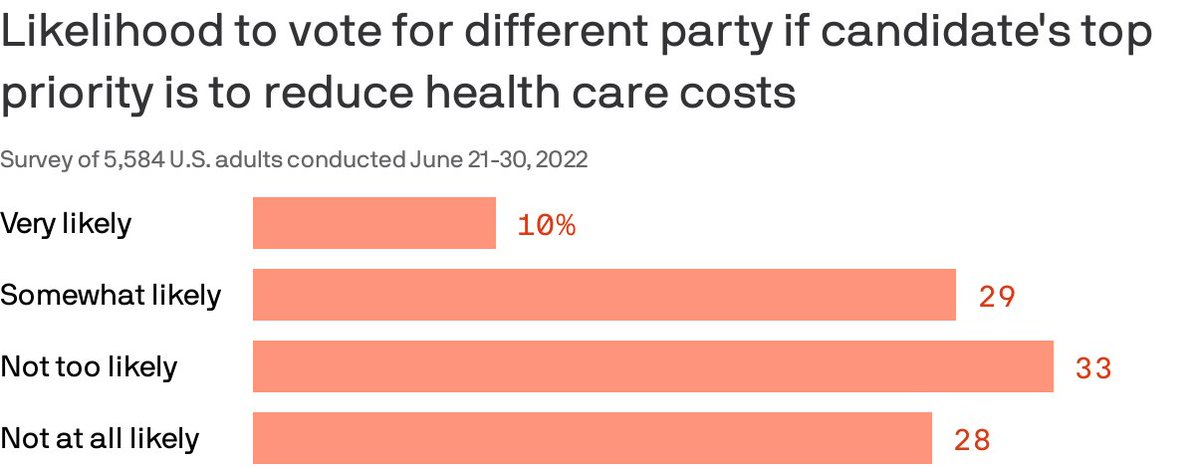
Almost 40% of Americans are willing to split their ticket and vote for a candidate from the opposing party who made a top priority of lowering health costs, according to a Gallup/West Health poll published Thursday.

Why it matters: Though candidates haven’t been talking much about medical costs in the run-up to the midterms, the issue remains enough of a priority that it could erode straight party-line voting.

By the numbers: 87% of Americans polled said a candidate’s plan to reduce the cost of health care services was very or somewhat important in casting a vote.

  • The issue cut across partisan lines, with 96% of Democrats and 77% of Republican respondents saying a candidate with a health care costs plan was an important factor.
  • 86% also said a plan to lower prescription drug prices is very or somewhat important. That’s especially true for seniors.

Of note: Democratic voters were more likely than Republicans to say they would cross party lines because health costs are a top priority. Four in 10 Democrats said they were likely to do so compared to about 1 in 5 Republicans.

America hopes 2021 will be less terrible

https://www.axios.com/axios-surveymonkey-poll-2021-hopes-7de84661-c2dd-43df-9509-3dda4a35a9f5.html

Axios-SurveyMonkey poll: America hopes 2021 will be less terrible - Axios

More than six out of 10 Americans are hopeful about what 2021 has in store for the world, according to a new Axios/SurveyMonkey poll.

The big picture: After a year dominated by the pandemic and a seemingly endless presidential election, Americans are overwhelmingly hopeful that things will get better with the pandemic — and more narrowly hopeful about Joe Biden’s presidency.

By the numbers: 63% of poll respondents said they’re more hopeful than fearful about what 2021 holds in store for the world, while 36% said they’re more fearful.

  • That’s a jump in optimism compared to the same poll heading into 2019, when just 51% said they were hopeful and 48% said they were fearful.
  • The only group that wasn’t optimistic about 2021 was Republicans: 41% said they were more hopeful, while 58% said they were more fearful.

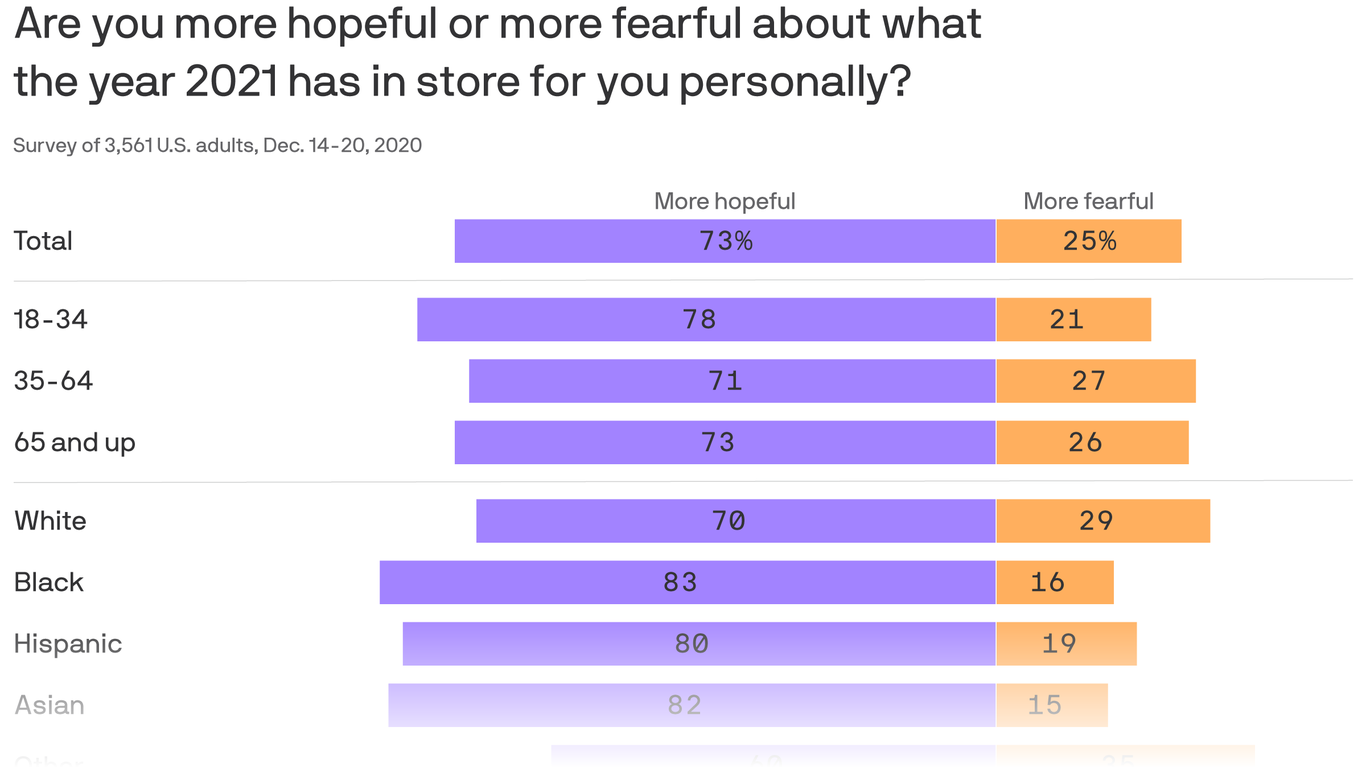
Between the lines: Americans were even more optimistic about the year ahead for them personally — mostly driven by the hopes of young adults, people of color and Democrats.

The coronavirus was the one issue that united most people in optimism. Overall, 76% were more hopeful than fearful about the pandemic next year — a view that held across most age groups, racial and ethnic groups, and parties.

  • 82% of Democrats, 72% of Republicans, and 73% of independents said they were more hopeful than fearful.

The Biden presidency was more divisive. Overall, 56% were more hopeful about his presidency, while 42% were more fearful.

  • Not surprisingly, Republicans are the most pessimistic: 82% said they’re more fearful than hopeful about his presidency.
  • By contrast, 59% of independents said they’re more hopeful about it — and 92% of Democrats said the same.

And while Republicans are ready for President Trump to take on a big leadership role in the Republican Party after his presidency ends, that’s not true of everyone else.

  • 75% of Republicans said they’re more concerned that Trump will play too small a role in the future of the GOP rather than too big a role — while 51% of all respondents said they’re more concerned that he’ll play too big a role.
  • And more than half of Republicans (52%) said they believe Trump will have a major role in the Republican Party, while 30% said they think he’ll have a minor role.
  • By contrast, just 34% of all respondents expect him to play a major role, while 32% think he’ll have a minor role and 31% think he’ll have no role at all.

Cartoon – U.S. Covid 19 Response

Bad Leader Cartoons and Comics - funny pictures from CartoonStock

What Do You Want?

Coronavirus cases exceed 100,000 in one day for the first time, even as the nation is split on the pandemic vs. the economy

https://www.washingtonpost.com/health/covid-19-cases-record-100000/2020/11/04/9733adcc-1ec8-11eb-b532-05c751cd5dc2_story.html

COVID-19 cases exceed 100,000 a day for the first time, even as the nation  is split on the pandemic versus the economy | The Seattle Times

The coronavirus pandemic reached a dire milestone Wednesday when the number of new U.S. infections topped 100,000 in one day for the first time, continuing a resurgence that showed no sign of slowing.

The pandemic is roaring across the Midwest and Plains states. Seven states set records for hospitalizations for covid-19, the disease caused by the virus. And Connecticut, Iowa, Maine, Michigan, Minnesota, Nebraska and North Dakota saw jumps of more than 45 percent in their seven-day rolling average of new infections, considered the best measure of the spread of the virus.

The record, 104,004 cases, was reached a day after the deeply divided nation went to the polls to choose between President Trump and Democratic nominee Joe Biden, an election widely seen as a choice between fully reopening the economy and aggressively quelling the outbreak.

Just as they split almost down the middle on the two candidates, voters broke into almost equal camps on how to address the pandemic that has killed more than 233,000 people and infected nearly 9.5 million people in the United States.

“It’s clear we’re heading into a period where we’re going to see increasing hospitalization and deaths in the U.S. And it worries me how little we’re doing about it,” said Tom Frieden, director of the Centers for Disease Control and Prevention during the Obama administration. “We know by now how fast this virus can move. You have to get ahead of it.”

After more than nine months of restrictions, some state leaders are hesitant to risk further pandemic fatigue, Frieden said.

But if case counts continue rising at the current rate and strong action isn’t taken, viral transmission may soon reach a point in some areas where nothing will stop the virus except another shutdown, he said.

“The numbers keep going up, and we’re only getting closer and closer to Thanksgiving and Christmas,” when some families are expected to congregate indoors and risk spreading the virus further, said Eleanor Murray, an assistant professor of epidemiology at Boston University. “For so many reasons, the next few weeks are going to be bad for us and good for covid.”

With Trump and his aides fighting to hold on to the White House, the federal response to the pandemic, which already leaves major responsibilities to the states, may be even more fractured, Murray said.

“Something that deeply worries me is either way this election goes, Trump will still be in charge the next few weeks, when cases are higher than they’ve ever been,” she said. “And he’s made clear there will be no top-down, coordinated action coming from the federal government.”

Despite months of surveys that clearly indicated strong voter disapproval of the president’s response to the pandemic could weigh heavily against his reelection effort, more voters chose the economy as the primary issue in casting their ballots, exit polling showed.

Even if Biden captures the White House, the results appear to signal that, for many people, covid-19 is not as daunting as the prospect of being unable to pay their bills or send their children to school.

“I got news for you, pal. Covid-19 is over. It’s done,” said Nick Arnone, owner of HLSM, a software company for the power sports industry in Plains, Pa. “We have therapeutics, so deaths are way down. We are very close to a vaccine. We’ve got to ride it out now.

About 35 percent of voters said the economy was the most important issue for them, while about 17 percent cited the pandemic and about 2 in 10 were motivated most by racial inequality.

At the same time, however, just over half the voters said it is more important to contain the virus, even if that hurts the economy, while slightly more than 4 in 10 said rebuilding the economy is most critical, even if that impairs work to quell the virus.

In El Paso, where the pandemic is surging, James Clark said he voted for Biden because of the uncontrolled outbreak.

Covid was the main reason . . . and the things he was saying specifically about it,” Clark said. “I mean there were some things Trump was doing well, too, but overall it was covid.”

Some analysts were surprised and concerned that voters appeared to view the decision before them as a choice between the virus and their livelihoods, rather than as intertwined problems that could be solved together.

“That was shocking to me, that Trump could convince so many people it was a choice between the economy and pandemic,” said Eric Topol, a cardiologist and head of the Scripps Research Translational Institute in San Diego. “I’m amazed the extent he pulled that off, because it’s so obviously a false dichotomy. There’s no way for the economy to thrive unless we get control of the pandemic.”

On the campaign trail, Biden warned voters of a “dark winter” and invoked empty chairs in homes where families grieved the death of a loved one. He suggested he would follow science and tighten restrictions in places where that was necessary.

Trump repeatedly declared that the country was “rounding the turn” on the pandemic and said a vaccine was almost ready to be distributed. “You know what we want? We want normal,” Trump said this past weekend in Butler, Pa.

The two political messages were consistent with the viewpoints of each candidate’s base, said Kathleen Hall Jamieson, director of the Annenberg Public Policy Center at the University of Pennsylvania.

Biden has much more support among urban voters and people of color who, until recently, have been hit harder by the pandemic. Trump’s base is more White and rural, constituencies that have been slammed by the virus only in recent weeks, as the number of infections soared in the Upper Midwest and Plains states, she said.

“Who’s more likely to know someone’s who’s died? People who are already more likely to be Democrats than Republicans,” Jamieson said. “The lived experience of the two constituencies, the base vote for each side, is different.”

In Florida, which Trump carried more easily than expected, Biden’s emphasis on the pandemic hampered grass-roots campaigning, said Susan MacManus, an emerita professor of political science at the University of South Florida. With Biden emphasizing social distancing, the Democratic campaign there followed his lead.

“The Republicans never let their foot off the pedal in terms of continuing to register [voters] and going door to door, all through the covid,” she said. “The Democrats, once covid hit, they made a conscious effort, not going door to door.”

Rep. Donna Shalala (D-Fla.), who appeared to be headed toward losing her seat to television newscaster Maria Elvira Salazar (R) in Miami, campaigned heavily on Trump’s response to the virus.

Stefan Baral, a physician and epidemiologist at Johns Hopkins School of Public Health, Wednesday faulted Democrats’ pandemic messaging, saying Biden did not adequately express empathy for the economic hardships caused by the pandemic-related shutdowns.

“This is a terrible virus. But empathy for all the folks who have lost their jobs and lost their opportunities and kids who are out of school — I just never felt that message of empathy come across at all,” Baral said.

When some people heard Biden talk about the dark winter ahead, they thought, “The first thing he’s going to do is close my business,” Baral said.

Voters also had to make up their minds amid a torrent of misinformation and purposeful distortion about the pandemic, said Matthew Seeger, a risk communication expert at Wayne State University in Michigan, who helped the CDC develop its past communications plans.

“The messaging around the pandemic has been deliberately confused and strategically manipulated to downplay its significance,” Seeger said. “You combine that with the fact that this is a slow-moving crisis with risk fatigue starting to settle in, and you can see why public perception is what it is.”

In Chandler, Ariz., a suburb southeast of Phoenix last week, Al Fandick said he considers the pandemic wildly overblown and masks largely pointless. Fandick, 53, who runs a transport company, said he found it absurd that he was required to wear a mask to enter a restaurant but could remove the face covering once he sat down.

“Having a face mask on while I walk into that restaurant, but then I can take that face mask off, that’s like having a peeing section in a pool,” Fandick said.

Aside from trips to visit people in the hospital, he never wore a mask until Maricopa County began mandating it for public spaces, a policy he vehemently opposes, he said.

“Don’t need the hassle,” he said.

On the other side of the gulf are those who see the accelerating pandemic and a possibly very deadly period ahead.

“It is demoralizing to feel like: Here we are in November. A third surge is not just underway, but has already surpassed past surges. And people still don’t understand what’s happening and what’s at stake,” said Murray of Boston University.

“We are in the middle of an emergency. We have cases higher than they have ever been since this pandemic started, and yet you will have people paying less attention than ever to covid,” Murray said. “We as a country are not in a place right now where it’s safe to do that.”