

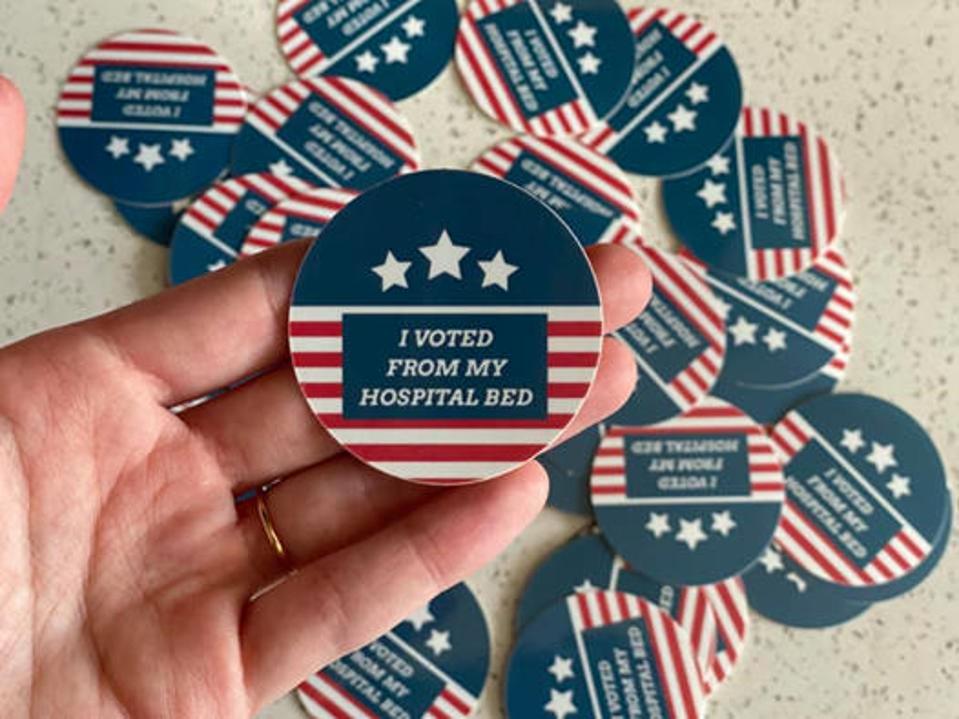
While voter suppression efforts are making it harder to vote in places like Texas, Georgia and Florida, one strategy makes voting during the pandemic a little easier: voting from your hospital bed.
State rules and deadlines vary, but at least 38 states allow emergency absentee ballots for registered voters who unexpectedly cannot vote in person, including patients who are suddenly hospitalized.
With Covid-19 cases and hospitalizations spiking, hospital-room voting has become especially relevant in 2020.
Patients and family members staying with them are often surprised to learn that they can vote from the hospital, said Dr. Kelly Wong, resident physician in emergency medicine at the Warren Alpert Medical School of Brown University and founder of Patient Voting, a nonpartisan organization that helps hospitalized patients and family members vote.
As a medical student in her home state of South Dakota during the 2016 election, Wong noticed a surprising and potentially dangerous pattern: sick patients were delaying trips to the emergency room or arguing against being admitted to the hospital because they didn’t want to miss the chance to vote.
Wong thought patients shouldn’t have to choose between voting and their health.
But she didn’t know the process for registered voters to vote from the hospital; she didn’t even know there was a process. When she found it was possible, she realized how difficult it was to figure out how to do it.
She was not alone.
“The biggest barrier to patient voting is that they don’t know they can,” Wong said.
In 2018, she founded Patient Voting to close the knowledge gap—just in time for the midterm elections.
The group now publishes state-specific processes for all 50 states, and operates with volunteers in 38 states. They partner with 25 medical schools and 15 hospitals in eight states—including battleground states of Florida, Michigan and Pennsylvania where the 2020 presidential candidates are fighting for every vote.
Wong keeps the organization staunchly nonpartisan. Her motivation is to safeguard patients’ health.
“I joke that in a selfish way, this is a way that patients don’t have to leave the hospital,” Wong said. “If they can accomplish their priorities while staying in the hospital, that’s good for their health.”
This year, voting is a priority for many Americans.
“This is a really defining moment in our history,” said Dr. Sarah Welsh, medical director of the pediatric intensive care unit at Hasbro Children’s Hospital in Rhode Island. “It is our duty as citizens not only to vote ourselves, but to lift our heads up and realize that there are others around us that we interact with on a daily basis that would have limitations.”
Hospitalized patients, or those who are in and out of hospitals with chronic illnesses, may be especially vulnerable to being disenfranchised, according to Dr. Alison Hayward, faculty advisor and board member of Patient Voting and assistant professor of emergency medicine at Brown. “Those people need to have their voices heard because there are huge issues at stake that will really affect their lives.”
A Small Army
In June, Brown University medical students Katie Barry and Meghan McCarthy, both 23, signed on as national medical student coordinators for Patient Voting.
“We are really interested in helping to empower patients, especially those who otherwise might have their voices not heard or overlooked,” said Barry. She realized Covid-19 was not going to be gone by November. “I wanted to help out in any way I could.”
According to Barry and McCarthy, the current generation of doctors in training are especially focused on social determinants of health such as civil rights, housing, and food.
“Along with biology and science, there’s a big emphasis on the social factors that affect some patients’ health,” McCarthy said. “It’s hard to ignore once we get into the hospitals how all these factors affect your patients’ health.”
Barry agreed. “We realize now that in order to care for people, we need to do more than provide the medical care.”
Going Digital
Patient Voting is getting some help to spread the word about hospital-room voting. At Hasbro Children’s Hospital, Patient Voting is newly embedded into the interface patients use to watch TV and get health and hospital information.
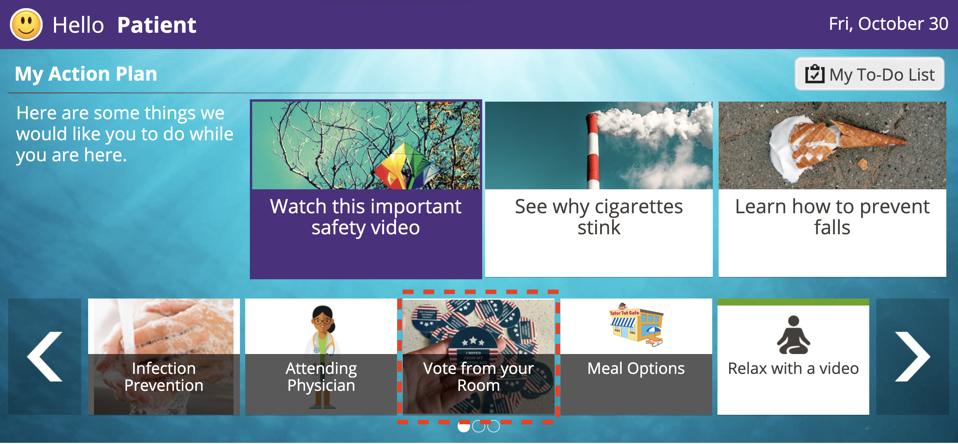
GetWellNetwork, a patient engagement company that provides digital health technology and serves 10 million patients a year in 700 hospitals and clinics nationwide, operates that platform.
The company jumped on the opportunity to help enable parents vote so they wouldn’t have to leave their child’s bedside. GetWellNetwork incorporated Patient Voting into the platform within a day of hearing about the program.
“Our whole philosophy is to help people take an active role in their journey,” said Michael O’Neil, Jr., GetWellNetwork’s founder and CEO.
The company takes what is a typically powerless human experience and uses digital tools to “put the patient in the pilot’s seat,” O’Neil said.
Partnering to enable patient voting fits their philosophy. “It’s a perfect opportunity to spring into action and follow this notion of empowerment,” O’Neil said. “It just happens to be in the context of voting in this case.”
It’s Not Too Late
In the run-up to the election, Patient Voting has experienced a frenzy of requests for help, though it’s not clear how many people vote this way. After the 2018 midterms, Wong and her team contacted state boards of elections to gather such data; they found that most states do not track the number of ballots from hospitalized voters.
Wong herself is spending part of Monday requesting an emergency absentee ballot on behalf of a patient in Rhode Island. She wouldn’t be allowed to do that everywhere; in North Carolina, for example, healthcare employees are prohibited from witnessing emergency absentee ballots.
“I see how thankful people are when they’re able to get the information they needed to be able to vote,” said Hayward, who has been responding to patient and family inquiries. “It feels really good to be involved in a nonpartisan effort in this time…Everyone wants to be able to vote and to have their voice heard.”






 HENRY KOTULA