Another 3 million Americans filed for unemployment last week

https://www.axios.com/jobless-claims-coronavirus-3-million-460364c8-be73-437c-b99c-fa7d75aad87e.html?stream=top&utm_source=alert&utm_medium=email&utm_campaign=alerts_all

Data: U.S. Employment and Training Administration via FRED; Chart: Andrew Witherspoon/Axios

Data: U.S. Employment and Training Administration via FRED; Chart: Andrew Witherspoon/Axios

Another 2.98 million Americans filed for unemployment last week, the Labor Department said on Thursday.

Why it matters: The coronavirus is still forcing a historically high number of Americans out of work. In two months alone, more than 36 million people have filed jobless claims.

Between the lines: The pace of new applications has slowed from its peak in March, but the weekly numbers are still way higher than before businesses shuttered to contain the outbreak.

  • There are more jobless workers that haven’t been able to get their application through. State unemployment offices are racing to get through an avalanche of unemployment filings — with states like New York processing more claims in the past few months than they have in years.
  • Measuring the backlog is “like trying to measure the ocean, it’s constantly moving,” New York Labor Department commissioner Roberta Reardon said in a press call yesterday.
  • While more Americans than ever before are eligible for unemployment, including gig workers, some states are just beginning to scale up to accept those applications.

By the numbers: The total number of people continuing to receive unemployment benefits — after initially applying — rose, bringing the total to a record 22.8 million.

  • A decrease in this figure would be an indication that Americans are returning back to work.

The bottom line: Goldman Sachs estimates the unemployment rate will hit 25%, matching the peak level of joblessness during the Great Depression.


Window of Opportunity is Closing for Coronavirus Response

https://www.axios.com/rick-bright-testimony-opening-statement-6817ae7a-5196-4357-b83c-d3ff96990efd.html?stream=health-care&utm_source=alert&utm_medium=email&utm_campaign=alerts_healthcare

Window of opportunity – definition and meaning – Market Business News

A top vaccine doctor who was ousted from his position in April is expected to testify Thursday that the Trump administration was unprepared for the coronavirus, and that the U.S. could face the “darkest winter in modern history” if it doesn’t develop a national coordinated response, according to prepared testimony first obtained by CNN.

The big picture: Rick Bright, the former head of the Biomedical Advanced Research and Development Authority (BARDA), will tell Congress that leadership at the Department of Health and Human Services ignored his warnings in January, February and March about a potential shortage of medical supplies.

  • He will testify that HHS “missed early warning signals” and “forgot important pages from our pandemic playbook” early on — but that “for now, we need to focus on getting things right going forward.”
  • Bright’s testimony also reiterates claims from a whistleblower report he filed last week that alleges he was ousted over his attempts to limit the use of hydroxychloroquine — an unproven drug touted by President Trump — to treat the coronavirus.

What he’s saying: Bright will testify he urged HHS to ramp up production of
masks, respirators and medical supplies as far back as January. Those warnings were dismissed, Bright says, and he was “cut out of key high-level meetings to combat COVID-19.”

  • “I continue to believe that we must act urgently to effectively combat this deadly disease. Our window of opportunity is closing. If we fail to develop a national coordinated response, based in science, I fear the pandemic will get far worse and be prolonged, causing unprecedented illness and fatalities.”

Bright will call for a national strategy to combat the virus, including “tests that are accurate, rapid, easy to use, low cost, and available to everyone who needs them.”

  • “Without clear planning and implementation of the steps that I and other experts have outlined, 2020 will be darkest winter in modern history.”

Read Bright’s prepared statement.


The latest in the U.S.

https://www.axios.com/newsletters/axios-vitals-72173ec6-3383-4391-afbb-a5ed682e5d7a.html?utm_source=newsletter&utm_medium=email&utm_campaign=newsletter_axiosvitals&stream=top

COVID-19 in the U.S.

As of May 12, 2020, 11pm EDT

Deaths       Confirmed Cases

82,376           1,369,574

Trump and some top aides question accuracy of coronavirus death ...


The U.S. will “without a doubt” have more coronavirus infections and deaths in the fall and winter if effective testing, contact tracing and social distancing measures are not scaled up to adequate levels, NIAID director Anthony Fauci testified on Tuesday.

  • He also said that the “consequences could be really serious” for states and cities that reopen without meeting federal guidelines.

Sen. Mitt Romney (R-Utah) criticized the Trump administration’s coronavirus testing coordinator Adm. Brett Giroir at a Senate hearing Tuesday, accusing him of framing U.S. testing data in a politically positive light: “I find our testing record nothing to celebrate whatsoever.”

Millions of Americans are risking their lives to feed us and bring meals, toiletries and new clothes to our doorsteps — but their pay, benefits and working conditions do not reflect the dangers they face at work, Axios’ Erica Pandey reports.

House Democrats released Tuesday their phase 4 $3 trillion coronavirus relief proposal that would provide billions of additional aid to state and local governments, hospitals and other Democratic priorities.

The American Federation of Teachers launched several capstone lesson plans Tuesday to help K-12 teachers measure student progress during school closures and overcome the challenges of a remote learning setting.

Grocery staples in the U.S. cost more in the last month than in almost 50 years, according to new data out Tuesday from the U.S. Bureau of Labor Statistics.

A new study by economists at the University of Illinois, Harvard Business School, Harvard University and the University of Chicago projects that more than 100,000 small businesses have permanently closed since the coronavirus pandemic was declared in March, the Washington Post reports.


Even health care jobs aren’t safe

https://www.axios.com/newsletters/axios-vitals-cacbbdf4-4694-4db3-9299-5a7e29ebee7e.html?utm_source=newsletter&utm_medium=email&utm_campaign=newsletter_axiosvitals&stream=top

Unemployment rate soars to 14.7% in April - Axios

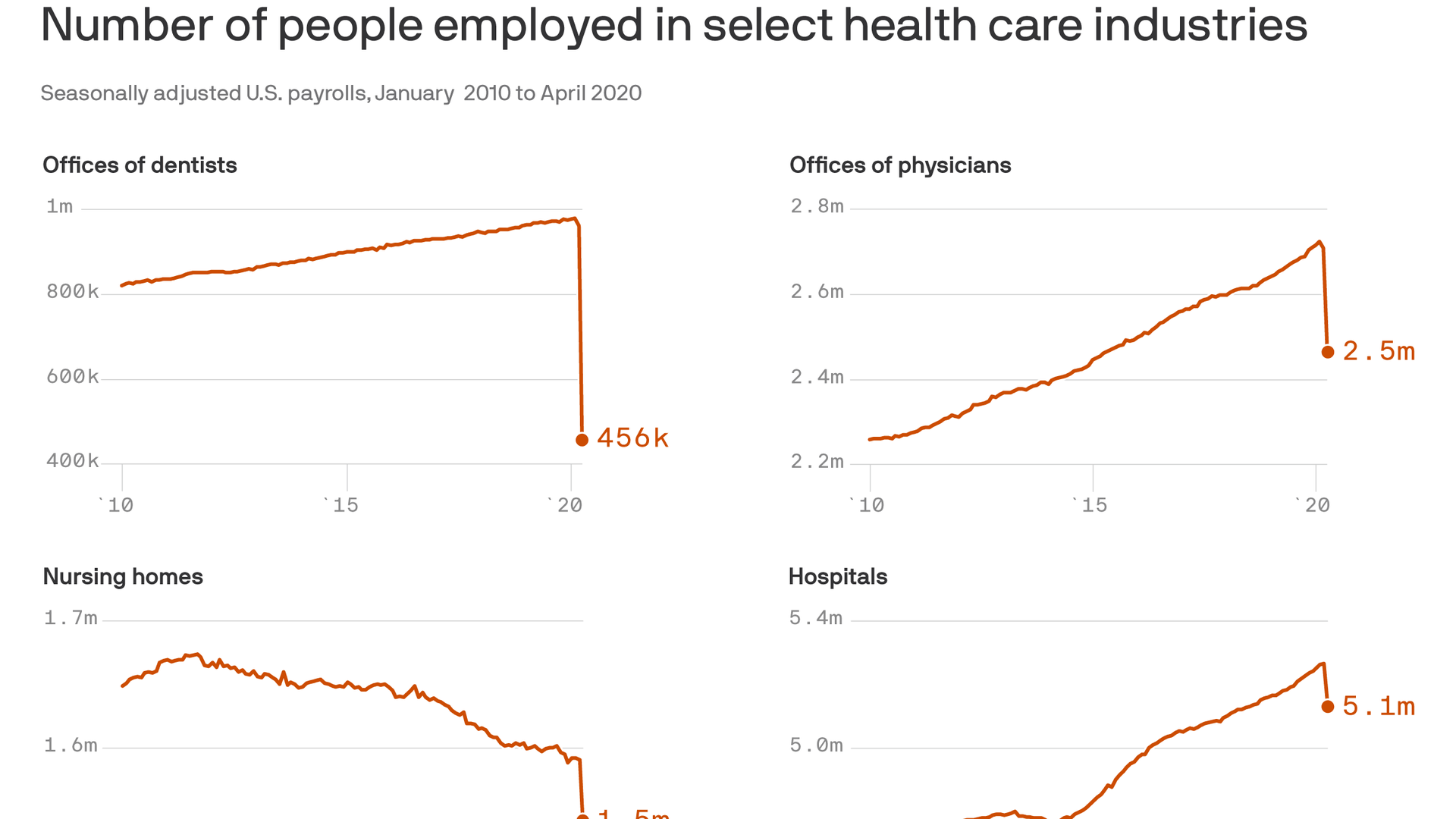
The coronavirus pandemic is a health care crisis, but health care still isn’t immune from the rampant job losses the pandemic has wrought, Axios’ Bob Herman reports.

By the numbers: The health care industry lost more than 1.4 million jobs in April.

The reason: These jobs have gone away because outpatient care has dried up, as providers postponed elective procedures.

  • More than four out of five of those lost jobs were at dentists, doctors’ offices, chiropractors and other outpatient settings.
  • Technicians, billing clerks and medical assistants who work in outpatient settings — many of whom are not highly paid — have felt the brunt of the job losses.

What’s next: Don’t expect a quick return, even as elective procedures are able to come back online.

  • Patients who have lost their insurance or are worried about catching the coronavirus in a waiting room will likely stay away even from outpatient facilities.
  • “Of all the places people want to come back to quickly, a health care setting is probably not at the top of the list,” said Ani Turner, a health economist at Altarum.

What we’re watching: All of these delays in elective care a boon to insurers, who are saving a lot of money while outpatient procedures are on ice.

  • Some insurers will likely have to pay big rebates to their customers as a result. UnitedHealth Group is getting a jump start on that process, announcing $1.5 billion worth of voluntary premium credits and waived fees.


Coronavirus’ double whammy on vulnerable populations

https://www.axios.com/newsletters/axios-vitals-e6483366-26b3-4f34-99c1-f2b356e47b4a.html?utm_source=newsletter&utm_medium=email&utm_campaign=newsletter_axiosvitals&stream=top

The coronavirus' double whammy on minorities and low-income ...

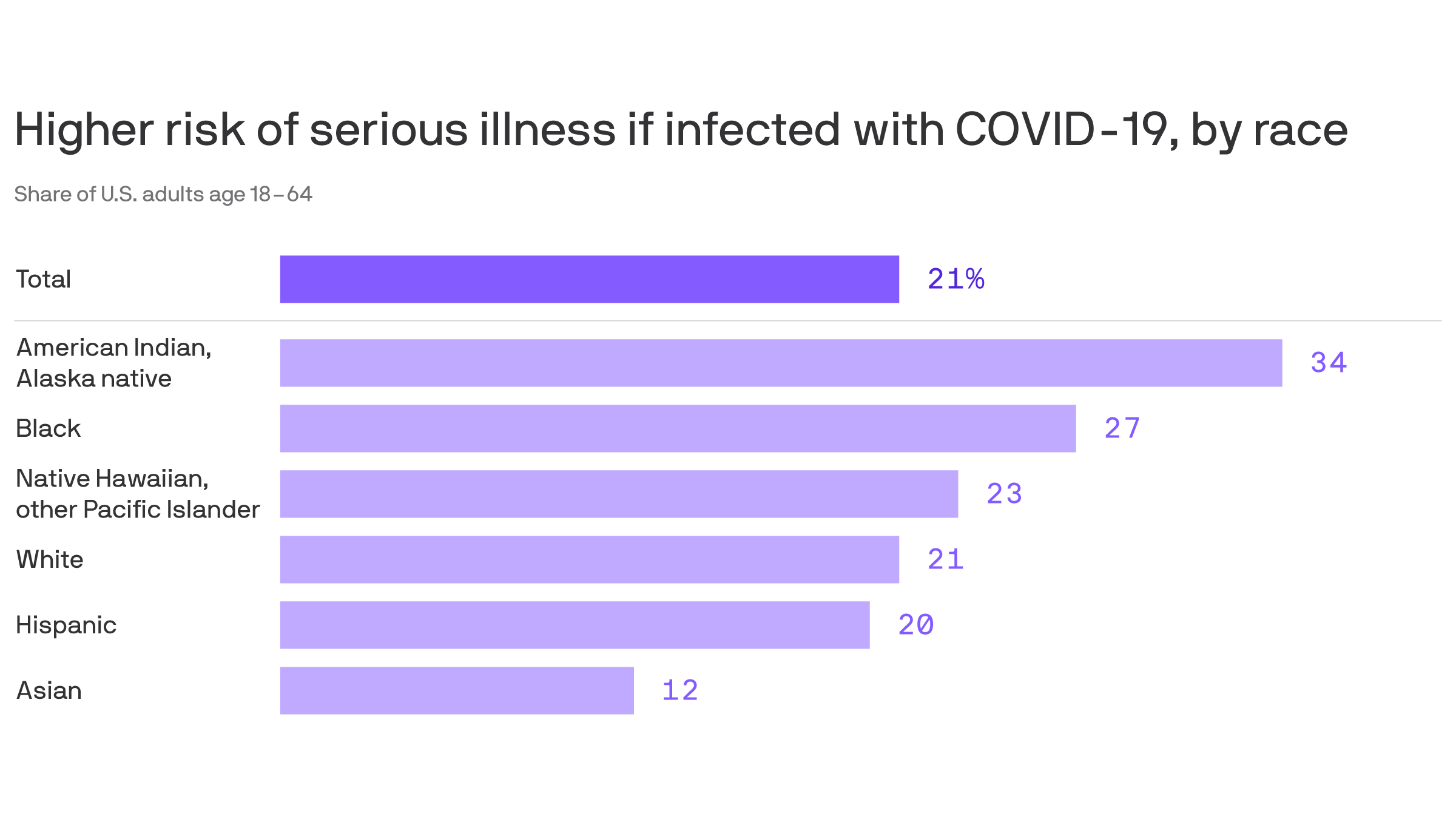
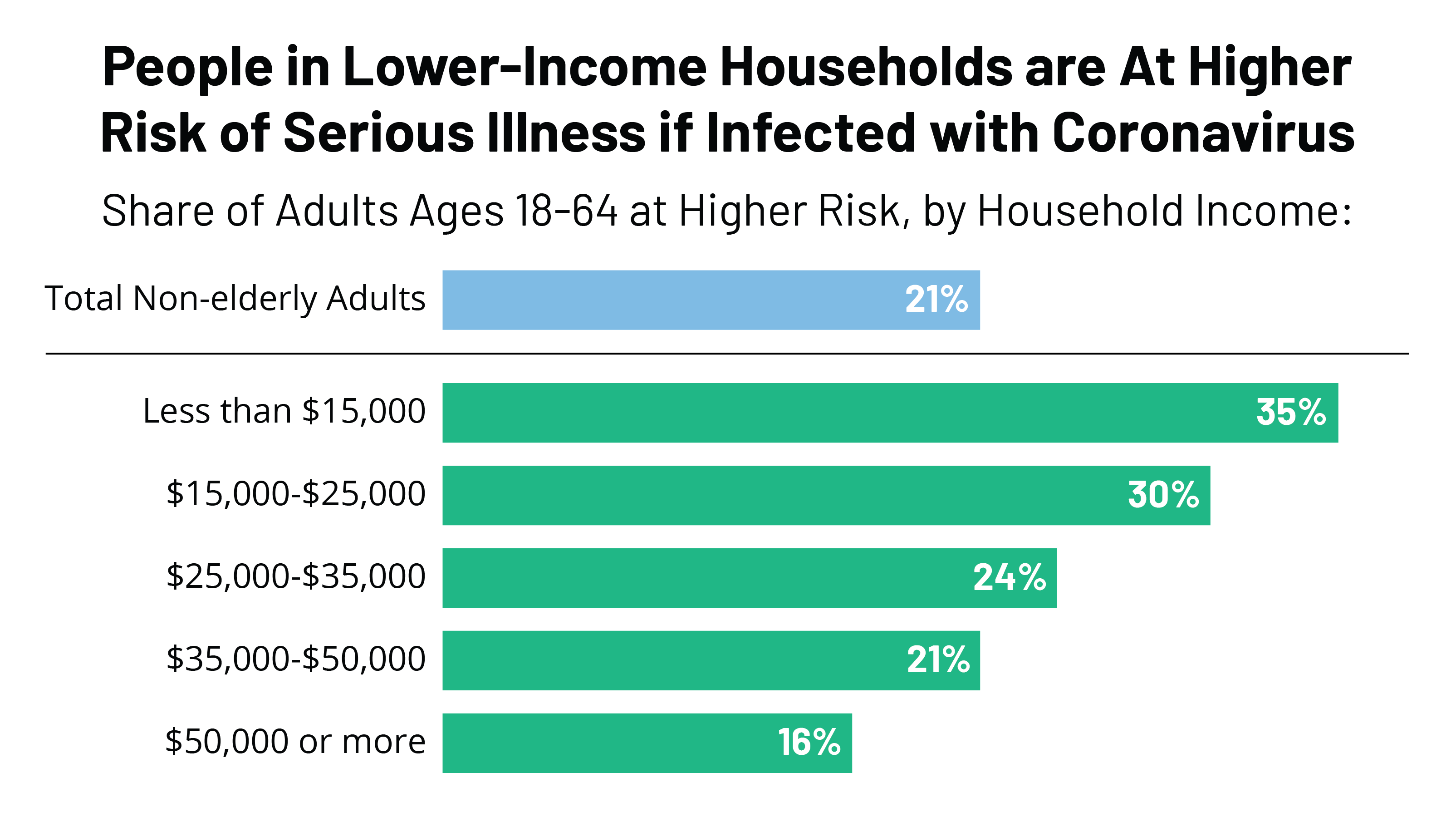
Minorities and low-income people are more likely to become seriously ill if infected with the coronavirus, according to a new Kaiser Family Foundation analysis.

Why it matters: These populations are also less likely to be able to social distance, or have been hit hardest economically by doing so. The coronavirus may be a national problem, but its impact is most devastating to the people who were already worse off.

Kaiser Family Foundation - Health Policy Research, Analysis ...


The big picture: Even before the virus hit, minorities suffered from worse health outcomes, in part because they’re more likely to be low-income — which is also correlated with higher rates of chronic conditions.

  • People with underlying health conditions — like heart disease, chronic obstructive pulmonary disease (COPD), uncontrolled asthma, diabetes or obesity — are more vulnerable to severe illness from the novel coronavirus.
  • Health care and socioeconomic disparities also exacerbate Native Americans’ and black Americans’ risk.
  • And “even though the shares of Hispanic and Native Hawaiian or Pacific Islander nonelderly adults at higher risk for serious illness if infected are similar to that of White adults, these groups face disparities in other health, social, and economic factors that may contribute to barriers to health care associated with coronavirus,” KFF adds.

Between the lines: People with low-income jobs deemed essential — like grocery store workers, home health aides or delivery drivers — are also at higher risk of contracting the virus.

  • Those in other low-income jobs, like in retail or restaurants, are more likely to be out of work right now or working fewer hours.
  • As the fight between businesses and workers heats up in states reopening sooner than public health experts advise, low-income workers have less of an option to quit if they feel unsafe.


Another 3.169 million Americans file for unemployment benefits

https://finance.yahoo.com/news/jobless-claims-another-3-million-americans-expected-to-have-filed-for-unemployment-benefits-170914685.html

Jobless claims: Another 3.169 million Americans file for ...

Market participants got another pulse check on the U.S. labor market Thursday, as the world continues to grapple with the COVID-19 pandemic and ahead of the highly-anticipated April jobs report.

Another 3.169 million Americans filed for unemployment benefits in the week ending May 2, exceeding economists expectations for 3 million initial jobless claims. The prior week’s figure was revised higher to 3.846 million from the previously reported 3.839 million. So far over the past seven weeks, more than 33 million Americans have filed unemployment insurance claims.

Continuing claims, which lags initial jobless claims data by one week, totaled a record 22.65 million in the week ending April 25. The prior week’s 17.99 million continuing claims was revised higher to 18.01 million.

The weekly number of jobless claims has been steadily declining even as the cumulative number remains high.

“Jobless claims in the U.S. slowed again last week, but not as much as hoped. As the economy re-opens more broadly this process should accelerate, but the economic pain resulting from mass unemployment will restrain the recovery process,” ING economist James Knightley said in a note Thursday.

“This report tells us nothing about hiring though, which is likely to remain weak for some time to come given the economically depressing effects of social distancing, consumer caution relating to Covid-19 fears, travel restrictions and the legacy of tens of millions of people being out of work,” Knightley added.

map

Certain states got hit harder than others last week, as backlogs continue to get processed. California saw the highest number of initial jobless claims at an estimated 318,000 on an unadjusted basis, down from 325,000 in the prior week. Texas reported 247,000, down from 254,000 in the previous week. Georgia had an estimated 227,000 and New York reported 195,000. Florida, which had the highest number of claims in the prior week, reported 173,000 in the week ending May 2, down considerably from 433,000.

Thursday’s weekly claims report comes ahead of the Bureau of Labor Statistic’s April jobs report and on the heels of the ADP employment report. Wednesday morning, the U.S. private sector lost 20.23 million jobs in April and was the worst loss in the report’s history, according to ADP.

“Job losses of this scale are unprecedented. The total number of job losses for the month of April alone was more than double the total jobs lost during the Great Recession,” ADP Research Institute Co-Head Ahu Yildirmaz said in a statement.

“Additionally, it is important to note that the report is based on the total number of payroll records for employees who were active on a company’s payroll through the 12th of the month. This is the same time period the Bureau of Labor and Statistics uses for their survey,” Yildirmaz added.

Though the ADP report is not always a reliable indicator of what the BLS report will illustrate, it does provide a bit of insight into the health of employment in the U.S.

“The report is a bit light on details of any potential methodological problems this month. The ADP counts anyone on the active payroll rather than just people who were paid during the month, which is the official non-farm payroll definition. Within many people put on temporary layoff, that could have created a discrepancy, with those people still on the active payroll, but not counted in the official non-farm payroll figures and also qualifying as unemployed in the other official household survey,” Capital Economics said in a note Wednesday.

Economists polled by Bloomberg expect 21.3 million jobs losses in April when the BLS releases its report Friday morning, down significantly from 701,000 job losses in March. The unemployment rate is estimated to have surged to 16% from 4.4% in the prior month.

“April jobs report should go down in infamy,” Bank of America economists said in a note Wednesday. “The April employment report will reveal unprecedented job losses as the economy has been shutdown to control the spread of COVID-19.” The firm projects 22 million job losses during the month amid the global pandemic.  

One important thing to note with April’s jobs report is that there might be some discrepancies in the two surveys. A furloughed person, who is not working but has not been laid off, will be classified as unemployed or temporarily laid off in the household survey. However, if they were paid at any point during the establishment survey period, they will be classified as employed.

As of Thursday morning, there were 3.7 million confirmed coronavirus cases and 264,000 deaths globally, according to Johns Hopkins University data. In the U.S., there were 1.2 million cases and 73,000 deaths.


States cut Medicaid as millions of jobless workers look to safety net

https://www.politico.com/amp/news/2020/05/05/states-cut-medicaid-programs-239208?utm_source=The+Fiscal+Times&utm_campaign=f343554e9c-EMAIL_CAMPAIGN_2020_05_06_09_42&utm_medium=email&utm_term=0_714147a9cf-f343554e9c-390702969

Medicaid Cuts Could Hurt Seniors Most | Muskegon Tribune

Three states have cut back state spending on the program since the pandemic hit, and more are warning of painful cuts to benefits and services.

States facing sudden drops in tax revenue amid the pandemic are announcing deep cuts to their Medicaid programs just as millions of newly jobless Americans are surging onto the rolls.

And state officials are worried that they’ll have to slash benefits for patients and payments to health providers in the safety net insurance program for the poor unless they get more federal aid.

State Medicaid programs in the previous economic crisis cut everything from dental services to podiatry care — and reduced payments to hospitals and doctors in order to balance out spending on other needs like roads, schools and prisons. Medicaid officials warn the gutting could be far worse this time, because program enrollment has swelled in recent years largely because of Obamacare’s expansion.

The looming crisis facing Medicaid programs “is going to be the ’09 recession on steroids,” said Matt Salo, head of the National Association of Medicaid Directors. “It’s going to hit hard, and it’s going to hit fast.”

Medicaid programs, among the largest budget items in most states, provide health insurance to roughly 70 million poor adults, children, the disabled and pregnant women. The federal government on average pays roughly 60 percent of program costs, with poorer states receiving a higher share. States have the latitude to adjust benefits, payments to health care providers and eligibility requirements with oversight by the federal government.

Now, governors are turning to Congress for help as it weighs a new package to rescue state budgets battered by the pandemic. They’re asking lawmakers to provide a bigger boost to Medicaid payments and provide hundreds of billions of dollars in aid to shore up state budgets.

Medicaid naturally faces heightened demand as economic conditions worsen. But that leaves states facing more need at the same time that they have less money.

“The cruel nature of the economic downturn is that at a time when you need a social safety net is also the time when government revenues shrink,” Ohio Gov. Mike DeWine, a Republican, said Tuesday as he announced $210 million in cuts to his state’s Medicaid program in the next two months.

The vast majority of a $229 million spending cut made by Colorado Democratic Gov. Jared Polis last week came from Medicaid, though new federal funds will forestall an immediate reduction in benefits or payments to health providers. State legislative committee staff have warned Medicaid enrollment there could spike by 500,000 by the end of the year.

In Georgia, where Medicaid enrollment is projected to rise by as much as 567,000, Republican Gov. Brian Kemp and legislative leaders have instructed every state agency to prepare for 14 percent reductions across the board.

House Democrats are pushing to deliver a $1 trillion-plus package in aid to state and local governments and to support safety net programs, which could alleviate pressure on states to make deep cuts to health care during a pandemic. Some Republican lawmakers have questioned the need for more aid, after Congress has shoveled out trillions of dollars in rescue funding.

Congress already gave states a temporary 6 percent increase in the federal portion of Medicaid spending in an earlier coronavirus package. That prompted Alaska Gov. Mike Dunleavy, a Republican, to cut state Medicaid spending $31 million last month, saying the temporary federal boost would make up the difference.

State officials largely agreed the increase was helpful but said it likely will be washed out by an expected enrollment surge. The nation’s governors say Congress — in addition to providing at least $500 billion in direct support to states — must double the Medicaid funding boost to 12 percent as it did in the previous recession. At least one Republican senator facing a tough reelection fight, Cory Gardner of Colorado, said his state sorely needs extra Medicaid funding to avoid “harmful budget cuts.”

Anywhere from 11 million to 23 million more people could sign up for Medicaid over the next several months. The demand will be even greater in roughly three-quarters of states that expanded Medicaid enrollment to poor adults under the Affordable Care Act.

The portion of state budgets devoted to Medicaid spending has grown quickly since the previous recession, making it a riper target for cuts. Medicaid spending on average accounted for 15.7 percent of state budgets in fiscal 2009, a number that jumped to 19.7 percent in fiscal 2019.

Medicaid enrollment data in some states often lags, making it difficult to determine how much national sign-ups have climbed since jobless claims began surging two months ago. Some states have begun to report notable surges, however, and larger increases are expected in the coming months.

Arizona in the past two months saw 78,000 people enroll in Medicaid and the Children’s Health Insurance Program, which receives more generous funding from the federal government. Virginia has seen a 20 percent increase in enrollment applications since mid-March.

In New Mexico, where 42 percent of the population was already enrolled in Medicaid, sign-ups in the first two weeks of April surged by about 10,000 more people than were expected before the pandemic.

New Mexico’s top Medicaid official said the budget is a significant concern for a state heavily reliant on oil and natural gas. She worries a prolonged economic downturn could force the state to roll back pay increases to Medicaid providers enacted last year, and another planned pay raise for next year is almost certainly off the table.

States that accepted the temporary Medicaid payment increase from Congress are barred from cutting back enrollment while they’re receiving the enhanced funds. That leaves states with the option of cutting benefits or provider payments to find Medicaid savings, which could ignite fierce brawls in state capitals.

Michigan state Rep. Mary Whiteford, the Republican chairwoman of a health care appropriations panel, said the state’s Medicaid enrollment could increase from 2.4 million to 2.8 million by the end of the year.

“We are just planning for major cuts moving forward,” Whiteford said.

Before the pandemic, states had socked away $72 billion in rainy day funds — an all-time high, said Brian Sigritz of the National Association of State Budget Officers. But that figure was easily dwarfed by the $150 billion Congress provided to state and local governments in an earlier package, and it’s far short of what states are demanding.

“Now, we’re looking at greater declines than what we saw during the Great Recession and increased spending,” Sigritz said. “If there aren’t more federal funds, states will have to look at cutting funding for key services: public safety, education, health care. That’s where the money is.”


9 states seek $36B in federal advances for unemployment claims

https://www.politico.com/states/california/story/2020/05/05/9-states-seek-36b-in-federal-advances-for-unemployment-claims-1282530?utm_source=The+Fiscal+Times&utm_campaign=f343554e9c-EMAIL_CAMPAIGN_2020_05_06_09_42&utm_medium=email&utm_term=0_714147a9cf-f343554e9c-390702969

9 states seek $36B in federal advances for unemployment claims

Nine states have told the Department of Labor they plan to ask for $36 billion in federal advances to cover the astronomical cost of unemployment payouts amid the coronavirus pandemic, according to new information provided to POLITICO Tuesday night by federal officials.

Illinois, which had fiscal problems before the coronavirus, tops the list with an $11 billion request in May and June.

California, the first state to borrow, plans to seek the next-highest amount over the same two months: $8 billion.

Texas will ask for advances totaling $6.4 billion in May, June and July and New York will ask for $4.4 billion in the same three months.

Connecticut, Hawaii, Massachusetts, Ohio and West Virginia have also signaled an intent to borrow between May and July to fund their unemployment systems. Some of the states, like Illinois and California, only requested advances for May and June.

There is no approval process for the advances, a department spokesperson said. States notify the Departments of Labor and Treasury of their needs, the spokesperson said, and the Department of Labor certifies those amounts to the Treasury Department.

States are able to draw down advances as they need them, but won’t necessarily end up using the full amounts.

California took out its first $348 million unemployment insurance loan last week, slipping into the red just two years after repaying the $65 billion it borrowed from the federal government during and after the Great Recession. It was one of about three dozen states that took out federal loans to weather the last downturn, a scenario likely to repeat itself in the coming weeks and months as unemployment numbers soar nationwide.

The latest national figures last week showed that more than 30 million had filed jobless claims since mid-March.

California’s unemployment insurance system, funded by payroll taxes, was barely solvent before the pandemic blindsided the economy, with less of a cushion than any other state or territory except for the U.S. Virgin Islands, according to the Department of Labor’s Trust Fund Solvency Report.

Besides Hawaii, all of the states requesting advances also fell well below the department’s recommended solvency level.

Since mid-March, California Gov. Gavin Newsom said Monday, the state has issued $7.8 billion in unemployment relief, and more than 4.1 million people have filed claims — about 21 percent of the state’s pre-pandemic workforce.

Newsom stressed that the state was “good for our word,” but called for direct federal aid. “This pandemic is bigger than even the state of California,” he said. “The economic consequences of this pandemic are such that we can balance our budgets without substantial cuts, unless we get additional federal support.”

States won’t accrue interest on these federal loans through Dec. 31, under the federal Families First Coronavirus Response Act. But the last round of unemployment fund borrowing cost California $1.4 billion in interest payments, according to the state’s Department of Finance.


ADP National Employment Report

https://adpemploymentreport.com/2020/April/NER/NER-April-2020.aspx?utm_source=The+Fiscal+Times&utm_campaign=f343554e9c-EMAIL_CAMPAIGN_2020_05_06_09_42&utm_medium=email&utm_term=0_714147a9cf-f343554e9c-390702969

Private-sector employment decreased by 20,236,000 from March to April, on a seasonally adjusted basis.


Grim and getting worse: US set for historic unemployment surge

https://news.yahoo.com/grim-getting-worse-us-set-historic-unemployment-surge-015532438.html

Grim and getting worse: US set for historic unemployment surge

Like a global tsunami, the coronavirus pandemic has caused a huge loss of life and taken a massive economic toll.

In the US economy, skyrocketing unemployment is the most-visible sign of the devastation: almost overnight, at least 30 million workers lost their jobs.

The April employment report, due out Friday, is expected to show the jobless rate soaring into double digits, perhaps as high as 20 percent, far surpassing the worst of the global financial crisis and reaching levels not seen since the Great Depression last century.

The US government and central bank worked at a stunning pace to rush out aid and financing to workers and businesses to try to prevent a complete economic collapse, but there is a growing fear that the temporary shutdowns imposed to contain the spread of the virus will become permanent for many companies.

The coronavirus has infected nearly 1.2 million people in the United States and killed around 70,000, according to a count from Johns Hopkins University, and analysts fear some of the economic damage may be permanent.

“We took the elevator down, but we’re going to need to take the stairs back up,” Tom Barkin, president of the Federal Reserve Bank of Richmond, said in a recent speech.

Despite nearly $3 trillion in financial aid approved by Congress in March alone and trillions more in liquidity provided by the Federal Reserve, the US economy contracted by 4.8 percent in the first three months of the year — a period that included only a couple of weeks of the strict business shutdowns.

The second quarter could see the economy plunge by twice that amount.

– The worst is yet to come –

The data on the jobs market has become so bad so fast that there are no comparisons.

Statisticians in the Labor Department’s Bureau of Labor Statistics (BLS), which produces the monthly unemployment report, are using natural disasters as a point of reference.

“The closest that we have in terms of what was in our playbook has been usually hurricanes, because they tend to be large and impact significant periods of time, or areas,” BLS Associate Commissioner Julie Hatch Maxfield told AFP.

But even devastating events, like Hurricane Katrina in 2005, were regional — not national and certainly not global.

The job losses spread from airlines and hotels to restaurants and factories as states ordered lockdowns and then closed schools, sending initial claims for unemployment insurance surging from mid-March, with 20 million posted in the four weeks of April alone.

But those figures could underestimate the true size of the shock, since many people have not been able to file for benefits, and others do not qualify.

The official unemployment rate in March jumped from a historic low of 3.5 percent to 4.4 percent, with 701,000 jobs lost.

But the monthly data, which are separate from the jobless claims reports, are calculated only during the pay period that includes the 12th day of each month, so they too missed the real picture. BLS said the survey of households likely underestimated the jobless rate, which should have been 5.4 percent.

April will be far worse, with some economists projecting jobs losses at 28 million and a 17 percent unemployment rate. And as more businesses report their data, job losses in March are expected to be revised higher as well.

Employment in the private sector alone collapsed 20.2 million last month, US payroll services firm ADP said Wednesday. But ADP acknowledges the data do not present the complete picture.

“Job losses of this scale are unprecedented. The total number of job losses for the month of April alone was more than double the total jobs lost during the Great Recession,” said Ahu Yildirmaz, co-head of the ADP Research Institute.

– False rebound, slow comeback –

Job losses during the global financial crisis in 2008 and 2009 totaled 8.6 million and the unemployment rate peaked at 10 percent.

Even among workers who are still employed, many have seen their hours cut.

“It’s now clear the economy was in a downdraft much more rapidly than anyone expected,” Diane Swonk, chief economist at Grant Thornton, told AFP.

The expansive government aid programs mean the US might see a temporary pickup in hiring in May and June, Swonk said.

But if small businesses aren’t fully back to normal by July, which depends on consumers feeling safe enough to go back to restaurants and shops, “they’re going to have to lay them off again,” she said.