1.4 million healthcare jobs lost in April

https://www.beckershospitalreview.com/workforce/1-4-million-healthcare-jobs-lost-in-april.html?utm_medium=email

1.4 million health-care workers lost their jobs due to the ...

Healthcare lost 1.4 million jobs in April amid the COVID-19 pandemic, primarily in ambulatory healthcare services, according to the latest jobs report from the U.S. Bureau of Labor Statistics.

The April count compares to 43,000 healthcare jobs lost in March.

Within ambulatory healthcare services, April job losses included offices of dentists (503,300), offices of physicians (243,300), and offices of other healthcare practitioners (205,100).

Hospitals lost 134,900 jobs last month, compared to the 200 positions they added to the U.S. economy in March.

The April jobs report marks the second consecutive month that healthcare employment did not grow. In the 12 months prior to March — the month the World Health Organization declared the COVID-19 spread a pandemic — industry employment had grown by 374,000, according to the bureau.

Bloomberg reported the number of healthcare workers has doubled to 16 million in the last three decades, and until March, the industry has lost jobs in only four months during that period.

Overall, the U.S. lost 20.5 million jobs in April, and the unemployment rate reached 14.7 percent, the highest since the Great Depression, according to the bureau.

The unemployment rate does not reflect Americans still working who have had their hours or pay reduced, The New York Times noted.


Coronavirus’ double whammy on vulnerable populations

https://www.axios.com/newsletters/axios-vitals-e6483366-26b3-4f34-99c1-f2b356e47b4a.html?utm_source=newsletter&utm_medium=email&utm_campaign=newsletter_axiosvitals&stream=top

The coronavirus' double whammy on minorities and low-income ...

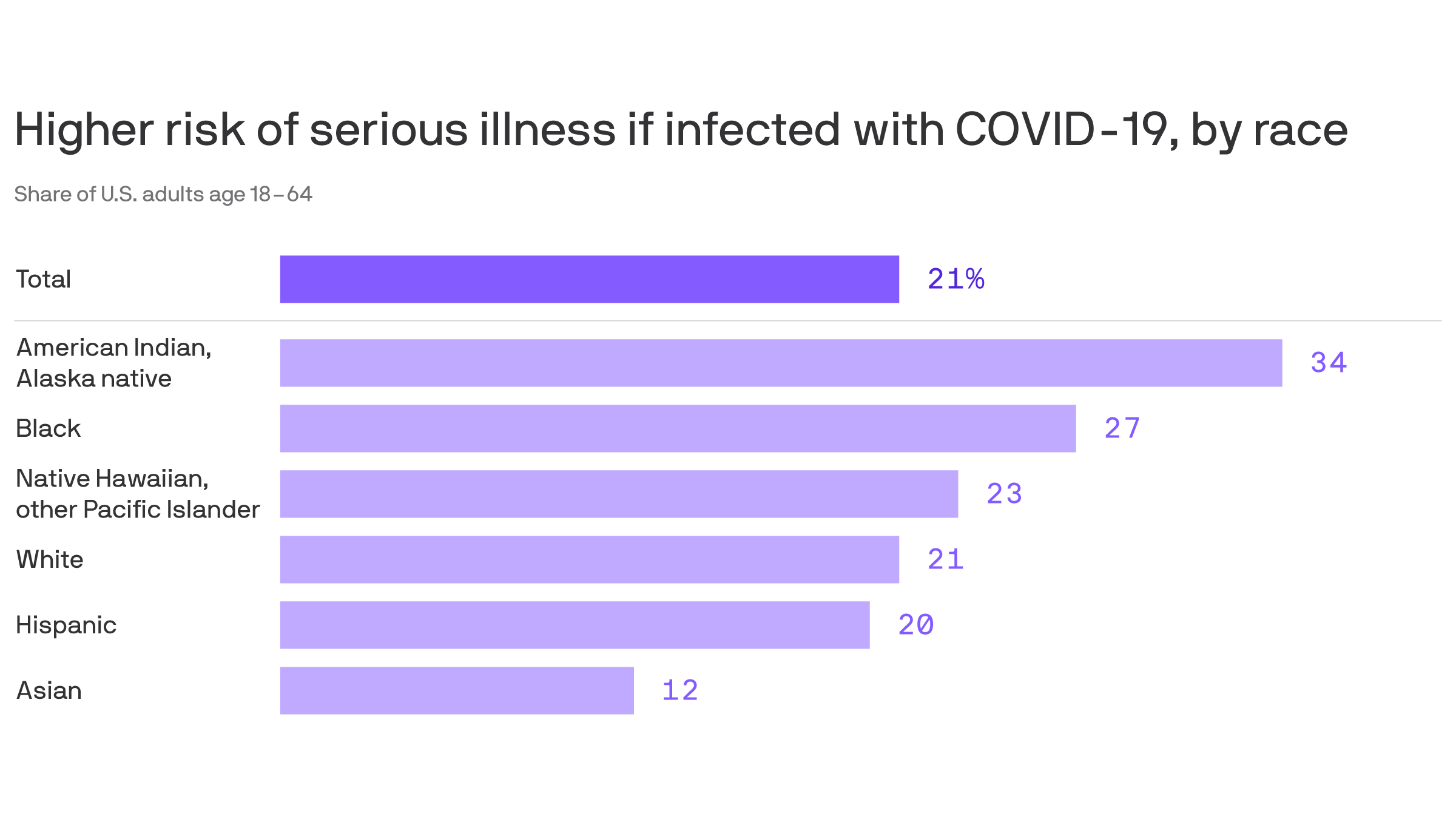
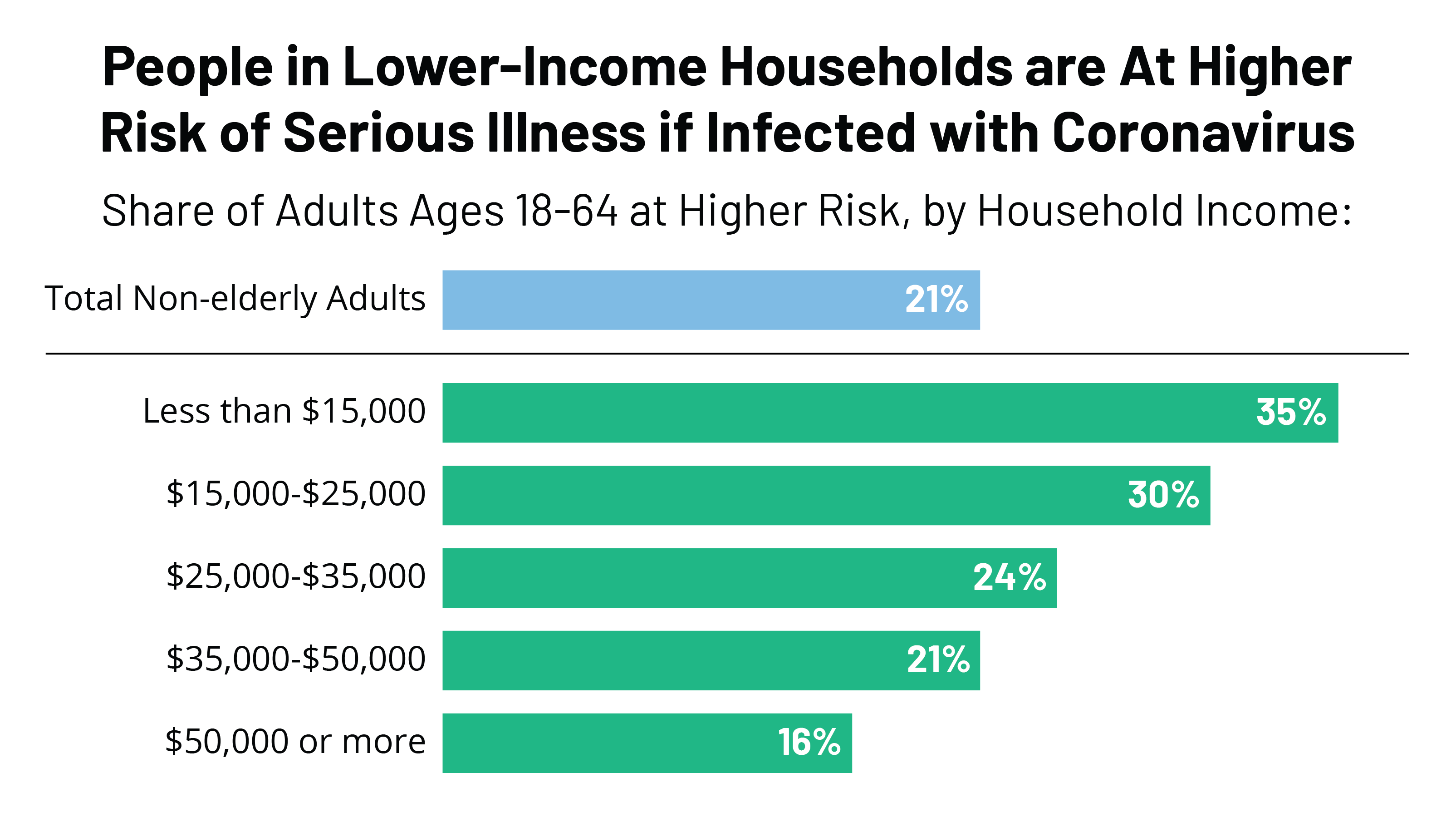
Minorities and low-income people are more likely to become seriously ill if infected with the coronavirus, according to a new Kaiser Family Foundation analysis.

Why it matters: These populations are also less likely to be able to social distance, or have been hit hardest economically by doing so. The coronavirus may be a national problem, but its impact is most devastating to the people who were already worse off.

Kaiser Family Foundation - Health Policy Research, Analysis ...


The big picture: Even before the virus hit, minorities suffered from worse health outcomes, in part because they’re more likely to be low-income — which is also correlated with higher rates of chronic conditions.

  • People with underlying health conditions — like heart disease, chronic obstructive pulmonary disease (COPD), uncontrolled asthma, diabetes or obesity — are more vulnerable to severe illness from the novel coronavirus.
  • Health care and socioeconomic disparities also exacerbate Native Americans’ and black Americans’ risk.
  • And “even though the shares of Hispanic and Native Hawaiian or Pacific Islander nonelderly adults at higher risk for serious illness if infected are similar to that of White adults, these groups face disparities in other health, social, and economic factors that may contribute to barriers to health care associated with coronavirus,” KFF adds.

Between the lines: People with low-income jobs deemed essential — like grocery store workers, home health aides or delivery drivers — are also at higher risk of contracting the virus.

  • Those in other low-income jobs, like in retail or restaurants, are more likely to be out of work right now or working fewer hours.
  • As the fight between businesses and workers heats up in states reopening sooner than public health experts advise, low-income workers have less of an option to quit if they feel unsafe.


States face economic death spiral from Coronavirus

https://www.axios.com/coronavirus-states-economy-295ac091-9dc2-4852-be67-d070ec268d8c.html

YEAR-OVER-YEAR CHANGE IN STATE TAX REVENUES

April 2020 vs. April 2019, select states

States face economic death spiral from coronavirus - Business Insider


Early numbers show how significantly the coronavirus is devastating states’ revenue streams — and could force choices between raising taxes or gutting services and laying off public employees.

Why it matters: Even as some states move toward reopening, the economic ramifications of having shut down will haunt them far into the future.

  • When states can reopen, and how quickly industries are able to bounce back, could either worsen or improve projections.

What to watch: Sens. Bob Menendez (D-N.J.) and Bill Cassidy (R-La.) plan to introduce bipartisan legislation as soon as next week that would create a $500 billion fund designed to help struggling state and municipality budgets in the wake of COVID-19.

  • “If there was another way to do this, I’d rather do it the other way,” Cassidy tells Axios. “But what I don’t want to happen is all this money spent for families and for employers to go to waste because cities cannot provide essential services.”
  • Menendez tells Axios: “This is the time to step up to the plate.”

By the numbers: The Urban Institute has been compiling lost revenue data as states make it publicly available. So far, there are figures for about one in four states that compare this April’s state income and sales tax revenue collections against those from April 2019.

  • The data shows collections dropping between 20% and more than 50%, depending on the state, senior researcher Lucy Dadayan tells Axios — and those figures could get worse as new data comes in.
  • South Dakota is an outlier in the states the Urban Institute has tracked so far, in that revenues actually appear up for April. That may be largely because it is one of very few states that did not issue a stay at home order. But experts expect to see revenue declines next month.
  • Although it has not yet released April sales tax numbers to enable a year-over-year comparison, California’s staggering tax revenue loss due to COVID-19 has led to an expected $54.3 billion budget shortfall through FY 2021 — including a $13.4 billion shortfall this fiscal year, the governor announced Thursday. That’s with a $21 billion surplus last year.
  • New York also has yet to release April tax revenue data, but its latest budget projection has the state short as much as $13.3 billion in FY 2021, according to Dadayan’s analysis of most recent state budget projections. Illinois is looking at a more than $4.6 billion shortfall for next fiscal year.
  • Arizona is projecting to be short more than half a billion dollars for this fiscal year.
  • The projected shortfalls for FY 2020, which ends at the end of June for most states, is arguably a bigger problem because there isn’t much time left to make changes, per Axios’ Dan Primack.

The big picture: Democratic-leaning cities have seen the highest case and death rates. But red and blue states alike are facing serious budget shortfalls.

  • That’s why some Republican senators are getting behind efforts to provide federal dollars to help states balance budgets.
  • Even after accounting for state emergency savings accounts — which in many states were at an all-time high — 33 states will likely need to fill budget gaps of 5% or more, according to a recent analysis by Moody’s Analytics.
  • 21 states would need to fill gaps of 10% or more.
  • “Anybody is going to be overwhelmed by this — even states who were well prepared,” Dan White, director of government consulting and fiscal policy research at Moody’s Analytics, tells Axios.

Between the lines: Much of the burden will likely be pushed on struggling local governments’ plates, White said.

  • Cities have also lost smaller revenue sources such as hotel occupancy fees, inspection fees and construction fees.
  • Some could be forced to lay off public workers needed to combat the virus and keep the public safe — such as firefighters, paramedics, public hospital workers.
  • It’s either that or raise taxes in the midst of high unemployment and financial insecurity. “That’s the death spiral,” said Menendez, who has been talking with mayors across his state.
  • New York City Mayor Bill de Blasio has already said he may have to start furloughing municipal employees if the city doesn’t receive federal funds to help fill budget gaps.

Some state and local governments will wait to make tough budget decisions in the hopes that they get needed funds from Congress, which is in heated negotiations around the fourth stimulus package.

Republican lawmakers have been hesitant to provide this much federal help to states, but they’ve been warming to the idea.

  • Menendez says he expects several Republican senators besides Cassidy to sign on to their proposal.


The New Culture War

American Identity Is The New Culture War - Auburn Seminary

You’re either a liberal snowflake controlled by big government or a greedy conservative willing to sacrifice Grandma for the economy. It took less than two months for Americans to get here.

Wear a mask? You’re a liberal snowflake controlled by big government. Want to reopen restaurants? You’re a greedy conservative willing to sacrifice Grandma for the economy.

It took less than two months for the coronavirus pandemic to become just the latest battle in the culture wars.

With the country still in the firm grip of the coronavirus pandemic, conservatives are on social media and Fox News stoking protests that argue masks, stay-at-home orders and social distancing violate constitutional rights and are causing unacceptable harm to the economy.

Liberals, at the same time, say personal liberties must be sacrificed for public health, even as millions file for unemployment and more than a quarter of the work force is jobless in some states.

Take a look at what two governors — one from a reliably Republican state and another from a reliably Democratic state — said this week.

“We have a public health crisis in this country, there’s no doubt about it,” Gov. Tate Reeves of Mississippi said in an appearance on “Fox News Sunday.” “But we also have an economic crisis.”

“We have turned the corner and we are on the decline,” Gov. Andrew M. Cuomo said, citing an article showing that the death rate has fallen by half in New York City, in his daily briefing on Wednesday. “To me, that vindicates what we are doing here in New York, which says: Follow the science, follow the data, put the politics aside and the emotion aside. What we’re doing here shows results.”

The problem with all these politics? Epidemiology.

So far, the virus has hit Democratic states the hardest, with the most cases per capita in five deeply Democratic states — New York, New Jersey, Massachusetts, California and Illinois. Cities have borne the brunt of the caseload. And African-Americans and Latinos — a key part of the Democratic coalition — are getting sick and dying of the virus at higher rates.

But anyone who believes this virus is fading away — or somehow contained to urban areas — is engaging in some serious magical thinking.

At least 25,000 new coronavirus cases are identified almost daily, meaning that the total in the United States — which has the highest number of known cases in the world — is expanding daily by 2 to 4 percent.

New York Times analysis found that 18 of the states that are reopening had an increase of daily average cases over the last two weeks. Fifteen of those states are led by Republican governors.

Three of the top five states where the virus is spreading the fastest — Texas, Georgia and Ohio — have Republican governors and Republican-controlled legislatures. All three have moved toward reopening.

In the Midwest and South, smaller towns and more rural areas have suddenly been hit hard as the virus tears through nursing homes, meatpacking plants and prisons.

The nation’s highest per capita infection rate can be found in Trousdale County, Tenn., a rural county where a prison has become a hot spot. Businesses in the county are reopening this week.

In the Trump era, rural counties like Trousdale have represented the backbone of the Republican base. In Trousdale, nearly 67 percent of the county supported President Trump in 2016. Over all, the average margin of victory in rural counties won by Republicans was nearly 47 percent in 2016.

Rural areas tend to be older and have a larger share of the population with pre-existing medical conditions, making them far more vulnerable to the worst health effects of the virus.

Republican governors and conservative activists may think the coronavirus is an urban problem. Or a density problem. Or, quite frankly, a Democratic problem.

They may soon find out that it’s not.


Another 3.169 million Americans file for unemployment benefits

https://finance.yahoo.com/news/jobless-claims-another-3-million-americans-expected-to-have-filed-for-unemployment-benefits-170914685.html

Jobless claims: Another 3.169 million Americans file for ...

Market participants got another pulse check on the U.S. labor market Thursday, as the world continues to grapple with the COVID-19 pandemic and ahead of the highly-anticipated April jobs report.

Another 3.169 million Americans filed for unemployment benefits in the week ending May 2, exceeding economists expectations for 3 million initial jobless claims. The prior week’s figure was revised higher to 3.846 million from the previously reported 3.839 million. So far over the past seven weeks, more than 33 million Americans have filed unemployment insurance claims.

Continuing claims, which lags initial jobless claims data by one week, totaled a record 22.65 million in the week ending April 25. The prior week’s 17.99 million continuing claims was revised higher to 18.01 million.

The weekly number of jobless claims has been steadily declining even as the cumulative number remains high.

“Jobless claims in the U.S. slowed again last week, but not as much as hoped. As the economy re-opens more broadly this process should accelerate, but the economic pain resulting from mass unemployment will restrain the recovery process,” ING economist James Knightley said in a note Thursday.

“This report tells us nothing about hiring though, which is likely to remain weak for some time to come given the economically depressing effects of social distancing, consumer caution relating to Covid-19 fears, travel restrictions and the legacy of tens of millions of people being out of work,” Knightley added.

map

Certain states got hit harder than others last week, as backlogs continue to get processed. California saw the highest number of initial jobless claims at an estimated 318,000 on an unadjusted basis, down from 325,000 in the prior week. Texas reported 247,000, down from 254,000 in the previous week. Georgia had an estimated 227,000 and New York reported 195,000. Florida, which had the highest number of claims in the prior week, reported 173,000 in the week ending May 2, down considerably from 433,000.

Thursday’s weekly claims report comes ahead of the Bureau of Labor Statistic’s April jobs report and on the heels of the ADP employment report. Wednesday morning, the U.S. private sector lost 20.23 million jobs in April and was the worst loss in the report’s history, according to ADP.

“Job losses of this scale are unprecedented. The total number of job losses for the month of April alone was more than double the total jobs lost during the Great Recession,” ADP Research Institute Co-Head Ahu Yildirmaz said in a statement.

“Additionally, it is important to note that the report is based on the total number of payroll records for employees who were active on a company’s payroll through the 12th of the month. This is the same time period the Bureau of Labor and Statistics uses for their survey,” Yildirmaz added.

Though the ADP report is not always a reliable indicator of what the BLS report will illustrate, it does provide a bit of insight into the health of employment in the U.S.

“The report is a bit light on details of any potential methodological problems this month. The ADP counts anyone on the active payroll rather than just people who were paid during the month, which is the official non-farm payroll definition. Within many people put on temporary layoff, that could have created a discrepancy, with those people still on the active payroll, but not counted in the official non-farm payroll figures and also qualifying as unemployed in the other official household survey,” Capital Economics said in a note Wednesday.

Economists polled by Bloomberg expect 21.3 million jobs losses in April when the BLS releases its report Friday morning, down significantly from 701,000 job losses in March. The unemployment rate is estimated to have surged to 16% from 4.4% in the prior month.

“April jobs report should go down in infamy,” Bank of America economists said in a note Wednesday. “The April employment report will reveal unprecedented job losses as the economy has been shutdown to control the spread of COVID-19.” The firm projects 22 million job losses during the month amid the global pandemic.  

One important thing to note with April’s jobs report is that there might be some discrepancies in the two surveys. A furloughed person, who is not working but has not been laid off, will be classified as unemployed or temporarily laid off in the household survey. However, if they were paid at any point during the establishment survey period, they will be classified as employed.

As of Thursday morning, there were 3.7 million confirmed coronavirus cases and 264,000 deaths globally, according to Johns Hopkins University data. In the U.S., there were 1.2 million cases and 73,000 deaths.


Trump will urge Supreme Court to strike down Obamacare

https://www.politico.com/news/2020/05/06/trump-supreme-court-obamacare-240366?utm_source=The+Fiscal+Times&utm_campaign=f343554e9c-EMAIL_CAMPAIGN_2020_05_06_09_42&utm_medium=email&utm_term=0_714147a9cf-f343554e9c-390702969

Trump will urge Supreme Court to strike down Obamacare - YouTube

Attorney General Bill Barr had urged the White House to soften its attack on the law during the pandemic.

President Donald Trump on Wednesday said his administration will urge the Supreme Court to overturn Obamacare, maintaining its all-out legal assault on the health care law amid a pandemic that will drive millions of more Americans to depend on its coverage.

The administration appears to be doubling down on its legal strategy, even after Attorney General William Barr this week warned top Trump officials about the political ramifications of undermining the health care safety net during the coronavirus emergency.

Democrats two years ago took back the House of Representatives and statehouses across the country by promising to defend Obamacare, in particular its insurance protections that prevent sick people from being denied coverage or charged more because of a health condition. The issue may prove to be even more salient in November amid the Covid-19 outbreak that health experts believe will persist through the fall.

The Justice Department had a Wednesday deadline to change its position in a case brought by Republican-led states, but Trump told reporters Wednesday afternoon his administration would stand firm. DOJ declined to comment.

“Obamacare is a disaster, but we’ve made it barely acceptable,” Trump said.

The Supreme Court later this fall will hear a lawsuit from the GOP-led states that argue the Affordable Care Act was rendered invalid after Congress eliminated its tax penalty for not having health insurance. A coalition of Democratic state attorneys general and the Democratic-led House of Representatives are defending the law in court.

The Trump administration had previously shifted its legal position in this case, but appears to have decided against doing so again. DOJ originally argued the courts should throw out just Obamacare’s preexisting condition protections, before last year urging that the entire law be struck down.

The Supreme Court is expected to hear the case during its next term starting in October, but it hasn’t scheduled arguments yet. A decision is unlikely before the Nov. 3 election. The court has previously upheld Obamacare in two major challenges that threatened the law’s survival.

About 20 million people have been covered by Obamacare, and the law is expected to provide a major safety net during the economic freefall brought on by the coronavirus. Millions more are expected to join the Medicaid rolls, especially in states that joined Obamacare’s expansion to poor adults. Others who lost workplace health insurance can sign up on the law’s health insurance marketplaces, though the Trump administration isn’t doing much to advertise coverage options.

House Democrats in a filing to the Supreme Court on Wednesday said the pandemic showcased why justices should preserve the law.

“Although Congress may not have enacted the ACA with the specific purpose of combatting a pandemic, the nation’s current public-health emergency has made it impossible to deny that broad access to affordable health care is not just a life-or death matter for millions of Americans, but an indispensable precondition to the social intercourse on which our security, welfare, and liberty ultimately depend,” their brief read.

Obamacare has grown more popular since the GOP’s failed repeal bid during Trump’s first year in office, though the law is still broadly disliked by Republicans. Many Democrats are eager to again run on their defense of Obamacare this fall. That includes presumptive presidential nominee Joe Biden, who has advocated for building on the health care law rather than pursuing a comprehensive progressive overhaul like “Medicare for All.”

Top Trump officials have long been split on the legal strategy in the Obamacare lawsuit. Barr and Alex Azar, the Health and Human Services secretary, both opposed a broader attack on the law, but White House officials have been more supportive, seeing it as a chance to fulfill Trump’s pledge to repeal Obamacare. Barr, in a Monday meeting with Vice President Mike Pence and other White House officials, made an eleventh-hour plea for the administration to soften its legal stance ahead of the Supreme Court’s briefing deadline.


States cut Medicaid as millions of jobless workers look to safety net

https://www.politico.com/amp/news/2020/05/05/states-cut-medicaid-programs-239208?utm_source=The+Fiscal+Times&utm_campaign=f343554e9c-EMAIL_CAMPAIGN_2020_05_06_09_42&utm_medium=email&utm_term=0_714147a9cf-f343554e9c-390702969

Medicaid Cuts Could Hurt Seniors Most | Muskegon Tribune

Three states have cut back state spending on the program since the pandemic hit, and more are warning of painful cuts to benefits and services.

States facing sudden drops in tax revenue amid the pandemic are announcing deep cuts to their Medicaid programs just as millions of newly jobless Americans are surging onto the rolls.

And state officials are worried that they’ll have to slash benefits for patients and payments to health providers in the safety net insurance program for the poor unless they get more federal aid.

State Medicaid programs in the previous economic crisis cut everything from dental services to podiatry care — and reduced payments to hospitals and doctors in order to balance out spending on other needs like roads, schools and prisons. Medicaid officials warn the gutting could be far worse this time, because program enrollment has swelled in recent years largely because of Obamacare’s expansion.

The looming crisis facing Medicaid programs “is going to be the ’09 recession on steroids,” said Matt Salo, head of the National Association of Medicaid Directors. “It’s going to hit hard, and it’s going to hit fast.”

Medicaid programs, among the largest budget items in most states, provide health insurance to roughly 70 million poor adults, children, the disabled and pregnant women. The federal government on average pays roughly 60 percent of program costs, with poorer states receiving a higher share. States have the latitude to adjust benefits, payments to health care providers and eligibility requirements with oversight by the federal government.

Now, governors are turning to Congress for help as it weighs a new package to rescue state budgets battered by the pandemic. They’re asking lawmakers to provide a bigger boost to Medicaid payments and provide hundreds of billions of dollars in aid to shore up state budgets.

Medicaid naturally faces heightened demand as economic conditions worsen. But that leaves states facing more need at the same time that they have less money.

“The cruel nature of the economic downturn is that at a time when you need a social safety net is also the time when government revenues shrink,” Ohio Gov. Mike DeWine, a Republican, said Tuesday as he announced $210 million in cuts to his state’s Medicaid program in the next two months.

The vast majority of a $229 million spending cut made by Colorado Democratic Gov. Jared Polis last week came from Medicaid, though new federal funds will forestall an immediate reduction in benefits or payments to health providers. State legislative committee staff have warned Medicaid enrollment there could spike by 500,000 by the end of the year.

In Georgia, where Medicaid enrollment is projected to rise by as much as 567,000, Republican Gov. Brian Kemp and legislative leaders have instructed every state agency to prepare for 14 percent reductions across the board.

House Democrats are pushing to deliver a $1 trillion-plus package in aid to state and local governments and to support safety net programs, which could alleviate pressure on states to make deep cuts to health care during a pandemic. Some Republican lawmakers have questioned the need for more aid, after Congress has shoveled out trillions of dollars in rescue funding.

Congress already gave states a temporary 6 percent increase in the federal portion of Medicaid spending in an earlier coronavirus package. That prompted Alaska Gov. Mike Dunleavy, a Republican, to cut state Medicaid spending $31 million last month, saying the temporary federal boost would make up the difference.

State officials largely agreed the increase was helpful but said it likely will be washed out by an expected enrollment surge. The nation’s governors say Congress — in addition to providing at least $500 billion in direct support to states — must double the Medicaid funding boost to 12 percent as it did in the previous recession. At least one Republican senator facing a tough reelection fight, Cory Gardner of Colorado, said his state sorely needs extra Medicaid funding to avoid “harmful budget cuts.”

Anywhere from 11 million to 23 million more people could sign up for Medicaid over the next several months. The demand will be even greater in roughly three-quarters of states that expanded Medicaid enrollment to poor adults under the Affordable Care Act.

The portion of state budgets devoted to Medicaid spending has grown quickly since the previous recession, making it a riper target for cuts. Medicaid spending on average accounted for 15.7 percent of state budgets in fiscal 2009, a number that jumped to 19.7 percent in fiscal 2019.

Medicaid enrollment data in some states often lags, making it difficult to determine how much national sign-ups have climbed since jobless claims began surging two months ago. Some states have begun to report notable surges, however, and larger increases are expected in the coming months.

Arizona in the past two months saw 78,000 people enroll in Medicaid and the Children’s Health Insurance Program, which receives more generous funding from the federal government. Virginia has seen a 20 percent increase in enrollment applications since mid-March.

In New Mexico, where 42 percent of the population was already enrolled in Medicaid, sign-ups in the first two weeks of April surged by about 10,000 more people than were expected before the pandemic.

New Mexico’s top Medicaid official said the budget is a significant concern for a state heavily reliant on oil and natural gas. She worries a prolonged economic downturn could force the state to roll back pay increases to Medicaid providers enacted last year, and another planned pay raise for next year is almost certainly off the table.

States that accepted the temporary Medicaid payment increase from Congress are barred from cutting back enrollment while they’re receiving the enhanced funds. That leaves states with the option of cutting benefits or provider payments to find Medicaid savings, which could ignite fierce brawls in state capitals.

Michigan state Rep. Mary Whiteford, the Republican chairwoman of a health care appropriations panel, said the state’s Medicaid enrollment could increase from 2.4 million to 2.8 million by the end of the year.

“We are just planning for major cuts moving forward,” Whiteford said.

Before the pandemic, states had socked away $72 billion in rainy day funds — an all-time high, said Brian Sigritz of the National Association of State Budget Officers. But that figure was easily dwarfed by the $150 billion Congress provided to state and local governments in an earlier package, and it’s far short of what states are demanding.

“Now, we’re looking at greater declines than what we saw during the Great Recession and increased spending,” Sigritz said. “If there aren’t more federal funds, states will have to look at cutting funding for key services: public safety, education, health care. That’s where the money is.”


9 states seek $36B in federal advances for unemployment claims

https://www.politico.com/states/california/story/2020/05/05/9-states-seek-36b-in-federal-advances-for-unemployment-claims-1282530?utm_source=The+Fiscal+Times&utm_campaign=f343554e9c-EMAIL_CAMPAIGN_2020_05_06_09_42&utm_medium=email&utm_term=0_714147a9cf-f343554e9c-390702969

9 states seek $36B in federal advances for unemployment claims

Nine states have told the Department of Labor they plan to ask for $36 billion in federal advances to cover the astronomical cost of unemployment payouts amid the coronavirus pandemic, according to new information provided to POLITICO Tuesday night by federal officials.

Illinois, which had fiscal problems before the coronavirus, tops the list with an $11 billion request in May and June.

California, the first state to borrow, plans to seek the next-highest amount over the same two months: $8 billion.

Texas will ask for advances totaling $6.4 billion in May, June and July and New York will ask for $4.4 billion in the same three months.

Connecticut, Hawaii, Massachusetts, Ohio and West Virginia have also signaled an intent to borrow between May and July to fund their unemployment systems. Some of the states, like Illinois and California, only requested advances for May and June.

There is no approval process for the advances, a department spokesperson said. States notify the Departments of Labor and Treasury of their needs, the spokesperson said, and the Department of Labor certifies those amounts to the Treasury Department.

States are able to draw down advances as they need them, but won’t necessarily end up using the full amounts.

California took out its first $348 million unemployment insurance loan last week, slipping into the red just two years after repaying the $65 billion it borrowed from the federal government during and after the Great Recession. It was one of about three dozen states that took out federal loans to weather the last downturn, a scenario likely to repeat itself in the coming weeks and months as unemployment numbers soar nationwide.

The latest national figures last week showed that more than 30 million had filed jobless claims since mid-March.

California’s unemployment insurance system, funded by payroll taxes, was barely solvent before the pandemic blindsided the economy, with less of a cushion than any other state or territory except for the U.S. Virgin Islands, according to the Department of Labor’s Trust Fund Solvency Report.

Besides Hawaii, all of the states requesting advances also fell well below the department’s recommended solvency level.

Since mid-March, California Gov. Gavin Newsom said Monday, the state has issued $7.8 billion in unemployment relief, and more than 4.1 million people have filed claims — about 21 percent of the state’s pre-pandemic workforce.

Newsom stressed that the state was “good for our word,” but called for direct federal aid. “This pandemic is bigger than even the state of California,” he said. “The economic consequences of this pandemic are such that we can balance our budgets without substantial cuts, unless we get additional federal support.”

States won’t accrue interest on these federal loans through Dec. 31, under the federal Families First Coronavirus Response Act. But the last round of unemployment fund borrowing cost California $1.4 billion in interest payments, according to the state’s Department of Finance.


ADP National Employment Report

https://adpemploymentreport.com/2020/April/NER/NER-April-2020.aspx?utm_source=The+Fiscal+Times&utm_campaign=f343554e9c-EMAIL_CAMPAIGN_2020_05_06_09_42&utm_medium=email&utm_term=0_714147a9cf-f343554e9c-390702969

Private-sector employment decreased by 20,236,000 from March to April, on a seasonally adjusted basis.


Cartoon – Poor Safety and False Hopes

The False Hope Comics And Cartoons | The Cartoonist Group