Recession fears are rising. Why are people still quitting their jobs?

Interest rates are rising, inflation is lingering at four-decade highs, the economy appears to be slowing and experts fear a recession is on the way. But Americans are still quitting their jobs at near-record rates in the face of growing economic uncertainty. 

The percentage of American workers who quit their jobs set a record earlier this year and has only dropped slightly as the economy slows from two years of torrid growth. After reaching 2.9 percent this spring, the quits rate dropped to 2.7 percent in July, according to data released Tuesday by the Labor Department.

The idea of quitting a job amid a period of increased cost of living and a dubious economic future may seem counterintuitive. But the labor market has remained stacked in favor of workers, who see ample opportunities to boost their earnings to supplant increased costs from inflation.

Despite recent declines, job openings still outnumber unemployed workers by a sizable margin, illustrating just how tight the labor market remains,” wrote AnnElizabeth Konkel, an economist at Indeed Hiring Lab, in a Monday analysis.

There were roughly two open jobs for every unemployed American, according to Labor Department data, giving job seekers ample opportunities to find new jobs with better pay or working conditions. Businesses are still scrambling to find enough workers to keep up with consumer spending — which is well above pre-pandemic levels — from a workforce that remains smaller than it was before COVID-19.

“It seems possible that employer demand would need to cool significantly more before recruiters start to notice an easing in recruiting conditions,” Konkel wrote.

In other words, employers still have too many open jobs and not enough candidates to avoid boosting wages and other perks to find talent. And that means workers still have ample incentive to quit for a better-paying job, particularly with inflation still high.

Job seekers on Indeed.com are looking for ever-higher wages, Konkel explained. The number of Indeed users seeking jobs with a $20 per hour wage rose above those seeking $15 per hour in June 2022, and the number of jobseekers looking for $25 per hour is up 122 percent over the past 12 months.

Konkel attributed the spike in job seekers looking for more money to the steady increase in advertised wages and the inflation they’ve helped to feed.

Once job seekers know it’s possible to attain a higher wage, their expectations may shift and act as a pull factor in searching for a higher dollar amount. In this case, the shift in job seeker expectations from searching for $15 to instead $20 is clear,” Konkel explained.

“On the flip side, inflation continues to take a bite out of workers’ paychecks,” she continued, noting that only 46 percent of workers saw wage gains that outpaced inflation.

The pressure to quit for a higher paying job has been highest in the private sector, where 3.5 percent of the workforce left their current employer in July. Workers in industries with historically low wages, tough working conditions and limited teleworking options have led the charge.

The leisure and hospitality sector posted a whopping 6.1 percent quit rate in July, down sharply from 6.9 percent a year ago but still nearly twice the national quit rate.

Restaurants and bars in particular have struggled to return to pre-pandemic employment levels despite rapidly raising wages. The pressure has also made it nearly impossible for those businesses to fire or lay off employees, even amid usual season turnover.

“Hospitality companies tell us that what was once a ‘one strike, you’re out’ rule for employees who failed to show up at work without notice is now more like a ‘ten strikes, you’re out’ rule. They cannot afford to fire workers because they cannot afford to replace them,” said Julia Pollak, chief economist at ZipRecruiter.

“The decline in terminations in industries like hospitality have been so large, they have more than offset the increase in layoffs in the tech sector,” she explained.

Quits have also remained high in retail (4 percent) and the transportation and warehousing sectors (3.5 percent), with both industries facing threats from a decline in goods spending and rising interest rates.

Even so, there are some signs of waning worker confidence, which may lead to a decline in quits.

ZipRecruiter’s job seeker confidence index dropped 4.5 points in August to an all-time low of 97.8, Pollak said, with a greater number of applicants looking for job security over higher wages.

Since the pandemic, job seekers have been looking for higher pay, less stress, and greater flexibility. In August however, job security rose to the second-place spot in their priority ranking,” Pollak explained.

“One in four employed job seekers say they feel less secure about their current job than they did six months ago. Rising risk of a recession, paired with a wave of recent tech layoffs, has made employees more concerned about the precarity of their jobs.”

Patient acuity is driving up hospital costs, AHA says

https://www.healthcarefinancenews.com/news/patient-acuity-driving-hospital-costs-aha-says?mkt_tok=NDIwLVlOQS0yOTIAAAGGiU3xe0NkF9CXkX2TRevw1rc34F0gW3xrh4u01QiSJCzDyJT2rG2TAkJAz344ryPgANhHM9yerPG9lZlib0xHBLXAwqAMIXRTIvQXgJLT

The AHA wants Congress to halt Medicare payment cuts and extend or make permanent certain waivers, among other requests.

The American Hospital Association has released a report on patient acuity that shows hospital patients are sicker and more medically complex than they were before the COVID-19 pandemic.

This is driving up hospital costs for labor, drugs and supplies, according to the AHA report. 

Hospital patient acuity, as measured by average length of stay, rose almost 10% between 2019 and 2021, including a 6% increase for non-COVID-19 Medicare patients as the pandemic contributed to delayed and avoided care, the report said. For example, the average length of stay rose 89% for patients with rheumatoid arthritis and 65% for patients with neuroblastoma and adrenal cancer. 

In 2022, patient acuity as reflected in the case mix index rose 11.1% for mastectomy patients, 15% for appendectomy patients and 7% for hysterectomy patients.

WHY THIS MATTERS

Mounting costs, combined with economy-wide inflation and reimbursement shortfalls, are threatening the financial stability of hospitals around the country, according to the AHA report.

The length of stay due to increasing acuity is occurring at a time of significant financial challenges for hospitals and health systems, which have still not received support to address the Delta and Omicron surges that have comprised the majority of all COVID-19 admissions, the AHA said. 

The AHA is asking Congress to halt its Medicare payment cuts to hospitals and other providers; extend or make permanent certain waivers that improve efficiency and access to care; extend expiring health insurance subsidies for millions of patients; and hold commercial insurers accountable for improper and burdensome business practices.

THE LARGER TREND

Hospitals, through the AHA, have long been asking the federal government for relief beyond what’s been allocated in provider relief funds.

In January, the American Hospital Association sought at least $25 billion for hospitals to help combat workforce shortages and labor costs exacerbated by what the AHA called “exorbitant” rates on the part of some staffing agencies. The Department of Health and Human Services released $2 billion in additional funding for hospitals.

In March, the AHA asked Congress to allocate additional provider relief funds beyond the original $175 billion in the Coronavirus Aid, Relief and Economic Security Act.

Earlier this month, the Centers for Medicare and Medicaid Services increased what it originally proposed for payment in the Inpatient Prospective Payment system rule. The AHA said the increase was not enough to offset expenses and inflation.

COVID is not done with us, part six (…seven? eight?)

https://mailchi.mp/30feb0b31ba0/the-weekly-gist-july-15-2022?e=d1e747d2d8

The rise of ubiquitous self-testing and the paucity of accurate, timely data from the CDC on COVID numbers has left us feeling our way in the dark in terms of the current state of the pandemic. Clearly there’s a new surge underway, driven by the BA.5 variant. What we can report from our experiences on the road over the past few weeks is that the wave is significant. 

We’re hearing from our health system members that inpatient COVID volumes and COVID-related ED visits are significantly up again—often double or more what they were just two months agoalthough still well below levels of past surges. Length of stay for COVID inpatients is shorter, with fewer ICU visits than during the Delta surge—about the same intensity, proportionally, as during Omicron.

But COVID-related staffing shortages are once again having a real impact on hospitals’ ability to deliver care—clinical and non-clinical staff callouts are at high levels again, as during Omicron.

One piece of good news: masking is back in vogue among many health system executive teams, likely in response to a number of “superspreader” events: gatherings of hospital staff over the past few weeks that resulted in clusters of cases. One system described an all-hands session for anesthesiologists that resulted in more than a dozen cases across the next week—forcing the hospital to cancel procedures. 

We’re worried that this BA.5 surge is just getting started, and with booster uptake stagnating and masking all but nonexistent in the general population, the late summer and early autumn situation could be significantly worse.

Be careful out there.

The tight labor market is impacting provider volumes

https://mailchi.mp/8e26a23da845/the-weekly-gist-june-17th-2022?e=d1e747d2d8

Health systems are on edge after two quarters of shaky financial performance, with skyrocketing labor and supply costs compressing margins. But in addition to cost challenges, many are also reporting a softening of demand, with profitable surgeries and other procedures and diagnostics being hit hard. Some report seeing a drop in elective services (as one COO told us, “We may have finally worked our way through the backlog of delayed procedures from 2020 and 2021”), but in many cases, hospitals are missing the staff necessary to open up much-needed surgical capacity.

One system reported having to shut down operating rooms due to a lack of surgical techsEven more pressing is a shortage in anesthesia capacity, with systems across the country having trouble staffing anesthesiologists and nurse anesthetists. Some practitioners have been rolled up into large, investor-owned groups, which then have taken providers out-of-network for key insurers.

But regardless of ownership structure, a shortage of providers has led to “shoestring staffing” with little ability to cover absences or departures, leading to last-minute cancellations of procedures. Pediatric hospitals have been particularly hard-hit. Most rely on subspecialty-trained anesthesiologists, and as one physician leader pointed out, children’s hospitals use anesthesia not just for surgeries, but also for diagnostics, radiation therapy and other treatments where sedation isn’t required for adults. 

All in, the shortage of anesthesiologists is leading to critical treatment delays and exacerbating revenue concerns. Moreover, systems are facing frustrated consumers, who care little about the complexities of the healthcare workforce shortage and supply chain challenges that led to an abrupt cancellation of their care. 

COVID-fatigued health workers are mobilizing

https://www.axios.com/2022/06/02/health-care-workers-unions-covid-fatigue

Health care workers nationwide are organizing and pushing for workplace changes like better pay or more favorable staffing ratios after waves of pandemic-fueled burnout and frustration.

Why it matters: COVID-19 and its aftereffects triggered an exodus of health care workers. Those who stayed are demanding more from health systems that claim to be reaching their own breaking points.

  • “The pandemic exacerbated a crisis that was already there,” Michelle Boyle, a Pittsburgh nurse told Axios. “It went from being a crisis to being a catastrophic freefall in staffing.”

Driving the news: About 1,400 resident physicians in public Los Angeles County hospitals have authorized a strike if their demands for pay parity with other local facilities aren’t met in contract negotiations this week.

  • Nurses demonstrated across Pennsylvania in early May, protesting one state lawmaker’s inaction on legislation that would have set nurse-to-patient ratios.
  • A fight is brewing in Minnesota as contracts covering 15,000 nurses in several hospital systems are expiring.
  • Some 2,000 resident physicians and interns at Stanford University and the University of Vermont Medical Center joined an affiliate of the SEIU for medical workers that claims more than 20,000 members nationwide.
  • In North Carolina, where union membership is low, staff at Mission Health in Asheville voted to unionize largely over staffing concerns.

Less than half of the of nearly 12,000 nurses polled by the American Nurses Association last year believe their employer cares about their concerns, and 52% of those surveyed said they intend to leave their jobs or are considering doing so.

The other side: Hospital operators generally oppose unionization efforts, as well as mandated staffing ratios.

  • “The last thing we need is requirements set by somebody in Washington as to exactly how many nurses ought to be providing service at any given time,” said Chip Kahn, CEO of the Federation of American Hospitals. “That ought to be a local decision based on the need in the hospital at the time.”
  • The American Organization for Nursing Leadership, an affiliate of the American Hospital Association, also opposes staffing ratios.
  • The industry says decisions on staffing and workplace rules are best left to local executives who need to be flexible to meet shifting demand for care.
  • “You’re basically taking away the flexibility of those on the scene to determine what it takes to provide the needed patient care,” Kahn said.

Go deeper: The pandemic drove up labor costs significantly for hospitals that were forced to pay travel nurses to fill workforce gaps during COVID surges.

  • April marked the fourth month in a row this year that major hospitals and health care systems reported negative margins, a Kaufman Hall report found. And executives say things could worsen amid inflation and stubborn supply chain woes.

And yet, some big hospital chains like Tenet reported strong earnings in the first quarter.

Between the lines: California is the only state to have set staffing ratios for nurses, but hospital unions in other states have fought for similar requirements in their contracts.

  • In California, every nurse on a general hospital floor has no more than five patients to care for at a time; nurses in ICUs should care for no more than two patients.
  • Nurses want look-alike standards in states like Pennsylvania, where only some hospitals have staffing ratios, saying short-staffing threatens patients’ well-being.

What we’re watching: While many legislative proposals failed this year, unions representing health care workers say their message is getting across.

  • Unions in Illinois, Pennsylvania and Washington state are redoubling efforts for staffing ratio legislation modeled on California’s.
  • In New York, nurses passed a law that took effect in January mandating staffing committees at hospitals.

The bottom line: The labor tension is a sobering coda to a health crisis that’s stretched health systems and workers alike in unprecedented ways.

“What you’re seeing is nurses finally saying enough is enough and this system is broken and we need it to be fixed,” said Denelle Korin, a nurse alliance coordinator with Nurses of Pennsylvania.

CEO resignations hit record high

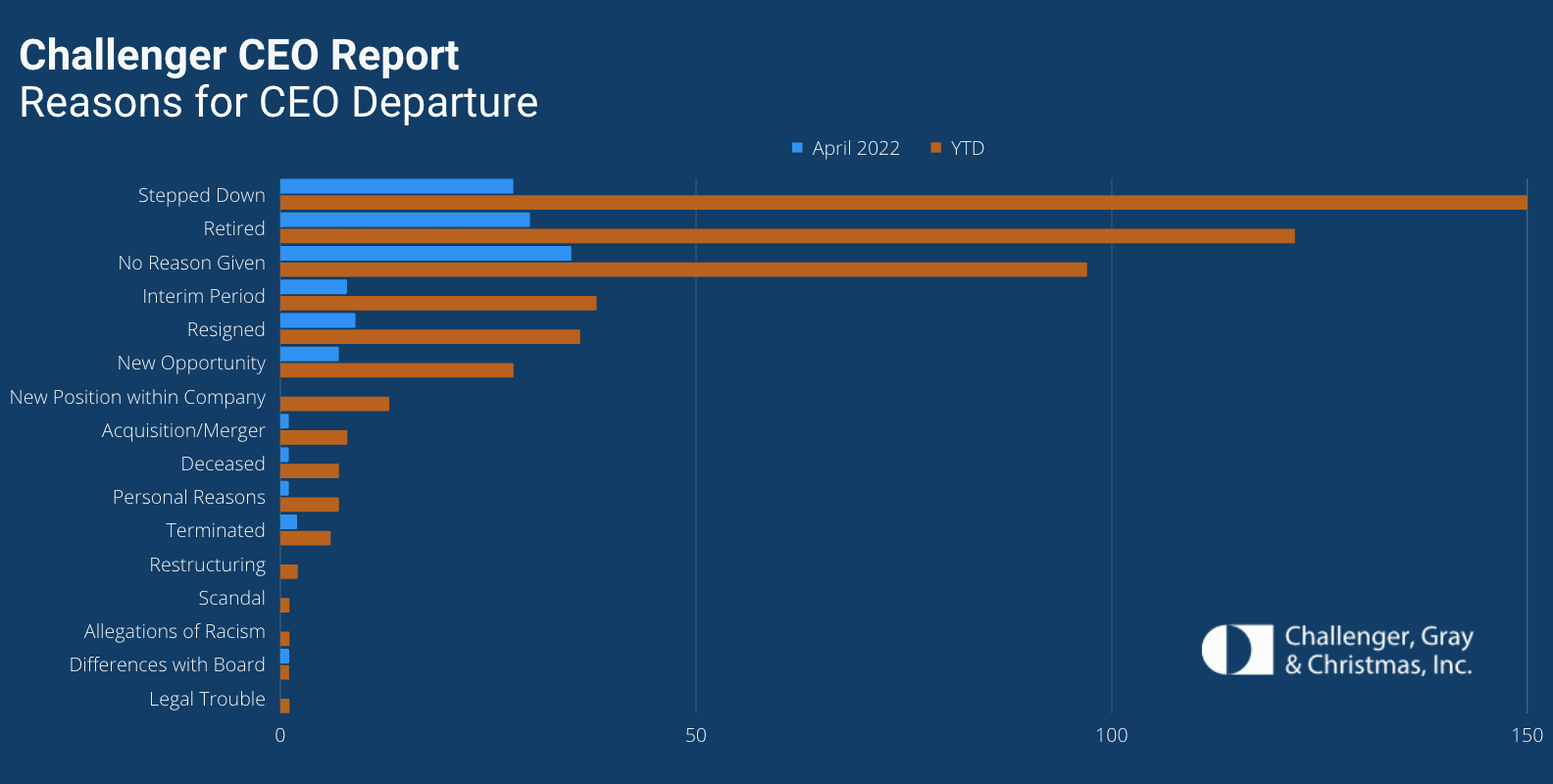
Dozens of hospital CEOs have resigned this year as a record number of chiefs across all industries have exited their roles, according to a May 18 Challenger, Gray & Christmas report. 

Nearly 520 CEOs left their posts between Jan. 1 and the end of April, the highest total since the executive outplacement and coaching firm began tracking CEO changes in 2002. The total is up 18 percent from the 440 CEO exits announced in the same period of 2021. 

Thirty-six hospital CEOs exited their roles in the first four months of this year. That’s up from the 20 hospital chiefs who resigned in the same period last year, according to the report. 

CEOs are leaving their positions and businesses are making changes at the top for several reasons, Challenger, Gray & Christmas Senior Vice President Andrew Challenger said. 

“Inflation, staffing shortages, and possible recession concerns are giving more cause for companies to reevaluate leadership,” Mr. Challenger said. “This, after years of companies trying to figure out the right formula to attract and retain talent and create a culture of inclusion, issues that often start at the top.”

Hospital labor expenses up 37% from pre-pandemic levels in March

Dive Brief:

  • Hospitals’ labor costs rose by more than a third from pre-pandemic levels by March 2022, according to a report out Wednesday from Kaufman Hall.
  • Heightened temporary and traveling labor costs were a main contributor, with contract labor accounting for 11% of hospitals’ total labor expenses in 2022 compared to 2% in 2019, the report found.
  • Contract nurses’ median hourly wages rose 106% over the period, from $64 an hour to $132 an hour, while employed nurse wages increased 11%, from $35 an hour to $39 an hour, the report found.

Dive Insight:

The new data from Kaufman Hall supports concerns hospital executives expressed while releasing first quarter earnings results, as higher-than expected labor costs spurred some operators, like HCA, to lower their financial full-year guidance.

The ongoing use of contract labor amid shortages driven by heightened turnover was a key factor executives cited for higher costs, and follows the findings from Kaufman Hall’s latest report.

More than a third of nurses surveyed by staffing firm Incredible Health said they plan to leave their current jobs by the end of this year, according to a March report. While burnout is driving them to leave, higher salaries are the top motivating factor for taking other positions, that report found.

Kaufman Hall’s report, which analyzes data from more than 900 hospitals across the country, found hospitals spent $5,494 in labor expenses per adjusted discharge in March compared to $4,009 roughly three years ago.

Costs rose for hospitals in every region, though the South and West experienced the largest increases from pre-pandemic levels as those expenses rose 43% and 42%, respectively.

The West and Northeast/Mid-Atlantic regions saw the highest expenses consistently from 2019 to 2022, according to the report.

“The pandemic made longstanding labor challenges in the healthcare sector much worse, making it far more expensive to care for hospitalized patients over the past two years,” said Erik Swanson, senior vice president of data and analytics at Kaufman Hall.

“Hospitals now face a number of pressures to attract and retain affordable clinical staff, maintain patient safety, deliver quality services and increase their efficiency,” Swanson said.

The report also notes that hospitals are competing with non-hospital employers also pursuing hourly staff, though those companies can pass along wage increases to consumers through higher prices “in a way healthcare organizations cannot,” the report said.

Some hospitals, like HCA Healthcare and Universal Health Services, are looking to raise prices for health plans amid rising nurse salaries, according to reporting from The Wall Street Journal.

Another recent report from group purchasing organization Premier found the CMS underestimated hospital labor spending when making payment adjustments for the 2022 fiscal year, resulting in hospitals receiving only a 2.4% rate increase compared to a 6.5% increase in hospital labor rates.

To match the rates hospitals are now paying staff, an adequate inpatient payment update for fiscal 2023 is needed, that report said.

The CMS proposed its IPPS rule for FY 2023 on April 18 that includes a 3.2% hike to inpatient hospital payments, which provider groups like the American Hospital Association rebuked as “simply unacceptable” considering inflation and rising hospital labor costs.

Companies should brace for a culture of quitting

Organizations should prepare themselves for a continuation of quits as a new culture of quitting becomes the norm as the annual quit rate stands to jump up nearly 20 percent from annual pre pandemic levels, according to Gartner

The pre pandemic average for quits stood at 31.9 million, but that figure could rise to 37.4 million this year, said executive consultancy Gartner in an April 28 news release

“An individual organization with a turnover rate of 20 percent before the pandemic could face a turnover rate as high as 24 percent in 2022 and the years to come,” Piers Hudson, senior director in the Gartner HR practice said in the news release. “For example, a workforce of 25,000 employees would need to prepare for an additional 1,000 voluntary departures.”

The reason for the likely increase in quits is new flexibility in work arrangements and employees’ higher expectations, according to Gartner. A misalignment between leaders and workers is also contributing to the attrition. 

“Organizations must look forward, not backward, and design a post-pandemic employee experience that meets employees’ changing expectations and leverages the advantages of hybrid work,” said Mr. Hudson.

More Americans are quitting — and job openings hit record high

Across industries, 4.54 million Americans quit or changed jobs in March, the highest level since December 2000, according to seasonally adjusted data released May 3 by the Bureau of Labor Statistics.

The count is up from 4.38 million in February. In the healthcare and social assistance sector, 542,000 Americans left their jobs in March, compared to 561,000 the previous month, according to the bureau.

The number of job openings in the U.S. also hit a record high of 11.55 million in March, up from 11.34 million in February, according to the bureau. Job openings in the healthcare and social assistance sector remained similar in February and March, at around 2 million.

During the pandemic, hospital CEOs are among those who have joined the list of workers quitting. Additionally, older, tenured employees in America are part of the trend.

Although there continues to be churn in the labor market, Fitch Ratings projects the U.S. labor market will recover jobs lost during the pandemic by the end of August.