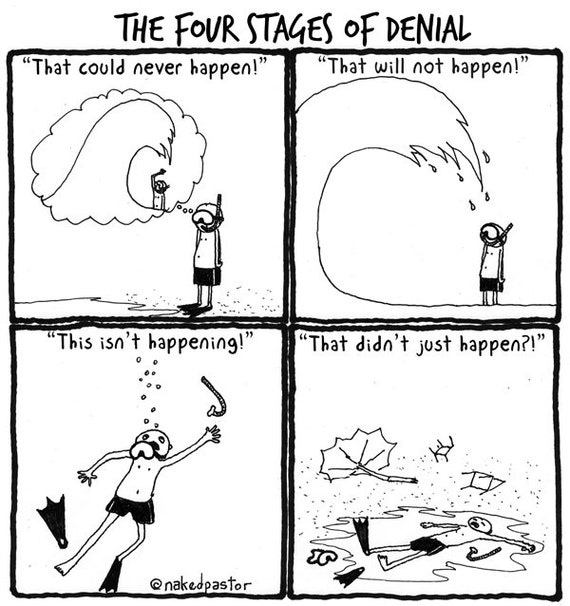
Cartoon – The Four Stages of Denial

The Four Stages of Denial CARTOON | Etsy

Huge Study Throws Cold Water on Antimalarials for COVID-19

https://www.medpagetoday.com/infectiousdisease/covid19/86642?xid=nl_mpt_DHE_2020-05-23&eun=g885344d0r&utm_source=Sailthru&utm_medium=email&utm_campaign=Daily%20Headlines%20Top%20Cat%20HeC%20%202020-05-23&utm_term=NL_Daily_DHE_dual-gmail-definition

Huge Study Throws Cold Water on Antimalarials for COVID-19 ...

— No support for continued use seen in analysis of 15,000 patients who got controversial drugs

Chloroquine or hydroxychloroquine (HCQ), with or without an antibiotic, in hospitalized COVID-19 patients were associated with increased risk of death in the hospital and higher rates of arrhythmias, analysis of outcomes in nearly 100,000 patients indicated.

The 15,000 patients who received HCQ or chloroquine were about twice as likely to die compared to controls who did not receive these agents after adjusting for covariates (18.o% for hydroxychloroquine and 16% for chloroquine versus 9.3% for controls), reported Mandeep Mehra, MD, of Brigham and Women’s Hospital in Boston, and colleagues.

The drug was also associated with a higher risk of ventricular arrhythmia during hospitalization (6.1% for hydroxychloroquine, 4.3% for chloroquine versus 0.3% for controls), the authors wrote in The Lancet.

Moreover, risks for both in-hospital mortality and ventricular arrhythmia were even higher compared to controls when either drug was combined with a macrolide antibiotic, they noted.

Mehra said in a statement these drugs should not be used as treatments for COVID-19 outside of clinical trials.

“This is the first large scale study to find statistically robust evidence that treatment with chloroquine or hydroxychloroquine does not benefit patients with COVID-19,” he said. “Instead, our findings suggest it may be associated with an increased risk of serious heart problems and increased risk of death. Randomised clinical trials are essential to confirm any harms or benefits associated with these agents.”

Mehra’s group analyzed some 96,000 patients from 671 hospitals on six continents with COVID-19 infection, from Dec. 20 to April 14, all of whom had either died or been discharged from the hospital by April 21.

Overall, 14,888 patients were treated with hydroxychloroquine, chloroquine, hydroxychloroquine with a macrolide antibiotic or chloroquine with an antibiotic, and their results were compared to 81,144 controls who did not receive these drugs.

Authors adjusted for demographic factors, as well as cardiovascular disease, diabetes, lung disease, smoking, immunosuppressed conditions and baseline disease severity.

The estimated excess risk attributable to the drug regimen rather than other factors, such as comorbidities, ranged from 34% to 35%.

Arrhythmia’s greatest risk was in the group who received hydroxychloroquine and a macrolide antibiotic such as azithromycin (8% versus 0.3% of controls), and this regimen was associated with a more than five-fold risk of developing an arrhythmia while hospitalized, though cause and effect cannot be inferred, the group noted.

“Previous small-scale studies have failed to identify robust evidence of a benefit and larger, randomised controlled trials are not yet completed,” said co-author Frank Ruschitzka, MD, Director of the Heart Center at University Hospital Zurich in a statement. “However, we now know from our study that the chance that these medications improve outcomes in COVID-19 is quite low.”

An accompanying editorial by Christian Funck-Brentano, MD, PhD, and Joe-Elie Salem, MD, PhD, of Sorbonne Université in Paris, noted limitations of the observational data, but said the authors “should be commended for providing results from a well designed and controlled study … in a very large sample of hospitalized patients.”

They also cautioned against attributing the increased risk of hospital deaths to the higher incidence of arrhythmias, noting that “the relationship between death and ventricular tachycardia was not studied and causes of deaths (i.e., arrhythmic vs non-arrhythmic) were not adjudicated.”

The editorialists nevertheless concluded both hydroxychloroquine and chloroquine, with or without azithromycin, “are not useful and could be harmful in hospitalized patients with COVID-19,” and stressed the importance of clinical trials for these drugs.

“The global community awaits the results of ongoing, well powered randomized controlled trials showing the effects of chloroquine and hydroxychloroquine on COVID-19 clinical outcomes,” they wrote.


Cartoon – Blinded by Science

A Politician Delivers A Campaign Speech Acrylic Print by Paul Noth

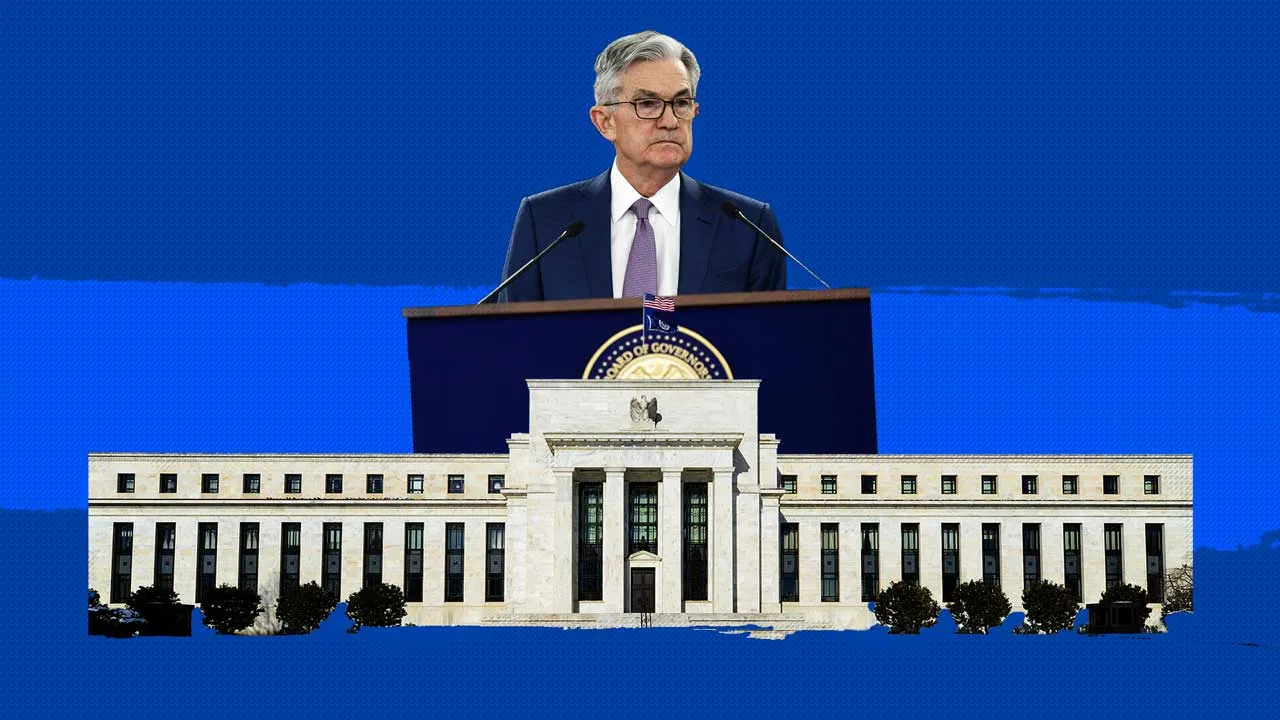
Jay Powell warns US recovery could take until end of 2021

https://www.ft.com/content/2ed602f1-ed11-4221-8d0b-ef85018c96ea

Fed Makes Second Emergency Rate Cut to Zero Due To Coronavirus ...

Fed chair says economy may not fully bounce back until virus vaccine is available.

Federal Reserve chair Jay Powell has warned that a full US economic recovery may take until the end of next year and require the development of a Covid-19 vaccine.

“For the economy to fully recover, people will have to be fully confident. And that may have to await the arrival of a vaccine,” Mr Powell told CBS News on Sunday. A full revival would happen, he said, but “it may take a while . . . it could stretch through the end of next year, we really don’t know”.

He added: “Assuming there is not a second wave of the coronavirus, I think you will see the economy recover steadily through the second half of this year.”

Mr Powell told CBS it was likely there would be a “couple more months” of net job losses, with the unemployment rate climbing to as high as 20-25 per cent. But he said it was “good news” that the “overwhelming” majority of those claiming unemployment benefits report themselves as having been laid off temporarily, meaning they are expecting to go back to their old jobs.

Oil prices and stocks in Asia rose on Monday despite the gloomy outlook. West Texas Intermediate, the US crude benchmark, climbed 4.4 per cent to take it above $30 a barrel for the first time in two months. Brent crude, the international benchmark, rose 3.6 per cent to $33.67 a barrel. Japan’s Topix was up 0.4 per cent and China’s CSI 300 index of Shanghai- and Shenzhen-listed stocks added 0.6 per cent.

Donald Trump, US president, said last week that he hoped to have a vaccine ready by the end of 2020. But public health experts, including Anthony Fauci, the head of the US National Institute of Allergy and Infectious Diseases, and Rick Bright, the recently ousted head of the US Biomedical Advanced Research and Development Authority, have warned that the process is likely to take longer.

Dr Fauci, a high-profile member of Mr Trump’s coronavirus task force, has said he expects the search for a vaccine to take at least a year to 18 months. But Dr Bright has said that was too optimistic.

Some world leaders have also raised doubts about the immediate prospects for a vaccine. Giuseppe Conte, prime minister of Italy, said at the weekend that his country could “not afford” to wait for a vaccine, while Boris Johnson, UK prime minister, warned that a vaccine “might not come to fruition” at all.

Mr Powell said that while lawmakers had “done a great deal and done it very quickly”, Congress and the Fed may need to do more “to avoid longer-run damage to the economy”.

The Fed chair said fiscal policies that “help businesses avoid avoidable insolvencies and that do the same for individuals” would position the US economy for a strong recovery post-crisis.

Mr Powell also reiterated his position against using negative interest rates, something Mr Trump has called for. The Fed chair told CBS that the Federal Open Market Committee had eschewed negative interest rates after the last financial crisis in favour of “other tools” such as forward guidance and quantitative easing.

The US Congress has already approved nearly $3tn of economic relief measures intended to support struggling businesses and individuals, but there is growing consensus in Washington that more fiscal stimulus will be needed — even if Democrats and Republicans are divided over how to dole out federal funds.

Late on Friday, the Democrat-controlled House of Representatives passed Nancy Pelosi’s plan for $3tn in new stimulus spending.

Mr Trump has repeatedly called for the next stimulus to include a cut to payroll taxes — deductions for entitlements such as social security and Medicare. Last week, Larry Kudlow, the top White House economic adviser, suggested that lower corporate taxes and looser business regulation should be part of any future relief package.

The Trump administration has taken a more bullish stance on the US economic recovery than Mr Powell, with White House officials repeatedly insisting that the economy will bounce back before the end of the year.

Mr Powell told CBS it was a “reasonable expectation that there will be growth in the second half of the year” but “we won’t get back to where we were by the end of the year”.


Trump faces criticism over lack of national plan on coronavirus

Trump faces criticism over lack of national plan on coronavirus
COVID-19 National Health Plan – Primary Care – Central Patient ...

The Trump administration is facing intense criticism for the lack of a national plan to handle the coronavirus pandemic as some states begin to reopen.

Public health experts, business leaders and current administration officials say the scattershot approach puts states at risk and leaves the U.S. vulnerable to a potentially open-ended wave of infections this fall.

The White House has in recent days sought to cast itself as in control of the pandemic response, with President Trump touring a distribution center to tout the availability of personal protective equipment and press secretary Kayleigh McEnany detailing for the first time that the administration did have its own pandemic preparedness plan.

Still, the White House lacks a national testing strategy that experts say will be key to preventing future outbreaks and has largely left states to their own devices on how to loosen restrictions meant to slow the spread of the virus. Trump this week even suggested widespread testing may be “overrated” as he encouraged states to reopen businesses.

The Centers for Disease Control and Prevention (CDC) on Thursday night issued long-awaited guidance intended to aid restaurants, bars and workplaces as they allow employees and customers to return, but they appeared watered down compared to previously leaked versions.

Some experts said the lack of clear federal guidance on reopening could hamper the economic recovery. 

“A necessary condition for a healthy economy is a healthy population. This kind of piecemeal reopening with everyone using different criteria for opening, we’re taking a big risk,” said Mark Zandi, chief economist at Moody’s Analytics.

The lack of coherent direction from the White House was driven home this week by damaging testimony by a former top U.S. vaccine official who claims he was ousted from his post improperly.

“We don’t have a single point of leadership right now for this response, and we don’t have a master plan for this response. So those two things are absolutely critical,” said Rick Bright, who led the Biomedical Advanced Research and Development Authority until he was demoted in late April.

The U.S. faces the “darkest winter in modern history” if it does not develop a more coordinated national response, Bright said. “Our window of opportunity is closing.”

From the start, the White House has let states chart their own responses to the pandemic.

The administration did not issue a nationwide stay-at-home order, resulting in a hodgepodge of state orders at different times, with varying levels of restrictions.

Facing a widespread shortage, states were left to procure their own personal protective equipment, ventilators and testing supplies. Trump resisted using federal authority to force companies to manufacture and sell equipment to the U.S. government.

Without clear federal guidance, state officials were competing against each other and the federal government, turning the medical supply chain into a free-for-all as they sought scarce and expensive supplies from private vendors on the commercial market.

“The fact that we had questions about our ability to have enough mechanical ventilators, and you had states basically bidding against each other, trying to secure personal protective equipment …  it shouldn’t be happening during a pandemic,” said Amesh Adalja, a senior scholar at the Johns Hopkins University Center for Health Security.

Internally, the administration struggled to mount a unified front as various agencies jockeyed for control. Multiple agencies have been providing contradictory instructions.

At first, Department of Health and Human Services (HHS) Secretary Alex Azar led the White House coronavirus task force.

Roughly a month, later he was replaced by Vice President Pence. The Federal Emergency Management Agency (FEMA) was later tasked with leading the response to get supplies to states, while senior White House adviser Jared Kushner led what has been dubbed a “shadow task force” to engage the private sector. Now, FEMA is reportedly winding down its role, and turning its mission back over to HHS.

The CDC has been largely absent throughout the pandemic. Director Robert Redfield has drawn the ire of President Trump as well as outside experts, and he has been seen infrequently at White House briefings.

“I think seeing the nation’s public health agency hobbled at a time like this and looking over its shoulder at its political bosses is something I hoped I would never see, and I’ve been working with the CDC for over 30 years,” said Lawrence Gostin, a professor of public health at Georgetown University.

“I think that people will die because the public health agency has lost its visibility and its credibility and that it’s being politically interfered with,” he added.

The administration recently has taken some steps to improve on the initial response to the pandemic.

Ventilator production has increased, and the U.S. is no longer seeing a shortage of the devices. 

Testing has improved dramatically as well, though experts think the U.S. needs to be testing thousands of more people per day before the country can reopen.

The administration also unveiled plans to expand the Strategic National Stockpile’s supply of gowns, respirators, testing supplies and other equipment, after running out of supplies early in the pandemic.

Adalja said the administration’s positive steps are coming way too late. 

“It’s May 15, we should have been in this position January 15,” he said.

McEnany on Friday for the first time detailed the White House’s preparedness plan that replaced the Obama-era pandemic playbook, an acknowledgement that Trump’s predecessor did leave a road map, despite claims to the contrary from some of the president’s allies.

She did not give many specifics on the previously unknown plan. Instead, McEnany declared the Trump administration’s handling of the virus had been “one of the best responses we’ve seen in our country’s history.”

Yet as states look to reopen businesses and get people back to work, the White House is taking a back seat as governors set their own guidelines for easing stay-at-home orders and restrictions on social activities.

The White House in April issued a three-step plan for states to reopen their economies, but it has largely been ignored by states and by the president.

Dozens of governors have begun easing restrictions on businesses and social activities without meeting the White House guidelines. Trump has been urging them to move even faster, backing anti-lockdown protesters in Michigan, Virginia, Minnesota and Pennsylvania.

Even scaled-down guidance from federal agencies is critical for providing a road map for state and local leaders, and for businesses considering how best to resume operations, said Neil Bradley, chief policy officer with the U.S. Chamber of Commerce.

“We need guidance because it helps instill confidence about the right types of approaches to take, but when you begin to move away from guidance and into either regulations or very strict approach, then that’s increasingly going to be unworkable in lots of different locations,” Bradley said.


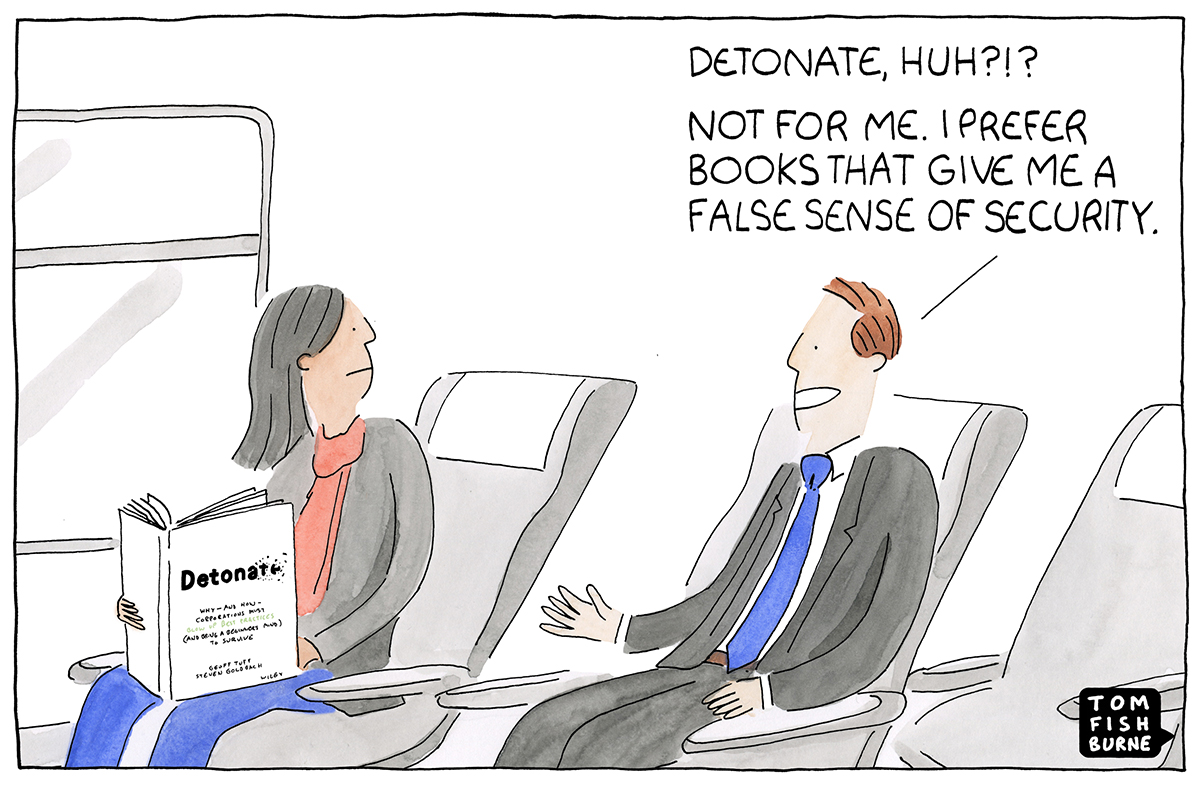
Cartoon – Poor Safety and False Hopes

The False Hope Comics And Cartoons | The Cartoonist Group