Health Care in 2019: Year in Review

https://www.commonwealthfund.org/blog/2019/health-care-2019-year-review

Health care was front and center for policymakers and the American public in 2019. An appeals court delivered a decision on the Affordable Care Act’s (ACA’s) individual mandate. In the Democratic primaries, almost all the presidential candidates talked about health reform — some seeking to build on the ACA, others proposing to radically transform the health system. While the ACA remains the law of the land, the current administration continues to take executive actions that erode coverage and other gains. In Congress, we witnessed much legislative activity around surprise bills and drug costs. Meanwhile, far from Washington, D.C., the tech giants in Silicon Valley are crashing the health care party with promised digital transformations. If you missed any of these big developments, here’s a short overview.


1. A decision from appeals court on the future of the ACA: On December 18, an appeals court struck down the ACA’s individual mandate in Texas v. United States, a suit brought by Texas and 17 other states. The court did not rule on the constitutionality of the ACA in its entirety, but sent it back to a lower court. Last December, that court ruled the ACA unconstitutional based on Congress repealing the financial penalty associated with the mandate. The case will be appealed to the U.S. Supreme Court, but the timing of the SCOTUS ruling is uncertain, leaving the future of the ACA hanging in the balance once again.


2. Democratic candidates propose health reform options: From a set of incremental improvements to the ACA to a single-payer plan like Medicare for All, every Democratic candidate who is serious about running for president has something to say about health care. Although these plans vary widely, they all expand the number of Americans with health insurance, and some manage to reduce health spending at the same time.


3. Rise in uninsured: Gains in coverage under the ACA appear to be stalling. In 2018, an estimated 30.4 million people were uninsured, up from a low of 28.6 million in 2016, according to a recent Commonwealth Fund survey. Nearly half of uninsured adults may have been eligible for subsidized insurance through ACA marketplaces or their state’s expanded Medicaid programs.


4. Changes to Medicaid: States continue to look for ways to alter their Medicaid programs, some seeking to impose requirements for people to work or participate in other qualifying activities to receive coverage. In Arkansas, the only state to implement work requirements, more than 17,000 people lost their Medicaid coverage in just three months. A federal judge has halted the program in Arkansas. Other states are still applying for waivers; none are currently implementing work requirements.


5. Public charge rule: The administration’s public charge rule, which deems legal immigrants who are not yet citizens as “public charges” if they receive government assistance, is discouraging some legal immigrants from using public services like Medicaid. The rule impacts not only immigrants, but their children or other family members who may be citizens. DHS estimated that 77,000 could lose Medicaid or choose not to enroll. The public charge rule may be contributing to a dramatic recent increase in the number of uninsured children in the U.S.


6. Open enrollment numbers: As of the seventh week of open enrollment, 8.3 million people bought health insurance for 2020 on HealthCare.gov, the federal marketplace. Taking into account that Nevada transitioned to a state-based exchange, and Maine and Virginia expanded Medicaid, this is roughly equivalent to 2019 enrollment. In spite of the Trump administration’s support of alternative health plans, like short-term plans with limited coverage, more new people signed up for coverage in 2020 than in the previous year. As we await final numbers — which will be released in March — it is also worth noting that enrollment was extended until December 18 because consumers experienced issues on the website. In addition, state-based marketplaces have not yet reported; many have longer enrollment periods than the federal marketplace.


7. Outrage over surprise bills: Public outrage swelled this year over unexpected medical bills, which may occur when a patient is treated by an out-of-network provider at an in-network facility. These bills can run into tens of thousands of dollars, causing crippling financial problems. Congress is searching for a bipartisan solution but negotiations have been complicated by fierce lobbying from stakeholders, including private equity companies. These firms have bought up undersupplied specialty physician practices and come to rely on surprise bills to swell their revenues.


8. Employer health care coverage becomes more expensive: Roughly half the U.S. population gets health coverage through their employers. While employers and employees share the cost of this coverage, the average annual growth in the combined cost of employees’ contributions to premiums and their deductibles outpaced growth in U.S. median income between 2008 and 2018 in every state. This is because employers are passing along a larger proportion to employees, which means that people are incurring higher out-of-pocket expenses. Sluggish wage growth has also exacerbated the problem.


9. Tech companies continue inroads into health care: We are at the dawn of a new era in which technology companies may become critical players in the health care system. The management and use of health data to add value to common health care services is a prime example. Recently, Ascension, a huge national health system, reached an agreement with Google to store clinical data on 50 million patients in the tech giant’s cloud. But the devil is in the details, and tech companies and their provider clients are finding themselves enmeshed in a fierce debate over privacy, ownership, and control of health data.


10. House passes drug-cost legislation: For the first time, the U.S. House of Representatives passed comprehensive drug-cost-control legislation, H.R. 3. Reflecting the public’s distress over high drug prices, the legislation would require that the government negotiate the price of up to 250 prescription drugs in Medicare, limit drug manufacturers’ ability to annually hike prices in Medicare, and place the first-ever cap on out-of-pocket drug costs for Medicare beneficiaries. This development is historic but unlikely to result in immediate change. Its prospects in the Republican–controlled Senate are dim.



Trading high deductibles for narrow networks

https://mailchi.mp/f3434dd2ba5d/the-weekly-gist-december-20-2019?e=d1e747d2d8

Related image

For many employers, narrowing provider networks has been a bridge too far, despite unrelenting healthcare cost growth.

A recent Los Angeles Times profile of a Boston union that was able not only to lower costs but also nearly eliminate employee cost-sharing may make doubters reconsider. Unite Here Local 26, which represents 9,000 hotel workers and their families, implemented a narrow network health plan in 2013, when two-thirds of its members agreed to forego care at certain marquee academic hospitals, which charged two to three times more than others in the Boston area.

Today the union actually pays less in medical costs per member than it did six years ago, and premiums are ten percent lower than the national average, despite Boston being one of the highest-cost healthcare markets in the country. Employees pay no deductibles, and generic medications cost them only $1. Savings have translated into raises for many employees, with some low-income workers seeing a pay jump of up to 39 percent across six years.

As we’ve discussed in the past, employers are reaching a limit on how high they can push deductibles, especially in a tight labor market. Some are beginning to experiment with various network options that lower health care costs—but many have been reticent to change benefit design in any way that could be perceived as narrowing choice.

Local 26’s experience shows that well-designed narrow networks, implemented with employee education and buy-in, can provide cost relief for both businesses and individuals that can be sustained over time.


A look at what lies under the (high) deductible

https://mailchi.mp/f3434dd2ba5d/the-weekly-gist-december-20-2019?e=d1e747d2d8


With the continued growth in high deductible health plans (HDHPs) in both employer- and exchange-based insurance markets, a larger number of services are falling “under the deductible”, leaving patients responsible for the full cost of care

The graphic above illustrates the national cost ranges of ten common outpatient services, based on data from a publicly-available commercial claims databaseIt’s not just minor services like lab tests or diagnostic imaging that are falling under the deductible—many consumers are now paying full freight for a growing list of outpatient procedures like cataract or carpal tunnel surgery, or even knee arthroscopy.

Shopping can pay off: for any service, the highest-priced provider can be over three times the lowest-priced, translating into thousands of dollars of savings for patients with high-deductible plans.

Outpatient services now account for over half the revenue of many health systems. As deductibles climb, more and more of the (profitable) health system services are becoming “shoppable” for consumers—creating an imperative for systems to both lower costs and pursue rational pricing as scrutiny becomes more intense.


Obamacare Ruling May Spare Republicans Some Political Pain

Image result for Obamacare Ruling May Spare Republicans Some Political Pain

The practical effect of the decision is likely to be months of delays, pushing the final outcome of the case beyond the 2020 election.

A federal appeals court in New Orleans handed Republicans a Christmas present.

The court had been considering a case with the potential to dismantle the entire Affordable Care Act, an outcome that could have set off waves of chaos and disruption leading up to the November election, and for which there was very little contingency planning.


The court had two main options. It could have agreed with the Trump administration, along with a set of Republican state officials and a district court in Texas, and overturned all of the law. Or it could have upheld Obamacare, undermining the arguments of the White House and its allies.

The court found a third way. In a decision at the close of business Wednesday, two of the three judges signaled their support for a key part of the Republicans’ legal argument. The two agreed with a lower court that Obamacare’s individual mandate had been made unconstitutional by a 2017 law that eliminated the financial penalty for remaining uninsured. But the judges punted on the case’s key question of what that meant for the rest of the health law, asking a lower court to reconsider it. The effect is likely to be months of delays, pushing the final outcome of the case beyond the 2020 election.


Starting in 2017, the Republicans’ failed effort to repeal and replace large portions of the health law was deeply unpopular and became a central campaign theme of the 2018 election, in which Democrats won a House majority. Democrats cast themselves as the protectors of Obamacare’s most popular provisions, especially its protections for Americans with pre-existing health conditions.

While most Democrats would have favored a court ruling that upheld Obamacare, a reprise of those politics could have given them a lift in an election year. Voters tend to trust Democrats more than Republicans on health care, but much of the debate during the primary season has focused on ambitious new expansions of government coverage. Those proposals do not enjoy the widespread support attached to the preservation of Obamacare’s core consumer protections.

Those dynamics have allowed Republicans to focus on arguments that they will protect private insurance and oppose socialism, without forcing them to articulate their own detailed health plans. President Trump has periodically hinted at an imminent Obamacare replacement plan, but he has yet to produce one. Mitch McConnell, the Senate majority leader, has declined to produce or advance a major health care bill in the Senate.


But if a court had ruled that all of Obamacare had to be wiped off the books, it would have been far harder for Republicans to avoid articulating their vision for health care. The public did not like their previous attempts in 2017, and there has been little progress, even behind the scenes, to produce an alternative plan more palatable to the public. Two concepts have emerged since then, one from a group of conservative think tanks, and one from the House Republican Study Committee. Neither has received much public attention by party leaders, and both share the basic structure of an earlier legislative plan that divided Republican legislators so much that it never made it to a vote.

Meanwhile, Democrats could have retreated to safer ground, by promising to reinstate popular Obamacare provisions.


If the court had overturned all of Obamacare, it could have meant major disruptions to the health system. Such a ruling, if upheld by the Supreme Court, would have eliminated consumer protections for people with pre-existing health conditions, and wiped away financial assistance that have helped millions of middle-class Americans buy their own coverage.

It would have erased the Medicaid expansion, which provides health insurance to millions of low-income Americans in three dozen states. It would have reversed Medicare policies that make prescription drugs more affordable for seniors, and Food and Drug Administration rules that have allowed cheaper copies of expensive biologic drugs to enter the market.

It would have undone major experiments in the delivery of care, meant to improve health care quality. It would have rolled back enhanced punishments for Medicare fraud. It would have reduced requirements that workplaces provide space for lactating mothers to pump breast milk, and requirements that chain restaurants post calorie counts for their food.

Around 20 million more Americans would have become uninsured, according to an estimate from the Urban Institute. Experts on Medicare policy said they were not even sure how some of the changes could have been carried out now that they have been enshrined in complex regulations and built on in subsequent laws.


None of those effects would have happened immediately, even if the Fifth Circuit had agreed in full with the lower court; the Supreme Court would have probably weighed in. But the prospect of such huge changes had the potential to reset the political conversation about health care in both parties. By avoiding a decision on the case’s consequences, the Fifth Circuit has effectively postponed that shift.

In a statement Wednesday night, President Trump applauded the court’s ruling that the individual mandate was unconstitutional. But he emphasized that the decision would not result in any meaningful changes to voters’ health care.

“The radical health care changes being proposed by the far left would strip Americans of their current coverage,” he said. “I will not let this happen. Providing affordable, high-quality health care will always be my priority. They are trying to take away your health care, and I am trying to give the American people the best health care in the world.”


Such a statement would have been harder to issue if the court panel had agreed with the arguments made by Mr. Trump’s lawyers and called for the reversal of Obamacare’s coverage expansions.

Democrats’ frustration with the court’s indecision was palpable. Chuck Schumer, the Senate minority leader, described the judges’ move as “cowardly.” The decision is “obviously an attempt to shield Republicans from the massive blowback they would receive from the public if the highest court in the land were to strike down the A.C.A. before the upcoming election,” he said in a statement.

It’s possible, of course, that the case will reach a final disposition sooner anyway. California’s attorney general, Xavier Becerra, announced that he and other Democratic state officials involved in the case would be appealing the decision to the Supreme Court. Even though the appellate court sent the case back to Texas, the country’s highest court could still choose to take it, should four justices wish to. But the most likely path involves months or years of additional litigation, with lingering uncertainty over the fate of Obamacare.


Fifth Circuit Appeals Court Strikes Down the Affordable Care Act’s Individual Mandate

https://www.commonwealthfund.org/blog/2019/fifth-circuit-appeals-court-strikes-down-affordable-care-acts-individual-mandate

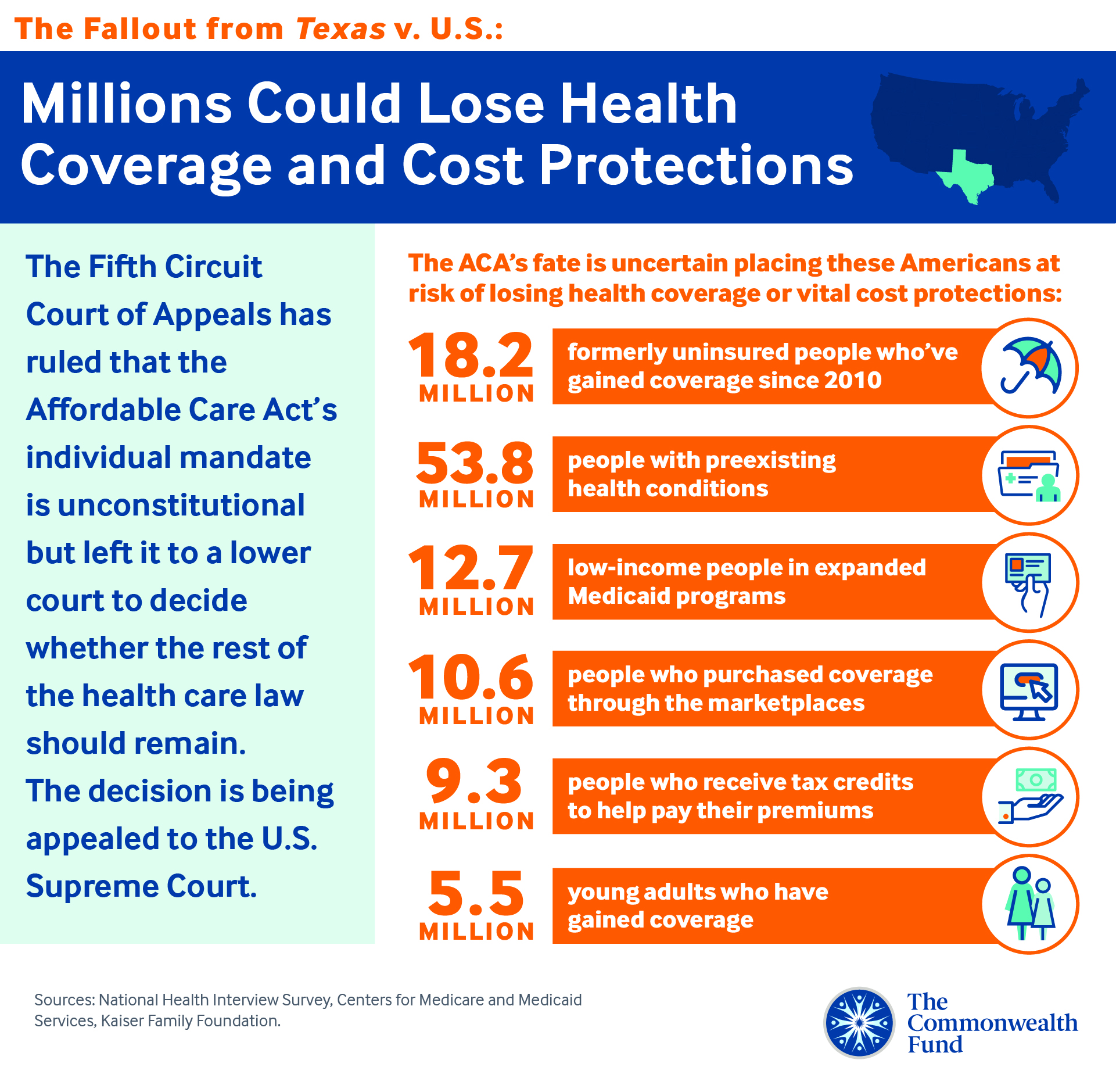
The Fallout from Texas v. U.S.:

Yesterday, a three-judge panel from the Fifth Circuit Court of Appeals struck down the Affordable Care Act (ACA)’s individual mandate. The judges agreed with a lower court decision issued in the case, Texas v. U.S., in December 2018 that the individual mandate is unconstitutional but, unlike the lower court, did not decide that the rest of the ACA is also unconstitutional. Instead, the judges remanded, or sent back, the decision to the same lower court judge to consider. California Attorney General Xavier Becerra, who is leading the 21 Democratic state attorneys general defending the law, along with the U.S. House of Representatives, immediately announced he would appeal the decision to the Supreme Court.

Whether the Supreme Court will decide to take the case now or wait for the decision of Judge O’Connor’s, of the lower court, is uncertain. If the Court decides to take the case now, they could expedite the briefing process and issue a decision in 2020. If it does not take the case now, a ruling will be delayed until after the 2020 presidential election.

No one knows how the Supreme Court will ultimately rule. But we do know that if the Court decides to strike down the ACA, the human toll will be immense and tragic. The law has granted unprecedented health security to millions:

  • 18.2 million formerly uninsured people have gained coverage since 2010
  • 53.8 million Americans with preexisting health conditions are now protected
  • 12.7 million low-income people are insured through expanded Medicaid
  • 10.6 million people have coverage through the ACA marketplaces, 9.3 million of whom receive tax credits to help them pay their premiums
  • 5.5 million young adults have gained coverage, many by staying on their parents’ plans
  • 45 million Medicare beneficiaries have much better drug coverage.

Such a decision will also trigger massive disruption throughout the U.S. health system. The health care industry represents nearly 20 percent of the nation’s economy; the ACA has touched every corner of it. The law restructured the individual and small-group health insurance markets, expanded and streamlined the Medicaid program, improved Medicare benefits, and reformed the way Medicare pays doctors, hospitals, and other providers. It was a catalyst for the movement toward value-based care and established a regulatory pathway for biosimilars — less expensive versions of biologic drugs. States have rewritten laws to incorporate the ACA’s provisions. Insurers, hospitals, physicians, and state and local governments have invested billions of dollars in adjusting to these changes.

The law’s popular preexisting health condition protections have made it possible for people with minor-to-serious health problems to apply for coverage in the same way healthier people have always done. These protections have given the estimated 53.8 million Americans with preexisting health conditions the peace of mind that they will never be denied health insurance because of their health.

More than 150 million people who get coverage through their employers now are eligible for free preventive care, and their children can stay on their policies to age 26.

The wide racial and income inequities in health insurance coverage that have been partly remedied by the ACA would return. Hospitals and providers, especially safety-net institutions, would struggle with mounting uncompensated care burdens and sicker and more costly patients who are not receiving the preventive care they need.

The ACA tore down financial barriers to health care for millions, many of whom were uninsured for most of their lives. It has demonstrably helped people get the health care they need in states across the country. Research indicates that Medicaid expansion has led to improved health status and lower mortality risk.

To date, neither the Trump administration, which has sided with the plaintiffs in the case, nor its Republican colleagues in Congress have offered a replacement plan in the event the law is struck down. The historic progress made by Americans, particularly those with middle and lower incomes and people of color, could unravel. Voters are already telling policymakers they are worried about their ability to afford health care. Yesterday’s decision and the uncertain path forward to the Supreme Court is certain to escalate those worries. With the nation entering the 2020 presidential election year, the Supreme Court may decide to take up the case this term.


Number of Americans with a primary care provider declined 2% over a decade, new study shows

https://www.fiercehealthcare.com/practices/moving-wrong-direction-fewer-americans-have-a-primary-care-provider-new-study-shows?mkt_tok=eyJpIjoiTTJOalpXTXdOV0ZoWkdGbCIsInQiOiJZMlwvUGpSNHhPVGp6ZkdVdkhmSXdza2hJcElGRTJiTDNjWGR0ZnFsOFc4K0Q1eExXR3ZBNWpsTVZ3cmVhRGlMZ1VaOTVyTUlWd2NWQmVPYlBMUkFkTzV0WGNjRWxuNHhuZUFUTVY0dDdsUlwvczdmd0VHVHBBb013b25LMEx5YzhXIn0%3D&mrkid=959610

social determinants

Despite the health benefits, fewer Americans have a primary care provider, according to a new study.

The number of patients in the U.S. who have a primary care provider declined by 2% in a little over a decade, according to the study published in JAMA Internal Medicine.

While that may not sound like much, that decline translates to millions of Americans who do not have primary care, the researchers said.

In the study, researchers from Harvard Medical School looked at primary care use from 2002 to 2015, which raises concerns given that primary care is associated with better health among patients.

“Primary care is the thread that runs through the fabric of all healthcare, and this study demonstrates we are potentially slowly unweaving that fabric,” said the lead author David M. Levine, M.D., a Harvard Medical School instructor in medicine at Brigham and Women’s Hospital in Boston, where he practices internal medicine and primary care, in an announcement about the study.

“America is already behind the curve when it comes to primary care; this shows we are moving in the wrong direction,” Levine said.

The study found that in 2002, 77% of adult Americans had an identified primary care physician, a level that dropped to 75% in 2015. In addition, the study found a particularly marked decline in primary care among younger Americans and those without complex medical issues.

Having a primary care provider decreased across the board for Americans in their 30s, 40s, and 50s. Among 30-year-olds, the number dropped from 71% to 64% from 2002 to 2015.

Among those with no complex conditions, having primary care declined in every decade of age through their 60s. The exception to the decline were less healthy patients. People with three or more chronic health conditions having a primary care physician remained relatively stable, the study found.

Patients who are male, Latino, black or Asian without insurance and lived in the South were much less likely to have a primary care doctor, the study found.

The researchers suggested several steps to stop the decline and increase the rates of Americans with primary care providers, including changes in the primary care payment system, a move toward value-based care and investments in new technology. They also called for creating incentives to encourage more physicians to choose primary care, particularly in rural areas, and increasing the number of Americans with health insurance.

“To improve Americans’ health, we should prioritize investments to reinvigorate the American primary care system,” said senior author Bruce E. Landon, M.D., professor of healthcare policy in the Blavatnik Institute at Harvard Medical School and professor of medicine at Beth Israel Deaconess Medical Center, where he practices internal medicine.

A study released earlier this year from the Patient-Centered Primary Care Collaborative found states that spend more on primary care have better patient outcomes, including fewer hospitalizations and emergency department visits. A separate study found a direct link between the number of primary care doctors and an increase in life expectancy.


Government funding bill deal will repeal key ACA taxes

https://www.axios.com/government-funding-bill-affordable-care-act-taxes-ce13c0af-15d8-4e54-8210-296afa68e9b0.html

U.S. Capitol building

Congress is expected to soon announce a deal to repeal the Affordable Care Act’s health insurance, medical device and “Cadillac” employer health plan taxes — and to raise the smoking age to 21, according to a senior House Democratic aide familiar with talks.

Why it matters: The decision is a colossal win for the health care industry.

  • If this wasn’t good enough news for the industry, the deal won’t address surprise medical bills — and it avoids prescription drug prices except for the CREATES Act, which helps generics get to market faster.
  • The taxes have been repeatedly delayed. And while the industry has pushed for their repeal for years, it hasn’t yet been successful.

Between the lines: Voters are decidedly not asking Washington to lift industry taxes while avoiding dealing with two of the most popular health care issues, but if that’s how this plays out, it’s a great indicator that the industry’s lobbying strength is as good as ever.

  • It’s also a good sign that cost control — the intention of the Cadillac tax, a 40% excise tax on the most generous employer plans — is still not very popular with lawmakers, even as health care costs continue to rise.
  • The tax was expected to raise $200 billion over 10 years.

The other side: The industry says that the ACA taxes end up getting passed along to patients.


Americans Still Favor Private Healthcare System

https://news.gallup.com/poll/268985/americans-favor-private-healthcare-system.aspx

Americans Still Favor Private Healthcare System

STORY HIGHLIGHTS

  • 54% prefer private system; 42% support government-run system
  • Two-thirds of Democrats favor a government-run system
  • Majority continue to see government responsibility for ensuring coverage

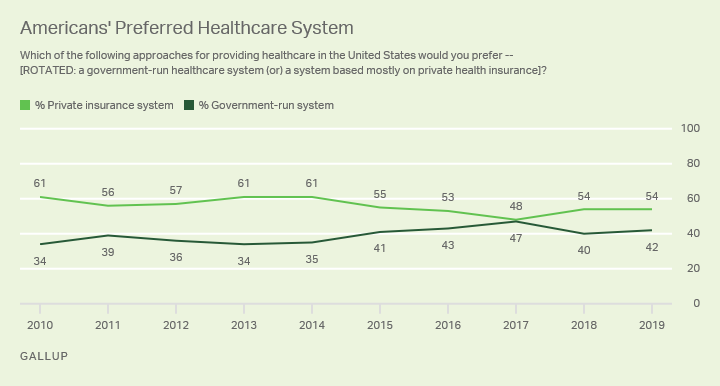
Americans continue to prefer a healthcare system based on private insurance (54%) over a government-run healthcare system (42%). Support for a government-run system averaged 36% from 2010 to 2014 but has been 40% or higher each of the past five years.

Line graph. Americans prefer a healthcare system based on private insurance to a government system by 54% to 42%.

These results are based on Gallup’s annual Health and Healthcare poll, conducted Nov. 1-14. Although more Americans have warmed to the idea of a greater government role in paying for healthcare, it remains the minority view in the U.S. This could create a challenge in a general election campaign for a Democratic presidential nominee advocating a “Medicare for All” or other healthcare plan that would greatly expand the government’s role in the healthcare system.

Democratic candidates’ plans for greater government involvement in healthcare are, however, consistent with the views of their party’s base. Since 2015, after most of the Affordable Care Act’s provisions had gone into effect, an average of 65% of Democrats have favored a government-run system.

Over the same period, Republicans have been overwhelmingly opposed to a government-run system, with an average of 13% preferring that approach while 84% have wanted to retain a private system.

Independents have been closely divided in recent years, but in 2019 tilt more toward a private (50%) than a government-run (45%) system.

Compared with the five-year period spanning the ACA’s passage and implementation from 2010 to 2014, support for a government-run system has increased among all party groups, with larger increases among independents (10 percentage points) and Democrats (seven points) than among Republicans (four points).


Changes in Preferences for Private vs. Government-Run Healthcare System, by Political Party
Figures are the average percentage holding each view in the five-year period
2010-2014 2015-2019
% %
Democrats
System based on private insurance 36 31
Government-run system 58 65
Independents
System based on private insurance 58 49
Government-run system 36 46
Republicans
System based on private insurance 88 84
Government-run system 9 13
GALLUP

Majority in U.S. Say Government Has Responsibility to Ensure Healthcare

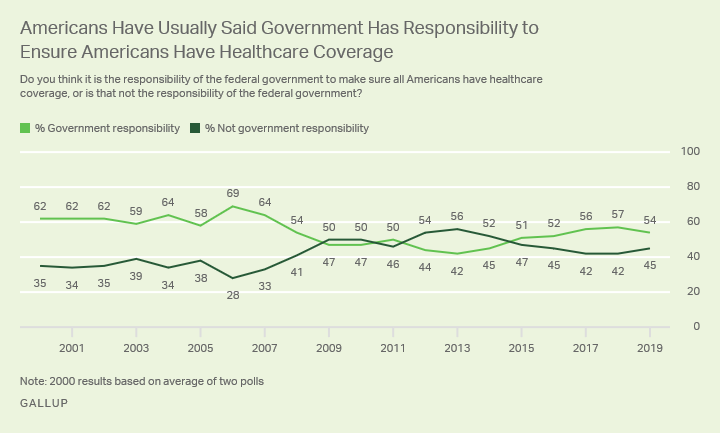
While Americans tend not to favor government-run healthcare, they do believe the federal government has a responsibility to ensure that all Americans have healthcare coverage. In the current survey, 54% hold this view, while 45% say it is not the government’s responsibility.

Recent support for the government having responsibility for ensuring healthcare coverage is not as high as it was from 2001 to 2007, when more than six in 10 Americans commonly expressed that opinion.

By contrast, from 2009 to 2014 — when the Obama administration and congressional Democrats developed, passed and implemented the Affordable Care Act — fewer Americans thought the government should ensure everyone has healthcare coverage. During that period, between 42% and 50% thought the government had that responsibility, the lowest measures in Gallup’s trend.

Line graph. Americans believe the federal government has a responsibility to ensure all in the U.S. have healthcare coverage.

Between 2009 and 2014, the percentages of Republicans and independents who thought the government should be responsible for ensuring healthcare coverage dropped at least 20 points, with a smaller eight-point drop among Democrats.

Democrats’ views are now back to where they were before 2009, while independents and especially Republicans have yet to return to prior levels, though independents are back above the majority level.

Changes in Belief That the Federal Government Has a Responsibility to Ensure All Americans Have Healthcare Coverage, by Political Party
Figures are the average percentage in each period
2001-2008 2009-2014 2015-2019
% % %
Democrats 80 72 80
Independents 64 44 56
Republicans 38 16 21
U.S. adults 62 46 54
GALLUP

Bottom Line

Americans have complex views on healthcare, with a majority saying the government should make sure everyone has coverage — but not necessarily pay for it through a government-run system. The Affordable Care Act was essentially an attempt to bridge these preferences by making coverage available to all through government-backed health insurance exchanges, but allowing those with insurance through an employer or other means to keep it.

Still, the law itself has been controversial, and Americans are currently as likely to disapprove of it as to approve. As such, it is fair to question to what extent Americans would embrace Democratic attempts to move to a healthcare system that goes further than the ACA does, or to support further Republican attempts to dismantle the law.

Healthcare is an issue that directly affects all Americans. Republican and Democratic political leaders have very different ideas about what healthcare policy should be. Additionally, the Democratic presidential campaign has revealed that even candidates in the same party can disagree on the best ways to address the U.S. healthcare system. With little consensus on the best way to approach healthcare policy, it promises to remain a key issue in U.S. politics and elections for the foreseeable future.


43% of U.S. Households Report Preexisting Conditions

https://news.gallup.com/poll/269003/households-report-preexisting-conditions.aspx

43% of U.S. Households Report Preexisting Conditions

STORY HIGHLIGHTS

  • 15% say they themselves have a preexisting health condition
  • 9% say they and someone else in their household have preexisting conditions
  • 19% say a family member has a preexisting condition

About one in four Americans (24%) report that they personally (15%) or they and a member of their household (9%) “have a long-term medical condition, illness or disease that would be considered a ‘preexisting’ condition by a health insurance company.” Factoring in the additional 19% who say another family member has such an illness or disease, the total percentage of U.S. households in which at least one member reports having a preexisting condition is 43%.

Americans’ Reports of Preexisting Medical Conditions in Their Household, 2018-2019
Do you, personally, or does another member of your family living with you, have a long-term medical condition, illness or disease that would be considered a “pre-existing condition” by a health insurance company?
Nov 1-11, 2018 Nov 1-14, 2019
% %
Respondent 16 15
Respondent and a family member 11 9
Family member 17 19
No one in family 54 57
GALLUP

These data are from Gallup’s annual Health and Healthcare survey, conducted Nov. 1-14, and are based on respondents’ self-reports. The survey does not probe about the nature of a respondent’s preexisting condition. Definitions of such conditions vary because individual insurance companies primarily determine what qualifies as a preexisting condition and what does not. They can include cancer or heart disease, but also asthma, high blood pressure or obesity.

Protecting individuals with preexisting conditions from being denied coverage by their insurers was a key tenet in Democrats’ campaign for and passage of the Affordable Care Act in 2010. It became a powerful election-year issue in the 2018 midterms for Democrats after President Donald Trump and Republicans in Congress tried to repeal the law. Gallup has found that Americans who report having a preexisting condition are somewhat more approving of the ACA than are those who do not report having such a condition.

Age Is the Biggest Differentiator in Reported Preexisting Conditions

Across key demographic groups, age stands out as the biggest factor in self-reports of preexisting conditions; the older individual Americans are, the more likely they are to report having one. About one in three adults aged 65 and older (33%) and 50 to 64 (31%) report having a preexisting condition — a rate about twice as high as what young adults aged 18 to 29 report (16%).

Aggregated data from Gallup’s 2018 and 2019 measures reveal other key differences across subgroups:

  • About a third of U.S. adults who are overweight report having a preexisting condition (32%) — much higher than the 21% among those whose self-reported weight is normal or underweight.
  • U.S. whites (29%) are more likely to report having such an illness or disease than are nonwhites (20%).
  • Women (29%) report having a preexisting condition at a higher rate than do men (21%).
  • U.S. adults living in low- (26%) and middle-income households (29%) are more likely to report having a preexisting condition than are those in upper-income households (21%).
Incidence of Preexisting Medical Conditions, Based on Self-Reported Data, by Subgroup
Do you, personally, or does another member of your family living with you, have a long-term medical condition, illness or disease that would be considered a “pre-existing condition” by a health insurance company?
Respondent personally Respondent or family member
% %
65+ years old 33 50
Overweight 32 50
50-64 years old 31 49
Democrat 31 50
Women 29 49
White 29 46
Middle household income ($40,000-$99,999/year) 29 45
Lower household income (less than $40,000/year) 26 43
Independent 24 42
30-49 years old 23 40
Republican 22 40
Men 21 38
Upper household income ($100,000 or more/year) 21 45
Normal weight/Underweight 21 39
Nonwhite 20 38
18-29 years old 16 38
Data aggregated from 2018 and 2019 polls
GALLUP

Across political party groups, Democrats (31%) are more likely to report having a preexisting condition than are independents (24%) and Republicans (22%). A Gallup analysis finds that across age and weight groups, Democrats are more likely than Republicans to report having a preexisting condition. This might suggest that some respondents are answering the question through a political lens — with Democrats more sensitive to the issue of preexisting conditions and therefore more likely to report having one, and Republicans more inclined to downplay the issue and less likely to report having such a condition themselves.

Bottom Line

As many Americans shop for healthcare plans in the current ACA open enrollment period, a sizable percentage of them will need to navigate a market that includes plans that may not provide them with coverage for preexisting conditions. The Trump administration is encouraging consumers currently on the ACA individual market to seek out short-term private plans that in many cases do not protect those with preexisting conditions. These new, non-ACA plans are now available during the ACA’s seventh annual open enrollment period after the administration loosened restrictions on them last year in an effort to offer more affordable alternatives to ACA plans.

The ACA’s provision on preexisting conditions has survived many challenges. Public officials of both major political parties have expressed commitment to the issue and have offered various plans to protect Americans with preexisting conditions from being denied coverage. But Americans have been lukewarm about the law that made the largest breakthrough on the issue — though it is a bit more popular among those who report having a preexisting condition themselves.


More Americans Delaying Medical Treatment Due to Cost

https://news.gallup.com/poll/269138/americans-delaying-medical-treatment-due-cost.aspx?fbclid=IwAR1p3J0ocF_YjiG8qFqOO7fVGqF-v1v6K0vtJjaKlhviLyUbpLFBa2ZJONY

Image result for More Americans Delaying Medical Treatment Due to Cost

STORY HIGHLIGHTS

  • A third of U.S. adults say their family couldn’t afford care in past year
  • One in four say care was deferred for a serious medical condition
  • Lower-income adults and Democrats most likely to report delayed care

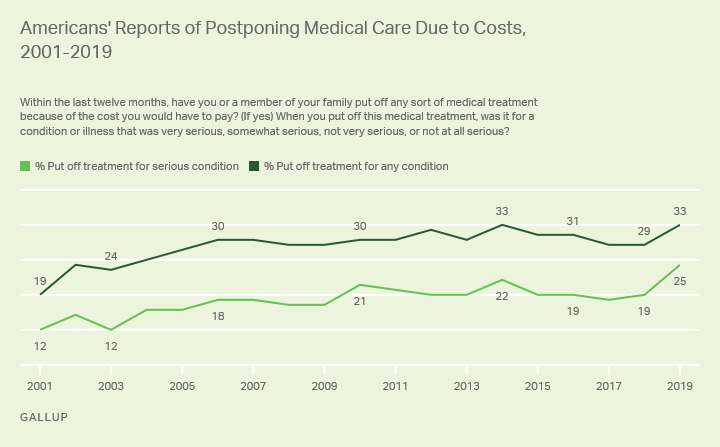
A record 25% of Americans say they or a family member put off treatment for a serious medical condition in the past year because of the cost, up from 19% a year ago and the highest in Gallup’s trend. Another 8% said they or a family member put off treatment for a less serious condition, bringing the total percentage of households delaying care due to costs to 33%, tying the high from 2014.

Gallup first asked this question in 1991, at which time 22% reported that they or a family member delayed care for any kind of condition, including 11% for a serious condition. The figures were similar in the next update in 2001, and Gallup has since asked this question annually as part of its Health and Healthcare poll. This year’s survey was conducted Nov. 1-14.

Americans’ reports of family members delaying any sort of medical treatment for cost reasons were lower in the early to mid-2000s when closer to a quarter reported the problem. Since 2006, the rate has averaged 30%.

The pattern is similar for the subset of Americans postponing medical treatment for a serious condition. The rate rose from 12% in 2001 to an average of 19% since 2006. However, the current 25% is the highest yet, exceeding the prior high-point of 22% recorded in 2014.

Income Gap Widens for Cost-Related Delays for Serious Conditions

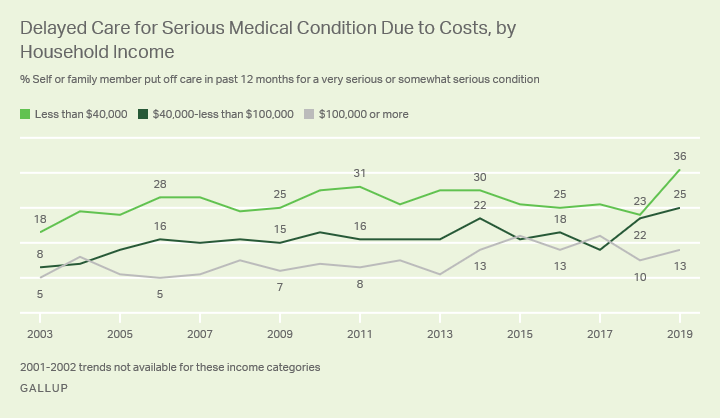
Reports of delaying treatment for a serious condition jumped 13 percentage points in the past year to 36% among adults in households earning less than $40,000 per year while it was essentially flat (up a non statistically significant three points) among those in middle-income and higher-income households.

As a result of the spike in lower-income households this year, the gap between the top and bottom income groups for failure to seek treatment for a serious medical condition widened to 23 percentage points in 2019. The income gap had averaged 17 points in the early years of Barack Obama’s presidency, but narrowed to an average 11 points in the first few years after implementation of the ACA, from 2015 to 2018.

Line graph, 2003-2019. U.S. adults saying family put off medical care for serious condition due to costs, by household income.

Delayed Care Up Most Among Those With Pre-Existing Conditions

Reports of delaying care for a serious condition due to costs are also up 13 points compared with last year among Americans who report they or another household member has a “pre-existing condition.”

At the same time, there has been virtually no change in the percentage of adults without pre-existing conditions in the household who delayed care for a serious health issue in the past year, currently 12% versus 11% in 2018.

Changes in health insurance coverage don’t appear to be the cause of the increase in delayed care as the percentage uninsured is 11% in the poll, within the 9% to 11% range seen each year since 2015. Also, the percentage delaying care has increased a similar proportion among those covered by private health insurance or Medicare/Medicaid as well as among the uninsured.

Recent Reports of Delayed Care May Have a Partisan Component

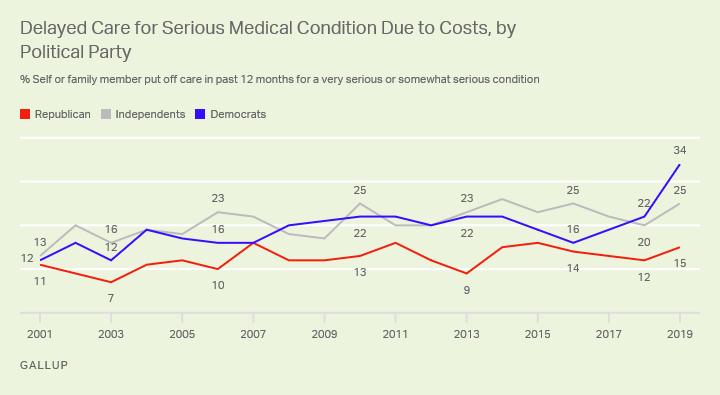
A cautionary note in the new findings is that most of the recent increase in reports that family members are delaying treatment for serious conditions has occurred among self-identified Democrats. This is up 12 points since 2018 among Democrats, compared with three- and five-point increases among Republicans and independents, respectively.

This ties in with Democrats’ higher likelihood than Republicans of reporting that they or a household family member has a pre-existing medical condition.

Whether these gaps are indicative of real differences in the severity of medical and financial problems faced by Democrats compared with Republicans or Democrats’ greater propensity to perceive problems in these areas isn’t entirely clear. But it’s notable that the partisan gap on putting off care for serious medical treatment is currently the widest it’s been in two decades.

Line graph, 2003-2019. U.S. adults saying family put off medical care for serious condition due to costs, by party ID.

Implications

Since 2001, Gallup has tracked a near 50% increase in the percentage of Americans saying that they or a family member chose not to get medical care because of the costs they would have to pay. Such delays in medical treatment, whether for injuries, illnesses or chronic conditions, can have significant implications for the economy and healthcare system, but also the political climate.

One indicator of the stress that delayed care can put on the healthcare system is the use of emergency departments. According to the American Hospital Association, patient visits to emergency departments in community hospitals increased 19% between 2001 and 2016 and has likely climbed to over 20% by today. While that may reflect many factors, including the aging of the population and the number of Americans living in close proximity to hospitals, it may also be indicative of a greater need for emergency care due to lack of routine care.

While most of the increase Gallup sees in delayed treatment occurred over a decade ago, the sharp increase in the past year, particularly among Democrats, suggests that healthcare costs could be a more potent political issue than previously seen. Presidential candidates who acknowledge the problem and propose solutions to address it may find a receptive ear among voters.

From an economic perspective, delayed care can have a range of negative effects, including reduced workplace productivity in the short-term, and increased healthcare costs and in the long-term — costs that ultimately burden the federal budget which has ripple effects on the economy.