The Huge Waste in the U.S. Health System

A study finds evidence for how to reduce some of it, but also a large blind spot on how to remove the rest.

Even a divided America can agree on this goal: a health system that is cheaper but doesn’t sacrifice quality. In other words, just get rid of the waste.

A new study, published Monday in JAMA, finds that roughly 20 percent to 25 percent of American health care spending is wasteful. It’s a startling number but not a new finding. What is surprising is how little we know about how to prevent it.

William Shrank, a physician who is chief medical officer of the health insurer Humana and the lead author of the study, said, “One contribution of our study is that we show that we have good evidence on how to eliminate some kinds of waste, but not all of it.”

Following the best available evidence, as reviewed in the study, would eliminate only one-quarter of the waste — reducing health spending by about 5 percent.

Teresa Rogstad of Humana and Natasha Parekh, a physician with the University of Pittsburgh, were co-authors of the study, which combed through 54 studies and reports published since 2012 that estimated the waste or savings from changes in practice and policy.

Because American health spending is so high — almost 18 percent of the economy and over $10,000 per person per year — even small percentages in savings translate into huge dollars.

The estimated waste is at least $760 billion per year. That’s comparable to government spending on Medicare and exceeds national military spending, as well as total primary and secondary education spending.

If we followed the evidence available, we would save about $200 billion per year, about what is spent on the medical care for veterans, the Department of Education and the Department of Energy, combined. That amount could provide health insurance for at least 20 million Americans, or three-quarters of the currently uninsured population.

The largest source of waste, according to the study, is administrative costs, totaling $266 billion a year. This includes time and resources devoted to billing and reporting to insurers and public programs. Despite this high cost, the authors found no studies that evaluate approaches to reducing it.

“That doesn’t mean we have no ideas about how to reduce administrative costs,” said Don Berwick, a physician and senior fellow at the Institute for Healthcare Improvement and author of an editorial on the JAMA study.

Moving to a single-payer system, he suggested, would largely eliminate the vast administrative complexity required by attending to the payment and reporting requirements of various private payers and public programs. But doing so would run up against powerful stakeholders whose incomes derive from the status quo. “What stands in the way of reducing waste — especially administrative waste and out-of-control prices — is much more a lack of political will than a lack of ideas about how to do it.”

While the lead author works for Humana, he also has experience in government and academia, and this is being seen as a major attempt to refine previous studies of health care waste. Reflecting the study’s importance, JAMA published several accompanying editorials. A co-author of one editorial, Ashish Jha of the Harvard Global Health Institute and the Harvard T.H. Chan School of Public Health, said: “It’s perfectly possible to reduce administrative waste in a system with private insurance. In fact, Switzerland, the Netherlands and other countries with private payers have much lower administrative costs than we do. We should focus our energies on administrative simplification, not whether it’s in a single-payer system or not.”

After administrative costs, prices are the next largest area that the JAMA study identified as waste. The authors’ estimate for this is $231 billion to $241 billion per year, on prices that are higher than what would be expected in more competitive health care markets or if we imposed price controls common in many other countries. The study points to high brand drug prices as the major contributor. Although not explicitly raised in the study, consolidated hospital markets also contribute to higher prices.

variety of approaches could push prices downward, but something might be lost in doing so. “High drug prices do motivate investment and innovation,” said Rachel Sachs, an associate professor of law at Washington University in St. Louis.

That doesn’t mean all innovation is good or worth the price. “It means we should be aware of how we reduce prices, taking into consideration which kinds of products and which populations it might affect,” she said.

Likewise, studies show that when hospitals are paid less, quality can degrade, even leading to higher mortality rates.

Other categories of waste examined by the JAMA study encompass inefficient, low-value and uncoordinated care. Together, these total at least $205 billion.

With more than half of medical treatments lacking solid evidence of effectiveness, it’s not surprising that these areas add up to a large total. They include things like hospital-acquired infections; use of high-cost services when lower-cost ones would suffice; low rates of preventive care; avoidable complications and avoidable hospital admissions and readmissions; and services that provide little to no benefit.

In addition to wasting money, these problems can have direct adverse health effects; lead to unwarranted patient anxiety and stress; and lower patient satisfaction and trust in the health system.

Here the study’s findings are relatively more optimistic. It found evidence on approaches that could eliminate up to half of waste in these categories. The current movement toward value-based payment, promoted by the Affordable Care Act, is intended to address these issues while removing their associated waste. The idea is to pay hospitals and doctors in ways that incentivize efficiency and good outcomes, rather than paying for every service regardless of need or results.

Putting this theory into practice has proved difficult. “Value-based payment hasn’t been as effective as people had hoped,” said Karen Joynt Maddox, a physician and co-director of the Center for Health Economics and Policy at Washington University in St. Louis and a co-author of another editorial of the JAMA study.

So far, only a few value-based payment approaches seem to produce savings, and not a lot. Some of the more promising approaches are those that give hospitals and doctors a single payment “as opposed to paying for individual services,” said Zirui Song, a physician and a health economist with Harvard Medical School.

“Savings tend to come from physicians referring patients to lower-priced facilities or cutting back on potentially lower-value care in areas such as procedures, tests or post-acute service,” he said.

There is evidence of savings from some bundled payment programs. These provide a fixed overall budget for care related to a procedure over a specific period, like 90 days of hip replacement care. Accountable care organizations also seem to drive out a little waste. These give health groups the chance to earn bonuses for accepting financial risk and if they reach some targets on quality of care.

The final area of waste illuminated by the JAMA study is fraud and abuse, accounting for $59 billion to $84 billion a year. As much as politicians love to say they’ll tackle this, it’s a relatively small fraction of overall health care waste, around 10 percent. More could be spent on reducing it, but there’s an obvious drawback if it costs more than a dollar to save a dollar in fraud.

Because health care waste comes from many sources, no single policy will address it. Most important, we have evidence on how to reduce only a small fraction of the waste — we need to do a better job of amassing evidence about what works.



NY Local employers predict 3.6% increase in health benefit costs in 2020

https://www.crainsnewyork.com/health-pulse/local-employers-predict-36-increase-health-benefit-costs-2020?utm_source=health-pulse-tuesday&utm_medium=email&utm_campaign=20191028&utm_content=hero-readmore

Image result for chronic care management

Employers in the metro area expect their spending on benefits to rise 3.6% next year after accounting for changes designed to hold down costs, according to an analysis by Mercer.

That trend would be lower than the 3.9% increase employers experienced this year, with local organizations spending $16,059 per active employee. That’s more than 20% higher than the average cost per employee nationwide.

The benefits consultant broke out the responses of 170 employers in New York City, its surrounding counties, northern New Jersey and southern Connecticut for Crain’s from its 2019 National Survey of Employer-Sponsored Health Plans.

In the area, the average contribution to premiums for an individual employee is $199 a month in a PPO plan, $169 a month in an HMO and $107 a month in a consumer-directed health plan, which tends to have a higher deductible.

The median deductible for members in a PPO plan was $500 locally.

Nationwide, there was a split, with the average deductible for businesses between 10 and 499 employees increasing nearly 13%, to $2,285, while employers with 500 or more workers raised the average deductible in a PPO plan just $10, or 1%, to $992.

Companies are looking to telemedicine and management programs for their highest-cost members as ways to keep fees down, said Mary Lamattina, a senior consultant at Mercer. She said most clients she works with have at least one beneficiary with $1 million in annual medical expenses.

“Employers are getting away from cost shifting and looking at other ways to tackle affordability,” she said.

Nationwide, employers spent 3% more on health costs this year, driven in part by specialty drug spending. Costs for specialty drugs rose 10.5% this year.

Ninety percent of employers with 500 workers or more said they viewed monitoring or managing high-cost claimants as important or very important. One strategy companies reported using was introducing a tech-enabled chronic care management program for conditions such as diabetes.

About 88% of large employers said they offer telemedicine as an option, but only 9% of eligible employees had taken advantage of the programs.

Lamattina pointed out that utilization was nearly four times higher at organizations that waived a copay for telemedicine use, compared with employers that charged a $40 copay. “

“Utilization can be driven by the cost,” she said. “Convenience is really key to getting people to use the benefit.” —Jonathan LaMantia


Premiums for ACA Health Plans Drop in 2020

https://www.realclearhealth.com/2019/10/23/premiums_for_aca_health_plans_drop_in_2020_279468.html?utm_source=morning-scan&utm_medium=email&utm_campaign=mailchimp-newsletter&utm_source=RC+Health+Morning+Scan&utm_campaign=dfd654c92e-MAILCHIMP_RSS_EMAIL_CAMPAIGN&utm_medium=email&utm_term=0_b4baf6b587-dfd654c92e-84752421&mc_cid=dfd654c92e&mc_eid=cb200f8a98

Image result for Premiums for ACA Health Plans Drop in 2020

Premiums for the most popular health plans sold under the Affordable Care Act will drop for the second consecutive year, the Trump administration said Tuesday, as the law enters its 10th year and shows further signs of stabilizing.


A group of Republicans has unveiled its healthcare plan. Here is what’s new and what isn’t

https://www.fiercehealthcare.com/payer/a-group-republicans-have-a-new-healthcare-plan-here-what-new-and-what-isn-t?mkt_tok=eyJpIjoiT0RZNE4yTm1PV1psTmpNeSIsInQiOiJ5R3gxMEwrdUhPWUdZVlBTZ3NWWkdMV08xOCtObDdFaGdHaE1hN0o4Z2p5WnBaN3hjd2lDVm5ybnBhWUtUNFdlTW1LcndtaTN1WUtNVzg1NmUrQjJmWEhqTWpJR3BkUmVuZmVNS2FzdmRWdENuMEtNT0tJMXozUW93N0lVQmZ5WSJ9&mrkid=959610

Capitol building in Washington

The Republican Study Committee (RSC), a group of 145 House GOP lawmakers, rolled out a new healthcare plan to counter Democrats’ call for “Medicare for All.”

However, the plan itself closely resembles the Affordable Care Act (ACA) repeal bill called the American Health Care Act (AHCA) that the House passed in 2017 and contributed greatly to the loss of the GOP House majority in 2018.

For the plan to become law, Republicans would have to retake the House in 2020, and President Donald Trump would need to be reelected. However, if those victories happen, the plan could be a blueprint for how a GOP-controlled Congress would move forward on healthcare, as the committee counts among its members both GOP leadership and rank and file.

Here are three takeaways from the plan:

Shifting to high-risk pools

The plan would retain the ACA’s requirement that individual market plans cover pre-existing conditions. However, it takes out provisions that ensure patients with pre-existing conditions get affordable coverage such as requirements that prevent plans from charging sicker people higher premiums than healthy customers.

The plan does introduce high-risk pools that would be used by people with high healthcare costs, a commonly deployed tactic by states for the individual market before the ACA. The high-risk pools would be funded by repackaging the funding used for the ACA’s subsidies and the Medicaid expansion.

However, the plan doesn’t identify the full amount that should be devoted to high-risk pools, which segregate high-cost customers on the individual market.

The plan cites a 2017 report from consulting firm Milliman that estimated a federally supported high-risk pool could require $3.3 billion to $16.7 billion a year. The AHCA also called for high-risk pools but only gave $2.5 billion a year to help states fund them.

While the “$17 billion annual price tag may not seem ideal, it sets up a sustainable path for the individual market,” the RSC report said.

The desire for more funding for high-risk pools is likely a nod to Democratic attacks during the 2018 midterms that the AHCA threatened pre-existing condition protections. The nonpartisan Congressional Budget Office said the AHCA, which let states waive pre-existing condition protections, would lead to people in those states not getting affordable coverage for their pre-existing conditions.

While the AHCA had funding for high-risk pools, experts across the healthcare spectrum said that it wasn’t enough. It would remain to be seen how much more funding would be needed.

Doubling down again on health savings accounts

Bolstering health savings accounts has been a very popular reform idea among Republicans, and that enthusiasm is clear in the RSC plan.

The plan proposes to increase how much an employee can contribute to a health savings account. Currently, an individual can contribute $3,500 and a family can contribute $7,000.

A 2018 bill that passed out of the House but didn’t make it through Congress increased the contribution cap to $6,650 for an individual and $13,300 for a family.

Now, the RSC plan wants to increase the figures again, this time to $9,000 per individual and $18,000 for families, in line with a proposal from libertarian think tank Cato Institute.

“The RSC plan would also expand health savings accounts so that they could be used for a number of health services and products that currently must be paid for with after-tax dollars,” the plan said.

Replace Medicaid expansion with a block grant

This is another common reform in ACA repeal plans. The bill would phase out the enhanced federal matching rate for the Medicaid expansion to pre-expansion levels.

In addition, the bill would replace the existing open-ended federal match with a fixed amount in a block grant.

But the plan has a new twist in a new “flex-grant” that would give more funding to states that adopt a work requirement. However, half of the funding for any flex-grant must go toward supporting the purchase of private plans for low-income individuals.

So far, 12 states have gotten approval from the Trump administration to install work requirements for their Medicaid expansion population. But of those 12 states, three have had their work requirement programs struck down by legal challenges.

Some states are also considering installing their own block grants. Tennessee has released a draft proposal for a block grant but has yet to get federal approval.


Employers aren’t changing their health benefits

https://www.axios.com/employers-health-care-coverage-insurance-2020-election-e0ce92cf-c106-44fe-bb35-1c3c6e452712.html

Image result for Employers aren't changing their health benefits

Companies rarely switch the health plans they offer to their workers, and seem to be especially cautious in the 2020 election year.

The big picture: Medical and drug costs are crushing employers and workers alike. But altering benefits — which could require employees to change their doctors — could provoke even more anger.

By the numbers: Roughly half of employers offering health benefits did not shop around for new plans or insurance companies for 2019, according to the Kaiser Family Foundation’s latest employer benefit survey.

  • Of the half that did shop, just 18% changed to a new insurance carrier.
  • That means fewer than 10% of all employers switched carriers.
  • Large corporations, like GM, are much less likely to tinker with coverage than smaller firms.

“Disruption is the enemy,” Mike Turpin, an employer health care consultant at the brokerage USI Insurance Services, said on a call with Wall Street investors last week.

  • Turpin said he has seen even less switching for 2020 because employers don’t want to make waves over health care in an election year — “which buys another year” for the large, incumbent health insurance companies.

Between the lines: More companies have moved workers into less comprehensive plans since the Affordable Care Act was passed, but those changes often have been met with either immediate condemnation (like Harvard in 2015) or delayed outrage as workers shoulder more costs.

  • “It is telling that brokers perform an analysis for employers that’s called ‘disruption analysis’ — the goal of which is not to be disruptive, but to minimize disruption,” said Katherine Hempstead, a health policy adviser at the Robert Wood Johnson Foundation.

Yes, but: Millions of people still switch health plans every year when they buy it on their own, change jobs, get laid off or retire.


Americans already pay a ‘gigantic’ hidden health-care tax, economists say

https://www.washingtonpost.com/business/2019/10/16/americans-already-pay-gigantic-hidden-health-care-tax-economists-say/?fbclid=IwAR1dG0uH1k6nZ8hC3UL7z8pDZtyTQa55NAWxM1Nni1uh7CLsD0sEaGjqie8

Image without a caption


The topic of Medicare-for-all was front and center — again — during Tuesday night’s Democratic presidential debate. Moderators were particularly interested in how its supporters, like Sen. Elizabeth Warren (D-Mass.), would pay for it. Specifically, would it require raising taxes on the middle class?

To some economists, the question is moot: Americans already pay a massive “tax” to fund health care, they say. It just happens to go to private insurance companies, rather than the federal government.

That’s the argument put forth in Emmanuel Saez and Gabriel Zucman’s new book,The Triumph of Injustice.” The economists at the University of California at Berkeley, who have advised Warren and Sen. Bernie Sanders (I-Vt.) on the creation of a wealth tax, call private health insurance costs “taxes in everything but name.” They are automatically deducted from workers’ paychecks. And they are essentially mandatory for families who don’t want to be crippled by long-term health-care costs or unexpected illnesses.

“Whether insurance premiums are paid to a public monopoly (the government) or to a private monopoly (the notoriously uncompetitive US private health insurance system) makes little difference,” the economists write. “Both payments reduce the take-home pay of workers; and although it’s always possible to evade taxes or to refuse to pay one thin dime to insurance companies, in practice almost everyone abides.”

The issue sparked a spirited discussion during Tuesday’s debate in Ohio for the 12 Democrats vying to take on President Trump in 2020, with Warren and Sanders’s plans getting blasted as being overly expensive and unworkable. Warren was specifically called out for refusing to say whether her proposal would result in higher taxes for the middle class or get into how it would eliminate employer-sponsored coverage for 160 million Americans. Although she vowed that her plan would not raise overall costs for the middle class, she notably evaded the specific issue of taxes.

Saez and Zucman have produced an estimate of just how much we’re already paying for health insurance and find it’s a little north of $1 trillion per year: “close to 6% of national income in 2019 — the equivalent of one-third of all federal income tax payments!” Health insurance costs raise the average effective tax rate on American labor from 29 percent to 37 percent, they said.

Thinking about health-care costs in this way is useful, Saez and Zucman write, because it allows for better tax comparisons between the United States and other wealthy countries, most of which fund health care via their tax codes. “Americans on average keep about the same fraction of their pretax income as their European brethren,” they write.

One of the key uncertainties about transitioning to a Medicare-for-all plan like the ones proposed by Warren and Sanders is whether doing so would raise or lower total health-care costs. Preliminary estimates have so far yielded wildly divergent outcomes, in part, because the financing specifics behind various candidates’ plans are largely still up in the air. How the change would affect the wallet of the typical middle-class tax payer relative to other groups also remains an open question.

But the Saez and Zucman data underscore that Americans already are paying a large health-care levy that is for all intents and purposes mandatory. If you consider health insurance costs as a tax on labor, as they do, it means the extremely rich, who derive most of their income from capital, are carrying a disproportionately light share of the total health cost load.


Drug price hikes cost US billions, report finds

https://thehill.com/policy/healthcare/464891-drug-price-hikes-cost-us-billions-report-finds?utm_source=&utm_medium=email&utm_campaign=25262


Drug companies raised prices on seven popular drugs during 2017 and 2018 without clinical evidence that the drugs had been improved in any way, according to a new report.

The increases cost patients and insurers more than $5 billion, the Institute for Clinical and Economic Review (ICER) found in its report. None of the drugs examined showed evidence of improved safety or effectiveness, the analysis found.

The report looked at the seven top-selling drugs by sales revenue that had price increases of more than two times inflation, as measured by the medical consumer price index.

The culprits, and how much they added to drug spending over two years:

  • Humira: $1.9 billion
  • Rituxan: $806 million
  • Lyrica: $688 million
  • Truvada: $550 million
  • Neulasta: $489 million
  • Cialis: $403 million
  • Tecfidera: $313 million

Read more here.


Market Consolidation on Trial

Market Consolidation on Trial

Image result for Market Consolidation on Trial

California Attorney General Xavier Becerra alleges that Sutter Health used its pre-eminent market power to artificially inflate prices. Photo: Rich Pedroncelli/Associated Press

As a jury trial draws near in a major class-action lawsuit alleging anticompetitive practices by Northern California’s largest health system (PDF), a new CHCF study shows the correlation between the prices consumers pay and the extensive consolidation in the state’s health care markets. Importantly, the researchers estimated the independent effect of several types of industry consolidation in California — such as health insurers buying other insurers and hospitals buying physician practices. The report, prepared by UC Berkeley researchers, also examines potential policy responses.

While other states have initiated antitrust complaints against large hospital systems and medical groups in the past, the case against Sutter Health is unique in both the expansive nature of the alleged conduct and in the scale of the potential monetary damages. The complaint goes beyond claims of explicit anticompetitive contract terms and argues that by virtue of its very size and structure, the Northern California system imposed implicit or “de facto” terms that led to artificially inflated prices. Sutter Health vigorously denies the allegations.

The formation of large health systems like Sutter is neither new (PDF) nor unique to California (PDF). Several factors seem to be encouraging their growth, including payment models that place health care providers at financial risk for the cost of care, increased expectations from policymakers and payers around the continuum of patient needs that must be managed, and economies of scale for investments in information technology and administrative services. Some market participants also point to consolidation in other parts of the health care system, such as health plans and physician groups, as encouragement for their own mergers.

Economic Consolidation in California

In general, economists study two major categories of market consolidation:

  • Horizontal consolidation: Entities of the same type merge, such as the merger of two hospitals or insurance companies, or the merger of providers into a physician network.
  • Vertical consolidation: Entities of different types merge, such as when a hospital purchases a physician practice or when a pharmacy buys an insurance company.

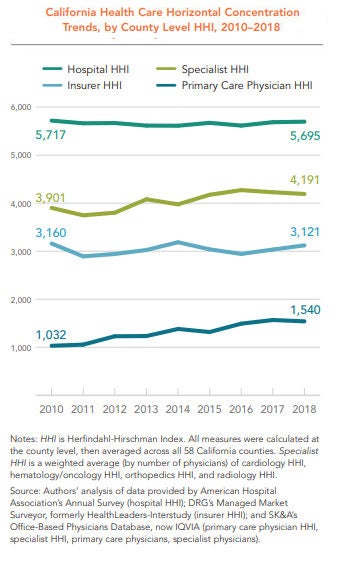
To measure market consolidation, the CHCF study relied on the Herfindahl-Hirschman Index (HHI), a metric used by the US Department of Justice and the Federal Trade Commission. An HHI of between 1,500 and 2,500 is considered moderately concentrated, and 2,500 or above is considered highly concentrated. According to this measure, horizontal concentration is high in California among hospitals, insurance companies, and specialist providers (and moderately high among primary care physicians), even though the level of concentration in all but primary care has remained relatively flat from 2010 to 2018.

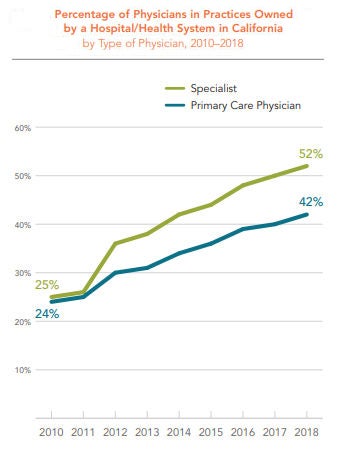
The percentage of physicians in practices owned by a hospital or health system increased dramatically in California between 2010 and 2018 — from 24% in 2010 to 42% in 2018. The percentage of specialists in practices owned by a hospital or health system rose even faster, from 25% in 2010 to 52% in 2018.
Consolidation Is Not Clinical Integration

While this study defined and quantified the extent of consolidation across several industry segments in California, it is important to note that it did not define, quantify, or evaluate clinical integration within the state. Clinical integration has been defined by others in many ways, but generally involves arrangements for coordinating and delivering a wide range of medical services across multiple settings.

As the CHCF study authors point out, other analysis has shown that various types of clinical integration can lead to broader adoption of health information technology and evidence-based care management processes. Data from the Integrated Healthcare Association suggests that certain patient benefit designs and provider risk-sharing arrangements associated with clinical integration can lead to higher quality and lower costs.

Crucially, an emerging body of law (PDF) suggests that clinical integration does not require formal ownership and joint bargaining with payers.

Relationship Between Consolidation and Health Insurance Premiums

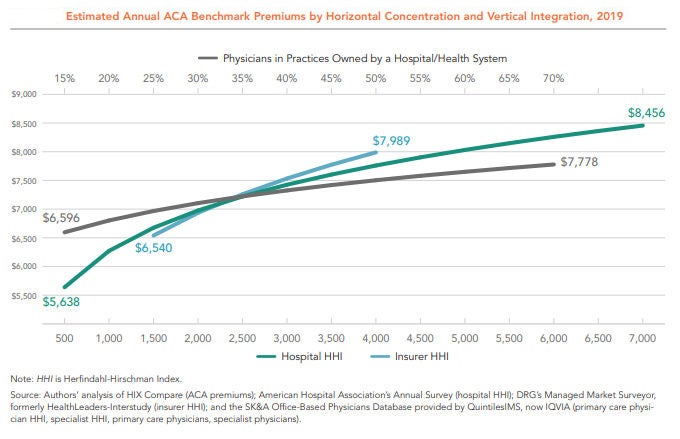
Among the six variables analyzed in the CHCF study, three showed a positive and statistically significant association with higher premiums: insurance company mergers, hospital mergers, and the percentage of primary care physicians in practices owned by hospitals and health systems. The remaining three variables studied — specialist provider mergers, primary care provider mergers, and the percentage of specialists in practices owned by a hospital and health system — were statistically insignificant.

The figure below shows the independent relationship between market concentration and premiums for these three variables. As the lines move left to right, concentration increases — that is, fewer individual insurers, hospitals, or providers occupy the market. The vertical axis shows the average premiums associated with each level of market concentration. In short, regardless of the industry structure represented by the other variables, insurer consolidation, hospital consolidation, and hospital-physician mergers each lead to higher premiums.

Unexplained Price Variation and Growth

Health insurance premiums rise when the underlying cost of medical care increases. California ranks as the 16th most expensive state on average in terms of the seven common services the researchers studied, after adjusting for wage differences across states. Among all states, California has the eighth-highest prices for normal childbirth, defined as vaginal delivery without complications. Childbirth is the most common type of hospital admission, and the relatively standardized procedure is comparable across states.

Even within California, prices vary widely and are growing rapidly. For example, the 2016 average wage-adjusted price for a vaginal delivery was twice as high in Rating Area 9 (which has Monterey as its largest county) as it was in Rating Area 19 (San Diego) — $22,751 versus $11,387. (See next figure.) Prices for the service are increasing rapidly across counties — rising anywhere from 29% in San Francisco from 2012 to 2016 to 40% in Orange County over the same period.

The authors of the CHCF report investigated the impact of various types of consolidation on the prices of individual medical services in California. For cesarean births without complications, a 10% rise in hospital HHI is associated with a 1.3% increase in price.

Potential Policy Responses to Consolidation

While the study shows significant associations between various types of market concentration and the prices consumers pay, policymakers should carefully consider implementing steps that restrain the inflationary impact of consolidation while allowing the benefits of clinical integration to proliferate. To that end, the authors of the CHCF report offered a series of recommendations, which include:

Enforce antitrust laws. Federal and state governments should scrutinize proposed mergers and acquisitions to evaluate whether the net result is procompetitive or anticompetitive.

Restrict anticompetitive behaviors. Anticompetitive behaviors, such as all-or-nothing and anti-incentive contract terms, should be addressed through legislation or the courts in markets where providers are highly concentrated.

Revise anticompetitive reimbursement incentives. Reimbursement policies that reduce competition, such as Medicare rules that implicitly reward hospital-owned physician groups, should be adjusted.

Reduce barriers to market entry. Policies that restrict who can participate in the health care market, such as laws prohibiting nurse practitioners from practicing independently from a physician, should be changed when markets are concentrated.

Regulate provider and insurer rates. If antitrust enforcement is not successful and significant barriers to market entry exist — including those in small markets unable to support a competitive number of hospitals and specialists — regulating provider and insurer rates should be considered.

Encouraging meaningful competition in health care markets is an exceedingly difficult task for policymakers. It is no easier to promote the benefits of clinical integration while restraining the inflationary aspects of economic consolidation through public policy. Despite these challenges, the rapid rise in health care premiums and prices in the state require a fresh look at the consequences of widespread horizontal and vertical consolidation in California.