Tenet inks another $1B deal with SurgCenter Development for ambulatory surgery centers, long-term partnership

Tenet strikes $1.2B surgery center deal - NewsBreak

Dive Brief:

  • Tenet and its subsidiary USPI have entered into a $1.2 billion deal to acquire ambulatory surgery center operator SurgCenter Development, expanding on a previous $1.1 billion cash deal inked with SCD last year.
  • Under the new deal announced Monday, Tenet will acquire SCD’s ownership interests in 92 ambulatory surgery centers and other support services in 21 states.
  • In addition to the acquisition, USPI and SCD plan to enter into a five-year partnership and development agreement in which SCD will help facilitate “continuity and support for SCD’s facilities and physician partners.” USPI will also have exclusivity on developing new projects with SCD during the five-year agreement.

Dive Insight:

Despite being a legacy hospital operator, Tenet’s outpatient surgery business is key to its long-term strategy.

After the latest deal closes, USPI will operate 440 surgery centers in 35 states, Tenet said Tuesday. The acquisition will boost USPI’s footprint in existing markets, such as Florida where it already operates 47 centers and will gain an additional 15. USPI will also enter new markets, such as Michigan, with a sizable footprint at the outset, executives said Tuesday.

The deal includes 65 mature centers and 27 that have opened in the past year or will soon open and start performing their first cases. Tenet may also spend an additional $250 million to acquire equity interests from physician owners.

Tenet leaders touted SCD’s service line mix, pointing out that a significant portion of the cases performed by these centers are for musculoskeletal care, which includes total joint and spine procedures.

The deal is expected to generate $175 million in EBITDA during the first year, executives said. 

SVB Leerink analysts characterized the deal as savvy and said it will reshape the company’s earnings towards a “faster growing, higher margin, and improved capital return profile.”

Heading into 2021, Tenet had expected a greater share of its earnings power to come from its outpatient surgery business. This deal accelerates that aim over the long-term.

In 2014, Tenet’s ambulatory surgery business accounted for just 5% of the company’s overall earnings. Prior to this latest deal, Tenet expected the unit to account for 42% of its overall earnings in 2021.

This latest announcement follows Tenet’s deal in October with Compass Surgical Partners to acquire its ownership and management interests in nine ambulatory surgery centers located in Florida, North Carolina and Texas for an undisclosed sum.
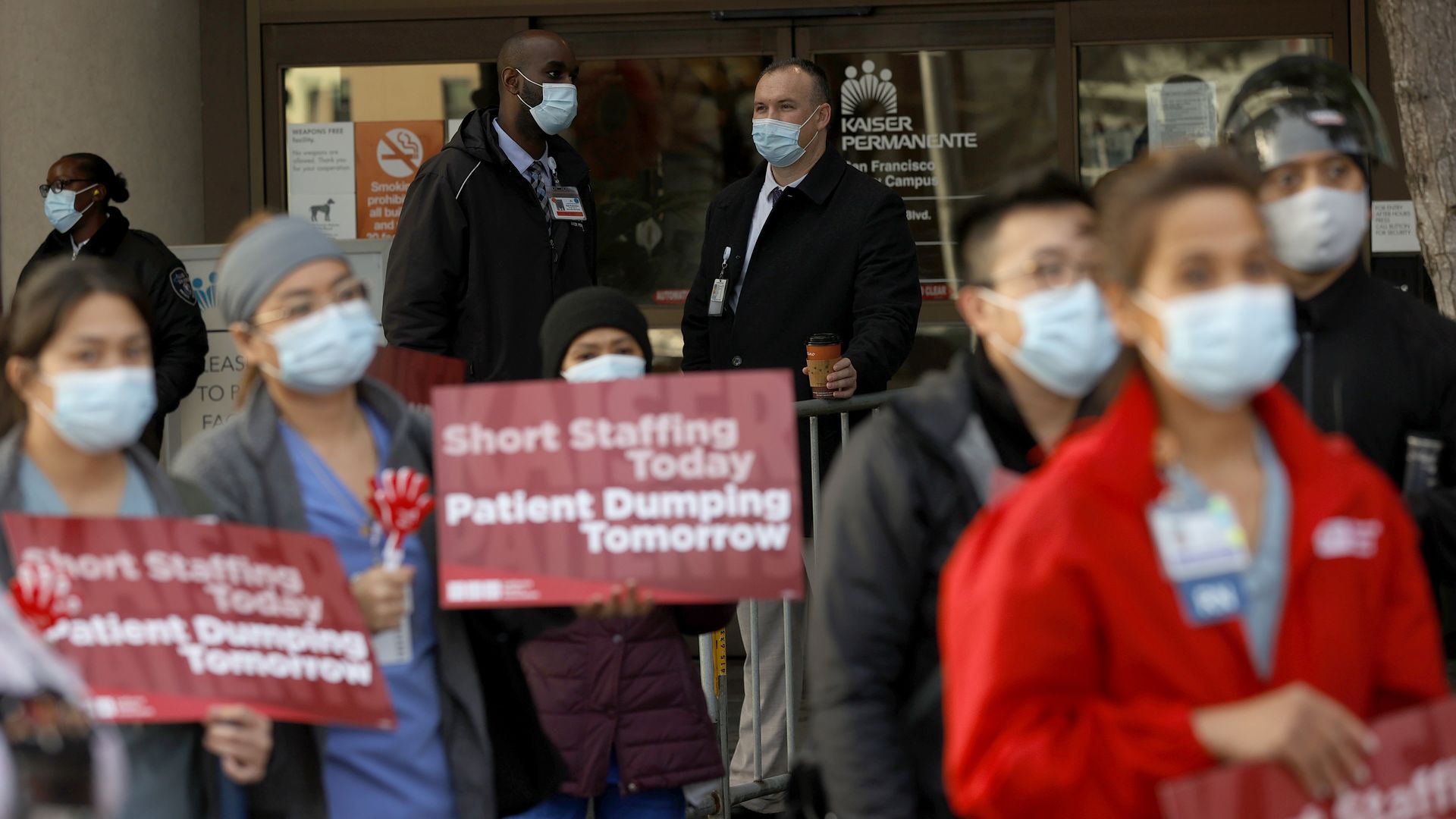
Kaiser Permanente averts strike in tentative deal with health care workers

Kaiser Permanente security guards monitor an informational picket outside of the Kaiser Permanente San Francisco Medical Center on November 10, 2021 in San Francisco, California.

Union leaders representing nearly 50,000 health care workers and medical staff reached a tentative agreement in a labor dispute Saturday, avoiding a strike set to begin Monday.

Why it matters: The breakthrough in talks comes as nurses, front-line technicians and other hospital employees face worker shortages and burnout due to the ongoing COVID-19 pandemic.

The big picture: More than 30,000 Kaiser Permanente employees in Oregon, Washington, California and other states threatened to walk out on Monday over lower pay for new hires, Reuters reports.

  • Kaiser and the Alliance of Health Care Unions ended up reaching a tentative four-year deal that includes wage increases, health and retirement benefits and bonus opportunities, per CBS News.

What they’re saying: “This agreement will mean patients will continue to receive the best care, and Alliance members will have the best jobs,” Hal Ruddick, executive director of Alliance, said in the statement.

  • “This landmark agreement positions Kaiser Permanente for a successful future focused on providing high-quality health care that is affordable and accessible for our more than 12 million members and the communities we serve,” said Christian Meisner, senior vice president and chief human resources officer at Kaiser.

What’s next: The agreement heads to union members for ratification, and, if ratified, it will become retroactive to Oct. 1.

Senate bill would make telehealth reimbursement permanent for certain services

https://www.healthcarefinancenews.com/news/senate-bill-would-make-telehealth-reimbursement-permanent-certain-services

A bipartisan group of senators have introduced a bill to make telehealth reimbursement permanent for certain services such as those provided by physical therapists, audiologists, occupational therapists and speech language pathologists.

Sens. Steve Daines (R-Mont.), Tina Smith (D-Minn.), Jerry Moran (R-Kan.) and Jacky Rosen (D-Nev.) introduced the “Expanded Telehealth Access Act” on Thursday, according to The Hill.

If passed, the legislation would extend telehealth reimbursement policies that were temporarily added during the COVID-19 public health emergency.

WHY THIS MATTERS

The Centers for Medicare and Medicaid Services has long said that Congressional action is needed to make emergency telehealth measures permanent.

But on Tuesday, CMS released new actions that will allow Medicare to pay for mental health virtual visits furnished by Rural Health Clinics and Federally-Qualified Health Centers. This is through telecommunications technology such as audio-only telehealth calls.

Telehealth is particularly important for rural areas where patients may have to travel long distances for care.

The Senate bill has the support of the American Telehealth Association, the American Physical Therapy Association, the American Speech-Language-Hearing Association and the American Occupational Therapy Association, among others, according to the report.

The biggest issue in telehealth reimbursement remains. This is whether providers will be continued to be paid at in-person parity for a telehealth visit. 

THE LARGER TREND

The Senate Bill is a companion to a House bill introduced in March by Rep. Mikie Sherrill (D-NJ) called the Expanded Telehealth Access Act.

In May, Senator Daines, one of the sponsors of Thursday’s legislation, with Senator Catherine Cortez Masto (D-Nev.), proposed the “Telehealth Expansion Act of 2021” to permanently allow first-dollar coverage of virtual care under high-deductible health plans.

Tenet strikes $1.2B surgery center deal

Tenet Healthcare Corp. signs deal for ambulatory surgery center at Good  Samaritan Hospital with Hospital for Special Surgery - South Florida  Business Journal

Dallas-based Tenet Healthcare and one of its subsidiaries have entered into a definitive agreement to acquire Towson, Md.-based SurgCenter Development. 

Under the agreement, Tenet and its subsidiary United Surgical Partners International will acquire ownership interests in 92 ambulatory surgery centers and related ambulatory support services for approximately $1.2 billion. Of the 92 ASCs, 16 of them are under development and have not yet opened. 

Under the deal, expected to close in the fourth quarter of this year, SurgCenter and USPI will also enter into an agreement to develop at least 50 centers over a five-year period. 

“We are extremely pleased to announce this transformative transaction and partnership, which builds upon USPI’s position as a premier growth partner and SCD’s track record of developing high-quality centers with leading physicians,” Saum Sutaria, MD, CEO of Tenet Healthcare, said in a Nov. 8 news release. “By welcoming these centers into our company, USPI will maintain its reach as the largest ambulatory platform for musculoskeletal services, a high-growth service line.”

Tenet said it expects the deal to generate strong financial returns. 

UPMC workers to strike Nov. 18

Workers at Pittsburgh-based UPMC plan to strike over wages and benefits, the Post-Gazette reported Nov. 5. 

Service Employees International Union Healthcare Pennsylvania, which does not represent the workers but is supporting them, told Becker’s Hospital Review the strike would involve workers at UPMC hospitals in Pittsburgh, including transporters, dietary workers, housekeepers, nurses, patient care techs, medical assistants, pharmacy techs, surgical techs, valets, therapists, health unit coordinators and administrative assistants. Workers plan to strike for one day on Nov. 18.

The workers are demanding a $20 per hour minimum wage, affordable high-quality healthcare, elimination of all medical debt and respect for union rights, according to a union news release.

Their strike notice came after UPMC announced Nov. 2 that the health system is giving 92,000 staff members a bonus of $500 to thank them for their work during the pandemic. UPMC will issue the bonuses on Nov. 26. The health system also announced improvements to employee compensation and benefit programs, including raising the entry level wage to $15.75 in January, according to the Post-Gazette

“There was no ‘thank you pay’ until we started organizing to strike,” Juilia Centofanti, pharmacy tech at UPMC Children’s Hospital of Pittsburgh, said in a news release.

Ms. Centofanti added that employees are “owed this [$20 per hour wage] and so much more,” and said she “will continue organizing with my co-workers for the pay, safer staffing and union rights we deserve.”

In announcing the bonuses, Leslie Davis, president and CEO of UPMC, told workers, “Over the past 20 months, you have risen in truly exceptional ways to meet challenges we could have never anticipated. With your critical support, UPMC continues to care for so many.”

A UPMC spokesperson declined to comment to Becker’s on Nov. 5.

UPMC is a $23 billion healthcare provider and insurer. SEIU Healthcare Pennsylvania has been trying to organize about 3,500 hourly workers at UPMC Presbyterian and Shadyside hospitals for nearly a decade, but has not yet held a unionization vote, according to the Post-Gazette.

Read the full report here.

Lower volumes, higher wages, supply chain disruption all dragged down hospital

Hospitals’ performances declined “by almost every metric” during September as volumes dropped, average patient stays rose and expenses increased “dramatically” due to labor and supply chain issues, Kaufman Hall wrote in its latest monthly report.

Although revenue increased compared to this time last year, the industry analyst said that these pressures have led median change in hospital operating margin to decline 18.2% from August to September, not including CARES act funding.

These declines were greatest across regions heavily affected by the recent delta surge, with the west part of the country seeing the largest year-over-year drop in its median change in operating EBITDA margin (38%), Kaufman Hall wrote.

Hospital size also played a role in margin performance, they wrote, with hospitals containing more than 500 beds seeing year-over-year declines of 36% while those with 25 or fewer beds actually seeing their margins increase year over year.

Adjusted discharges dropped 5.1% month over month but remained up 11.4% year over year. Patient days similarly dropped 1.4% month over month, “reflecting a decrease in COVID-19-related hospitalizations,” but are still up 11.4% year over year, according to the report. Notably, the average length of stay saw increases across the board—0.7% month over month and 4.8% year over year.

Expenses and revenues continued their hand-in-hand climb during September.

For the former, total expenses grew 2.2% month over month and 11.2% year over year. Labor expenses increased 1.4% month over month at the same time as workers per patient bed declined, the group wrote. Other non-labor expenses, including drugs and medical supplies, also saw a 1.3% month-over-month increase.

“Multiple factors are contributing to alarming and sustained increases in hospital expenses,” Erik Swanson, a senior vice president of data and analytics with Kaufman Hall. “Growth in labor expenses are outpacing increases in hours worked, suggesting hospitals are paying more due to nationwide labor shortages. Rising supply and drug expenses also point to worldwide supply chain issues.”

Hospital revenues saw their seventh consecutive month of year-to-date increases when compared to 2020 and 2019 alike, “due in part to yearly rate changes and the continued rise in higher acuity cases,” Kaufman Hall wrote. Specifically, gross operating revenues minus CARES grew 12.3% year over year from 2020 and 12.3% year over year from 2019, with inpatient revenue rising faster than outpatient revenue.

Month over month was a different story, however, with gross operating revenue without CARES dropping 1.4%. While inpatient revenue was up 1.5% from August, a 3.3% decline in outpatient revenue “suggests that consumer worries about accessing care during the recent delta surge have led to another downswing,” Kaufman Hall wrote.  

Kaufman Hall’s reports incorporate data from more than 900 U.S. hospitals. The September numbers follow early warnings of delta-fueled recovery roadblocks from the group’s preceding monthly reports as well as recent hospital chain earnings calls highlighting high revenues, costs and COVID-19 patient counts.

The future of hospitals will be outside of hospitals

https://www.axios.com/the-future-of-hospitals-will-be-outside-of-hospitals-b3074182-a3cb-466e-89cb-66d2a0a27a72.html

Illustration of a medical red cross with beams of light cast from one side

Hospitals in the future will look far more tech-enabled and consumer-focused — when patients are actually even getting care in a hospital building itself.

Why it matters: Hospitals were already pushing more care outside their four walls before the pandemic. COVID accelerated that shift, forcing hospitals to reimagine what’s possible to deliver in patients’ homes, experts say.

The big picture: One way to picture what hospitals of the future will look like is to look at two brand new hospital buildings opened this fall by competing Pennsylvania health systems.

  • The buildings, by Penn Medicine and Highmark Health both offer hotel-like amenities such as better food, streaming services, and better-positioned outlets for cell phone charging. They’ve also made medical records more accessible to patients, executives say.
  • But they were also designed with the belief that, in the future, only the most complex care might be delivered in them.

State of play: Every medical room in Penn Medicine’s new $1.6 billion health pavilion can be turned into an ICU-capable room when needed.

  • It added 7% in costs to the project, but made sense considering the ICU demands of the pandemic and “not knowing what the future will be,” CEO Kevin Mahoney told Axios.
  • The hospital also offers patients bedside tablets that allow patients to control the light and temperature of the room, and to activate frosted privacy glass on the doors of their rooms.
  • The benefits are two-fold: patients really like it and it can help free up staff to focus on more critical tasks, Mahoney said.

“The pandemic was an amplifier for natural trends that were already starting to develop,” Highmark CEO David Holmberg told Axios. “The complexity of medical procedures [in hospitals] is going to be significantly higher.”

The bottom line: Tech advances will change the entire hospital experience no matter where the care is delivered.

  • Wearables will provide digital biomarkers to allow better patient monitoring from the home. “Smart” infrastructure will help patients find parking and navigate massive hospital campuses when they need to go into the hospital.
  • And 5G will allow doctors to pull up massive amounts of personalized data on a wireless screen in seconds, Hon Pak, chief medical officer at Samsung Electronics told Axios.
  • “The perspective we want to bring to the smart hospital is it’s not just about caring for the condition or the disease, but it’s about caring for the whole,” Pak said.

Moody’s: Rising costs will slow hospitals rebuilding margins to pre-COVID-19 levels

https://www.healthcarefinancenews.com/news/rising-costs-will-make-it-difficult-hospitals-rebuild-margins-pre-covid-levels-moodys-says

Operating cash flow margins for nonprofit hospitals fell to a median 7% in 2020.

A shortage of nurses and other workers will continue to erode hospital financial performance into 2022, according to a new Healthcare Quarterly report from Moody’s.

A rise in COVID-19 cases in various regions of the United States has contributed to a wave of nurses, often burned out, resigning to take care of family, to work in less acute healthcare settings such as ambulatory care or to pursue higher-paying contract opportunities, such as becoming a travel nurse.

Hospitals are also having difficulty finding other types of healthcare workers, such as respiratory therapists and imaging technicians, as well as nonclinical workers in areas such as dietary, housekeeping and environmental services.

WHY THIS MATTERS

The report holds no surprises for hospital executives, who already know the financial affect labor shortages are having on revenue. But Moody’s confirms projections that rising costs will make it difficult for hospitals to rebuild margins to pre-COVID-19 levels. 

Labor shortages are driving up costs and also may be limiting the number of lucrative elective procedures, resulting in lost revenue. Not-for-profit hospitals saw operating cash flow margins fall to a median 7% in 2020, from 8.3% in the three prior years, according to Moody’s median data.

Hospitals using contract nurses report that hourly wages are very high, in some cases higher now with the Delta variant than during earlier COVID-19 surges. Many hospitals and health systems have also increased minimum wages for nonclinical workers and are finding they must compete with other service sectors, such as the food industry, to attract nonclinical staff.

Given their substantial reliance on government reimbursement from Medicare and Medicaid, most healthcare providers maintain limited pricing flexibility to offset the costs of higher wages. While there are opportunities for more lucrative commercial insurance contracts, rates are the subject of intense negotiations, limiting providers’ pricing power, Moody’s said. 

Providers with strong liquidity and diversified cash flow will remain better positioned to manage stress from cost constraints. Hospitals are taking steps to retain nurses, including developing “float pools” of nurses who can work in multiple departments, increasing retention and merit pay, and expanding healthcare benefits such as mental health and child care services. 

LifeBridge Health, a not-for-profit health system operating in Baltimore and Carroll County, Maryland, paid its nursing staff retention bonuses in December 2020 as the labor market tightened. To recruit nurses, many systems are offering signing bonuses in exchange for multi-year work commitments as well as scholarship and loan forgiveness programs with local nursing schools.

While these strategies will ease the effect of labor shortages over the long term, they will cause hospitals’ costs to increase in 2022 as salaries and benefits typically represent at least half of a hospital’s expenses. Labor shortages will also likely spark an increase in unionization efforts or lead to more difficult negotiations between unions and providers, potentially increasing costs via new contracts.

THE LARGER TREND

The quarterly report focused on the impact of labor shortages and cost pressures for various sectors, including hospitals, insurers, pharmaceuticals, healthcare services such as staffing firms and health insurers.

Health insurers are less affected by labor shortages, wage pressure and potentially burgeoning inflation than many other healthcare sectors, Moody’s said. Insurers reset premiums each year, which helps them to offset inflation. But if the government does not keep up with payment, providers will look to insurers to make up the shortfall. 

Large physician staffing companies, such as Envision Healthcare Corporation and Team Health Holdings, will experience pressure on their profitability as it becomes harder and more expensive to fill open positions as burnout and retirements decrease the number of doctors available to work.

Travel nurse staffing has higher profit margin resilience compared to physician staffing, the report said. 

For real estate investment trusts, worker shortages are slowing net operating income growth for REITs to invest in senior housing and skilled nursing facilities.

Growth in salaries and benefits has exceeded hospitals’ expense growth, a trend likely to continue for the remainder of 2021 and into 2022, Moody’s said in an earlier October report.

In one bright spot in the earlier report, Moody’s noted recent rises in nursing school enrollment indicating a more robust long-term staffing pipeline. However, the aging population, combined with a healthcare workforce that may be retiring from their jobs or quitting due to burnout, represent long-term healthcare staffing challenges nationwide.

Moody’s: Labor shortages weaken hospitals’ financial performance

Labor shortages from the COVID-19 pandemic will continue to worsen the financial performance of nonprofit and for-profit hospitals into 2022, an October Moody’s quarterly report found.

As nurses and other workers deal with burnout and resign from positions, some hospitals are limiting elective procedures, which is reducing revenue. They’re also increasing minimum wage and using contract nurses with much higher hourly wages.

Physician staffing companies like Envision Healthcare Corp. and TeamHealth will also struggle with profitability as it becomes more difficult to fill open positions because of fewer available physicians, the report said. 

An Association of American Medical Colleges study in 2020 found that more than 2 out of 5 physicians will be 65 or older by 2030; COVID-19 is accelerating retirement.

Meanwhile, health insurers are not as affected by labor shortages, wage pressure and inflation, according to the report. Because their product is more short-term and premiums reset every year, they have more flexibility when it comes to inflation.

FTC tightens reins on merger control: 6 things to know

Federal Trade Commission (FTC) Definition

The Federal Trade Commission announced Oct. 25 it is restoring its practice of requiring companies that previously pursued an anticompetitive merger to get prior approval for future transactions. 

Six things to know: 

1. The FTC will now require companies to get prior approval from the agency for any transaction “affecting each relevant market for which a violation was alleged” for at least 10 years. 

2. The FTC said in some situations it may seek prior approval provisions that cover broader geographic markets beyond just the relevant markets affected by the merger. The agency will consider several factors to make the determination, including the level of market concentration, the degree to which the transaction increases concentration and evidence of anticompetitive market dynamics. 

3. The FTC is less likely to pursue a prior approval provision against merging companies that abandon their transaction, the commission said. 

4. The FTC is reinstating the prior approval practice after the commission voted in July to repeal a 1995 policy statement that prevented the agency from imposing these merger restrictions. 

5. The agency said it has already implemented the policy by imposing strict limits on future acquisitions by Denver-based DaVita after the company’s acquisition of University of Utah Health’s dialysis clinics.  

6. “The FTC should not have to waste valuable time and resources investigating clearly anticompetitive deals that should have died in the boardroom,” Holly Vedova, director of the agency’s bureau of competition, said in a news release. “Restoring the long-standing prior approval policy forces acquisitive firms to think twice before going on a buying binge because the FTC can simply say no.”