

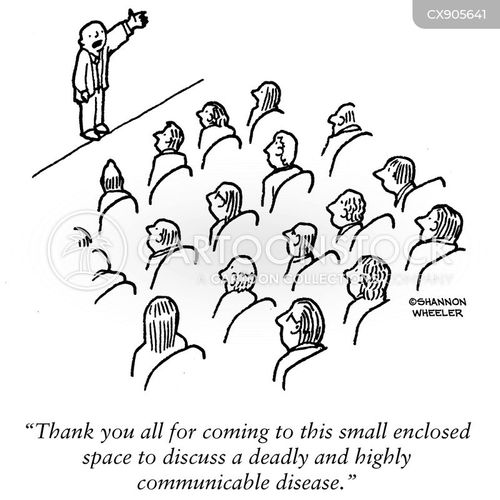
Cartoon – State of the Union: Thank You All for Coming

Those on the front lines of the fight against the novel coronavirus worry about keeping themselves, their families and their patients safe.
This story is part of a series examining the state of healthcare six months into the public health emergency declared for COVID-19.
There’s no end in sight for the country as it grapples with another surge of COVID-19 cases.
That’s especially true for nurses seeking the reprieve of their hospitals returning to normal operations sometime this year. Many in the South and West are now treating ICUs full of COVID-19 patients they hoped would never arrive in their states, largely spared from spring’s first wave.
And like many other essential workers, those in healthcare are falling ill and dying from COVID-19. The total number of nurses stricken by the virus is still unclear, though the Centers for Disease Control and Prevention has reported 106,180 cases and 552 deaths among healthcare workers. That’s almost certainly an undercount.
National Nurses United, the country’s largest nurses union, told Healthcare Dive it has counted 165 nurse deaths from COVID-19 and an additional 1,060 healthcare worker deaths.
Safety concerns have ignited union activity among healthcare workers during the pandemic, and also given them an opportunity to punctuate labor issues that aren’t new, like nurse-patient ratios, adequate pay and racial equality.
At the same time, the hospitals they work for are facing some of their worst years yet financially, after months of delayed elective procedures and depleted volumes that analysts predict will continue through the year. Many have instituted furloughs and layoffs or other workforce reduction measures.
Healthcare Dive had in-depth conversations with three nurses to get a clearer picture of how they’re faring amid the once-in-a-century pandemic. Here’s what they said.
Elizabeth Lalasz has worked at John H. Stroger Hospital in Chicago for the past 10 years. Her hospital is a safety net facility, catering to those who are “Black, Latinx, the homeless, inmates,” Lalasz told Healthcare Dive. “People who don’t actually receive the kind of healthcare they should in this country.”
Data from the CDC show racial and ethnic minority groups are at increased risk of getting COVID-19 or experiencing severe illness, regardless of age, due to long-standing systemic health and social inequities.
CDC data reveal that Black people are five times more likely to contract the virus than white people.
This spring Lalasz treated inmates from the Cook County Jail, an epicenter in the city and also the country. “That population gradually decreased, and then we just had COVID patients, many of them Latinx families,” she said.

Once Chicago’s curve began to flatten and the hospital could take non-COVID patients, those coming in for treatment were desperately sick. They’d been delaying care for non-COVID conditions, worried a trip to the hospital could risk infection.
A Kaiser Family Foundation poll conducted in May found that 48% of Americans said they or a family member had skipped or delayed medical care because of the pandemic. And 11% said the person’s condition worsened as a result of the delayed care.
When patients do come into Lalasz’s hospital, many have “chest pain, then they also have diabetes, asthma, hypertension and obesity, it just adds up,” she said.
“So now we’re also treating people who’ve been delaying care. But after the recent southern state surges, the hospital census started going down again,” she said.
Amy Arlund works the night shift at Kaiser Fresno as an ICU nurse, which she’s done for the past two decades.
She’s also on the hospital’s infection control committee, where for years she’s fought to control the spread of clostridium difficile colitis, or C. diff., in her facility. The highly infectious disease can live on surfaces outside the body for months or sometimes years.
The measures Arlund developed to control C. diff served as her litmus test, as “the top, most stringent protocols we could adhere to,” when coronavirus patients arrived at her hospital, she told Healthcare Dive.
But when COVID-19 cases surged in northern states this spring, “it’s like all those really strict isolation protocols that prior to COVID showing up would be disciplinable offenses were gone,” Arlund said.
Widespread personal protective equipment shortages at the start of the pandemic led the CDC and the Occupational Safety and Health Administration to change their longstanding guidance on when to use N95 respirator masks, which have long been the industry standard when dealing with novel infectious diseases.
The CDC also issued guidance for N95 respirator reuse, an entirely new concept to nurses like Arlund who say those changes go against everything they learned in school.
“I think the biggest change is we always relied on science, and we have always relied heavily on infection control protocols to guide our practice,” Arlund said. “Now infection control is out of control, we can no longer rely on the information and resources we always have.”

The CDC says experts are still learning how the coronavirus spreads, though person-to-person transmission is most common, while the World Health Organization recently acknowledged that it wouldn’t rule out airborne transmission of the virus.
In Arlund’s ICU, she’s taken care of dozens of COVID positive patients and patients ruled out for coronavirus, she said. After a first wave in the beginning of April, cases dropped, but are now rising again.
Other changing guidance weighing heavily on nurses is how to effectively treat coronavirus patients.
“Are we doing remdesivir this week or are we going back to the hydroxychloroquine, or giving them convalescent plasma?”Arlund said. “Next week I’m going to be giving them some kind of lavender enema, who knows.”
Erik Andrews, a rapid response nurse at Riverside Community Hospital in California, has treated coronavirus patients since the pandemic started earlier this year. He likens ventilating them to diffusing a bomb.
“These types of procedures generate a lot of aerosols, you have to do everything in perfectly stepwise fashion, otherwise you’re going to endanger yourself and endanger your colleagues,” Andrews, who’s been at Riverside for the past 13 years, told Healthcare Dive.
He and about 600 other nurses at the hospital went on strike for 10 days this summer after a staffing agreement between the hospital and its owner, HCA Healthcare, and SEIU Local 121RN, the union representing RCH nurses, ended without a renewal.
The nurses said it would lead to too few nurses treating too many patients during a pandemic. Insufficient PPE and recycling of single-use PPE were also putting nurses and patients at risk, the union said, and another reason for the strike.
But rapidly changing guidance around PPE use and generally inconsistent information from public officials are now making the nurses at his hospital feel apathetic.
“Unfortunately I feel like in the past few weeks it’s gotten to the point where you have to remind people about putting on their respirator instead of face mask, so people haven’t gotten lax, but definitely kind of become desensitized compared to when we first started,” Andrews said.

With two children at home, Andrews slept in a trailer in his driveway for 12 weeks when he first started treating coronavirus patients. The trailer is still there, just in case, but after testing negative twice he felt he couldn’t spend any more time away from his family.
He still worries though, especially about his coworkers’ families. Some coworkers he’s known for over a decade, including one staff member who died from COVID-19 related complications.
“It’s people you know and you know that their families worry about them every day,” he said. “So to know that they’ve had to deal with that loss is pretty horrifying, and to know that could happen to my family too.”

When COVID-19 cases swelled in New York and other northern states this spring, Erik Andrews, a rapid response nurse at Riverside Community Hospital in southern California, thought his hospital should have enough time to prepare for the worst.
Instead, he said his hospital faced staffing cuts and a lack of adequate personal protective equipment that led around 600 of its nurses to strike for 10 days starting in late June, just before negotiating a new contract with the hospital and its owner, Nashville-based HCA Healthcare.
“To feel like you were just put out there on the front lines with as minimal support necessary was incredibly disheartening,” Andrews said. Two employees at RCH have died from COVID-19, according to SEIU Local 121RN, the union representing them.
A spokesperson for HCA told Healthcare Dive the “strike has very little to do with the best interest of their members and everything to do with contract negotiations.”
Across the country, the pandemic is exacerbating labor tensions with nurses and other healthcare workers, leading to a string of disputes around what health systems are doing to keep front-line staff safe. The workers’ main concerns are adequate staffing and PPE. Ongoing or upcoming contract negotiations could boost their leverage.
But many of the systems that employ these workers are themselves stressed in a number of ways, above all financially, after months of delayed elective procedures and depleted volumes. Many have instituted furloughs and layoffs or other workforce reduction measures.
Striking a balance between doing union action at hospitals and continuing care for patients could be an ongoing challenge, Patricia Campos-Medina, co-director of New York State AFL-CIO/Cornell Union Leadership Institute.
“The nurses association has been very active since the beginning of the crisis, demanding PPE and doing internal activities in their hospitals demanding proper procedures,” Campos-Medina said. “They are front-line workers, so they have to be thoughtful in how they continue to provide care but also protect themselves and their patients.”
At Prime Healthcare’s Encino Hospital Medical Center, just outside Los Angeles, medical staff voted to unionize July 5, a week after the hospital laid off about half of its staff, including its entire clinical lab team, according to SEIU Local 121RN, which now represents those workers.
One of the first things the newly formed union will fight is “the unjust layoffs of their colleagues,” it said in a statement.
A Prime Healthcare spokesperson told Healthcare Dive 25 positions were cut. “These Encino positions were not part of front-line care and involved departments such as HR, food services, and lab services,” the system said.
Hospital service workers elsewhere who already have bargaining rights are also bringing attention to what they deem as staffing and safety issues.
In Chicago, workers at Loretto Hospital voted to authorize a strike Thursday. Those workers include patient care technicians, emergency room technicians, mental health staff and dietary and housekeeping staff, according to SEIU Healthcare Illinois, the union that represents them. They’ve been bargaining with hospital management for a new contract since December and plan to go on strike July 20.
Loretto Hospital is a safety-net facility, catering primarily to “Black and Brown West Side communities plagued with disproportionate numbers of COVID illnesses and deaths in recent months,” the union said.
The “Strike For Black Lives” is in response to “management’s failure to bargain in good faith on critical issues impacting the safety and well-being of both workers and patients — including poverty level wages and short staffing,” according to the union.
A Loretto spokesperson told Healthcare Dive the system is hopeful that continuing negotiations will bring an agreement, though it’s “planning as if a strike is eminent and considering the best options to continue to provide healthcare services to our community.”
Meanwhile in Joliet, Illinois, more than 700 nurses at Amita St. Joseph Medical Center went on strike July 4.
The Illinois Nurses Association which represents Amita nurses, cited ongoing concerns about staff and patient safety during the pandemic, namely adequate PPE, nurse-to-patient ratios and sick pay, they want addressed in the next contract. They are currently bargaining for a new one, and said negotiations stalled. The duration of the strike is still unclear.
However, a hospital spokesperson told Healthcare Dive, “Negotiations have been ongoing with proposals and counter proposals exchanged.”
The hospital’s most recent proposal “was not accepted, but negotiations will continue,” the system said.
INA is also upset with Amita’s recruitment of out-of-state nurses to replace striking ones during the COVID-19 pandemic.
It sent a letter to the Illinois Department of Financial and Professional Regulation, asserting the hospital used “emergency permits that are intended only for responding to the pandemic for purposes of aiding the hospital in a labor dispute.”
A Covid-19 vaccine, amazingly, is close. Why am I so worried?

A mere six months after identifying the SARS-CoV-2 virus as the cause of Covid-19, scientists are on the precipice of a having a vaccine to fight it. Moderna and the National Institutes of Health recently announced the start of a Phase 3 clinical trial, joining several others in a constructive rivalry that could save millions of lives.
It’s a truly impressive a feat and a testament to the power of basic and applied medical sciences. Under normal circumstances, vaccine approvals are measured in decades. Milestones that once took months or years have been achieved in days or weeks. If these efforts are successful, the Covid-19 vaccine could take a place alongside the Apollo missions as one of history’s greatest scientific achievements.
I’m optimistic. And yet, as someone who studies drug development, I want to temper expectations with a dose of realism and perhaps a bit of angst. Behind the proud declarations, many science and medical professionals have been whispering concerns. These whispers have escalated into a murmur. It’s time to cry them loudly:
Hey, Food and Drug Administration: Don’t be rash! Premature approval of a sub-standard Covid-19 vaccine could have dire implications, and not just for this pandemic. It could harm public health for years, if not generations, to come.
Unfortunately, elements now in place make such a disastrous outcome not only possible but in fact quite likely. Specifically, the FDA and its staff of chronically overworked and underappreciated regulators will face enormous public and political pressure to approve a vaccine. Whether or not one worries about an “October surprise” aimed at the upcoming election, regulators will be pressed hard. Some will stand firm. Some may resign in protest. But others could break and allow a bad vaccine to be released.
What makes a “bad vaccine”? Insufficient protection against the disease it is designed for, unwanted side effects, or some combination of the two. If an approved Covid-19 vaccine turns out to be ineffective, this could unintentionally promote wider spread of the disease by individuals who presume they were protected from it. Likewise, a negative experience with one vaccine might discourage the use of other vaccines that are far more safe and effective, whether they are for Covid-19 or other vaccine-preventable diseases.
Some things take time. Under normal circumstances, ensuring that a vaccine’s effects are safe and durable requires years of study and monitoring. And there is some evidence that natural immune responses to SARS-CoV-2 infection could be transient, making sustained investigation all the more necessary. A merely short-term effect could encourage vaccinated individuals to resume risky behaviors, which would all but guarantee that the epidemic endures. And if unintended side effects turn out to include, for instance, chronic inflammatory or autoimmune disease, a bad vaccine could impart lifelong damage.
But wait, there’s worse! A bad Covid-19 vaccine could further undermine confidence in the many safe, reliable vaccines already in our public health arsenal. Vaccine skepticism and anti-science bias, propagated by B-list celebrities and Russian troll farms, have been gaining strength all year. Combined with disappointing Covid-19 outcomes, such malign forces could facilitate the reemergence of once-vanquished foes — polio, measles, mumps, rubella, diphtheria, whooping cough, and tetanus — that once killed multitudes of children each year.
These are enormous risks. Placing all of our bets on a small set of untried vaccine technologies would be gobsmackingly foolish. Yet this is exactly what we are now doing. Most of the high-profile names capturing headlines are pursuing comparatively minor variations on a theme of genetic vaccines (those delivered via DNA or RNA). If one approach happens to work, the odds are higher the others will work as well. Disappointing results from one candidate, though, might presage failure across the board.
Rather than investing in a balanced portfolio of vaccines with different approaches — not to mention different therapies, devices, and diagnostics for treating Covid-19 — too many observers, too many companies, and too many governmental officials seem to be narrowly focused on hopes for a “savior” vaccine. Were that savior to fail, our national morale, already low, could plummet even further.
Don’t get me wrong. I, along with millions of Americans, want a Covid-19 vaccine. But we deserve one that’s been proven to be safe and effective.
It’s not too late to take a deep breath and devise a strategy to balance short- and long-term goals, including vaccination, improved diagnostics, and existing and novel treatments. We must support the FDA and hope that its scientists and physicians retain the strength and conviction to resist approving a substandard vaccine.
For encouragement, we should look to Frances Oldham Kelsey, a veritable patron saint of the FDA. In 1960, during her first month working for the agency, Kelsey was asked to approve a sedative called Kevadon, which had the potential to generate billions in revenue. Despite enormous pressure, Kelsey spotted a risk for toxicity and dug in her heels. She refused to rubber stamp the approval. Her actions saved the lives of countless babies. Kevadon, better known as thalidomide, proved to be one of the most dangerous and disfiguring drugs in history.
Kelsey passed away in 2015 at the age of 101. We must pray that her spirit inspires a new generation of FDA leaders with the courage to say, “No.”
/cloudfront-us-east-1.images.arcpublishing.com/tronc/36HGZQBI4BBZFNOWRKI4FQHOFM.tif)


 HENRY KOTULA