KHN’s ‘What The Health?’: Trump Twists on Virus Response

https://khn.org/news/khn-podcast-what-the-health-trump-twists-on-virus-response/
KHN's 'What The Health?': Trump Twists on Virus Response | Kaiser ...

President Donald Trump — who has spent the past six months trying to play down the coronavirus pandemic — seems to have pivoted. In back-to-back briefings on July 21 and 22, Trump cautioned that the U.S. is in a dangerous place vis-a-vis the pandemic. He urged the public to wear masks — although he has rarely worn one in public.

Meanwhile, Republicans in the Senate are scrambling to put together a package for the next COVID-19 relief bill, facing a July 31 deadline, when some of the benefits passed in the spring expire. House Democrats passed their bill in May.

This week’s panelists are Julie Rovner of Kaiser Health News, Joanne Kenen of Politico, Margot Sanger-Katz of The New York Times and Tami Luhby of CNN.

Among the takeaways from this week’s podcast:

  • Although Trump’s renewed emphasis on COVID-19 has surprised some of his critics, it may persuade his supporters to take actions promoted by public health officials. Trump’s emphasis on the importance of face coverings, perhaps coupled with the rising number of cases in parts of the country, could convince people who were otherwise dismissive of masks. People who do not necessarily trust public health officials may listen to Trump.
  • Republicans on Capitol Hill are in disarray on how to approach the next coronavirus relief bill. They are not in lockstep with the White House and are not supporting Trump’s call for a payroll tax cut.
  • One reason members of Congress are not eager to cut the payroll taxes is that the economic downturn has spurred concerns the Medicare and Social Security trust funds are being depleted faster than expected. However, analysts point out that when employment rises again, some of those concerns could dissipate.
  • A key sticking point in the economic relief package is whether to extend the bump in unemployment benefits that Congress approved in the spring. Lawmakers are facing a hard deadline on the issue because that money runs out next week, and the prohibition on evictions that was also part of an earlier COVID-19 relief bill ends even sooner. With rent, mortgages and other bills coming due Aug. 1, unemployed consumers could face a tough beginning of the month.
  • The Food and Drug Administration has approved limited use of pool testing for COVID-19. That allows approved labs to put together a small number of tests to run at once, thus conserving some of the materials needed for the process. If the pool tests positive, then those people whose results were pooled have to be tested again individually. The efforts have limited usefulness when rates of transmission are high in a community, but they may be helpful in specific settings, such as schools or workplaces.
  • New data shows that opioid addiction ticked back up in 2019, after a slight decline. Part of the problem is the growing use of the powerful — and dangerous — drug fentanyl. Economic woes also play a role. Addiction is often referred to as an epidemic of despair.
  • Although it’s unlikely the judicial system will overrule the administration’s efforts to bolster short-term insurance plans — which are generally less expensive but don’t offer as much protection for consumers as policies sold on the Affordable Care Act’s marketplaces — they could be circumvented if Democrats take over the White House. Even still, Democrats would likely have to find a way to make ACA plans more affordable.


US coronavirus data will now go straight to the White House. Here’s what this means for the world

https://theconversation.com/us-coronavirus-data-will-now-go-straight-to-the-white-house-heres-what-this-means-for-the-world-142814?utm_medium=email&utm_campaign=Latest%20from%20The%20Conversation%20for%20July%2028%202020%20-%201689316298&utm_content=Latest%20from%20The%20Conversation%20for%20July%2028%202020%20-%201689316298+Version+A+CID_abf5f3d50179e225ba3e81ad0fbb430c&utm_source=campaign_monitor_us&utm_term=US%20coronavirus%20data%20will%20now%20go%20straight%20to%20the%20White%20House%20Heres%20what%20this%20means%20for%20the%20world

US coronavirus data will now go straight to the White House ...

Led by physicians, scientists and epidemiologists, the US Centers for Disease Control and Prevention (CDC) is one of the most reliable sources of knowledge during disease outbreaks. But now, with the world in desperate need of authoritative information, one of the foremost agencies for fighting infectious disease has gone conspicuously silent.

For the first time since 1946, when the CDC came to life in a cramped Atlanta office to fight malaria, the agency is not at the front line of a public health emergency.

On April 22, CDC director Robert Redfield stood at the White House briefing room lectern and conceded that the coronavirus pandemic had “overwhelmed” the United States. Following Redfield at the podium, President Donald Trump said the CDC director had been “totally misquoted” in his warning that COVID-19 would continue to pose serious difficulties as the US moved into its winter ‘flu season in late 2020.

Invited to clarify, Redfield confirmed he had been quoted correctly in giving his opinion that there were potentially “difficult and complicated” times ahead.

Trump tried a different tack. “You may not even have corona coming back,” the president said, once again contradicting the career virologist. “Just so you understand.”

The exchange was interpreted by some pundits as confirmation that the CDC’s venerated expertise had been sidelined as the coronavirus continued to ravage the US.

In the latest development, the New York Times reported this week the CDC has even been bypassed in its data collection, with the Trump administration ordering hospitals to send COVID-19 data directly to the White House.

Diminished role

When facing previous public health emergencies the CDC was a hive of activity, holding regular press briefings and developing guidance that was followed by governments around the world. But during the greatest public health emergency in a century, it appears the CDC has been almost entirely erased by the White House as the public face of the COVID-19 pandemic response.

This diminished role is obvious to former leaders of the CDC, who say their scientific advice has never before been politicised to this extent.

As the COVID-19 crisis was unfolding, several CDC officials issued warnings, only to promptly disappear from public view. Nancy Messonnier, director of the CDC’s National Center for Immunization and Respiratory Diseases, predicted on February 25 that the virus was not contained and would grow into a pandemic.

The stock market plunged and Messonnier was removed from future White House press briefings. Between March 9 and June 12 there was no CDC presence at White House press briefings on COVID-19.

The CDC has erred during the pandemic, most significantly in its initial efforts to develop a test for COVID-19. The testing kits proved to be faulty – a problem compounded by sluggish efforts to rectify the situation – and then by severe delays in distributing enough tests to the public.

But many public health specialists are nevertheless baffled by the CDC’s low profile as the pandemic continues to sweep the globe.

“They have been sidelined,” said Howard Koh, former US assistant secretary for health. “We need their scientific leadership right now.”

What does it mean for the world?

The CDC being bypassed in the collection of COVID-19 data is another body blow to the agency’s standing.

Hospitals have instead been ordered to send all COVID-19 patient information to a central database in Washington DC.

This will have a range of likely knock-on effects. For starters, the new database will not be available to the public, prompting inevitable questions over the accuracy and transparency of data which will now be interpreted and shared by the White House.

The Department of Health and Human Services, which issued the new order, says the change will help the White House’s coronavirus task force allocate resources. But epidemiologists and public health experts around the world fear the new system will make it harder for people outside the White House to track the pandemic or access information.

This affects all nations, because one of the CDC’s roles is to provide sound, independent public health guidance on issues such as infectious diseases, healthy living, travel health, emergency and disaster preparedness, and drug efficacy. Other jurisdictions can then adapt this information to their local context — expertise that has become even more essential during a pandemic, when uncertainty is the norm.

It is difficult to recall a previous public health emergency when political pressure led to a change in the interpretation of scientific evidence.

What happens next?

Despite the inevitable challenges that come with tackling a pandemic in real time, the CDC remains the best-positioned agency – not just in the US but the entire world – to help us manage this crisis as safely as possible.

In the absence of US leadership, nations should start thinking about developing their own national centres for disease control. In Australia’s case, these discussions have been ongoing since the 1990s, stymied by cost and lack of political will.

COVID-19, and the current sidelining of the CDC, may be the impetus needed to finally dust off those plans and make them a reality.


Maps Of The USA That Made Us Say “Whoa”: States Resized According To Population Density

https://www.ranker.com/list/maps-mash-v1/mel-judson?format=slideshow&slide=25

States Resized According To Population Density

One question still dogs Administration: Why not try harder to solve the coronavirus crisis?

https://www.washingtonpost.com/politics/trump-not-solve-coronavirus-crisis/2020/07/26/7fca9a92-cdb0-11ea-91f1-28aca4d833a0_story.html?utm_source=ActiveCampaign&utm_medium=email&utm_content=Republicans+Roll+Out+%241+Trillion+Coronavirus+Relief+Plan&utm_campaign=TFT+Newsletter+07272020

Questions to ask students in class to help them deal with the ...

Both President Trump’s advisers and operatives laboring to defeat him increasingly agree on one thing: The best way for him to regain his political footing is to wrest control of the novel coronavirus.

In the six months since the deadly contagion was first reported in the United States, Trump has demanded the economy reopen and children return to school, all while scrambling to salvage his reelection campaign.

But allies and opponents agree he has failed at the one task that could help him achieve all his goals — confronting the pandemic with a clear strategy and consistent leadership.

Trump’s shortcomings have perplexed even some of his most loyal allies, who increasingly have wondered why the president has not at least pantomimed a sense of command over the crisis or conveyed compassion for the millions of Americans hurt by it.

People close to Trump, many speaking on the condition of anonymity to share candid discussions and impressions, say the president’s inability to wholly address the crisis is due to his almost pathological unwillingness to admit error; a positive feedback loop of overly rosy assessments and data from advisers and Fox News; and a penchant for magical thinking that prevented him from fully engaging with the pandemic.

In recent weeks, with more than 145,000 Americans now dead from the virus, the White House has attempted to overhaul — or at least rejigger — its approach. The administration has revived news briefings led by Trump and presented the president with projections showing how the virus is now decimating Republican states full of his voters. Officials have also set up a separate, smaller coronavirus working group led by Deborah Birx, the White House coronavirus response coordinator, along with Trump son-in-law and senior adviser Jared Kushner.

For many, however, the question is why Trump did not adjust sooner, realizing that the path to nearly all his goals — from an economic recovery to an electoral victory in November — runs directly through a healthy nation in control of the virus.

“The irony is that if he’d just performed with minimal competence and just mouthed words about national unity, he actually could be in a pretty strong position right now, where the economy is reopening, where jobs are coming back,” said Ben Rhodes, a deputy national security adviser to former president Barack Obama. “And he just could not do it.”

Many public health experts agree.

“The best thing that we can do to set our economy up for success and rebounding from the last few months is making sure our outbreak is in a good place,” said Caitlin Rivers, an epidemiologist at the Johns Hopkins Center for Health Security. “People are not going to feel comfortable returning to activities in the community — even if it’s allowed from a policy perspective — if they don’t feel the outbreak is under control.”

Some aides and outside advisers have tried to stress to Trump and others in his orbit that before he could move on to reopening the economy and getting the country back to work — and life — he needed to grapple with the reality of the virus.

But until recently, the president was largely unreceptive to that message, they said, not fully grasping the magnitude of the pandemic — and overly preoccupied with his own sense of grievance, beginning many conversations casting himself as the blameless victim of the crisis.

In the past couple of weeks, senior advisers began presenting Trump with maps and data showing spikes in coronavirus cases among “our people” in Republican states, a senior administration official said. They also shared projections predicting that virus surges could soon hit politically important states in the Midwest — including Michigan, Minnesota and Wisconsin, the official said.

This new approach seemed to resonate, as he hewed closely to pre-scripted remarks in a trio of coronavirus briefings last week.

“This could have been stopped. It could have been stopped quickly and easily. But for some reason, it wasn’t, and we’ll figure out what that reason was,” Trump said Thursday, seeming to simultaneously acknowledge his predicament while trying to assign blame elsewhere.

In addition to Birx and Kushner, the new coronavirus group guiding Trump includes Kushner advisers Adam Boehler and Brad Smith, according to two administration officials. Marc Short, chief of staff to Vice President Pence, also attends, along with Alyssa Farah, the White House director of strategic communications, and Stephen Miller, Trump’s senior policy adviser.

The working group’s goal is to meet every day, for no more than 30 minutes. It views its mission as half focused on the government’s response to the pandemic and half focused on the White House’s public message, the officials said.

White House spokeswoman Sarah Matthews defended the president’s handling of the crisis, saying he acted “early and decisively.”

“The president has also led an historic, whole-of-America coronavirus response — resulting in 100,000 ventilators procured, sourcing critical PPE for our front-line heroes, and a robust testing regime resulting in more than double the number of tests than any other country in the world,” Matthews said in an email statement. “His message has been consistent and his strong leadership will continue as we safely reopen the economy, expedite vaccine and therapeutics developments, and continue to see an encouraging decline in the U.S. mortality rate.”

For some, however, the additional effort is too little and far too late.

“This is a situation where if Trump did his job and put in the work to combat the health crisis, it would solve the economic crisis, and it’s an instance where the correct governing move is also the correct political move, and Trump is doing the opposite,” said Josh Schwerin, a senior strategist for Priorities USA, a super PAC supporting former vice president Joe Biden, the presumptive Democratic nominee.

Other anti-Trump operatives agree, saying he could make up lost ground and make his race with Biden far more competitive with a simple course correction.

“He’s staring in the mirror at night: That’s who can fix his political problem,” said John Weaver, one of the Republican strategists leading the Lincoln Project, a group known for its anti-Trump ads.

One of Trump’s biggest obstacles is his refusal to take responsibility and admit error.

In mid-March, as many of the nation’s businesses were shuttering early in the pandemic, Trump proclaimed in the Rose Garden, “I don’t take responsibility at all.” Those six words have neatly summed up Trump’s approach not only to the pandemic, but also to many of the other crises he has faced during his presidency.

“His operating style is to double- and triple-down on positions and to never, ever admit he’s wrong about anything,” said Anthony Scaramucci, a longtime Trump associate who briefly served as White House communications director and is now a critic of the president. “His 50-year track record is to bulldog through whatever he’s doing, whether it’s Atlantic City, which was a failure, or the Plaza Hotel, which was a failure, or Eastern Airlines, which was a failure. He can never just say, ‘I got it wrong and let’s try over again.’ ”

Another self-imposed hurdle for Trump has been his reliance on a positive feedback loop. Rather than sit for briefings by infectious-disease director Anthony S. Fauci and other medical experts, the president consumes much of his information about the virus from Fox News and other conservative media sources, where his on-air boosters put a positive spin on developments.

Consider one example from last week. About 6:15 a.m. that Tuesday on “Fox & Friends,” co-host Steve Doocy told viewers, “There is a lot of good news out there regarding the development of vaccines and therapeutics.” The president appears to have been watching because, 16 minutes later, he tweeted from his iPhone, “Tremendous progress being made on Vaccines and Therapeutics!!!”

It is not just pro-Trump media figures feeding Trump positive information. White House staffers have long made upbeat assessments and projections in an effort to satisfy the president. This, in turn, makes Trump further distrustful of the presentations of scientists and reports in the mainstream news media, according to his advisers and other people familiar with the president’s approach.

This dynamic was on display during an in-depth interview with “Fox News Sunday” anchor Chris Wallace that aired July 19. After the president claimed the United States had one of the lowest coronavirus mortality rates in the world, Wallace interjected to fact-check him: “It’s not true, sir.”

Agitated by Wallace’s persistence, Trump turned off-camera to call for White House press secretary Kayleigh McEnany. “Can you please get me the mortality rates?” he asked. Turning to Wallace, he said, “Kayleigh’s right here. I heard we have one of the lowest, maybe the lowest mortality rate anywhere in the world.”

Trump, relying on cherry-picked White House data, insisted that the United States was “number one low mortality fatality rates.”

Fox then interrupted the taped interview to air a voice-over from Wallace explaining that the White House chart showed Italy and Spain doing worse than the United States but countries like Brazil and South Korea doing better — and other countries that are doing better, including Russia, were not included on the White House chart. By contrast, worldwide data compiled by Johns Hopkins University shows the U.S. mortality rate is far from the lowest.

Trump is also predisposed to magical thinking — an unerring belief, at an almost elemental level, that he can will his goals into existence, through sheer force of personality, according to outside advisers and former White House officials.

The trait is one he shares with his late father and family patriarch, Fred Trump. In her best-selling memoir, “Too Much and Never Enough,” the president’s niece, Mary L. Trump, writes that Fred Trump was instantly taken by the “shallow message of self-sufficiency” he encountered in Norman Vincent Peale’s 1952 bestseller, “The Power of Positive Thinking.”

Some close to the president say that when Trump claims, as he did twice last week, that the virus will simply “disappear,” there is a part of him that actually believes the assessment, making him more reluctant to take the practical steps required to combat the pandemic.

Until recently, Trump also refused to fully engage with the magnitude of the crisis. After appointing Pence head of the coronavirus task force, the president gradually stopped attending task force briefings and was lulled into a false sense of assurance that the group had the virus under control, according to one person familiar with the dynamic.

Trump also maintained such a sense of grievance — about how the virus was personally hurting him, his presidency and his reelection prospects — that aides recount spending valuable time listening to his gripes, rather than focusing on crafting a national strategy to fight the pandemic.

Nonetheless, some White House aides insist the president has always been focused on aggressively responding to the virus. And some advisers are still optimistic that if Trump — who trails Biden in national polls — can sustain at least a modicum of self-discipline and demonstrate real focus on the pandemic, he can still prevail on Election Day.

Others are less certain, including critics who say Trump squandered an obvious solution — good governance and leadership — as the simplest means of achieving his other goals.

“There is quite a high likelihood where people look back and think between February and April was when Trump burned down his own presidency, and he can’t recover from it,” Rhodes said. “The decisions he made then ensured he’d be in his endless cycle of covid spikes and economic disruption because he couldn’t exhibit any medium- or long-term thinking.”


‘That’s Ridiculous.’ How America’s Coronavirus Response Looks Abroad.

WATCH THE VIDEO

Video -'That's Ridiculous.' How America's Coronavirus Response ...

From lockdowns to testing, we showed people around the world the facts and figures on how the U.S. has handled the pandemic.

The United States leads the world in Covid-19 deaths, nearing 150,000 lost lives. The unemployment figures brought on by the pandemic are mind-boggling. The Trump administration’s slow and haphazard response has been widely criticized. But what does it look like to young people around the world, whose governments moved quickly and aggressively to contain the coronavirus?

We wanted to know, so we reached out to quite a few and showed them charts, facts, photos and videos illustrating the U.S. response. Spoiler: They were not impressed.

Many advanced economies, from Germany to Singapore, directly supplemented salaries to save jobs. Other nations with fewer resources started mass testing at the first sign of an outbreak. Many countries mandated universal lockdowns — and successfully flattened the curve. In some parts of Europe, you could be fined for straying too far from your home. And Vietnam, a nation of 95 million people, has not seen a single Covid-19 death.

This Opinion video is a follow-up to a popular video we produced last year, which asked young Europeans to respond to American policies such as health care and parental leave. Many comments suggested we produce a sequel. Well, here it is — the Covid-19 edition.


The economy is in deep trouble again. Coronavirus is to blame

https://www.cnn.com/2020/07/23/business/coronavirus-economy-recovery/index.html

The economy is in deep trouble again. Coronavirus is to blame - CNN

Restaurant reservations are waning. The rebound in air travel is leveling off. And foot traffic at stores is dwindling once again. There is mounting evidence that America’s fragile economic recovery is already stalling as the number of coronavirus infections and deaths spike.

Real-time economic indicators bottomed out in May as stay-at-home orders were lifted and many Americans felt safe enough to start visiting shopping centers, restaurants and even airports.
That gave hope, perhaps prematurely, of a rapid V-shaped recovery for the United States from the historic collapse caused by the pandemic.
But there is now a growing sense that the recovery is losing steam as coronavirus infections surge in California, Texas, Florida and other Sun Belt states.
“The premature reopening of the U.S. economy has resulted in an intensification of the pandemic, which is now causing growth in the economy to slow,” Joe Brusuelas, chief economist at RSM International, wrote in a note to clients Tuesday.
The stall of the fragile recovery comes as Congress debates whether the economy needs more stimulus — and if so, how much to provide. The $600 weekly enhanced unemployment benefits expire this month unless lawmakers take action.
Economists say there is nothing to debate: The recovery is faltering.
“Activity is now clearly contracting in COVID hot spots, including the Sun Belt and the West,” Aneta Markowska, chief economist at Jefferies, wrote in a report on Monday.
That is hardly surprising, given that 22 states have either reversed or paused their reopening due to health concerns.

Recovery hopes overdone?

This doesn’t mean the US economy will keep shrinking in the third quarter. Economists are still betting GDP will turn sharply positive after having collapsed by an estimated 34% during the second quarter. But now they worry that the forecasts for blockbuster growth may be overly optimistic.
For instance, S&P Global Economics warned Wednesday that its estimate for a surge in third quarter GDP at an annualized pace of 22.2% is “at risk of weakening” because of the health crisis.
“Although our base case is for a gradual recovery through next year,” S&P economists wrote, “the [recent] surge in COVID-19 and hospitalizations has raised concerns that a more likely scenario is that the COVID-19 recession has not bottomed out.”
The latest real-time economic indicators suggest those concerns are warranted.
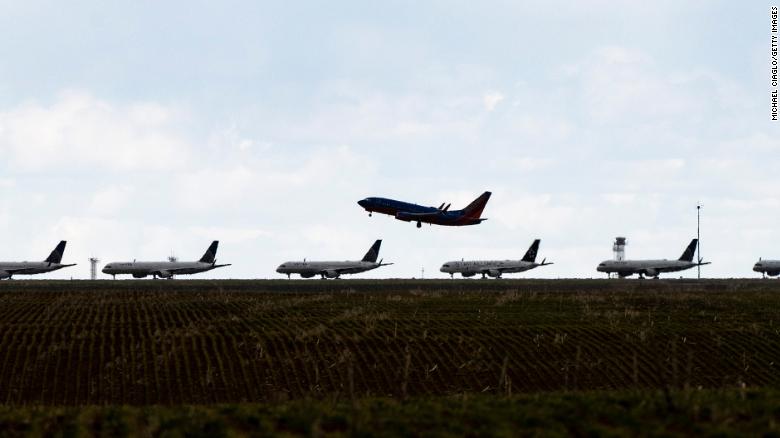
More turbulence for air travel: The resurgence of coronavirus infections is derailing the travel industry’s modest recovery. The number of air passengers processed through TSA security lines fell during the week ended July 20, compared with the prior week, according to Bank of America. This metric is down more than 70% from a year ago.
United (UAL) CEO Scott Kirby told CNBC on Wednesday that the airline doesn’t “expect to get anywhere close to normal until there’s a vaccine that’s been widely distributed to a large portion of the population.”
Restaurant trouble: As the CNN Business Recovery Dashboard clearly shows, restaurant reservations on OpenTable have weakened in recent weeks. During March and April, as the pandemic wreaked havoc, reservations were down nearly 100% from a year ago. That figure rebounded to down “only” 50% in mid-June, but has since rolled over and stood at -65% as of Monday.
Foot traffic to Chipotle (CMG) was down 47% during the first week in June, according to Placer.ai, an analytics platform that uses anonymized location data. Traffic improved to down just 30% by the end of June, but has since “stagnated” through mid-July, Placer.ai said.
Retail slowdown: In April, US retail traffic declined by a staggering 98%, according to Cowen. Traffic steadily improved, with June traffic down 57%, but that rebound has stalled. US retail traffic fell 47% from a year ago during the second week of July, Cowen said, a slight deterioration from the first week in July when traffic was down 45%.
Small business shutdowns: As of Sunday, 24.5% of small businesses in the United States were closed, according to Jefferies. That is worse than late June, when only 19% were closed. Jefferies pointed to “particular weakness in COVID hot spots” and noted that small business employment had dropped to levels unseen since the end of May.
Weaker spending: After plunging by as much as 31% year-over-year in early April, purchases on credit cards issued by Synchrony turned positive in late June. However, Synchrony (SYF) said Tuesday that spending during the first two weeks of July was down 2%.
Unemployment website visits: Web traffic to state unemployment portals “leveled off at still-high levels, suggesting labor market momentum has stalled,” Jefferies said. That jibes with official government statistics in the CNN Business Recovery Dashboard that show unemployment claims have tumbled from their spike this spring but remain elevated. In fact, another 1.4 million Americans filed for first-time unemployment benefits last week — the first increase in weekly claims since late March.
“The spread of the virus since mid-June has clearly had an adverse effect on economic activity,” economists at Bank of America wrote in a note to clients Wednesday. “It is clear that the path of the economic recovery cannot be disentangled from the path of the virus.”

No vaccine, no recovery?

That’s not to say all real-time indicators are negative right now. For instance, Jefferies said one of the last metrics to bottom out, a US job listing index that the bank created with alternative data platform Thinknum, continued to improve even last week.
Still, the New York Federal Reserve’s weekly economic index, which is composed of metrics on the labor market, consumer behavior and goods production, dropped for the first time since hitting the pandemic low point in late April.
All of this raises stakes in the race to develop a vaccine that is effective against Covid-19.
Vaccine hopes, on top of unprecedented easy money from the Federal Reserve, have helped catapult the stock market. The S&P 500 has spiked 46% since the March 23 low and is now positive for the year.
Real progress is being made on the vaccine front, underscored by a $1.95 billion deal announced Wednesday for Pfizer (PFE) to produce millions of Covid-19 vaccine doses for the US government.
Yet healthcare execs remain more cautious than Wall Street. Seventy-three percent of healthcare industry leaders polled by Lazard estimate that a vaccine won’t be widely available until at least the second half of 2021.
“It is becoming quite clear that absent an accessible and widely distributed vaccine,” RSM’s Brusuelas said, “there will be no complete economic recovery.”


Initial Unemployment Claims Rise For First Time in 16 Weeks; Air Travel, Restaurant Reservations, and Retail Businesses Face Declines and Closures

https://www.cnn.com/2020/07/23/economy/coronavirus-unemployment-benefits/index.html

Travel fears at their highest since 9/11 due to coronavirus - Axios

On Thursday, for the first time in 16 weeks, the Department of Labor reported an increase in initial unemployment claims, with 1.4 million Americans filing for the first time during the week of July 20. First-time claims peaked in late March with 6.9 million claims, and have fallen each week since until last week. Continued claims for the week were at 16.2 million, showing a drop in almost 1 million claims from the previous week. As unemployment claims look to be increasing, the additional $600 in weekly unemployment benefits is set to expire on July 31 (CNN).

Additional economic indicators point to uncertainty. Air travel continues to drop as cases surge nationwide, with 70 percent fewer passengers traveling through security lines compared to a year ago. As we have previously reported, airlines including United and American Airlines have prepared for massive job cuts, and companies including Southwest and United have cut flight schedules by as much as 65 percent (WSJ).

Restaurant reservations have also plummeted, dropping an additional 15 percent from mid-June to late July. Retail and small businesses are also taking a hit as cases continue to rise, with more than 24 percent of small businesses in the U.S. closed as of Sunday, down from 19 percent in late June (CNN).


New CDC Report Says Nearly Half of U.S. Population Is at Risk of Contracting Severe COVID-19

https://www.cidrap.umn.edu/news-perspective/2020/07/chronic-conditions-put-nearly-half-us-adults-risk-severe-covid-19

Coronavirus Disease 2019 Case Surveillance — United States ...

Chronic conditions put nearly half of US adults at risk for severe COVID-19

About 47% of US adults have an underlying condition strongly tied to severe COVID-19 illness, researchers at the Centers for Disease Control and Prevention (CDC) have found.

The model-based study, published today in the CDC’s Morbidity and Mortality Weekly Report, used self-reported data from the 2018 Behavioral Risk Factor Surveillance System and the US Census.

Researchers analyzed the data for the prevalence of chronic obstructive pulmonary disease (COPD), heart disease, diabetes, chronic kidney disease (CKD), and obesity in residents of 3,142 counties in all 50 states and the District of Columbia. They defined obesity as having a body mass index (BMI) of 30 kg/m2 or higher.

They found that prevalence patterns generally followed population distributions, with high numbers in large cities, but that these conditions were more prevalent in rural than in urban areas. Counties with the highest prevalence of these conditions were generally clustered in the Southeast and Appalachia.

Severe COVID-19 disease, requiring hospitalization, intensive care, and mechanical ventilation or leading to death, is most common in people of advanced age and in those who have at least one of the previously mentioned underlying conditions.

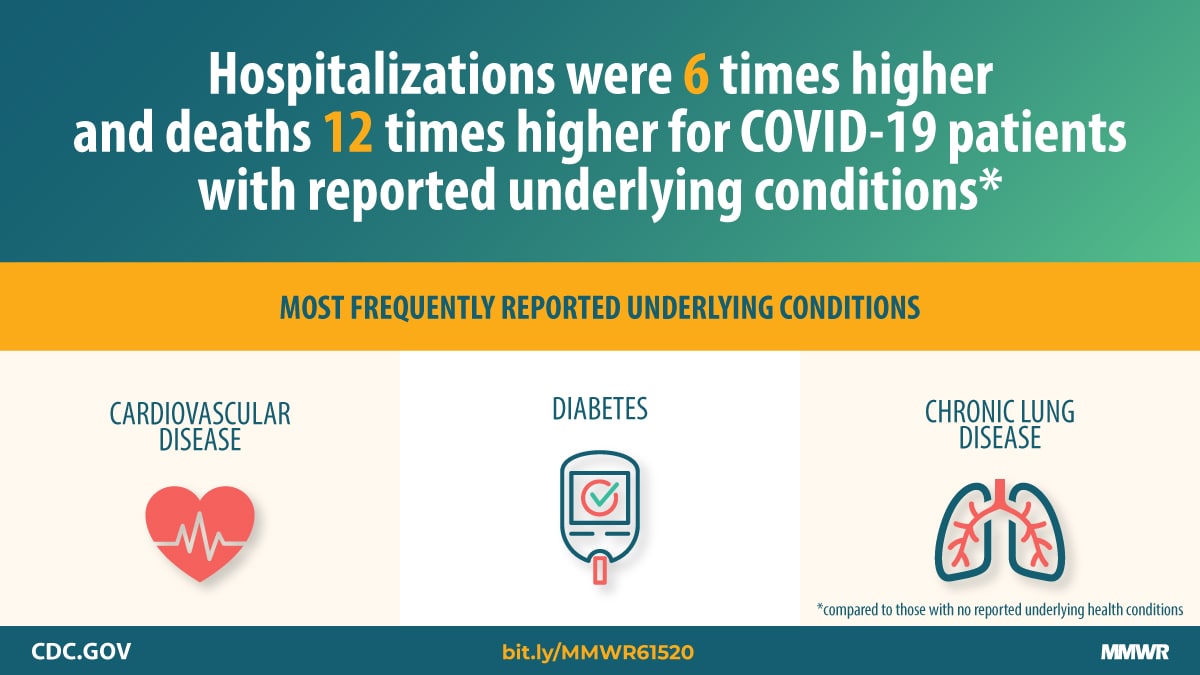
A CDC analysis last month of US COVID-19 patient surveillance data from Jan 22 to May 30 showed that those with underlying conditions were hospitalized six times more often, needed intensive care five times more often, and had a death rate 12 times higher than those without these conditions. But the authors of today’s reported noted that the earlier study defined obesity as a BMI of 40 kg/m2 or higher and included some conditions with mixed or limited evidence of a tie to poor coronavirus outcomes.

Prevalence of underlying conditions in rural, urban counties

Median estimated county prevalence of any underlying illness was 47.2% (range, 22.0% to 66.2%). Numbers of people with any underlying condition ranged from 4,300 in rural counties to 301,744 in large cities.

Prevalence of obesity was 35.4% (range, 15.2% to 49.9%), while it was 12.8% for diabetes (range, 6.1% to 25.6%), 8.9% for COPD (range, 3.5% to 19.9%), 8.6% for heart disease (range, 3.5% to 15.1%), and 3.4% for CKD, 3.4% (range, 1.8% to 6.2%).

Nationwide, the overall weighted prevalence of adults with chronic underlying conditions was 30.9% for obesity, 11.4% for diabetes, 6.9% for COPD, 6.8% for heart disease, and 3.1% for CKD.

The estimated median prevalence of any underlying condition generally increased with increasing county remoteness, ranging from 39.4% in large metropolitan counties to 48.8% in rural ones.

Resource allocation, preventive health measures

The authors noted that access to healthcare resources in some rural counties may be poor, adding to the risk of severe COVID-19 outcomes.

“The findings can help local decision-makers identify areas at higher risk for severe COVID-19 illness in their jurisdictions and guide resource allocation and implementation of community mitigation strategies,” they wrote. “These findings also emphasize the importance of prevention efforts to reduce the prevalence of these underlying medical conditions and their risk factors such as smoking, unhealthy diet, and lack of physical activity.”

The researchers called for future studies to include the weighting of the contribution of each underlying illness according to the risk of serious COVID-19 outcomes and identifying and integrating other factors leading to susceptibility to both infection and serious outcomes to better estimate the number of people at increased risk for COVID-19 infection. 


MLB faces its first coronavirus crisis with Marlins outbreak less than a week into season

https://www.washingtonpost.com/sports/2020/07/26/marlins-delay-return-miami-after-apparent-coronavirus-outbreak-among-players/?utm_campaign=wp_main&utm_medium=social&utm_source=facebook&fbclid=IwAR1u7AypEX5AoBbLoaKIZ9tSyJqE-khQkODR5GviFpI3LJk8cV6T89CoYcw

Less than a week in, the 2020 Major League Baseball season has already reached its first crisis point, with the Miami Marlins reportedly stuck in Philadelphia and forced to cancel their home opener in Miami on Monday night after as many as a dozen players and coaches tested positive for the coronavirus.

The outbreak potentially has far-reaching consequences, affecting not only the Marlins, but the Philadelphia Phillies, who hosted the Marlins this weekend; the Baltimore Orioles, who were scheduled to open a series in Miami on Monday night; and the New York Yankees, who start a series in Philadelphia on Monday, in which they would occupy the same visitors’ clubhouse the Marlins just departed.

Major League Baseball has made no formal indication of what it would take to halt the 2020 season, with the ultimate decision resting with Commissioner Rob Manfred. An MLB spokesperson did not immediately return a message seeking comment Monday.

On Sunday, following their game against the Phillies, the Marlins decided to remain overnight at their Philadelphia hotel rather than travel home as scheduled, after three players tested positive. A fourth had tested positive on Friday. The plan, at that point, was to fly home Monday in time for their 7:10 p.m. game at Marlins Park against the Orioles.

In the meantime, the rest of the team’s traveling party was awaiting test results, which according to ESPN, resulted in an additional eight players and two coaches testing positive. Under MLB’s 2020 operations manual, players or coaches who test positive on the road are required to remain in that city and quarantine for 14 days, and must test negative twice at least 24 hours apart to return to the roster.

Unlike most other major sports leagues, MLB decided against the “bubble” model of bringing teams together, under strict quarantine rules, to one or two hub cities to stage its season — an option the players’ union rejected this spring. Instead, the 30 MLB teams are playing in 30 different stadiums and traveling between cities, a step that experts believe increases the degree of difficulty for pulling off a season.

Teams have been granted expanded, 30-man rosters at the start of the season, plus up to an additional 30 reserves who train at an alternative site — which means the Marlins, theoretically, could field a team for its upcoming games, made up of a combination of unaffected players from their big league roster and reserves from their alternative site in nearby Jupiter, Fla.

However, the larger questions are how the Marlins’ outbreak occurred and whether such a crisis, coming within days of teams beginning to travel for games, is cause enough for MLB to take stronger action. Although Florida has among the highest caseload of coronavirus of any state in the United States, the Marlins have been out of the state for nearly a week, having played exhibition games in Atlanta last week before opening their season in Philadelphia.


I’m a doctor in Miami. Here’s how I know Florida’s covid-19 outbreak won’t improve anytime soon.

https://www.washingtonpost.com/opinions/2020/07/21/im-doctor-miami-heres-how-i-know-floridas-covid-19-outbreak-wont-improve-anytime-soon/?utm_campaign=wp_main&utm_medium=social&utm_source=facebook&fbclid=IwAR3cbnYiDkNswMcWc3AzmM2BfSOF5bskUtLUf83b66MI3ojH49xTygQVrUI

July 26: Tracking Florida COVID-19 Cases, Hospitalizations, and ...

I knew something was amiss when I had my car repaired in early June, shortly after Miami began relaxing its coronavirus restrictions. At first glance, the dealership looked as if it was following the recommended precautions: Every other seat was blocked off with tape, and customers and workers were wearing face coverings.

On closer inspection, many of the customers’ nostrils protruded above their masks. Staff members wore masks with one-way valves, allowing their breath to escape as they told customers the cost of fixing their clunkers. And no one was enforcing limits on the number of customers who could enter the reception area while waiting for their repairs.

It wasn’t just the repair shop. As I walked around my neighborhood in the early evenings, I’d pass houses with cars packed into their driveways. The sounds of Pitbull and J Balvin blared through the tropical shrubbery — a sure sign of a Miami house party.

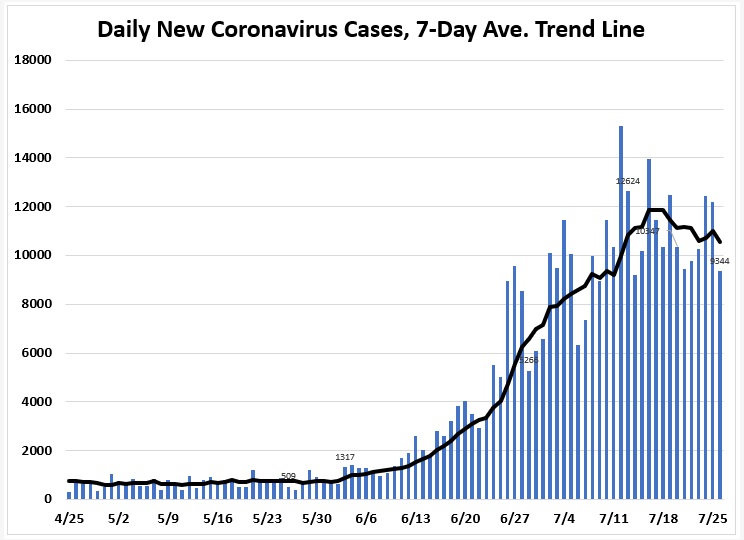
A month later, Miami has become the pandemic’s epicenter. Miami-Dade County’s intensive-care units and emergency departments are jammed. Specialists unaccustomed to managing critically ill patients are being called into action. The state has sent 100 additional health workers, mostly nurses, to the county’s large public hospital to help its exhausted staff.

I see patients in one of the hospital’s primary-care clinics. Recently, a colleague started her week as ward attending by being called to a code, one of several occurring simultaneously in different parts of the hospital; a middle-aged woman recovering from the coronavirus had suddenly gone into cardiac arrest. Other colleagues have been intubating physically fit young people who precipitously went into respiratory failure.

This is what happens when your state becomes a national embarrassment. And the reason is clear: We have suffered from failures of political leadership at every level.

Florida’s challenges are similar to those that New York and other northern states faced months ago. But while leaders in those states took aggressive action and modeled good behavior, our state has been significantly more laissez-faire and chaotic. Bars and restaurants closed for indoor service in March but reopened in June; now, Miami-Dade County’s mayor has shut them down again. Opening business might have worked if our state and local officials had enforced the correct wearing of appropriate masks, or modeled good mask-wearing behavior themselves, or provided businesses with instructions on maintaining proper ventilation. But they didn’t.

Covid-19 testing is woefully inadequate, and the lucky folks who can actually score an appointment at one of the state’s free testing sites, such as Marlins Park, are waiting more than a week to receive their results. The perpetually underfunded and politically influenced Florida Department of Health lacks enough staff to adequately trace all the people who test positive. Our leaders should have developed a robust public-health infrastructure capable of supporting contact tracing and quarantine enforcement long ago. They didn’t, and scrambling to assemble these systems in the midst of a pandemic is too little, too late.

Ironically, I feel safer at work, where everyone wears masks correctly and takes proper precautions, than I do out in public. We still have adequate personal protective equipment — for now — and are not yet forced to wear garbage bags and rain ponchos like our colleagues in New York. But many staff are already calling in sick, and we worry we won’t have enough nurses, respiratory therapists and doctors to manage the continuing deluge. And still young medical trainees tell me they see crowds of people, many without masks, congregating in the trendy areas of Miami Beach and in Miami’s Brickell neighborhood.

Meanwhile, Florida Gov. Ron DeSantis (R), who only recently began reliably sporting a mask, has thrown up his hands and proclaimed that younger adults are “going to do what they’re going to do,” arguing that he’s powerless to stop them. At the same time, he’s been bullying local school districts to offer in-person classes next month. Unfortunately, many public schools are housed in environmentally unhealthy buildings with lousy ventilation. Several classrooms in my daughter’s public high school lack windows; in other rooms, the windows that do exist don’t open. For years, the building’s outdated air-conditioning system has emitted a musty smell.

In a rational world, the federal government would help us test more people, faster; state and federal leaders would set an example by wearing masks correctly and consistently; local officials would strictly enforce quarantine rules; someone would slap warning labels on those awful ubiquitous online ads for valved masks; and our public health departments would be guided by health experts, not politicians. But this is Florida, a state with a well-established history of being anything but rational.

So for now, the state’s citizens continue to muddle through. My fellow physicians and I are trying to stay on top of a fast-changing situation, while also keeping an eye on hurricane season. In the absence of responsible leadership, we doubt Florida will stop setting records — of the wrong kind — anytime soon.